CONNECT 2
LITERACY
COMMUNICATION SUPPORTS FOR GUIDED READING
HELEN TAINSH AND JANE FARRALL
CENTRE FOR LITERACY
AND DISABILITY
STUDIES
We would like to acknowledge the Centre for Literacy and
Disability Studies at the University of North Carolina for the
generous sharing of their expertise and knowledge.
GUIDED READING
Help students to understand that:
•  Reading involves thinking and meaning making;
•  They can use a range of strategies in their reading to collect
information, understand text, etc.
Must use a wide variety of books and other print materials:
•  Commercial books;
•  Personal experience books;
•  Custom books.
NOT listening comprehension.
PURPOSES FOR
READING
Need to set a purpose every time you do guided reading;
If you don’t set a purpose students think they have to
remember everything – or become passive;
Purpose needs to be broad enough to motivate processing of
entire text.
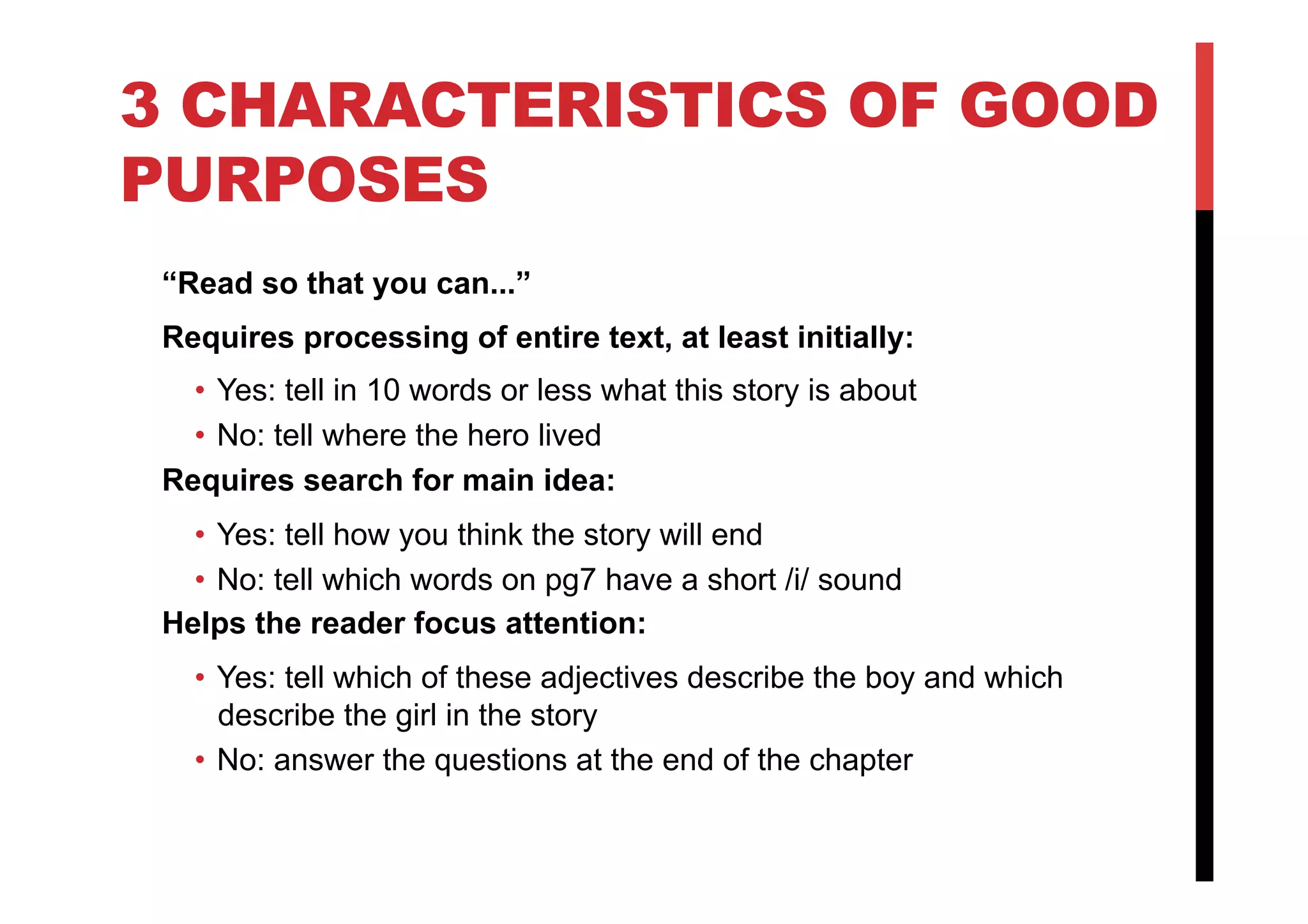
3 CHARACTERISTICS OF GOOD
PURPOSES
“Read so that you can...”
Requires processing of entire text, at least initially:
•  Yes: tell in 10 words or less what this story is about
•  No: tell where the hero lived
Requires search for main idea:
•  Yes: tell how you think the story will end
•  No: tell which words on pg7 have a short /i/ sound
Helps the reader focus attention:
•  Yes: tell which of these adjectives describe the boy and which
describe the girl in the story
•  No: answer the questions at the end of the chapter
GUIDED READING
1 book per week;
Different purpose each day;
Build confidence;
Some students will participate in the repeated readings or in
setting purposes as they become more skilled;
Help students become independent.
TYPES OF GUIDED
READING
Picture walk;
Before-During-After (Three Part);
Directed Reading-Thinking Activity;
KWL (What do I Know, what do I Want to know, what have I
Learned).
GUIDED READING
FOLLOW-UPS
Action purposes – Reader’s Theatre, Drawing, etc;
Linguistic purposes – sentence ordering, word ordering,
write our own version.
5 PART GUIDED
READING
Before reading:
1. Build or activate background knowledge
2. Purpose “Read so that you can”
During reading:
3. Read/listen
After reading:
4. Task directly related to the purpose
5. Feedback/Discussion (typically woven into follow-up)
•  What makes you say that? How do you know? Why do you
think so?
•  Help students gain cognitive clarity so they can be successful
again or next time
THE VERY HUNGRY
CATERPILLAR
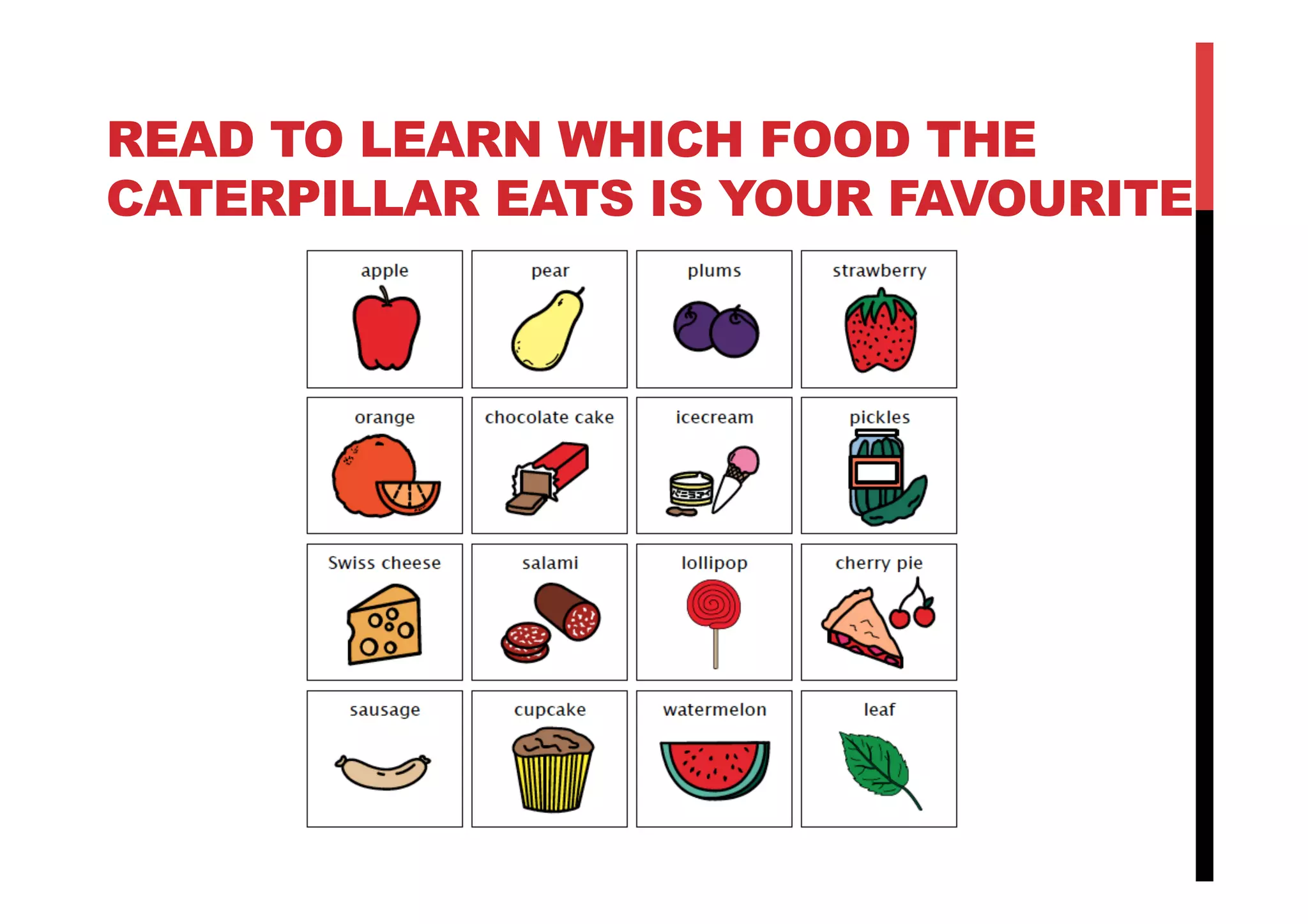
1.  Read to learn which food the caterpillar eats is your
favourite (before reading, list the foods in the book)
The very hungry caterpillar
By Eric Carle
PARTICIPATION FOR
STUDENTS WITH CCN
If they have a comprehensive communication system (eg
PODD) then they can use that to participate across the day;
If they don’t then we need to provide ways for them to
participate;
AND we need to work towards getting them a comprehensive
communication system.
CUSTOM SUPPORTS FOR
STUDENTS WHO NEED AAC
Can be developed for each purpose for each book while we
work on a more comprehensive system for each student.
Positives:
•  Students with CCN can participate in discussing the purpose
Negatives:
•  The language is shown once or twice and then disappears
•  Language generally isn’t useful throughout the day
•  Student has no way of communicating through the whole day
•  Lots of ongoing work constantly preparing these resources
•  Limited to the language provided
READ TO LEARN WHICH FOOD THE
CATERPILLAR EATS IS YOUR FAVOURITE
CUSTOM SUPPORTS FOR
STUDENTS WHO USE AAC
Only ever a temporary solution
Need to pair them with aided language displays as soon as
possible
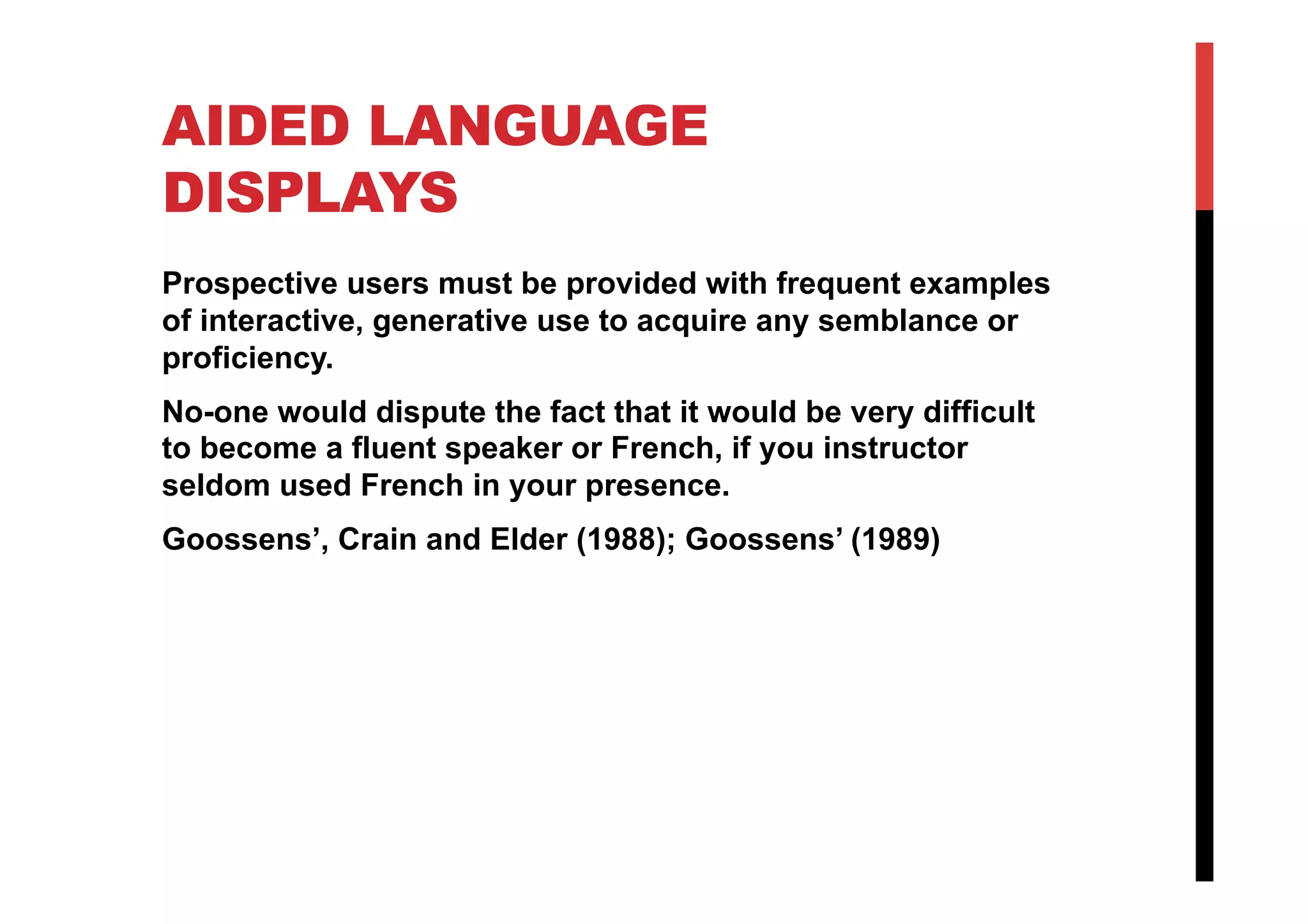
AIDED LANGUAGE
DISPLAYS
Prospective users must be provided with frequent examples
of interactive, generative use to acquire any semblance or
proficiency.
No-one would dispute the fact that it would be very difficult
to become a fluent speaker or French, if you instructor
seldom used French in your presence.
Goossens’, Crain and Elder (1988); Goossens’ (1989)
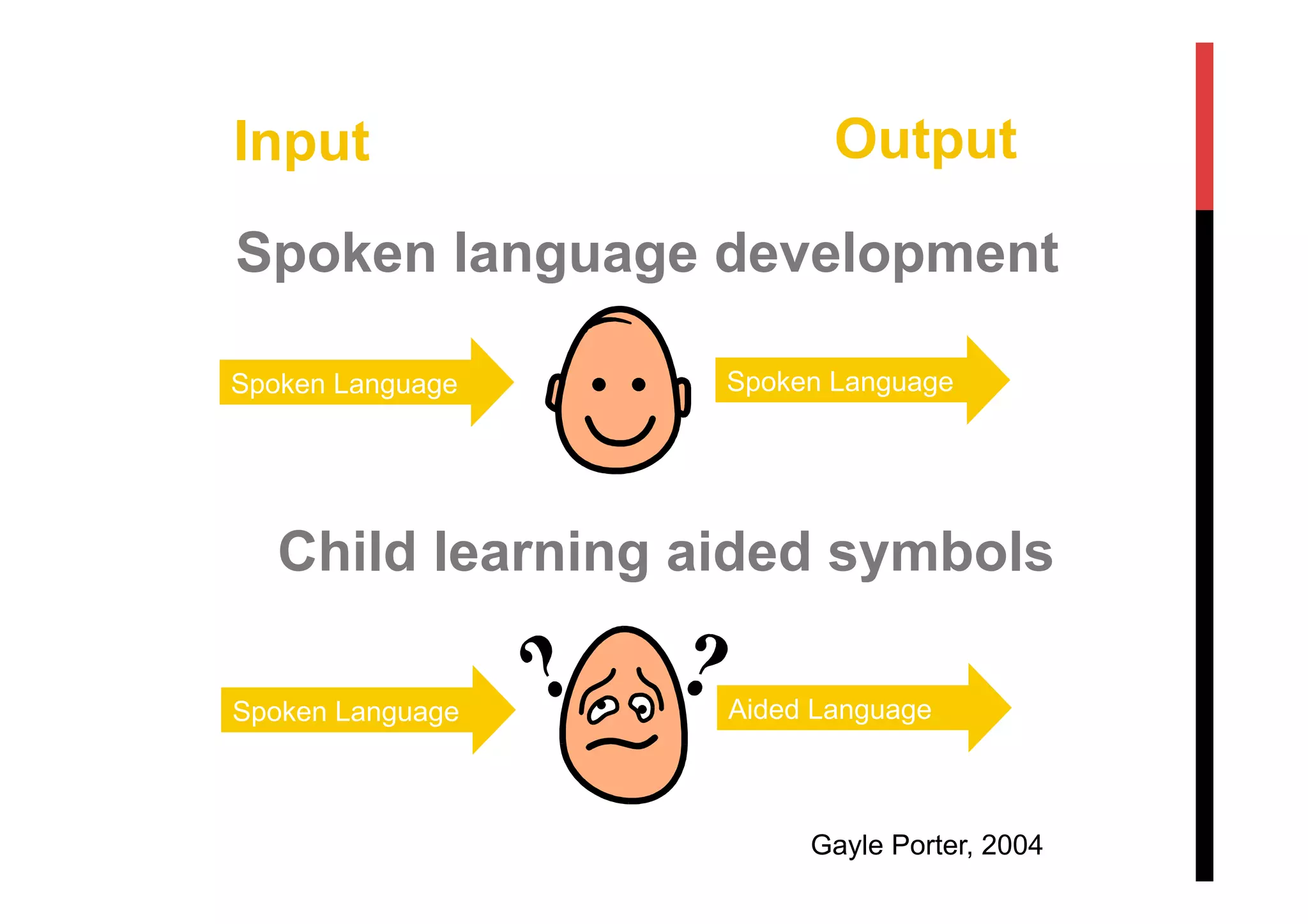
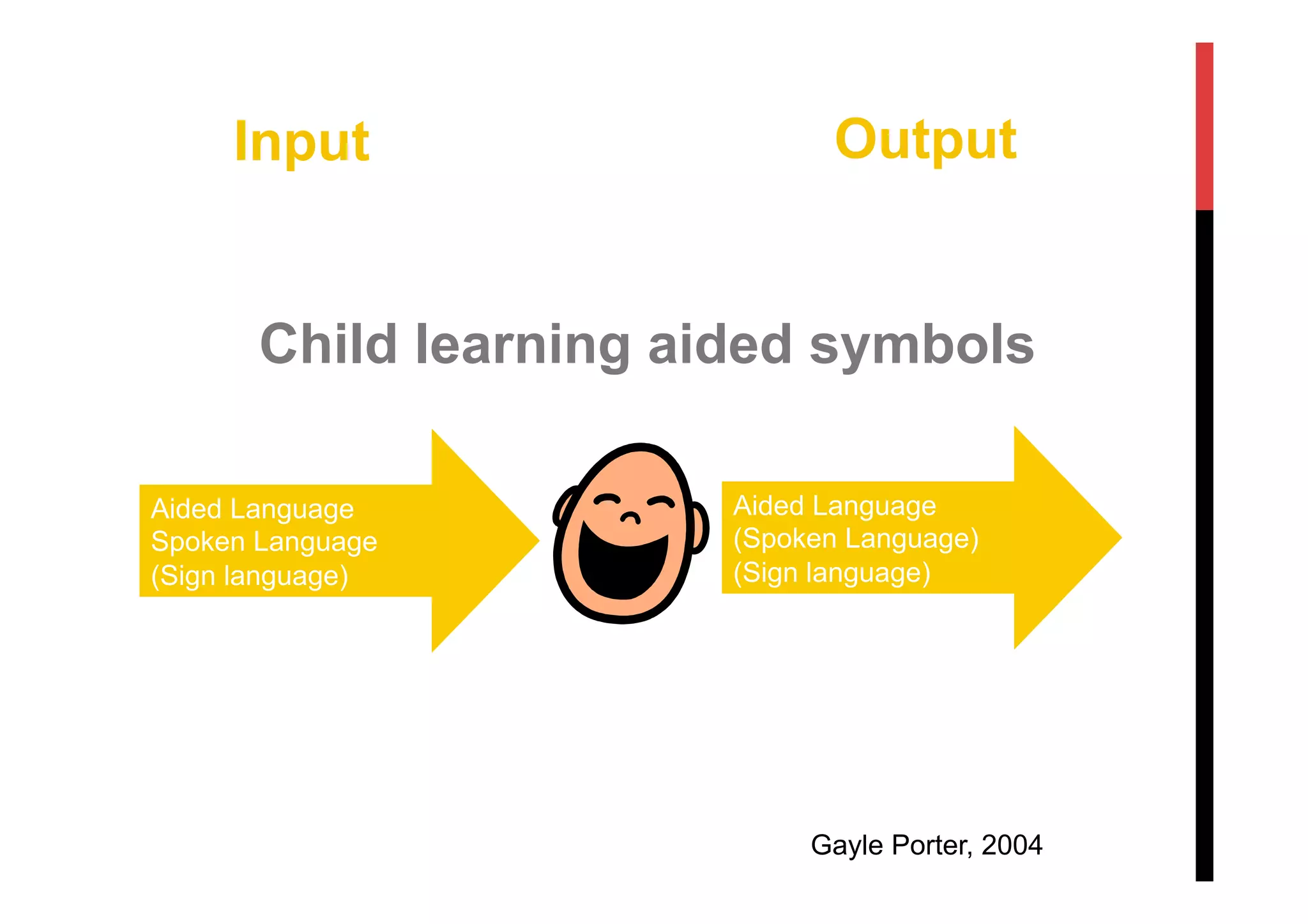
Input Output
Spoken language development
Spoken Language Spoken Language
Spoken Language Aided Language
Child learning aided symbols
Gayle Porter, 2004
Input Output
Child learning aided symbols
Aided Language
Spoken Language
(Sign language)
Aided Language
(Spoken Language)
(Sign language)
Gayle Porter, 2004
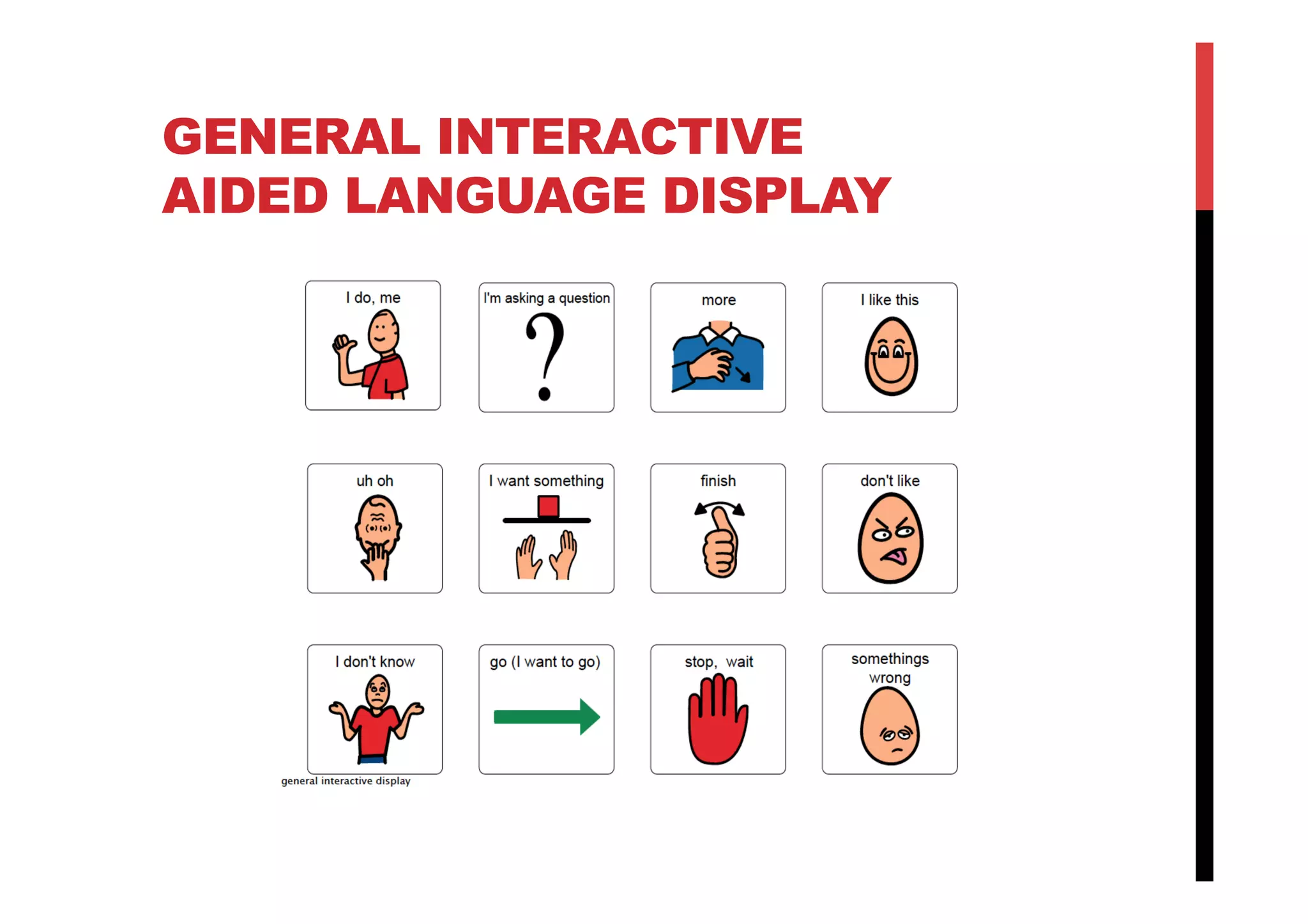
GENERAL INTERACTIVE
AIDED LANGUAGE DISPLAY
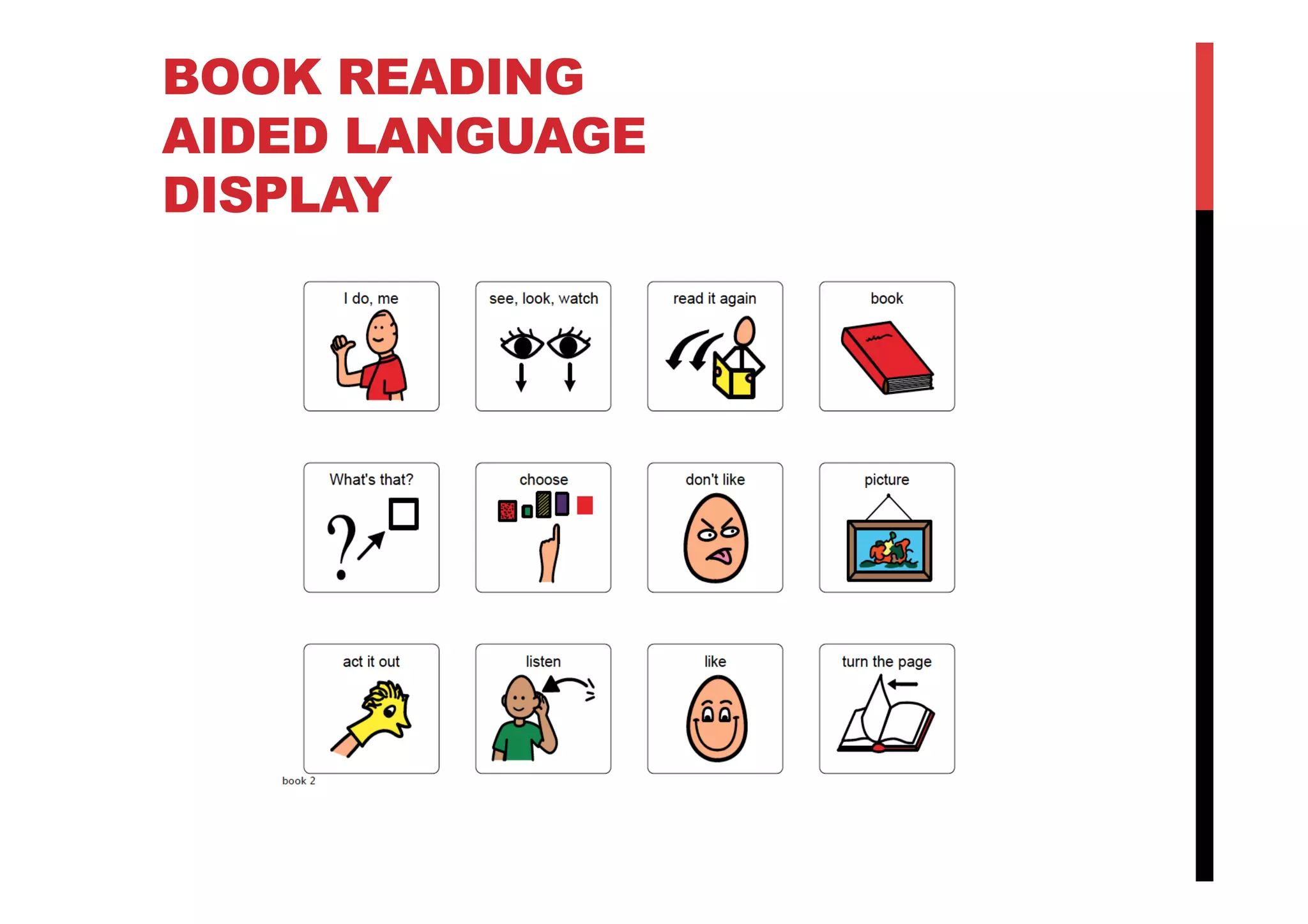
BOOK READING
AIDED LANGUAGE
DISPLAY
AIDED LANGUAGE
DISPLAYS
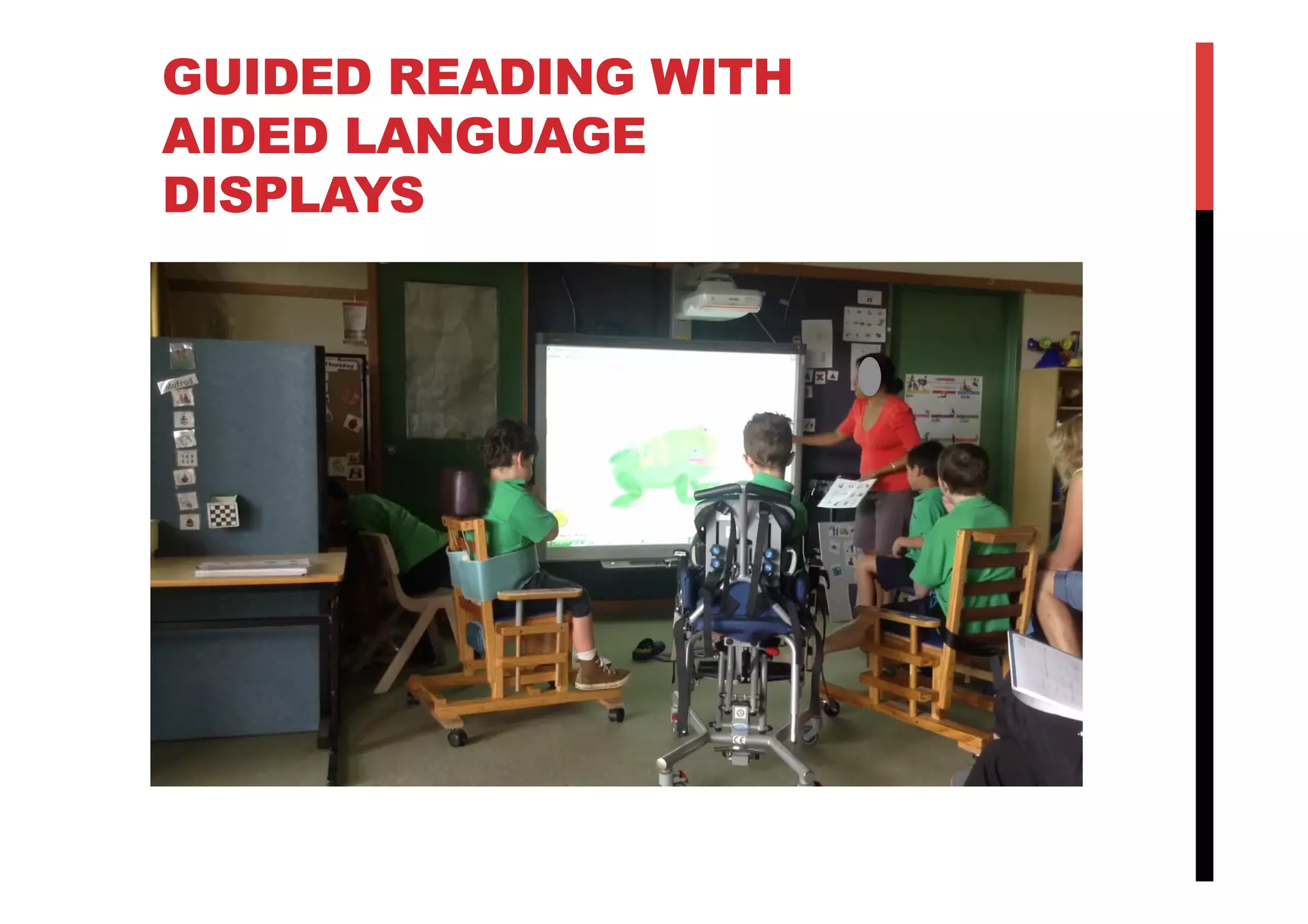
Aided Language Displays provide access to a range of
vocabulary that can be used repeatedly within an activity.
Lots of opportunities to make language visible
Great resources on aided language at
http://praacticalaac.org/tag/aided-language-input/
GUIDED READING WITH
AIDED LANGUAGE
DISPLAYS
AIDED LANGUAGE
DISPLAYS
Generic across a range of books
Positives:
•  Students with CCN can be more interactive in the book
reading
•  Students can have more control over book reading
•  Work for guided reading and self-selected reading
•  Lots of opportunities to repeatedly model language
Negatives:
•  Don’t have specific language needed for books
•  Limited to the language provided on each ALD
AIDED LANGUAGE
DISPLAYS
Short term solution
Need to provide students with a more comprehensive AAC
system as soon as we can so they have language for the
whole activity and the whole day
COMPREHENSIVE AAC
SUPPORTS
Used across the whole day
Positives:
•  Long term solution, all day every day
•  Can be used across a wide range of purposes
•  Rich links to language development
•  Students with CCN can:
•  Share an opinion
•  Ask a question
•  Change the ending
•  Predict the title
•  Lots of opportunities to repeatedly model language
•  Generic templates are available
•  Don’t need to constantly make more
Negatives:
•  Takes support staff a while to learn
•  Core vocabulary arrangements require language before use
COMPREHENSIVE AAC
SUPPORTS
Enables teachers to:
•  Model and expand an extensive vocabulary
•  Activate background knowledge with a student
•  Set a wide range of purposes
Enables students to:
•  Relate information about life experiences and other texts
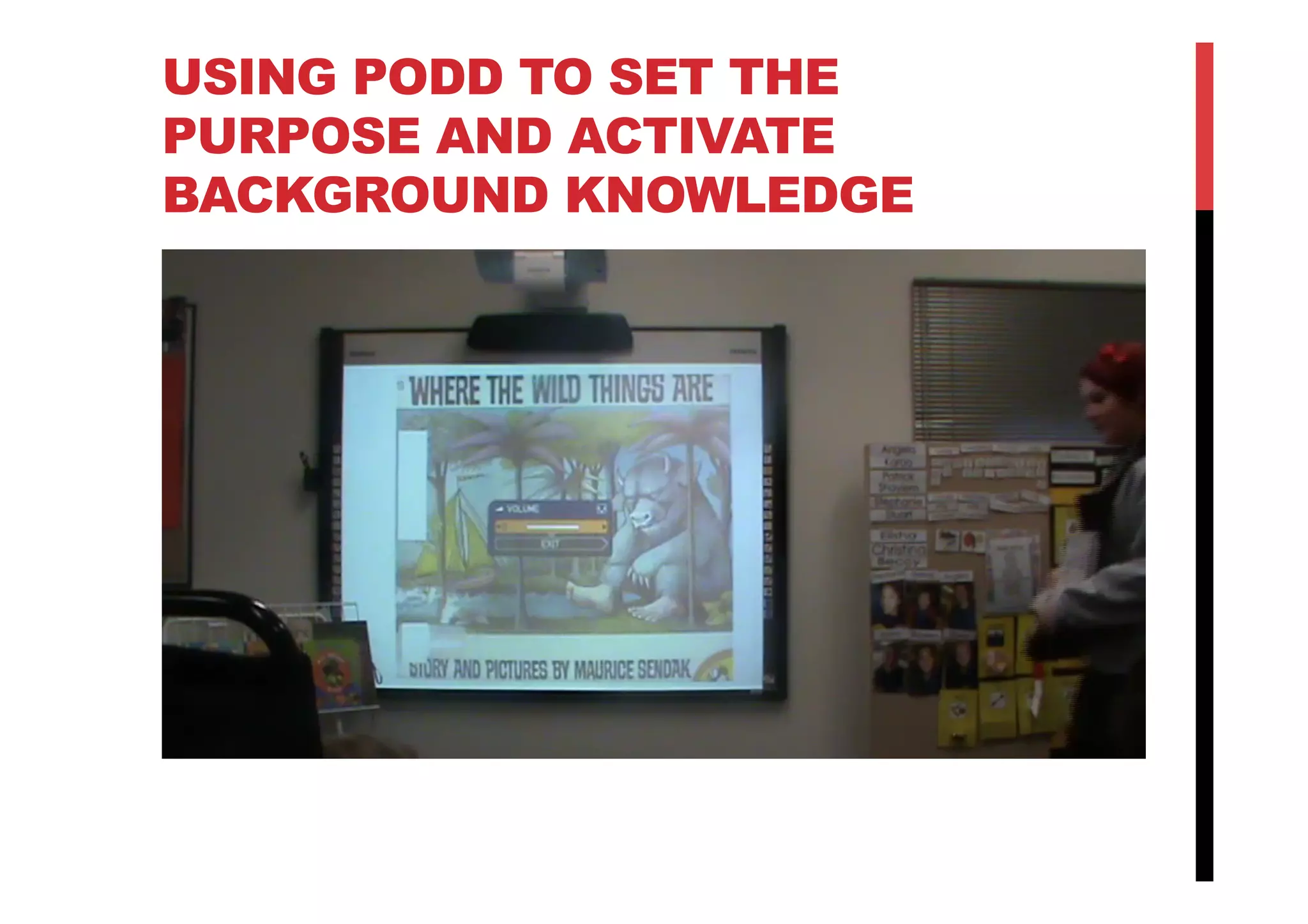
USING PODD TO SET THE
PURPOSE AND ACTIVATE
BACKGROUND KNOWLEDGE
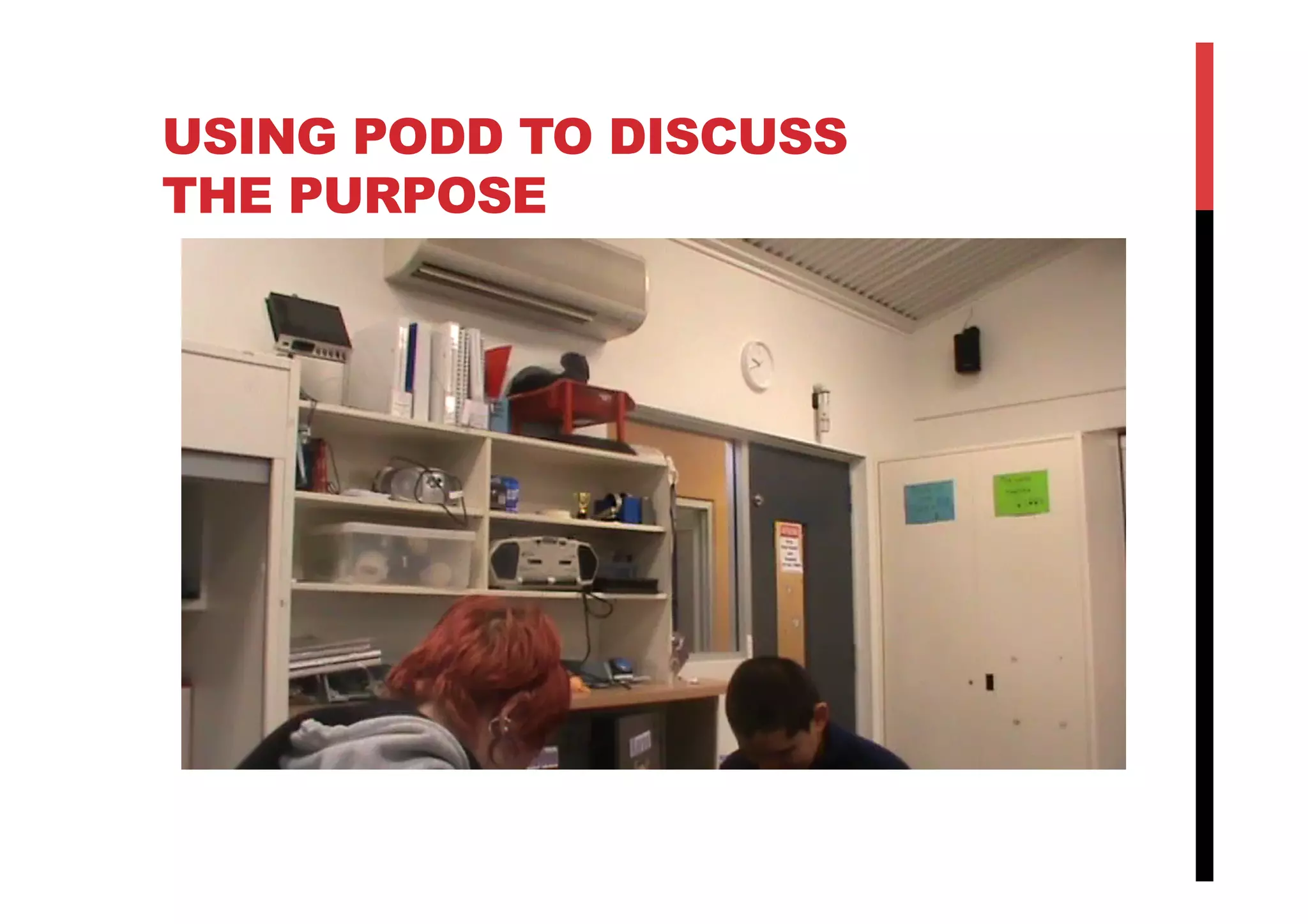
USING PODD TO DISCUSS
THE PURPOSE
PARTICIPATION FOR
STUDENTS WITH CCN
If they have a comprehensive communication system (eg
PODD) then they can use that to participate across the day;
If they don’t then we need to provide ways for them to
participate;
AND we need to work towards getting them a comprehensive
communication system.

Connect2Literacy: Communication Supports for Guided Reading

  • 1.
    CONNECT 2 LITERACY COMMUNICATION SUPPORTSFOR GUIDED READING HELEN TAINSH AND JANE FARRALL
  • 2.
    CENTRE FOR LITERACY ANDDISABILITY STUDIES We would like to acknowledge the Centre for Literacy and Disability Studies at the University of North Carolina for the generous sharing of their expertise and knowledge.
  • 3.
    GUIDED READING Help studentsto understand that: •  Reading involves thinking and meaning making; •  They can use a range of strategies in their reading to collect information, understand text, etc. Must use a wide variety of books and other print materials: •  Commercial books; •  Personal experience books; •  Custom books. NOT listening comprehension.
  • 4.
    PURPOSES FOR READING Need toset a purpose every time you do guided reading; If you don’t set a purpose students think they have to remember everything – or become passive; Purpose needs to be broad enough to motivate processing of entire text.
  • 5.
    3 CHARACTERISTICS OFGOOD PURPOSES “Read so that you can...” Requires processing of entire text, at least initially: •  Yes: tell in 10 words or less what this story is about •  No: tell where the hero lived Requires search for main idea: •  Yes: tell how you think the story will end •  No: tell which words on pg7 have a short /i/ sound Helps the reader focus attention: •  Yes: tell which of these adjectives describe the boy and which describe the girl in the story •  No: answer the questions at the end of the chapter
  • 6.
    GUIDED READING 1 bookper week; Different purpose each day; Build confidence; Some students will participate in the repeated readings or in setting purposes as they become more skilled; Help students become independent.
  • 7.
    TYPES OF GUIDED READING Picturewalk; Before-During-After (Three Part); Directed Reading-Thinking Activity; KWL (What do I Know, what do I Want to know, what have I Learned).
  • 8.
    GUIDED READING FOLLOW-UPS Action purposes– Reader’s Theatre, Drawing, etc; Linguistic purposes – sentence ordering, word ordering, write our own version.
  • 9.
    5 PART GUIDED READING Beforereading: 1. Build or activate background knowledge 2. Purpose “Read so that you can” During reading: 3. Read/listen After reading: 4. Task directly related to the purpose 5. Feedback/Discussion (typically woven into follow-up) •  What makes you say that? How do you know? Why do you think so? •  Help students gain cognitive clarity so they can be successful again or next time
  • 10.
    THE VERY HUNGRY CATERPILLAR 1. Read to learn which food the caterpillar eats is your favourite (before reading, list the foods in the book)
  • 11.
    The very hungrycaterpillar By Eric Carle
  • 12.
    PARTICIPATION FOR STUDENTS WITHCCN If they have a comprehensive communication system (eg PODD) then they can use that to participate across the day; If they don’t then we need to provide ways for them to participate; AND we need to work towards getting them a comprehensive communication system.
  • 13.
    CUSTOM SUPPORTS FOR STUDENTSWHO NEED AAC Can be developed for each purpose for each book while we work on a more comprehensive system for each student. Positives: •  Students with CCN can participate in discussing the purpose Negatives: •  The language is shown once or twice and then disappears •  Language generally isn’t useful throughout the day •  Student has no way of communicating through the whole day •  Lots of ongoing work constantly preparing these resources •  Limited to the language provided
  • 14.
    READ TO LEARNWHICH FOOD THE CATERPILLAR EATS IS YOUR FAVOURITE
  • 15.
    CUSTOM SUPPORTS FOR STUDENTSWHO USE AAC Only ever a temporary solution Need to pair them with aided language displays as soon as possible
  • 16.
    AIDED LANGUAGE DISPLAYS Prospective usersmust be provided with frequent examples of interactive, generative use to acquire any semblance or proficiency. No-one would dispute the fact that it would be very difficult to become a fluent speaker or French, if you instructor seldom used French in your presence. Goossens’, Crain and Elder (1988); Goossens’ (1989)
  • 17.
    Input Output Spoken languagedevelopment Spoken Language Spoken Language Spoken Language Aided Language Child learning aided symbols Gayle Porter, 2004
  • 18.
    Input Output Child learningaided symbols Aided Language Spoken Language (Sign language) Aided Language (Spoken Language) (Sign language) Gayle Porter, 2004
  • 19.
  • 20.
  • 21.
    AIDED LANGUAGE DISPLAYS Aided LanguageDisplays provide access to a range of vocabulary that can be used repeatedly within an activity. Lots of opportunities to make language visible Great resources on aided language at http://praacticalaac.org/tag/aided-language-input/
  • 22.
    GUIDED READING WITH AIDEDLANGUAGE DISPLAYS
  • 23.
    AIDED LANGUAGE DISPLAYS Generic acrossa range of books Positives: •  Students with CCN can be more interactive in the book reading •  Students can have more control over book reading •  Work for guided reading and self-selected reading •  Lots of opportunities to repeatedly model language Negatives: •  Don’t have specific language needed for books •  Limited to the language provided on each ALD
  • 24.
    AIDED LANGUAGE DISPLAYS Short termsolution Need to provide students with a more comprehensive AAC system as soon as we can so they have language for the whole activity and the whole day
  • 25.
    COMPREHENSIVE AAC SUPPORTS Used acrossthe whole day Positives: •  Long term solution, all day every day •  Can be used across a wide range of purposes •  Rich links to language development •  Students with CCN can: •  Share an opinion •  Ask a question •  Change the ending •  Predict the title •  Lots of opportunities to repeatedly model language •  Generic templates are available •  Don’t need to constantly make more Negatives: •  Takes support staff a while to learn •  Core vocabulary arrangements require language before use
  • 26.
    COMPREHENSIVE AAC SUPPORTS Enables teachersto: •  Model and expand an extensive vocabulary •  Activate background knowledge with a student •  Set a wide range of purposes Enables students to: •  Relate information about life experiences and other texts
  • 27.
    USING PODD TOSET THE PURPOSE AND ACTIVATE BACKGROUND KNOWLEDGE
  • 28.
    USING PODD TODISCUSS THE PURPOSE
  • 29.
    PARTICIPATION FOR STUDENTS WITHCCN If they have a comprehensive communication system (eg PODD) then they can use that to participate across the day; If they don’t then we need to provide ways for them to participate; AND we need to work towards getting them a comprehensive communication system.