Conflict Resolution Basics
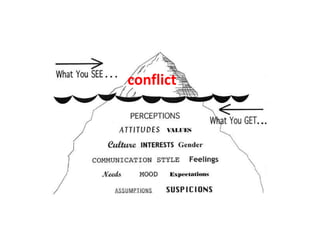
conflict
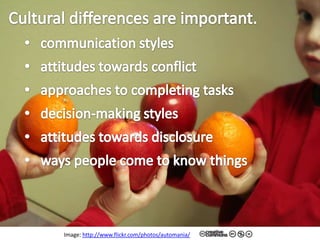
Image: http://www.flickr.com/photos/automania/
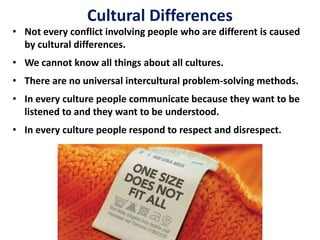
• Not every conflict involving people who are different is caused
by cultural differences.
• We cannot know all things about all cultures.
• There are no universal intercultural problem-solving methods.
• In every culture people communicate because they want to be
listened to and they want to be understood.
• In every culture people respond to respect and disrespect.
Cultural Differences
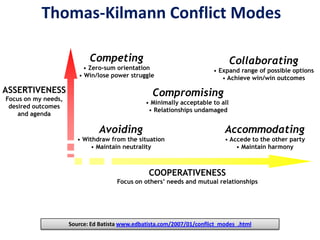
Thomas-Kilmann Conflict Modes
Source: Ed Batista www.edbatista.com/2007/01/conflict_modes_.html
ASSERTIVENESS
Focus on my needs,
desired outcomes
and agenda
COOPERATIVENESS
Focus on others’ needs and mutual relationships
Avoiding
• Withdraw from the situation
• Maintain neutrality
Accommodating
• Accede to the other party
• Maintain harmony
Competing
• Zero-sum orientation
• Win/lose power struggle
Collaborating
• Expand range of possible options
• Achieve win/win outcomes
Compromising
• Minimally acceptable to all
• Relationships undamaged
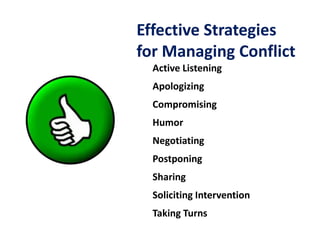
Effective Strategies
for Managing Conflict
Active Listening
Apologizing
Compromising
Humor
Negotiating
Postponing
Sharing
Soliciting Intervention
Taking Turns
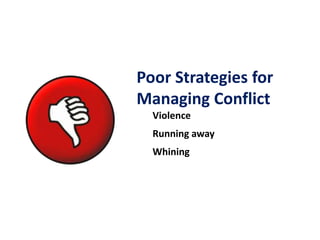
Poor Strategies for
Managing Conflict
Violence
Running away
Whining
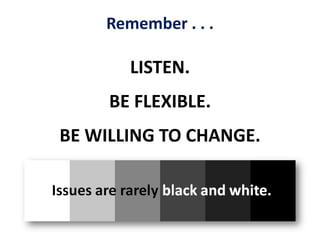
LISTEN.
BE FLEXIBLE.
BE WILLING TO CHANGE.
Remember . . .
More Resources
Conflict Resolution Network, http://www.crnhq.org/
Skills Converged,
http://www.skillsconverged.com/FreeTrainingMaterials/tabi
d/258/articleType/CategoryView/categoryId/97/Conflict-
Management.aspx
Community Toolbox,
http://ctb.ku.edu/en/tablecontents/sub_section_main_1164.
aspx
Campus-adr.org, http://www.campus-
adr.org/Training_Center/content/trainingtools/
www.mncampuscompact.org/clio

Conflict resolution basics

  • 1.
  • 2.
  • 3.
  • 4.
    • Not everyconflict involving people who are different is caused by cultural differences. • We cannot know all things about all cultures. • There are no universal intercultural problem-solving methods. • In every culture people communicate because they want to be listened to and they want to be understood. • In every culture people respond to respect and disrespect. Cultural Differences
  • 5.
    Thomas-Kilmann Conflict Modes Source:Ed Batista www.edbatista.com/2007/01/conflict_modes_.html ASSERTIVENESS Focus on my needs, desired outcomes and agenda COOPERATIVENESS Focus on others’ needs and mutual relationships Avoiding • Withdraw from the situation • Maintain neutrality Accommodating • Accede to the other party • Maintain harmony Competing • Zero-sum orientation • Win/lose power struggle Collaborating • Expand range of possible options • Achieve win/win outcomes Compromising • Minimally acceptable to all • Relationships undamaged
  • 6.
    Effective Strategies for ManagingConflict Active Listening Apologizing Compromising Humor Negotiating Postponing Sharing Soliciting Intervention Taking Turns
  • 7.
    Poor Strategies for ManagingConflict Violence Running away Whining
  • 8.
    LISTEN. BE FLEXIBLE. BE WILLINGTO CHANGE. Remember . . .
  • 9.
    More Resources Conflict ResolutionNetwork, http://www.crnhq.org/ Skills Converged, http://www.skillsconverged.com/FreeTrainingMaterials/tabi d/258/articleType/CategoryView/categoryId/97/Conflict- Management.aspx Community Toolbox, http://ctb.ku.edu/en/tablecontents/sub_section_main_1164. aspx Campus-adr.org, http://www.campus- adr.org/Training_Center/content/trainingtools/
  • 10.