CONDUCTING POLYMERS
Introduction to Polymers
Polymer basics Long chain like molecular structure where repeated molecular units are connected by covalent bonds Polymers used as insulators eg. polyethylene Variation in crystallization and orientation results in vast morphologies of polymers today Properties of polymers: - good chemical resistivity at room temperature - low density and Young’s modulus - brittleness at low temperatures - can be stretched to form films
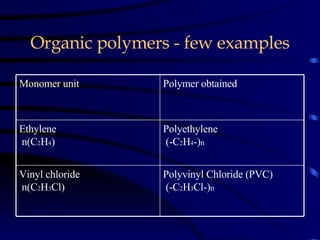
Organic polymers - few examples Polyvinyl Chloride (PVC) (-C 2 H 3 Cl-) n Vinyl chloride n(C 2 H 3 Cl) Polyethylene (-C 2 H 4 -) n Ethylene n(C 2 H 4 )  Polymer obtained Monomer unit
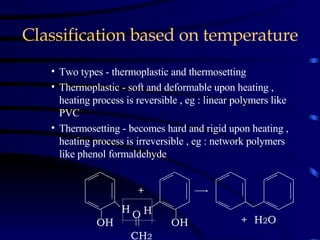
Classification based on temperature Two types - thermoplastic and thermosetting Thermoplastic - soft and deformable upon heating , heating process is reversible , eg : linear polymers like PVC  Thermosetting - becomes hard and rigid upon heating , heating process is irreversible , eg : network polymers like phenol formaldehyde H OH + H OH O CH 2 +  H 2 O
Discovery of conducting polymers Discovered in the late seventies (1977) by Alan Heegar , Dr. Hideki Shirakawa and Alan Macdiarmid Before that polymers were used as insulators in the electronic industry Advantages over conductors Chemical - ion transport possible , redox behavior , catalytic properties, electrochemical effects, Photoactivity, Junction effects Mechanical - light weight , flexible , non metallic surface properties
Conductivity Polymers become conducting upon doping Polymer becomes electronically charged Polymer chains generate charge carriers Concentration of dopant causes certain electrons to become unpaired Formation of polarons and bipolarons They have extended p-orbital system
Classification of conducting polymers
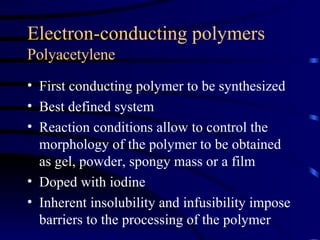
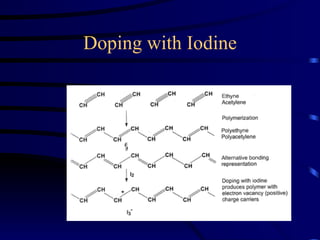
Electron-conducting polymers Polyacetylene First conducting polymer to be synthesized Best defined system Reaction conditions allow to control the morphology of the polymer to be obtained as gel, powder, spongy mass or a film Doped with iodine Inherent insolubility and infusibility impose barriers to the processing of the polymer
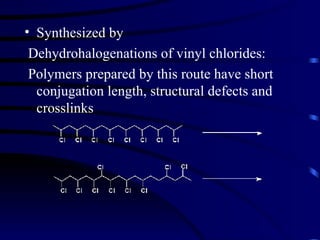
Synthesized by  Dehydrohalogenations of vinyl chlorides: Polymers prepared by this route have short conjugation length, structural defects and crosslinks
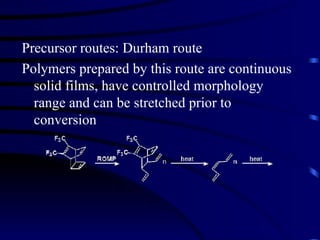
Precursor routes: Durham route Polymers prepared by this route are continuous solid films, have controlled morphology range and can be stretched prior to conversion
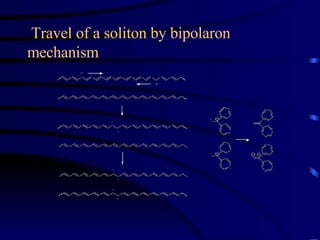
Conduction mechanism R and L forms are interconverted through a charge carrier soliton Soliton is a mobile, charged or a neutral defect or a kink in the polymer chain It propagates down the polymer chain For short chains Kivelson mechanism is involved
Travel of a soliton by bipolaron mechanism
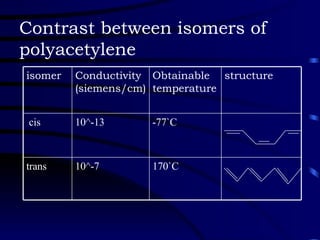
Contrast between isomers of polyacetylene 170`C 10^-7 trans -77`C 10^-13 cis structure Obtainable temperature Conductivity (siemens/cm) isomer
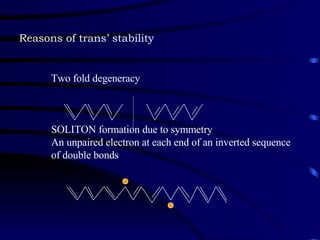
Reasons of trans’ stability Two fold degeneracy SOLITON formation due to symmetry An unpaired electron at each end of an inverted sequence of double bonds
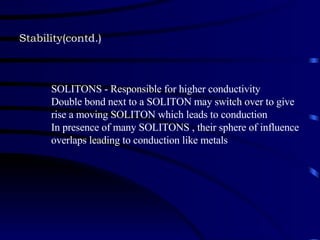
Stability(contd.) SOLITONS - Responsible for higher conductivity Double bond next to a SOLITON may switch over to give rise a moving SOLITON which leads to conduction  In presence of many SOLITONS , their sphere of influence overlaps leading to conduction like metals
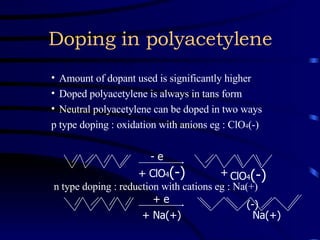
Doping in polyacetylene Amount of dopant used is significantly higher Doped polyacetylene is always in tans form Neutral polyacetylene can be doped in two ways p type doping : oxidation with anions eg : ClO 4 (-) n type doping : reduction with cations eg : Na(+) - e + ClO 4 (-) + ClO 4 (-) + e + Na(+) (-) Na(+)
Method of doping   Chemical oxidants : iodine , nitronium species , transition metal salts  Chemical reducing agents : sodium naphthamide  Electrochemical methods : used dopants ClO4(-) , BF4(-) and other complex species
Doping with Iodine
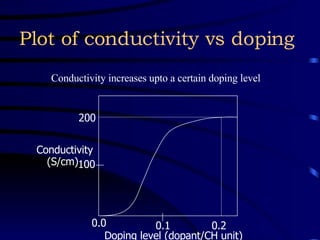
Effect of dopant Conductivity - increases upto a certain doping level  Stability - decreases Morphology : due to presence of charges shape will not be retained - reason why doped polyacetylene is always trans
Plot of conductivity vs doping Conductivity increases upto a certain doping level  200 100 0.0 0.1 0.2 Doping level (dopant/CH unit) Conductivity (S/cm)
Polypyrrole Hetero atomic polymers  More stable Easy to prepare Greater opportunity to functionalize
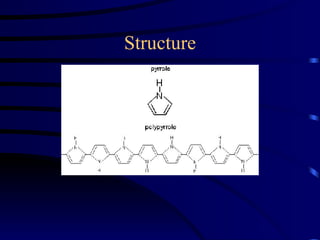
Structure
Disadvantages of polypyrrole High cost  Difficult in processing  Lack of mechanical stability after doping Difficult to fabricate
Various Applications
Coatings Prevents buildup of static charge in insulators Absorbs the harmful radiation from electrical appliances which are harmful to the nearby appliances Polymerization of conducting plastics used in circuit boards
Sensors(to gases and solns.) Polypyrroles can detect NO2 and NH3 gases by changing its conductivity  Biosensor : polymerization of polyacetylene in presence of enzyme glucose oxidase and suitable redox mediator like triiodide will give rise to a polymer which acts as glucose sensor
Polymeric Ferroelectric RAM(PFRAM) Uses polymer ferroelectric material Dipole is used to store data Provides low cost per bit with high chip capacity Low power consumption No power required in stand by mode Isn’t a fast access memory
Biocompatible Polymers Artificial nerves Brain cells
Batteries Light weight Rechargeable Example - Polypyrrole - Li & Polyaniline - Li
Displays Flat panels Related problems : low life time & long switching time
Conductive Adhesive Monomers are placed between two conducting plates and it allows it to polymerize Conducting objects can be stuck together yet allowing electric current to pass through the bonds
Current Status
Problem areas Reproducibility Stability Difficulty to process Short life span High cost Difficult to fabricate in labs
New Developments Application to ‘Smart Structures’ Conducting polymer nanowires

conducting polymers

  • 1.
  • 2.
  • 3.
    Polymer basics Longchain like molecular structure where repeated molecular units are connected by covalent bonds Polymers used as insulators eg. polyethylene Variation in crystallization and orientation results in vast morphologies of polymers today Properties of polymers: - good chemical resistivity at room temperature - low density and Young’s modulus - brittleness at low temperatures - can be stretched to form films
  • 4.
    Organic polymers -few examples Polyvinyl Chloride (PVC) (-C 2 H 3 Cl-) n Vinyl chloride n(C 2 H 3 Cl) Polyethylene (-C 2 H 4 -) n Ethylene n(C 2 H 4 ) Polymer obtained Monomer unit
  • 5.
    Classification based ontemperature Two types - thermoplastic and thermosetting Thermoplastic - soft and deformable upon heating , heating process is reversible , eg : linear polymers like PVC Thermosetting - becomes hard and rigid upon heating , heating process is irreversible , eg : network polymers like phenol formaldehyde H OH + H OH O CH 2 + H 2 O
  • 6.
    Discovery of conductingpolymers Discovered in the late seventies (1977) by Alan Heegar , Dr. Hideki Shirakawa and Alan Macdiarmid Before that polymers were used as insulators in the electronic industry Advantages over conductors Chemical - ion transport possible , redox behavior , catalytic properties, electrochemical effects, Photoactivity, Junction effects Mechanical - light weight , flexible , non metallic surface properties
  • 7.
    Conductivity Polymers becomeconducting upon doping Polymer becomes electronically charged Polymer chains generate charge carriers Concentration of dopant causes certain electrons to become unpaired Formation of polarons and bipolarons They have extended p-orbital system
  • 8.
  • 9.
    Electron-conducting polymers PolyacetyleneFirst conducting polymer to be synthesized Best defined system Reaction conditions allow to control the morphology of the polymer to be obtained as gel, powder, spongy mass or a film Doped with iodine Inherent insolubility and infusibility impose barriers to the processing of the polymer
  • 10.
    Synthesized by Dehydrohalogenations of vinyl chlorides: Polymers prepared by this route have short conjugation length, structural defects and crosslinks
  • 11.
    Precursor routes: Durhamroute Polymers prepared by this route are continuous solid films, have controlled morphology range and can be stretched prior to conversion
  • 12.
    Conduction mechanism Rand L forms are interconverted through a charge carrier soliton Soliton is a mobile, charged or a neutral defect or a kink in the polymer chain It propagates down the polymer chain For short chains Kivelson mechanism is involved
  • 13.
    Travel of asoliton by bipolaron mechanism
  • 14.
    Contrast between isomersof polyacetylene 170`C 10^-7 trans -77`C 10^-13 cis structure Obtainable temperature Conductivity (siemens/cm) isomer
  • 15.
    Reasons of trans’stability Two fold degeneracy SOLITON formation due to symmetry An unpaired electron at each end of an inverted sequence of double bonds
  • 16.
    Stability(contd.) SOLITONS -Responsible for higher conductivity Double bond next to a SOLITON may switch over to give rise a moving SOLITON which leads to conduction In presence of many SOLITONS , their sphere of influence overlaps leading to conduction like metals
  • 17.
    Doping in polyacetyleneAmount of dopant used is significantly higher Doped polyacetylene is always in tans form Neutral polyacetylene can be doped in two ways p type doping : oxidation with anions eg : ClO 4 (-) n type doping : reduction with cations eg : Na(+) - e + ClO 4 (-) + ClO 4 (-) + e + Na(+) (-) Na(+)
  • 18.
    Method of doping Chemical oxidants : iodine , nitronium species , transition metal salts Chemical reducing agents : sodium naphthamide Electrochemical methods : used dopants ClO4(-) , BF4(-) and other complex species
  • 19.
  • 20.
    Effect of dopantConductivity - increases upto a certain doping level Stability - decreases Morphology : due to presence of charges shape will not be retained - reason why doped polyacetylene is always trans
  • 21.
    Plot of conductivityvs doping Conductivity increases upto a certain doping level 200 100 0.0 0.1 0.2 Doping level (dopant/CH unit) Conductivity (S/cm)
  • 22.
    Polypyrrole Hetero atomicpolymers More stable Easy to prepare Greater opportunity to functionalize
  • 23.
  • 24.
    Disadvantages of polypyrroleHigh cost Difficult in processing Lack of mechanical stability after doping Difficult to fabricate
  • 25.
  • 26.
    Coatings Prevents buildupof static charge in insulators Absorbs the harmful radiation from electrical appliances which are harmful to the nearby appliances Polymerization of conducting plastics used in circuit boards
  • 27.
    Sensors(to gases andsolns.) Polypyrroles can detect NO2 and NH3 gases by changing its conductivity Biosensor : polymerization of polyacetylene in presence of enzyme glucose oxidase and suitable redox mediator like triiodide will give rise to a polymer which acts as glucose sensor
  • 28.
    Polymeric Ferroelectric RAM(PFRAM)Uses polymer ferroelectric material Dipole is used to store data Provides low cost per bit with high chip capacity Low power consumption No power required in stand by mode Isn’t a fast access memory
  • 29.
  • 30.
    Batteries Light weightRechargeable Example - Polypyrrole - Li & Polyaniline - Li
  • 31.
    Displays Flat panelsRelated problems : low life time & long switching time
  • 32.
    Conductive Adhesive Monomersare placed between two conducting plates and it allows it to polymerize Conducting objects can be stuck together yet allowing electric current to pass through the bonds
  • 33.
  • 34.
    Problem areas ReproducibilityStability Difficulty to process Short life span High cost Difficult to fabricate in labs
  • 35.
    New Developments Applicationto ‘Smart Structures’ Conducting polymer nanowires