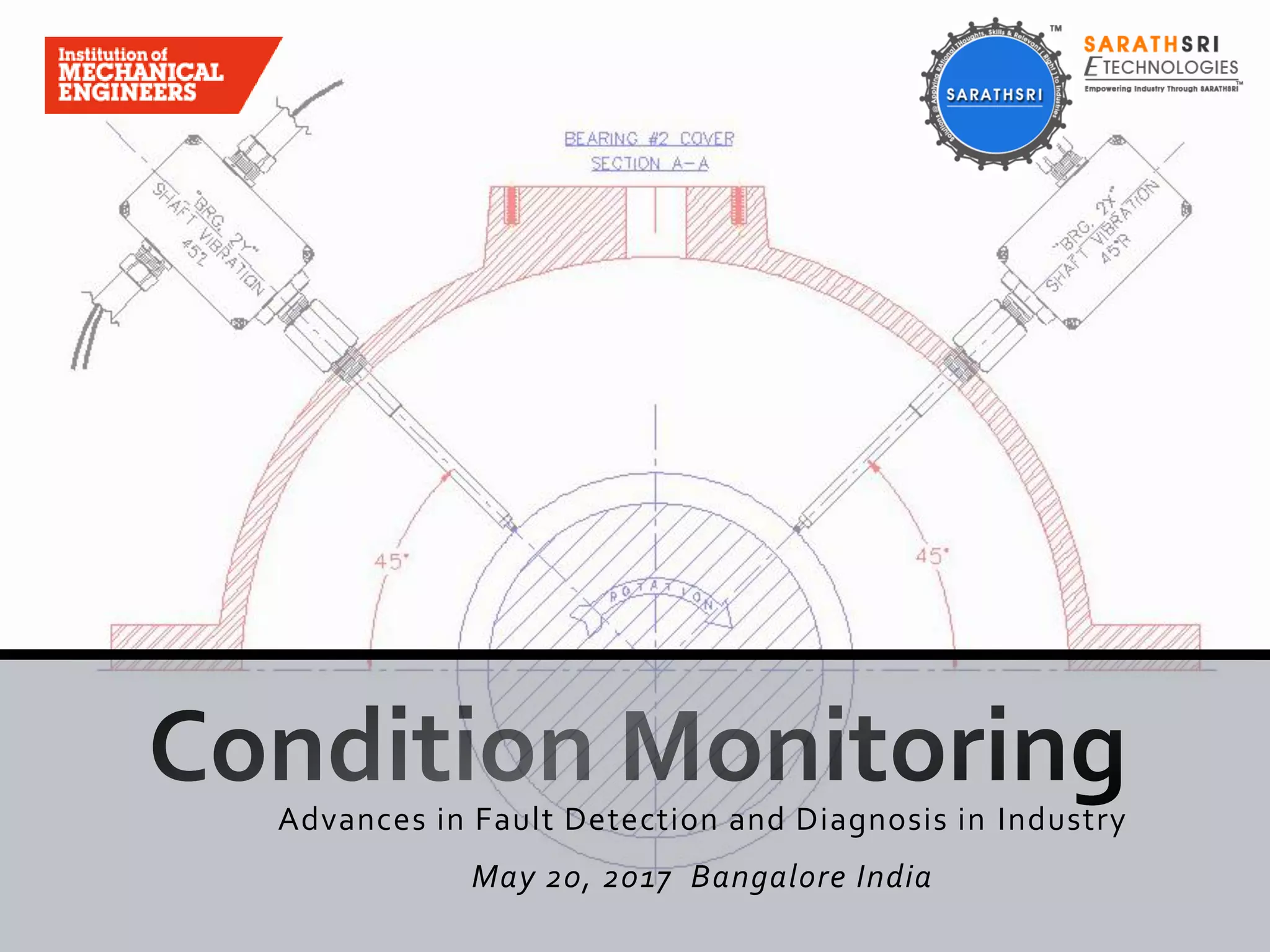
Advances in Fault Detection and Diagnosis in Industry
May 20, 2017 Bangalore India
• Introduction to Condition Monitoring in Industry
• Fault Detection, Diagnosis and Prognosis
• Fault Management
• Condition Monitoring System
• Fault Detection – Process Model
• Fault Diagnosis - Plausibility Checks
• Data Analysis
• On-line Enterprise Asset Management
•
Overview
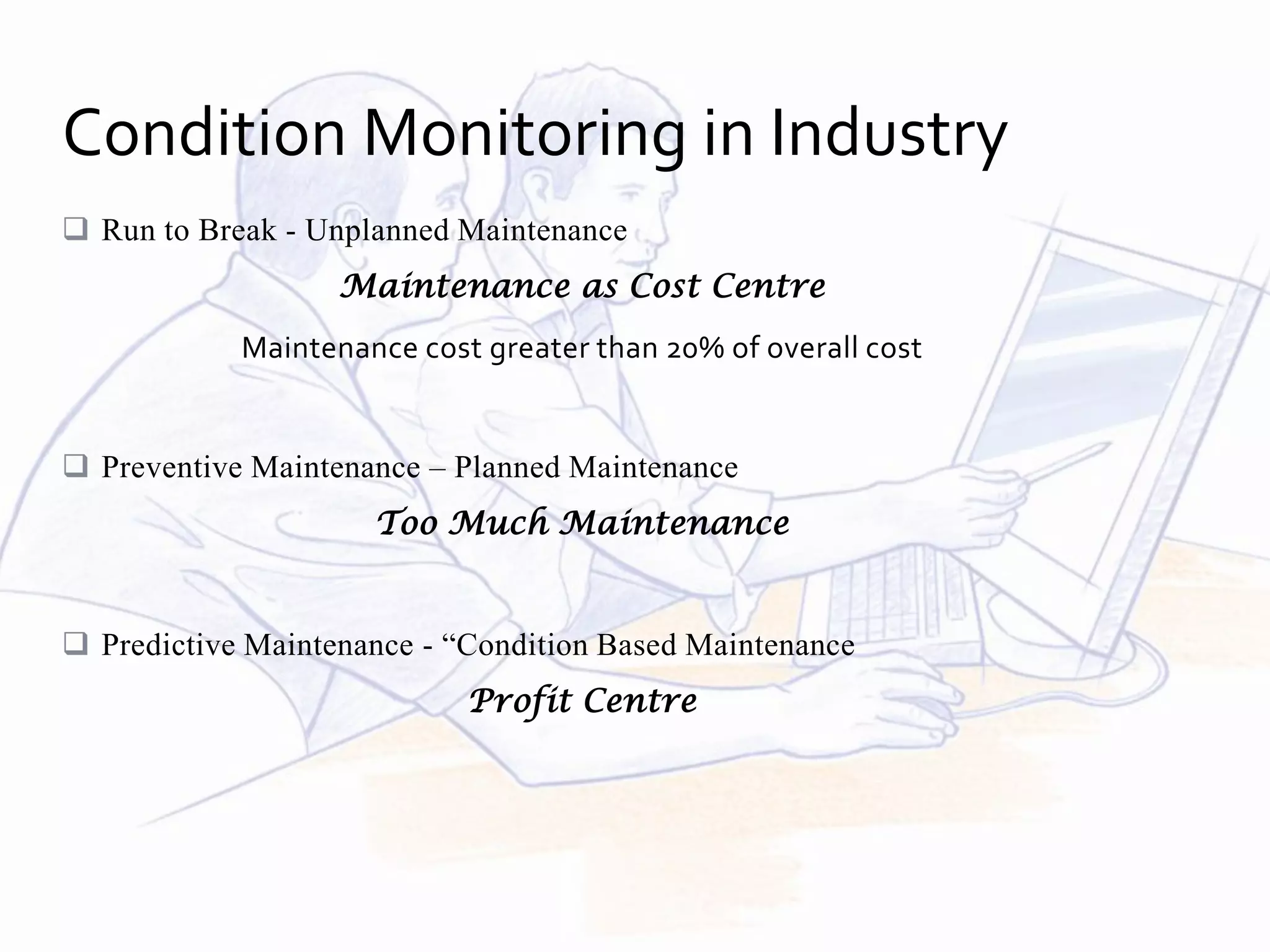
 Run to Break - Unplanned Maintenance
Maintenance as Cost Centre
Maintenance cost greater than 20% of overall cost
 Preventive Maintenance – Planned Maintenance
Too Much Maintenance
 Predictive Maintenance - “Condition Based Maintenance
Profit Centre
Condition Monitoring in Industry
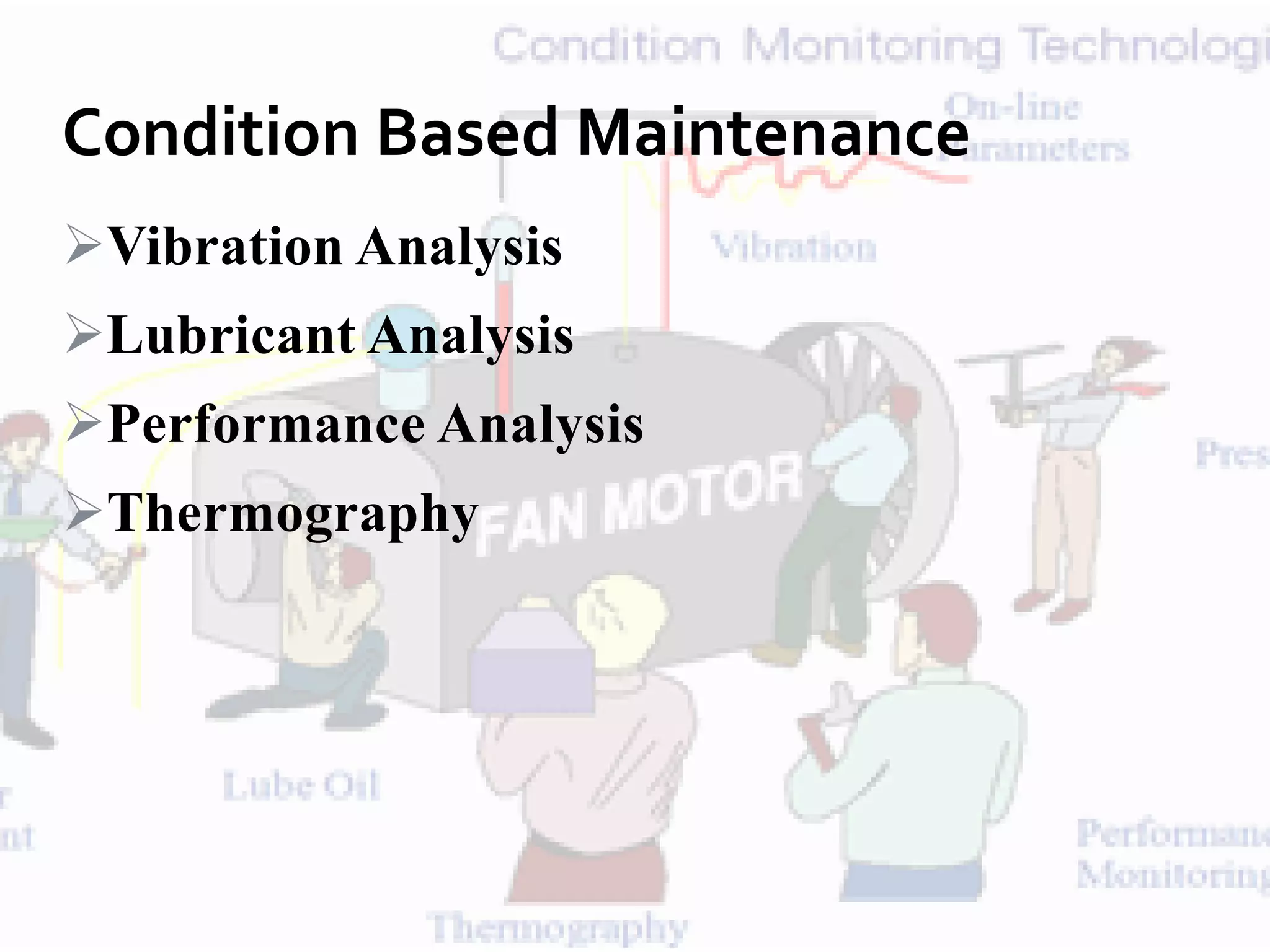
Vibration Analysis
Lubricant Analysis
Performance Analysis
Thermography
Condition Based Maintenance
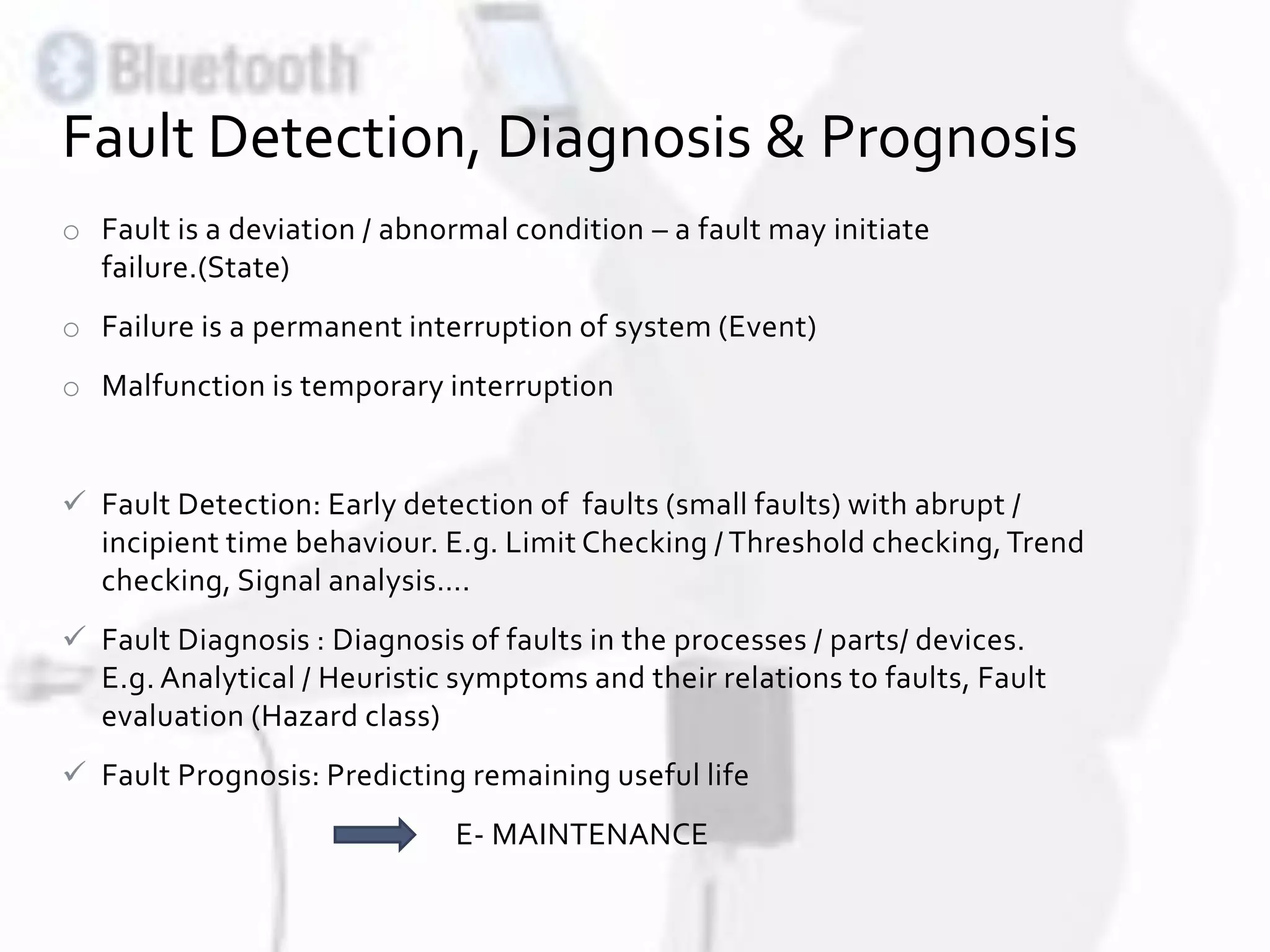
o Fault is a deviation / abnormal condition – a fault may initiate
failure.(State)
o Failure is a permanent interruption of system (Event)
o Malfunction is temporary interruption
 Fault Detection: Early detection of faults (small faults) with abrupt /
incipient time behaviour. E.g. Limit Checking / Threshold checking,Trend
checking, Signal analysis….
 Fault Diagnosis : Diagnosis of faults in the processes / parts/ devices.
E.g. Analytical / Heuristic symptoms and their relations to faults, Fault
evaluation (Hazard class)
 Fault Prognosis: Predicting remaining useful life
E- MAINTENANCE
Fault Detection, Diagnosis & Prognosis
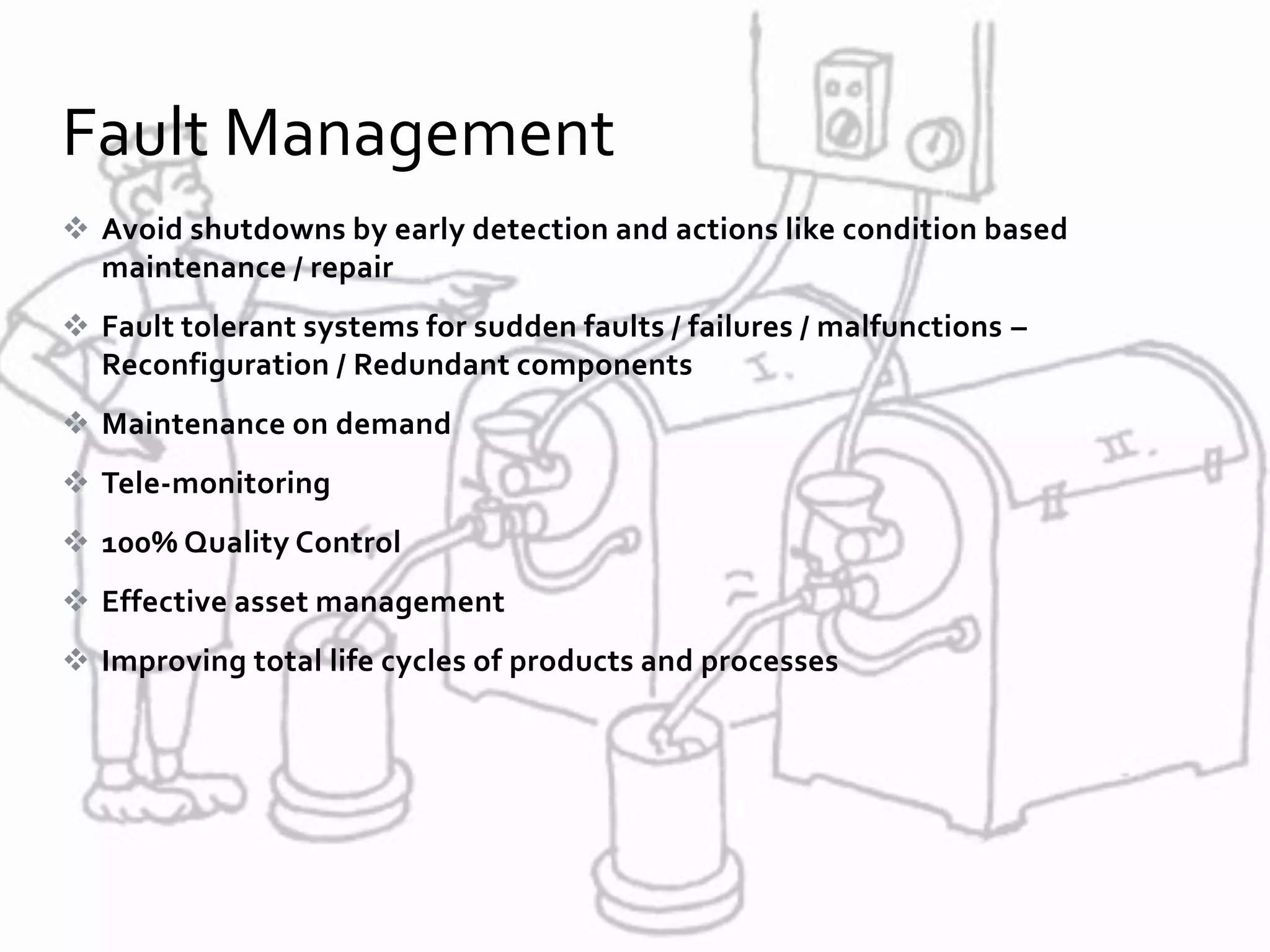
 Avoid shutdowns by early detection and actions like condition based
maintenance / repair
 Fault tolerant systems for sudden faults / failures / malfunctions –
Reconfiguration / Redundant components
 Maintenance on demand
 Tele-monitoring
 100% Quality Control
 Effective asset management
 Improving total life cycles of products and processes
Fault Management
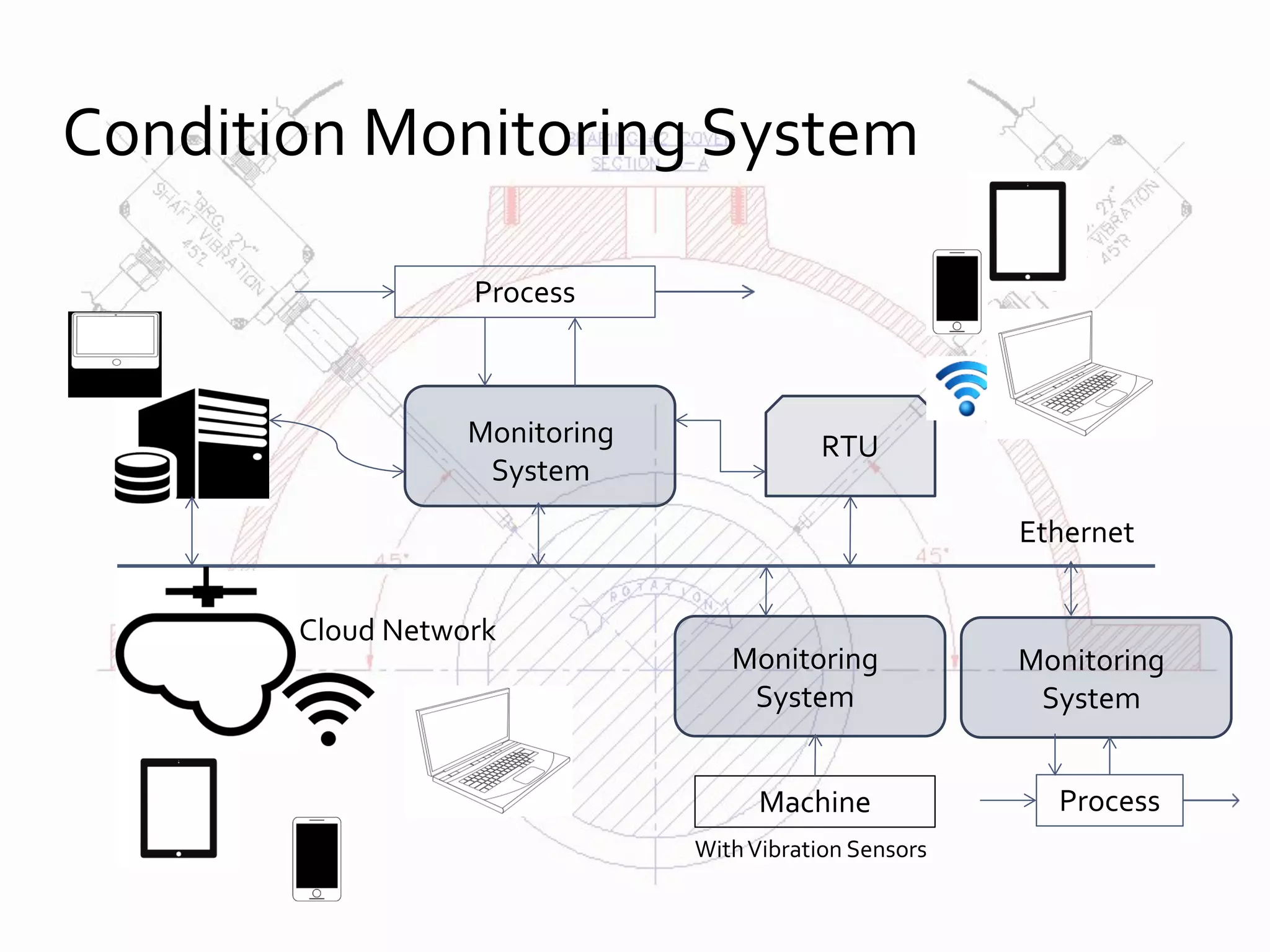
Condition Monitoring System
Process
Monitoring
System
RTU
Ethernet
Cloud Network
Monitoring
System
Monitoring
System
Machine
WithVibration Sensors
Process
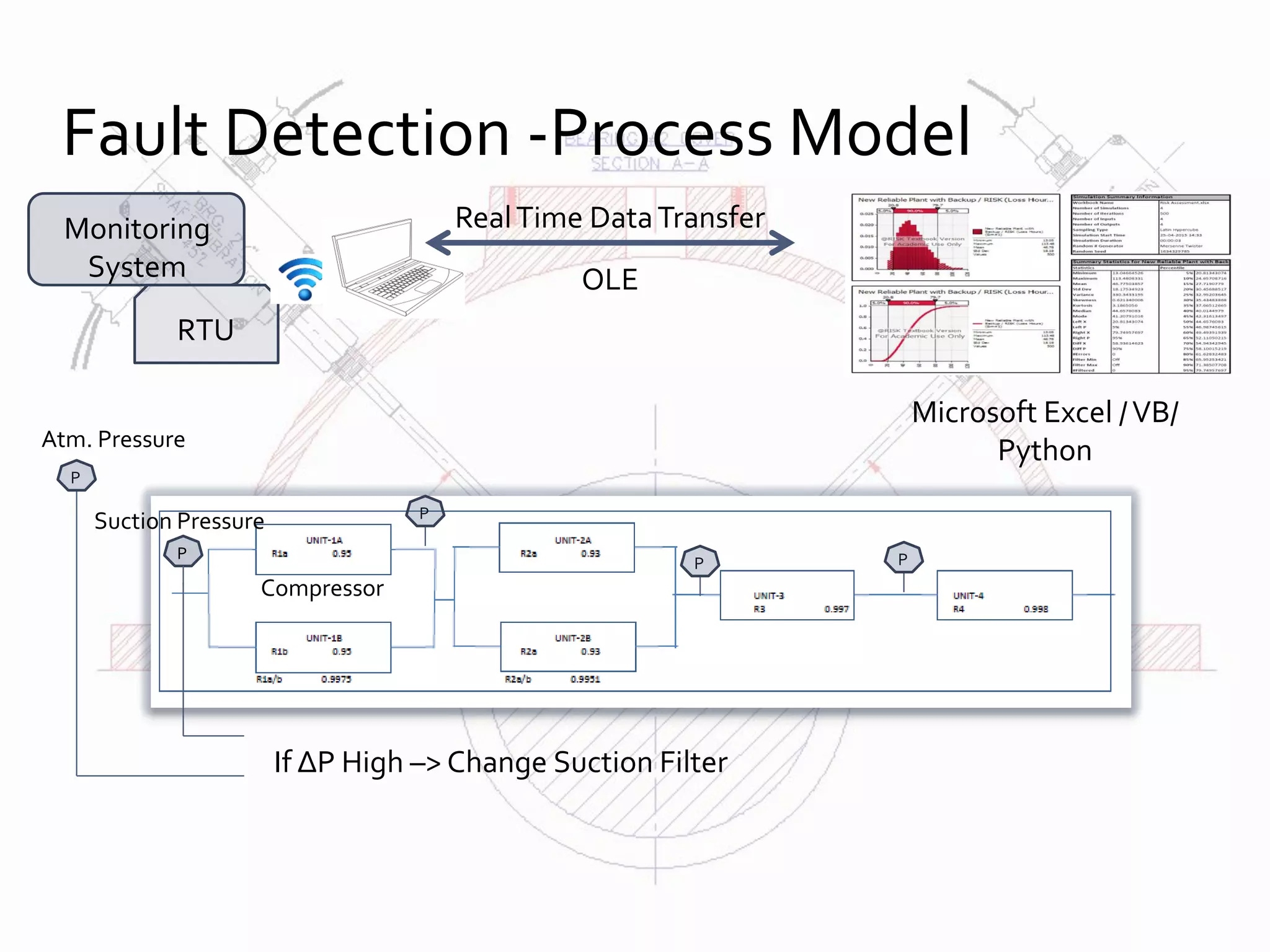
Fault Detection -Process Model
RTU
RealTime DataTransfer
OLE
Monitoring
System
Microsoft Excel /VB/
Python
P
P
P P
P
If ΔP High –> Change Suction Filter
Atm. Pressure
Compressor
Suction Pressure
First step towards Model Based Fault Detection
- By checking the plausibility of its indicated values (Rough Process Model)
- Using Microsoft Excel / VB / Python
- For above example:
IF [ΔP > ΔPmax] THEN [CHANGE SUCTION FILTER]
- More examples: Oil Pressure of engine Poil with speed N and C.W Tw
- IF[N < 2000 rpm] AND [Tw < 40 C]THEN [2.5 bar < Poil > 4 bar}
- Trend Analysis using “LOOKUP” function in Excel
- Use VBA macros to “Diagnose Faults”
Fault Diagnosis – Plausibility Checks
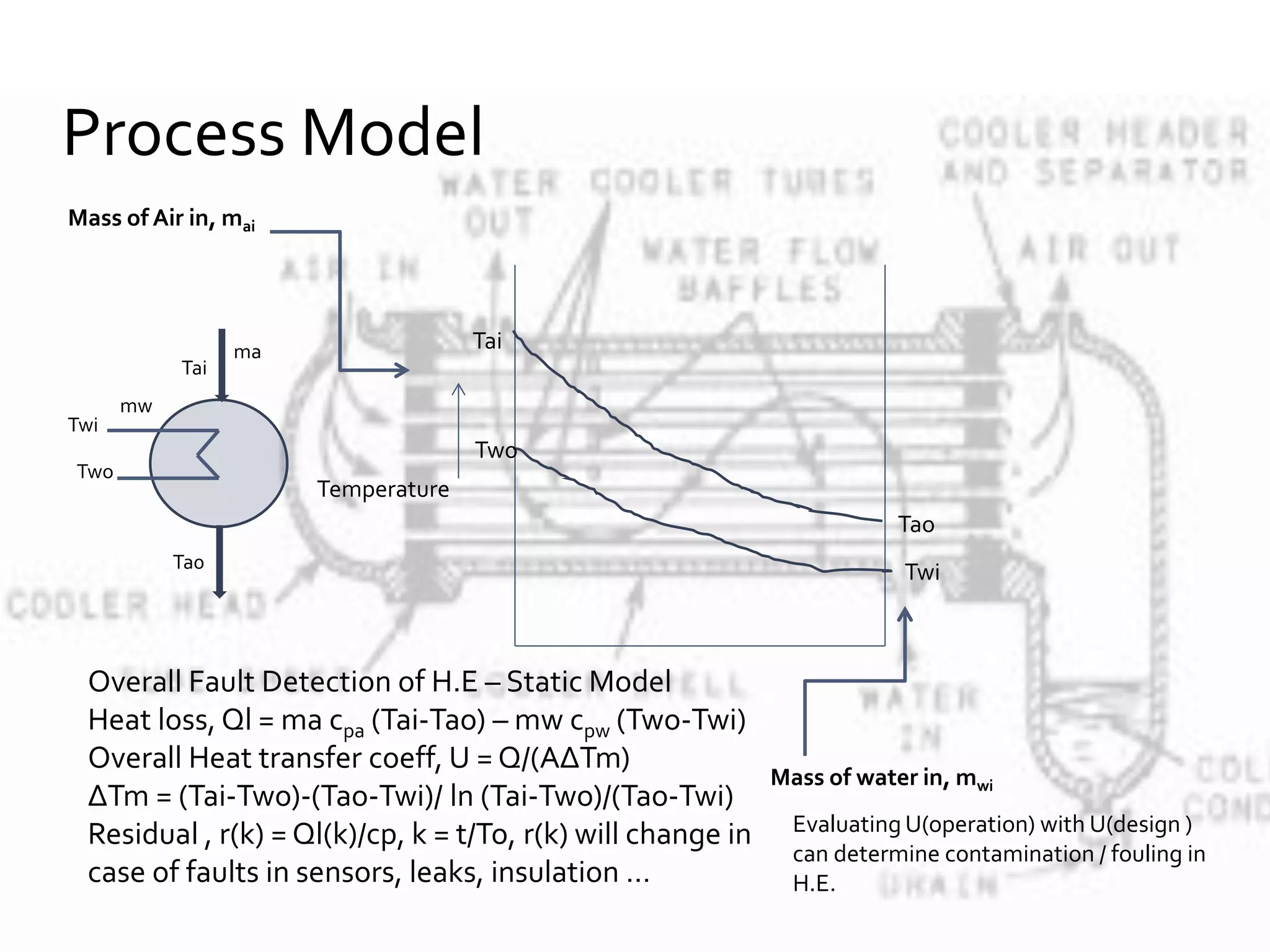
Process Model
Mass of Air in, mai
Mass of water in, mwi
Temperature
Tai
Two
Twi
Tao
ma
mw
Tai
Ta0
Twi
Two
Overall Fault Detection of H.E – Static Model
Heat loss, Ql = ma cpa (Tai-Tao) – mw cpw (Two-Twi)
Overall Heat transfer coeff, U = Q/(AΔTm)
ΔTm = (Tai-Two)-(Tao-Twi)/ ln (Tai-Two)/(Tao-Twi)
Residual , r(k) = Ql(k)/cp, k = t/To, r(k) will change in
case of faults in sensors, leaks, insulation …
Evaluating U(operation) with U(design )
can determine contamination / fouling in
H.E.
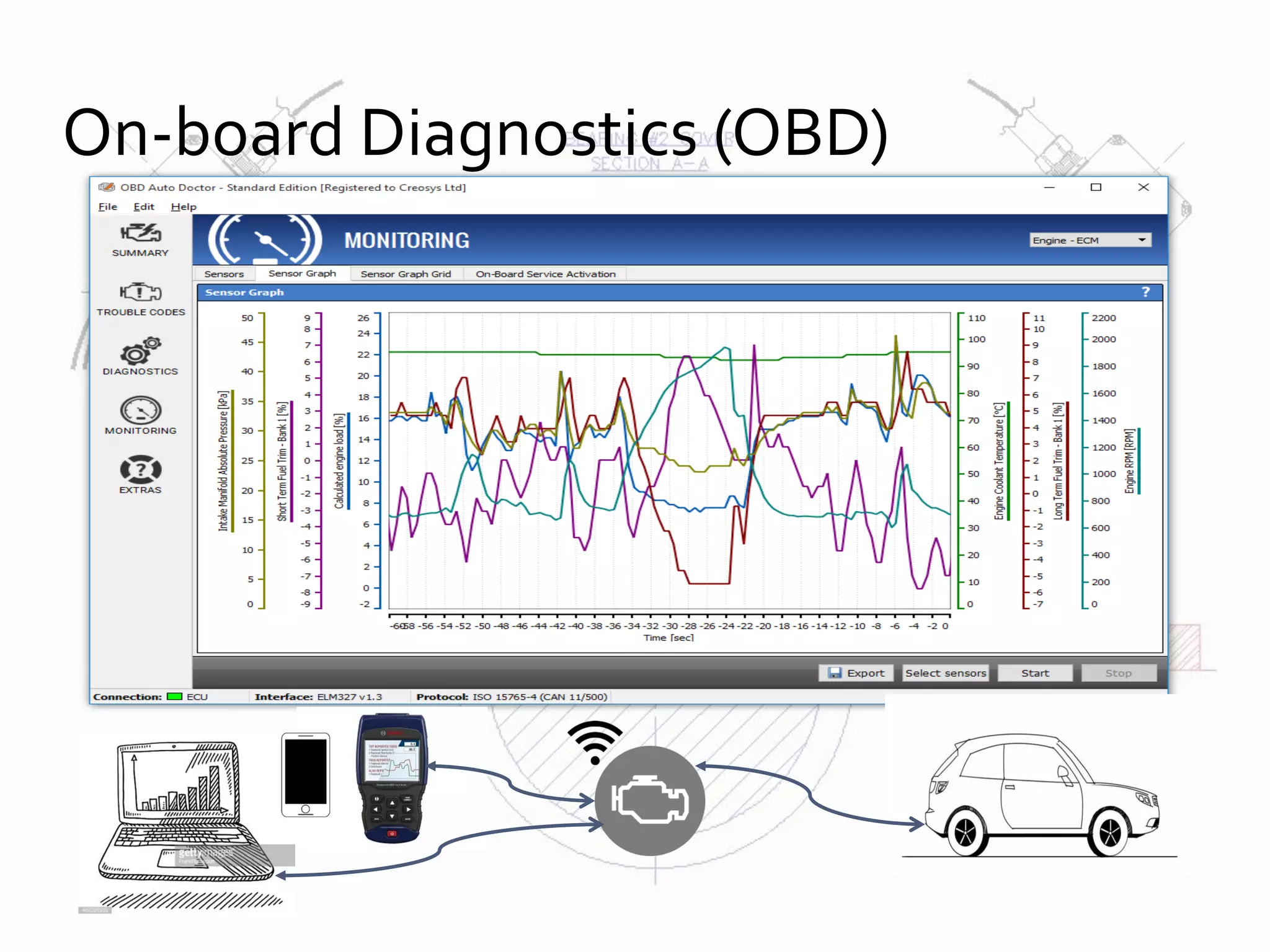
On-board Diagnostics (OBD)
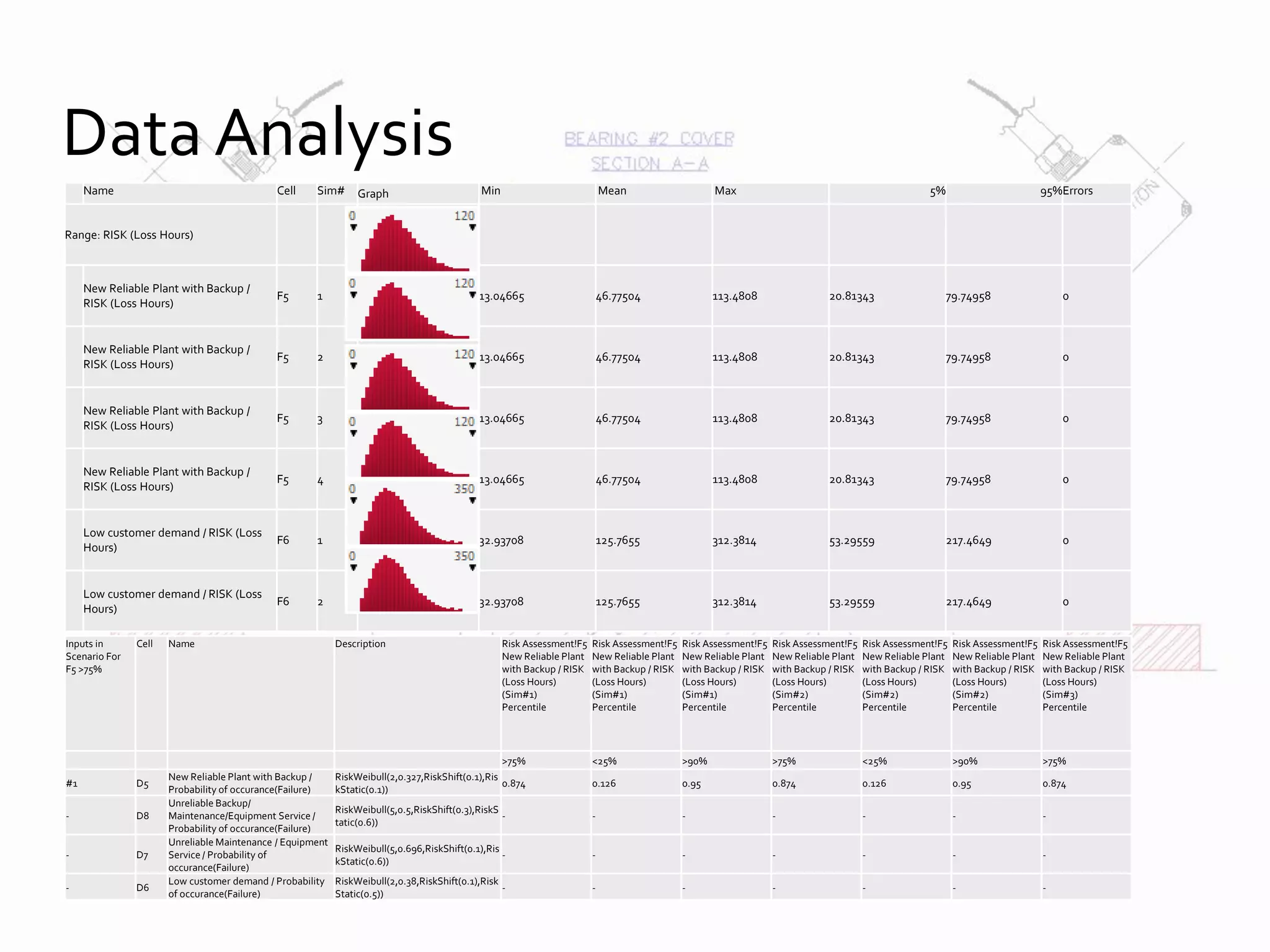
Data Analysis
Name Cell Sim# Graph Min Mean Max 5% 95%Errors
Range: RISK (Loss Hours)
New Reliable Plant with Backup /
RISK (Loss Hours)
F5 1 13.04665 46.77504 113.4808 20.81343 79.74958 0
New Reliable Plant with Backup /
RISK (Loss Hours)
F5 2 13.04665 46.77504 113.4808 20.81343 79.74958 0
New Reliable Plant with Backup /
RISK (Loss Hours)
F5 3 13.04665 46.77504 113.4808 20.81343 79.74958 0
New Reliable Plant with Backup /
RISK (Loss Hours)
F5 4 13.04665 46.77504 113.4808 20.81343 79.74958 0
Low customer demand / RISK (Loss
Hours)
F6 1 32.93708 125.7655 312.3814 53.29559 217.4649 0
Low customer demand / RISK (Loss
Hours)
F6 2 32.93708 125.7655 312.3814 53.29559 217.4649 0
Inputs in
Scenario For
F5 >75%
Cell Name Description Risk Assessment!F5
New Reliable Plant
with Backup / RISK
(Loss Hours)
(Sim#1)
Percentile
Risk Assessment!F5
New Reliable Plant
with Backup / RISK
(Loss Hours)
(Sim#1)
Percentile
Risk Assessment!F5
New Reliable Plant
with Backup / RISK
(Loss Hours)
(Sim#1)
Percentile
Risk Assessment!F5
New Reliable Plant
with Backup / RISK
(Loss Hours)
(Sim#2)
Percentile
Risk Assessment!F5
New Reliable Plant
with Backup / RISK
(Loss Hours)
(Sim#2)
Percentile
Risk Assessment!F5
New Reliable Plant
with Backup / RISK
(Loss Hours)
(Sim#2)
Percentile
Risk Assessment!F5
New Reliable Plant
with Backup / RISK
(Loss Hours)
(Sim#3)
Percentile
>75% <25% >90% >75% <25% >90% >75%
#1 D5
New Reliable Plant with Backup /
Probability of occurance(Failure)
RiskWeibull(2,0.327,RiskShift(0.1),Ris
kStatic(0.1))
0.874 0.126 0.95 0.874 0.126 0.95 0.874
- D8
Unreliable Backup/
Maintenance/Equipment Service /
Probability of occurance(Failure)
RiskWeibull(5,0.5,RiskShift(0.3),RiskS
tatic(0.6))
- - - - - - -
- D7
Unreliable Maintenance / Equipment
Service / Probability of
occurance(Failure)
RiskWeibull(5,0.696,RiskShift(0.1),Ris
kStatic(0.6))
- - - - - - -
- D6
Low customer demand / Probability
of occurance(Failure)
RiskWeibull(2,0.38,RiskShift(0.1),Risk
Static(0.5))
- - - - - - -
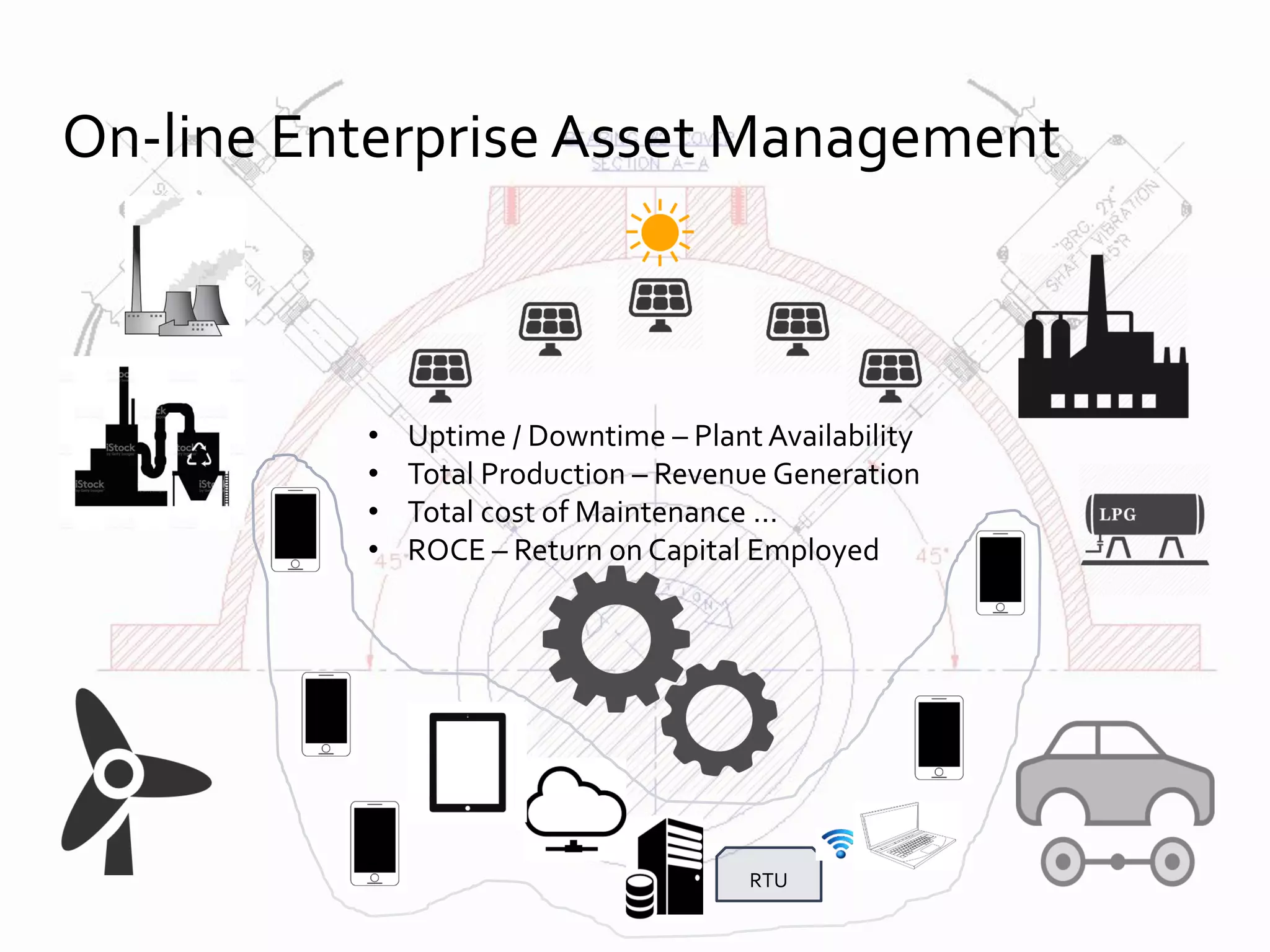
On-line Enterprise Asset Management
• Uptime / Downtime – Plant Availability
• Total Production – Revenue Generation
• Total cost of Maintenance …
• ROCE – Return on Capital Employed
RTU
• Sarathsri E-Technologies, Bangalore
• Institutions of Mechanical Engineers, South Asia, India
• Air Liquide , France
• BOSCH , India
• Indian Institute of Technology
References
 Fault Diagnosis Systems by Rolf Isermann, Springer 2006
 Fault Diagnosis Applications by Rolf Isermann, Springer
 Vibration based Condition Monitoring by Robert Bond Randall, WILEY 2011
 Artificial IntelligenceTools: Decision support Systems in Condition Monitoring
and Diagnosis by Diego Galar Pascual, CRC Press 2015
 https://opcfoundation.org/
Acknowledgment
ThankYou
ಧನ್ಯ ವಾದ
धन्यवाद
ありがとうございました
谢谢
Danke
Merci

Condition monitoring

  • 1.
    Advances in FaultDetection and Diagnosis in Industry May 20, 2017 Bangalore India
  • 2.
    • Introduction toCondition Monitoring in Industry • Fault Detection, Diagnosis and Prognosis • Fault Management • Condition Monitoring System • Fault Detection – Process Model • Fault Diagnosis - Plausibility Checks • Data Analysis • On-line Enterprise Asset Management • Overview
  • 3.
     Run toBreak - Unplanned Maintenance Maintenance as Cost Centre Maintenance cost greater than 20% of overall cost  Preventive Maintenance – Planned Maintenance Too Much Maintenance  Predictive Maintenance - “Condition Based Maintenance Profit Centre Condition Monitoring in Industry
  • 4.
    Vibration Analysis Lubricant Analysis PerformanceAnalysis Thermography Condition Based Maintenance
  • 5.
    o Fault isa deviation / abnormal condition – a fault may initiate failure.(State) o Failure is a permanent interruption of system (Event) o Malfunction is temporary interruption  Fault Detection: Early detection of faults (small faults) with abrupt / incipient time behaviour. E.g. Limit Checking / Threshold checking,Trend checking, Signal analysis….  Fault Diagnosis : Diagnosis of faults in the processes / parts/ devices. E.g. Analytical / Heuristic symptoms and their relations to faults, Fault evaluation (Hazard class)  Fault Prognosis: Predicting remaining useful life E- MAINTENANCE Fault Detection, Diagnosis & Prognosis
  • 6.
     Avoid shutdownsby early detection and actions like condition based maintenance / repair  Fault tolerant systems for sudden faults / failures / malfunctions – Reconfiguration / Redundant components  Maintenance on demand  Tele-monitoring  100% Quality Control  Effective asset management  Improving total life cycles of products and processes Fault Management
  • 7.
    Condition Monitoring System Process Monitoring System RTU Ethernet CloudNetwork Monitoring System Monitoring System Machine WithVibration Sensors Process
  • 8.
    Fault Detection -ProcessModel RTU RealTime DataTransfer OLE Monitoring System Microsoft Excel /VB/ Python P P P P P If ΔP High –> Change Suction Filter Atm. Pressure Compressor Suction Pressure
  • 9.
    First step towardsModel Based Fault Detection - By checking the plausibility of its indicated values (Rough Process Model) - Using Microsoft Excel / VB / Python - For above example: IF [ΔP > ΔPmax] THEN [CHANGE SUCTION FILTER] - More examples: Oil Pressure of engine Poil with speed N and C.W Tw - IF[N < 2000 rpm] AND [Tw < 40 C]THEN [2.5 bar < Poil > 4 bar} - Trend Analysis using “LOOKUP” function in Excel - Use VBA macros to “Diagnose Faults” Fault Diagnosis – Plausibility Checks
  • 10.
    Process Model Mass ofAir in, mai Mass of water in, mwi Temperature Tai Two Twi Tao ma mw Tai Ta0 Twi Two Overall Fault Detection of H.E – Static Model Heat loss, Ql = ma cpa (Tai-Tao) – mw cpw (Two-Twi) Overall Heat transfer coeff, U = Q/(AΔTm) ΔTm = (Tai-Two)-(Tao-Twi)/ ln (Tai-Two)/(Tao-Twi) Residual , r(k) = Ql(k)/cp, k = t/To, r(k) will change in case of faults in sensors, leaks, insulation … Evaluating U(operation) with U(design ) can determine contamination / fouling in H.E.
  • 11.
  • 12.
    Data Analysis Name CellSim# Graph Min Mean Max 5% 95%Errors Range: RISK (Loss Hours) New Reliable Plant with Backup / RISK (Loss Hours) F5 1 13.04665 46.77504 113.4808 20.81343 79.74958 0 New Reliable Plant with Backup / RISK (Loss Hours) F5 2 13.04665 46.77504 113.4808 20.81343 79.74958 0 New Reliable Plant with Backup / RISK (Loss Hours) F5 3 13.04665 46.77504 113.4808 20.81343 79.74958 0 New Reliable Plant with Backup / RISK (Loss Hours) F5 4 13.04665 46.77504 113.4808 20.81343 79.74958 0 Low customer demand / RISK (Loss Hours) F6 1 32.93708 125.7655 312.3814 53.29559 217.4649 0 Low customer demand / RISK (Loss Hours) F6 2 32.93708 125.7655 312.3814 53.29559 217.4649 0 Inputs in Scenario For F5 >75% Cell Name Description Risk Assessment!F5 New Reliable Plant with Backup / RISK (Loss Hours) (Sim#1) Percentile Risk Assessment!F5 New Reliable Plant with Backup / RISK (Loss Hours) (Sim#1) Percentile Risk Assessment!F5 New Reliable Plant with Backup / RISK (Loss Hours) (Sim#1) Percentile Risk Assessment!F5 New Reliable Plant with Backup / RISK (Loss Hours) (Sim#2) Percentile Risk Assessment!F5 New Reliable Plant with Backup / RISK (Loss Hours) (Sim#2) Percentile Risk Assessment!F5 New Reliable Plant with Backup / RISK (Loss Hours) (Sim#2) Percentile Risk Assessment!F5 New Reliable Plant with Backup / RISK (Loss Hours) (Sim#3) Percentile >75% <25% >90% >75% <25% >90% >75% #1 D5 New Reliable Plant with Backup / Probability of occurance(Failure) RiskWeibull(2,0.327,RiskShift(0.1),Ris kStatic(0.1)) 0.874 0.126 0.95 0.874 0.126 0.95 0.874 - D8 Unreliable Backup/ Maintenance/Equipment Service / Probability of occurance(Failure) RiskWeibull(5,0.5,RiskShift(0.3),RiskS tatic(0.6)) - - - - - - - - D7 Unreliable Maintenance / Equipment Service / Probability of occurance(Failure) RiskWeibull(5,0.696,RiskShift(0.1),Ris kStatic(0.6)) - - - - - - - - D6 Low customer demand / Probability of occurance(Failure) RiskWeibull(2,0.38,RiskShift(0.1),Risk Static(0.5)) - - - - - - -
  • 13.
    On-line Enterprise AssetManagement • Uptime / Downtime – Plant Availability • Total Production – Revenue Generation • Total cost of Maintenance … • ROCE – Return on Capital Employed RTU
  • 14.
    • Sarathsri E-Technologies,Bangalore • Institutions of Mechanical Engineers, South Asia, India • Air Liquide , France • BOSCH , India • Indian Institute of Technology References  Fault Diagnosis Systems by Rolf Isermann, Springer 2006  Fault Diagnosis Applications by Rolf Isermann, Springer  Vibration based Condition Monitoring by Robert Bond Randall, WILEY 2011  Artificial IntelligenceTools: Decision support Systems in Condition Monitoring and Diagnosis by Diego Galar Pascual, CRC Press 2015  https://opcfoundation.org/ Acknowledgment
  • 15.