Start with the Name of Allah
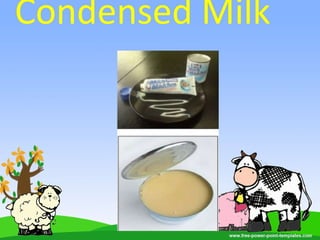
Condensed Milk
Group Members
 Farzana Sarwar 16-uglc-606
 Sahar Khalid 16-uglc-607
Contents
• History
• Condensed Milk.
• Shelf life of condensed milk.
• Processing of Condensed Milk.
• Objective of manufacturing condensed milk.
• Packaging of condensed milk.
• Uses of condensed milk.
History of condensed milk
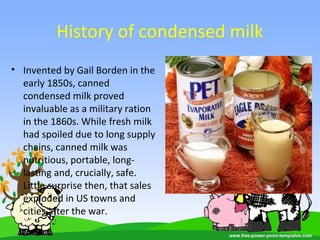
• Invented by Gail Borden in the
early 1850s, canned
condensed milk proved
invaluable as a military ration
in the 1860s. While fresh milk
had spoiled due to long supply
chains, canned milk was
nutritious, portable, long-
lasting and, crucially, safe.
Little surprise then, that sales
exploded in US towns and
cities after the war.
Condensed Milk;
Condensed milk is relatively a young dairy product
made from evaporated milk with sugar added.
Mostly found in the form of sweetened condensed milk.
Used in numerous dessert recipes.
Water content is removed from this milk.
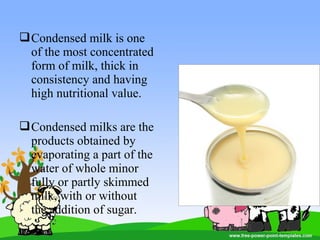
Condensed milk is one
of the most concentrated
form of milk, thick in
consistency and having
high nutritional value.
Condensed milks are the
products obtained by
evaporating a part of the
water of whole minor
fully or partly skimmed
milk, with or without
the addition of sugar.
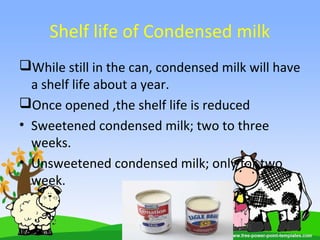
Shelf life of Condensed milk
While still in the can, condensed milk will have
a shelf life about a year.
Once opened ,the shelf life is reduced
• Sweetened condensed milk; two to three
weeks.
• Unsweetened condensed milk; only for two
week.
Arms Race
Objectives of manufacturing
condensed milk
• 1- Preservation of milk ,and
• 2- Reduction in bulk for the purpose of long distance
transport
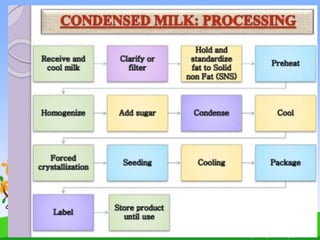
Processing of condensed milk
1.Receiving milk
2.Filtration/clarification (pre-heating)
3.Standardization
4.Fore-warming/pre-heating
5.Addition of sugar
6.Condensing
7.Homogenization
8.Cooling and Crystallization
1-Receiving milk;
Milk received at temprature of 10 degree
celcius (50degree F).
Milk should be clean
• free from odour or off-flavour
• reasonably free from extraneous matter.
No abnormal milk should be accepted.
Milk is preheated to 35-40 degree
Celcious
Remove visible foreign matters
2-Filtrationclarification(pre-
heating)
3-Standardization
 To maintain legal standards in the finish product.
 There are three stages for standardization of raw
milk;
a)Desired ratio of fats and solids not fat is
established.I t is usually 1:2.44.
b)Establishes the desired ratio of added sugar to
the total milk-solid.
c)Adjust the concentration of the finished
condensed milk to desired %of total solids.
4-Fore-warmingpre-heating
This refer to heating standardized milk before
it condensed
These are ;
1)To ensure that finished product free from
micro-organisms and enzymes
2)To ensure uninterrupted boiling in the vacuum
pan
3)To controlling objectionable age-thickening in
the finished product
5-Addition of sugar
For preserving the condensed milk without
sterilization
It is highly refined cane or beet sugar
Sucrose is added
Other sweetening agents, such as
• Corn syrup solids, glucose and dextrose (have
also replace sugar 5 to 25 %)
6-Condensing
Removal of water from the standardized milk.
Advantages of condensing milk in vacuum;
• Dre economy of operation
• Rapidness of evaporation
• Protection of milk against heat demage
• The condensing is carried out at temp 130 to
145 degree celcious
7- Homogenization
The hot and condensed milk is invariably
homogenized before it is cooled and
crystallized .
To abtain a uniform fat emulsion and reduce
fat separation to a minimum during storage.
A special type of homogenizer suitable for
highly viscous product is used at a total
pressure of 2500psi
8-Cooling and Crystallization
• The condensed milk is then cooled .
• Prompt cooling is desirable to delay the
tendency of age-thickening and discoloration.
Packaging of Condensed Milk
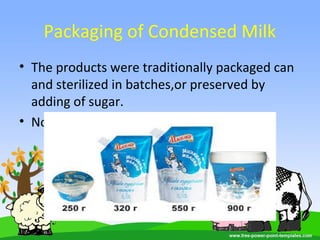
• The products were traditionally packaged can
and sterilized in batches,or preserved by
adding of sugar.
• Now available in pouches.
Uses of Condensed milk
• 1- Condensed milks are widely used for re-
constituation into sweet milk drinks.
• 2- Condensed milks are very commonly used in the
preparation of tea or coffee.
• 3- They are also widely used in the ice-cream
preparation.
• 4- They are used in canday and confectionary
products.
• 5- They are often used in prepared foods in various
ways and form.
ANY
QUESTION???
condensed milk processing

condensed milk processing

  • 1.
    Start with theName of Allah
  • 2.
  • 3.
    Group Members  FarzanaSarwar 16-uglc-606  Sahar Khalid 16-uglc-607
  • 4.
    Contents • History • CondensedMilk. • Shelf life of condensed milk. • Processing of Condensed Milk. • Objective of manufacturing condensed milk. • Packaging of condensed milk. • Uses of condensed milk.
  • 5.
    History of condensedmilk • Invented by Gail Borden in the early 1850s, canned condensed milk proved invaluable as a military ration in the 1860s. While fresh milk had spoiled due to long supply chains, canned milk was nutritious, portable, long- lasting and, crucially, safe. Little surprise then, that sales exploded in US towns and cities after the war.
  • 6.
    Condensed Milk; Condensed milkis relatively a young dairy product made from evaporated milk with sugar added. Mostly found in the form of sweetened condensed milk. Used in numerous dessert recipes. Water content is removed from this milk.
  • 7.
    Condensed milk isone of the most concentrated form of milk, thick in consistency and having high nutritional value. Condensed milks are the products obtained by evaporating a part of the water of whole minor fully or partly skimmed milk, with or without the addition of sugar.
  • 8.
    Shelf life ofCondensed milk While still in the can, condensed milk will have a shelf life about a year. Once opened ,the shelf life is reduced • Sweetened condensed milk; two to three weeks. • Unsweetened condensed milk; only for two week.
  • 9.
  • 10.
    Objectives of manufacturing condensedmilk • 1- Preservation of milk ,and • 2- Reduction in bulk for the purpose of long distance transport
  • 11.
    Processing of condensedmilk 1.Receiving milk 2.Filtration/clarification (pre-heating) 3.Standardization 4.Fore-warming/pre-heating 5.Addition of sugar 6.Condensing 7.Homogenization 8.Cooling and Crystallization
  • 12.
    1-Receiving milk; Milk receivedat temprature of 10 degree celcius (50degree F). Milk should be clean • free from odour or off-flavour • reasonably free from extraneous matter. No abnormal milk should be accepted.
  • 13.
    Milk is preheatedto 35-40 degree Celcious Remove visible foreign matters 2-Filtrationclarification(pre- heating)
  • 14.
    3-Standardization  To maintainlegal standards in the finish product.  There are three stages for standardization of raw milk; a)Desired ratio of fats and solids not fat is established.I t is usually 1:2.44. b)Establishes the desired ratio of added sugar to the total milk-solid. c)Adjust the concentration of the finished condensed milk to desired %of total solids.
  • 15.
    4-Fore-warmingpre-heating This refer toheating standardized milk before it condensed These are ; 1)To ensure that finished product free from micro-organisms and enzymes 2)To ensure uninterrupted boiling in the vacuum pan 3)To controlling objectionable age-thickening in the finished product
  • 16.
    5-Addition of sugar Forpreserving the condensed milk without sterilization It is highly refined cane or beet sugar Sucrose is added Other sweetening agents, such as • Corn syrup solids, glucose and dextrose (have also replace sugar 5 to 25 %)
  • 17.
    6-Condensing Removal of waterfrom the standardized milk. Advantages of condensing milk in vacuum; • Dre economy of operation • Rapidness of evaporation • Protection of milk against heat demage • The condensing is carried out at temp 130 to 145 degree celcious
  • 18.
    7- Homogenization The hotand condensed milk is invariably homogenized before it is cooled and crystallized . To abtain a uniform fat emulsion and reduce fat separation to a minimum during storage. A special type of homogenizer suitable for highly viscous product is used at a total pressure of 2500psi
  • 19.
    8-Cooling and Crystallization •The condensed milk is then cooled . • Prompt cooling is desirable to delay the tendency of age-thickening and discoloration.
  • 20.
    Packaging of CondensedMilk • The products were traditionally packaged can and sterilized in batches,or preserved by adding of sugar. • Now available in pouches.
  • 21.
    Uses of Condensedmilk • 1- Condensed milks are widely used for re- constituation into sweet milk drinks. • 2- Condensed milks are very commonly used in the preparation of tea or coffee. • 3- They are also widely used in the ice-cream preparation. • 4- They are used in canday and confectionary products. • 5- They are often used in prepared foods in various ways and form.
  • 23.