EMB2203
FUNDAMENTALS OF
CAD/CAM
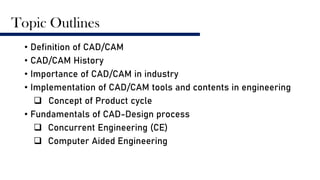
Topic Outlines
• Definition of CAD/CAM
• CAD/CAM History
• Importance of CAD/CAM in industry
• Implementation of CAD/CAM tools and contents in engineering
 Concept of Product cycle
• Fundamentals of CAD-Design process
 Concurrent Engineering (CE)
 Computer Aided Engineering
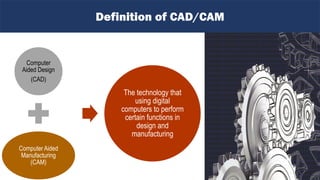
Definition of CAD/CAM
Computer
Aided Design
(CAD)
Computer Aided
Manufacturing
(CAM)
The technology that
using digital
computers to perform
certain functions in
design and
manufacturing
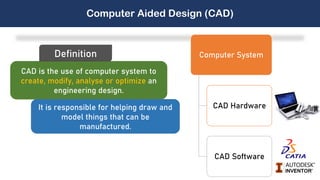
CAD is the use of computer system to
create, modify, analyse or optimize an
engineering design.
Computer Aided Design (CAD)
Definition
It is responsible for helping draw and
model things that can be
manufactured.
Computer System
CAD Hardware
CAD Software
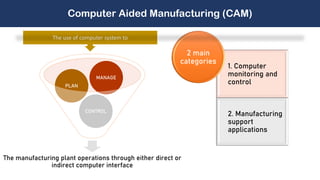
The manufacturing plant operations through either direct or
indirect computer interface
CONTROL
PLAN
MANAGE
The use of computer system to
1. Computer
monitoring and
control
2. Manufacturing
support
applications
2 main
categories
Computer Aided Manufacturing (CAM)
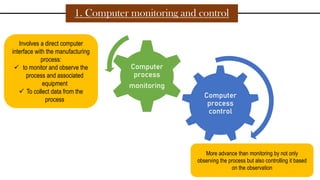
Computer
process
control
Computer
process
monitoring
Involves a direct computer
interface with the manufacturing
process:
 to monitor and observe the
process and associated
equipment
 To collect data from the
process
More advance than monitoring by not only
observing the process but also controlling it based
on the observation
1. Computer monitoring and control
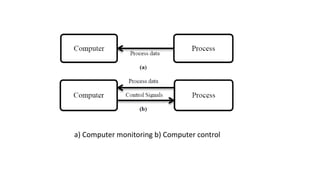
a) Computer monitoring b) Computer control
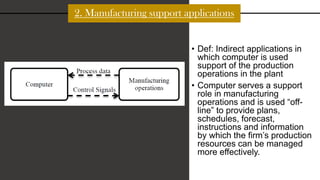
• Def: Indirect applications in
which computer is used
support of the production
operations in the plant
• Computer serves a support
role in manufacturing
operations and is used “off-
line” to provide plans,
schedules, forecast,
instructions and information
by which the firm’s production
resources can be managed
more effectively.
2. Manufacturing support applications
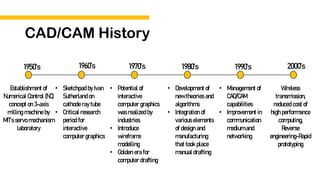
CAD/CAM History
Establishment of
Numerical Control (NC)
concept on 3-axis
milling machine by
MIT’s servo mechanism
laboratory
• Sketchpad by Ivan
Sutherland on
cathode ray tube
• Critical research
period for
interactive
computer graphics
• Potential of
interactive
computer graphics
was realized by
industries
• Introduce
wireframe
modelling
• Golden era for
computer drafting
• Development of
new theories and
algorithms
• Integration of
various elements
of design and
manufacturing
that took place
manual drafting
• Management of
CAD/CAM
capabilities
• Improvement in
communication
medium and
networking
Wireless
transmission,
reduced cost of
high performance
computing,
Reverse
engineering-Rapid
prototyping
1950’s 1990’s
1980’s
1970’s
1960’s 2000’s
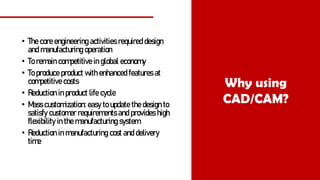
• The core engineering activities required design
and manufacturing operation
• To remain competitive in global economy
• To produce product with enhanced features at
competitive costs
• Reduction in product life cycle
• Mass customization: easy to update the design to
satisfy customer requirements and provides high
flexibility in the manufacturing system
• Reduction in manufacturing cost and delivery
time
Why using
CAD/CAM?
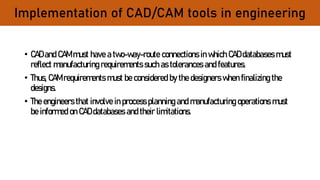
Implementation of CAD/CAM tools in engineering
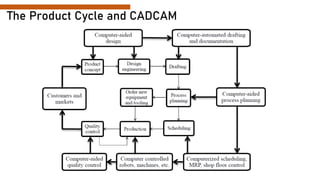
• CAD and CAM must have a two-way-route connections in which CAD databases must
reflect manufacturing requirements such as tolerances and features.
• Thus, CAM requirements must be considered by the designers when finalizing the
designs.
• The engineers that involve in process planning and manufacturing operations must
be informed on CAD databases and their limitations.
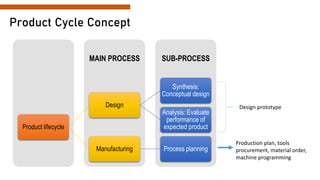
SUB-PROCESS
MAIN PROCESS
Product lifecycle
Design
Synthesis:
Conceptual design
Analysis: Evaluate
performance of
expected product
Manufacturing Process planning
Product Cycle Concept
Design prototype
Production plan, tools
procurement, material order,
machine programming
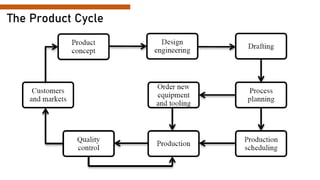
The Product Cycle
The Product Cycle and CADCAM
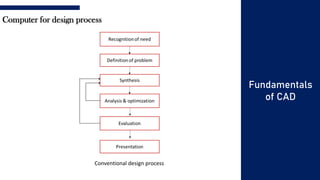
Computer for design process
Conventional design process
Fundamentals
of CAD
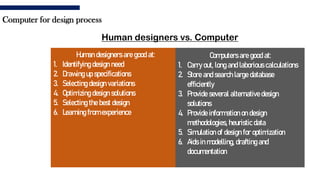
Human designers vs. Computer
Human designers are good at:
1. Identifying design need
2. Drawing up specifications
3. Selecting design variations
4. Optimizing design solutions
5. Selecting the best design
6. Learning from experience
Computers are good at:
1. Carry out, long and laborious calculations
2. Store and search large database
efficiently
3. Provide several alternative design
solutions
4. Provide information on design
methodologies, heuristic data
5. Simulation of design for optimization
6. Aids in modelling, drafting and
documentation
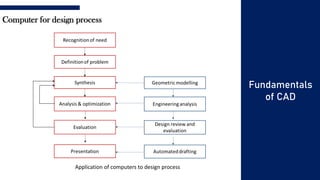
Computer for design process
Fundamentals
of CAD
Application of computers to design process
Concurrent Engineering
• A new technique adopted to improve efficiency of product design and reduce
product cycle design team
• Team of people from different function areas
• Encourage interaction between different departments
• Able to improve workflow
• Eliminates conflict and procedures
• Robust products can be created
• Integration of various tools such as CAD system with solid modelling capabilities,
Enterprise Resource Planning (ERP), Product life Management (PLM) and many
more.
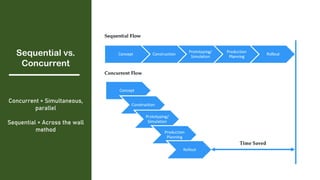
Sequential vs.
Concurrent
Concurrent = Simultaneous,
parallel
Sequential = Across the wall
method
Computer Aided Engineering (CAE)
• To analyse CAD geometry, allowing the designer to simulate and study how
the product will behave
• Example: Mass property calculations, mechanical assembly tesing
(dimensional checking, interference checking), kinematic analysis and
animation (movement visualization, simulation) FEM analysis , Fluid
analysis, Vibration analysis, Thermal analysis, etc.
Video
Next class session
• CAD/CAM Hardware
 Introduction to type of systems
 CAD/CAM system evaluation criteria

computer system to create, modify, analyse or optimize an engineering design.

  • 1.
  • 2.
    Topic Outlines • Definitionof CAD/CAM • CAD/CAM History • Importance of CAD/CAM in industry • Implementation of CAD/CAM tools and contents in engineering  Concept of Product cycle • Fundamentals of CAD-Design process  Concurrent Engineering (CE)  Computer Aided Engineering
  • 3.
    Definition of CAD/CAM Computer AidedDesign (CAD) Computer Aided Manufacturing (CAM) The technology that using digital computers to perform certain functions in design and manufacturing
  • 4.
    CAD is theuse of computer system to create, modify, analyse or optimize an engineering design. Computer Aided Design (CAD) Definition It is responsible for helping draw and model things that can be manufactured. Computer System CAD Hardware CAD Software
  • 5.
    The manufacturing plantoperations through either direct or indirect computer interface CONTROL PLAN MANAGE The use of computer system to 1. Computer monitoring and control 2. Manufacturing support applications 2 main categories Computer Aided Manufacturing (CAM)
  • 6.
    Computer process control Computer process monitoring Involves a directcomputer interface with the manufacturing process:  to monitor and observe the process and associated equipment  To collect data from the process More advance than monitoring by not only observing the process but also controlling it based on the observation 1. Computer monitoring and control
  • 7.
    a) Computer monitoringb) Computer control
  • 8.
    • Def: Indirectapplications in which computer is used support of the production operations in the plant • Computer serves a support role in manufacturing operations and is used “off- line” to provide plans, schedules, forecast, instructions and information by which the firm’s production resources can be managed more effectively. 2. Manufacturing support applications
  • 9.
    CAD/CAM History Establishment of NumericalControl (NC) concept on 3-axis milling machine by MIT’s servo mechanism laboratory • Sketchpad by Ivan Sutherland on cathode ray tube • Critical research period for interactive computer graphics • Potential of interactive computer graphics was realized by industries • Introduce wireframe modelling • Golden era for computer drafting • Development of new theories and algorithms • Integration of various elements of design and manufacturing that took place manual drafting • Management of CAD/CAM capabilities • Improvement in communication medium and networking Wireless transmission, reduced cost of high performance computing, Reverse engineering-Rapid prototyping 1950’s 1990’s 1980’s 1970’s 1960’s 2000’s
  • 10.
    • The coreengineering activities required design and manufacturing operation • To remain competitive in global economy • To produce product with enhanced features at competitive costs • Reduction in product life cycle • Mass customization: easy to update the design to satisfy customer requirements and provides high flexibility in the manufacturing system • Reduction in manufacturing cost and delivery time Why using CAD/CAM?
  • 11.
    Implementation of CAD/CAMtools in engineering • CAD and CAM must have a two-way-route connections in which CAD databases must reflect manufacturing requirements such as tolerances and features. • Thus, CAM requirements must be considered by the designers when finalizing the designs. • The engineers that involve in process planning and manufacturing operations must be informed on CAD databases and their limitations.
  • 12.
    SUB-PROCESS MAIN PROCESS Product lifecycle Design Synthesis: Conceptualdesign Analysis: Evaluate performance of expected product Manufacturing Process planning Product Cycle Concept Design prototype Production plan, tools procurement, material order, machine programming
  • 13.
  • 14.
  • 15.
    Computer for designprocess Conventional design process Fundamentals of CAD
  • 16.
    Human designers vs.Computer Human designers are good at: 1. Identifying design need 2. Drawing up specifications 3. Selecting design variations 4. Optimizing design solutions 5. Selecting the best design 6. Learning from experience Computers are good at: 1. Carry out, long and laborious calculations 2. Store and search large database efficiently 3. Provide several alternative design solutions 4. Provide information on design methodologies, heuristic data 5. Simulation of design for optimization 6. Aids in modelling, drafting and documentation Computer for design process
  • 17.
    Computer for designprocess Fundamentals of CAD Application of computers to design process
  • 18.
    Concurrent Engineering • Anew technique adopted to improve efficiency of product design and reduce product cycle design team • Team of people from different function areas • Encourage interaction between different departments • Able to improve workflow • Eliminates conflict and procedures • Robust products can be created • Integration of various tools such as CAD system with solid modelling capabilities, Enterprise Resource Planning (ERP), Product life Management (PLM) and many more.
  • 19.
    Sequential vs. Concurrent Concurrent =Simultaneous, parallel Sequential = Across the wall method
  • 20.
    Computer Aided Engineering(CAE) • To analyse CAD geometry, allowing the designer to simulate and study how the product will behave • Example: Mass property calculations, mechanical assembly tesing (dimensional checking, interference checking), kinematic analysis and animation (movement visualization, simulation) FEM analysis , Fluid analysis, Vibration analysis, Thermal analysis, etc.

  • 21.
  • 22.
    Next class session •CAD/CAM Hardware  Introduction to type of systems  CAD/CAM system evaluation criteria