Computer Networking Basics Equipment Cabling
Setup Sharing Tcpip Iis Neo Institute download
https://ebookbell.com/product/computer-networking-basics-
equipment-cabling-setup-sharing-tcpip-iis-neo-institute-50363114
Explore and download more ebooks at ebookbell.com
Here are some recommended products that we believe you will be
interested in. You can click the link to download.
Basics Of Computer Networking 1st Thomas Robertazzi
https://ebookbell.com/product/basics-of-computer-networking-1st-
thomas-robertazzi-4195718
Computer Networking For Beginners The Complete Guide To Network
Systems Wireless Technology Ip Subnetting Including The Basics Of
Cybersecurity The Of Things For Artificial Intelligence Callaway
https://ebookbell.com/product/computer-networking-for-beginners-the-
complete-guide-to-network-systems-wireless-technology-ip-subnetting-
including-the-basics-of-cybersecurity-the-of-things-for-artificial-
intelligence-callaway-23703156
Computer Networking For Beginners The Complete Guide To Network
Systems Wireless Technology Ip Subnetting Including The Basics Of
Cybersecurity The Of Things For Artificial Intelligence Callaway
https://ebookbell.com/product/computer-networking-for-beginners-the-
complete-guide-to-network-systems-wireless-technology-ip-subnetting-
including-the-basics-of-cybersecurity-the-of-things-for-artificial-
intelligence-callaway-23716376
Networking For Beginners An Easy Guide To Learning Computer Network
Basics Take Your First Step Master Wireless Technology The Osi Model
Ip Subnetting Routing Protocols And Internet Essentials Russell Scott
https://ebookbell.com/product/networking-for-beginners-an-easy-guide-
to-learning-computer-network-basics-take-your-first-step-master-
wireless-technology-the-osi-model-ip-subnetting-routing-protocols-and-
internet-essentials-russell-scott-28687130
Computer Networking The Beginners Guide For Mastering Computer
Networking The Internet And The Osi Model Computer Networking Series
Book 1 1st Edition Ramon Nastase
https://ebookbell.com/product/computer-networking-the-beginners-guide-
for-mastering-computer-networking-the-internet-and-the-osi-model-
computer-networking-series-book-1-1st-edition-ramon-nastase-48248434
Computer Networking 1st Edition Shriram K Vasudevan V Subashri Dp
Kothari
https://ebookbell.com/product/computer-networking-1st-edition-shriram-
k-vasudevan-v-subashri-dp-kothari-51747872
Computer Networking Global Edition James Kurose Keith Ross
https://ebookbell.com/product/computer-networking-global-edition-
james-kurose-keith-ross-54296692
Computer Networking Firststep Wendell Odom
https://ebookbell.com/product/computer-networking-firststep-wendell-
odom-2021600
Computer Networking And The Internet 5th Edition 5th Edition Fred
Halsall
https://ebookbell.com/product/computer-networking-and-the-
internet-5th-edition-5th-edition-fred-halsall-2194972
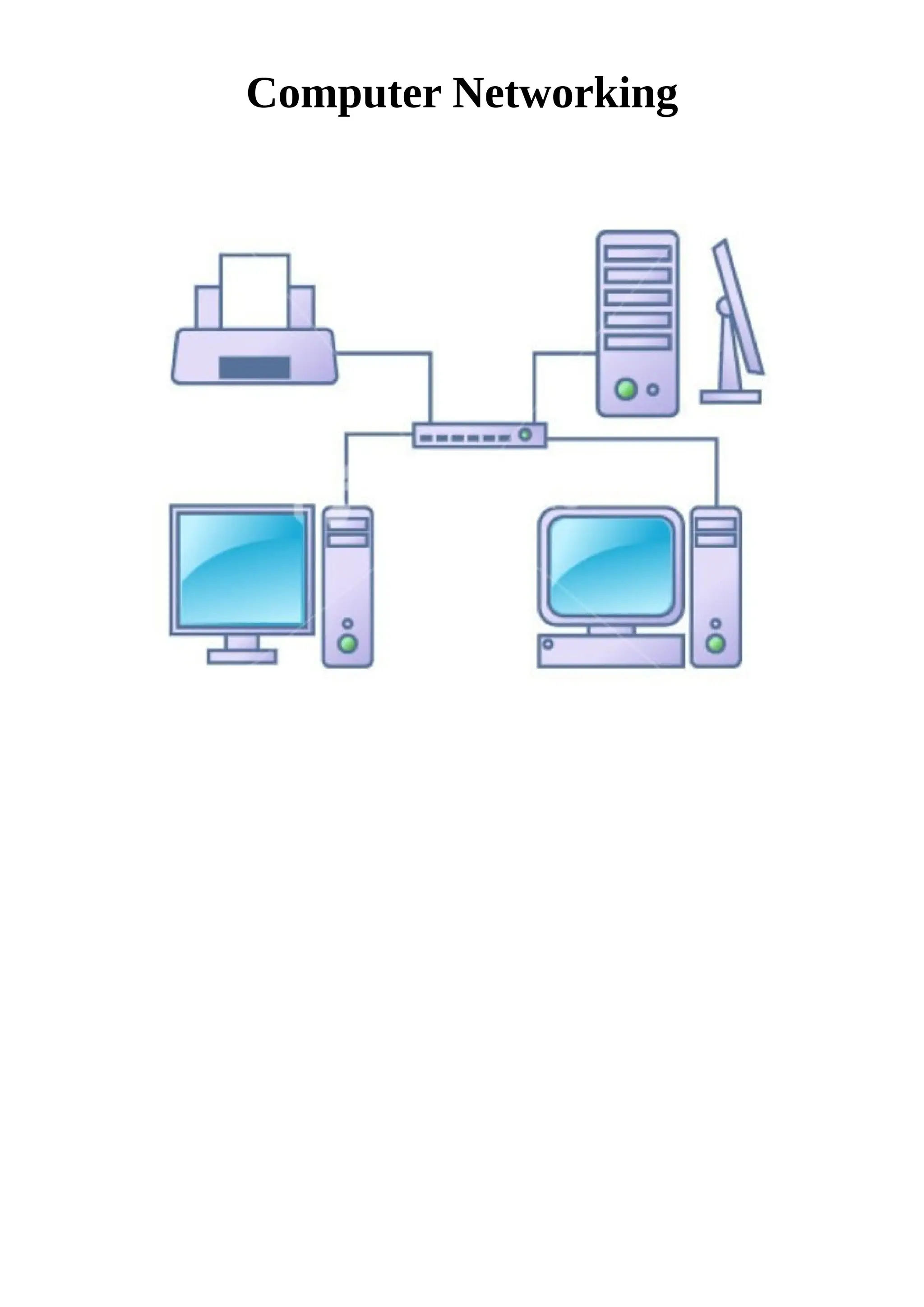
Computer Networking
Theory and Practical
Published by:
NEO Publishing House
CONTENTS
THEORY
1. Introduction to Networks, Advantages and Types 5
2. Network Interface Card (NIC) 13
3. Copper Cables
16
4. Optical Fibre Cable (OFC)
18
5. Network Equipment & Standards 19
6. Wireless LAN (Wi-Fi)
31
7. Wireless MAN (Wi-MaX)
37
8. VSAT Technology
40
9. Leased Networks 41
10.Powerline Networks
42
PRACTICAL
1. Cabling, Crimping and Connections 43
2. OSI Model and Network Layers 48
3. Networking using Windows XP 55
4. Introduction to TCP / IP Protocol
64
5. TCP / IP Classes and Addressing
67
6. Internet Connection Sharing in Windows
71
7. Wireless Networking in Windows 74
8. Internet Information Services (FTP & WWW Server) 80
9. Networking using Windows 7 82
10. FTP & WWW Server Services in Windows 7 86
11. TeamViewer
89
Introduction to Networks and Advantages
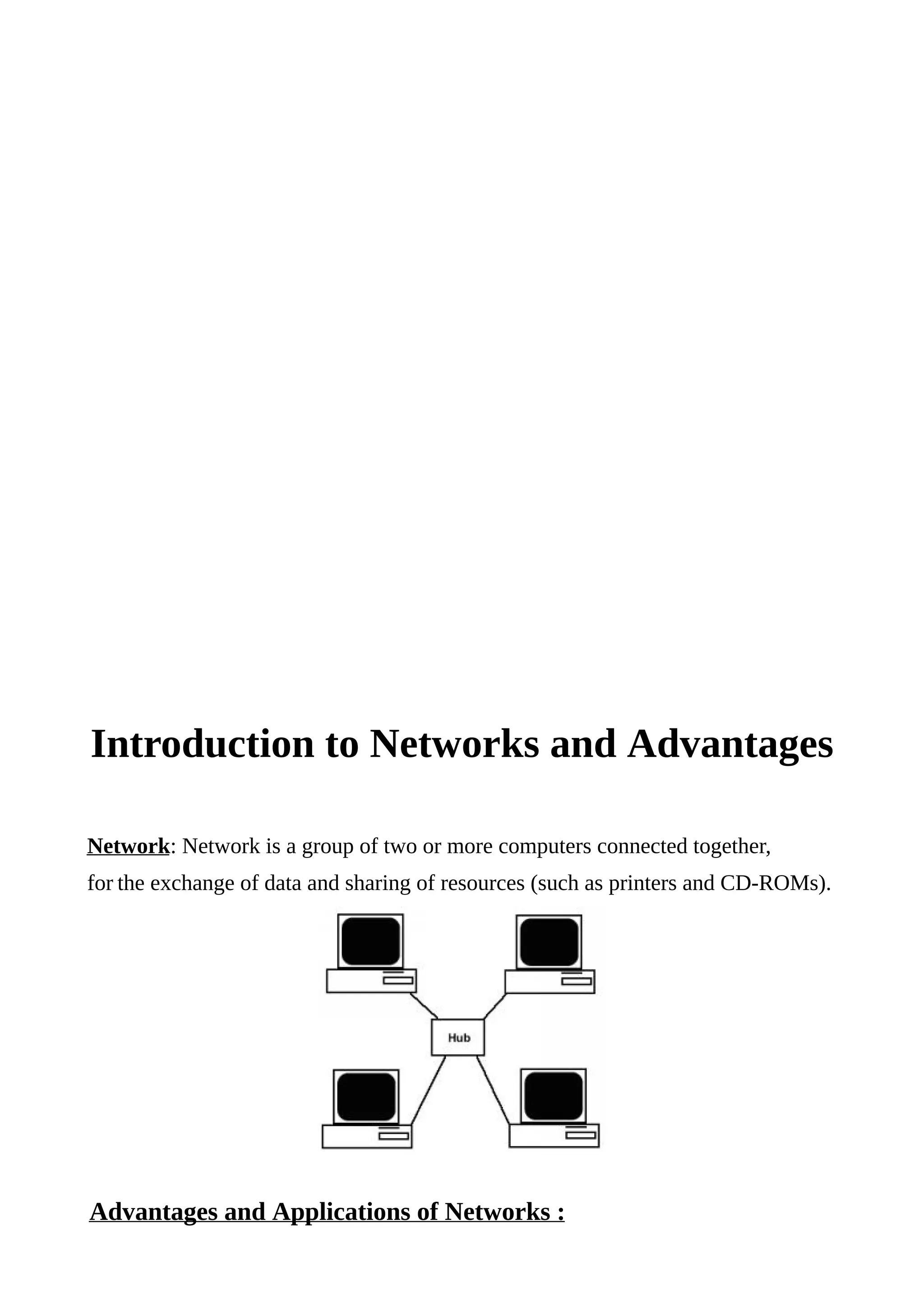
Network: Network is a group of two or more computers connected together,
for the exchange of data and sharing of resources (such as printers and CD-ROMs).
Advantages and Applications of Networks :
1. Fast Service / Time Saving
The Information can be synchronized among different computers at a high
speed. When one user makes a change to an on-line data other can see the
change immediately. (Ex : Reservation Systems, E-Seva, On-Line banking Etc)
2. Information / Data Sharing
Information or Data can be shared between different departments, organizations
and between different places (Data in Organizations, Internet Etc…)
3. High Security
We can provide security by storing the Data in Server , instead of storing in
different Computers (We can protect Data from Modification, Deletion, Theft, fire
and floods etc)
4. High Reliability / Easy to Backup
Data can replicated on two or more Hard Disks or even two or more computers,
when one Hard Disk or machine goes down, the other can be used. (We can
protect Data from power failures, Hard Disk failures, Heat Problem & Viruses)
5. Resources Sharing
Hardware resources like Printers, Scanners , CD ROMs ,Floppy Drives, Modems
Etc… can be shared to different clients on the Network.
6. Communications
Communications across the network is cheap and fast (Internet Chatting,
E-Mails, Net-to-Phone, Netmeeting Etc…)
7. Software can be shared
The Application Software installed in the Server can be shared amongst different
users, So cost will be reduced.
8. Cost reduced and Easy Maintenance if it is Time Sharing / Thin client Network.
In Time Sharing Networks Dumb Terminals are used.
In Thin client network thin clients / thin PC s (Without Hard Disk) are used.
Types of Networks (By Scale)
1. LAN – Local Area Network
Connects a number of computers located geographically close to one another. For
example, two computers directly connected to each other can be considered to be a
LAN. A corporate network that services multiple adjacent buildings can also be
considered as a LAN.
2. WLAN - Wireless Local Area Network
A type of local-area network that uses high-frequency radio waves rather than wires to
communicate between nodes.
3. CAN –Campus-Area Networks
A network that connects two or more LANs but that is limited to a specific and
contiguous geographical area such as a college campus, industrial complex, or a
military base. A CAN, may be considered a type of MAN (metropolitan area network),
but is generally limited to an area that is smaller than a typical MAN.
4. MAN- Metropolitan Area Network
Connects computers or LANs within the Town / City / Metropolitan area by using
Leased / Dedicated lines, ISDN, ADSL (Telephone lines) or Fiber Optic Cables. A
MAN typically covers an area of between 5 and 50 km range.
5. WMAN- Wireless Metropolitan Area Network
Connects computers or LANs within the Town City / Metropolitan area by using long
range wireless technology called Microwave.
6. WAN- Wide Area Network
Ties / connects together computers or LANs in locations that could be distributed
throughout the country or even overseas by using PSTN, ISDN, Fiber Optic Cables.
Most WANs comprise a number of LANs connected by long-distance, high-speed
data-links.
7. WWAN- Wireless Wide Area Network
Ties / connects together computers or LANs in locations that could be distributed
throughout the country or even overseas by using Satellite links.
8. GAN – Global Area Network
Refers to any network that is composed of different interconnected computer networks
(WANs) and also covers an unlimited geographical area
9. PAN – Personal Area Network
is a computer network used for communication among computer devices (including
telephones and personal digital assistants) close to one person. Personal area networks
may be wired with computer buses such as USB, IrDA, Bluetooth and FireWire etc
10. SAN – Storage Area Network
In computing, a storage area network (SAN) is an architecture to attach remote
computer storage devices (such as disk arrays, tape libraries and optical jukeboxes) to
servers in such a way that, to the operating system, the devices appear as locally
attached. Although cost and complexity is dropping, as of 2007, SANs are still
uncommon outside larger enterprises.
Network Hierarchies (Types by Architecture)
The connections between the various PCs in a network also can fit one of two logical
hierarchies. The alternatives form a class system among PCs. Some networks treat all
PCs the same; others elevate particular computers to a special, more important role.
Although the network server the same role in either case, these two hierarchical
systems enforce a few differences in how the network is used.
Peer-to-Peer Networks
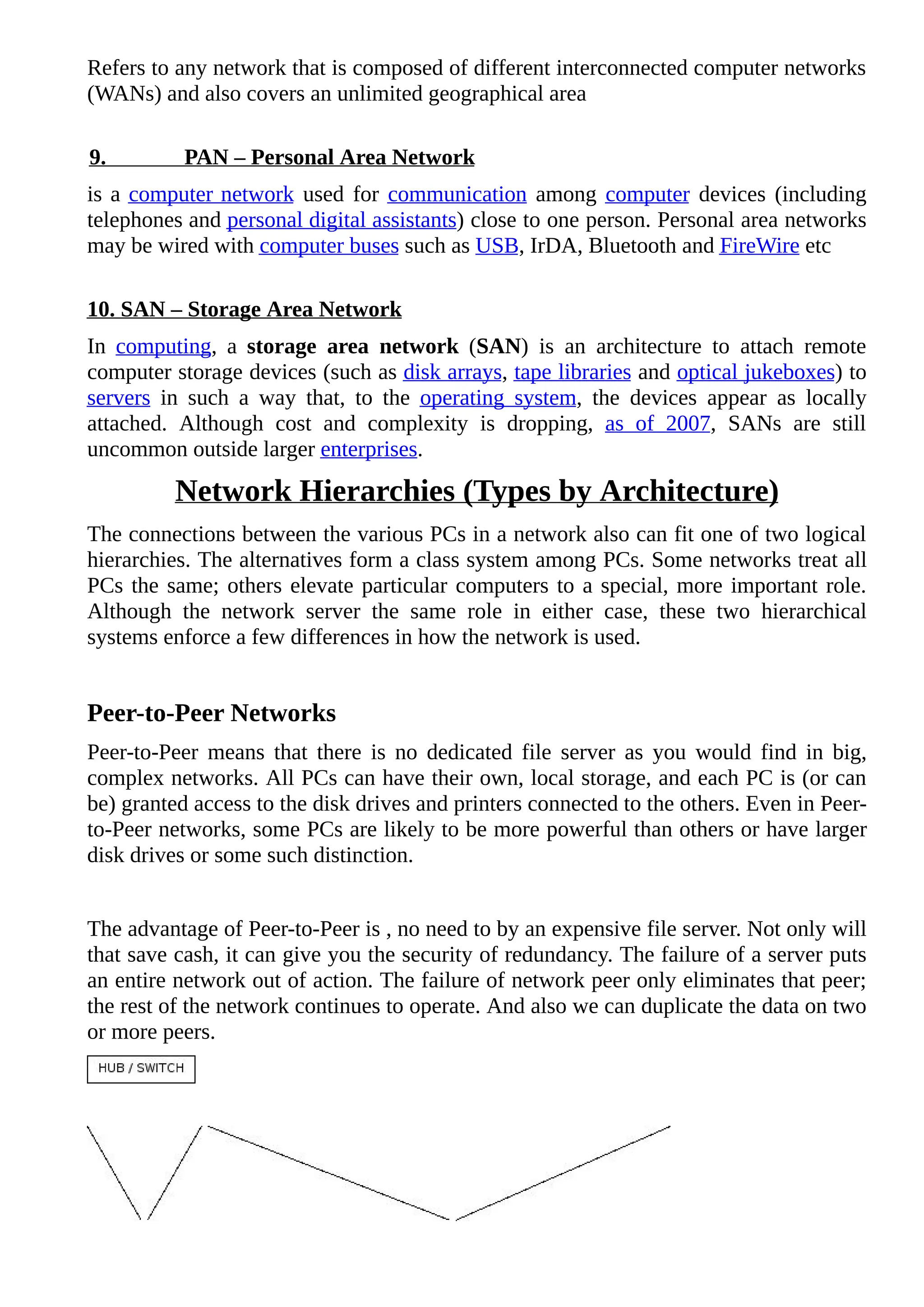
Peer-to-Peer means that there is no dedicated file server as you would find in big,
complex networks. All PCs can have their own, local storage, and each PC is (or can
be) granted access to the disk drives and printers connected to the others. Even in Peer-
to-Peer networks, some PCs are likely to be more powerful than others or have larger
disk drives or some such distinction.
The advantage of Peer-to-Peer is , no need to by an expensive file server. Not only will
that save cash, it can give you the security of redundancy. The failure of a server puts
an entire network out of action. The failure of network peer only eliminates that peer;
the rest of the network continues to operate. And also we can duplicate the data on two
or more peers.
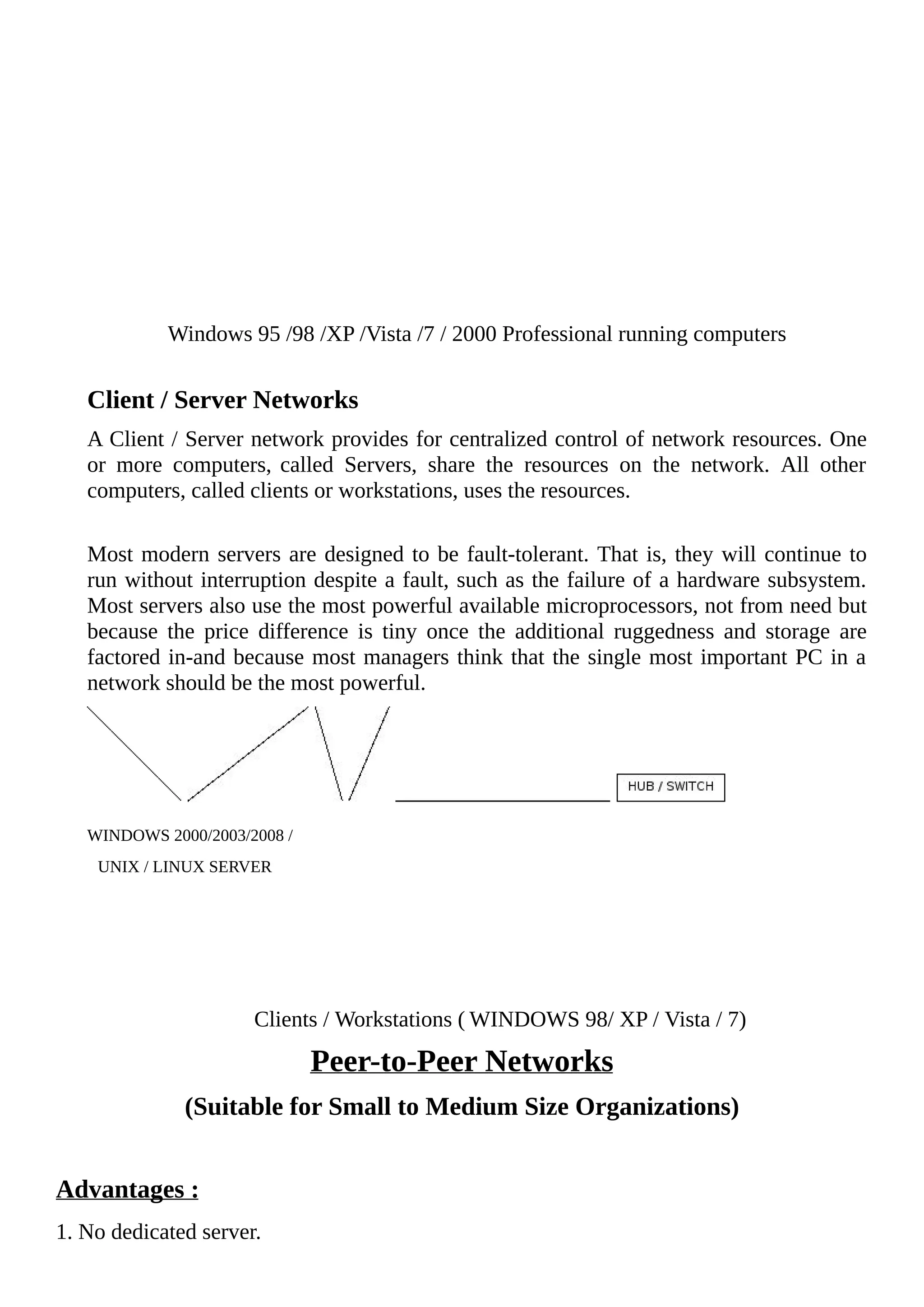
Windows 95 /98 /XP /Vista /7 / 2000 Professional running computers
Client / Server Networks
A Client / Server network provides for centralized control of network resources. One
or more computers, called Servers, share the resources on the network. All other
computers, called clients or workstations, uses the resources.
Most modern servers are designed to be fault-tolerant. That is, they will continue to
run without interruption despite a fault, such as the failure of a hardware subsystem.
Most servers also use the most powerful available microprocessors, not from need but
because the price difference is tiny once the additional ruggedness and storage are
factored in-and because most managers think that the single most important PC in a
network should be the most powerful.
WINDOWS 2000/2003/2008 /
UNIX / LINUX SERVER
Clients / Workstations ( WINDOWS 98/ XP / Vista / 7)
Peer-to-Peer Networks
(Suitable for Small to Medium Size Organizations)
Advantages :
1. No dedicated server.
2. Less expensive.
3. Easy to install and maintain.
4. Good file, printer, and CD-ROM sharing.
Disadvantages:
1. Slow operation.
2. Not good for database applications.
3. Less reliable (server is workstation).
4. Low Security
5. Limited expandability.
Client / Server Networks
(Suitable for Medium to Large Size Organizations)
Advantages :
1. Fast operation.
2. Expandable.
3. Will work with any application.
4. Handles shared database applications.
5. More reliable (dedicated server).
6. Highest level of security.
7. Applications can be shared.
Disadvantages:
1. Needs dedicated server.
2. More expensive to buy.
3. More expensive to maintain
Internet
Random documents with unrelated
content Scribd suggests to you:
RESPECT BEES SHOW THEIR QUEEN
When a fertile queen moves about the combs her subjects always
open a way for her to pass, and the bees seem to vie with each other
in the respect they show their ruler.
The virgin queen never has much respect shown her. The workers
do not even trouble themselves to get out of her way when she moves
about the cluster. She must run over the bees and get about the best
she can.
When a hive is opened and combs removed, a virgin queen is
pretty sure to take wing, especially if the operation of removing the
frames is not performed quietly, or late in the day. However, there is
no danger of the queen being lost as she will fly but a short distance
from the hive and immediately return.
DESTROYING QUEEN-CELLS WHEN
INTRODUCING QUEENS
As stated on a previous page, some queen-cells will be built on the
combs that have brood in them. It will not be necessary to look the
combs over and destroy those cells if a young queen is introduced. In
the course of twenty-four hours after the queen gets possession of
the combs, she will destroy the cells, that is, the queen will open
them near the base and sting the nymph, or nearly matured queen as
the case may be, and the bees will soon finish the work of destroying
the cell, and removing the dead queen. There are, however,
exceptions to this rule, and once in a while a young queen is
permitted to “hatch out” and take possession of the colony. In that
case, the queen just introduced is destroyed. This so seldom
happens, and does not happen at all except in cases where an old
queen is introduced, that it is not worth while to spend time in
looking the combs over for queen-cells.
THE OBSERVATORY HIVE FOR STUDYING
THE HABITS OF BEES
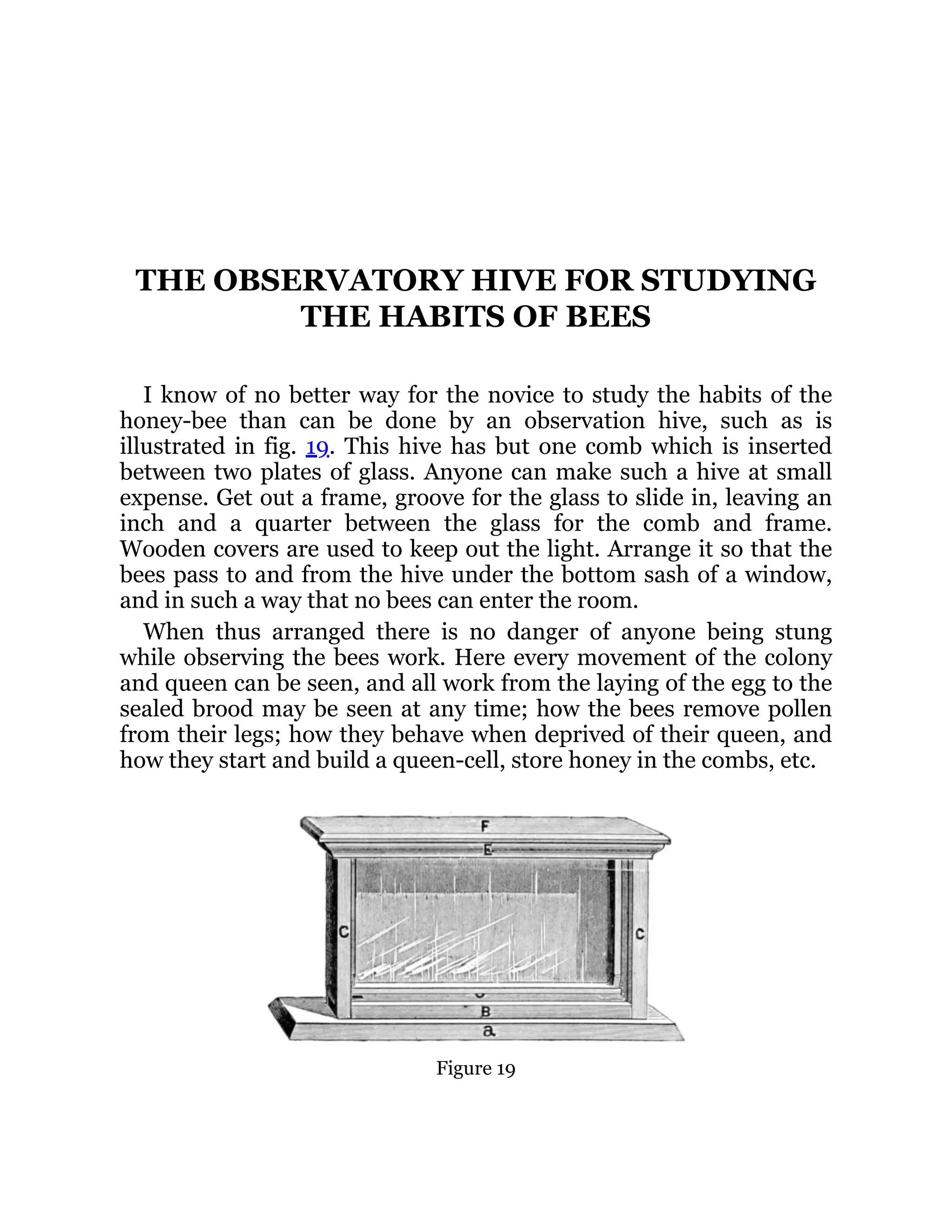
I know of no better way for the novice to study the habits of the
honey-bee than can be done by an observation hive, such as is
illustrated in fig. 19. This hive has but one comb which is inserted
between two plates of glass. Anyone can make such a hive at small
expense. Get out a frame, groove for the glass to slide in, leaving an
inch and a quarter between the glass for the comb and frame.
Wooden covers are used to keep out the light. Arrange it so that the
bees pass to and from the hive under the bottom sash of a window,
and in such a way that no bees can enter the room.
When thus arranged there is no danger of anyone being stung
while observing the bees work. Here every movement of the colony
and queen can be seen, and all work from the laying of the egg to the
sealed brood may be seen at any time; how the bees remove pollen
from their legs; how they behave when deprived of their queen, and
how they start and build a queen-cell, store honey in the combs, etc.
Figure 19
If the observation hive contains a small colony of bees and an
unfertile queen, it will be seen that the bees do not take the least
notice of her. Apparently she is of no more consequence before
becoming fertile than other bees in the hive; yet should she be
removed from the colony, the bees would soon miss her, and make as
much fuss over her loss as they would had she been a fertile queen.
The fact that bees pay no attention to a queen, is the best evidence
that she is not fertile.
COMPARATIVE SIZE OF QUEENS
Figure 20
Figure 21
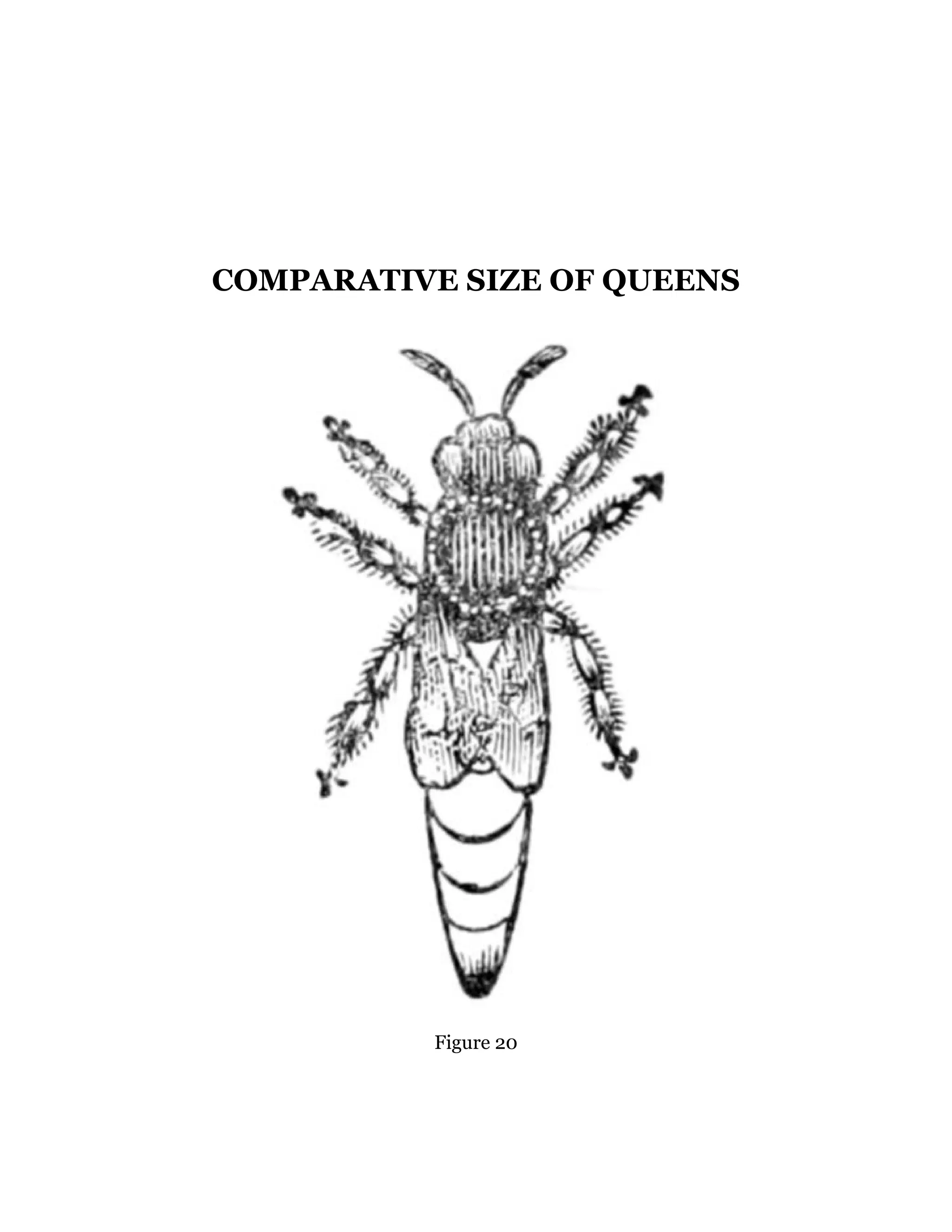
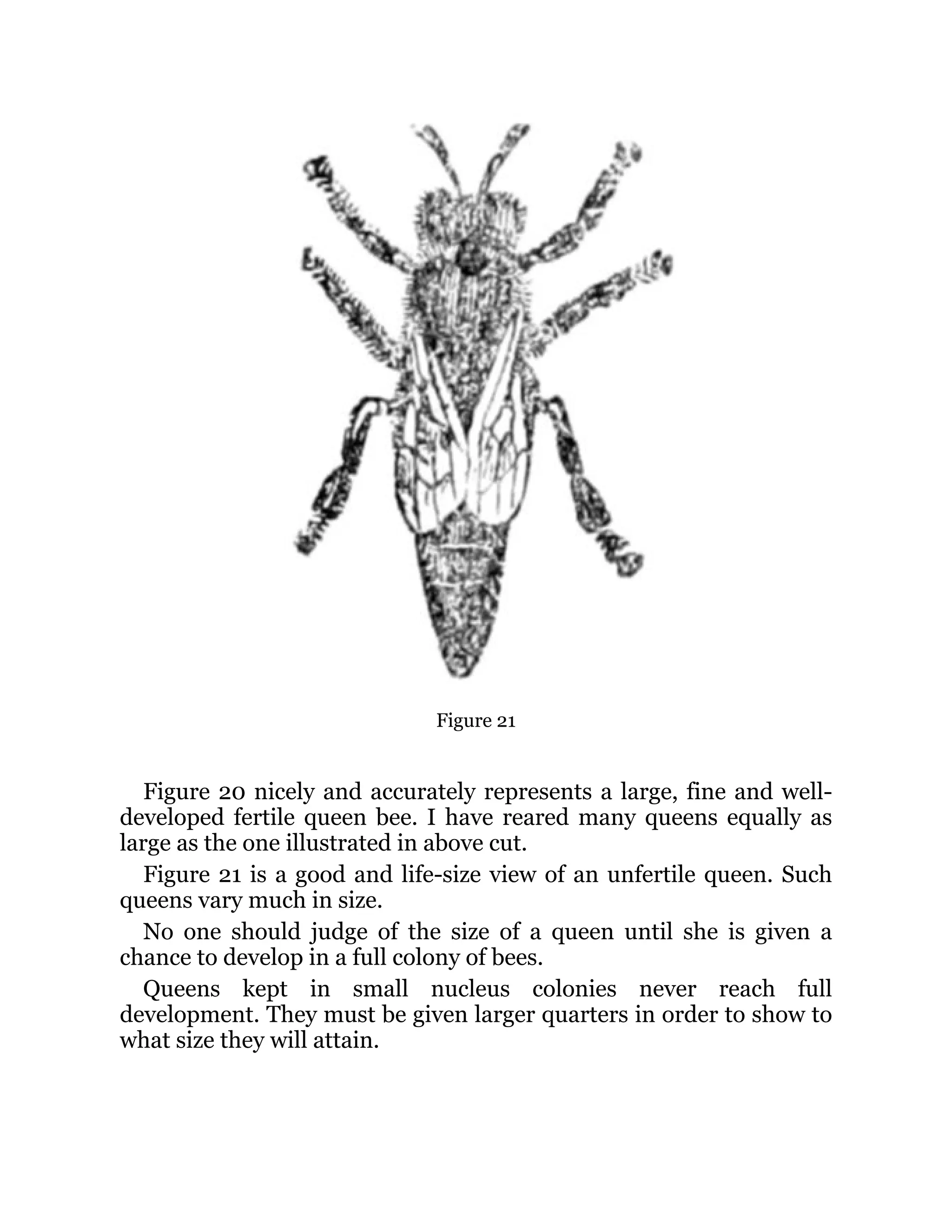
Figure 20 nicely and accurately represents a large, fine and well-
developed fertile queen bee. I have reared many queens equally as
large as the one illustrated in above cut.
Figure 21 is a good and life-size view of an unfertile queen. Such
queens vary much in size.
No one should judge of the size of a queen until she is given a
chance to develop in a full colony of bees.
Queens kept in small nucleus colonies never reach full
development. They must be given larger quarters in order to show to
what size they will attain.
PREVENTING HONEY FROM CANDYING
Some years ago I accidentally discovered a process by which honey
that has once candied can be preserved in the liquid state for a long
time.
It is my opinion that it is much the best plan to let all honey candy
and then liquify it. Possibly there are some kinds of honey that if
treated by the process below given, would not remain in the liquid
state only a short time. But for most kinds the treatment will be a
success, and preserve it many months.
Several years ago I received some honey in sixty-pound cans that
was nearly as hard as sugar. It was melted and put in half-pound
bottles. To keep it from candying again before I could dispose of it,
the bottles were placed on a shelf over the kitchen stove, where the
temperature would rise to 110 degrees during the day and would not
go below 60 degrees at night. This same lot of honey stood zero
weather for two winters without going back.
The above is the entire process. It is heat for a long time that does
the business. Honey in large cans would need to be kept in a high
temperature at least a month, but the process will surely prevent it
from candying after it is once liquified.
Arrange the details of heating to suit your conditions. Large
quantities of honey can be kept in a room well up from the floor, and
a good hot fire running for a long time.
Steam heat, if convenient to use, is the proper thing. Small
quantities of honey can be treated about as mentioned in my own
case.
TO THE READER
If the methods herein given for rearing queens is not made clear I
shall be glad at any time to give personal explanation. Later on I may
issue a “supplement” in which many of the parts of my system of
queen-rearing will be illustrated and more minutely explained. Send
in the questions and they shall receive attention.
THE QUEEN-REARING OUTFIT
There are certain necessary things used in queen-rearing which I
can supply at the prices given opposite each article named.
The queen nursery, 35 cages, $1.50.
The tin pipe for burning tobacco when introducing queens, 50 cents.
Small hive, four frames, nailed ready for use, including cone-feeder, 50 cents.
Small hive complete, including pint of bees, one best Adel breeding queen,
$5.00.
Same with select tested Adel queen, $4.00.
All the above, and one of the latest improved queen-traps, sent for
$9.00. These goods must go by express, as they are too large to go by
mail.
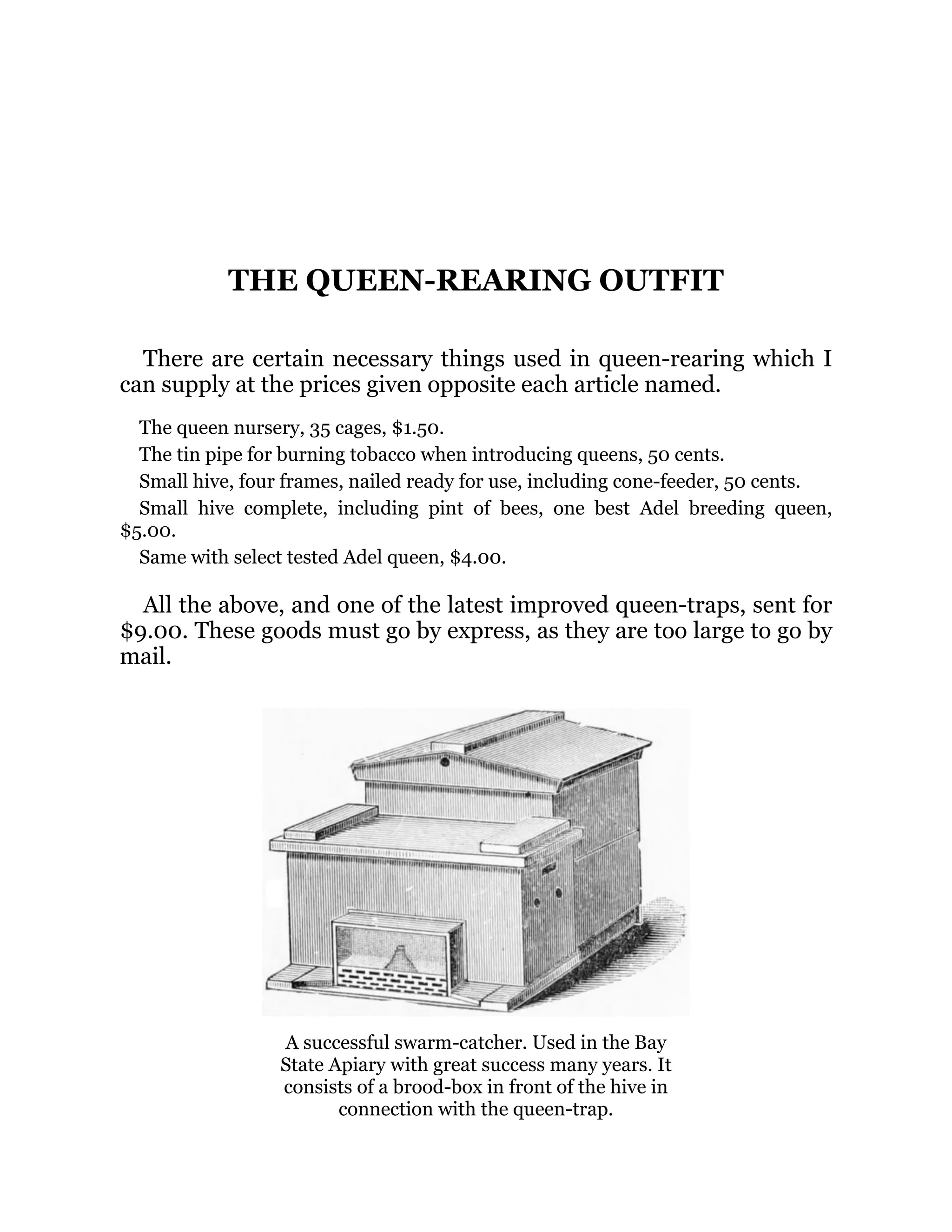
A successful swarm-catcher. Used in the Bay
State Apiary with great success many years. It
consists of a brood-box in front of the hive in
connection with the queen-trap.
Bee=hives Frames
Section
Honey=boxes
Shipping=cases
Honey and Wax
Extractors
Bee=smokers
Bee=comb
Foundation
Comb=Foundation
Machines
Comb=Foundation
Fasteners
Perforated
Queen=Excluder
s
In fact, a full line of everything required by
bee-keepers. The superior excellence of these
goods is such that they have a world-wide
reputation, and dealers handling them
generally say:
Root’s Goods
AT
Root’s Prices
For convenience of bee-keepers in obtaining
supplies without sending direct to factory and
paying high freight charges, as well as suffering
long delays in transit, a number of dealers have
established distributing-points at many large
centers, where goods are shipped from factory
in carload lots.
In a notice of this kind it is impossible to give
a list of dealers that will be accurate year after
year. If you do not find their card in Gleanings
in Bee Culture or other journals, send to us
The A. I. Root Co.
Medina, Ohio,
Makes a Specialty of Manufacturing
Bee=keepers’ Supplies
of All Kinds
and we will give you name of dealer located
nearest you. In addition to twenty-five such
distributing-houses in United States, there are
wholesale dealers in Kingston, Jamaica;
Havana, Cardenas, and Cienfuegos, Cuba; at
various points in Gt. Britain; also in Australia
and New Zealand.
An illustrated catalog mailed free.
The American
Bee Journal
THE OLDEST BEE
PAPER IN
AMERICA
In order to become
a progressive apiarist, and at the same time realize the most money
from your bees, you cannot afford to be without a good bee-paper.
THE AMERICAN BEE JOURNAL, established in 1861, is a 16-page
weekly, well illustrated, and fully up-to-date in everything pertaining
to bee-culture.
Its Departments
Contributed Articles
Discussions of Important Topics and Bee-Keeping Experiences—
by experts.
Convention Proceedings—Just what this implies.
Questions and Answers
In charge of Dr. C. C. Miller, a bee-keeper of over 40 years’
experience, who answers all questions. Invaluable to beginners in
bee-keeping.
Editorial Comments—Just what this indicates.
The Weekly Budget
Being mainly personal items and miscellaneous matters of interest
to bee-keepers.
Beedom Boiled Down—Cream of bee-literature.
The Afterthought
This is in charge of Mr. E. E. Hasty, who reviews what has
appeared in recent numbers of the AMERICAN BEE JOURNAL,
pointing out any errors and commending the good things.
Our Bee=Keeping Sisters
Miss Emma M. Wilson (sister-in-law and assistant in the apiary of
Dr. C. C. Miller) has charge of this department. It is especially
intended for women bee-keepers, though its contents are just as
helpful to the men-folks.
From Many Fields
Short experiences and reports of the honey crop, conditions of
bees, etc.
Price of the BEE JOURNAL, one year, $1.00; or for $1.75 we will
send the BEE JOURNAL a year and a copy of Dr. Miller’s “Forty
Years Among the Bees,” book alone, $1.
Send for free Sample Copy, and Catalogue of Bee Supplies.
GEORGE W. YORK & CO.,
144 & 146 E. Erie St., Chicago, Ill.
We are the Largest Manufacturers of Bee-Keepers’ Supplies in the
Northwest
☞ SEND FOR CATALOG
Minneapolis, Minnesota.
We have the Best Goods, the Lowest Prices, and the Best Shipping
Facilities
OUR DANDY or SHALLOW DOVE HIVE
With Super for Sections, 4 × 5 or 3⅝ × 5, is the Best for raising
COMB HONEY
We manufacture the Best
SWARM CATCHER
Up to the present time that is put on the market.
Our Improved Daisy Foundation Fastener
Is in the lead of all others. If you want your Bees to winter well get
our
WINTER CASES
They will winter Bees for a Century. You must remember that we
manufacture
THE BEST BEE-KEEPERS’ SUPPLIES
and we guarantee everything to be just as represented.
We also manufacture the finest Sections; they are the best on the
market. Our sections are made by an automatic section machine,
which will make 120,000 finished sections in ten hours.
TRANSCRIBER’S NOTES
1. Fig. 16, rotated the image 180°.
2. Silently corrected typographical errors and
variations in spelling.
3. Retained anachronistic, non-standard, and
uncertain spellings as printed.
*** END OF THE PROJECT GUTENBERG EBOOK IMPROVED QUEEN-
REARING; OR, HOW TO REAR LARGE, PROLIFIC, LONG-LIVED
QUEEN BEES ***
Updated editions will replace the previous one—the old editions
will be renamed.
Creating the works from print editions not protected by U.S.
copyright law means that no one owns a United States
copyright in these works, so the Foundation (and you!) can copy
and distribute it in the United States without permission and
without paying copyright royalties. Special rules, set forth in the
General Terms of Use part of this license, apply to copying and
distributing Project Gutenberg™ electronic works to protect the
PROJECT GUTENBERG™ concept and trademark. Project
Gutenberg is a registered trademark, and may not be used if
you charge for an eBook, except by following the terms of the
trademark license, including paying royalties for use of the
Project Gutenberg trademark. If you do not charge anything for
copies of this eBook, complying with the trademark license is
very easy. You may use this eBook for nearly any purpose such
as creation of derivative works, reports, performances and
research. Project Gutenberg eBooks may be modified and
printed and given away—you may do practically ANYTHING in
the United States with eBooks not protected by U.S. copyright
law. Redistribution is subject to the trademark license, especially
commercial redistribution.
START: FULL LICENSE
THE FULL PROJECT GUTENBERG LICENSE
PLEASE READ THIS BEFORE YOU DISTRIBUTE OR USE THIS WORK
To protect the Project Gutenberg™ mission of promoting the
free distribution of electronic works, by using or distributing this
work (or any other work associated in any way with the phrase
“Project Gutenberg”), you agree to comply with all the terms of
the Full Project Gutenberg™ License available with this file or
online at www.gutenberg.org/license.
Section 1. General Terms of Use and
Redistributing Project Gutenberg™
electronic works
1.A. By reading or using any part of this Project Gutenberg™
electronic work, you indicate that you have read, understand,
agree to and accept all the terms of this license and intellectual
property (trademark/copyright) agreement. If you do not agree
to abide by all the terms of this agreement, you must cease
using and return or destroy all copies of Project Gutenberg™
electronic works in your possession. If you paid a fee for
obtaining a copy of or access to a Project Gutenberg™
electronic work and you do not agree to be bound by the terms
of this agreement, you may obtain a refund from the person or
entity to whom you paid the fee as set forth in paragraph 1.E.8.
1.B. “Project Gutenberg” is a registered trademark. It may only
be used on or associated in any way with an electronic work by
people who agree to be bound by the terms of this agreement.
There are a few things that you can do with most Project
Gutenberg™ electronic works even without complying with the
full terms of this agreement. See paragraph 1.C below. There
are a lot of things you can do with Project Gutenberg™
electronic works if you follow the terms of this agreement and
help preserve free future access to Project Gutenberg™
electronic works. See paragraph 1.E below.
1.C. The Project Gutenberg Literary Archive Foundation (“the
Foundation” or PGLAF), owns a compilation copyright in the
collection of Project Gutenberg™ electronic works. Nearly all the
individual works in the collection are in the public domain in the
United States. If an individual work is unprotected by copyright
law in the United States and you are located in the United
States, we do not claim a right to prevent you from copying,
distributing, performing, displaying or creating derivative works
based on the work as long as all references to Project
Gutenberg are removed. Of course, we hope that you will
support the Project Gutenberg™ mission of promoting free
access to electronic works by freely sharing Project Gutenberg™
works in compliance with the terms of this agreement for
keeping the Project Gutenberg™ name associated with the
work. You can easily comply with the terms of this agreement
by keeping this work in the same format with its attached full
Project Gutenberg™ License when you share it without charge
with others.
1.D. The copyright laws of the place where you are located also
govern what you can do with this work. Copyright laws in most
countries are in a constant state of change. If you are outside
the United States, check the laws of your country in addition to
the terms of this agreement before downloading, copying,
displaying, performing, distributing or creating derivative works
based on this work or any other Project Gutenberg™ work. The
Foundation makes no representations concerning the copyright
status of any work in any country other than the United States.
1.E. Unless you have removed all references to Project
Gutenberg:
1.E.1. The following sentence, with active links to, or other
immediate access to, the full Project Gutenberg™ License must
appear prominently whenever any copy of a Project
Gutenberg™ work (any work on which the phrase “Project
Gutenberg” appears, or with which the phrase “Project
Gutenberg” is associated) is accessed, displayed, performed,
viewed, copied or distributed:
This eBook is for the use of anyone anywhere in the United
States and most other parts of the world at no cost and
with almost no restrictions whatsoever. You may copy it,
give it away or re-use it under the terms of the Project
Gutenberg License included with this eBook or online at
www.gutenberg.org. If you are not located in the United
States, you will have to check the laws of the country
where you are located before using this eBook.
1.E.2. If an individual Project Gutenberg™ electronic work is
derived from texts not protected by U.S. copyright law (does not
contain a notice indicating that it is posted with permission of
the copyright holder), the work can be copied and distributed to
anyone in the United States without paying any fees or charges.
If you are redistributing or providing access to a work with the
phrase “Project Gutenberg” associated with or appearing on the
work, you must comply either with the requirements of
paragraphs 1.E.1 through 1.E.7 or obtain permission for the use
of the work and the Project Gutenberg™ trademark as set forth
in paragraphs 1.E.8 or 1.E.9.
1.E.3. If an individual Project Gutenberg™ electronic work is
posted with the permission of the copyright holder, your use and
distribution must comply with both paragraphs 1.E.1 through
1.E.7 and any additional terms imposed by the copyright holder.
Additional terms will be linked to the Project Gutenberg™
License for all works posted with the permission of the copyright
holder found at the beginning of this work.
1.E.4. Do not unlink or detach or remove the full Project
Gutenberg™ License terms from this work, or any files
containing a part of this work or any other work associated with
Project Gutenberg™.
1.E.5. Do not copy, display, perform, distribute or redistribute
this electronic work, or any part of this electronic work, without
prominently displaying the sentence set forth in paragraph 1.E.1
with active links or immediate access to the full terms of the
Project Gutenberg™ License.
1.E.6. You may convert to and distribute this work in any binary,
compressed, marked up, nonproprietary or proprietary form,
including any word processing or hypertext form. However, if
you provide access to or distribute copies of a Project
Gutenberg™ work in a format other than “Plain Vanilla ASCII” or
other format used in the official version posted on the official
Project Gutenberg™ website (www.gutenberg.org), you must,
at no additional cost, fee or expense to the user, provide a copy,
a means of exporting a copy, or a means of obtaining a copy
upon request, of the work in its original “Plain Vanilla ASCII” or
other form. Any alternate format must include the full Project
Gutenberg™ License as specified in paragraph 1.E.1.
1.E.7. Do not charge a fee for access to, viewing, displaying,
performing, copying or distributing any Project Gutenberg™
works unless you comply with paragraph 1.E.8 or 1.E.9.
1.E.8. You may charge a reasonable fee for copies of or
providing access to or distributing Project Gutenberg™
electronic works provided that:
• You pay a royalty fee of 20% of the gross profits you derive
from the use of Project Gutenberg™ works calculated using the
method you already use to calculate your applicable taxes. The
fee is owed to the owner of the Project Gutenberg™ trademark,
but he has agreed to donate royalties under this paragraph to
the Project Gutenberg Literary Archive Foundation. Royalty
payments must be paid within 60 days following each date on
which you prepare (or are legally required to prepare) your
periodic tax returns. Royalty payments should be clearly marked
as such and sent to the Project Gutenberg Literary Archive
Foundation at the address specified in Section 4, “Information
about donations to the Project Gutenberg Literary Archive
Foundation.”
• You provide a full refund of any money paid by a user who
notifies you in writing (or by e-mail) within 30 days of receipt
that s/he does not agree to the terms of the full Project
Gutenberg™ License. You must require such a user to return or
destroy all copies of the works possessed in a physical medium
and discontinue all use of and all access to other copies of
Project Gutenberg™ works.
• You provide, in accordance with paragraph 1.F.3, a full refund of
any money paid for a work or a replacement copy, if a defect in
the electronic work is discovered and reported to you within 90
days of receipt of the work.
• You comply with all other terms of this agreement for free
distribution of Project Gutenberg™ works.
1.E.9. If you wish to charge a fee or distribute a Project
Gutenberg™ electronic work or group of works on different
terms than are set forth in this agreement, you must obtain
permission in writing from the Project Gutenberg Literary
Archive Foundation, the manager of the Project Gutenberg™
trademark. Contact the Foundation as set forth in Section 3
below.
1.F.
1.F.1. Project Gutenberg volunteers and employees expend
considerable effort to identify, do copyright research on,
transcribe and proofread works not protected by U.S. copyright
law in creating the Project Gutenberg™ collection. Despite these
efforts, Project Gutenberg™ electronic works, and the medium
on which they may be stored, may contain “Defects,” such as,
but not limited to, incomplete, inaccurate or corrupt data,
transcription errors, a copyright or other intellectual property
infringement, a defective or damaged disk or other medium, a
computer virus, or computer codes that damage or cannot be
read by your equipment.
1.F.2. LIMITED WARRANTY, DISCLAIMER OF DAMAGES - Except
for the “Right of Replacement or Refund” described in
paragraph 1.F.3, the Project Gutenberg Literary Archive
Foundation, the owner of the Project Gutenberg™ trademark,
and any other party distributing a Project Gutenberg™ electronic
work under this agreement, disclaim all liability to you for
damages, costs and expenses, including legal fees. YOU AGREE
THAT YOU HAVE NO REMEDIES FOR NEGLIGENCE, STRICT
LIABILITY, BREACH OF WARRANTY OR BREACH OF CONTRACT
EXCEPT THOSE PROVIDED IN PARAGRAPH 1.F.3. YOU AGREE
THAT THE FOUNDATION, THE TRADEMARK OWNER, AND ANY
DISTRIBUTOR UNDER THIS AGREEMENT WILL NOT BE LIABLE
TO YOU FOR ACTUAL, DIRECT, INDIRECT, CONSEQUENTIAL,
PUNITIVE OR INCIDENTAL DAMAGES EVEN IF YOU GIVE
NOTICE OF THE POSSIBILITY OF SUCH DAMAGE.
1.F.3. LIMITED RIGHT OF REPLACEMENT OR REFUND - If you
discover a defect in this electronic work within 90 days of
receiving it, you can receive a refund of the money (if any) you
paid for it by sending a written explanation to the person you
received the work from. If you received the work on a physical
medium, you must return the medium with your written
explanation. The person or entity that provided you with the
defective work may elect to provide a replacement copy in lieu
of a refund. If you received the work electronically, the person
or entity providing it to you may choose to give you a second
opportunity to receive the work electronically in lieu of a refund.
If the second copy is also defective, you may demand a refund
in writing without further opportunities to fix the problem.
1.F.4. Except for the limited right of replacement or refund set
forth in paragraph 1.F.3, this work is provided to you ‘AS-IS’,
WITH NO OTHER WARRANTIES OF ANY KIND, EXPRESS OR
IMPLIED, INCLUDING BUT NOT LIMITED TO WARRANTIES OF
MERCHANTABILITY OR FITNESS FOR ANY PURPOSE.
1.F.5. Some states do not allow disclaimers of certain implied
warranties or the exclusion or limitation of certain types of
damages. If any disclaimer or limitation set forth in this
agreement violates the law of the state applicable to this
agreement, the agreement shall be interpreted to make the
maximum disclaimer or limitation permitted by the applicable
state law. The invalidity or unenforceability of any provision of
this agreement shall not void the remaining provisions.
1.F.6. INDEMNITY - You agree to indemnify and hold the
Foundation, the trademark owner, any agent or employee of the
Foundation, anyone providing copies of Project Gutenberg™
electronic works in accordance with this agreement, and any
volunteers associated with the production, promotion and
distribution of Project Gutenberg™ electronic works, harmless
from all liability, costs and expenses, including legal fees, that
arise directly or indirectly from any of the following which you
do or cause to occur: (a) distribution of this or any Project
Gutenberg™ work, (b) alteration, modification, or additions or
deletions to any Project Gutenberg™ work, and (c) any Defect
you cause.
Section 2. Information about the Mission
of Project Gutenberg™
Project Gutenberg™ is synonymous with the free distribution of
electronic works in formats readable by the widest variety of
computers including obsolete, old, middle-aged and new
computers. It exists because of the efforts of hundreds of
volunteers and donations from people in all walks of life.
Volunteers and financial support to provide volunteers with the
assistance they need are critical to reaching Project
Gutenberg™’s goals and ensuring that the Project Gutenberg™
collection will remain freely available for generations to come. In
2001, the Project Gutenberg Literary Archive Foundation was
created to provide a secure and permanent future for Project
Gutenberg™ and future generations. To learn more about the
Project Gutenberg Literary Archive Foundation and how your
efforts and donations can help, see Sections 3 and 4 and the
Foundation information page at www.gutenberg.org.
Section 3. Information about the Project
Gutenberg Literary Archive Foundation
The Project Gutenberg Literary Archive Foundation is a non-
profit 501(c)(3) educational corporation organized under the
laws of the state of Mississippi and granted tax exempt status
by the Internal Revenue Service. The Foundation’s EIN or
federal tax identification number is 64-6221541. Contributions
to the Project Gutenberg Literary Archive Foundation are tax
deductible to the full extent permitted by U.S. federal laws and
your state’s laws.
The Foundation’s business office is located at 809 North 1500
West, Salt Lake City, UT 84116, (801) 596-1887. Email contact
links and up to date contact information can be found at the
Foundation’s website and official page at
www.gutenberg.org/contact
Section 4. Information about Donations to
the Project Gutenberg Literary Archive
Foundation
Project Gutenberg™ depends upon and cannot survive without
widespread public support and donations to carry out its mission
of increasing the number of public domain and licensed works
that can be freely distributed in machine-readable form
accessible by the widest array of equipment including outdated
equipment. Many small donations ($1 to $5,000) are particularly
important to maintaining tax exempt status with the IRS.
The Foundation is committed to complying with the laws
regulating charities and charitable donations in all 50 states of
the United States. Compliance requirements are not uniform
and it takes a considerable effort, much paperwork and many
fees to meet and keep up with these requirements. We do not
solicit donations in locations where we have not received written
confirmation of compliance. To SEND DONATIONS or determine
the status of compliance for any particular state visit
www.gutenberg.org/donate.
While we cannot and do not solicit contributions from states
where we have not met the solicitation requirements, we know
of no prohibition against accepting unsolicited donations from
donors in such states who approach us with offers to donate.
International donations are gratefully accepted, but we cannot
make any statements concerning tax treatment of donations
received from outside the United States. U.S. laws alone swamp
our small staff.
Please check the Project Gutenberg web pages for current
donation methods and addresses. Donations are accepted in a
number of other ways including checks, online payments and
credit card donations. To donate, please visit:
www.gutenberg.org/donate.
Section 5. General Information About
Project Gutenberg™ electronic works
Professor Michael S. Hart was the originator of the Project
Gutenberg™ concept of a library of electronic works that could
be freely shared with anyone. For forty years, he produced and
distributed Project Gutenberg™ eBooks with only a loose
network of volunteer support.
Project Gutenberg™ eBooks are often created from several
printed editions, all of which are confirmed as not protected by
copyright in the U.S. unless a copyright notice is included. Thus,
we do not necessarily keep eBooks in compliance with any
particular paper edition.
Most people start at our website which has the main PG search
facility: www.gutenberg.org.
This website includes information about Project Gutenberg™,
including how to make donations to the Project Gutenberg
Literary Archive Foundation, how to help produce our new
eBooks, and how to subscribe to our email newsletter to hear
about new eBooks.
Welcome to our website – the perfect destination for book lovers and
knowledge seekers. We believe that every book holds a new world,
offering opportunities for learning, discovery, and personal growth.
That’s why we are dedicated to bringing you a diverse collection of
books, ranging from classic literature and specialized publications to
self-development guides and children's books.
More than just a book-buying platform, we strive to be a bridge
connecting you with timeless cultural and intellectual values. With an
elegant, user-friendly interface and a smart search system, you can
quickly find the books that best suit your interests. Additionally,
our special promotions and home delivery services help you save time
and fully enjoy the joy of reading.
Join us on a journey of knowledge exploration, passion nurturing, and
personal growth every day!
ebookbell.com
Computer Networking Basics Equipment Cabling Setup Sharing Tcpip Iis Neo Institute

  • 1.
    Computer Networking BasicsEquipment Cabling Setup Sharing Tcpip Iis Neo Institute download https://ebookbell.com/product/computer-networking-basics- equipment-cabling-setup-sharing-tcpip-iis-neo-institute-50363114 Explore and download more ebooks at ebookbell.com
  • 2.
    Here are somerecommended products that we believe you will be interested in. You can click the link to download. Basics Of Computer Networking 1st Thomas Robertazzi https://ebookbell.com/product/basics-of-computer-networking-1st- thomas-robertazzi-4195718 Computer Networking For Beginners The Complete Guide To Network Systems Wireless Technology Ip Subnetting Including The Basics Of Cybersecurity The Of Things For Artificial Intelligence Callaway https://ebookbell.com/product/computer-networking-for-beginners-the- complete-guide-to-network-systems-wireless-technology-ip-subnetting- including-the-basics-of-cybersecurity-the-of-things-for-artificial- intelligence-callaway-23703156 Computer Networking For Beginners The Complete Guide To Network Systems Wireless Technology Ip Subnetting Including The Basics Of Cybersecurity The Of Things For Artificial Intelligence Callaway https://ebookbell.com/product/computer-networking-for-beginners-the- complete-guide-to-network-systems-wireless-technology-ip-subnetting- including-the-basics-of-cybersecurity-the-of-things-for-artificial- intelligence-callaway-23716376 Networking For Beginners An Easy Guide To Learning Computer Network Basics Take Your First Step Master Wireless Technology The Osi Model Ip Subnetting Routing Protocols And Internet Essentials Russell Scott https://ebookbell.com/product/networking-for-beginners-an-easy-guide- to-learning-computer-network-basics-take-your-first-step-master- wireless-technology-the-osi-model-ip-subnetting-routing-protocols-and- internet-essentials-russell-scott-28687130
  • 3.
    Computer Networking TheBeginners Guide For Mastering Computer Networking The Internet And The Osi Model Computer Networking Series Book 1 1st Edition Ramon Nastase https://ebookbell.com/product/computer-networking-the-beginners-guide- for-mastering-computer-networking-the-internet-and-the-osi-model- computer-networking-series-book-1-1st-edition-ramon-nastase-48248434 Computer Networking 1st Edition Shriram K Vasudevan V Subashri Dp Kothari https://ebookbell.com/product/computer-networking-1st-edition-shriram- k-vasudevan-v-subashri-dp-kothari-51747872 Computer Networking Global Edition James Kurose Keith Ross https://ebookbell.com/product/computer-networking-global-edition- james-kurose-keith-ross-54296692 Computer Networking Firststep Wendell Odom https://ebookbell.com/product/computer-networking-firststep-wendell- odom-2021600 Computer Networking And The Internet 5th Edition 5th Edition Fred Halsall https://ebookbell.com/product/computer-networking-and-the- internet-5th-edition-5th-edition-fred-halsall-2194972
  • 6.
  • 7.
  • 8.
  • 9.
    CONTENTS THEORY 1. Introduction toNetworks, Advantages and Types 5
  • 10.
    2. Network InterfaceCard (NIC) 13 3. Copper Cables 16 4. Optical Fibre Cable (OFC) 18 5. Network Equipment & Standards 19 6. Wireless LAN (Wi-Fi) 31 7. Wireless MAN (Wi-MaX) 37 8. VSAT Technology 40 9. Leased Networks 41 10.Powerline Networks 42 PRACTICAL 1. Cabling, Crimping and Connections 43 2. OSI Model and Network Layers 48 3. Networking using Windows XP 55 4. Introduction to TCP / IP Protocol 64 5. TCP / IP Classes and Addressing 67 6. Internet Connection Sharing in Windows 71 7. Wireless Networking in Windows 74 8. Internet Information Services (FTP & WWW Server) 80 9. Networking using Windows 7 82 10. FTP & WWW Server Services in Windows 7 86
  • 11.
  • 12.
    Introduction to Networksand Advantages Network: Network is a group of two or more computers connected together, for the exchange of data and sharing of resources (such as printers and CD-ROMs). Advantages and Applications of Networks :
  • 13.
    1. Fast Service/ Time Saving The Information can be synchronized among different computers at a high speed. When one user makes a change to an on-line data other can see the change immediately. (Ex : Reservation Systems, E-Seva, On-Line banking Etc) 2. Information / Data Sharing Information or Data can be shared between different departments, organizations and between different places (Data in Organizations, Internet Etc…) 3. High Security We can provide security by storing the Data in Server , instead of storing in different Computers (We can protect Data from Modification, Deletion, Theft, fire and floods etc) 4. High Reliability / Easy to Backup Data can replicated on two or more Hard Disks or even two or more computers, when one Hard Disk or machine goes down, the other can be used. (We can protect Data from power failures, Hard Disk failures, Heat Problem & Viruses) 5. Resources Sharing Hardware resources like Printers, Scanners , CD ROMs ,Floppy Drives, Modems Etc… can be shared to different clients on the Network. 6. Communications Communications across the network is cheap and fast (Internet Chatting, E-Mails, Net-to-Phone, Netmeeting Etc…) 7. Software can be shared The Application Software installed in the Server can be shared amongst different users, So cost will be reduced. 8. Cost reduced and Easy Maintenance if it is Time Sharing / Thin client Network. In Time Sharing Networks Dumb Terminals are used. In Thin client network thin clients / thin PC s (Without Hard Disk) are used.
  • 14.
    Types of Networks(By Scale) 1. LAN – Local Area Network Connects a number of computers located geographically close to one another. For example, two computers directly connected to each other can be considered to be a LAN. A corporate network that services multiple adjacent buildings can also be considered as a LAN. 2. WLAN - Wireless Local Area Network A type of local-area network that uses high-frequency radio waves rather than wires to communicate between nodes. 3. CAN –Campus-Area Networks A network that connects two or more LANs but that is limited to a specific and contiguous geographical area such as a college campus, industrial complex, or a military base. A CAN, may be considered a type of MAN (metropolitan area network), but is generally limited to an area that is smaller than a typical MAN. 4. MAN- Metropolitan Area Network Connects computers or LANs within the Town / City / Metropolitan area by using Leased / Dedicated lines, ISDN, ADSL (Telephone lines) or Fiber Optic Cables. A MAN typically covers an area of between 5 and 50 km range. 5. WMAN- Wireless Metropolitan Area Network Connects computers or LANs within the Town City / Metropolitan area by using long range wireless technology called Microwave. 6. WAN- Wide Area Network Ties / connects together computers or LANs in locations that could be distributed throughout the country or even overseas by using PSTN, ISDN, Fiber Optic Cables. Most WANs comprise a number of LANs connected by long-distance, high-speed data-links. 7. WWAN- Wireless Wide Area Network Ties / connects together computers or LANs in locations that could be distributed throughout the country or even overseas by using Satellite links. 8. GAN – Global Area Network
  • 15.
    Refers to anynetwork that is composed of different interconnected computer networks (WANs) and also covers an unlimited geographical area 9. PAN – Personal Area Network is a computer network used for communication among computer devices (including telephones and personal digital assistants) close to one person. Personal area networks may be wired with computer buses such as USB, IrDA, Bluetooth and FireWire etc 10. SAN – Storage Area Network In computing, a storage area network (SAN) is an architecture to attach remote computer storage devices (such as disk arrays, tape libraries and optical jukeboxes) to servers in such a way that, to the operating system, the devices appear as locally attached. Although cost and complexity is dropping, as of 2007, SANs are still uncommon outside larger enterprises. Network Hierarchies (Types by Architecture) The connections between the various PCs in a network also can fit one of two logical hierarchies. The alternatives form a class system among PCs. Some networks treat all PCs the same; others elevate particular computers to a special, more important role. Although the network server the same role in either case, these two hierarchical systems enforce a few differences in how the network is used. Peer-to-Peer Networks Peer-to-Peer means that there is no dedicated file server as you would find in big, complex networks. All PCs can have their own, local storage, and each PC is (or can be) granted access to the disk drives and printers connected to the others. Even in Peer- to-Peer networks, some PCs are likely to be more powerful than others or have larger disk drives or some such distinction. The advantage of Peer-to-Peer is , no need to by an expensive file server. Not only will that save cash, it can give you the security of redundancy. The failure of a server puts an entire network out of action. The failure of network peer only eliminates that peer; the rest of the network continues to operate. And also we can duplicate the data on two or more peers.
  • 16.
    Windows 95 /98/XP /Vista /7 / 2000 Professional running computers Client / Server Networks A Client / Server network provides for centralized control of network resources. One or more computers, called Servers, share the resources on the network. All other computers, called clients or workstations, uses the resources. Most modern servers are designed to be fault-tolerant. That is, they will continue to run without interruption despite a fault, such as the failure of a hardware subsystem. Most servers also use the most powerful available microprocessors, not from need but because the price difference is tiny once the additional ruggedness and storage are factored in-and because most managers think that the single most important PC in a network should be the most powerful. WINDOWS 2000/2003/2008 / UNIX / LINUX SERVER Clients / Workstations ( WINDOWS 98/ XP / Vista / 7) Peer-to-Peer Networks (Suitable for Small to Medium Size Organizations) Advantages : 1. No dedicated server.
  • 17.
    2. Less expensive. 3.Easy to install and maintain. 4. Good file, printer, and CD-ROM sharing. Disadvantages: 1. Slow operation. 2. Not good for database applications. 3. Less reliable (server is workstation). 4. Low Security 5. Limited expandability. Client / Server Networks (Suitable for Medium to Large Size Organizations) Advantages : 1. Fast operation. 2. Expandable. 3. Will work with any application. 4. Handles shared database applications. 5. More reliable (dedicated server). 6. Highest level of security. 7. Applications can be shared. Disadvantages: 1. Needs dedicated server. 2. More expensive to buy. 3. More expensive to maintain Internet
  • 18.
    Random documents withunrelated content Scribd suggests to you:
  • 19.
    RESPECT BEES SHOWTHEIR QUEEN When a fertile queen moves about the combs her subjects always open a way for her to pass, and the bees seem to vie with each other in the respect they show their ruler. The virgin queen never has much respect shown her. The workers do not even trouble themselves to get out of her way when she moves about the cluster. She must run over the bees and get about the best she can. When a hive is opened and combs removed, a virgin queen is pretty sure to take wing, especially if the operation of removing the frames is not performed quietly, or late in the day. However, there is no danger of the queen being lost as she will fly but a short distance from the hive and immediately return.
  • 20.
    DESTROYING QUEEN-CELLS WHEN INTRODUCINGQUEENS As stated on a previous page, some queen-cells will be built on the combs that have brood in them. It will not be necessary to look the combs over and destroy those cells if a young queen is introduced. In the course of twenty-four hours after the queen gets possession of the combs, she will destroy the cells, that is, the queen will open them near the base and sting the nymph, or nearly matured queen as the case may be, and the bees will soon finish the work of destroying the cell, and removing the dead queen. There are, however, exceptions to this rule, and once in a while a young queen is permitted to “hatch out” and take possession of the colony. In that case, the queen just introduced is destroyed. This so seldom happens, and does not happen at all except in cases where an old queen is introduced, that it is not worth while to spend time in looking the combs over for queen-cells.
  • 21.
    THE OBSERVATORY HIVEFOR STUDYING THE HABITS OF BEES I know of no better way for the novice to study the habits of the honey-bee than can be done by an observation hive, such as is illustrated in fig. 19. This hive has but one comb which is inserted between two plates of glass. Anyone can make such a hive at small expense. Get out a frame, groove for the glass to slide in, leaving an inch and a quarter between the glass for the comb and frame. Wooden covers are used to keep out the light. Arrange it so that the bees pass to and from the hive under the bottom sash of a window, and in such a way that no bees can enter the room. When thus arranged there is no danger of anyone being stung while observing the bees work. Here every movement of the colony and queen can be seen, and all work from the laying of the egg to the sealed brood may be seen at any time; how the bees remove pollen from their legs; how they behave when deprived of their queen, and how they start and build a queen-cell, store honey in the combs, etc. Figure 19
  • 22.
    If the observationhive contains a small colony of bees and an unfertile queen, it will be seen that the bees do not take the least notice of her. Apparently she is of no more consequence before becoming fertile than other bees in the hive; yet should she be removed from the colony, the bees would soon miss her, and make as much fuss over her loss as they would had she been a fertile queen. The fact that bees pay no attention to a queen, is the best evidence that she is not fertile.
  • 23.
    COMPARATIVE SIZE OFQUEENS Figure 20
  • 24.
    Figure 21 Figure 20nicely and accurately represents a large, fine and well- developed fertile queen bee. I have reared many queens equally as large as the one illustrated in above cut. Figure 21 is a good and life-size view of an unfertile queen. Such queens vary much in size. No one should judge of the size of a queen until she is given a chance to develop in a full colony of bees. Queens kept in small nucleus colonies never reach full development. They must be given larger quarters in order to show to what size they will attain.
  • 25.
    PREVENTING HONEY FROMCANDYING Some years ago I accidentally discovered a process by which honey that has once candied can be preserved in the liquid state for a long time. It is my opinion that it is much the best plan to let all honey candy and then liquify it. Possibly there are some kinds of honey that if treated by the process below given, would not remain in the liquid state only a short time. But for most kinds the treatment will be a success, and preserve it many months. Several years ago I received some honey in sixty-pound cans that was nearly as hard as sugar. It was melted and put in half-pound bottles. To keep it from candying again before I could dispose of it, the bottles were placed on a shelf over the kitchen stove, where the temperature would rise to 110 degrees during the day and would not go below 60 degrees at night. This same lot of honey stood zero weather for two winters without going back. The above is the entire process. It is heat for a long time that does the business. Honey in large cans would need to be kept in a high temperature at least a month, but the process will surely prevent it from candying after it is once liquified. Arrange the details of heating to suit your conditions. Large quantities of honey can be kept in a room well up from the floor, and a good hot fire running for a long time. Steam heat, if convenient to use, is the proper thing. Small quantities of honey can be treated about as mentioned in my own case.
  • 26.
    TO THE READER Ifthe methods herein given for rearing queens is not made clear I shall be glad at any time to give personal explanation. Later on I may issue a “supplement” in which many of the parts of my system of queen-rearing will be illustrated and more minutely explained. Send in the questions and they shall receive attention.
  • 27.
    THE QUEEN-REARING OUTFIT Thereare certain necessary things used in queen-rearing which I can supply at the prices given opposite each article named. The queen nursery, 35 cages, $1.50. The tin pipe for burning tobacco when introducing queens, 50 cents. Small hive, four frames, nailed ready for use, including cone-feeder, 50 cents. Small hive complete, including pint of bees, one best Adel breeding queen, $5.00. Same with select tested Adel queen, $4.00. All the above, and one of the latest improved queen-traps, sent for $9.00. These goods must go by express, as they are too large to go by mail. A successful swarm-catcher. Used in the Bay State Apiary with great success many years. It consists of a brood-box in front of the hive in connection with the queen-trap.
  • 28.
    Bee=hives Frames Section Honey=boxes Shipping=cases Honey andWax Extractors Bee=smokers Bee=comb Foundation Comb=Foundation Machines Comb=Foundation Fasteners Perforated Queen=Excluder s In fact, a full line of everything required by bee-keepers. The superior excellence of these goods is such that they have a world-wide reputation, and dealers handling them generally say: Root’s Goods AT Root’s Prices For convenience of bee-keepers in obtaining supplies without sending direct to factory and paying high freight charges, as well as suffering long delays in transit, a number of dealers have established distributing-points at many large centers, where goods are shipped from factory in carload lots. In a notice of this kind it is impossible to give a list of dealers that will be accurate year after year. If you do not find their card in Gleanings in Bee Culture or other journals, send to us The A. I. Root Co. Medina, Ohio, Makes a Specialty of Manufacturing Bee=keepers’ Supplies of All Kinds
  • 29.
    and we willgive you name of dealer located nearest you. In addition to twenty-five such distributing-houses in United States, there are wholesale dealers in Kingston, Jamaica; Havana, Cardenas, and Cienfuegos, Cuba; at various points in Gt. Britain; also in Australia and New Zealand. An illustrated catalog mailed free. The American Bee Journal THE OLDEST BEE PAPER IN AMERICA In order to become a progressive apiarist, and at the same time realize the most money from your bees, you cannot afford to be without a good bee-paper. THE AMERICAN BEE JOURNAL, established in 1861, is a 16-page weekly, well illustrated, and fully up-to-date in everything pertaining to bee-culture. Its Departments Contributed Articles Discussions of Important Topics and Bee-Keeping Experiences— by experts. Convention Proceedings—Just what this implies. Questions and Answers In charge of Dr. C. C. Miller, a bee-keeper of over 40 years’ experience, who answers all questions. Invaluable to beginners in bee-keeping. Editorial Comments—Just what this indicates. The Weekly Budget Being mainly personal items and miscellaneous matters of interest to bee-keepers. Beedom Boiled Down—Cream of bee-literature. The Afterthought This is in charge of Mr. E. E. Hasty, who reviews what has appeared in recent numbers of the AMERICAN BEE JOURNAL, pointing out any errors and commending the good things. Our Bee=Keeping Sisters Miss Emma M. Wilson (sister-in-law and assistant in the apiary of Dr. C. C. Miller) has charge of this department. It is especially
  • 30.
    intended for womenbee-keepers, though its contents are just as helpful to the men-folks. From Many Fields Short experiences and reports of the honey crop, conditions of bees, etc. Price of the BEE JOURNAL, one year, $1.00; or for $1.75 we will send the BEE JOURNAL a year and a copy of Dr. Miller’s “Forty Years Among the Bees,” book alone, $1. Send for free Sample Copy, and Catalogue of Bee Supplies. GEORGE W. YORK & CO., 144 & 146 E. Erie St., Chicago, Ill. We are the Largest Manufacturers of Bee-Keepers’ Supplies in the Northwest ☞ SEND FOR CATALOG Minneapolis, Minnesota. We have the Best Goods, the Lowest Prices, and the Best Shipping Facilities OUR DANDY or SHALLOW DOVE HIVE With Super for Sections, 4 × 5 or 3⅝ × 5, is the Best for raising COMB HONEY
  • 31.
    We manufacture theBest SWARM CATCHER Up to the present time that is put on the market. Our Improved Daisy Foundation Fastener Is in the lead of all others. If you want your Bees to winter well get our WINTER CASES They will winter Bees for a Century. You must remember that we manufacture THE BEST BEE-KEEPERS’ SUPPLIES and we guarantee everything to be just as represented. We also manufacture the finest Sections; they are the best on the market. Our sections are made by an automatic section machine, which will make 120,000 finished sections in ten hours.
  • 33.
    TRANSCRIBER’S NOTES 1. Fig.16, rotated the image 180°. 2. Silently corrected typographical errors and variations in spelling. 3. Retained anachronistic, non-standard, and uncertain spellings as printed.
  • 34.
    *** END OFTHE PROJECT GUTENBERG EBOOK IMPROVED QUEEN- REARING; OR, HOW TO REAR LARGE, PROLIFIC, LONG-LIVED QUEEN BEES *** Updated editions will replace the previous one—the old editions will be renamed. Creating the works from print editions not protected by U.S. copyright law means that no one owns a United States copyright in these works, so the Foundation (and you!) can copy and distribute it in the United States without permission and without paying copyright royalties. Special rules, set forth in the General Terms of Use part of this license, apply to copying and distributing Project Gutenberg™ electronic works to protect the PROJECT GUTENBERG™ concept and trademark. Project Gutenberg is a registered trademark, and may not be used if you charge for an eBook, except by following the terms of the trademark license, including paying royalties for use of the Project Gutenberg trademark. If you do not charge anything for copies of this eBook, complying with the trademark license is very easy. You may use this eBook for nearly any purpose such as creation of derivative works, reports, performances and research. Project Gutenberg eBooks may be modified and printed and given away—you may do practically ANYTHING in the United States with eBooks not protected by U.S. copyright law. Redistribution is subject to the trademark license, especially commercial redistribution. START: FULL LICENSE
  • 35.
    THE FULL PROJECTGUTENBERG LICENSE
  • 36.
    PLEASE READ THISBEFORE YOU DISTRIBUTE OR USE THIS WORK To protect the Project Gutenberg™ mission of promoting the free distribution of electronic works, by using or distributing this work (or any other work associated in any way with the phrase “Project Gutenberg”), you agree to comply with all the terms of the Full Project Gutenberg™ License available with this file or online at www.gutenberg.org/license. Section 1. General Terms of Use and Redistributing Project Gutenberg™ electronic works 1.A. By reading or using any part of this Project Gutenberg™ electronic work, you indicate that you have read, understand, agree to and accept all the terms of this license and intellectual property (trademark/copyright) agreement. If you do not agree to abide by all the terms of this agreement, you must cease using and return or destroy all copies of Project Gutenberg™ electronic works in your possession. If you paid a fee for obtaining a copy of or access to a Project Gutenberg™ electronic work and you do not agree to be bound by the terms of this agreement, you may obtain a refund from the person or entity to whom you paid the fee as set forth in paragraph 1.E.8. 1.B. “Project Gutenberg” is a registered trademark. It may only be used on or associated in any way with an electronic work by people who agree to be bound by the terms of this agreement. There are a few things that you can do with most Project Gutenberg™ electronic works even without complying with the full terms of this agreement. See paragraph 1.C below. There are a lot of things you can do with Project Gutenberg™ electronic works if you follow the terms of this agreement and help preserve free future access to Project Gutenberg™ electronic works. See paragraph 1.E below.
  • 37.
    1.C. The ProjectGutenberg Literary Archive Foundation (“the Foundation” or PGLAF), owns a compilation copyright in the collection of Project Gutenberg™ electronic works. Nearly all the individual works in the collection are in the public domain in the United States. If an individual work is unprotected by copyright law in the United States and you are located in the United States, we do not claim a right to prevent you from copying, distributing, performing, displaying or creating derivative works based on the work as long as all references to Project Gutenberg are removed. Of course, we hope that you will support the Project Gutenberg™ mission of promoting free access to electronic works by freely sharing Project Gutenberg™ works in compliance with the terms of this agreement for keeping the Project Gutenberg™ name associated with the work. You can easily comply with the terms of this agreement by keeping this work in the same format with its attached full Project Gutenberg™ License when you share it without charge with others. 1.D. The copyright laws of the place where you are located also govern what you can do with this work. Copyright laws in most countries are in a constant state of change. If you are outside the United States, check the laws of your country in addition to the terms of this agreement before downloading, copying, displaying, performing, distributing or creating derivative works based on this work or any other Project Gutenberg™ work. The Foundation makes no representations concerning the copyright status of any work in any country other than the United States. 1.E. Unless you have removed all references to Project Gutenberg: 1.E.1. The following sentence, with active links to, or other immediate access to, the full Project Gutenberg™ License must appear prominently whenever any copy of a Project Gutenberg™ work (any work on which the phrase “Project
  • 38.
    Gutenberg” appears, orwith which the phrase “Project Gutenberg” is associated) is accessed, displayed, performed, viewed, copied or distributed: This eBook is for the use of anyone anywhere in the United States and most other parts of the world at no cost and with almost no restrictions whatsoever. You may copy it, give it away or re-use it under the terms of the Project Gutenberg License included with this eBook or online at www.gutenberg.org. If you are not located in the United States, you will have to check the laws of the country where you are located before using this eBook. 1.E.2. If an individual Project Gutenberg™ electronic work is derived from texts not protected by U.S. copyright law (does not contain a notice indicating that it is posted with permission of the copyright holder), the work can be copied and distributed to anyone in the United States without paying any fees or charges. If you are redistributing or providing access to a work with the phrase “Project Gutenberg” associated with or appearing on the work, you must comply either with the requirements of paragraphs 1.E.1 through 1.E.7 or obtain permission for the use of the work and the Project Gutenberg™ trademark as set forth in paragraphs 1.E.8 or 1.E.9. 1.E.3. If an individual Project Gutenberg™ electronic work is posted with the permission of the copyright holder, your use and distribution must comply with both paragraphs 1.E.1 through 1.E.7 and any additional terms imposed by the copyright holder. Additional terms will be linked to the Project Gutenberg™ License for all works posted with the permission of the copyright holder found at the beginning of this work. 1.E.4. Do not unlink or detach or remove the full Project Gutenberg™ License terms from this work, or any files
  • 39.
    containing a partof this work or any other work associated with Project Gutenberg™. 1.E.5. Do not copy, display, perform, distribute or redistribute this electronic work, or any part of this electronic work, without prominently displaying the sentence set forth in paragraph 1.E.1 with active links or immediate access to the full terms of the Project Gutenberg™ License. 1.E.6. You may convert to and distribute this work in any binary, compressed, marked up, nonproprietary or proprietary form, including any word processing or hypertext form. However, if you provide access to or distribute copies of a Project Gutenberg™ work in a format other than “Plain Vanilla ASCII” or other format used in the official version posted on the official Project Gutenberg™ website (www.gutenberg.org), you must, at no additional cost, fee or expense to the user, provide a copy, a means of exporting a copy, or a means of obtaining a copy upon request, of the work in its original “Plain Vanilla ASCII” or other form. Any alternate format must include the full Project Gutenberg™ License as specified in paragraph 1.E.1. 1.E.7. Do not charge a fee for access to, viewing, displaying, performing, copying or distributing any Project Gutenberg™ works unless you comply with paragraph 1.E.8 or 1.E.9. 1.E.8. You may charge a reasonable fee for copies of or providing access to or distributing Project Gutenberg™ electronic works provided that: • You pay a royalty fee of 20% of the gross profits you derive from the use of Project Gutenberg™ works calculated using the method you already use to calculate your applicable taxes. The fee is owed to the owner of the Project Gutenberg™ trademark, but he has agreed to donate royalties under this paragraph to the Project Gutenberg Literary Archive Foundation. Royalty
  • 40.
    payments must bepaid within 60 days following each date on which you prepare (or are legally required to prepare) your periodic tax returns. Royalty payments should be clearly marked as such and sent to the Project Gutenberg Literary Archive Foundation at the address specified in Section 4, “Information about donations to the Project Gutenberg Literary Archive Foundation.” • You provide a full refund of any money paid by a user who notifies you in writing (or by e-mail) within 30 days of receipt that s/he does not agree to the terms of the full Project Gutenberg™ License. You must require such a user to return or destroy all copies of the works possessed in a physical medium and discontinue all use of and all access to other copies of Project Gutenberg™ works. • You provide, in accordance with paragraph 1.F.3, a full refund of any money paid for a work or a replacement copy, if a defect in the electronic work is discovered and reported to you within 90 days of receipt of the work. • You comply with all other terms of this agreement for free distribution of Project Gutenberg™ works. 1.E.9. If you wish to charge a fee or distribute a Project Gutenberg™ electronic work or group of works on different terms than are set forth in this agreement, you must obtain permission in writing from the Project Gutenberg Literary Archive Foundation, the manager of the Project Gutenberg™ trademark. Contact the Foundation as set forth in Section 3 below. 1.F. 1.F.1. Project Gutenberg volunteers and employees expend considerable effort to identify, do copyright research on, transcribe and proofread works not protected by U.S. copyright
  • 41.
    law in creatingthe Project Gutenberg™ collection. Despite these efforts, Project Gutenberg™ electronic works, and the medium on which they may be stored, may contain “Defects,” such as, but not limited to, incomplete, inaccurate or corrupt data, transcription errors, a copyright or other intellectual property infringement, a defective or damaged disk or other medium, a computer virus, or computer codes that damage or cannot be read by your equipment. 1.F.2. LIMITED WARRANTY, DISCLAIMER OF DAMAGES - Except for the “Right of Replacement or Refund” described in paragraph 1.F.3, the Project Gutenberg Literary Archive Foundation, the owner of the Project Gutenberg™ trademark, and any other party distributing a Project Gutenberg™ electronic work under this agreement, disclaim all liability to you for damages, costs and expenses, including legal fees. YOU AGREE THAT YOU HAVE NO REMEDIES FOR NEGLIGENCE, STRICT LIABILITY, BREACH OF WARRANTY OR BREACH OF CONTRACT EXCEPT THOSE PROVIDED IN PARAGRAPH 1.F.3. YOU AGREE THAT THE FOUNDATION, THE TRADEMARK OWNER, AND ANY DISTRIBUTOR UNDER THIS AGREEMENT WILL NOT BE LIABLE TO YOU FOR ACTUAL, DIRECT, INDIRECT, CONSEQUENTIAL, PUNITIVE OR INCIDENTAL DAMAGES EVEN IF YOU GIVE NOTICE OF THE POSSIBILITY OF SUCH DAMAGE. 1.F.3. LIMITED RIGHT OF REPLACEMENT OR REFUND - If you discover a defect in this electronic work within 90 days of receiving it, you can receive a refund of the money (if any) you paid for it by sending a written explanation to the person you received the work from. If you received the work on a physical medium, you must return the medium with your written explanation. The person or entity that provided you with the defective work may elect to provide a replacement copy in lieu of a refund. If you received the work electronically, the person or entity providing it to you may choose to give you a second opportunity to receive the work electronically in lieu of a refund.
  • 42.
    If the secondcopy is also defective, you may demand a refund in writing without further opportunities to fix the problem. 1.F.4. Except for the limited right of replacement or refund set forth in paragraph 1.F.3, this work is provided to you ‘AS-IS’, WITH NO OTHER WARRANTIES OF ANY KIND, EXPRESS OR IMPLIED, INCLUDING BUT NOT LIMITED TO WARRANTIES OF MERCHANTABILITY OR FITNESS FOR ANY PURPOSE. 1.F.5. Some states do not allow disclaimers of certain implied warranties or the exclusion or limitation of certain types of damages. If any disclaimer or limitation set forth in this agreement violates the law of the state applicable to this agreement, the agreement shall be interpreted to make the maximum disclaimer or limitation permitted by the applicable state law. The invalidity or unenforceability of any provision of this agreement shall not void the remaining provisions. 1.F.6. INDEMNITY - You agree to indemnify and hold the Foundation, the trademark owner, any agent or employee of the Foundation, anyone providing copies of Project Gutenberg™ electronic works in accordance with this agreement, and any volunteers associated with the production, promotion and distribution of Project Gutenberg™ electronic works, harmless from all liability, costs and expenses, including legal fees, that arise directly or indirectly from any of the following which you do or cause to occur: (a) distribution of this or any Project Gutenberg™ work, (b) alteration, modification, or additions or deletions to any Project Gutenberg™ work, and (c) any Defect you cause. Section 2. Information about the Mission of Project Gutenberg™
  • 43.
    Project Gutenberg™ issynonymous with the free distribution of electronic works in formats readable by the widest variety of computers including obsolete, old, middle-aged and new computers. It exists because of the efforts of hundreds of volunteers and donations from people in all walks of life. Volunteers and financial support to provide volunteers with the assistance they need are critical to reaching Project Gutenberg™’s goals and ensuring that the Project Gutenberg™ collection will remain freely available for generations to come. In 2001, the Project Gutenberg Literary Archive Foundation was created to provide a secure and permanent future for Project Gutenberg™ and future generations. To learn more about the Project Gutenberg Literary Archive Foundation and how your efforts and donations can help, see Sections 3 and 4 and the Foundation information page at www.gutenberg.org. Section 3. Information about the Project Gutenberg Literary Archive Foundation The Project Gutenberg Literary Archive Foundation is a non- profit 501(c)(3) educational corporation organized under the laws of the state of Mississippi and granted tax exempt status by the Internal Revenue Service. The Foundation’s EIN or federal tax identification number is 64-6221541. Contributions to the Project Gutenberg Literary Archive Foundation are tax deductible to the full extent permitted by U.S. federal laws and your state’s laws. The Foundation’s business office is located at 809 North 1500 West, Salt Lake City, UT 84116, (801) 596-1887. Email contact links and up to date contact information can be found at the Foundation’s website and official page at www.gutenberg.org/contact
  • 44.
    Section 4. Informationabout Donations to the Project Gutenberg Literary Archive Foundation Project Gutenberg™ depends upon and cannot survive without widespread public support and donations to carry out its mission of increasing the number of public domain and licensed works that can be freely distributed in machine-readable form accessible by the widest array of equipment including outdated equipment. Many small donations ($1 to $5,000) are particularly important to maintaining tax exempt status with the IRS. The Foundation is committed to complying with the laws regulating charities and charitable donations in all 50 states of the United States. Compliance requirements are not uniform and it takes a considerable effort, much paperwork and many fees to meet and keep up with these requirements. We do not solicit donations in locations where we have not received written confirmation of compliance. To SEND DONATIONS or determine the status of compliance for any particular state visit www.gutenberg.org/donate. While we cannot and do not solicit contributions from states where we have not met the solicitation requirements, we know of no prohibition against accepting unsolicited donations from donors in such states who approach us with offers to donate. International donations are gratefully accepted, but we cannot make any statements concerning tax treatment of donations received from outside the United States. U.S. laws alone swamp our small staff. Please check the Project Gutenberg web pages for current donation methods and addresses. Donations are accepted in a number of other ways including checks, online payments and
  • 45.
    credit card donations.To donate, please visit: www.gutenberg.org/donate. Section 5. General Information About Project Gutenberg™ electronic works Professor Michael S. Hart was the originator of the Project Gutenberg™ concept of a library of electronic works that could be freely shared with anyone. For forty years, he produced and distributed Project Gutenberg™ eBooks with only a loose network of volunteer support. Project Gutenberg™ eBooks are often created from several printed editions, all of which are confirmed as not protected by copyright in the U.S. unless a copyright notice is included. Thus, we do not necessarily keep eBooks in compliance with any particular paper edition. Most people start at our website which has the main PG search facility: www.gutenberg.org. This website includes information about Project Gutenberg™, including how to make donations to the Project Gutenberg Literary Archive Foundation, how to help produce our new eBooks, and how to subscribe to our email newsletter to hear about new eBooks.
  • 46.
    Welcome to ourwebsite – the perfect destination for book lovers and knowledge seekers. We believe that every book holds a new world, offering opportunities for learning, discovery, and personal growth. That’s why we are dedicated to bringing you a diverse collection of books, ranging from classic literature and specialized publications to self-development guides and children's books. More than just a book-buying platform, we strive to be a bridge connecting you with timeless cultural and intellectual values. With an elegant, user-friendly interface and a smart search system, you can quickly find the books that best suit your interests. Additionally, our special promotions and home delivery services help you save time and fully enjoy the joy of reading. Join us on a journey of knowledge exploration, passion nurturing, and personal growth every day! ebookbell.com