Computer Network Homework Help
For any Homework related queries, Call us at : - +1 678 648 4277
You can mail us at : - support@computernetworkassignmenthelp.com or
reach us at : - https://www.computernetworkassignmenthelp.com/
Problem
Problem 1
Clustering
Consider the Erdos-Renyi random graph G1(n, p) with mean degree a.
(a) Show that in the limit of large n, the expected number of triangles in the network is a
constant.
(b) Calculate the clustering coefficient C in the limit of large n. Note: The clustering
coefficient is defined as three times the number of triangles divided by the number of
connected triplets. A “connected triplet” means three vertices uvw with edges (u, v) and
(v,w). The edge (u,w) can be present or not.
(c) Calculate the clustering coefficient C for the Erdos-Renyi random graph G2(n, p) with
p(n) = a log(n)/n. Compare your answer with part (b) in the limit of large n.
(d) Compare the ratio of the diameters of G1 and G2 in the limit of large n.
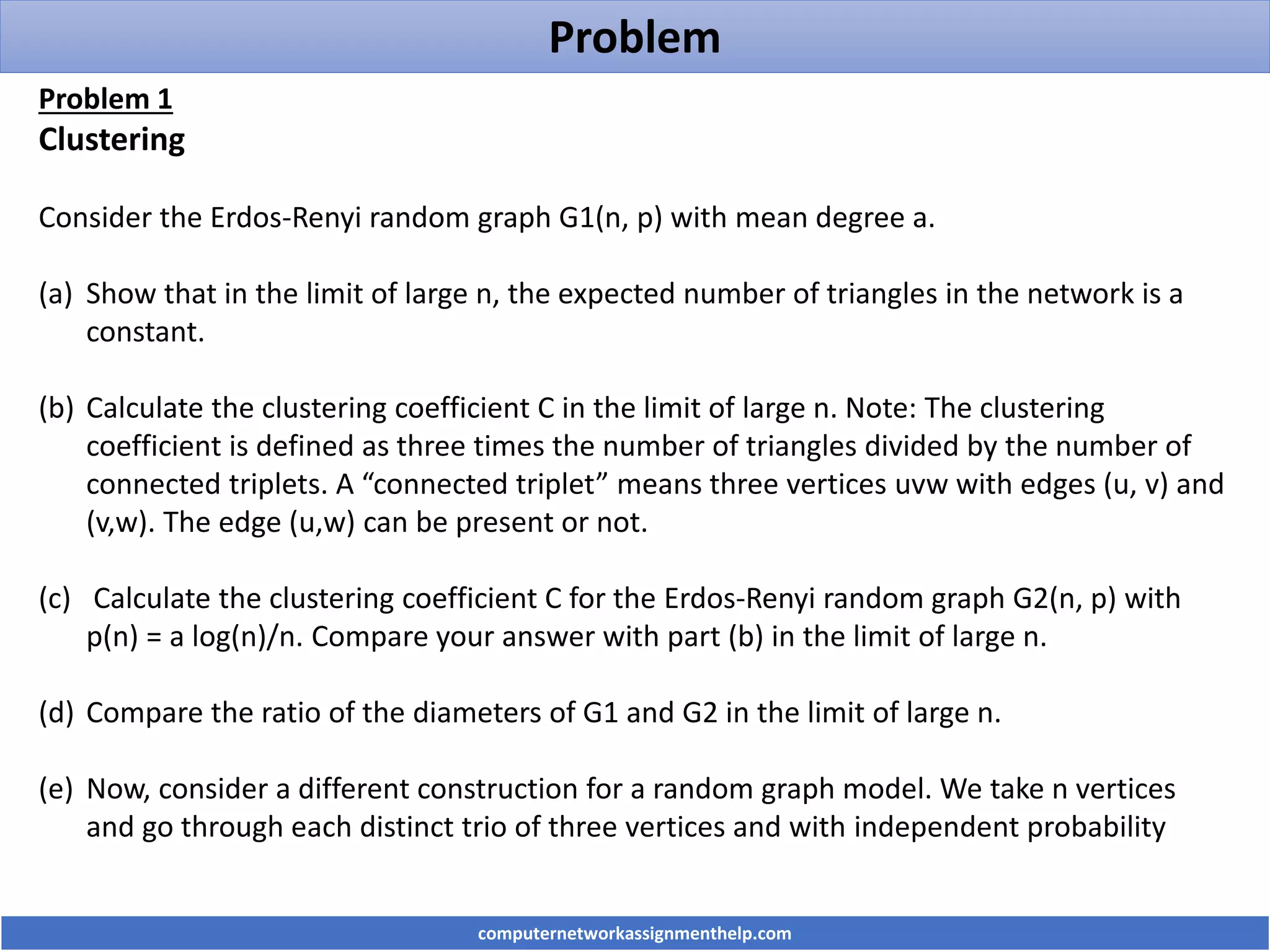
(e) Now, consider a different construction for a random graph model. We take n vertices
and go through each distinct trio of three vertices and with independent probability
computernetworkassignmenthelp.com
connect the trio using three edges to form a triangle. Compute the mean
vertex degree and clustering coefficient for this network model.
Problem 2.
Centrality in Infinite Graphs.
In this problem, you will demonstrate an example that shows that eigenvector centrality can
be very sensitive to minimal changes in a network. The problem is broken into different
components that finally lead to the conclusion.
Part I
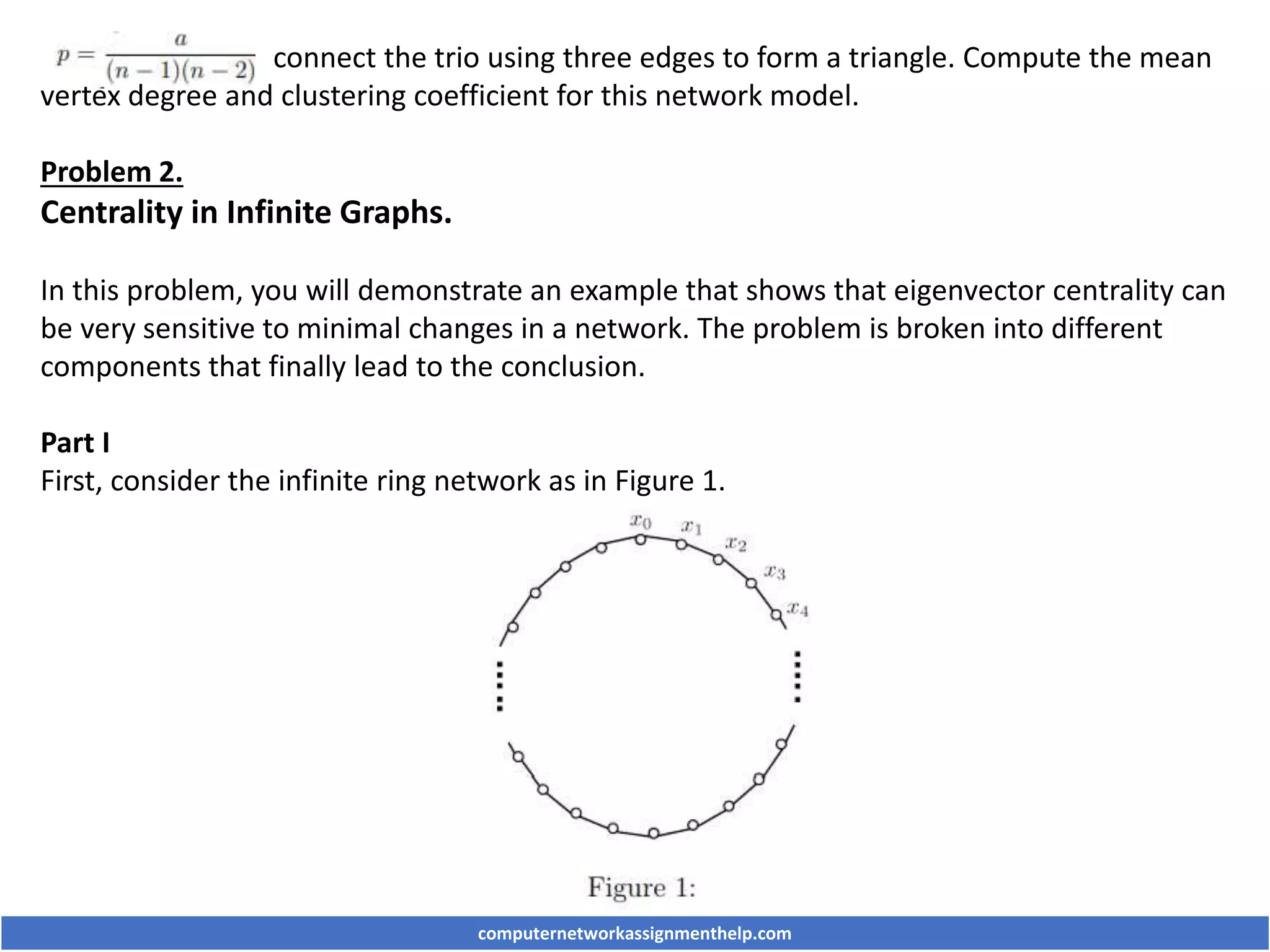
First, consider the infinite ring network as in Figure 1.
computernetworkassignmenthelp.com
Assume that xi is the eigenvector centrality measure of node i.
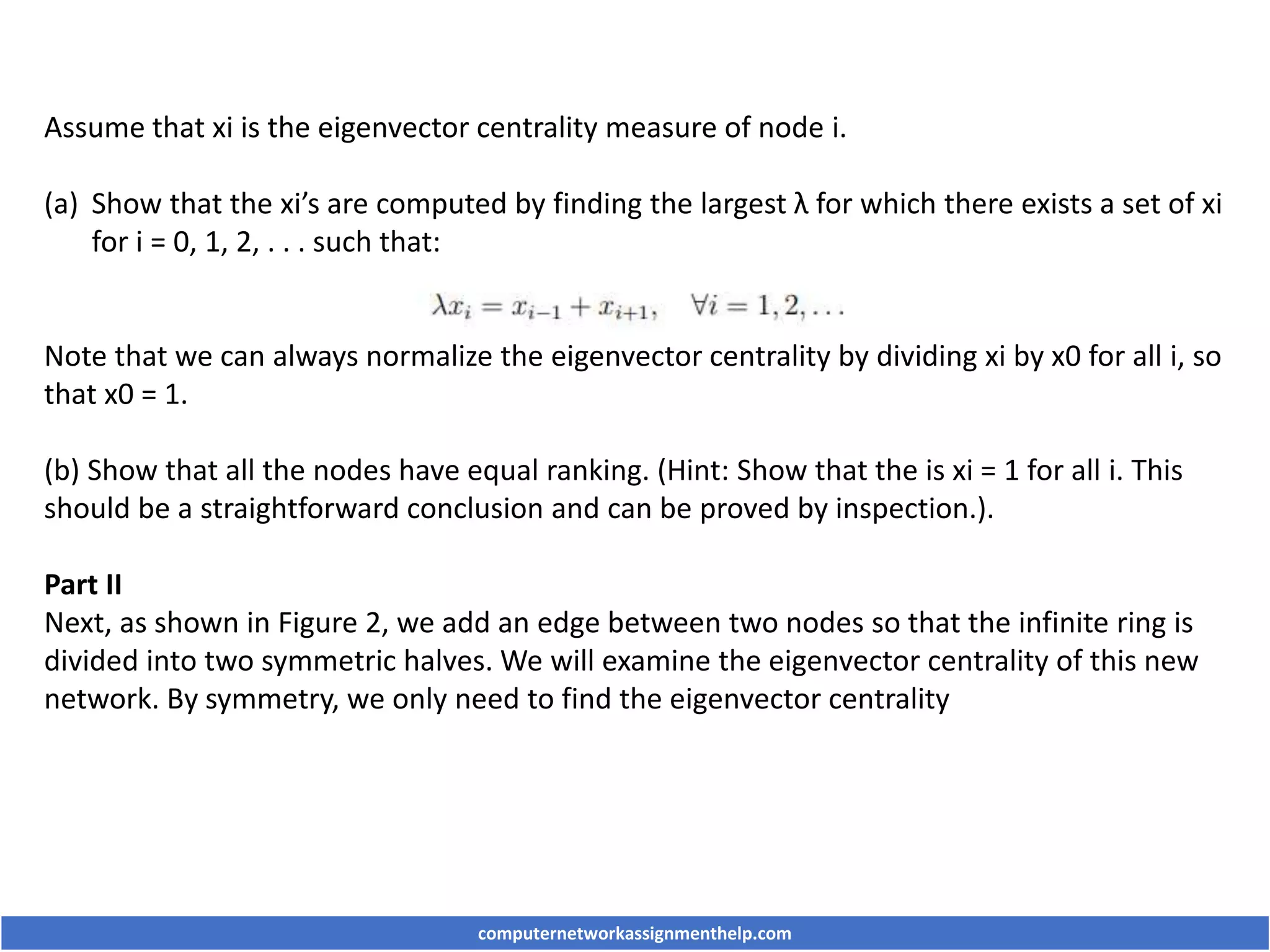
(a) Show that the xi’s are computed by finding the largest λ for which there exists a set of xi
for i = 0, 1, 2, . . . such that:
Note that we can always normalize the eigenvector centrality by dividing xi by x0 for all i, so
that x0 = 1.
(b) Show that all the nodes have equal ranking. (Hint: Show that the is xi = 1 for all i. This
should be a straightforward conclusion and can be proved by inspection.).
Part II
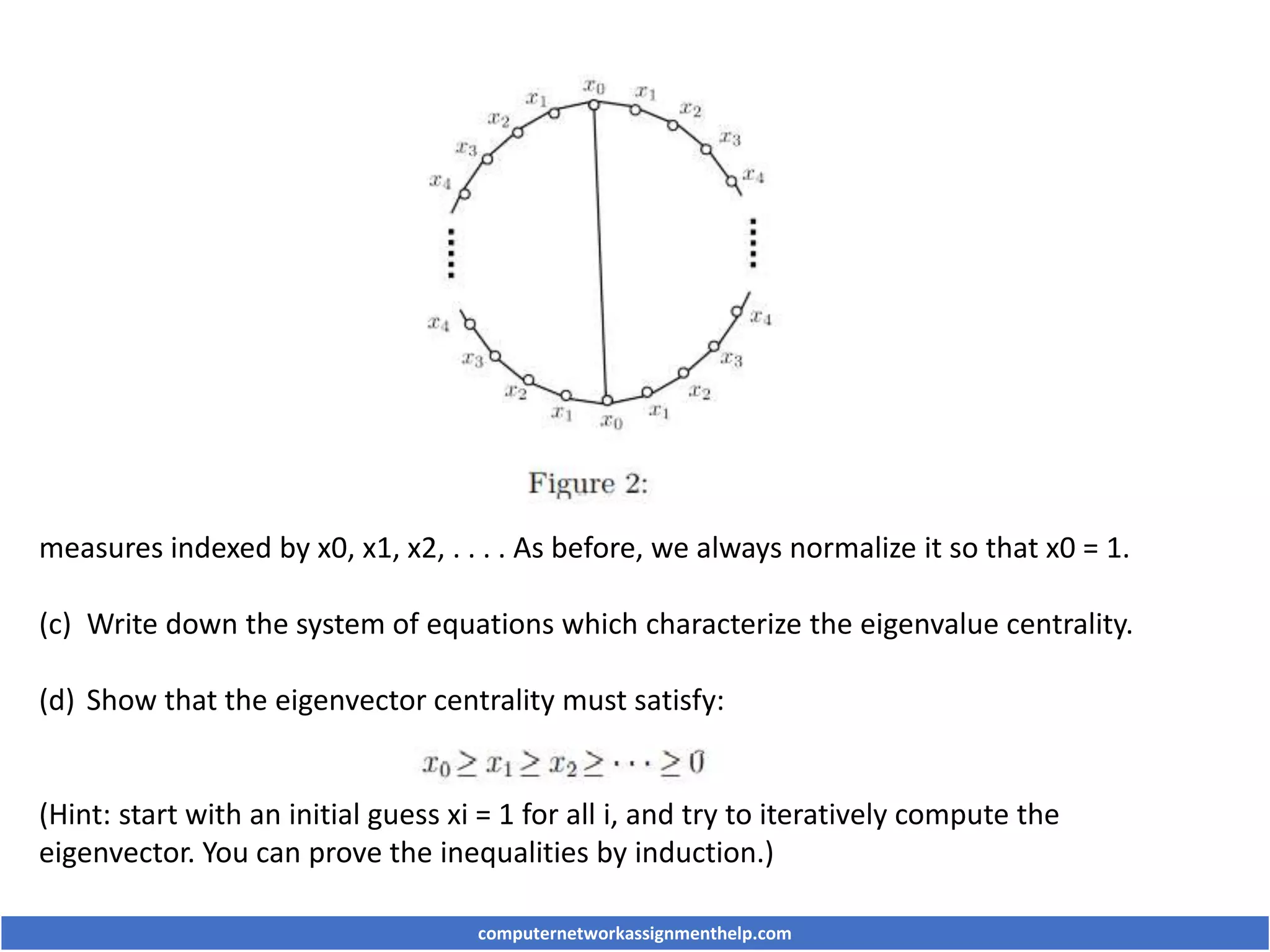
Next, as shown in Figure 2, we add an edge between two nodes so that the infinite ring is
divided into two symmetric halves. We will examine the eigenvector centrality of this new
network. By symmetry, we only need to find the eigenvector centrality
computernetworkassignmenthelp.com
measures indexed by x0, x1, x2, . . . . As before, we always normalize it so that x0 = 1.
(c) Write down the system of equations which characterize the eigenvalue centrality.
(d) Show that the eigenvector centrality must satisfy:
(Hint: start with an initial guess xi = 1 for all i, and try to iteratively compute the
eigenvector. You can prove the inequalities by induction.)
computernetworkassignmenthelp.com
(e) Show that the largest eigenvalue λ must satisfy:
2 ≤ λ ≤ 3
(Hint: observe the system of equations you wrote down for (c).)
(f) We have shown in Part (e) that xn is positive and decreasing in n. Please prove that
limn→∞ xn = 0.
(Hint: consider writing the system of equations in Q2 into the form of a linear dynamical
system with state y[n] given by:
write down the recursive equation y[n + 1] = Ay[n] that describes the evolution of the linear
dynamics, and think about the equilibrium.) Now you have demonstrated that by adding a
single edge one can change the relative centrality measure x x n 0 drastically.
computernetworkassignmenthelp.com
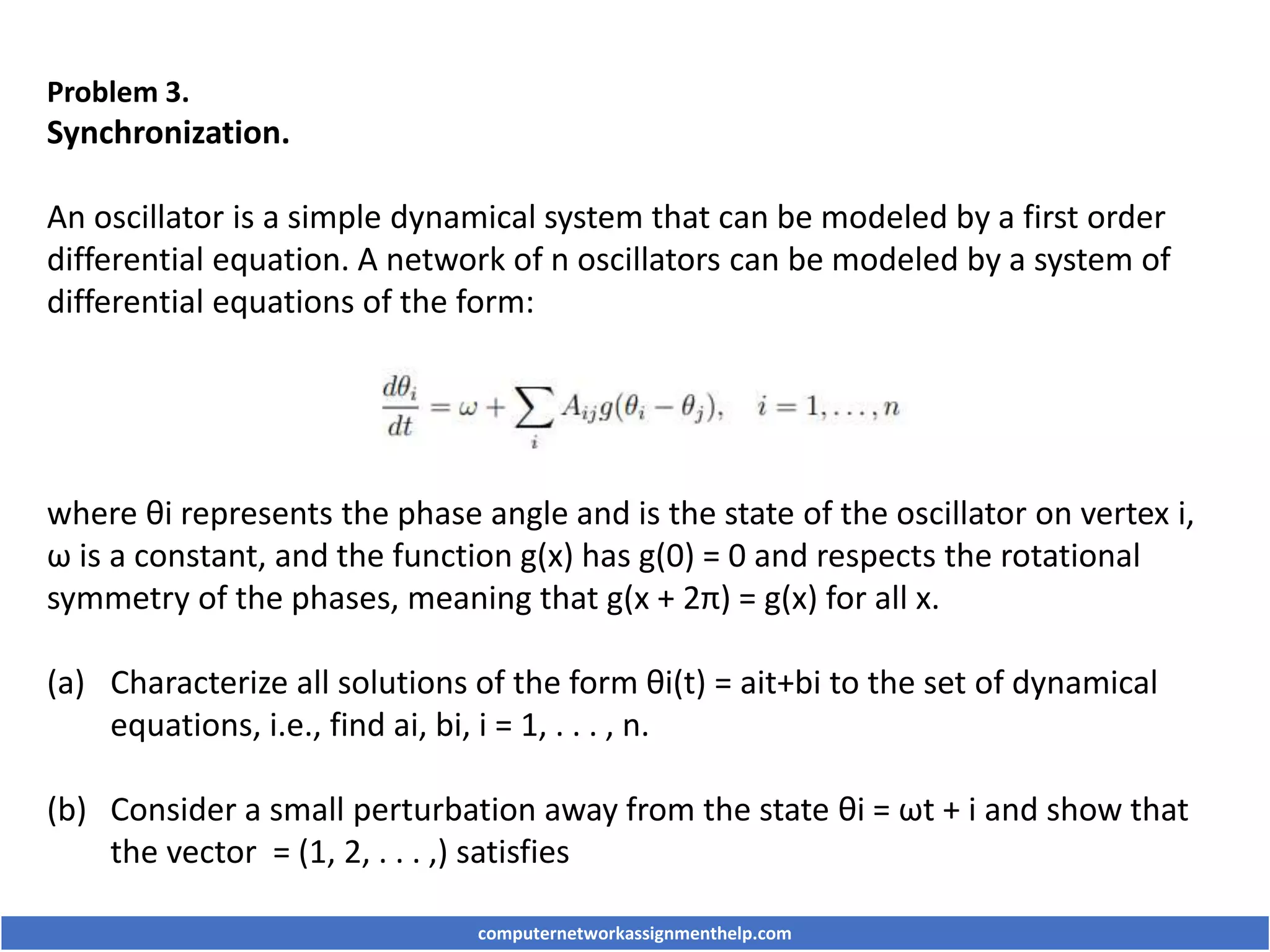
Problem 3.
Synchronization.
An oscillator is a simple dynamical system that can be modeled by a first order
differential equation. A network of n oscillators can be modeled by a system of
differential equations of the form:
where θi represents the phase angle and is the state of the oscillator on vertex i,
ω is a constant, and the function g(x) has g(0) = 0 and respects the rotational
symmetry of the phases, meaning that g(x + 2π) = g(x) for all x.
(a) Characterize all solutions of the form θi(t) = ait+bi to the set of dynamical
equations, i.e., find ai, bi, i = 1, . . . , n.
(b) Consider a small perturbation away from the state θi = ωt + i and show that
the vector = (1, 2, . . . ,) satisfies
computernetworkassignmenthelp.com
Your solution should specify L in terms of [Aij ], the adjacency matrix of an undirected
graph. (Hint: Using the Taylor series approximation of g(·) around
(c) Show that L = MTM where M is the incidence matrix, i.e., the rows correspond to the
edges and columns correspond to the vertices. Therefore, for every edge e = (i, j) between
i, j where i < j we have that
(d) Argue that L is a symmetric matrix and that for any vector x we have that xTLx ≥ 0.
Conclude from this that all the eigenvalues of L are non–negative. (Hint: Use the fact that
all eigenvalues, λ, of a symmetric matrix, P, are of the form
computernetworkassignmenthelp.com
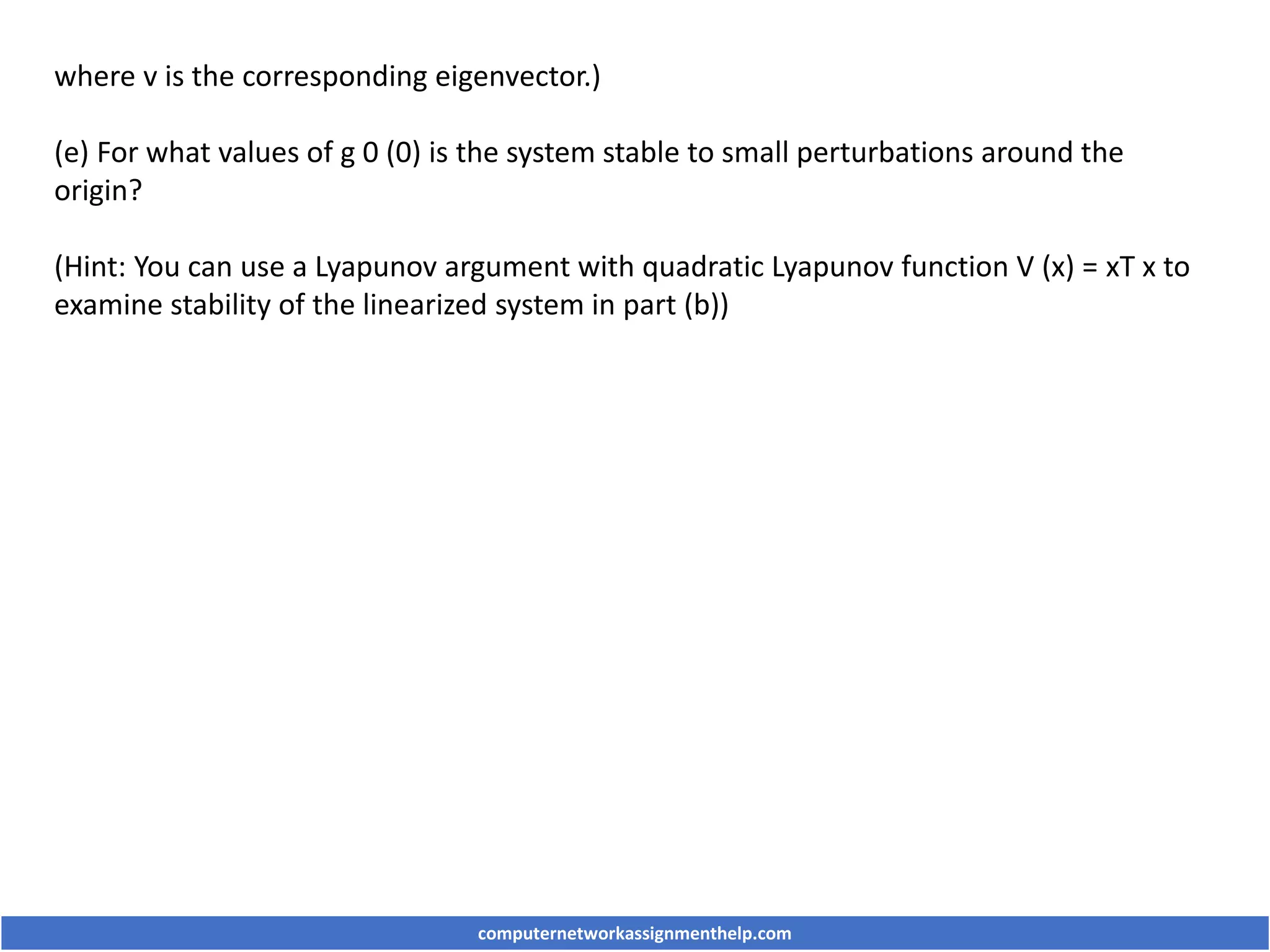
where v is the corresponding eigenvector.)
(e) For what values of g 0 (0) is the system stable to small perturbations around the
origin?
(Hint: You can use a Lyapunov argument with quadratic Lyapunov function V (x) = xT x to
examine stability of the linearized system in part (b))
computernetworkassignmenthelp.com
Solution
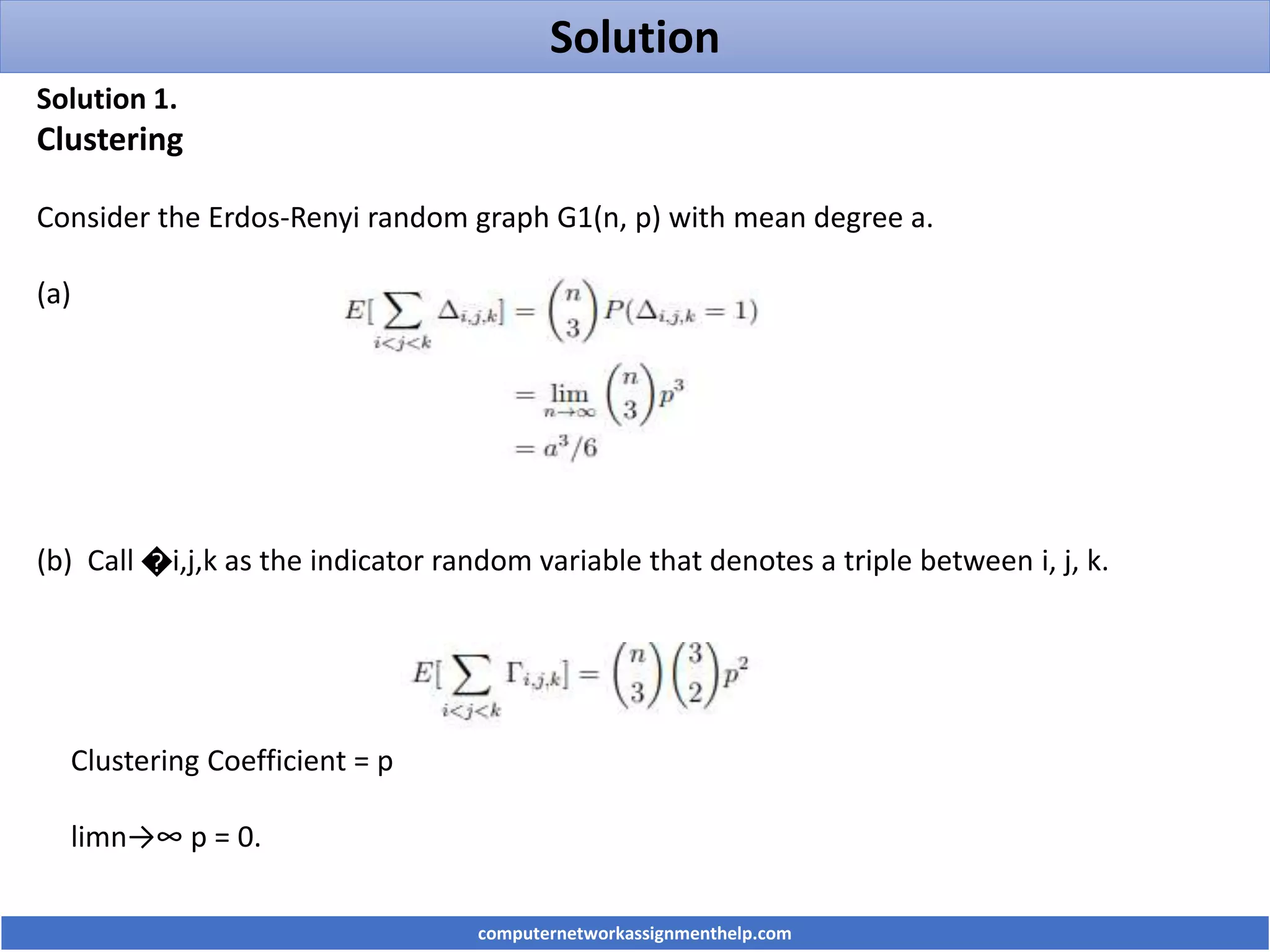
Solution 1.
Clustering
Consider the Erdos-Renyi random graph G1(n, p) with mean degree a.
(a)
(b) Call �i,j,k as the indicator random variable that denotes a triple between i, j, k.
Clustering Coefficient = p
limn→∞ p = 0.
computernetworkassignmenthelp.com
(c) As shown before, it is just p, and still 0. But since p is larger in the latter case, there is a
higher chance that a triple is actually a triangle.
(d) For the value of p in G1 the graph is almost surely disconnected. As a result it has
infinite diameter. On the other hand, G2 has a diameter that is Ω(log(n)) (and is almost
surely connected). Therefore, the ratio G2/G1 = 0
(e) Pick an arbitrary vertex i, let Δij be the indicator random variable denoting a link
between i, j. Then
Then the average degree is E[Δij ](n�1) = a. Observe that in this case the number of
triangles grow linearly as the number of nodes
Number of Triangle =
computernetworkassignmenthelp.com
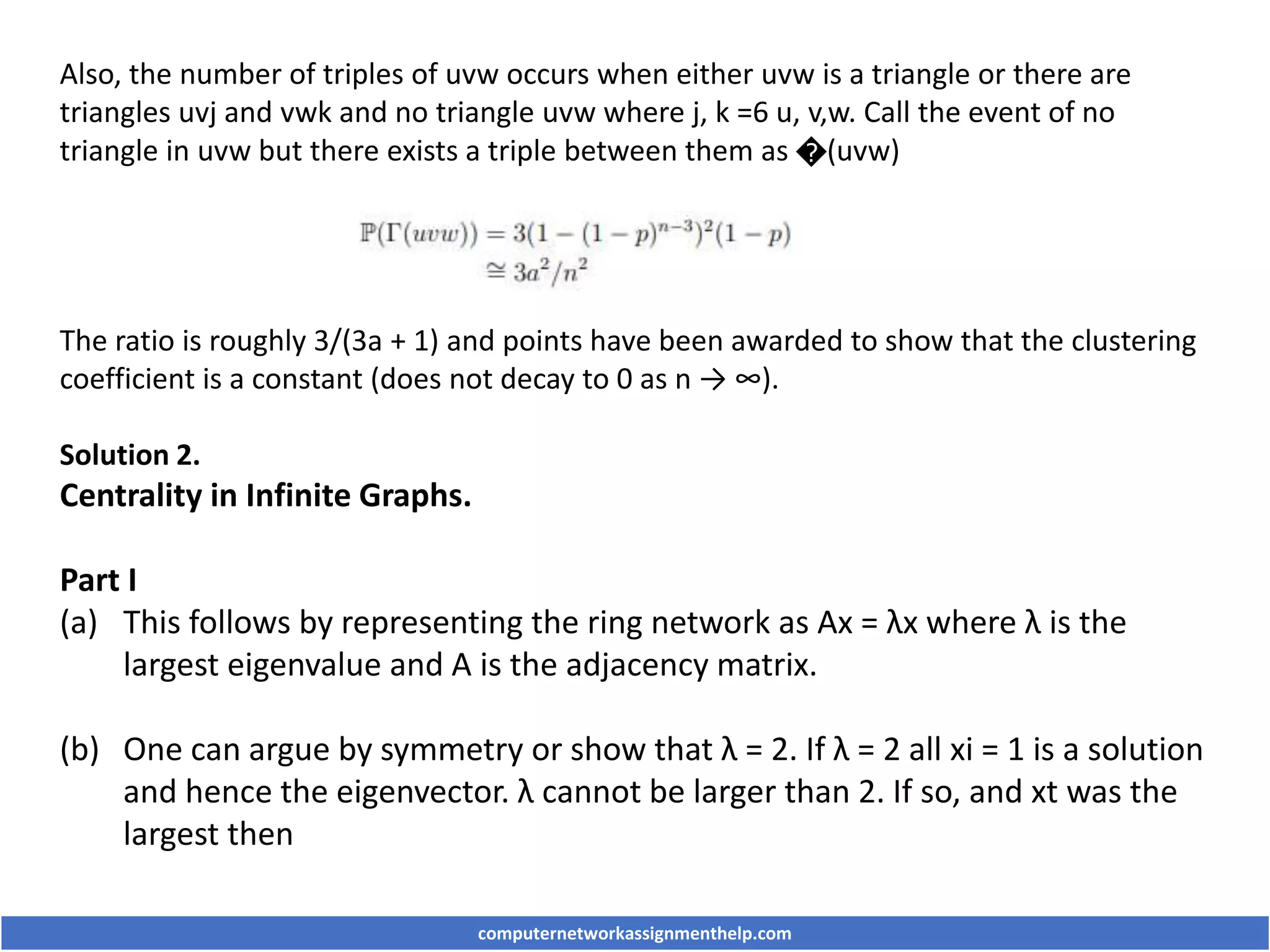
Also, the number of triples of uvw occurs when either uvw is a triangle or there are
triangles uvj and vwk and no triangle uvw where j, k =6 u, v,w. Call the event of no
triangle in uvw but there exists a triple between them as �(uvw)
The ratio is roughly 3/(3a + 1) and points have been awarded to show that the clustering
coefficient is a constant (does not decay to 0 as n → ∞).
Solution 2.
Centrality in Infinite Graphs.
Part I
(a) This follows by representing the ring network as Ax = λx where λ is the
largest eigenvalue and A is the adjacency matrix.
(b) One can argue by symmetry or show that λ = 2. If λ = 2 all xi = 1 is a solution
and hence the eigenvector. λ cannot be larger than 2. If so, and xt was the
largest then
computernetworkassignmenthelp.com
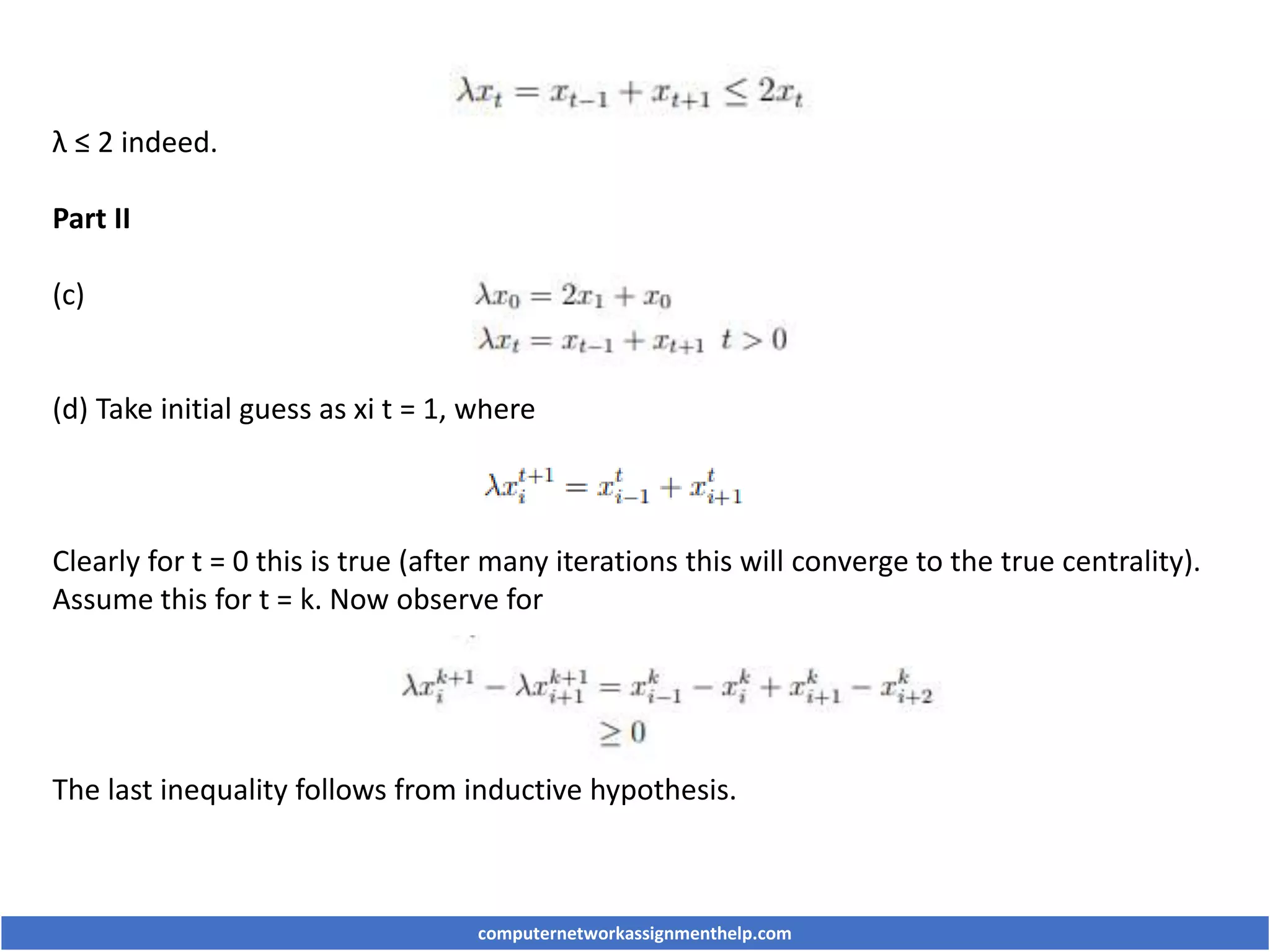
λ ≤ 2 indeed.
Part II
(c)
(d) Take initial guess as xi t = 1, where
Clearly for t = 0 this is true (after many iterations this will converge to the true centrality).
Assume this for t = k. Now observe for
The last inequality follows from inductive hypothesis.
computernetworkassignmenthelp.com
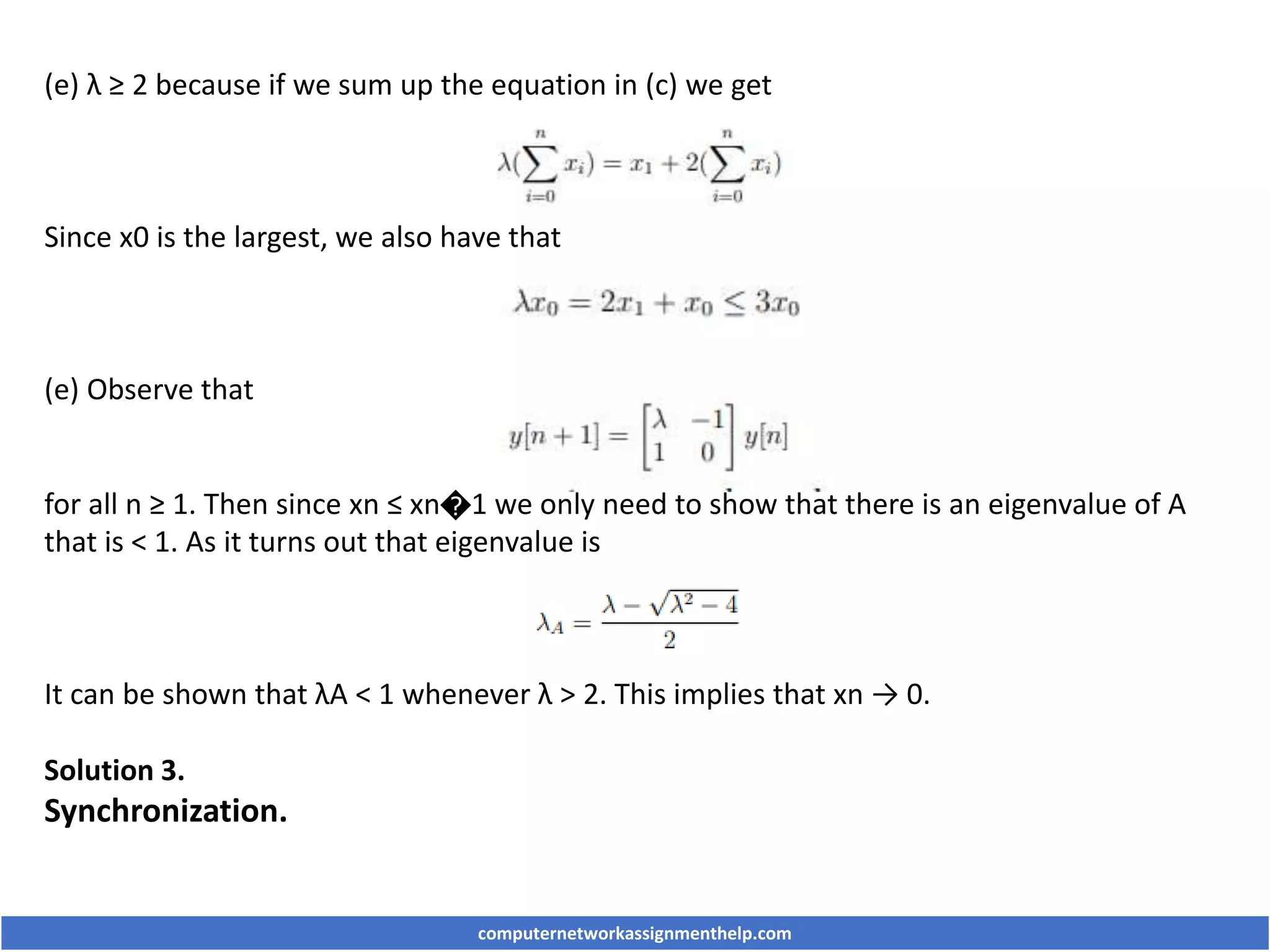
(e) λ ≥ 2 because if we sum up the equation in (c) we get
Since x0 is the largest, we also have that
(e) Observe that
for all n ≥ 1. Then since xn ≤ xn�1 we only need to show that there is an eigenvalue of A
that is < 1. As it turns out that eigenvalue is
It can be shown that λA < 1 whenever λ > 2. This implies that xn → 0.
Solution 3.
Synchronization.
computernetworkassignmenthelp.com
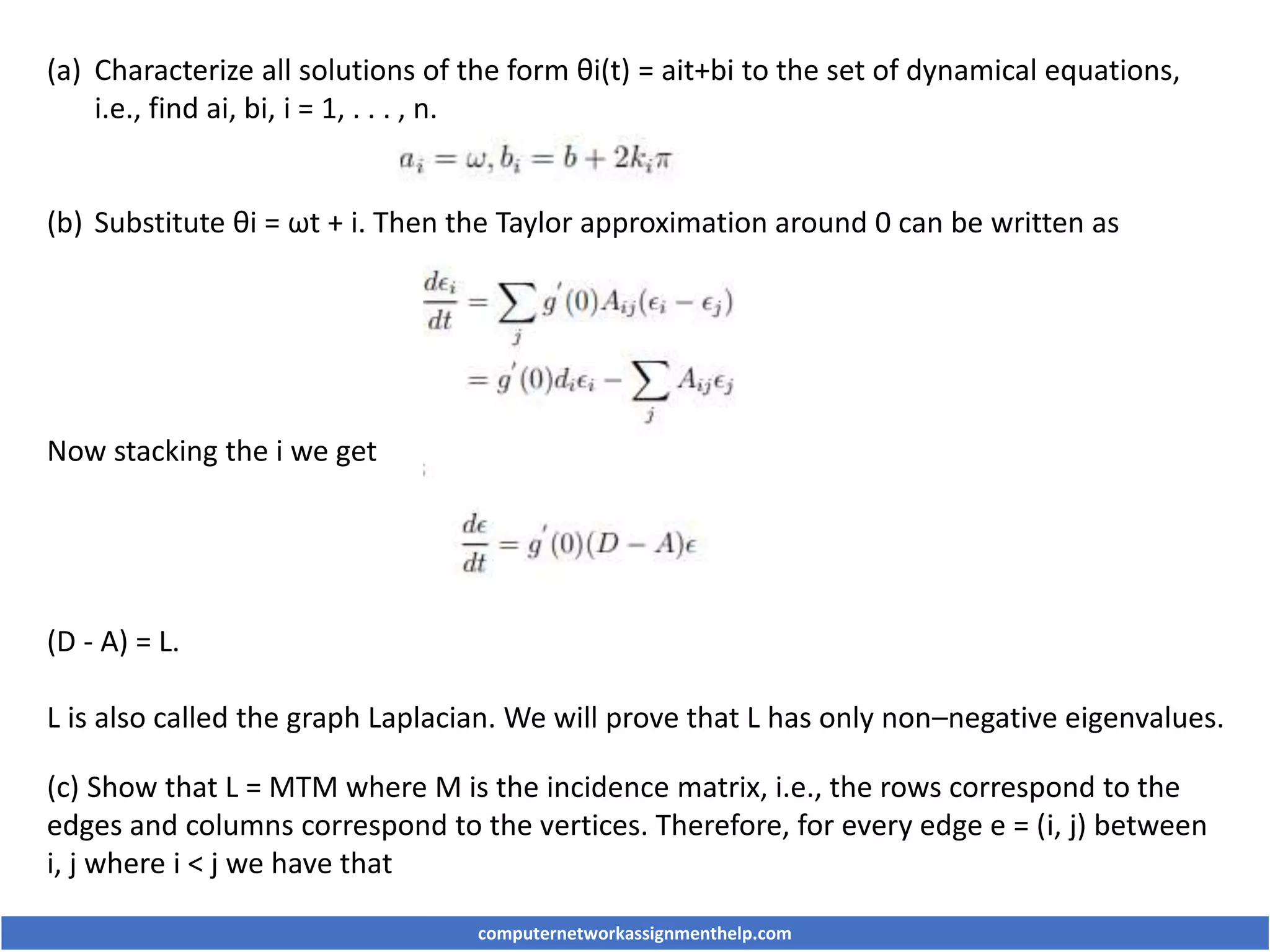
(a) Characterize all solutions of the form θi(t) = ait+bi to the set of dynamical equations,
i.e., find ai, bi, i = 1, . . . , n.
(b) Substitute θi = ωt + i. Then the Taylor approximation around 0 can be written as
Now stacking the i we get
(D - A) = L.
L is also called the graph Laplacian. We will prove that L has only non–negative eigenvalues.
(c) Show that L = MTM where M is the incidence matrix, i.e., the rows correspond to the
edges and columns correspond to the vertices. Therefore, for every edge e = (i, j) between
i, j where i < j we have that
computernetworkassignmenthelp.com
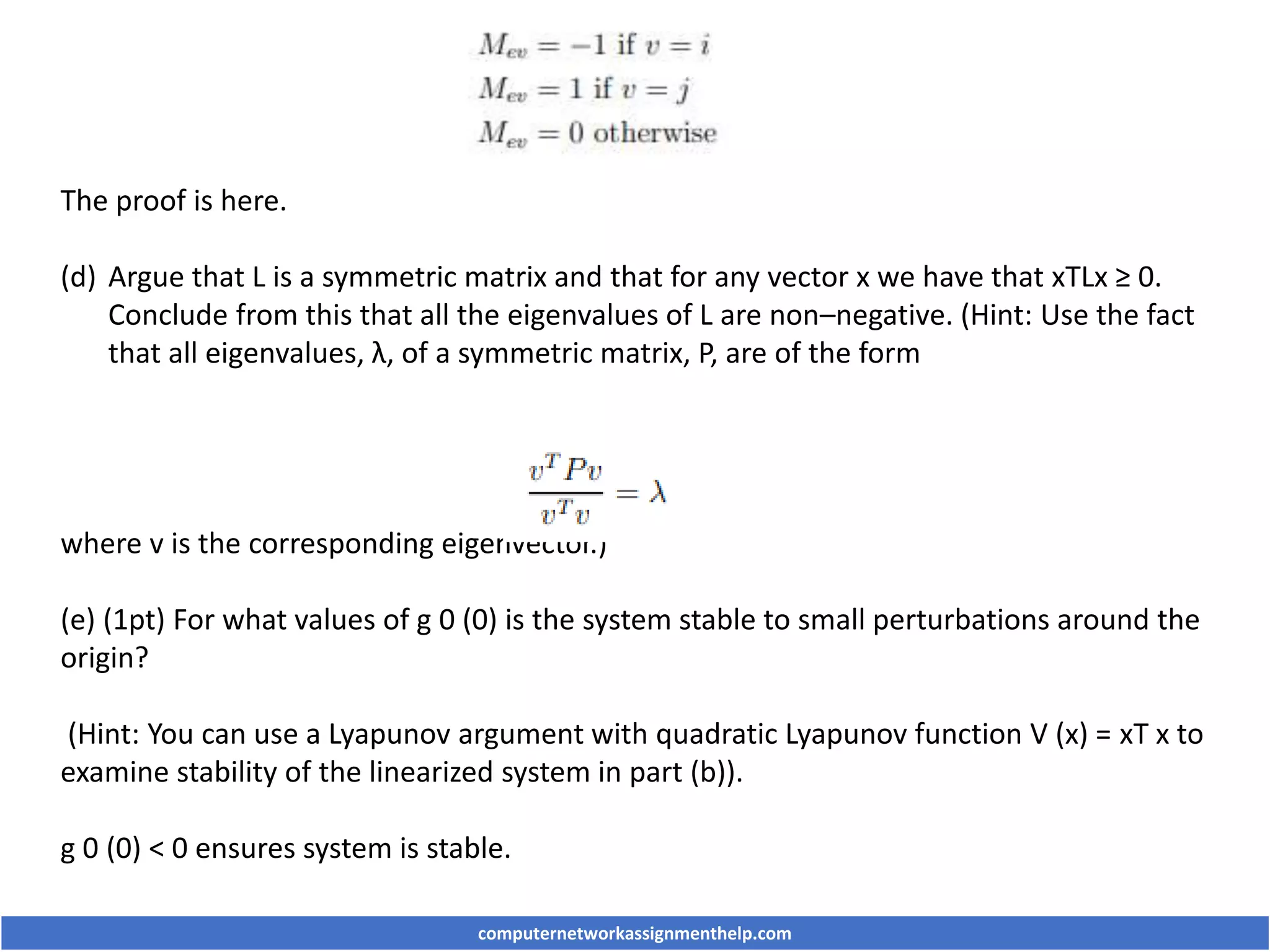
The proof is here.
(d) Argue that L is a symmetric matrix and that for any vector x we have that xTLx ≥ 0.
Conclude from this that all the eigenvalues of L are non–negative. (Hint: Use the fact
that all eigenvalues, λ, of a symmetric matrix, P, are of the form
where v is the corresponding eigenvector.)
(e) (1pt) For what values of g 0 (0) is the system stable to small perturbations around the
origin?
(Hint: You can use a Lyapunov argument with quadratic Lyapunov function V (x) = xT x to
examine stability of the linearized system in part (b)).
g 0 (0) < 0 ensures system is stable.
computernetworkassignmenthelp.com

Computer Network Homework Help

  • 1.
    Computer Network HomeworkHelp For any Homework related queries, Call us at : - +1 678 648 4277 You can mail us at : - support@computernetworkassignmenthelp.com or reach us at : - https://www.computernetworkassignmenthelp.com/
  • 2.
    Problem Problem 1 Clustering Consider theErdos-Renyi random graph G1(n, p) with mean degree a. (a) Show that in the limit of large n, the expected number of triangles in the network is a constant. (b) Calculate the clustering coefficient C in the limit of large n. Note: The clustering coefficient is defined as three times the number of triangles divided by the number of connected triplets. A “connected triplet” means three vertices uvw with edges (u, v) and (v,w). The edge (u,w) can be present or not. (c) Calculate the clustering coefficient C for the Erdos-Renyi random graph G2(n, p) with p(n) = a log(n)/n. Compare your answer with part (b) in the limit of large n. (d) Compare the ratio of the diameters of G1 and G2 in the limit of large n. (e) Now, consider a different construction for a random graph model. We take n vertices and go through each distinct trio of three vertices and with independent probability computernetworkassignmenthelp.com
  • 3.
    connect the triousing three edges to form a triangle. Compute the mean vertex degree and clustering coefficient for this network model. Problem 2. Centrality in Infinite Graphs. In this problem, you will demonstrate an example that shows that eigenvector centrality can be very sensitive to minimal changes in a network. The problem is broken into different components that finally lead to the conclusion. Part I First, consider the infinite ring network as in Figure 1. computernetworkassignmenthelp.com
  • 4.
    Assume that xiis the eigenvector centrality measure of node i. (a) Show that the xi’s are computed by finding the largest λ for which there exists a set of xi for i = 0, 1, 2, . . . such that: Note that we can always normalize the eigenvector centrality by dividing xi by x0 for all i, so that x0 = 1. (b) Show that all the nodes have equal ranking. (Hint: Show that the is xi = 1 for all i. This should be a straightforward conclusion and can be proved by inspection.). Part II Next, as shown in Figure 2, we add an edge between two nodes so that the infinite ring is divided into two symmetric halves. We will examine the eigenvector centrality of this new network. By symmetry, we only need to find the eigenvector centrality computernetworkassignmenthelp.com
  • 5.
    measures indexed byx0, x1, x2, . . . . As before, we always normalize it so that x0 = 1. (c) Write down the system of equations which characterize the eigenvalue centrality. (d) Show that the eigenvector centrality must satisfy: (Hint: start with an initial guess xi = 1 for all i, and try to iteratively compute the eigenvector. You can prove the inequalities by induction.) computernetworkassignmenthelp.com
  • 6.
    (e) Show thatthe largest eigenvalue λ must satisfy: 2 ≤ λ ≤ 3 (Hint: observe the system of equations you wrote down for (c).) (f) We have shown in Part (e) that xn is positive and decreasing in n. Please prove that limn→∞ xn = 0. (Hint: consider writing the system of equations in Q2 into the form of a linear dynamical system with state y[n] given by: write down the recursive equation y[n + 1] = Ay[n] that describes the evolution of the linear dynamics, and think about the equilibrium.) Now you have demonstrated that by adding a single edge one can change the relative centrality measure x x n 0 drastically. computernetworkassignmenthelp.com
  • 7.
    Problem 3. Synchronization. An oscillatoris a simple dynamical system that can be modeled by a first order differential equation. A network of n oscillators can be modeled by a system of differential equations of the form: where θi represents the phase angle and is the state of the oscillator on vertex i, ω is a constant, and the function g(x) has g(0) = 0 and respects the rotational symmetry of the phases, meaning that g(x + 2π) = g(x) for all x. (a) Characterize all solutions of the form θi(t) = ait+bi to the set of dynamical equations, i.e., find ai, bi, i = 1, . . . , n. (b) Consider a small perturbation away from the state θi = ωt + i and show that the vector = (1, 2, . . . ,) satisfies computernetworkassignmenthelp.com
  • 8.
    Your solution shouldspecify L in terms of [Aij ], the adjacency matrix of an undirected graph. (Hint: Using the Taylor series approximation of g(·) around (c) Show that L = MTM where M is the incidence matrix, i.e., the rows correspond to the edges and columns correspond to the vertices. Therefore, for every edge e = (i, j) between i, j where i < j we have that (d) Argue that L is a symmetric matrix and that for any vector x we have that xTLx ≥ 0. Conclude from this that all the eigenvalues of L are non–negative. (Hint: Use the fact that all eigenvalues, λ, of a symmetric matrix, P, are of the form computernetworkassignmenthelp.com
  • 9.
    where v isthe corresponding eigenvector.) (e) For what values of g 0 (0) is the system stable to small perturbations around the origin? (Hint: You can use a Lyapunov argument with quadratic Lyapunov function V (x) = xT x to examine stability of the linearized system in part (b)) computernetworkassignmenthelp.com
  • 10.
    Solution Solution 1. Clustering Consider theErdos-Renyi random graph G1(n, p) with mean degree a. (a) (b) Call �i,j,k as the indicator random variable that denotes a triple between i, j, k. Clustering Coefficient = p limn→∞ p = 0. computernetworkassignmenthelp.com
  • 11.
    (c) As shownbefore, it is just p, and still 0. But since p is larger in the latter case, there is a higher chance that a triple is actually a triangle. (d) For the value of p in G1 the graph is almost surely disconnected. As a result it has infinite diameter. On the other hand, G2 has a diameter that is Ω(log(n)) (and is almost surely connected). Therefore, the ratio G2/G1 = 0 (e) Pick an arbitrary vertex i, let Δij be the indicator random variable denoting a link between i, j. Then Then the average degree is E[Δij ](n�1) = a. Observe that in this case the number of triangles grow linearly as the number of nodes Number of Triangle = computernetworkassignmenthelp.com
  • 12.
    Also, the numberof triples of uvw occurs when either uvw is a triangle or there are triangles uvj and vwk and no triangle uvw where j, k =6 u, v,w. Call the event of no triangle in uvw but there exists a triple between them as �(uvw) The ratio is roughly 3/(3a + 1) and points have been awarded to show that the clustering coefficient is a constant (does not decay to 0 as n → ∞). Solution 2. Centrality in Infinite Graphs. Part I (a) This follows by representing the ring network as Ax = λx where λ is the largest eigenvalue and A is the adjacency matrix. (b) One can argue by symmetry or show that λ = 2. If λ = 2 all xi = 1 is a solution and hence the eigenvector. λ cannot be larger than 2. If so, and xt was the largest then computernetworkassignmenthelp.com
  • 13.
    λ ≤ 2indeed. Part II (c) (d) Take initial guess as xi t = 1, where Clearly for t = 0 this is true (after many iterations this will converge to the true centrality). Assume this for t = k. Now observe for The last inequality follows from inductive hypothesis. computernetworkassignmenthelp.com
  • 14.
    (e) λ ≥2 because if we sum up the equation in (c) we get Since x0 is the largest, we also have that (e) Observe that for all n ≥ 1. Then since xn ≤ xn�1 we only need to show that there is an eigenvalue of A that is < 1. As it turns out that eigenvalue is It can be shown that λA < 1 whenever λ > 2. This implies that xn → 0. Solution 3. Synchronization. computernetworkassignmenthelp.com
  • 15.
    (a) Characterize allsolutions of the form θi(t) = ait+bi to the set of dynamical equations, i.e., find ai, bi, i = 1, . . . , n. (b) Substitute θi = ωt + i. Then the Taylor approximation around 0 can be written as Now stacking the i we get (D - A) = L. L is also called the graph Laplacian. We will prove that L has only non–negative eigenvalues. (c) Show that L = MTM where M is the incidence matrix, i.e., the rows correspond to the edges and columns correspond to the vertices. Therefore, for every edge e = (i, j) between i, j where i < j we have that computernetworkassignmenthelp.com
  • 16.
    The proof ishere. (d) Argue that L is a symmetric matrix and that for any vector x we have that xTLx ≥ 0. Conclude from this that all the eigenvalues of L are non–negative. (Hint: Use the fact that all eigenvalues, λ, of a symmetric matrix, P, are of the form where v is the corresponding eigenvector.) (e) (1pt) For what values of g 0 (0) is the system stable to small perturbations around the origin? (Hint: You can use a Lyapunov argument with quadratic Lyapunov function V (x) = xT x to examine stability of the linearized system in part (b)). g 0 (0) < 0 ensures system is stable. computernetworkassignmenthelp.com