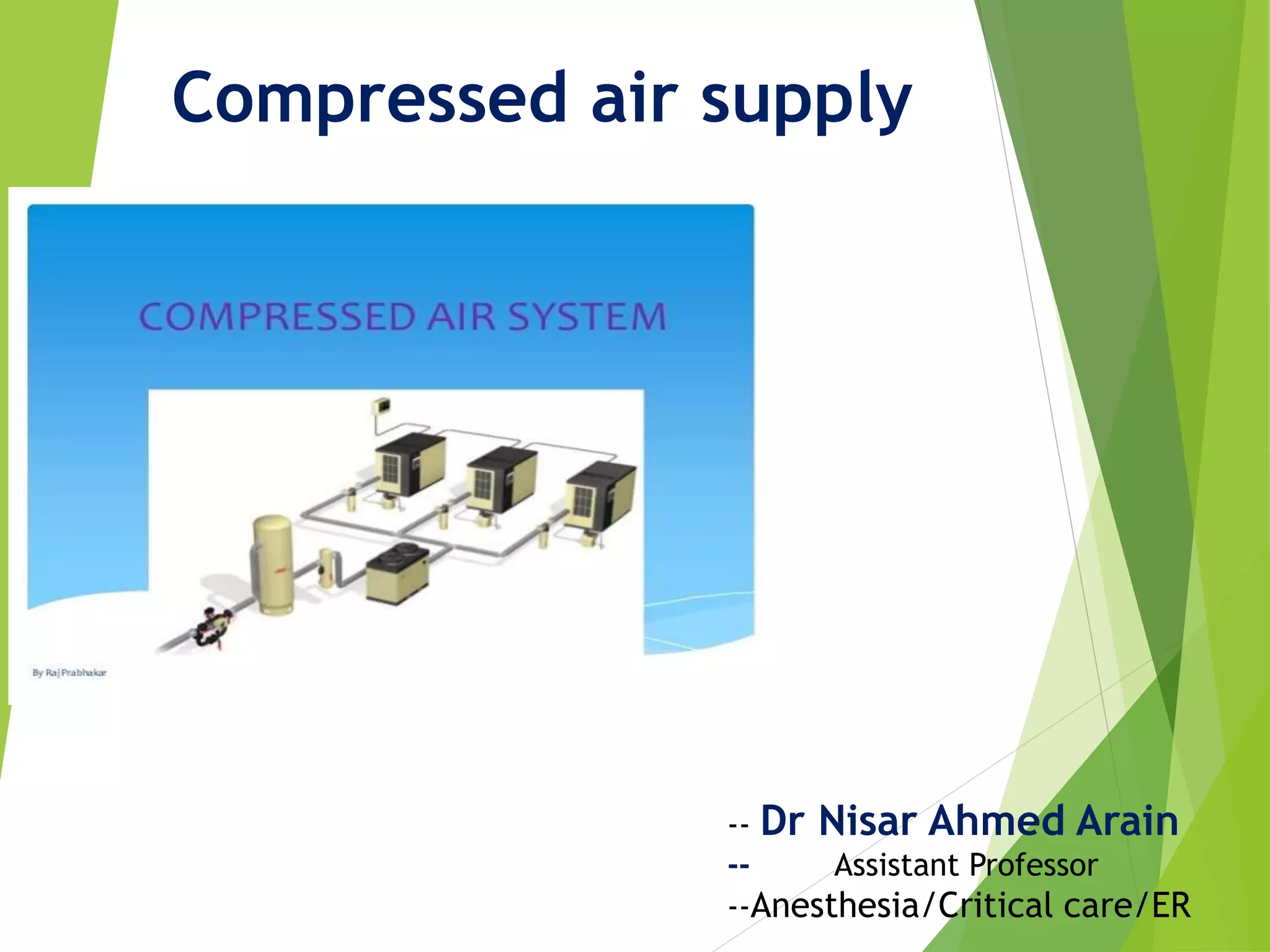
Compressed air supply
-- Dr Nisar Ahmed Arain
-- Assistant Professor
--Anesthesia/Critical care/ER
2
© UNEP 2006
--Training Agenda and Compressor
--Introduction
--Types of Compressors
--Assesment of Compressors
and compressed air system
--Energy efficiency opportunities
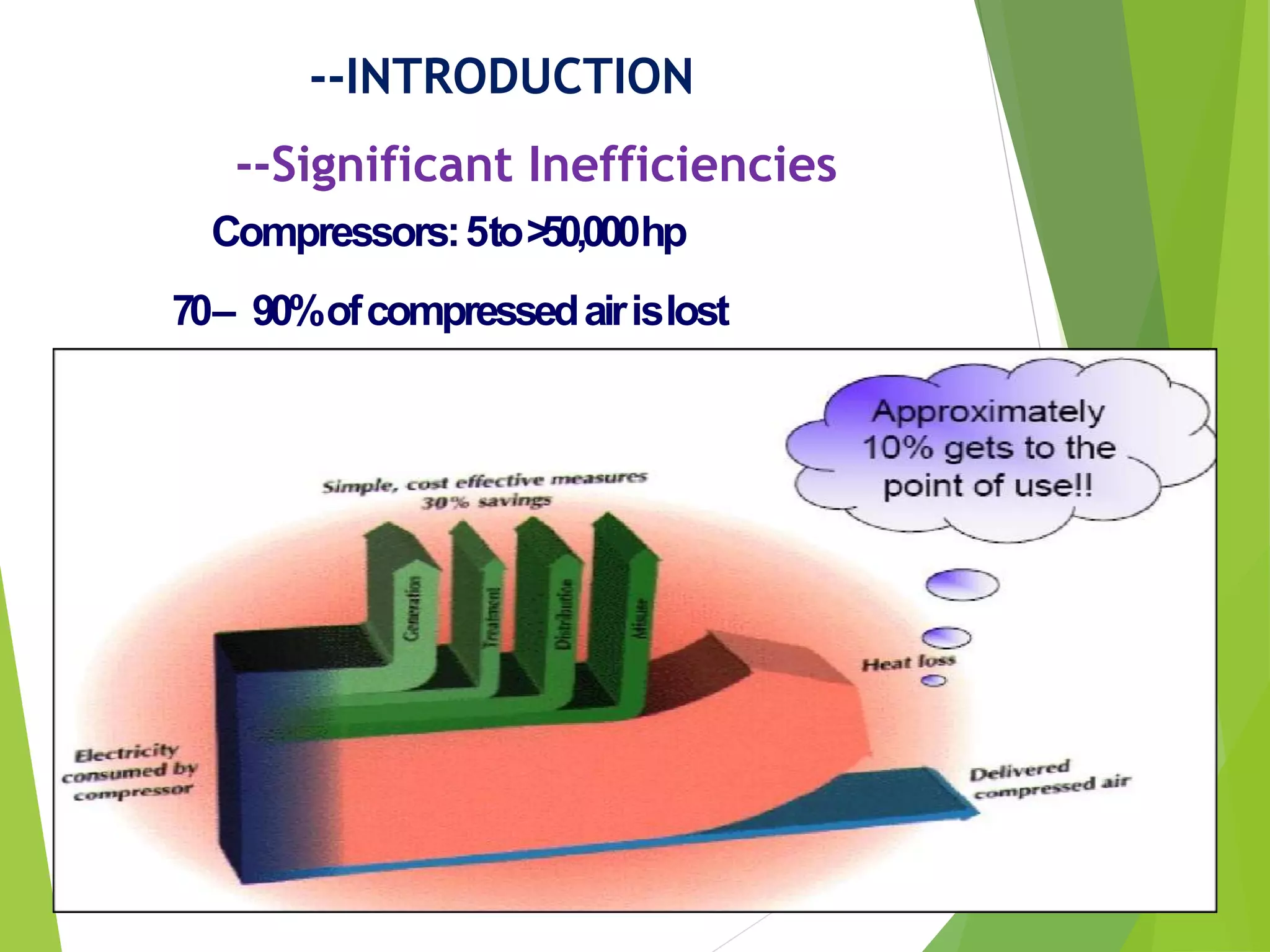
Compressors:5to>
50,000hp
70– 90%ofcompressedairislost
--INTRODUCTION
--Significant Inefficiencies
INTRODUCTION
--BENEFITS OF MANAGED SYSTEM
--Electricity Savings: 20—50%
--Maintenance reduced
--Downtime decreased
--Production increased and
--Product quality improved
Introduction
Main Components in
Compressed Air System
--Intake Air Filters
--Inter Stage
--Coolers After Coolers
--Coolers
--Air Dryers
--Moisture drain traps
--Receivers
-Training Agenda Compressor
--Introduction
--Types of Compressors
--Assesment of Compressors
and compressed air systems
--Energy efficiency opportunities
Typeof
compressor
Positive
displacement
Dynamic
Reciprocating Rotary Centrifugal Axial
-Types of Compressors
-Two Basic Compressor Types
-Types of Compressors
-Reciprocating Compressor
--Used for air and refrigerant Compression
--Works like a bicycle Pump: Cylinder volume
reduces while pressure increases with
pulsating output
--Many configurations are available
--Single acting when using one side of the piston
and double acting when using both sides
-Types of Compressors
-ROTATORY COMPRESSORS
--Rotators instead of Pistons: continuous discharge
--Benefits of Low cost, Compact, low weight, easy
to maintain sizes between 30 to 200 hp
--TYPES
--Lobe Compressor
--Screw compressor
--Rotatory Vane/Slide Vane
-Types of Compressors
-Centrifugal Compressor
--Rotating impeller transfers energy
to move air continuous duty
--Designed oil free High Volume
applications >12,000 cfm
- Types of Compressors
-Comparison of Compressors
--Efficiency at full, partial and no load
--Noise level
--Size
--Oil Carry-over
--Vibration
--Maintenance
--Capacity
--Pressure
-Training Agenda Compressor
--Introduction
--Types of Compressors
--Assesment of Compressors and
compressed air system
--Energy efficiency opportunity
--Assesment of Compressors
--Capacity of a Compressor
--Capacity:-Full rated volume of flow of
compressed gas
--Actual Flow Rate:-Free air delivery(FAD)
--FAD:- reduces by ageing, Poor Maintenance
and Fouled heat exchanger and altitude
--Energy Loss:-Percentage deviation of FAD
Capacity
--Assesment of Compressors
--Simple Capacity Assesment Method
--Isolate compressor and receiver and close receiver outlet
--Empty the receiver and the pipeline from water
--Start the compressor and activate the stop watch
--Note time taken to attain the normal operational pressure
P2(In the receiver)from initial pressure P1
Calculate the capacity FAD
--P2=Final Pressure after filling
(Kg/cm2a)
--P1=Initial Pressure(Kg/cm2a)
after bleeding)
--P0=Atmospheric pressure
(Kg/cm2a)
--V=Storage volume in m3 which
includes receiver, after cooler
and delivery piping
--T=Time taken to build up
pressure to P2 in minutes
--Assesment of Compressors
--Compressor Efficiency
--Most practical specific power consumption
(KW/Volume flow rate)
--Other methods
a-Isothermia-1
b-Volumatric
c-Adiabatic
d-Mechenical
-Assesment of Compressors
-Compressor Efficiency
-Isothermal efficiency
--Isothermal efficiency=Actual measured input power
per Isothermal power
--Isothermal power(KW)=P1 x Q1 x logger / 36.7-P1=
Absolute intake pressure Kg Per cm2
--Q1=Free air delivered m3 per hr
--r=Pressure ratio P2/P1s
-Assesment of Compressors
-Compressor Efficiency
-Volumetric efficiency
--Volumetric efficiency=Free air
delivered/compressor displacement
--Compressor displacement=ΠxD2/4xL xS xχ x
n-D=Cylinderbore,meterL=Cylinderbore,
meterL=Cylinderstroke,meterS=compressor
speedrpmX =1forsingleactingand2for
doubleactingcylindersn=No.ofcylinders
-Assesment of Compressors
-Leaks
--consequences
--Energy waste: 20 – 30% of output
--Drop in the system pressure
--shorter equipment life
--Common leakage areas
--Couplings, hoses, tubes, fittings
--Pressure regulators
--Open condensate traps, shut off valve
--Pipe joints, disconnects, thread sealants
-Assesment of Compressors
-Leak Qualification Method
-Total Leakage Calculation
--Leakage (%) = [(Tx100)/(T +
t)]
--T=On load time(minutes)
t=off load time (Minutes)
--well maintained system: less than 10%
leakages
-Assesment of Compressors
-Quantifying leaks on the shop floor
--Shut off compressed air operated equipment's run compressor
to charge the system to set pressure of operation
--Note the time taken for “Load” and “Unload” cycles calculate
quantity of leakage (previous slide)
If Q is actual free air supplied during trial
(m3/min) then
system leakage (m3/minute) = Q X T (T + t)
---Compressor capacity (m3/minute) = 35
---Cut in pressure, kg/cm2 = 6.8
---Cut out pressure, kg/cm2 = 7.5
---Load kW drawn = 188
kW
---Unload kW drawn = 54
kW
---Average ‘Load’ time =1.5
min
---Average ‘Unload’ time
-Assesment of Compressors
--EXAMPLE
-Raining Agenda: Compressor
--Introduction
--Types of compressors
--Assesment of compressors
and compressed air systems
--Energy efficiency
opportunities
-Energy Efficiency Opportunities
1-Location
significant influence on energy use
2-Elevation
Higher altitude = lower volumetric efficiency
-Energy Efficiency Opportunity
3. Air Intake
--Keep intake air free from contaminants, dust
or moist Keep intake air temperature low
--Every 4oC rise in inlet air Temperature = 1%
higher
energy consumption
--Keep ambient temperature low when an intake
air
filter is located at the compressor
-Energy Efficiency Opportunities
4. Pressure Drops in air Filter
--Install filter in cool location or draw air from
cool places
--Keep pressure drop across intake air filter
to a minimum
--Every 250 mm WC pressure drop =
2% higher energy consumption
-Energy Efficiency Opportunities
-5. Use Inter and After coolers
--Inlet air temperature rises at each stage of
multistage machine
--Inter coolers: heat exchangers that remove heat
between stages
--After coolers: reduce air temperature after final
stage
--Use water at low temperature: reduce power
-Energy Efficiency Opportunities
6.Pressure Settings
-Higher Pressure
a-More power by compressors
b-Lower volumetric efficiency
-Operating above operating pressures
a-Waste of energy
b-Excessive wear
Energy Efficiency Opportunities
6.Pressure setting cont.
--a-Reducing delivery pressure operating a compressor
at 120 PSIG instead of 100 PSIG: 10% less energy
and reduced leakage rate
--b-Compressor modulation by optimum pressure
settings, Applicable when different compressors
connected Segregating high/Low pressure
requirements
Pressure reducing valves no longer needed
-Energy Efficiency Opportunities
6-Pressure Settings cont.
--Design for minimum pressure drop in the distribution line
--Pressure drop: reduction in air pressure from the
compressor discharge to the point of use
--Pressure drop less then 10%
--Pressure drop caused by
a-corrosion
b-Inadequate sized piping couplings hoses
c-checked filter elements inadequate sized
3
0
© UNEP 2006
-- Energy Efficiency Opportunities
--6-Pressure settings cont.
--Design for minimum pressure drop in the
distribution line
--Different pipe size
--Typical pressure drop in compressed air line
-Energy Efficiency Opportunities
7-Minimizing Leakage
--Use ultrasonic acoustic detector
tighten joints and connections
replace faulty equipment
8-Condensate Removal
--Condensate formed as after cooler
reduces discharge air temperature
--Install condensate separator trap to
remove condensate
-- Energy Efficiency Opportunities
9-Controlled Usage
--Do not use for low pressure applications
agitation, combustion air, Pneumatic
conveying use blowers instead
10-Compressor Controls
--Automatically terns off compressor when
not needed
Energy Efficiency Opportunities
9-Maintainence Practices
--Lubrication:- checked regularly
--Air Filters:-Replaced regularly
--Condensate Traps:-Ensure drainage
--Air dryers:-Inspect and replace filters
THANK YOU

#Compressed air supply

  • 1.
    Compressed air supply --Dr Nisar Ahmed Arain -- Assistant Professor --Anesthesia/Critical care/ER
  • 2.
    2 © UNEP 2006 --TrainingAgenda and Compressor --Introduction --Types of Compressors --Assesment of Compressors and compressed air system --Energy efficiency opportunities
  • 3.
  • 4.
    INTRODUCTION --BENEFITS OF MANAGEDSYSTEM --Electricity Savings: 20—50% --Maintenance reduced --Downtime decreased --Production increased and --Product quality improved
  • 5.
    Introduction Main Components in CompressedAir System --Intake Air Filters --Inter Stage --Coolers After Coolers --Coolers --Air Dryers --Moisture drain traps --Receivers
  • 6.
    -Training Agenda Compressor --Introduction --Typesof Compressors --Assesment of Compressors and compressed air systems --Energy efficiency opportunities
  • 7.
    Typeof compressor Positive displacement Dynamic Reciprocating Rotary CentrifugalAxial -Types of Compressors -Two Basic Compressor Types
  • 8.
    -Types of Compressors -ReciprocatingCompressor --Used for air and refrigerant Compression --Works like a bicycle Pump: Cylinder volume reduces while pressure increases with pulsating output --Many configurations are available --Single acting when using one side of the piston and double acting when using both sides
  • 9.
    -Types of Compressors -ROTATORYCOMPRESSORS --Rotators instead of Pistons: continuous discharge --Benefits of Low cost, Compact, low weight, easy to maintain sizes between 30 to 200 hp --TYPES --Lobe Compressor --Screw compressor --Rotatory Vane/Slide Vane
  • 10.
    -Types of Compressors -CentrifugalCompressor --Rotating impeller transfers energy to move air continuous duty --Designed oil free High Volume applications >12,000 cfm
  • 11.
    - Types ofCompressors -Comparison of Compressors --Efficiency at full, partial and no load --Noise level --Size --Oil Carry-over --Vibration --Maintenance --Capacity --Pressure
  • 12.
    -Training Agenda Compressor --Introduction --Typesof Compressors --Assesment of Compressors and compressed air system --Energy efficiency opportunity
  • 13.
    --Assesment of Compressors --Capacityof a Compressor --Capacity:-Full rated volume of flow of compressed gas --Actual Flow Rate:-Free air delivery(FAD) --FAD:- reduces by ageing, Poor Maintenance and Fouled heat exchanger and altitude --Energy Loss:-Percentage deviation of FAD Capacity
  • 14.
    --Assesment of Compressors --SimpleCapacity Assesment Method --Isolate compressor and receiver and close receiver outlet --Empty the receiver and the pipeline from water --Start the compressor and activate the stop watch --Note time taken to attain the normal operational pressure P2(In the receiver)from initial pressure P1 Calculate the capacity FAD --P2=Final Pressure after filling (Kg/cm2a) --P1=Initial Pressure(Kg/cm2a) after bleeding) --P0=Atmospheric pressure (Kg/cm2a) --V=Storage volume in m3 which includes receiver, after cooler and delivery piping --T=Time taken to build up pressure to P2 in minutes
  • 15.
    --Assesment of Compressors --CompressorEfficiency --Most practical specific power consumption (KW/Volume flow rate) --Other methods a-Isothermia-1 b-Volumatric c-Adiabatic d-Mechenical
  • 16.
    -Assesment of Compressors -CompressorEfficiency -Isothermal efficiency --Isothermal efficiency=Actual measured input power per Isothermal power --Isothermal power(KW)=P1 x Q1 x logger / 36.7-P1= Absolute intake pressure Kg Per cm2 --Q1=Free air delivered m3 per hr --r=Pressure ratio P2/P1s
  • 17.
    -Assesment of Compressors -CompressorEfficiency -Volumetric efficiency --Volumetric efficiency=Free air delivered/compressor displacement --Compressor displacement=ΠxD2/4xL xS xχ x n-D=Cylinderbore,meterL=Cylinderbore, meterL=Cylinderstroke,meterS=compressor speedrpmX =1forsingleactingand2for doubleactingcylindersn=No.ofcylinders
  • 18.
    -Assesment of Compressors -Leaks --consequences --Energywaste: 20 – 30% of output --Drop in the system pressure --shorter equipment life --Common leakage areas --Couplings, hoses, tubes, fittings --Pressure regulators --Open condensate traps, shut off valve --Pipe joints, disconnects, thread sealants
  • 19.
    -Assesment of Compressors -LeakQualification Method -Total Leakage Calculation --Leakage (%) = [(Tx100)/(T + t)] --T=On load time(minutes) t=off load time (Minutes) --well maintained system: less than 10% leakages
  • 20.
    -Assesment of Compressors -Quantifyingleaks on the shop floor --Shut off compressed air operated equipment's run compressor to charge the system to set pressure of operation --Note the time taken for “Load” and “Unload” cycles calculate quantity of leakage (previous slide) If Q is actual free air supplied during trial (m3/min) then system leakage (m3/minute) = Q X T (T + t)
  • 21.
    ---Compressor capacity (m3/minute)= 35 ---Cut in pressure, kg/cm2 = 6.8 ---Cut out pressure, kg/cm2 = 7.5 ---Load kW drawn = 188 kW ---Unload kW drawn = 54 kW ---Average ‘Load’ time =1.5 min ---Average ‘Unload’ time -Assesment of Compressors --EXAMPLE
  • 22.
    -Raining Agenda: Compressor --Introduction --Typesof compressors --Assesment of compressors and compressed air systems --Energy efficiency opportunities
  • 23.
    -Energy Efficiency Opportunities 1-Location significantinfluence on energy use 2-Elevation Higher altitude = lower volumetric efficiency
  • 24.
    -Energy Efficiency Opportunity 3.Air Intake --Keep intake air free from contaminants, dust or moist Keep intake air temperature low --Every 4oC rise in inlet air Temperature = 1% higher energy consumption --Keep ambient temperature low when an intake air filter is located at the compressor
  • 25.
    -Energy Efficiency Opportunities 4.Pressure Drops in air Filter --Install filter in cool location or draw air from cool places --Keep pressure drop across intake air filter to a minimum --Every 250 mm WC pressure drop = 2% higher energy consumption
  • 26.
    -Energy Efficiency Opportunities -5.Use Inter and After coolers --Inlet air temperature rises at each stage of multistage machine --Inter coolers: heat exchangers that remove heat between stages --After coolers: reduce air temperature after final stage --Use water at low temperature: reduce power
  • 27.
    -Energy Efficiency Opportunities 6.PressureSettings -Higher Pressure a-More power by compressors b-Lower volumetric efficiency -Operating above operating pressures a-Waste of energy b-Excessive wear
  • 28.
    Energy Efficiency Opportunities 6.Pressuresetting cont. --a-Reducing delivery pressure operating a compressor at 120 PSIG instead of 100 PSIG: 10% less energy and reduced leakage rate --b-Compressor modulation by optimum pressure settings, Applicable when different compressors connected Segregating high/Low pressure requirements Pressure reducing valves no longer needed
  • 29.
    -Energy Efficiency Opportunities 6-PressureSettings cont. --Design for minimum pressure drop in the distribution line --Pressure drop: reduction in air pressure from the compressor discharge to the point of use --Pressure drop less then 10% --Pressure drop caused by a-corrosion b-Inadequate sized piping couplings hoses c-checked filter elements inadequate sized
  • 30.
    3 0 © UNEP 2006 --Energy Efficiency Opportunities --6-Pressure settings cont. --Design for minimum pressure drop in the distribution line --Different pipe size --Typical pressure drop in compressed air line
  • 31.
    -Energy Efficiency Opportunities 7-MinimizingLeakage --Use ultrasonic acoustic detector tighten joints and connections replace faulty equipment 8-Condensate Removal --Condensate formed as after cooler reduces discharge air temperature --Install condensate separator trap to remove condensate
  • 32.
    -- Energy EfficiencyOpportunities 9-Controlled Usage --Do not use for low pressure applications agitation, combustion air, Pneumatic conveying use blowers instead 10-Compressor Controls --Automatically terns off compressor when not needed
  • 33.
    Energy Efficiency Opportunities 9-MaintainencePractices --Lubrication:- checked regularly --Air Filters:-Replaced regularly --Condensate Traps:-Ensure drainage --Air dryers:-Inspect and replace filters
  • 34.