Binance Trading Terms
Comprehensive Overview of Terms and Concepts
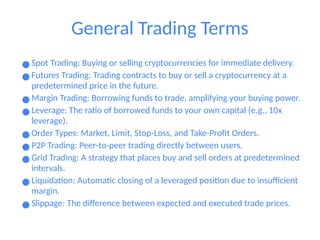
General Trading Terms
● Spot Trading: Buying or selling cryptocurrencies for immediate delivery.
● Futures Trading: Trading contracts to buy or sell a cryptocurrency at a
predetermined price in the future.
● Margin Trading: Borrowing funds to trade, amplifying your buying power.
● Leverage: The ratio of borrowed funds to your own capital (e.g., 10x
leverage).
● Order Types: Market, Limit, Stop-Loss, and Take-Profit Orders.
● P2P Trading: Peer-to-peer trading directly between users.
● Grid Trading: A strategy that places buy and sell orders at predetermined
intervals.
● Liquidation: Automatic closing of a leveraged position due to insufficient
margin.
● Slippage: The difference between expected and executed trade prices.
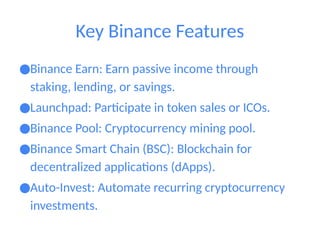
Key Binance Features
●Binance Earn: Earn passive income through
staking, lending, or savings.
●Launchpad: Participate in token sales or ICOs.
●Binance Pool: Cryptocurrency mining pool.
●Binance Smart Chain (BSC): Blockchain for
decentralized applications (dApps).
●Auto-Invest: Automate recurring cryptocurrency
investments.
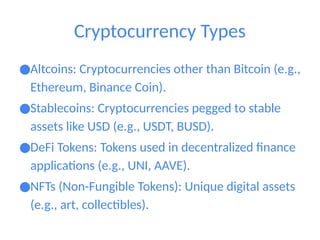
Cryptocurrency Types
●Altcoins: Cryptocurrencies other than Bitcoin (e.g.,
Ethereum, Binance Coin).
●Stablecoins: Cryptocurrencies pegged to stable
assets like USD (e.g., USDT, BUSD).
●DeFi Tokens: Tokens used in decentralized finance
applications (e.g., UNI, AAVE).
●NFTs (Non-Fungible Tokens): Unique digital assets
(e.g., art, collectibles).
Indicators and Tools
●Candlestick Charts: Represent price
movements over time.
●Technical Indicators: RSI, MACD, Bollinger
Bands.
●Volume: Total quantity of an asset traded
within a timeframe.
Fees and Costs
●Trading Fee: Percentage charged for each
trade (maker and taker fees).
●Withdrawal Fee: Charged when withdrawing
cryptocurrencies.
●Funding Rate: Fee paid between long and
short traders in futures.
Risk Management
●Stop-Loss: Strategy to limit potential losses.
●HODL: Holding cryptocurrencies long-term
regardless of market conditions.
●Diversification: Spreading investments across
assets to reduce risk.
Security Features
●2FA (Two-Factor Authentication): Adds extra
security.
●Whitelisting: Restricts withdrawals to specific
wallet addresses.
●SAFU (Secure Asset Fund for Users):
Emergency insurance fund.
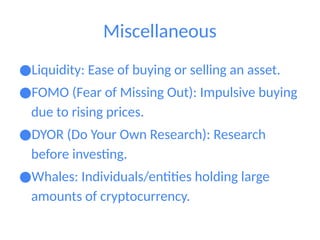
Miscellaneous
●Liquidity: Ease of buying or selling an asset.
●FOMO (Fear of Missing Out): Impulsive buying
due to rising prices.
●DYOR (Do Your Own Research): Research
before investing.
●Whales: Individuals/entities holding large
amounts of cryptocurrency.

Comprehensive Binance Trading Terms Overview

  • 1.
    Binance Trading Terms ComprehensiveOverview of Terms and Concepts
  • 2.
    General Trading Terms ●Spot Trading: Buying or selling cryptocurrencies for immediate delivery. ● Futures Trading: Trading contracts to buy or sell a cryptocurrency at a predetermined price in the future. ● Margin Trading: Borrowing funds to trade, amplifying your buying power. ● Leverage: The ratio of borrowed funds to your own capital (e.g., 10x leverage). ● Order Types: Market, Limit, Stop-Loss, and Take-Profit Orders. ● P2P Trading: Peer-to-peer trading directly between users. ● Grid Trading: A strategy that places buy and sell orders at predetermined intervals. ● Liquidation: Automatic closing of a leveraged position due to insufficient margin. ● Slippage: The difference between expected and executed trade prices.
  • 3.
    Key Binance Features ●BinanceEarn: Earn passive income through staking, lending, or savings. ●Launchpad: Participate in token sales or ICOs. ●Binance Pool: Cryptocurrency mining pool. ●Binance Smart Chain (BSC): Blockchain for decentralized applications (dApps). ●Auto-Invest: Automate recurring cryptocurrency investments.
  • 4.
    Cryptocurrency Types ●Altcoins: Cryptocurrenciesother than Bitcoin (e.g., Ethereum, Binance Coin). ●Stablecoins: Cryptocurrencies pegged to stable assets like USD (e.g., USDT, BUSD). ●DeFi Tokens: Tokens used in decentralized finance applications (e.g., UNI, AAVE). ●NFTs (Non-Fungible Tokens): Unique digital assets (e.g., art, collectibles).
  • 5.
    Indicators and Tools ●CandlestickCharts: Represent price movements over time. ●Technical Indicators: RSI, MACD, Bollinger Bands. ●Volume: Total quantity of an asset traded within a timeframe.
  • 6.
    Fees and Costs ●TradingFee: Percentage charged for each trade (maker and taker fees). ●Withdrawal Fee: Charged when withdrawing cryptocurrencies. ●Funding Rate: Fee paid between long and short traders in futures.
  • 7.
    Risk Management ●Stop-Loss: Strategyto limit potential losses. ●HODL: Holding cryptocurrencies long-term regardless of market conditions. ●Diversification: Spreading investments across assets to reduce risk.
  • 8.
    Security Features ●2FA (Two-FactorAuthentication): Adds extra security. ●Whitelisting: Restricts withdrawals to specific wallet addresses. ●SAFU (Secure Asset Fund for Users): Emergency insurance fund.
  • 9.
    Miscellaneous ●Liquidity: Ease ofbuying or selling an asset. ●FOMO (Fear of Missing Out): Impulsive buying due to rising prices. ●DYOR (Do Your Own Research): Research before investing. ●Whales: Individuals/entities holding large amounts of cryptocurrency.