Composting: Making the Black Gold
for a sustainable living on an
individual or community level
Dr. Sanghamitra Kundu
What is Composting?
 Transformation of organic matter (food wastes, dry
leaves, plant wastes, etc.) through decomposition into
a biologically humus-rich substance which aids is soil
conditioning.
 Microorganisms (bacteria and fungi), invertebrates
(insects and earthworms) helps in this composting
process.
What materials can be composted?
Greens/wets (N)
 Vegetable scraps,
fruits
 Egg shells
 Tea bags, tea leaves
 Garden waste,
flowers, clippings
 Garden trimmings
Browns/drys (C)
 Dry leaves, dry plants
 Shredded Paper, paper
cups/plates (without the
wax coating)
 Sawdust
 Coffee grounds and filters
 Nut shells
 Dryer lint
 Pine cones
Meat, dairy products, fats, pet poop, bones, diseased plants, chemical
fertilizers/herbicide containing plants are to be avoided
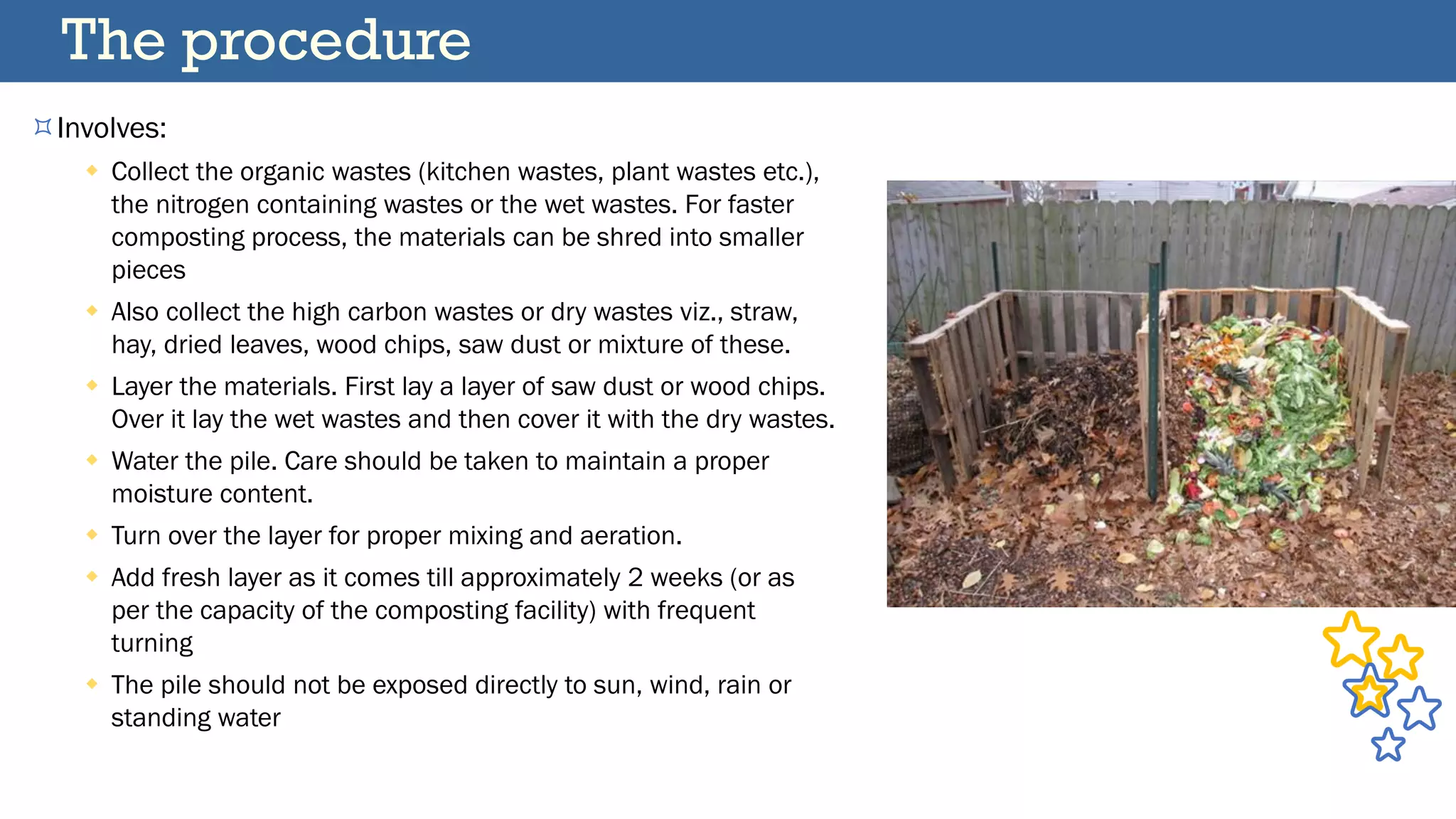
Involves:
 Collect the organic wastes (kitchen wastes, plant wastes etc.),
the nitrogen containing wastes or the wet wastes. For faster
composting process, the materials can be shred into smaller
pieces
 Also collect the high carbon wastes or dry wastes viz., straw,
hay, dried leaves, wood chips, saw dust or mixture of these.
 Layer the materials. First lay a layer of saw dust or wood chips.
Over it lay the wet wastes and then cover it with the dry wastes.
 Water the pile. Care should be taken to maintain a proper
moisture content.
 Turn over the layer for proper mixing and aeration.
 Add fresh layer as it comes till approximately 2 weeks (or as
per the capacity of the composting facility) with frequent
turning
 The pile should not be exposed directly to sun, wind, rain or
standing water
The procedure
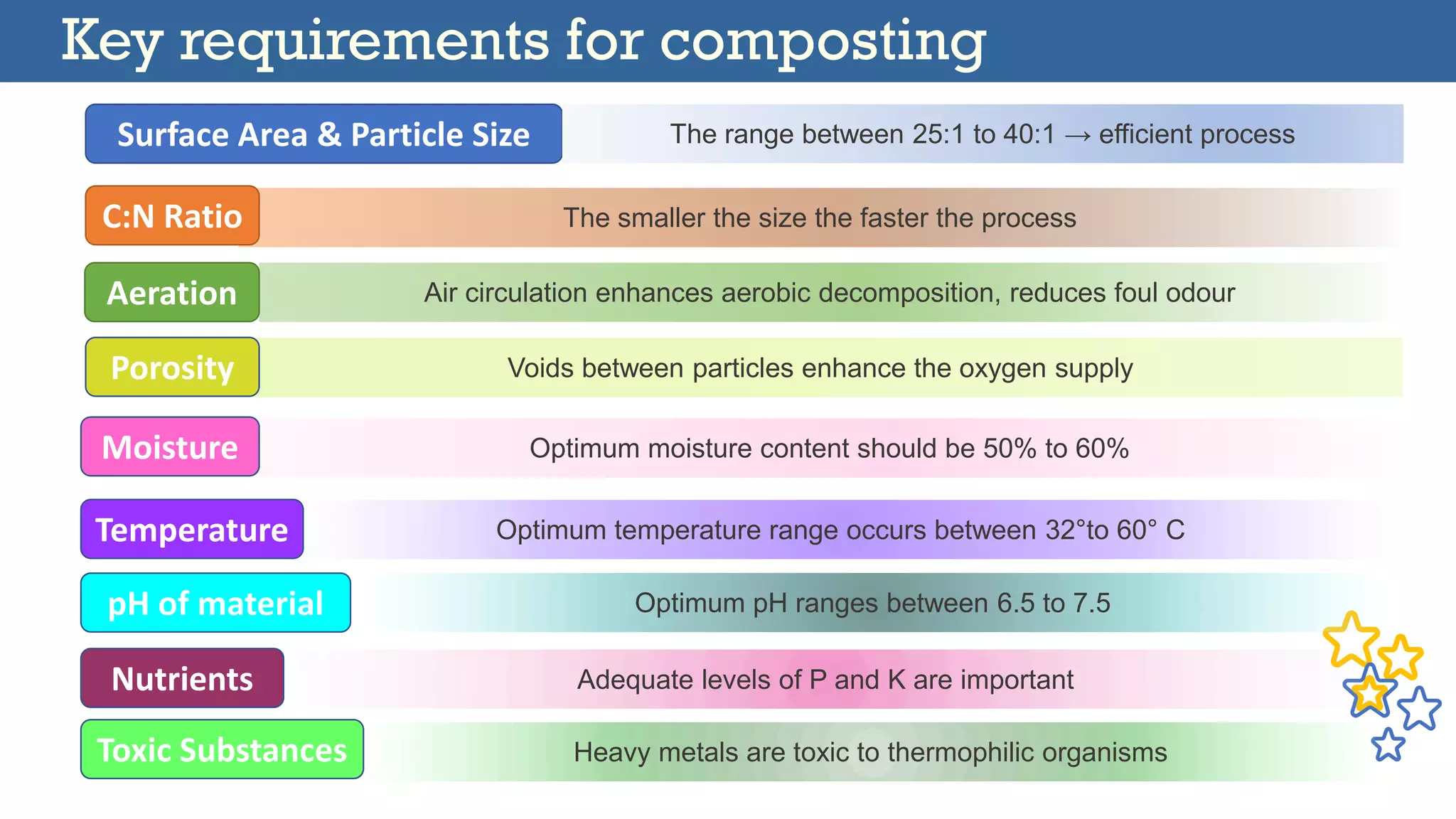
Heavy metals are toxic to thermophilic organisms
Adequate levels of P and K are important
Optimum pH ranges between 6.5 to 7.5
Voids between particles enhance the oxygen supply
Optimum temperature range occurs between 32°to 60° C
Optimum moisture content should be 50% to 60%
The smaller the size the faster the process
Air circulation enhances aerobic decomposition, reduces foul odour
Key requirements for composting
Surface Area & Particle Size
C:N Ratio
Aeration
Nutrients
Porosity
Moisture
Temperature
pH of material
Toxic Substances
The range between 25:1 to 40:1 → efficient process
What happens in a compost pile?
The composting process can be divided into two main
periods:
Active composting
oPeriod of vigorous microbial activity during which readily degradable
material is decomposed as well as some of the more decay-resistant
material, such as cellulose
Curing
oFollows active composting
oCharacterized by a lower level of microbial activity and the further
decomposition of the products of the active composting stage.
oWhen curing has reached its final stage, the compost is said to be
stabilized.
What happens in a compost pile?
The active composting period has three temperature
ranges.
These ranges are defined by the types of micro-
organisms that dominate the pile during those
temperatures and are called psychrophilic, mesophilic,
and thermophilic.
 Psychrophilic temperatures are generally defined as those
below 10⁰C
 Mesophilic between 10 and 45⁰C
 Thermophilic above 45⁰C.
Depending on the operation, the compost pile typically
takes from 2 to 3 days to increase beyond mesophilic
temperatures and reach the thermophilic stage of
composting
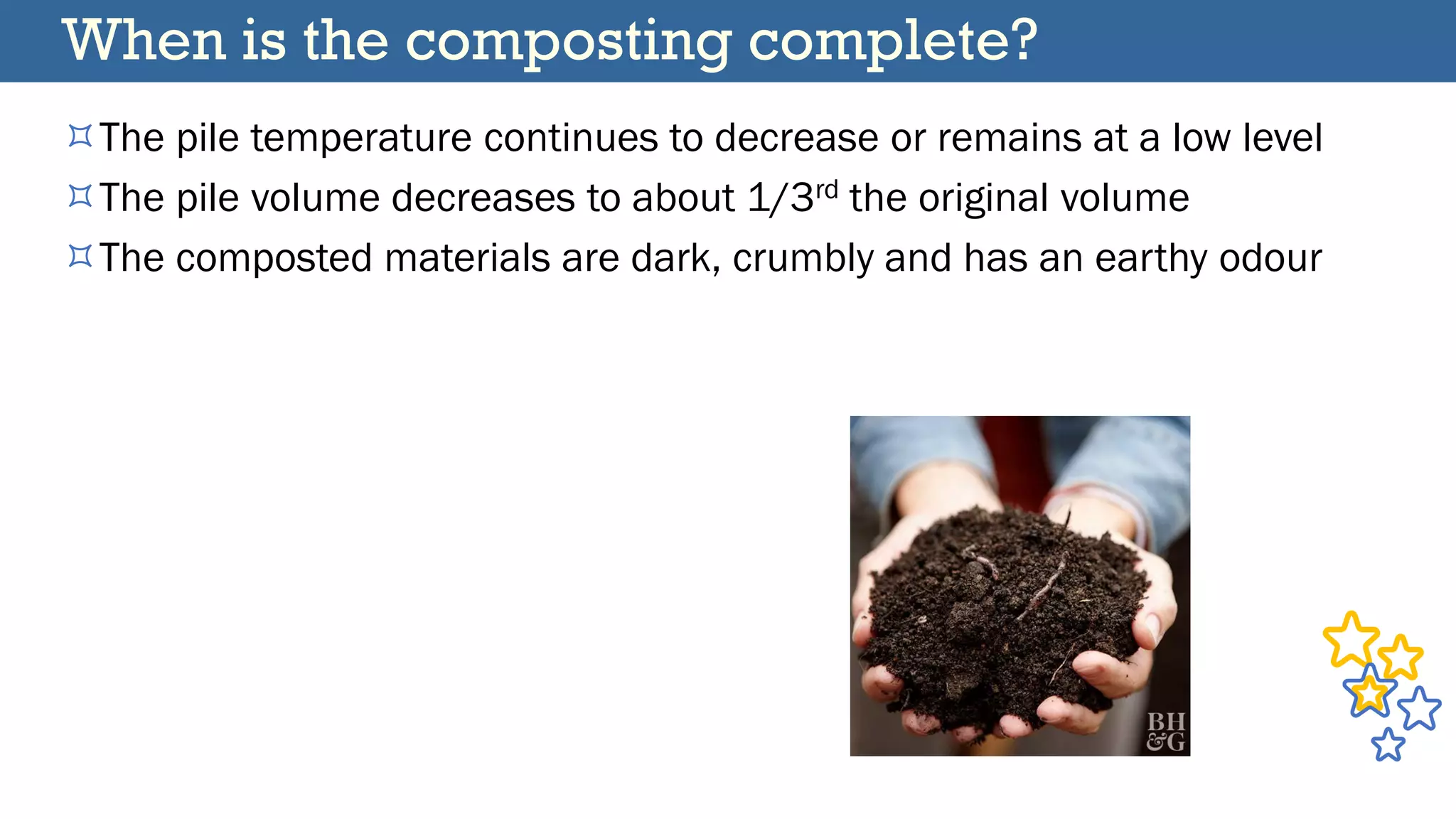
When is the composting complete?
The pile temperature continues to decrease or remains at a low level
The pile volume decreases to about 1/3rd the original volume
The composted materials are dark, crumbly and has an earthy odour
Ways of composting
Composting bins
Space friendly i.e. advantageous when space
availability is a concern
Expensive
Difficulty in turning
Has a limited capacity
Ways of composting
Home made
Three bins (if you have
enough garden space and
also have good amount of
garden waste)
o One for the fresh waste
o One for active decomposition
phase
o One for the curing of the
compost
Indian Khamba (Customized
& suitable for small living
spaces with not much
garden space i.e.
flats/apartments)
Ways of composting
Bin less pile
Just a pile with no partitions
Easy and nothing to build
Take several months to build the compost
Uncontrolled and hence there may be
pockets of non-decomposed waste
oHence risky for further usage.
Ways of composting
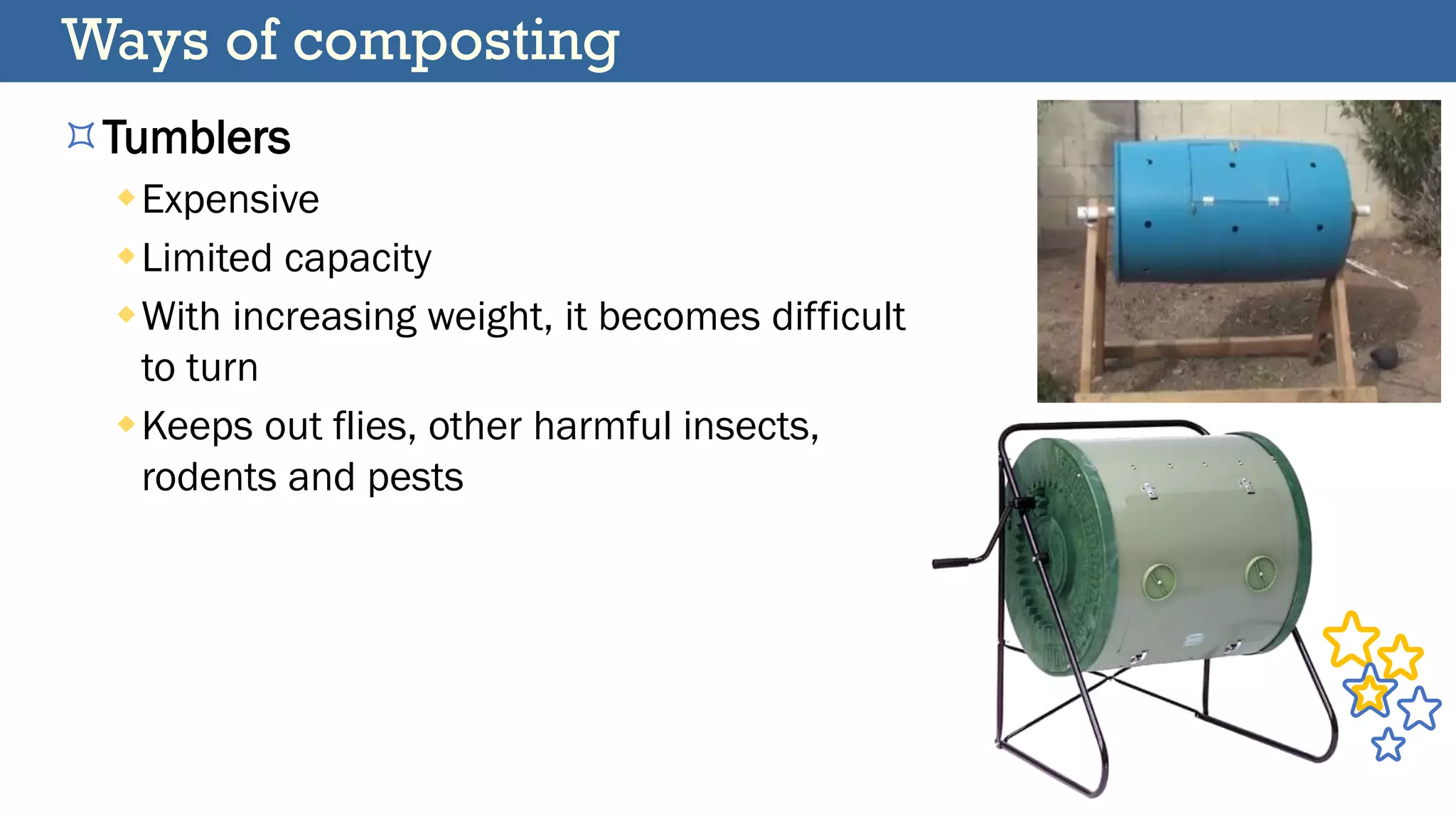
Tumblers
Expensive
Limited capacity
With increasing weight, it becomes difficult
to turn
Keeps out flies, other harmful insects,
rodents and pests
Ways of composting
Sheet Composting
 "Sheet composting" is an ideal early-fall
technique that makes use of abundant leaves.
o Removes spent plants from garden beds, layer on
kitchen scraps, shredded leaves, rotted straw, grass
clippings, and a bit of fertilizer to supply some
nitrogen. Dig or till it in, and by spring there will be
lots of earthworms and a few un-decomposed
chunks.
 Sheet composting is also a very good way to
reinvigorate a garden with poor or depleted soil.
 Benefits: Little effort or cost
 Disadvantages:
o Takes much longer than normal compost pile
o Carbon residues can take the nitrogen from soil for
decomposition or releases nitrogen in the wrong
form in the atmosphere
Ways of composting
Trench Composting
 Trenching is the act of burying the organic waste directly into garden soil.
 Advantage:
o It enables to compost meat, grains, dairy and cooked foods in addition to other kitchen scraps.
 The soil cover above the waste should be at least 30-45 cm.
 Disadvantage: takes a much longer time to decompose
Ways of composting
VermiComposting
Product of the composting process using
various species of worms, usually red
wigglers, white worms, and other
earthworms, to create a mixture of
decomposing vegetable or food waste,
bedding materials, and vermicast.
Worms eat on food wastes which gets
converted to compost as they pass
through the worms body
Advantages
Environmentally responsible
Reduce waste load on landfill and sewage plants
Reduce generation of methane emissions (the most dangerous
green house gas) from landfills and lowers carbon footprint
Alternative to burning
Gives a vibrant garden devoid of chemical fertilizers
Prevent soil erosion
Enriches soil
Helps retaining moisture and suppress plant diseases and pests
Can be used for Mine reclamation
Additional advantages
Development of a proper waste audit system
Development of a composting Culture
Development of a closer bond with nature
Development of a sense of social responsibility
https://www.o2compost.com/Userfiles/PDF/O2Compost_AASHE_Stars_Flyer.
pdf
http://dcmga.com/files/2012/10/soil-and-composting.pdf
https://www.nrcs.usda.gov/Internet/FSE_DOCUMENTS/nrcs143_022229.pdf
https://www.slideshare.net/ILSR/the-important-role-for-micro-and-community-
composting
http://greenmountainfarmtoschool.org/wp-content/uploads/2016/01/Guide-
to-Staring-a-School-Compost-Program.pdf
http://cpcb.nic.in/municipal-solid-waste-rules/
http://www.compost.org/English/free_webinars.html
Wikipedia
Resources

Composting making black gold for a sustainable living on an individual or community level

  • 1.
    Composting: Making theBlack Gold for a sustainable living on an individual or community level Dr. Sanghamitra Kundu
  • 2.
    What is Composting? Transformation of organic matter (food wastes, dry leaves, plant wastes, etc.) through decomposition into a biologically humus-rich substance which aids is soil conditioning.  Microorganisms (bacteria and fungi), invertebrates (insects and earthworms) helps in this composting process.
  • 3.
    What materials canbe composted? Greens/wets (N)  Vegetable scraps, fruits  Egg shells  Tea bags, tea leaves  Garden waste, flowers, clippings  Garden trimmings Browns/drys (C)  Dry leaves, dry plants  Shredded Paper, paper cups/plates (without the wax coating)  Sawdust  Coffee grounds and filters  Nut shells  Dryer lint  Pine cones Meat, dairy products, fats, pet poop, bones, diseased plants, chemical fertilizers/herbicide containing plants are to be avoided
  • 4.
    Involves:  Collect theorganic wastes (kitchen wastes, plant wastes etc.), the nitrogen containing wastes or the wet wastes. For faster composting process, the materials can be shred into smaller pieces  Also collect the high carbon wastes or dry wastes viz., straw, hay, dried leaves, wood chips, saw dust or mixture of these.  Layer the materials. First lay a layer of saw dust or wood chips. Over it lay the wet wastes and then cover it with the dry wastes.  Water the pile. Care should be taken to maintain a proper moisture content.  Turn over the layer for proper mixing and aeration.  Add fresh layer as it comes till approximately 2 weeks (or as per the capacity of the composting facility) with frequent turning  The pile should not be exposed directly to sun, wind, rain or standing water The procedure
  • 5.
    Heavy metals aretoxic to thermophilic organisms Adequate levels of P and K are important Optimum pH ranges between 6.5 to 7.5 Voids between particles enhance the oxygen supply Optimum temperature range occurs between 32°to 60° C Optimum moisture content should be 50% to 60% The smaller the size the faster the process Air circulation enhances aerobic decomposition, reduces foul odour Key requirements for composting Surface Area & Particle Size C:N Ratio Aeration Nutrients Porosity Moisture Temperature pH of material Toxic Substances The range between 25:1 to 40:1 → efficient process
  • 6.
    What happens ina compost pile? The composting process can be divided into two main periods: Active composting oPeriod of vigorous microbial activity during which readily degradable material is decomposed as well as some of the more decay-resistant material, such as cellulose Curing oFollows active composting oCharacterized by a lower level of microbial activity and the further decomposition of the products of the active composting stage. oWhen curing has reached its final stage, the compost is said to be stabilized.
  • 7.
    What happens ina compost pile? The active composting period has three temperature ranges. These ranges are defined by the types of micro- organisms that dominate the pile during those temperatures and are called psychrophilic, mesophilic, and thermophilic.  Psychrophilic temperatures are generally defined as those below 10⁰C  Mesophilic between 10 and 45⁰C  Thermophilic above 45⁰C. Depending on the operation, the compost pile typically takes from 2 to 3 days to increase beyond mesophilic temperatures and reach the thermophilic stage of composting
  • 8.
    When is thecomposting complete? The pile temperature continues to decrease or remains at a low level The pile volume decreases to about 1/3rd the original volume The composted materials are dark, crumbly and has an earthy odour
  • 9.
    Ways of composting Compostingbins Space friendly i.e. advantageous when space availability is a concern Expensive Difficulty in turning Has a limited capacity
  • 10.
    Ways of composting Homemade Three bins (if you have enough garden space and also have good amount of garden waste) o One for the fresh waste o One for active decomposition phase o One for the curing of the compost Indian Khamba (Customized & suitable for small living spaces with not much garden space i.e. flats/apartments)
  • 11.
    Ways of composting Binless pile Just a pile with no partitions Easy and nothing to build Take several months to build the compost Uncontrolled and hence there may be pockets of non-decomposed waste oHence risky for further usage.
  • 12.
    Ways of composting Tumblers Expensive Limitedcapacity With increasing weight, it becomes difficult to turn Keeps out flies, other harmful insects, rodents and pests
  • 13.
    Ways of composting SheetComposting  "Sheet composting" is an ideal early-fall technique that makes use of abundant leaves. o Removes spent plants from garden beds, layer on kitchen scraps, shredded leaves, rotted straw, grass clippings, and a bit of fertilizer to supply some nitrogen. Dig or till it in, and by spring there will be lots of earthworms and a few un-decomposed chunks.  Sheet composting is also a very good way to reinvigorate a garden with poor or depleted soil.  Benefits: Little effort or cost  Disadvantages: o Takes much longer than normal compost pile o Carbon residues can take the nitrogen from soil for decomposition or releases nitrogen in the wrong form in the atmosphere
  • 14.
    Ways of composting TrenchComposting  Trenching is the act of burying the organic waste directly into garden soil.  Advantage: o It enables to compost meat, grains, dairy and cooked foods in addition to other kitchen scraps.  The soil cover above the waste should be at least 30-45 cm.  Disadvantage: takes a much longer time to decompose
  • 15.
    Ways of composting VermiComposting Productof the composting process using various species of worms, usually red wigglers, white worms, and other earthworms, to create a mixture of decomposing vegetable or food waste, bedding materials, and vermicast. Worms eat on food wastes which gets converted to compost as they pass through the worms body
  • 16.
    Advantages Environmentally responsible Reduce wasteload on landfill and sewage plants Reduce generation of methane emissions (the most dangerous green house gas) from landfills and lowers carbon footprint Alternative to burning Gives a vibrant garden devoid of chemical fertilizers Prevent soil erosion Enriches soil Helps retaining moisture and suppress plant diseases and pests Can be used for Mine reclamation
  • 17.
    Additional advantages Development ofa proper waste audit system Development of a composting Culture Development of a closer bond with nature Development of a sense of social responsibility
  • 18.