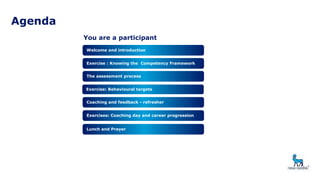
You are aparticipant
Welcome and introduction
Lunch and Prayer
The assessment process
Exercises: Coaching day and career progression
Coaching and feedback - refresher
Exercise : Knowing the Competency Framework
Agenda
Exercise: Behavioural targets
Mix & Mingle–
4
Nadine Abrahams
South Africa
Nadine has type 1 diabetes
5.
Everybody gets toknow what is
expected. Clear action-based
standards.
Prioritise development areas
based on current and Future
needs
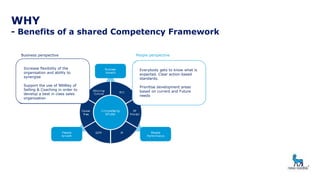
WHY
- Benefits of a shared Competency Framework
People perspective
Business perspective
Increase flexibility of the
organisation and ability to
synergise
Support the use of NNWay of
Selling & Coaching in order to
develop a best in class sales
organisation
P
resen t atio
ntit le Date
7
As we build our future together, use these tools to
develop your capabilities and achieve your goals
Novo Nordisk
8.
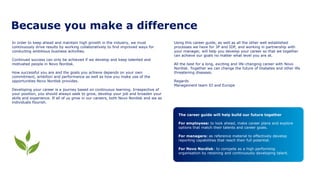
Because you makea difference
In order to keep ahead and maintain high growth in the industry, we must
continuously drive results by working collaboratively to find improved ways for
conducting ambitious business activities.
Continued success can only be achieved if we develop and keep talented and
motivated people in Novo Nordisk.
How successful you are and the goals you achieve depends on your own
commitment, ambition and performance as well as how you make use of the
opportunities Novo Nordisk provides.
Developing your career is a journey based on continuous learning. Irrespective of
your position, you should always seek to grow, develop your job and broaden your
skills and experience. If all of us grow in our careers, both Novo Nordisk and we as
individuals flourish.
Using this career guide, as well as all the other well established
processes we have for 3P and IDP, and working in partnership with
your manager, will help you develop your career so that we together
can achieve our goals no matter what level you are at.
All the best for a long, exciting and life-changing career with Novo
Nordisk. Together we can change the future of Diabetes and other life
threatening diseases.
Regards
Management team IO and Europe
The career guide will help build our future together
For employees: to look ahead, make career plans and explore
options that match their talents and career goals.
For managers: as reference material to effectively develop
reporting capabilities that reach their full potential.
For Novo Nordisk: to compete as a high performing
organisation by retaining and continuously developing talent.
9.
Content
1.0 Principles forprogression
2.0 Competencies fitting into the big picture of career development
3.0 Use of competencies for development
4.0 Progression criteria and process
5.0 The competency dictionary
10.
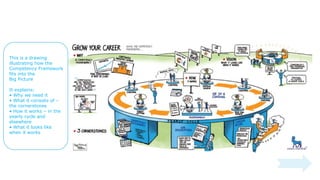
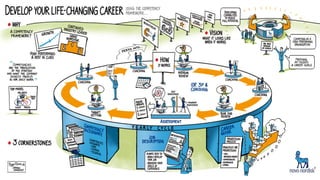
This is adrawing
illustrating how the
Competency Framework
fits into the
Big Picture
It explains:
• Why we need it
• What it consists of –
the cornerstones
• How it works – in the
yearly cycle and
elsewhere
• What it looks like
when it works
11.
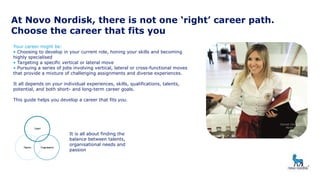
At Novo Nordisk,there is not one ‘right’ career path.
Choose the career that fits you
Your career might be:
• Choosing to develop in your current role, honing your skills and becoming
highly specialised
• Targeting a specific vertical or lateral move
• Pursuing a series of jobs involving vertical, lateral or cross-functional moves
that provide a mixture of challenging assignments and diverse experiences.
It all depends on your individual experiences, skills, qualifications, talents,
potential, and both short- and long-term career goals.
This guide helps you develop a career that fits you.
It is all about finding the
balance between talents,
organisational needs and
passion
Demet Derelioglu
Novo Nordisk
12.
1.0 Principles forcareer progression
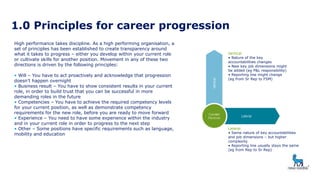
High performance takes discipline. As a high performing organisation, a
set of principles has been established to create transparency around
what it takes to progress – either you develop within your current role
or cultivate skills for another position. Movement in any of these two
directions is driven by the following principles:
• Will – You have to act proactively and acknowledge that progression
doesn’t happen overnight
• Business result – You have to show consistent results in your current
role, in order to build trust that you can be successful in more
demanding roles in the future
• Competencies – You have to achieve the required competency levels
for your current position, as well as demonstrate competency
requirements for the new role, before you are ready to move forward
• Experience – You need to have some experience within the industry
and in your current role in order to progress to the next step
• Other – Some positions have specific requirements such as language,
mobility and education
Vertical
• Nature of the key
accountabilities changes
• New key job dimensions might
be added (eg P&L responsibility)
• Reporting line might change
(eg from Sr Rep to FSM)
Lateral
• Same nature of key accountabilities
and job dimensions – but higher
complexity
• Reporting line usually stays the same
(eg from Rep to Sr Rep)
13.
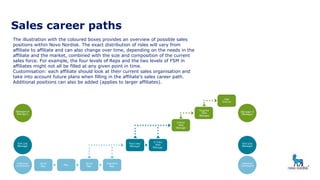
Sales career paths
Theillustration with the coloured boxes provides an overview of possible sales
positions within Novo Nordisk. The exact distribution of roles will vary from
affiliate to affiliate and can also change over time, depending on the needs in the
affiliate and the market, combined with the size and composition of the current
sales force. For example, the four levels of Reps and the two levels of FSM in
affiliates might not all be filled at any given point in time.
Customisation: each affiliate should look at their current sales organisation and
take into account future plans when filling in the affiliate’s sales career path.
Additional positions can also be added (applies to larger affiliates).
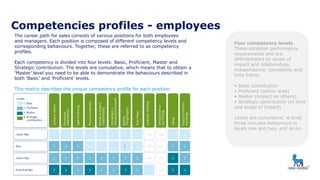
Competencies profiles -employees
The career path for sales consists of various positions for both employees
and managers. Each position is composed of different competency levels and
corresponding behaviours. Together, these are referred to as competency
profiles.
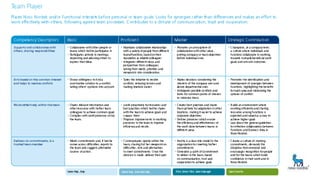
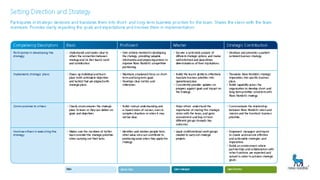
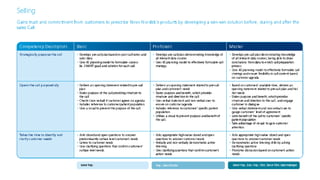
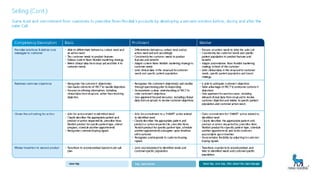
Each competency is divided into four levels: Basic, Proficient, Master and
Strategic contribution. The levels are cumulative, which means that to obtain a
‘Master’ level you need to be able to demonstrate the behaviours described in
both ‘Basic’ and ‘Proficient’ levels.
This matrix describes the unique competency profile for each position.
Four competency levels
These establish performance
requirements and are
differentiated by scope of
impact and relationships,
independence, complexity and
time frame.
• Basic contribution
• Proficient (within area)
• Master (impact on others)
• Strategic contribution (in time
and scope of impact)
Levels are cumulative, ie level
three includes behaviours in
levels one and two, and so on.
16.
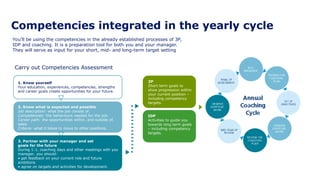
Competencies integrated inthe yearly cycle
You’ll be using the competencies in the already established processes of 3P,
IDP and coaching. It is a preparation tool for both you and your manager.
They will serve as input for your short, mid- and long-term target setting
Carry out Competencies Assessment
1. Know yourself
Your education, experiences, competencies, strengths
and career goals create opportunities for your future.
2. Know what is expected and possible
Job description: what the job consist of.
Competencies: the behaviours needed for the job.
Career path: the opportunities within, and outside of,
sales.
Criteria: what it takes to move to other positions.
3. Partner with your manager and set
goals for the future
During 1:1, coaching days and other meetings with you
manager, you should:
• get feedback on your current role and future
ambitions
• agree on targets and activities for development.
3P
Short term goals to
show progression within
your current position –
including competency
targets.
IDP
Activities to guide you
towards long term goals
– including competency
targets.
17.
3.0 Use ofcompetencies
for development
Gokcen Bayraktar
Novo Nordisk
The following scenarios describe how and
when to use the competencies together with your
manager. They build upon well established processes
in the company. Each of the scenarios focuses only on
the competency part of the processes. The remaining
steps are to be carried out as usual.
18.
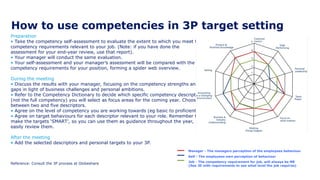
How to usecompetencies in 3P target setting
Preparation
• Take the competency self-assessment to evaluate the extent to which you meet the
competency requirements relevant to your job. (Note: if you have done the
assessment for your end-year review, use that report).
• Your manager will conduct the same evaluation.
• Your self-assessment and your manager’s assessment will be compared with the
competency requirements for your position, forming a spider web overview.
During the meeting
• Discuss the results with your manager, focusing on the competency strengths and
gaps in light of business challenges and personal ambitions.
• Refer to the Competency Dictionary to decide which specific competency descriptors
(not the full competency) you will select as focus areas for the coming year. Choose
between two and five descriptors.
• Agree on the level of competency you are working towards (eg basic to proficient)
• Agree on target behaviours for each descriptor relevant to your role. Remember to
make the targets ‘SMART’, so you can use them as guidance throughout the year, and
easily review them.
After the meeting
• Add the selected descriptors and personal targets to your 3P.
Reference: Consult the 3P process at Globeshare
Manager - The managers perception of the employees behaviour
Self - The employees own perception of behaviour
Job - The competency requirement for job, will always be ME
(See JD with requirements to see what level the job requires)
19.
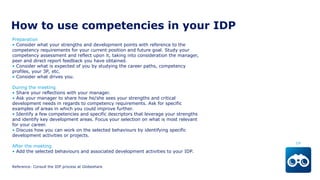
How to usecompetencies in your IDP
Preparation
• Consider what your strengths and development points with reference to the
competency requirements for your current position and future goal. Study your
competency assessment and reflect upon it, taking into consideration the manager,
peer and direct report feedback you have obtained.
• Consider what is expected of you by studying the career paths, competency
profiles, your 3P, etc.
• Consider what drives you.
During the meeting
• Share your reflections with your manager.
• Ask your manager to share how he/she sees your strengths and critical
development needs in regards to competency requirements. Ask for specific
examples of areas in which you could improve further.
• Identify a few competencies and specific descriptors that leverage your strengths
and identify key development areas. Focus your selection on what is most relevant
for your career.
• Discuss how you can work on the selected behaviours by identifying specific
development activities or projects.
After the meeting
• Add the selected behaviours and associated development activities to your IDP.
Reference: Consult the IDP process at Globeshare
20.
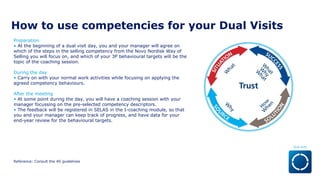
How to usecompetencies for your Dual Visits
Preparation
• At the beginning of a dual visit day, you and your manager will agree on
which of the steps in the selling competency from the Novo Nordisk Way of
Selling you will focus on, and which of your 3P behavioural targets will be the
topic of the coaching session.
During the day
• Carry on with your normal work activities while focusing on applying the
agreed competency behaviours.
After the meeting
• At some point during the day, you will have a coaching session with your
manager focussing on the pre-selected competency descriptors.
• The feedback will be registered in SELAS in the I-coaching module, so that
you and your manager can keep track of progress, and have data for your
end-year review for the behavioural targets.
Reference: Consult the 4S guidelines
21.
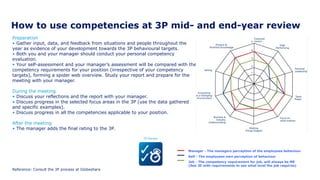
How to usecompetencies at 3P mid- and end-year review
Preparation
• Gather input, data, and feedback from situations and people throughout the
year as evidence of your development towards the 3P behavioural targets.
• Both you and your manager should conduct your personal competency
evaluation.
• Your self-assessment and your manager’s assessment will be compared with the
competency requirements for your position (irrespective of your competency
targets), forming a spider web overview. Study your report and prepare for the
meeting with your manager.
During the meeting
• Discuss your reflections and the report with your manager.
• Discuss progress in the selected focus areas in the 3P (use the data gathered
and specific examples).
• Discuss progress in all the competencies applicable to your position.
After the meeting
• The manager adds the final rating to the 3P.
Reference: Consult the 3P process at Globeshare
Manager - The managers perception of the employees behaviour
Self - The employees own perception of behaviour
Job - The competency requirement for job, will always be ME
(See JD with requirements to see what level the job requires)
22.
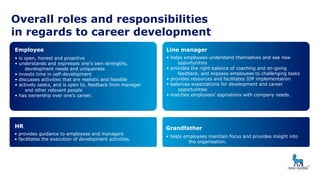
Overall roles andresponsibilities
in regards to career development
• helps employees understand themselves and see new
opportunities
• provides the right balance of coaching and on-going
feedback, and exposes employees to challenging tasks
• provides resources and facilitates IDP implementation
• balances expectations for development and career
opportunities
• matches employees’ aspirations with company needs.
Line manager
• is open, honest and proactive
• understands and expresses one’s own strengths,
development needs and uniqueness
• invests time in self-development
• discusses activities that are realistic and feasible
• actively seeks, and is open to, feedback from manager
and other relevant people
• has ownership over one’s career.
Employee
• helps employees maintain focus and provides insight into
the organisation.
Grandfather
• provides guidance to employees and managers
• facilitates the execution of development activities.
HR
23.
4.0 Progression criteria
andprocess
Present
ation
title
Slide
No 23
Date
Progression is about movement – it can be in
any direction, upwards or side wards. What is
important is not the direction, but identifying
your next step and exploring how to get there.
Idil Bayro
Novo Nordisk
24.
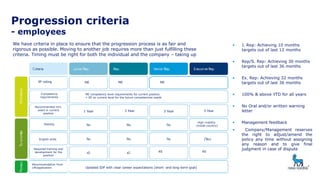
Progression criteria
- employees
Wehave criteria in place to ensure that the progression process is as fair and
rigorous as possible. Moving to another job requires more than just fulfilling these
criteria. Timing must be right for both the individual and the company – taking up
a progression too soon is setting yourself up for failure. A standardised progression
process will ensure all relevant factors are taken into consideration.
3P rating n/a
n/a
4S 4S
ME ME
Competency
requirements
ME competency level requirements for current position,
+ EE on current level for the future competencies needs
Recommended min.
years in current
position
Mobility
English skills
Required training and
development for the
position
Recommendation from
LM/application Updated IDP with clear career expectations (short- and long-term goal)
High mobility
(inside country)
ME
1 Year 3 Year 3 Year 3 Year
• J. Rep: Achieving 10 months
targets out of last 12 months
• Rep/S. Rep: Achieving 30 months
targets out of last 36 months
• Ex. Rep: Achieving 32 months
targets out of last 36 months
• 100% & above YTD for all years
• No Oral and/or written warning
letter
• Management feedback
• Company/Management reserves
the right to adjust/amend the
policy any time without assigning
any reason and to give final
judgment in case of dispute
25.
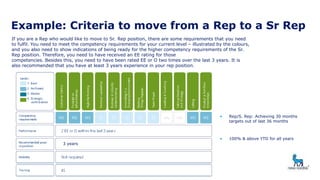
Example: Criteria tomove from a Rep to a Sr Rep
If you are a Rep who would like to move to Sr. Rep position, there are some requirements that you need
to fulfil. You need to meet the competency requirements for your current level – illustrated by the colours,
and you also need to show indications of being ready for the higher competency requirements of the Sr.
Rep position. Therefore, you need to have received an EE rating for those
competencies. Besides this, you need to have been rated EE or O two times over the last 3 years. It is
also recommended that you have at least 3 years experience in your rep position.
3 years
• Rep/S. Rep: Achieving 30 months
targets out of last 36 months
• 100% & above YTD for all years
26.
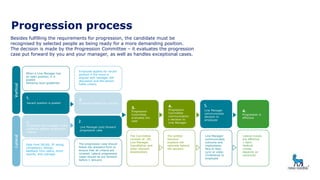
Progression process
Besides fulfillingthe requirements for progression, the candidate must be
recognised by selected people as being ready for a more demanding position.
The decision is made by the Progression Committee – it evaluates the progression
case put forward by you and your manager, as well as handles exceptional cases.
When a Line Manager has
an open position, it is
posted
following local guidelines
Employee applies for vacant
position if the move is
aligned with manager IDP
discussion and the person
fulfils criteria
Data from SELAS, 3P rating,
competency ratings,
feedback from peers, direct
reports, and manager
The progression case should
follow the standard form to
ensure that all criteria are
covered. Lateral progression
cases should be put forward
before 1 January.
The Committee
consists of: HR,
Line Manager,
Grandfather and
other relevant
stakeholders
The written
Decision
explains the
rationale behind
the decision
Line Manager
communicates
outcome and
implications
face to face,
Lync or video
Conference to
employee
Lateral moves
are effective
1 April.
Vertical
moves
depends on
vacancies
Vacant position is posted
Line Manager puts forward
progression case
Line Manager
communicates
decision to
employee
3.
Progression
Committee
evaluates the
case
4.
Progression
Committee
communication
s decision to
Line Manager
4.
Progression is
effective
2.
Employee applies for position
1.
Employee and manager collect
evidence against progression
criteria
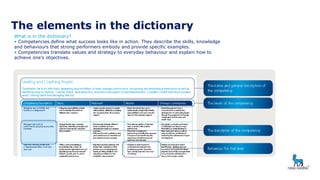
The elements inthe dictionary
What is in the dictionary?
• Competencies define what success looks like in action. They describe the skills, knowledge
and behaviours that strong performers embody and provide specific examples.
• Competencies translate values and strategy to everyday behaviour and explain how to
achieve one’s objectives.
29.
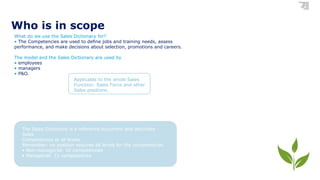
Who is inscope
Present
ation
title
Slide
No 29
Date
What do we use the Sales Dictionary for?
• The Competencies are used to define jobs and training needs, assess
performance, and make decisions about selection, promotions and careers.
The model and the Sales Dictionary are used by
• employees
• managers
• P&O.
Applicable to the whole Sales
Function: Sales Force and other
Sales positions.
The Sales Dictionary is a reference document and describes
Sales
Competencies at all levels.
Remember: no position requires all levels for the competencies.
• Non-managerial: 10 competencies
• Managerial: 12 competencies
30.
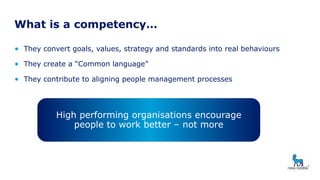
What is acompetency…
• They convert goals, values, strategy and standards into real behaviours
• They create a “Common language”
• They contribute to aligning people management processes
High performing organisations encourage
people to work better – not more
31.
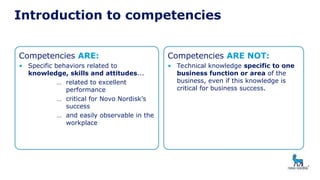
Competencies ARE:
• Specificbehaviors related to
knowledge, skills and attitudes...
… related to excellent
performance
… critical for Novo Nordisk’s
success
… and easily observable in the
workplace
Competencies ARE NOT:
• Technical knowledge specific to one
business function or area of the
business, even if this knowledge is
critical for business success.
Introduction to competencies
32.
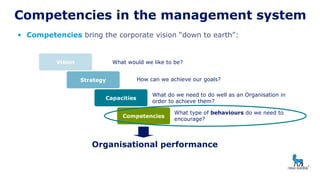
Competencies in themanagement system
• Competencies bring the corporate vision “down to earth”:
Capacitates
How can we achieve our goals?
What do we need to do well as an Organisation in
order to achieve them?
What type of behaviours do we need to
encourage?
Organisational performance
What would we like to be?
Vision
Strategy
Capacities
Competencies
33.
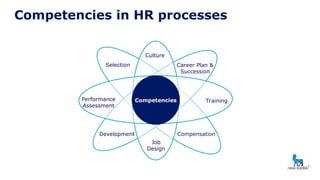
Competencies
Selection Career Plan&
Succession
Compensation
Performance
Assessment
Training
Job
Design
Development
Culture
Competencies in HR processes
34.
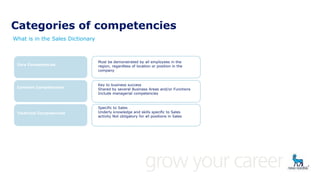
Categories of competencies
Whatis in the Sales Dictionary
Core Competencies
Common Competencies
Technical Competencies
Must be demonstrated by all employees in the
region, regardless of location or position in the
company
Key to business success
Shared by several Business Areas and/or Functions
Include managerial competencies
Specific to Sales
Underly knowledge and skills specific to Sales
activity Not obligatory for all positions in Sales
35.
The sales competencies
-EU
Present
ation
title
Slide
No 35
Date
Core
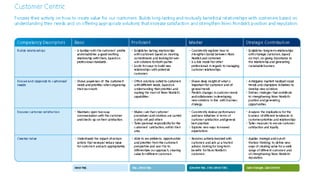
• Customer Centric
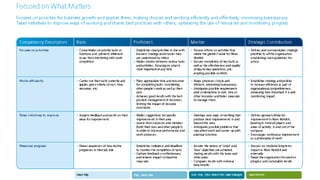
• Focused on What Matters
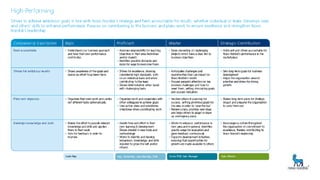
• High-Performing
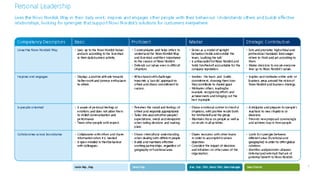
• Personal Leadership
Common
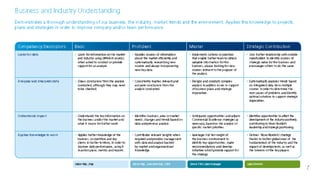
• Business & Industry Understanding
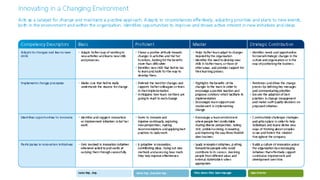
• Innovating in a Changing Environment
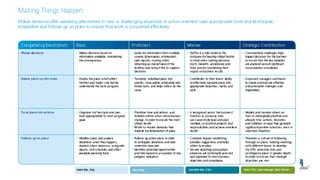
• Making Things Happen
• Team Player
Technical (function specific)
• Selling (Sales)
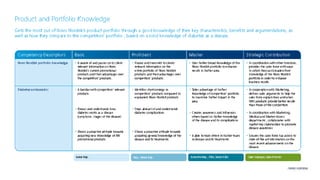
• Product & Portfolio Knowledge (Sales)
Managerial Competencies (only for managers)
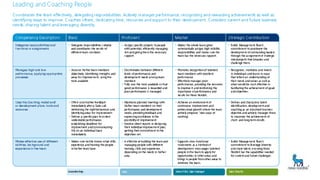
• Setting Direction and Strategy
• Leading and Coaching People
36.
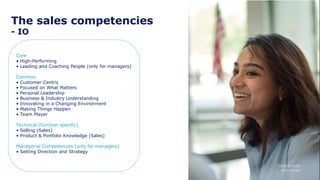
The sales competencies
-IO
Present
ation
title
Slide
No 36
Date
Core
• High-Performing
• Leading and Coaching People (only for managers)
Common
• Customer Centric
• Focused on What Matters
• Personal Leadership
• Business & Industry Understanding
• Innovating in a Changing Environment
• Making Things Happen
• Team Player
Technical (function specific)
• Selling (Sales)
• Product & Portfolio Knowledge (Sales)
Managerial Competencies (only for managers)
• Setting Direction and Strategy
37.
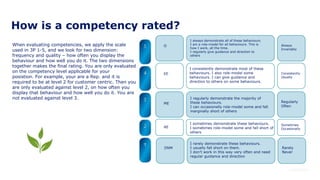
How is acompetency rated?
When evaluating competencies, we apply the scale
used in 3P 1-5, and we look for two dimension:
frequency and quality – how often you display the
behaviour and how well you do it. The two dimensions
together makes the final rating. You are only evaluated
on the competency level applicable for your
posistion. For example, your are a Rep. and it is
required to be at level 2 for customer centric. Then you
are only evaluated against level 2, on how often you
display that behaviour and how well you do it. You are
not evaluated against level 3.
O
EE
ME
AE
DNM
I always demonstrate all of these behaviours.
I am a role-model for all behaviours. This is
how I work, all the time.
I regularly give guidance and direction to
others
I consistently demonstrate most of these
behaviours. I also role-model some
behaviours. I can give guidance and
direction to others on some behaviours.
I regularly demonstrate the majority of
these behaviours.
I can occasionally role-model some and fall
marginally short of others
I sometimes demonstrate these behaviours.
I sometimes role-model some and fall short of
others
I rarely demonstrate these behaviours.
I usually fall short on them.
I don’t work in this way very often and need
regular guidance and direction
Always
Invariably
Consistently
Usually
Regularly
Often
Sometimes
Occasionally
Rarely
Never
38.
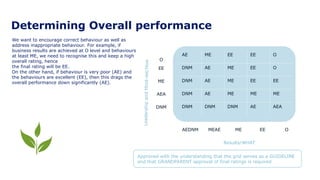
Determining Overall performance
Wewant to encourage correct behaviour as well as
address inappropriate behaviour. For example, if
business results are achieved at O level and behaviours
at least ME, we need to recognise this and keep a high
overall rating, hence
the final rating will be EE.
On the other hand, if behaviour is very poor (AE) and
the behaviours are excellent (EE), then this drags the
overall performance down significantly (AE).
AE ME EE EE O
DNM AE ME EE O
DNM AE ME EE EE
DNM AE ME ME ME
DNM DNM DNM AE AEA
O
EE
ME
AEA
DNM
AEDNM MEAE ME EE O
Leaders
hip
and
Mind
-set/H
ow
Results/WHAT
Approved with the understanding that the grid serves as a GUIDELINE
and that GRANDPARENT approval of final ratings is required
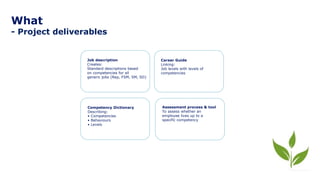
What
- Project deliverables
CompetencyDictionary
Describing:
• Competencies
• Behaviours
• Levels
Job description
Creates:
Standard descriptions based
on competencies for all
generic jobs (Rep, FSM, SM, SD)
Career Guide
Linking:
Job levels with levels of
competencies
Assessment process & tool
To assess whether an
employee lives up to a
specific competency
54.
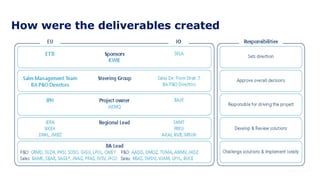
How were thedeliverables created
The deliverables are based on best practices from the Business Areas. They are created
at a workshop with selected Sales and P&O employees in the regions, and reviewed by
a larger number of employees from these same departments of all BAs.
55.
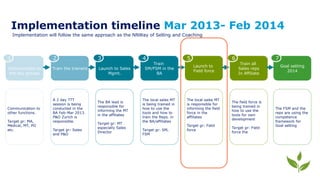
Implementation timeline Mar2013- Feb 2014
Implementation will follow the same approach as the NNWay of Selling and Coaching
Communicate to
the key groups
1
Train the trainers
2
Launch to Sales
Mgmt.
3
Train
SM/FSM in the
BA
4
Launch to
Field force
5
Train all
Sales reps
In Affiliate
6
Goal setting
2014
7
Communication to
other functions.
Target gr: MA,
Medical, MT, PO
etc.
A 2 day TTT
session is being
conducted in the
BA Feb-Mar 2013.
P&O Zurich is
responsible.
Target gr: Sales
and P&O
The BA lead is
responsible for
informing the MT
in the affiliates
Target gr: MT
especially Sales
Director
The local sales MT
is being trained in
how to use the
tools and how to
train the Reps. in
the BA/affiliates
Target gr: SM,
FSMSM/SFM in the
BA
The local sales MT
is responsible for
informing the field
force in the
affiliates
Target gr: Field
force
to
Field force
The field force is
being trained in
how to use the
tools for own
development
Target gr: Field
force the Affiliate
The FSM and the
reps are using the
competence
framework for
Goal setting
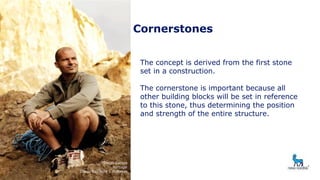
Cornerstones
Diogo Santos
Portugal
Diogo hastype 1 diabetes
The concept is derived from the first stone
set in a construction.
The cornerstone is important because all
other building blocks will be set in reference
to this stone, thus determining the position
and strength of the entire structure.
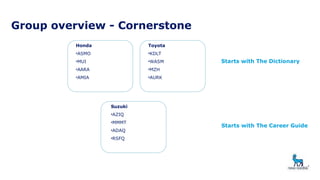
60.
Group overview -Cornerstone
Honda
•ASMO
•MUI
•AARA
•AMIA
Toyota
•KDLT
•WASM
•MZH
•AURK
Suzuki
•AZIQ
•MMMT
•ADAQ
•RSFQ
Starts with The Dictionary
Starts with The Career Guide
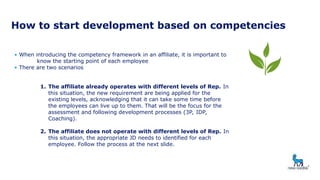
How to startdevelopment based on competencies
• When introducing the competency framework in an affiliate, it is important to
know the starting point of each employee
• There are two scenarios
1. The affiliate already operates with different levels of Rep. In
this situation, the new requirement are being applied for the
existing levels, acknowledging that it can take some time before
the employees can live up to them. That will be the focus for the
assessment and following development processes (3P, IDP,
Coaching).
2. The affiliate does not operate with different levels of Rep. In
this situation, the appropriate JD needs to identified for each
employee. Follow the process at the next slide.
63.
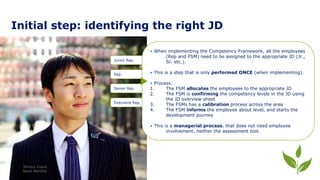
Initial step: identifyingthe right JD
Shinya Inoue
Novo Nordisk
Rep.
Senior Rep.
Executive Rep.
Junior Rep.
• When implementing the Competency Framework, all the employees
(Rep and FSM) need to be assigned to the appropriate JD (Jr.,
Sr. etc.).
• This is a step that is only performed ONCE (when implementing).
• Process:
1. The FSM allocates the employees to the appropriate JD
2. The FSM is confirming the competency levels in the JD using
the JD overview sheet
3. The FSMs has a calibration process across the area
4. The FSM informs the employee about level, and starts the
development journey
• This is a managerial process, that does not need employee
involvement, neither the assessment tool.
64.
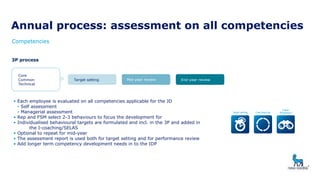
Annual process: assessmenton all competencies
Competencies
3P process
Core
Common
Technical
Target setting Mid-year review End-year review
• Each employee is evaluated on all competencies applicable for the JD
- Self assessment
- Managerial assessment
• Rep and FSM select 2-3 behaviours to focus the development for
• Individualised behavioural targets are formulated and incl. in the 3P and added in
the I-coaching/SELAS
• Optional to repeat for mid-year
• The assessment report is used both for target setting and for performance review
• Add longer term competency development needs in to the IDP
65.
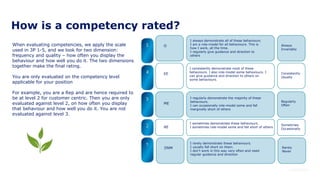
How is acompetency rated?
When evaluating competencies, we apply the scale
used in 3P 1-5, and we look for two dimension:
frequency and quality – how often you display the
behaviour and how well you do it. The two dimensions
together make the final rating.
You are only evaluated on the competency level
applicable for your position
For example, you are a Rep and are hence required to
be at level 2 for customer centric. Then you are only
evaluated against level 2, on how often you display
that behaviour and how well you do it. You are not
evaluated against level 3.
O
EE
ME
AE
DNM
I always demonstrate all of these behaviours.
I am a role-model for all behaviours. This is
how I work, all the time.
I regularly give guidance and direction to
others
I consistently demonstrate most of these
behaviours. I also role-model some behaviours. I
can give guidance and direction to others on
some behaviours.
I regularly demonstrate the majority of these
behaviours.
I can occasionally role-model some and fall
marginally short of others
I sometimes demonstrate these behaviours.
I sometimes role-model some and fall short of others
I rarely demonstrate these behaviours.
I usually fall short on them.
I don’t work in this way very often and need
regular guidance and direction
Always
Invariably
Consistently
Usually
Regularly
Often
Sometimes
Occasionally
Rarely
Never
1
2
3
4
5
66.
O
EE
ME
AE
DNM
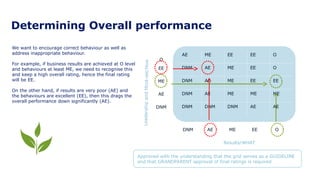
Determining Overall performance
Wewant to encourage correct behaviour as well as
address inappropriate behaviour.
For example, if business results are achieved at O level
and behaviours at least ME, we need to recognise this
and keep a high overall rating, hence the final rating
will be EE.
On the other hand, if results are very poor (AE) and
the behaviours are excellent (EE), then this drags the
overall performance down significantly (AE).
AE ME EE EE O
DNM AE ME EE O
DNM AE ME EE EE
DNM AE ME ME ME
DNM DNM DNM AE AE
DNM AE ME EE O
Leaders
hip
and
Mind
-set/H
ow
Results/WHAT
Approved with the understanding that the grid serves as a GUIDELINE
and that GRANDPARENT approval of final ratings is required
67.
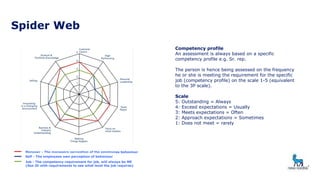
Spider Web
Competency profile
Anassessment is always based on a specific
competency profile e.g. Sr. rep.
The person is hence being assessed on the frequency
he or she is meeting the requirement for the specific
job (competency profile) on the scale 1-5 (equivalent
to the 3P scale).
Scale
5: Outstanding = Always
4: Exceed expectations = Usually
3: Meets expectations = Often
2: Approach expectations = Sometimes
1: Does not meet = rarely
Manager - The managers perception of the employees behaviour
Self - The employees own perception of behaviour
Job - The competency requirement for job, will always be ME
(See JD with requirements to see what level the job requires)
68.
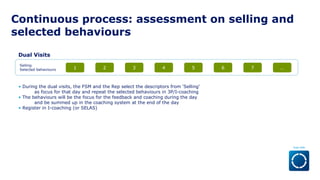
Continuous process: assessmenton selling and
selected behaviours
Dual Visits
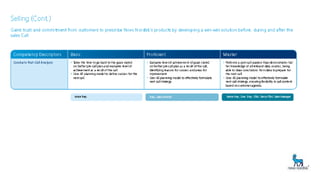
Selling
Selected behaviours 6
4
3
2
1 5 7 …
• During the dual visits, the FSM and the Rep select the descriptors from ‘Selling’
as focus for that day and repeat the selected behaviours in 3P/I-coaching
• The behaviours will be the focus for the feedback and coaching during the day
and be summed up in the coaching system at the end of the day
• Register in I-coaching (or SELAS)
How to applycompetencies in real life
• You will now apply the competencies in
different scenarios
1. Target setting
2. Coaching day
3. Career progression
• You are encouraged to use all available
material to solve the task
72.
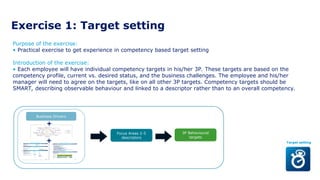
Exercise 1: Targetsetting
Purpose of the exercise:
• Practical exercise to get experience in competency based target setting
Introduction of the exercise:
• Each employee will have individual competency targets in his/her 3P. These targets are based on the
competency profile, current vs. desired status, and the business challenges. The employee and his/her
manager will need to agree on the targets, like on all other 3P targets. Competency targets should be
SMART, describing observable behaviour and linked to a descriptor rather than to an overall competency.
Target setting
+
+
Business Drivers
Focus Areas 2-5
descriptors
3P Behavioural
targets
73.
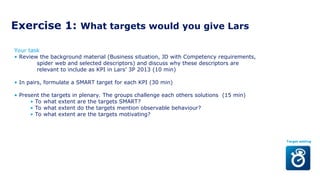
Exercise 1: Whattargets would you give Lars
Your task
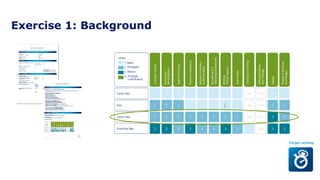
• Review the background material (Business situation, JD with Competency requirements,
spider web and selected descriptors) and discuss why these descriptors are
relevant to include as KPI in Lars’ 3P 2013 (10 min)
• In pairs, formulate a SMART target for each KPI (30 min)
• Present the targets in plenary. The groups challenge each others solutions (15 min)
• To what extent are the targets SMART?
• To what extent do the targets mention observable behaviour?
• To what extent are the targets motivating?
Target setting
74.
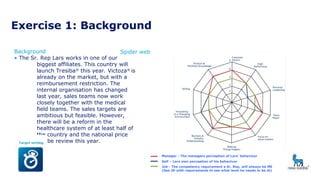
Exercise 1: Background
Background
•The Sr. Rep Lars works in one of our
biggest affiliates. This country will
launch Tresiba®
this year. Victoza®
is
already on the market, but with a
reimbursement restriction. The
internal organisation has changed
last year, sales teams now work
closely together with the medical
field teams. The sales targets are
ambitious but feasible. However,
there will be a reform in the
healthcare system of at least half of
the country and the national price
will be review this year.
Spider web
Manager - The managers perception of Lars’ behaviour
Self – Lars own perception of his behaviuor
Job - The competency requirement a Sr. Rep, will always be ME
(See JD with requirements to see what level he needs to be at)
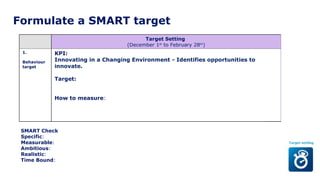
Target Setting
(December 1st
toFebruary 28th
)
1.
Behaviour
target
KPI:
Innovating in a Changing Environment - Identifies opportunities to
innovate.
Target:
How to measure:
SMART Check
Specific:
Measurable:
Ambitious:
Realistic:
Time Bound:
Formulate a SMART target
77.
Target Setting
(December 1st
toFebruary 28th
)
1.
Behaviour
target
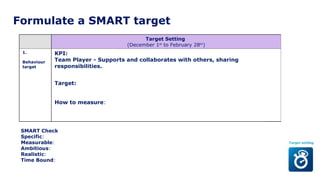
KPI:
Team Player - Supports and collaborates with others, sharing
responsibilities.
Target:
How to measure:
SMART Check
Specific:
Measurable:
Ambitious:
Realistic:
Time Bound:
Formulate a SMART target
78.
Target Setting
(December 1st
toFebruary 28th
)
1.
Behaviour
target
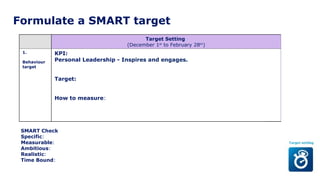
KPI:
Personal Leadership - Inspires and engages.
Target:
How to measure:
SMART Check
Specific:
Measurable:
Ambitious:
Realistic:
Time Bound:
Formulate a SMART target
79.
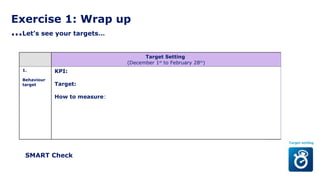
Exercise 1: Wrapup
…Let’s see your targets…
Target Setting
(December 1st
to February 28th
)
1.
Behaviour
target
KPI:
Target:
How to measure:
SMART Check
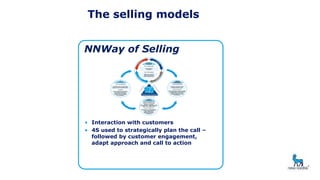
The selling models
NNWayof Selling
• Interaction with customers
• 4S used to strategically plan the call –
followed by customer engagement,
adapt approach and call to action
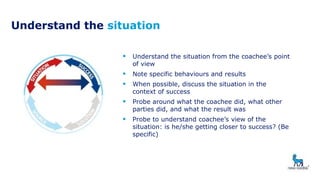
Understand the situation
•Understand the situation from the coachee’s point
of view
• Note specific behaviours and results
• When possible, discuss the situation in the
context of success
• Probe around what the coachee did, what other
parties did, and what the result was
• Probe to understand coachee’s view of the
situation: is he/she getting closer to success? (Be
specific)
85.
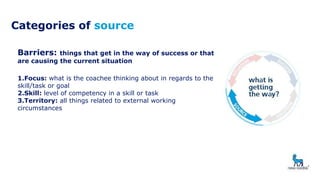
Categories of source
Barriers:things that get in the way of success or that
are causing the current situation
1.Focus: what is the coachee thinking about in regards to the
skill/task or goal
2.Skill: level of competency in a skill or task
3.Territory: all things related to external working
circumstances
86.
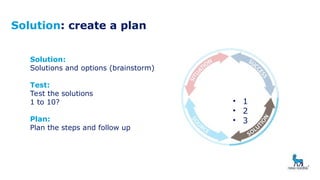
Solution: create aplan
Solution:
Solutions and options (brainstorm)
Test:
Test the solutions
1 to 10?
Plan:
Plan the steps and follow up
• 1
• 2
• 3
#1 Not to include in the PRINTED trainers manual – only for the presentation
Based on Trainer manual ver 14
#3 As an ambassador, you have to kick the TTT off in an inspiring way. You have to stimulate the audience’s interest for the topic, make them curious and eager to start working.
We suggest that you focus on two elements:
• The benefits of this (slide 2)
• A personal story from you (slide 3), where you show what this means in real life for real people, not just the corporate lingo.
Feel free to adjust the slides as you like, as long as you do not create messy or complicated slides. Remember, your role is to inspire and point out the importance of the workshop. Don’t mind the details in the programme – the facilitators will explain them later.
The facilitator: interview the ambassador, in order to reinforce the key messages: GM/P&O Dir, Sales/P&O etc
#5 Working with a shared model across functions and BAs implies a series of benefits both from a business and a
people perspective:
• Focus, alignment and performance,
shared identity and flexibility are some
of the key benefits for the business.
• Expectations and priorities, as well as
clear routes for growth, will be clearer
for all Novo Nordisk employees.
#30 They convert the associate’s strategy into behaviour which can be observed on a day to day basis. Competencies define BEHAVIOURS which are a model of success for the company, this is why they need to be adapted to every reality.
They have a common language as all associates share the same competencies and their meaning.
As we have seen, they are behind various people management processes which permits all the processes to be aligned in a common model.
The competency model enables us to identify the behaviours which enable us to work better, not more.
#31 Firstly, are we clear about WHAT they are?
Two basic ideas:
They define BEHAVIOURS relating to excellence in our work and the success of our business, they establish HOW we need to work to be a successful company.
They are behaviours which are particularly relevant for US (based on our strategy and our reality); they define how we want to be and how we want to be perceived by our customers, suppliers and all those concerned who interact with us and the Organisation.
Another significant aspect of these behaviours is that they can be OBSERVED in NN’s everyday activities.
Competencies are not knowledge eg.: Knowledge of the product for an SR or FSM is very important. However a competency is not scientific knowledge of a product, but how that product is presented... A competency refers to proper use of that knowledge.
#32 Based on our own vision and what we would like to be as a company our strategy explains the way in which we propose to achieve our business goals.
As a result it is necessary to identify what we need to do to achieve our goals and specifically the behaviours needed to demonstrate this at every level.
#33 Competencies are at the heart of the various people management processes.
#53 Explain the project – only show the slide the headlines
#54 DO NOT INCLUDE IN THE PRINT VERSION OF TTT MANUAL – topic already covered in the two next slides
#56 Invite the group to stand around the poster and present it…
#59 The ultimate objective of the concept of the CF is to work with development in a strategic way that is transparent for everybody, and that enables both employees and managers to know what is expected of them and what supporting tools are available. Before we dive into the USE of the CF, we have to dwell a little more with the core elements in the concept – that is what we’ll do in the cornerstone excise. The exercise is called the cornerstone because it is the starting point for the whole framework (elaborate over the meaning of cornerstone at slide). Use the FAQ document as reference in your preparation for background, rationale, elements, etc.
#60 Assign groups as fits. Add or delete boxes so that the number of participants is equal to the number of boxes.
Divide groups on most recent participants list and a good mix of sales and P&O
Give the groups names after locations in the BA/place (Rio de Janeiro, Amazones, Paris, Sydney)
#62 Why is this Competency Model being implemented?
The EU/IO Competency Model increases clarity and coherence for employees by outlining a people management system that increases alignment, synergies and efficiencies throughout our organisation. EU/IO strives to be high performing both from an individual and a team
perspective. We deliver on ambitious goals and grow by developing our talents.
A shared EU/IO Model supports:
• Effective people that deliver results in the right way
• Management focused on people and business performance
• Alignment of how we grow a business based on value
Alignment around a shared model is crucial to our strength and flexibility as an
organisation, and to our success in the present and future.
What is this Competency Model going to offer us?
The model defines and clarifies the issues below for everyone in EU/IO. It tells us:
• What we have to achieve and how we have to do it
• What standards and behaviours are expected of us
• What aspects should be prioritised in our development
• How to continue growing professionally
#63 In order to keep ahead and maintain high growth in the industry, we must continuously drive results by working collaboratively to find improved ways for conducting ambitious business activities. Continued success can only be achieved if we develop and keep talented and
motivated people in Novo Nordisk. How successful you are and the goals you achieve depend on your own commitment, ambition and performance, as well as how you make use of the opportunities Novo Nordisk provides. Developing your career is a journey based on continuous learning. Irrespective of your position, you should always seek to grow, develop your job and broaden your skills and experience. If all of us grow in our careers, both Novo Nordisk and we as individuals flourish. Using this career guide in addition to all the other well establish processes we have for 3P, IDP and working in partnership with your manager will help you develop your careers so that we together can achieve our goals no matter what level you are at.
The guide is built up of different elements: tools, process descriptions and guideline. Together, these elements provide guidance for employees and managers to work with career development. There is flexibility for BAs to customise some of the content. For example, add
further progression criteria or more specifications for promotion processes.
#81 If more training on setting competency based targets is desired, please contact local HR and/or contact CPO Performance Management.
#83 When presenting the exercise, explain the spider web in details – how to read it and that it is displaying the ROLE PROFILE not the competency levels but the frequency that the person is meeting the requirement for his or her profile.
#84 The JD is too small to be read, because we do not want the participants to get into unnecessary details, on the other hand, we need them to know where the competency requirements are listed so they can find them in real life.
#88 Wrap up on the participants targets in plenary, take notes on good examples and ask them to gather and send to you, in order to create a list for inspiration
#90 We assume that you are all well acquainted with using NNWoS and NNWoC.
So this is just a very quick reminder, as:
NNWoS/C is the foundation of many aspects of the Competency Framework.
You will be using the 4S model for planning purposes throughout these two days, and specifically NNWoC for some of the exercises/role plays.
When presenting: E.g. use an example where you have tried to use the 4S model in a situation, explain why, how, when and who. Use that to introduce the steps. Manage this part according to your audience.
#91 Explain briefly what are the similarities and the differences.
Say that we will focus mainly on NNWoC (however NNWoS is also important).
Refer to the 4S posters on the wall.
Ask them to use the 4S model during the two days, for instance in the role plays, when planning/preparing the exercises, when coaching in the role plays, etc.
Explain how the model appears in the Competency Framework:
• Foundation for some of the competencies (for example, the selling competencies and leading & coaching people)
• To be used in the Coaching Day situations (in addition to the competencies)
• Can and should be used in target setting and full-year review (using the competencies)
• When planning anything in relation to using the competencies
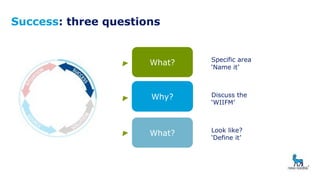
#92 Success has three parts to it.
Review each of the three questions and make the following points:
• What? It is important to select an area of focus in your coaching. Generally, this is the skill that provides the greatest value in helping the employee improve performance
• Why? One of the greatest motivators is connecting what you are doing to a relevant outcome: what’s in it for me?
• What? Clarity is power. It is not enough just to know the area of focus, we need to be clear on what it looks like and what has to happen to achieve success
Start by identifying the most important things to focus on.
#93 Review the slide bullets and reinforce the point that situation is best discussed in contrast to success.
Ask: Have you ever done a gap analysis? This type of thinking allows you to see the answer. The trick is to not get bogged down in the situation.
Next, let’s look at the last two quadrants of the model, Source and Solution.
#94 We must address the issue at its level and type of source.
Ask: What might be the source or cause of a representative not closing on a call?’ (Get 4 or 5 responses and write them down.)
For each category of source there are different approaches, when ‘focus’ is the source:
• Identify a success from the past. Relate that journey to the present
• Create steps to success: make it easy to take action and get positive results in the solution quadrant. In essence, sometimes you must lower the barriers to
raise the bar.
When you introduce a new skill or task, there is often a period where performance dips until the person develops expertise.
When ‘skill’ is the source, you might use the teaching skills model to teach and coach the skill.
When ‘territory’ is the source, help clarify what is and what is not in the control or influence of the employees. Steer them to what they can control.
The final quadrant is solution.
E.g. the example with the ‘Hockey stick’ curve for development. When you start trying to change behaviour it is normal that you get a dip before seeing the results (hence the shape of a hockey stick).
#95 The solution should address both the specific source and be directly pointed at the solution.
The solution can have several steps and it might be useful to break the solution into smaller steps.
Once you have developed a plan, test it. You might ask, ‘if you do X, will it help you achieve Y?’
There are three answers to this question: ‘yes,’ ‘no,’ and ‘maybe,’ and ‘maybe’ means no
You might also ask, ‘on a scale of 1-10, how committed are you to this solution?’
#96 Insert the group names of the winners
Play the Trumpet fanfare when announcing the group names…














![[DSC Europe 25] Josip Saban - Career building for data professionals.pptx](https://cdn.slidesharecdn.com/ss_thumbnails/zroflcttkm1vmli0txea-josip-saban-career-building-for-data-professionals-260123083019-587cdb8c-thumbnail.jpg?width=640&height=640&fit=bounds)


