Competences Mapping for Personal Learning Environment ManagementMalinka Ivanova, Technical University of SofiaMohamed Amine Chatti, RWTH Aachen University
Aims(1) to explore the students’ competences profiles and their capabilities for behavior activities to organize and plan learning	(2) to examine the functionality of a PLE to facilitate the achievement of missing competences
OutlineDo students possess needed competences for building a PLE? – students’ point of view	Competences – definitions and classificationA competences model for personal and professional developmentCompetences for PLE managementFunctionality of PLEs and competencesConclusion
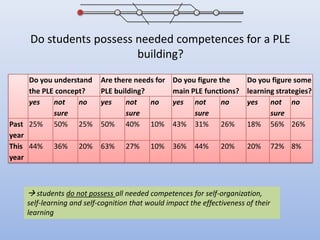
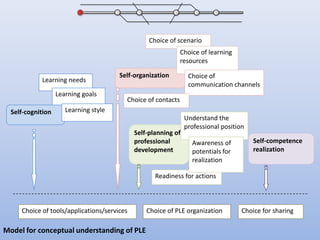
Do students possess needed competences for a PLE building?Self-cognitionSelf-answering of questions about:learning needs and goalspreferred media content format for learningpreferred communication channels clarification of the methods for information and knowledge absorbing and remembering
Do students possess needed competences for a PLE building?Self-organizationincreased individual control over learning, self-management through a process that involves the choice of the:learning scenario selection of learning resources reflection engaging in learning conversations with peers
Do students possess needed competences for a PLE building?Self-planning of personal development the students need to have a self-improvement plan (strategy) based on understanding of their current and future professional positions readiness for actionsawareness of potentials for realization
Do students possess needed competences for a PLE building?Self-competence realizationa student to be capable, effective, and in self-control
Do students possess needed competences for a PLE building? students do not possess all needed competences for self-organization, self-learning and self-cognition that would impact the effectiveness of their learning
Choice of scenarioChoice of learning resourcesSelf-organizationChoice of communication channelsLearning needsLearning goalsChoice of contactsLearning styleSelf-cognitionUnderstand the professional positionSelf-planning of professional developmentSelf-competence realizationAwareness of potentials for realizationReadiness for actionsChoice of tools/applications/servicesChoice of PLE organizationChoice for sharingModel for conceptual understanding of PLE
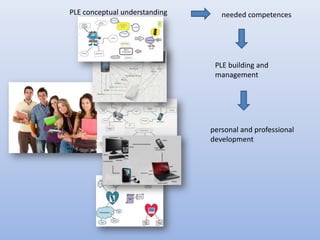
PLE conceptual understandingneeded competencesPLE building and managementpersonal and professional development
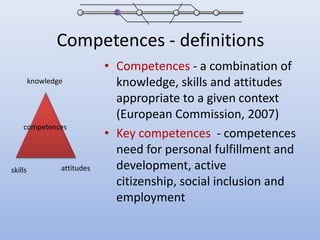
Competences - definitionsCompetences - a combination of knowledge, skills and attitudes appropriate to a given context (European Commission, 2007) Key competences - competences need for personal fulfillment and development, active citizenship, social inclusion and employmentknowledgecompetencesattitudesskills
Competences - definitionscompetency - any kind of qualification or ability, both formal and informal, a person should have in order to fulfill a particular task or job (Synergetics, 2007) competency - the behavior(s) supporting an area of work (Moore et al., 2002) competency - an input-based approach related to the behavior that is needed for performing the work or task
Competences - definitionscompetence - measures the output of a learning process and can be described as a standard that should be reached in order to perform a task (Horton, 2000)competence - an output-based approach focused on the demands of a certain job
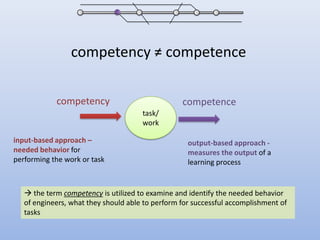
competency ≠ competencecompetencycompetencetask/workinput-based approach – needed behavior for performing the work or taskoutput-based approach - measures the output of a learning process the term competency is utilized to examine and identify the needed behavior of engineers, what they should able to perform for successful accomplishment of tasks
Competences - definitionsTechnical competences- possession of a designated level of technical skill or knowledge in a specific technical area(s) and the ability to keep up with current developments and trends in areas of expertise (Business Dictionary, 2011)They can be achieved through academic, apprenticeship or on-the-job training or a combination of these
Competences - definitionsFunctional competences- are described as on job-related competences (Aragon and Johnson, 2002)they are examined in aspect of the main phases at products manufacturing - production, marketing, research and development and support functions in utilization of information system, human resources, and infrastructure
Competences - definitionsSocial competences -cover all forms of behavior and equip individuals to participate in an effective and constructive way in social and working life (European Commission, 2007)Social competency - the ability and willingness to cooperate, to interact with others responsibly and behave in a group and relationally oriented way (Archanand Tutschek, 2002)Social competencies - the behavior that one needs to have and needs to demonstrate to interact and cooperate with others and to build and sustain different relationships (Cramer and van derZwaal, 2006)
Competences - definitionsGlobal competences- reflect on the needed abilities for successful dealing with different nationalities and working in different countriesThey are related to increasing complexity of organizational structures, innovations in information and communication technology and accelerated product life cycles (Mendenhall et al., 2001)
Competences - definitionsMeta-competences- the overarching abilities under which competences sheltersIt embraces the higher order abilities which have to do with being able to learn, adapt, anticipate and create. Meta-competences - a prerequisite for the development of capacities such as judgment, intuition and acumen upon which competences are based and without which competences cannot flourish (Brown and McCartney, 1995)Meta-competencesare also defined as the ability to read a new situation and adapt or apply appropriate competences, it may be seen as learning to learn, flexible transfer and application of knowledge and skills across contexts, or thinking outside the box (Rowanhill consultants Ltd., 2009)
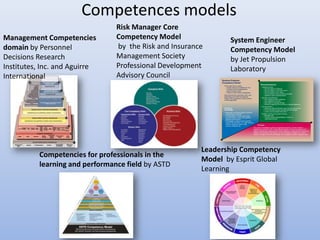
Competences modelsRisk Manager Core Competency Model  by  the Risk and Insurance Management Society Professional Development Advisory CouncilManagement Competencies domain by Personnel Decisions Research Institutes, Inc. and Aguirre InternationalSystem Engineer Competency Model by Jet Propulsion LaboratoryLeadership Competency Model  by Esprit Global LearningCompetencies for professionals in the learning and performance field by ASTD
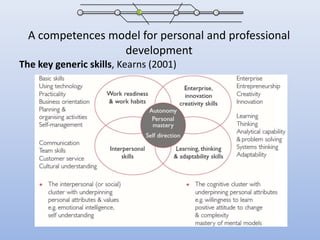
A competences model for personal and professional developmentThe key generic skills, Kearns (2001)
A competences model for personal and professional developmentCore competences, United Nations (2003)  communicationteamworkplanning & organizing accountabilitycreativityclient orientationcommitment to continuous learningtechnological awareness
A competences model for personal and professional developmentKey competences for software engineers, Shaw (2005)(1) discover client needs and translate them to software and system requirements(2) reconcile conflicting objectives, finding acceptable compromises(3) design appropriate solutions, using responsible engineering approaches(4) evaluate designs and products(5) understand and be able to apply theories and models that provide a basis for software design(6) work effectively in interdisciplinary contexts(7) work effectively within existing systems, both software artifacts and organizations(8) understand and be able to use current technical solution elements(9) program effectively in code creation, component use, and its integration(10) apply design and development methods and techniques as appropriate to realize solutions(11) organize and lead development teams, including team-building and negotiation(12) communicate effectively, both verbally and in writing(13) learn new models, techniques, and technologies as they emerge; integrate knowledge from multiple sources to develop solutions to problems
A competences model for personal and professional developmentKey competences for engineers, (Computing Accreditation commission of ABET, 2004)to use and apply current technical concepts and practices in the core information technologies to analyze, identify and define the requirements that must be satisfied to address problemsto design effective and usable IT-based solutions and integrate them into the user environment to assist in the creation of an effective project plan to identify and evaluate current and emerging technologies and assess their to analyze the impact of technology on individuals, organizations and society to demonstrate an understanding of best practices and standards and their application to demonstrate independent critical thinking and problem solving skills to collaborate in teams to communicate effectively and efficiently with clients, users and peers to recognize the need for continued learning throughout their career
Key competences for engineers, (Engineering Council, UK, 2003) (1) use a combination of general and specialist engineering knowledge and understanding to apply existing and emerging technology; (2) apply appropriate theoretical and practical methods to design, develop, manufacture, construct, commission, operate and maintain engineering products, processes, systems, and services; (3) provide technical and commercial management; (4) demonstrate effective interpersonal skills;(5) demonstrate a personal commitment to professional standards, recognizing obligations to society, the profession and the environmentA competences model for personal and professional development
A competences model for personal and professional developmentKey competences for engineers, Australia Accreditation Board (2005) (1) ability to apply knowledge of basic science and engineering fundamentals(2) ability to communicate effectively(3) in depth technical competence in at least one engineering discipline(4) ability to undertake problem identification, formulation and solution(5) ability to utilize a systems approach to design and operational performance(6) ability to function effectively as an individual and in multi-disciplinary and multi-cultural teams, with the capacity to be a leader or manager as well as an effective team member(7) understanding of social, cultural, global and environmental responsibilities of the professional engineers and the need of sustainable development (8) understanding of the principles of sustainable design and development(9) understanding of professional and ethical responsibilities and commitment to them(10) expectation of the need to undertake lifelong learning, and capacity to do so
A competences model for personal and professional developmentKey competences for lifelong learning, DeSeCo project (2005)(1) individuals need to be able to use a wide range of tools for interacting effectively with the environment:  both physical ones such as information technology and socio-cultural ones such as the use of language(2) individuals need to be able to engage with others, and since they will encounter people from a range of backgrounds, it is important that they are able to interact in heterogeneous groups (3)  individuals need to be able to take responsibility for managing their own lives, situate their lives in the broader social context and act autonomously
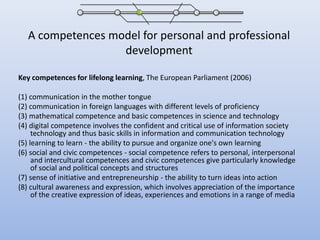
A competences model for personal and professional developmentKey competences for lifelong learning, The European Parliament (2006)(1) communication in the mother tongue (2) communication in foreign languages with different levels of proficiency(3) mathematical competence and basic competences in science and technology(4) digital competence involves the confident and critical use of information society technology and thus basic skills in information and communication technology (5) learning to learn - the ability to pursue and organize one's own learning (6) social and civic competences - social competence refers to personal, interpersonal and intercultural competences and civic competences give particularly knowledge of social and political concepts and structures (7) sense of initiative and entrepreneurship - the ability to turn ideas into action(8) cultural awareness and expression, which involves appreciation of the importance of the creative expression of ideas, experiences and emotions in a range of media
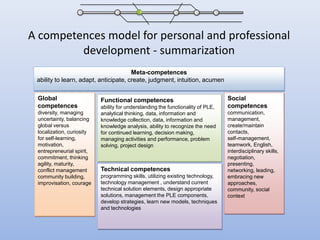
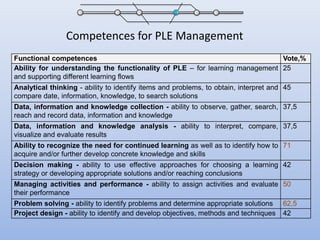
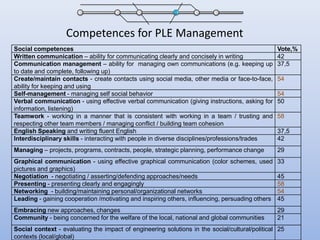
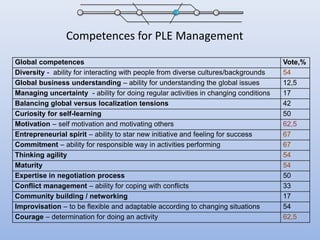
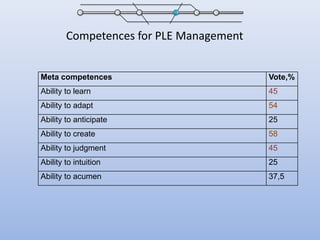
Meta-competencesability to learn, adapt, anticipate, create, judgment, intuition, acumenGlobal competencesdiversity,managing uncertainty, balancing global versus localization, curiosity for self-learning, motivation, entrepreneurial spirit, commitment, thinking agility, maturity, conflict management community building, improvisation, courageSocial competencescommunication, management, create/maintain contacts,self-management, teamwork, english, interdisciplinary skills, negotiation, presenting, networking, leading, embracing new approaches,community, social contextGlobal competencesdiversity, managing uncertainty, balancing global versus localization, curiosity for self-learning, motivation, entrepreneurial spirit, commitment, thinking agility, maturity, conflict management community building, improvisation, courageSocial competencescommunication, management, create/maintain contacts,self-management, teamwork, English, interdisciplinary skills, negotiation, presenting, networking, leading, embracing new approaches,community, social contextFunctional competencesability for understanding the functionality of PLE, analytical thinking, data, information and knowledge collection, data, information and knowledge analysis, ability to recognize the need for continued learning, decision making, managing activities and performance, problem solving, project designTechnical competencesprogramming skills, utilizing existing technology, technology management , understand current technical solution elements, design appropriate solutions, management the PLE components, develop strategies, learn new models, techniques and technologiesA competences model for personal and professional development - summarization
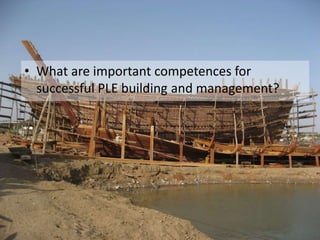
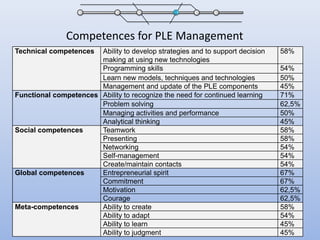
What are important competences for successful PLE building and management?
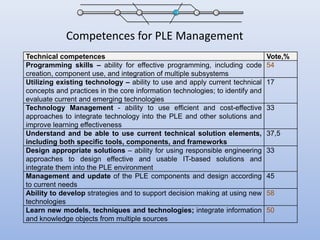
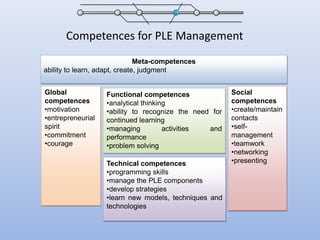
Competences for PLE Management
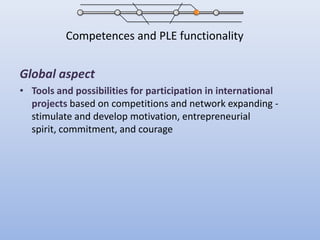
Meta-competencesability to learn, adapt, create, judgmentGlobal competencesmotivation
entrepreneurial spirit
commitment
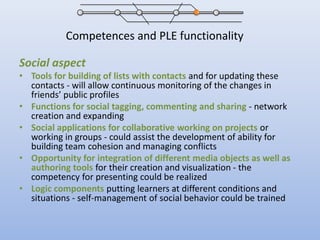
courageSocial competencescreate/maintain contacts
self-management
teamwork
networking
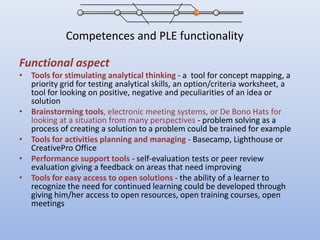
presentingFunctional competencesanalytical thinking
ability to recognize the need for continued learning

Competences Mapping for Personal Learning Environment Management

  • 1.
    Competences Mapping forPersonal Learning Environment ManagementMalinka Ivanova, Technical University of SofiaMohamed Amine Chatti, RWTH Aachen University
  • 2.
    Aims(1) to explorethe students’ competences profiles and their capabilities for behavior activities to organize and plan learning (2) to examine the functionality of a PLE to facilitate the achievement of missing competences
  • 3.
    OutlineDo students possessneeded competences for building a PLE? – students’ point of view Competences – definitions and classificationA competences model for personal and professional developmentCompetences for PLE managementFunctionality of PLEs and competencesConclusion
  • 4.
    Do students possessneeded competences for a PLE building?Self-cognitionSelf-answering of questions about:learning needs and goalspreferred media content format for learningpreferred communication channels clarification of the methods for information and knowledge absorbing and remembering
  • 5.
    Do students possessneeded competences for a PLE building?Self-organizationincreased individual control over learning, self-management through a process that involves the choice of the:learning scenario selection of learning resources reflection engaging in learning conversations with peers
  • 6.
    Do students possessneeded competences for a PLE building?Self-planning of personal development the students need to have a self-improvement plan (strategy) based on understanding of their current and future professional positions readiness for actionsawareness of potentials for realization
  • 7.
    Do students possessneeded competences for a PLE building?Self-competence realizationa student to be capable, effective, and in self-control
  • 8.
    Do students possessneeded competences for a PLE building? students do not possess all needed competences for self-organization, self-learning and self-cognition that would impact the effectiveness of their learning
  • 9.
    Choice of scenarioChoiceof learning resourcesSelf-organizationChoice of communication channelsLearning needsLearning goalsChoice of contactsLearning styleSelf-cognitionUnderstand the professional positionSelf-planning of professional developmentSelf-competence realizationAwareness of potentials for realizationReadiness for actionsChoice of tools/applications/servicesChoice of PLE organizationChoice for sharingModel for conceptual understanding of PLE
  • 10.
    PLE conceptual understandingneededcompetencesPLE building and managementpersonal and professional development
  • 11.
    Competences - definitionsCompetences- a combination of knowledge, skills and attitudes appropriate to a given context (European Commission, 2007) Key competences - competences need for personal fulfillment and development, active citizenship, social inclusion and employmentknowledgecompetencesattitudesskills
  • 12.
    Competences - definitionscompetency- any kind of qualification or ability, both formal and informal, a person should have in order to fulfill a particular task or job (Synergetics, 2007) competency - the behavior(s) supporting an area of work (Moore et al., 2002) competency - an input-based approach related to the behavior that is needed for performing the work or task
  • 13.
    Competences - definitionscompetence- measures the output of a learning process and can be described as a standard that should be reached in order to perform a task (Horton, 2000)competence - an output-based approach focused on the demands of a certain job
  • 14.
    competency ≠ competencecompetencycompetencetask/workinput-basedapproach – needed behavior for performing the work or taskoutput-based approach - measures the output of a learning process the term competency is utilized to examine and identify the needed behavior of engineers, what they should able to perform for successful accomplishment of tasks
  • 15.
    Competences - definitionsTechnicalcompetences- possession of a designated level of technical skill or knowledge in a specific technical area(s) and the ability to keep up with current developments and trends in areas of expertise (Business Dictionary, 2011)They can be achieved through academic, apprenticeship or on-the-job training or a combination of these
  • 16.
    Competences - definitionsFunctionalcompetences- are described as on job-related competences (Aragon and Johnson, 2002)they are examined in aspect of the main phases at products manufacturing - production, marketing, research and development and support functions in utilization of information system, human resources, and infrastructure
  • 17.
    Competences - definitionsSocialcompetences -cover all forms of behavior and equip individuals to participate in an effective and constructive way in social and working life (European Commission, 2007)Social competency - the ability and willingness to cooperate, to interact with others responsibly and behave in a group and relationally oriented way (Archanand Tutschek, 2002)Social competencies - the behavior that one needs to have and needs to demonstrate to interact and cooperate with others and to build and sustain different relationships (Cramer and van derZwaal, 2006)
  • 18.
    Competences - definitionsGlobalcompetences- reflect on the needed abilities for successful dealing with different nationalities and working in different countriesThey are related to increasing complexity of organizational structures, innovations in information and communication technology and accelerated product life cycles (Mendenhall et al., 2001)
  • 19.
    Competences - definitionsMeta-competences-the overarching abilities under which competences sheltersIt embraces the higher order abilities which have to do with being able to learn, adapt, anticipate and create. Meta-competences - a prerequisite for the development of capacities such as judgment, intuition and acumen upon which competences are based and without which competences cannot flourish (Brown and McCartney, 1995)Meta-competencesare also defined as the ability to read a new situation and adapt or apply appropriate competences, it may be seen as learning to learn, flexible transfer and application of knowledge and skills across contexts, or thinking outside the box (Rowanhill consultants Ltd., 2009)
  • 20.
    Competences modelsRisk ManagerCore Competency Model  by  the Risk and Insurance Management Society Professional Development Advisory CouncilManagement Competencies domain by Personnel Decisions Research Institutes, Inc. and Aguirre InternationalSystem Engineer Competency Model by Jet Propulsion LaboratoryLeadership Competency Model  by Esprit Global LearningCompetencies for professionals in the learning and performance field by ASTD
  • 21.
    A competences modelfor personal and professional developmentThe key generic skills, Kearns (2001)
  • 22.
    A competences modelfor personal and professional developmentCore competences, United Nations (2003) communicationteamworkplanning & organizing accountabilitycreativityclient orientationcommitment to continuous learningtechnological awareness
  • 23.
    A competences modelfor personal and professional developmentKey competences for software engineers, Shaw (2005)(1) discover client needs and translate them to software and system requirements(2) reconcile conflicting objectives, finding acceptable compromises(3) design appropriate solutions, using responsible engineering approaches(4) evaluate designs and products(5) understand and be able to apply theories and models that provide a basis for software design(6) work effectively in interdisciplinary contexts(7) work effectively within existing systems, both software artifacts and organizations(8) understand and be able to use current technical solution elements(9) program effectively in code creation, component use, and its integration(10) apply design and development methods and techniques as appropriate to realize solutions(11) organize and lead development teams, including team-building and negotiation(12) communicate effectively, both verbally and in writing(13) learn new models, techniques, and technologies as they emerge; integrate knowledge from multiple sources to develop solutions to problems
  • 24.
    A competences modelfor personal and professional developmentKey competences for engineers, (Computing Accreditation commission of ABET, 2004)to use and apply current technical concepts and practices in the core information technologies to analyze, identify and define the requirements that must be satisfied to address problemsto design effective and usable IT-based solutions and integrate them into the user environment to assist in the creation of an effective project plan to identify and evaluate current and emerging technologies and assess their to analyze the impact of technology on individuals, organizations and society to demonstrate an understanding of best practices and standards and their application to demonstrate independent critical thinking and problem solving skills to collaborate in teams to communicate effectively and efficiently with clients, users and peers to recognize the need for continued learning throughout their career
  • 25.
    Key competences forengineers, (Engineering Council, UK, 2003) (1) use a combination of general and specialist engineering knowledge and understanding to apply existing and emerging technology; (2) apply appropriate theoretical and practical methods to design, develop, manufacture, construct, commission, operate and maintain engineering products, processes, systems, and services; (3) provide technical and commercial management; (4) demonstrate effective interpersonal skills;(5) demonstrate a personal commitment to professional standards, recognizing obligations to society, the profession and the environmentA competences model for personal and professional development
  • 26.
    A competences modelfor personal and professional developmentKey competences for engineers, Australia Accreditation Board (2005) (1) ability to apply knowledge of basic science and engineering fundamentals(2) ability to communicate effectively(3) in depth technical competence in at least one engineering discipline(4) ability to undertake problem identification, formulation and solution(5) ability to utilize a systems approach to design and operational performance(6) ability to function effectively as an individual and in multi-disciplinary and multi-cultural teams, with the capacity to be a leader or manager as well as an effective team member(7) understanding of social, cultural, global and environmental responsibilities of the professional engineers and the need of sustainable development (8) understanding of the principles of sustainable design and development(9) understanding of professional and ethical responsibilities and commitment to them(10) expectation of the need to undertake lifelong learning, and capacity to do so
  • 27.
    A competences modelfor personal and professional developmentKey competences for lifelong learning, DeSeCo project (2005)(1) individuals need to be able to use a wide range of tools for interacting effectively with the environment: both physical ones such as information technology and socio-cultural ones such as the use of language(2) individuals need to be able to engage with others, and since they will encounter people from a range of backgrounds, it is important that they are able to interact in heterogeneous groups (3) individuals need to be able to take responsibility for managing their own lives, situate their lives in the broader social context and act autonomously
  • 28.
    A competences modelfor personal and professional developmentKey competences for lifelong learning, The European Parliament (2006)(1) communication in the mother tongue (2) communication in foreign languages with different levels of proficiency(3) mathematical competence and basic competences in science and technology(4) digital competence involves the confident and critical use of information society technology and thus basic skills in information and communication technology (5) learning to learn - the ability to pursue and organize one's own learning (6) social and civic competences - social competence refers to personal, interpersonal and intercultural competences and civic competences give particularly knowledge of social and political concepts and structures (7) sense of initiative and entrepreneurship - the ability to turn ideas into action(8) cultural awareness and expression, which involves appreciation of the importance of the creative expression of ideas, experiences and emotions in a range of media
  • 29.
    Meta-competencesability to learn,adapt, anticipate, create, judgment, intuition, acumenGlobal competencesdiversity,managing uncertainty, balancing global versus localization, curiosity for self-learning, motivation, entrepreneurial spirit, commitment, thinking agility, maturity, conflict management community building, improvisation, courageSocial competencescommunication, management, create/maintain contacts,self-management, teamwork, english, interdisciplinary skills, negotiation, presenting, networking, leading, embracing new approaches,community, social contextGlobal competencesdiversity, managing uncertainty, balancing global versus localization, curiosity for self-learning, motivation, entrepreneurial spirit, commitment, thinking agility, maturity, conflict management community building, improvisation, courageSocial competencescommunication, management, create/maintain contacts,self-management, teamwork, English, interdisciplinary skills, negotiation, presenting, networking, leading, embracing new approaches,community, social contextFunctional competencesability for understanding the functionality of PLE, analytical thinking, data, information and knowledge collection, data, information and knowledge analysis, ability to recognize the need for continued learning, decision making, managing activities and performance, problem solving, project designTechnical competencesprogramming skills, utilizing existing technology, technology management , understand current technical solution elements, design appropriate solutions, management the PLE components, develop strategies, learn new models, techniques and technologiesA competences model for personal and professional development - summarization
  • 30.
    What are importantcompetences for successful PLE building and management?
  • 31.
  • 32.
  • 33.
  • 34.
  • 35.
  • 36.
  • 37.
    Meta-competencesability to learn,adapt, create, judgmentGlobal competencesmotivation
  • 38.
  • 39.
  • 40.
  • 41.
  • 42.
  • 43.
  • 44.
  • 45.
    ability to recognizethe need for continued learning