Comparative Law and Its
Functions
Zubair Abbasi
American University of Cairo
Zubair.abbasi@aucegpt.edu
Lecture 1
Sunday 5 February 2017
1. Ahmad, an AUC student, enters into a civil marriage with Bettina while he
was attending a summer school at Cambridge University. Ahmad’s family
refused to accept their marriage as he was already engaged with his
cousin since his childhood. Upon his return, Ahmad is forced to pronounce
divorce. Bettina, a student of anthropology, thinks that this is not a valid
divorce because their marriage is governed under English law and not
Islamic law. Is she correct?
2. An Iranian doctor, who holds a US green card (permanent resident), is
denied boarding at the Dubai Airport due the recent travel ban. He sues
the manager of Trump International Hotel Dubai for compensation. Will
Dubai courts entertain this suit?
3. A US diplomatic staff ran over a pedestrian while over speeding at Tahir
Square. US government has offered to pay diyat to the legal heirs of the
victim. Should the legal heirs accept the payment?
Course Description
• This course introduces Comparative Law in its historical context by engaging
with the wide and growing literature that deals with the role of law and
institutions in the socio-economic and political development of nations.
Therefore, the focus of the course is not upon black letter law, though
statutes and case law are used as important points of reference.
• This course it divided into three main parts.
• In part I, nature and functions of Comparative Law are explored.
• Part II analyses specific areas of law from a comparative perspective. They include
contract law, family law, corporate law and constitutional law.
• Part III looks into the sources and methods of Comparative Law.
Course Specific Objectives
• Understand the key legal, political and economic features of the legal systems in
the world;
• Develop analytical writing skills and the ability to synthesize material from various
sources.
• Find, select, digest and effectively organise material to produce a coherent and
reasoned argument within specified deadlines.
• Ability to develop arguments and counter-arguments using diverse data and
evidence.
• Demonstrate ability to manage relevant learning resources/information/learning
strategies and to develop own arguments and opinions with minimum guidance.
• Work independently and as part of a group, including participation in oral
discussion.
• Communicate and engage in debates effectively and accurately, orally and in
writing, in a manner appropriate to the discipline and context.
Learning Outcomes
• Ability to apply comparative law to complex social and cultural
problems and choose analytical techniques to propose legal solutions.
• Ability to critically analyze the impact of various laws from a
comparative perspective.
• Ability to critically engage with and analyze statutes and case law.
• Ability to contextualize law beyond text.
Comparative Law
• Intellectual activity with law as its object and comparison as its process.
• Discovery or formulation of ‘a common law of mankind’.
• Macro comparison: spirit, styles, methods of thought and procedures of
legal systems.
• Micro comparison: specific legal institutions or problems (rules to solve
solve actual problems or conflicts of interests)
• Eg consumer protection against manufacturing faults or post divorce custody of
children.
• Study of similarities and differences
• Cultural v Technical (functional eg impact upon socio-economic developments)
• Local v Global
Comparative Law and other Disciplines
• Comparative and Private International Law (conflicts of laws)
• Solution to the conflict between domestic and foreign law v comparison of several legal
orders
• Which family law for dual nationals: Islamic or English divorce law?
• Comparative Law and Public International Law
• Comparative law helps us understand ‘the general principle of law recognized by civilized
nations.’
• Legal History ‘vertical comparison’ of law and comparative law ‘horizontal
comparison of modern legal systems’
• Comparative Law and International Human Rights Law
‘Just as the expansion of democracy, following the vision of Fukuyama, would herald the end of
history; similarly, it might be supposed that the diffusion of human rights would herald the end
of comparative law, in the sense that it announces an ahistorical society based on universal
standards.’ Horatia Muir Watt, Globalization and Comparative Law in The Oxford Handbook of
Comparative Law (OUP 2006) 4.
Functions of Comparative Law
• Better understanding of one’s own system by comparatists.
• Comparatists are also better placed to look beyond the ‘automatic assumptions’
taken for granted by lawyers.
• Acquisition of knowledge of foreign laws regardless of its utility.
• Such knowledge develops understanding among peoples and foster the peaceful coexistence of
nations.
• Understanding differences and similarities in legal systems and proposing efficient
solutions to legal problems.
• Comparative Law and Global Governance
• Focus on ‘common core’ features in the EU
• Coordination between multiple and overlapping legal orders at international level
• Tool for Reform & Social change (engineering)
• Understanding legal inertia (legal stagnation)
• Systematic international unification of law?
• Understanding Transplant Effect
• Understanding Mixed Legal Systems
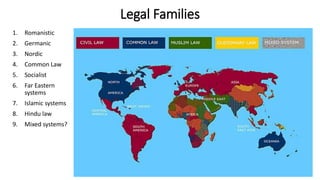
Legal Families
1. Romanistic
2. Germanic
3. Nordic
4. Common Law
5. Socialist
6. Far Eastern
systems
7. Islamic systems
8. Hindu law
9. Mixed systems?
Criteria for Classification of Legal Families
1. Race,
2. Culture,
3. Origins and history,
4. Sources,
5. Technique,
6. Structures,
7. Professionalization,
8. Doctrinal autonomy
9. Role of religion?
10. Any other?
Methods of Comparative Law
• Comparatist: Watch out, be brave, and keep alert!
• Functionality
• ‘… the legal system of every society essentially faces the same problems, and solve
these problems by different means though very often with similar results.’ Zweigert &
Kotz, An Introduction to Comparative Law, 31.
How does a legal system protect parties from an agreement not seriously intended?
V
What are the formal requirements for binding contracts?
• Legal and extra legal factors?
• When is an offer binding under German and Common Law?
• Binding when made v Binding until accepted
• But what is an offer under these two legal systems?
• Practice shows that German contracts transform offers into invitato offerendi and
Common law has the concept of estoppel.
Factors Shaping Legal Rules
• Basic Rule of Comparative Law is ‘… different legal system give the same or very
similar solutions, even as to detail, to the same problems of life, despite the
great differences in their historical development, conceptual structure, and
style of operation.
• It is true that there might be areas of social life which are impressed by
especially strong moral and ethical feelings, rooted in the particularities of the
prevailing religion, in historical tradition, in cultural development, or in the
character of the people.’
• These factors differ so much from one people to another that one cannot
expect the rules which govern such areas of life to be congruent.
• Should freedom of testation be curtailed in the interests of a decedent’s widow and
family?
• Should divorce be possible and, if so, under what conditions?
• Should it be possible to legitimate adulterine children?
• Should a married father be bound to support an adulterine child and, if so, under what
circumstances?’
Legal Transplants
Terminology: transfer, reception, inspiration, influence, cross-fertilisation, adaptation,
legal borrowing.
• Justinian Code 529-65
• Discovery of Justinian Code and its teaching in Bologna in 1070
• Napoleonic Code 1804
• German Code 1900
• Swiss Code 1907
• Ottoman Code: Majallah 1869-76
• Spanish Civil Code 1889
• Japanese Civil Code 1898
• Swiss Civil Code 1907
• Chinese Civil Code 1911
• Turkish Civil Code 1926
• Egyptian Civil Code 1949
Mixed Legal Systems
(i) civil law and customary law (26 jurisdictions)
(ii) civil law and common law (15 jurisdictions)
(iii) common law and customary law (15 jurisdictions)
(iv) civil law and Muslim law (11 jurisdictions);
(v) common law and Muslim law (8 jurisdictions)
(vi) common law, Muslim law, and customary law (6 jurisdictions)
(vii)civil law, common law, and Muslim law (5 jurisdictions)
(viii) civil law, common law, and customary law (5 jurisdictions)
(ix) civil law, Muslim law, and customary law (4 jurisdictions); and
(x) civil law, common law, and Talmudic law (1 jurisdiction).
Factors of Legal Change
1. Imposition of law through violence in one form or another;
2. Identical legal problems caused by the pollution of air, water, and soil, new
(bio)technology, an emerging claim culture, migration, urban decay etc
3. Change produced by the desire to follow prestigious models;
4. Reform for the purpose of improving economic performance.
• Jurisdictional arbitrage
• Since 1990, the World Bank alone has supported 330 rule-of-law projects and spent almost
$3 billion to fund them.
• The World Trade Organization agreements required legal changes on a massive scale in many
countries.
• Legal uniformity is may be based on commercial considerations motivated by regional and
international cooperation.
• China adopted its new Contract Code in 1999 to enhance the market economy by attracting foreign
investment.
• Political dimension to institutional change aimed at improving economic performance.
• Global powers try to shape politics of development through the use of vague notions, such as ‘good
governance’ or ‘democracy’.
• National legislatures and judiciaries use comparative law to create, reform, and
interpret national laws.
Types of Comparative Influence
• Comparative law as a source of fresh ideas
• Foreign law as a normative argument, which plays a role in justifying a court
decision or a statute:
• ‘normative’ use of foreign law: foreign legal experience is looked in to as an
illustration of how a certain rule is applied in practice, ‘an empirical argument’
• foreign countries as ‘laboratories’ of legal experiments for avoiding mistakes and
gauging the utility of foreign institutions
• Foreign law can be used for ‘ornamental purposes’: Drafters of the new
Dutch Civil Code of 1992 took pride in citing the (black-letter) law of more
than forty countries (including the civil codes of Brazil, Egypt, and Chile)
Comparative Law V Comparative Reasoning
• Not the form of foreign law, but the argument expressed in foreign law that
matters.
• Persuasive authority because of its inherent quality, not because it is foreign
• Use of foreign law is permissible to draw from international common ‘fund’ of
solutions and apply ‘universal method of interpretation’.
• It would be counterproductive to deal with a (new) problem without taking into
account the experiences elsewhere.
• All legal systems share the common goal of finding and applying the best and most just
legal rules
• Inspired by Natural Law tradition and has wider application in human rights law and private law
• However, in Printz v United States, Justice Scalia observed:
‘comparative analysis [is] inappropriate to the task of interpreting a constitution, though it was of course
quite relevant to the task of writing one’.
• This is quite logical as in a democratic society the legislature is permitted to do what a
court cannot do: to implement whatever legal rule it chooses, and on whatever basis.
• But note the difference between comparative law and comparative reasoning.
Motives and Strategies in Comparative Reasoning
• Inspiration or the mere quality of a foreign rule.
• ‘Cost-saving transplant’: saves time and money to use a solution which is
already in operation abroad.
• ‘Prestige Factor’: developing countries often introduce human rights charters
into their constitutions, even if these are not complied with in practice.
• Persuasive authority: references to foreign law strategically to improve the
acceptance of controversial court decisions.
• Influence of foreign law as a result of coincidence:
• Introduction of the Swiss Civil Code and the Code of Civil Procedure of the canton of
Neuchâtel in Turkey in 1926 because the then Turkish minister of justice had studied
there.
• Knowledge of foreign languages, the availability of foreign material,
intellectual curiosity, and the time available to decide a case.
Questions for Seminars
A. Comparative Law and Legal Families
1. Whether legal rules reflect the needs and desire of society and its ruling elite?
2. What factors are relevant for legal change? And why?
3. What is not Comparative Law?
4. What are macro and micro comparisons of laws?
5. What is vertical and horizontal comparison of law? How does it help us distinguish between
legal history and comparative law?
B. Legal Families
6. What are the criteria for classifying national legal systems into legal families?
7. In your opinion, which one is the most important criterion for the classification of legal
systems of the world and why?
8. Where does the Egyptian legal system fit into the classification of legal families? Functions of
C. Comparative Law
9. What are the benefits of studying Comparative Law?
10. What are the objectives that are served for comparing various legal systems?
11. What is the role of Comparative Law in global governance?
12. Are some legal systems better than others? Why or why not?
13. Why do legislatures or courts refer to foreign laws? Is it to find a better solution or are there
more strategic reasons?

Comparative_Law_and_its_Functions with indian perspective.pptx

  • 1.
    Comparative Law andIts Functions Zubair Abbasi American University of Cairo Zubair.abbasi@aucegpt.edu Lecture 1 Sunday 5 February 2017
  • 2.
    1. Ahmad, anAUC student, enters into a civil marriage with Bettina while he was attending a summer school at Cambridge University. Ahmad’s family refused to accept their marriage as he was already engaged with his cousin since his childhood. Upon his return, Ahmad is forced to pronounce divorce. Bettina, a student of anthropology, thinks that this is not a valid divorce because their marriage is governed under English law and not Islamic law. Is she correct? 2. An Iranian doctor, who holds a US green card (permanent resident), is denied boarding at the Dubai Airport due the recent travel ban. He sues the manager of Trump International Hotel Dubai for compensation. Will Dubai courts entertain this suit? 3. A US diplomatic staff ran over a pedestrian while over speeding at Tahir Square. US government has offered to pay diyat to the legal heirs of the victim. Should the legal heirs accept the payment?
  • 3.
    Course Description • Thiscourse introduces Comparative Law in its historical context by engaging with the wide and growing literature that deals with the role of law and institutions in the socio-economic and political development of nations. Therefore, the focus of the course is not upon black letter law, though statutes and case law are used as important points of reference. • This course it divided into three main parts. • In part I, nature and functions of Comparative Law are explored. • Part II analyses specific areas of law from a comparative perspective. They include contract law, family law, corporate law and constitutional law. • Part III looks into the sources and methods of Comparative Law.
  • 4.
    Course Specific Objectives •Understand the key legal, political and economic features of the legal systems in the world; • Develop analytical writing skills and the ability to synthesize material from various sources. • Find, select, digest and effectively organise material to produce a coherent and reasoned argument within specified deadlines. • Ability to develop arguments and counter-arguments using diverse data and evidence. • Demonstrate ability to manage relevant learning resources/information/learning strategies and to develop own arguments and opinions with minimum guidance. • Work independently and as part of a group, including participation in oral discussion. • Communicate and engage in debates effectively and accurately, orally and in writing, in a manner appropriate to the discipline and context.
  • 5.
    Learning Outcomes • Abilityto apply comparative law to complex social and cultural problems and choose analytical techniques to propose legal solutions. • Ability to critically analyze the impact of various laws from a comparative perspective. • Ability to critically engage with and analyze statutes and case law. • Ability to contextualize law beyond text.
  • 6.
    Comparative Law • Intellectualactivity with law as its object and comparison as its process. • Discovery or formulation of ‘a common law of mankind’. • Macro comparison: spirit, styles, methods of thought and procedures of legal systems. • Micro comparison: specific legal institutions or problems (rules to solve solve actual problems or conflicts of interests) • Eg consumer protection against manufacturing faults or post divorce custody of children. • Study of similarities and differences • Cultural v Technical (functional eg impact upon socio-economic developments) • Local v Global
  • 8.
    Comparative Law andother Disciplines • Comparative and Private International Law (conflicts of laws) • Solution to the conflict between domestic and foreign law v comparison of several legal orders • Which family law for dual nationals: Islamic or English divorce law? • Comparative Law and Public International Law • Comparative law helps us understand ‘the general principle of law recognized by civilized nations.’ • Legal History ‘vertical comparison’ of law and comparative law ‘horizontal comparison of modern legal systems’ • Comparative Law and International Human Rights Law ‘Just as the expansion of democracy, following the vision of Fukuyama, would herald the end of history; similarly, it might be supposed that the diffusion of human rights would herald the end of comparative law, in the sense that it announces an ahistorical society based on universal standards.’ Horatia Muir Watt, Globalization and Comparative Law in The Oxford Handbook of Comparative Law (OUP 2006) 4.
  • 9.
    Functions of ComparativeLaw • Better understanding of one’s own system by comparatists. • Comparatists are also better placed to look beyond the ‘automatic assumptions’ taken for granted by lawyers. • Acquisition of knowledge of foreign laws regardless of its utility. • Such knowledge develops understanding among peoples and foster the peaceful coexistence of nations. • Understanding differences and similarities in legal systems and proposing efficient solutions to legal problems. • Comparative Law and Global Governance • Focus on ‘common core’ features in the EU • Coordination between multiple and overlapping legal orders at international level • Tool for Reform & Social change (engineering) • Understanding legal inertia (legal stagnation) • Systematic international unification of law? • Understanding Transplant Effect • Understanding Mixed Legal Systems
  • 10.
    Legal Families 1. Romanistic 2.Germanic 3. Nordic 4. Common Law 5. Socialist 6. Far Eastern systems 7. Islamic systems 8. Hindu law 9. Mixed systems?
  • 11.
    Criteria for Classificationof Legal Families 1. Race, 2. Culture, 3. Origins and history, 4. Sources, 5. Technique, 6. Structures, 7. Professionalization, 8. Doctrinal autonomy 9. Role of religion? 10. Any other?
  • 12.
    Methods of ComparativeLaw • Comparatist: Watch out, be brave, and keep alert! • Functionality • ‘… the legal system of every society essentially faces the same problems, and solve these problems by different means though very often with similar results.’ Zweigert & Kotz, An Introduction to Comparative Law, 31. How does a legal system protect parties from an agreement not seriously intended? V What are the formal requirements for binding contracts? • Legal and extra legal factors? • When is an offer binding under German and Common Law? • Binding when made v Binding until accepted • But what is an offer under these two legal systems? • Practice shows that German contracts transform offers into invitato offerendi and Common law has the concept of estoppel.
  • 13.
    Factors Shaping LegalRules • Basic Rule of Comparative Law is ‘… different legal system give the same or very similar solutions, even as to detail, to the same problems of life, despite the great differences in their historical development, conceptual structure, and style of operation. • It is true that there might be areas of social life which are impressed by especially strong moral and ethical feelings, rooted in the particularities of the prevailing religion, in historical tradition, in cultural development, or in the character of the people.’ • These factors differ so much from one people to another that one cannot expect the rules which govern such areas of life to be congruent. • Should freedom of testation be curtailed in the interests of a decedent’s widow and family? • Should divorce be possible and, if so, under what conditions? • Should it be possible to legitimate adulterine children? • Should a married father be bound to support an adulterine child and, if so, under what circumstances?’
  • 14.
    Legal Transplants Terminology: transfer,reception, inspiration, influence, cross-fertilisation, adaptation, legal borrowing. • Justinian Code 529-65 • Discovery of Justinian Code and its teaching in Bologna in 1070 • Napoleonic Code 1804 • German Code 1900 • Swiss Code 1907 • Ottoman Code: Majallah 1869-76 • Spanish Civil Code 1889 • Japanese Civil Code 1898 • Swiss Civil Code 1907 • Chinese Civil Code 1911 • Turkish Civil Code 1926 • Egyptian Civil Code 1949
  • 15.
    Mixed Legal Systems (i)civil law and customary law (26 jurisdictions) (ii) civil law and common law (15 jurisdictions) (iii) common law and customary law (15 jurisdictions) (iv) civil law and Muslim law (11 jurisdictions); (v) common law and Muslim law (8 jurisdictions) (vi) common law, Muslim law, and customary law (6 jurisdictions) (vii)civil law, common law, and Muslim law (5 jurisdictions) (viii) civil law, common law, and customary law (5 jurisdictions) (ix) civil law, Muslim law, and customary law (4 jurisdictions); and (x) civil law, common law, and Talmudic law (1 jurisdiction).
  • 16.
    Factors of LegalChange 1. Imposition of law through violence in one form or another; 2. Identical legal problems caused by the pollution of air, water, and soil, new (bio)technology, an emerging claim culture, migration, urban decay etc 3. Change produced by the desire to follow prestigious models; 4. Reform for the purpose of improving economic performance. • Jurisdictional arbitrage • Since 1990, the World Bank alone has supported 330 rule-of-law projects and spent almost $3 billion to fund them. • The World Trade Organization agreements required legal changes on a massive scale in many countries. • Legal uniformity is may be based on commercial considerations motivated by regional and international cooperation. • China adopted its new Contract Code in 1999 to enhance the market economy by attracting foreign investment. • Political dimension to institutional change aimed at improving economic performance. • Global powers try to shape politics of development through the use of vague notions, such as ‘good governance’ or ‘democracy’. • National legislatures and judiciaries use comparative law to create, reform, and interpret national laws.
  • 17.
    Types of ComparativeInfluence • Comparative law as a source of fresh ideas • Foreign law as a normative argument, which plays a role in justifying a court decision or a statute: • ‘normative’ use of foreign law: foreign legal experience is looked in to as an illustration of how a certain rule is applied in practice, ‘an empirical argument’ • foreign countries as ‘laboratories’ of legal experiments for avoiding mistakes and gauging the utility of foreign institutions • Foreign law can be used for ‘ornamental purposes’: Drafters of the new Dutch Civil Code of 1992 took pride in citing the (black-letter) law of more than forty countries (including the civil codes of Brazil, Egypt, and Chile)
  • 18.
    Comparative Law VComparative Reasoning • Not the form of foreign law, but the argument expressed in foreign law that matters. • Persuasive authority because of its inherent quality, not because it is foreign • Use of foreign law is permissible to draw from international common ‘fund’ of solutions and apply ‘universal method of interpretation’. • It would be counterproductive to deal with a (new) problem without taking into account the experiences elsewhere. • All legal systems share the common goal of finding and applying the best and most just legal rules • Inspired by Natural Law tradition and has wider application in human rights law and private law • However, in Printz v United States, Justice Scalia observed: ‘comparative analysis [is] inappropriate to the task of interpreting a constitution, though it was of course quite relevant to the task of writing one’. • This is quite logical as in a democratic society the legislature is permitted to do what a court cannot do: to implement whatever legal rule it chooses, and on whatever basis. • But note the difference between comparative law and comparative reasoning.
  • 19.
    Motives and Strategiesin Comparative Reasoning • Inspiration or the mere quality of a foreign rule. • ‘Cost-saving transplant’: saves time and money to use a solution which is already in operation abroad. • ‘Prestige Factor’: developing countries often introduce human rights charters into their constitutions, even if these are not complied with in practice. • Persuasive authority: references to foreign law strategically to improve the acceptance of controversial court decisions. • Influence of foreign law as a result of coincidence: • Introduction of the Swiss Civil Code and the Code of Civil Procedure of the canton of Neuchâtel in Turkey in 1926 because the then Turkish minister of justice had studied there. • Knowledge of foreign languages, the availability of foreign material, intellectual curiosity, and the time available to decide a case.
  • 20.
    Questions for Seminars A.Comparative Law and Legal Families 1. Whether legal rules reflect the needs and desire of society and its ruling elite? 2. What factors are relevant for legal change? And why? 3. What is not Comparative Law? 4. What are macro and micro comparisons of laws? 5. What is vertical and horizontal comparison of law? How does it help us distinguish between legal history and comparative law? B. Legal Families 6. What are the criteria for classifying national legal systems into legal families? 7. In your opinion, which one is the most important criterion for the classification of legal systems of the world and why? 8. Where does the Egyptian legal system fit into the classification of legal families? Functions of C. Comparative Law 9. What are the benefits of studying Comparative Law? 10. What are the objectives that are served for comparing various legal systems? 11. What is the role of Comparative Law in global governance? 12. Are some legal systems better than others? Why or why not? 13. Why do legislatures or courts refer to foreign laws? Is it to find a better solution or are there more strategic reasons?

Editor's Notes

  • #3 Deadly gases leaked from a factory operated in the border area of Afghanistan by Union Carbide India Limited, a subsidiary of a US company Union Carbide Corporation, registered at Dubai. Many people died on both sides of the border. A civil case is filed by the Pakistani government before a US court for compensation. Whether US courts have jurisdiction? Victims of US drone attacks sued the US Consulate before the Peshawar High Court, Pakistan for the violation of their fundamental rights to life and property. Does the court have jurisdiction?
  • #16 A total of 232 jurisdictions globally were divided into five main families. The mixed legal systems formed the largest family (96 jurisdictions), followed by the civil law (89 jurisdictions), common law (42 jurisdictions), customary law (3 jurisdictions), and Muslim law (2 jurisdictions) http://www.juriglobe.ca/eng/apropos/index.php