2
CONTENTS:
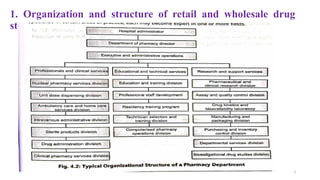
1. Organization andstructure of retail and wholesale drug store
2. Types and design
3. Legal requirements for establishment and maintenance of a drug store
4. Dispensing of proprietary products
5. Maintenance of records of retail and wholesale drug store
6
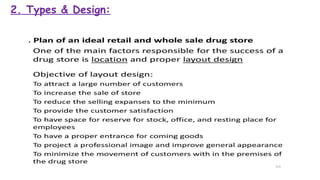
2. Types &Design:
• Drug store should fulfill all the requirements in schedule “N” (Schedule N contains regulations
& requirements for a pharmacy) of drug and cosmetics rules.
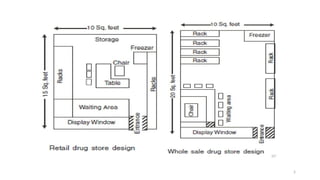
• To start a drug store a minimum of 150 sq. feet area
• Whole sale drug store a minimum of 200 sq. feet area
• On the basis of design the drug store is divided into following types:
1. Traditional drug stores
2. Personal service drug store
3. Prescription oriented drug store
4. Pharmaceutical center
5. Super drug store
7.
7
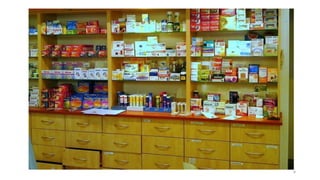
1.Traditional Drug Stores:
•Designed in such a manner that the entire area of Drug store is exposed to
customers
• Pleasing and professional appearance
• Convenient for both workers and customers
• Provides opportunity for maximum sales
• But there are good chances of theft in such design
9
2. Personal ServiceDrug Stores:
• The whole of the area is not exposed to the customer
• The customer interacts with the drug store personnel at the service counter
• The customer demands an article and the personnel provide the articles
• This service and design facilitates maximum interaction between drug store
employee and the customers.
• The success of the drug store depends upon the convenience and friendly service
of the personnel at the service counter.
11
3. Prescription OrientedDrug Store:
• They provide a comfortable waiting area where the customers are expected
to wait while his/her prescription is proceeding.
• In this type of design health related items, drugs and prescription
accessories are displayed in the vicinity while orthopedic and surgical
appliances are kept in a separate room.
• Cosmetics and gifts are arranged in a suitable area in the store.
13
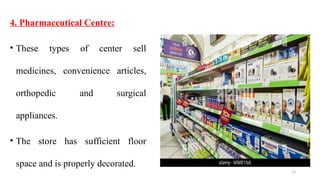
4. Pharmaceutical Centre:
•These types of center sell
medicines, convenience articles,
orthopedic and surgical
appliances.
• The store has sufficient floor
space and is properly decorated.
14.
14
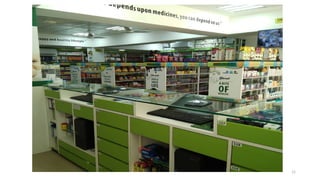
5. Super Drugstore:
• Drug stores have a huge floor area ranging from 5,000 to 10000
with a square design.
• Access to all-most-all the area in the drug store and can inspect,
handle and select articles themselves.
• The design is on self service pattern except for the prescription
department where self service is not possible.
16
3. Legal requirementsfor establishment and maintenance of a drug store
I] Licenses:-
a) General Licenses:
• These licenses are granted to person who have the premises for the business and who engage the
services of a qualified person to supervise the sale of a drug store.
• License for retail sale of drug store are issued in form 20 for drug specified in schedule C & C1
excluding those specified in Schedule X in form of 21 and for Schedule X in 20F.
• Conditions for general licenses:-
1.The license should be displayed in prominent place in a part of premises open to the public.
2.The license should comply with the provision of drug and cosmetics act and rules.
3.Any change in the staff should be reported to the licensing authority within one month.
4.Precaution prescribed by the licensing authority for the storage of Schedule C and C1 should be
observed.
5.For the sale of additional categories of drug listed in Schedule C & C1 excluding X the license
must take prior permission of the license authority.
17.
17
b) Restricted Licenses:
•The licenses for the restricted sale of drug other than those specified in
Schedule C1 and X and those specified in Schedule C1 not in X are issued in
the form 20A and 21A respectively.
• Conditions for restricted licenses:
1.Drug should be sold in their original container.
2.License should be complying with the provision of drugs and Cosmetics Acts
and Rules.
3.Drug only purchased from a duly licensed dealer.
4.The licenser must have adequate premises equipped with facilities for the
proper storage of drug.
18.
18
II] Minimum AcademicQualification:
• A registered Pharmacist is eligible
• Registration certificate is issued to Diploma or Degree in Pharmacy upon
completion of 650 hours training in medical store
• A graduate in Science (B. Sc) with 10yrs of MR experience
• A retail/ wholesale business can be run by appointing a registered pharmacist
19.
19
III] Minimum space:-
•Minimum space for retail is 150 sq. ft. area
• Minimum space for wholesale is 200 sq. ft. area
IV] Staff:-
• Training and orientation of staff
20.
20
4. Dispensing ofproprietary products:
• All dispensing of Proprietary products is required to be done either by the
Registered Pharmacist himself or under his direct supervision.
• The following procedure is adopted during dispensing of products:
1. Receiving the Prescription:
• The prescription should be received by the pharmacist himself, wherever
possible or a person trained properly to do so in a professional manner.
• The patient should be informed about the approximate time required for filling
the prescription.
21.
21
2. Reading andChecking the Prescription :
• On receiving the prescription, the pharmacist should first read the prescription
completely and carefully.
• He should verify that the name and address of the patient are correct, the
prescription is legally valid and is written correctly.
• He should not express any doubt regarding the contents of the prescription
either to the patient or to his messenger.
• The pharmacist should not add, omit or substitute any content of the
prescription without the consent of the physician.
22.
22
3. Dispensing, Packingand Labelling:
• The medicine should be selected from the stock and if in unit dosage form such as
tablets or capsules, the correct number should be counted and filled into previously
selected containers
• The labels of all containers of stock drugs should be checked when selected from
and replaced in stock, as well as at the time of actual dispensing, making three
checks in total.
• Any subsidiary label required should be properly affixed to the container.
• The container must be thoroughly polished to remove any finger prints.
23.
23
4. Finishing :
•The final product, the prescription and the labels should be rechecked before handing over to
the patient.
• All records must be completed including those required by legislation.
• The patient or his representative should be explained about the proper mode of administration
and storage of the medicine preferably in their local language.
• Dispensing of Schedule H and X Drugs Substances specified in Schedule H and X to the Drugs
and Cosmetics Act should not be sold by retail except on the prescription of a Registered
Medical Practitioner and in case of substances specified in Schedule X, prescriptions should be
in duplicate, one copy of which shall be retained b‘ the licensee for a period of 2 years.
24.
24
• A prescriptionfor Schedule H and X drugs should be :
(i) In writing and signed by the prescriber and dated by him.
(ii) Specify the name and address of the patient or the owner of the animal if the drug is meant for
veterinary use.
(iii) Indicate the total amount of medicine to be supplied and the dose to be given.
• The prescriptions for Schedule H and X drugs must not be dispensed more than once
unless the prescriber has stated thereon that it may be dispensed more than once until
specified
• At the time of dispensing there must be noted on the prescription above the signature
of prescriber, the name and address of the seller and the date of dispensing.
25.
25
5. Maintenance ofrecords of retail and wholesale drug store:
Records of Purchase of Drugs :
• The records pertaining to the purchase of all drugs whether intended to be sold by
retail or by wholesale should be maintained under the following headings:
(i) Date of purchase.
(ii) Name and address of the licensee from whom it is purchased
(iii) Name and quantity of the drug purchased and his license number, manufacturing
and its batch number.
(iv) Name of the manufacturer of the drug.
• Purchase bills including cash or credit memos should be kept as records.
26.
26
Records of Saleof Drugs :
• Sale of Drugs other than those specified in Schedule X:
Sale of any drug other than those specified in Schedule X is required to be recorded at the
time of supply in a prescribed register maintained for the purpose or in a cash or credit
memo book.
• The following particulars are required to be entered
(i) Serial number of the entry.
(ii) Date of supply.
(iii) Name and address of the prescriber.
(iv) Name and address of the patient or the name and address of the owner of the animal
if the drug is supplied for the veterinary use.
(vi) Names along with the quantities of drugs supplied.
(vii) In case of Schedule H and C drugs, the name of the manufacturer, its batch number
and the expiry date, if any.
(viii) Signature of the registered pharmacist under whose supervision the medicine was
made or supplied.
27.
27
Sale of Drugsspecified in Schedule X:
• Supply of Schedule X drugs should be recorded at the time of supply in a bound and serial numbered
register maintained for this purpose and separate pages should be allotted for each drugs.
• The following particulars should he entered in the said register:
(i) Date of Purchase supplier
(ii) Quantity received, if any, the name and address of supplier and the license number of the supplier.
(iii) Name and quantity of the drug supplied.
(iv) Manufacturer's name, batch or lot number.
(v) Name and address of the patient/purchaser.
(vi) Reference number of the prescription against which supplies were made.
(vii) Bill number and date of receipt of purchase and supply made by him.
(viii) Signature of the person under whose supervision the drugs have been supplied.
28.
28
• Drug file:Maintain a drug file Keep all the correspondence in the drug file.
Correspondence with drug authorities. License retention fee record Records of change
in constitution or change in premises, if any. Inspections records
• Correspondence file: Maintain a correspondence file and keep all correspondence
with dealers in this file.
• Drug license: Keep copies of all the documents submitted during the granting of the
license. Keep a copy of the retail sale drug licenses / wholesale drug licenses in the
file.
• Inspection record: Keep copies of all inspections done by the Drugs Control Officer
in your area.
29.
29
• Registered Pharmacist(RP): Keep copies of all the documents of the
Registered Pharmacist i.e. Regn. Certificate, i.e., registration certificate,
qualification certificates, and address proof.
• Change of Registered Pharmacist (RP): Keep copies of all the documents
regarding the change of RP. Application to Drug Department having the details
and dates of relieving of previous RP and joining of new RP, Copy of Regn.
Certificate, Qualification Certificates; Address Proof.
• Refrigerator: Purchase invoice of the refrigerator
• Purchase records of drugs: Maintain purchase files and keep all the purchase
invoices of drugs in chronological order. Keep payment records of drugs. Keep
a transportation record of drugs.
• Sale records of drugs: Maintain sale records of drugs by means of an invoice
book having all the details as per the Act. The sale of scheduled drugs must be
under the personal supervision of a registered pharmacist. Maintain sales
records in a legible manner.
30.
30
• Schedule-H1 register:Maintain schedule-H1 register for Schedule-H1 drugs
• TB Drugs record: Keep all the sales records of the TB drugs, as per the directions of
the drug department. or health authorities. i.e., details of the patients and details of
drugs given. Send the required details to the authorities from time to time.
• NDPS Drugs record: Keep all the sales records of the NDPS drugs, as per the
directions of the drug department.
• Expiry drugs: Keep a record of expired drugs, i.e., correspondence with the dealer for
returning the expired drugs.
• Returned drugs: Keep a record of drugs returned, i.e., correspondence with the dealer
for returning the expired drugs.
• Suspension of licenses: Keep records of suspension of licenses, if any.
• NSQ drug: Keep records of NSQ [not of standard quality] drugs (sampled from the
medical store and declared by Govt. Analyst) if any.
31.
31
FAQ
1. Write thecharacteristic feature of ideal drug store. (5M)
2. Explain the legal documents for obtaining license to open a drug store. (5M)
3. Write a note on maintenance of records for retail drug store/wholesale drug
store. 10M
4. Describe how the dispensing of proprietary medicines is done. 5M
![1
UNIT-I
D] Community Pharmacy](https://image.slidesharecdn.com/communitypharmacy-260203044105-7ab7aaa1/85/COMMUNITY-PHARMACY-CP-PRESENTATION-1-320.jpg)
![1
UNIT-I
D] Community Pharmacy](https://image.slidesharecdn.com/communitypharmacy-260203044105-7ab7aaa1/75/COMMUNITY-PHARMACY-CP-PRESENTATION-1-2048.jpg)


![16
3. Legal requirements for establishment and maintenance of a drug store
I] Licenses:-
a) General Licenses:
• These licenses are granted to person who have the premises for the business and who engage the
services of a qualified person to supervise the sale of a drug store.
• License for retail sale of drug store are issued in form 20 for drug specified in schedule C & C1
excluding those specified in Schedule X in form of 21 and for Schedule X in 20F.
• Conditions for general licenses:-
1.The license should be displayed in prominent place in a part of premises open to the public.
2.The license should comply with the provision of drug and cosmetics act and rules.
3.Any change in the staff should be reported to the licensing authority within one month.
4.Precaution prescribed by the licensing authority for the storage of Schedule C and C1 should be
observed.
5.For the sale of additional categories of drug listed in Schedule C & C1 excluding X the license
must take prior permission of the license authority.](https://image.slidesharecdn.com/communitypharmacy-260203044105-7ab7aaa1/85/COMMUNITY-PHARMACY-CP-PRESENTATION-16-320.jpg)
![18
II] Minimum Academic Qualification:
• A registered Pharmacist is eligible
• Registration certificate is issued to Diploma or Degree in Pharmacy upon
completion of 650 hours training in medical store
• A graduate in Science (B. Sc) with 10yrs of MR experience
• A retail/ wholesale business can be run by appointing a registered pharmacist](https://image.slidesharecdn.com/communitypharmacy-260203044105-7ab7aaa1/85/COMMUNITY-PHARMACY-CP-PRESENTATION-18-320.jpg)
![19
III] Minimum space:-
• Minimum space for retail is 150 sq. ft. area
• Minimum space for wholesale is 200 sq. ft. area
IV] Staff:-
• Training and orientation of staff](https://image.slidesharecdn.com/communitypharmacy-260203044105-7ab7aaa1/85/COMMUNITY-PHARMACY-CP-PRESENTATION-19-320.jpg)
![30
• Schedule-H1 register: Maintain schedule-H1 register for Schedule-H1 drugs
• TB Drugs record: Keep all the sales records of the TB drugs, as per the directions of
the drug department. or health authorities. i.e., details of the patients and details of
drugs given. Send the required details to the authorities from time to time.
• NDPS Drugs record: Keep all the sales records of the NDPS drugs, as per the
directions of the drug department.
• Expiry drugs: Keep a record of expired drugs, i.e., correspondence with the dealer for
returning the expired drugs.
• Returned drugs: Keep a record of drugs returned, i.e., correspondence with the dealer
for returning the expired drugs.
• Suspension of licenses: Keep records of suspension of licenses, if any.
• NSQ drug: Keep records of NSQ [not of standard quality] drugs (sampled from the
medical store and declared by Govt. Analyst) if any.](https://image.slidesharecdn.com/communitypharmacy-260203044105-7ab7aaa1/85/COMMUNITY-PHARMACY-CP-PRESENTATION-30-320.jpg)



![PERI-PROSTHETIC FRACTURE NAIL-PLATE CONSTRUCT [NPC].pptx](https://cdn.slidesharecdn.com/ss_thumbnails/drarunkumardrmohamedashrafperiprostheticfrasturenail-plateconstructnpc-260209164459-7e9d15a1-thumbnail.jpg?width=640&height=640&fit=bounds)


![ONFH[AVN HIP] -TRIPLE REGIME -A NOVAL SURGICAL CONCEPT .pptx](https://cdn.slidesharecdn.com/ss_thumbnails/onfhavnhip2026koaconcalicutdrgokuldevdrmashraf-260210064517-213ec005-thumbnail.jpg?width=640&height=640&fit=bounds)