Communication
   Skills
Objectives
By the end of the session, participants will know
1. What is communication
2. Why it is so important
3. How Communication Model works
4. Tips for sender / Receiver
5. Tips for Giving Feedback
3


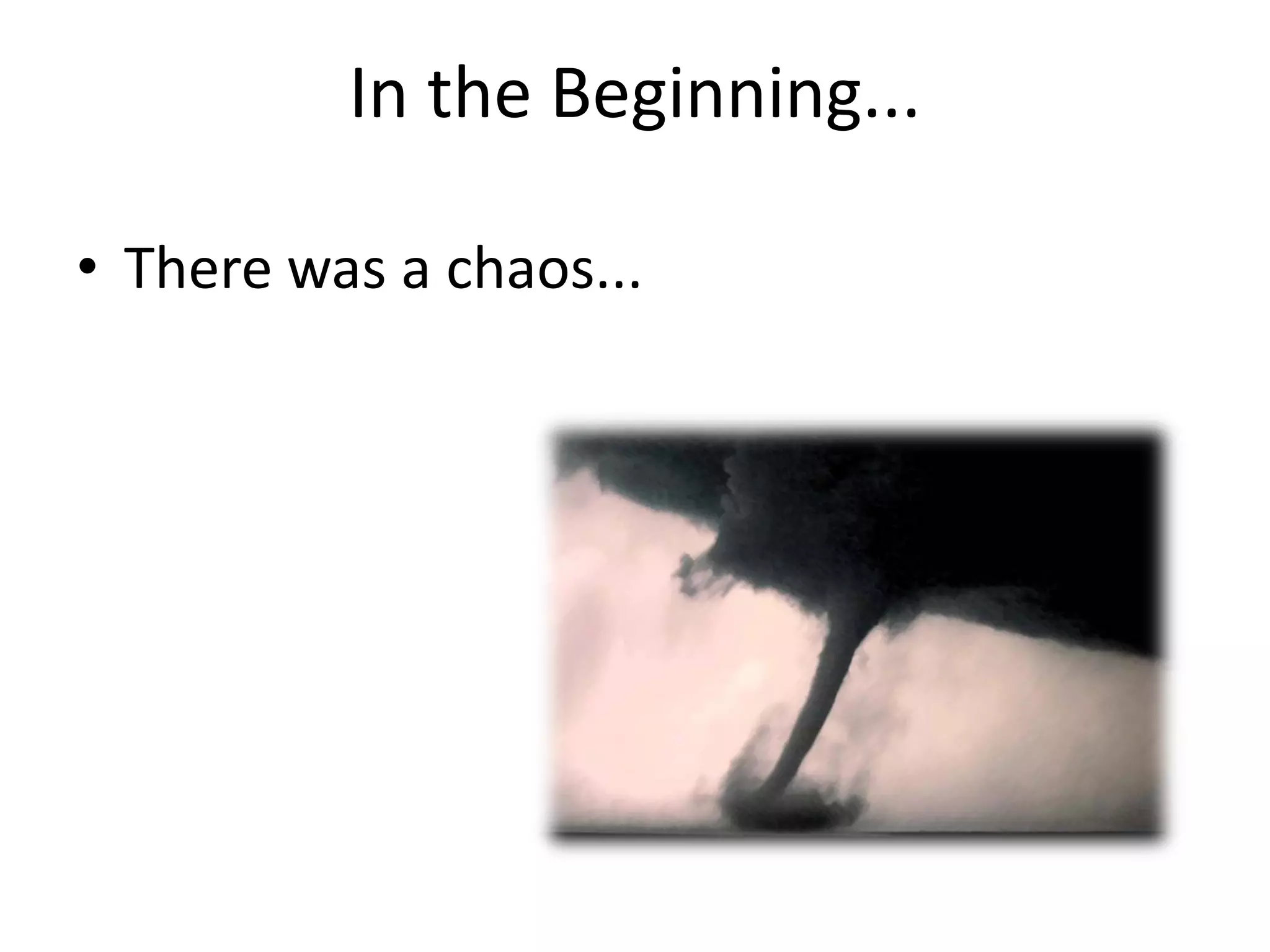
          In the Beginning...

• There was a chaos...
4


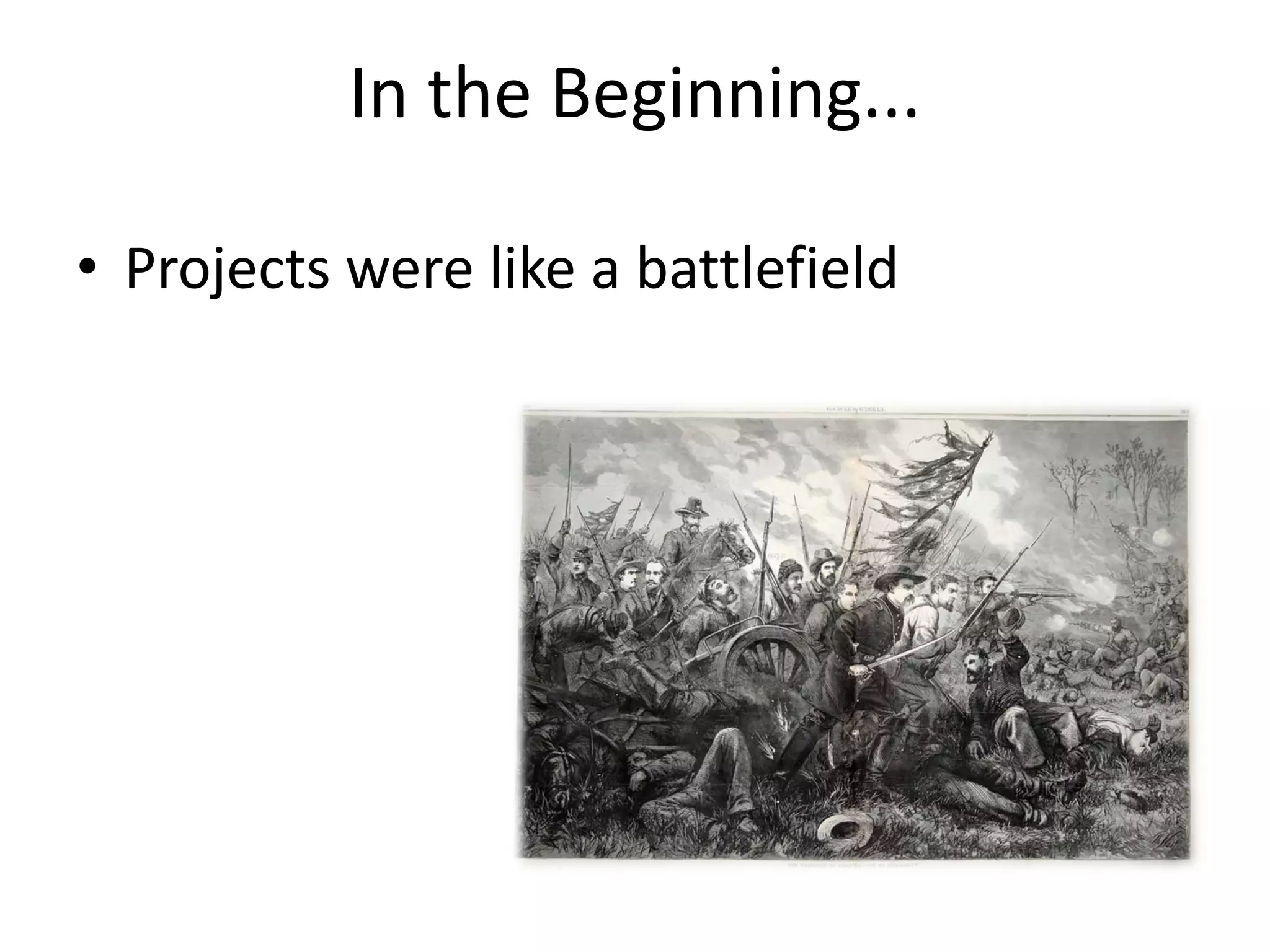
           In the Beginning...

• Projects were like a battlefield
5


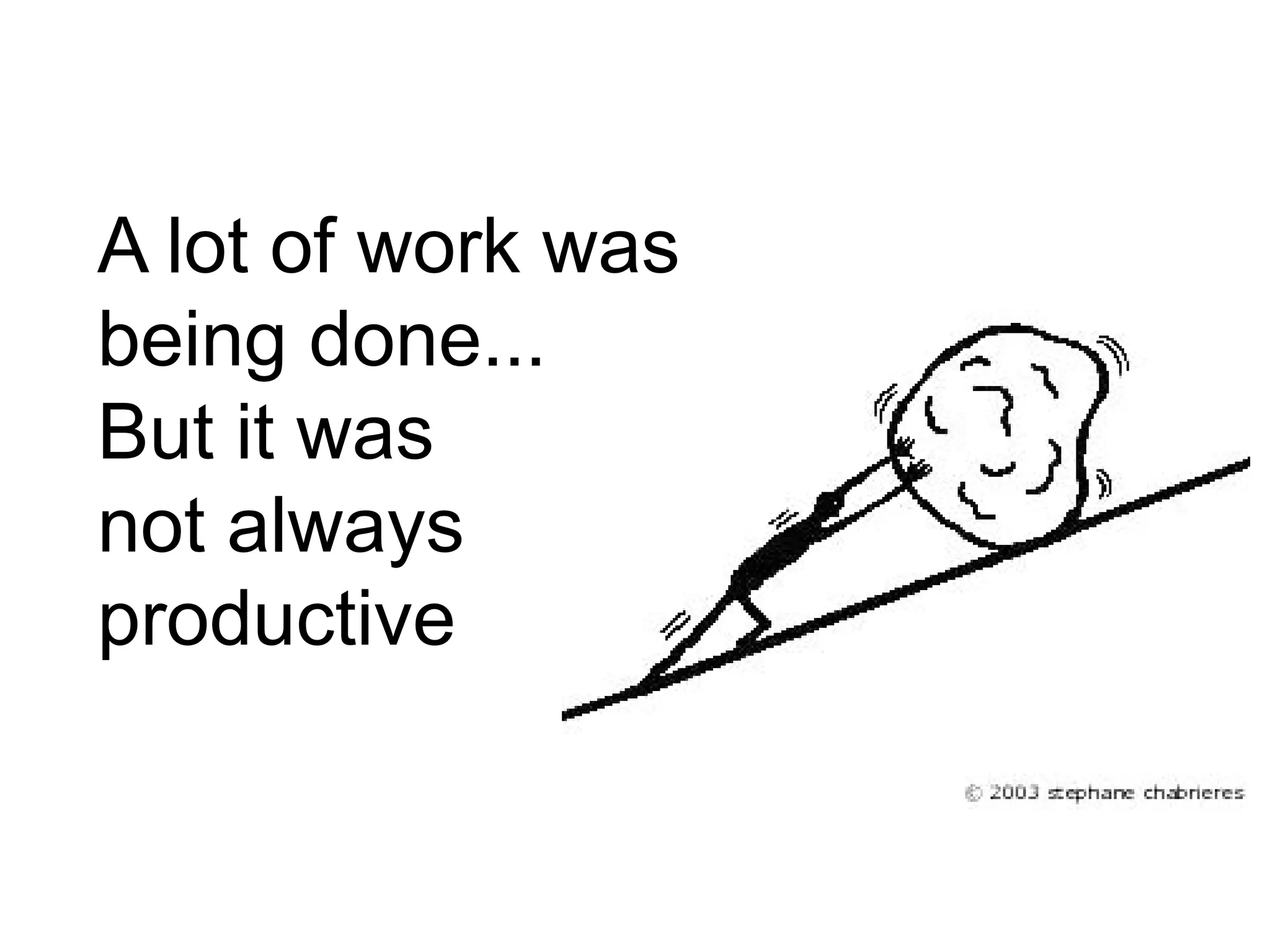
A lot of work was
being done...
But it was
not always
productive
Fundamentals
Communication
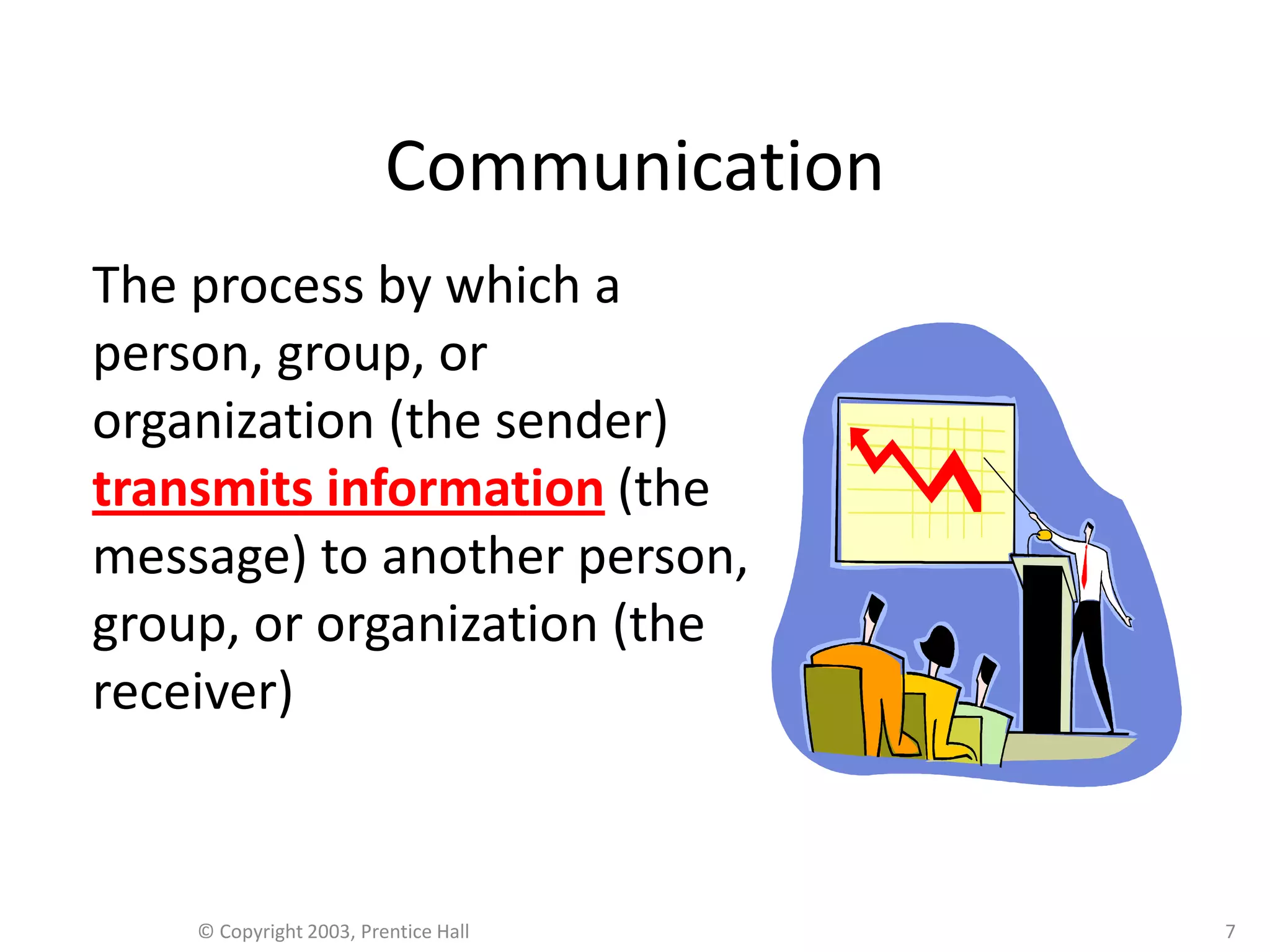
The process by which a
person, group, or
organization (the sender)
transmits information (the
message) to another person,
group, or organization (the
receiver)


    © Copyright 2003, Prentice Hall      7
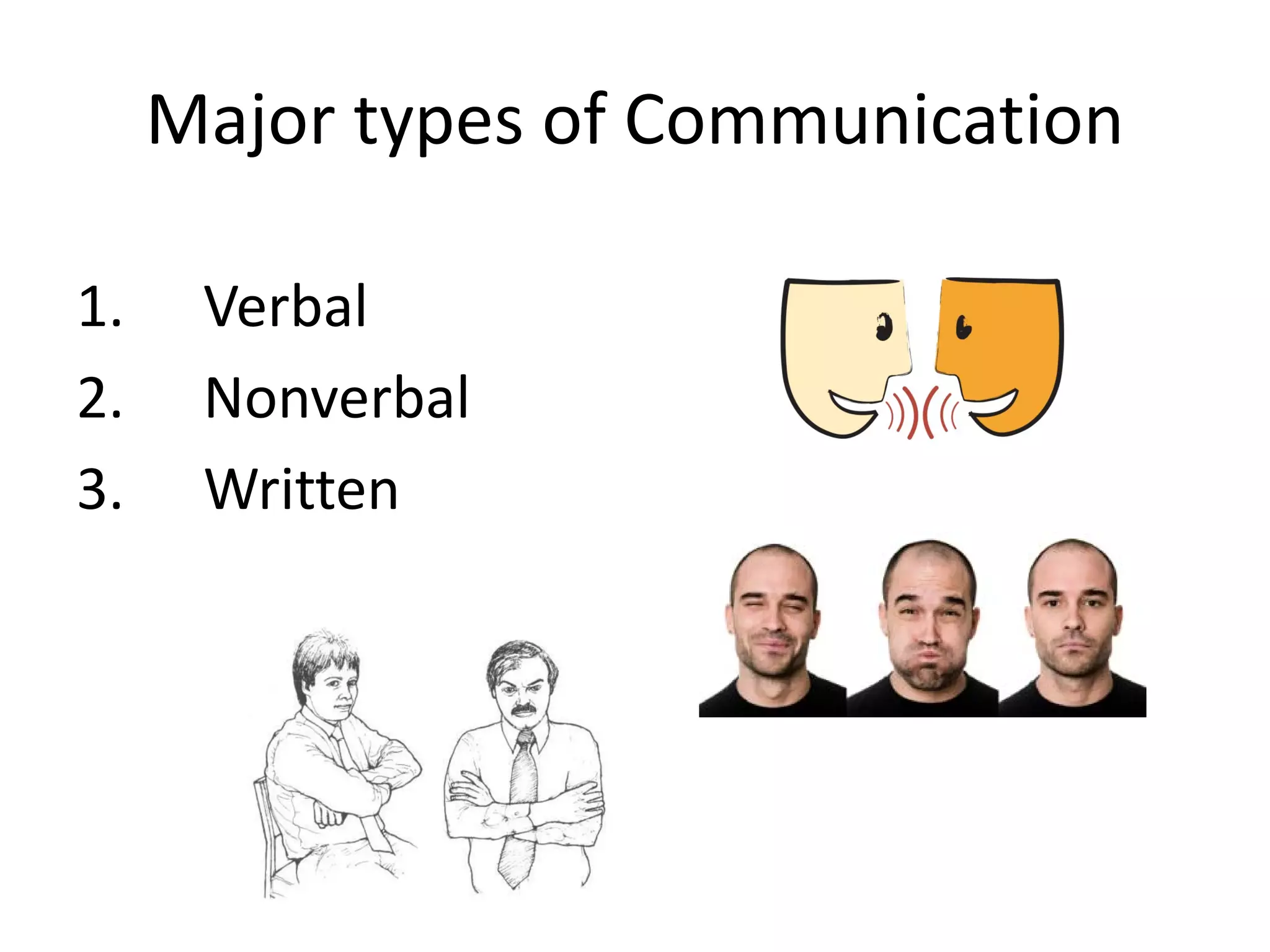
Major types of Communication

1.    Verbal
2.    Nonverbal
3.    Written
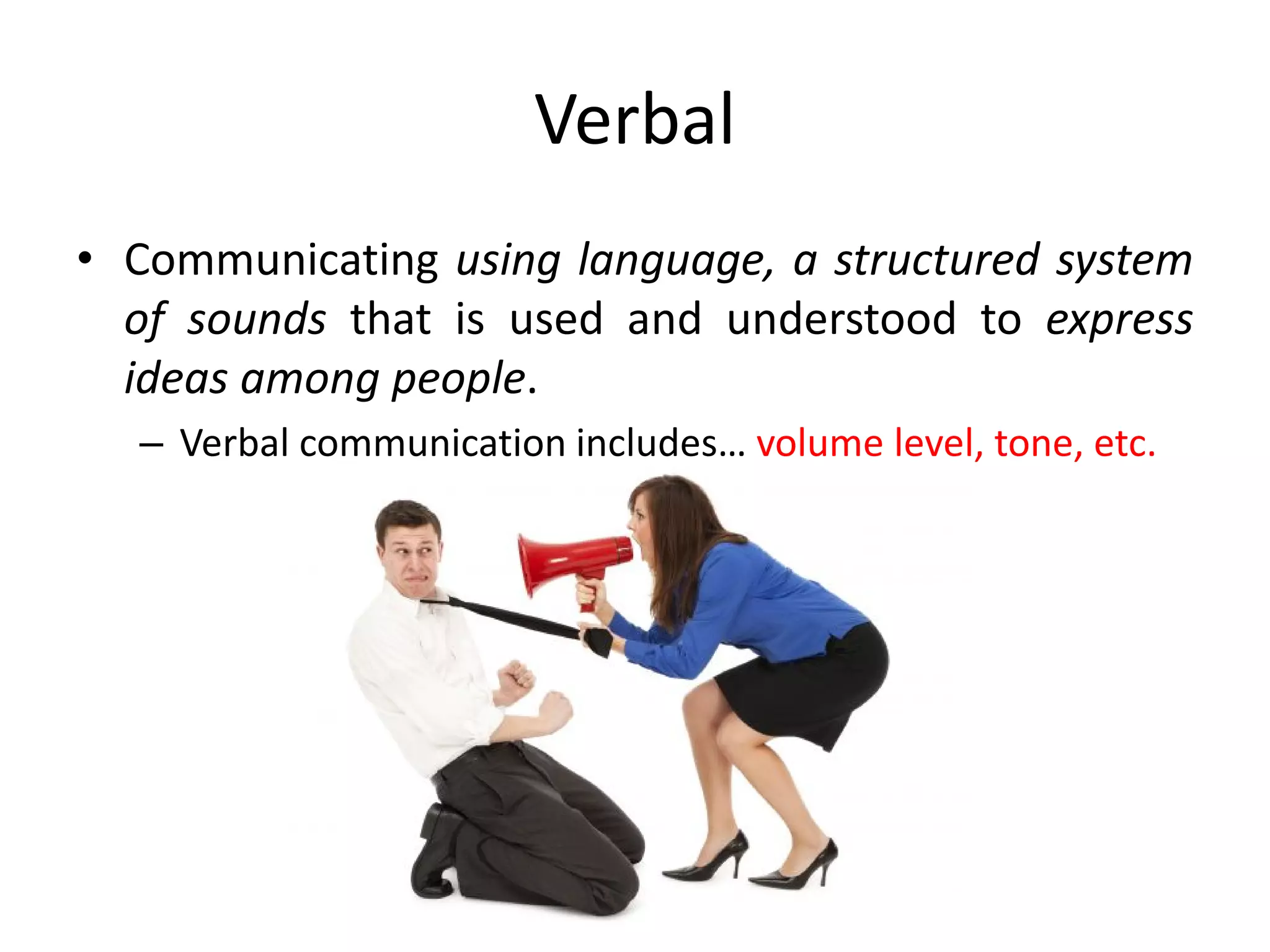
Verbal
• Communicating using language, a structured system
  of sounds that is used and understood to express
  ideas among people.
  – Verbal communication includes… volume level, tone, etc.
Listening Skills
• Listening is not a “passive” skill but a
  “receptive” skill. It requires as much attention
  and mental activity as speaking.
• That of the time an individual is engaged in
  communication, approximately 9 % is devoted
  to writing, 16 % to reading, 30 % to speaking,
  and 45 % to listening.
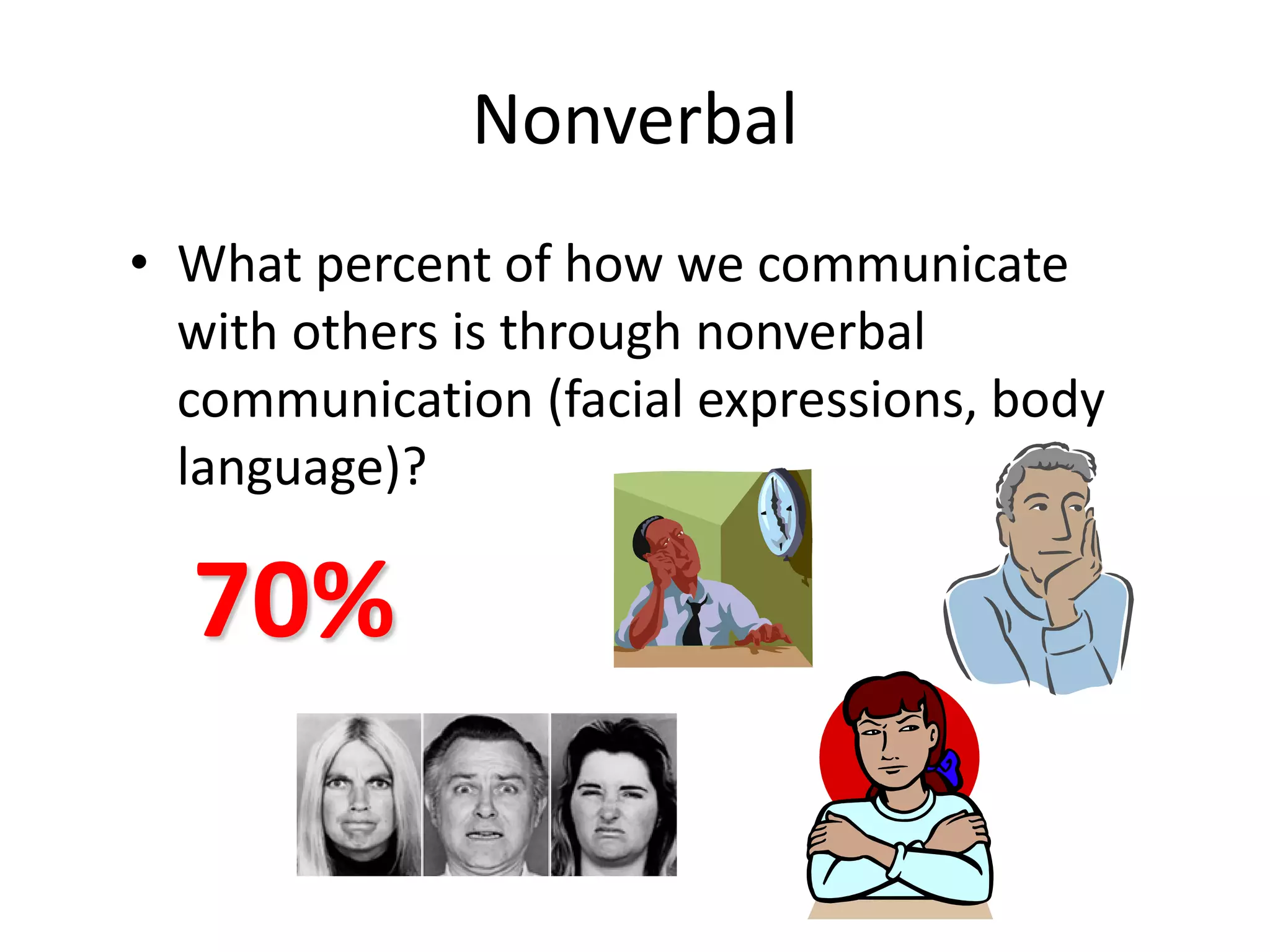
Nonverbal
• What percent of how we communicate
  with others is through nonverbal
  communication (facial expressions, body
  language)?

  70%
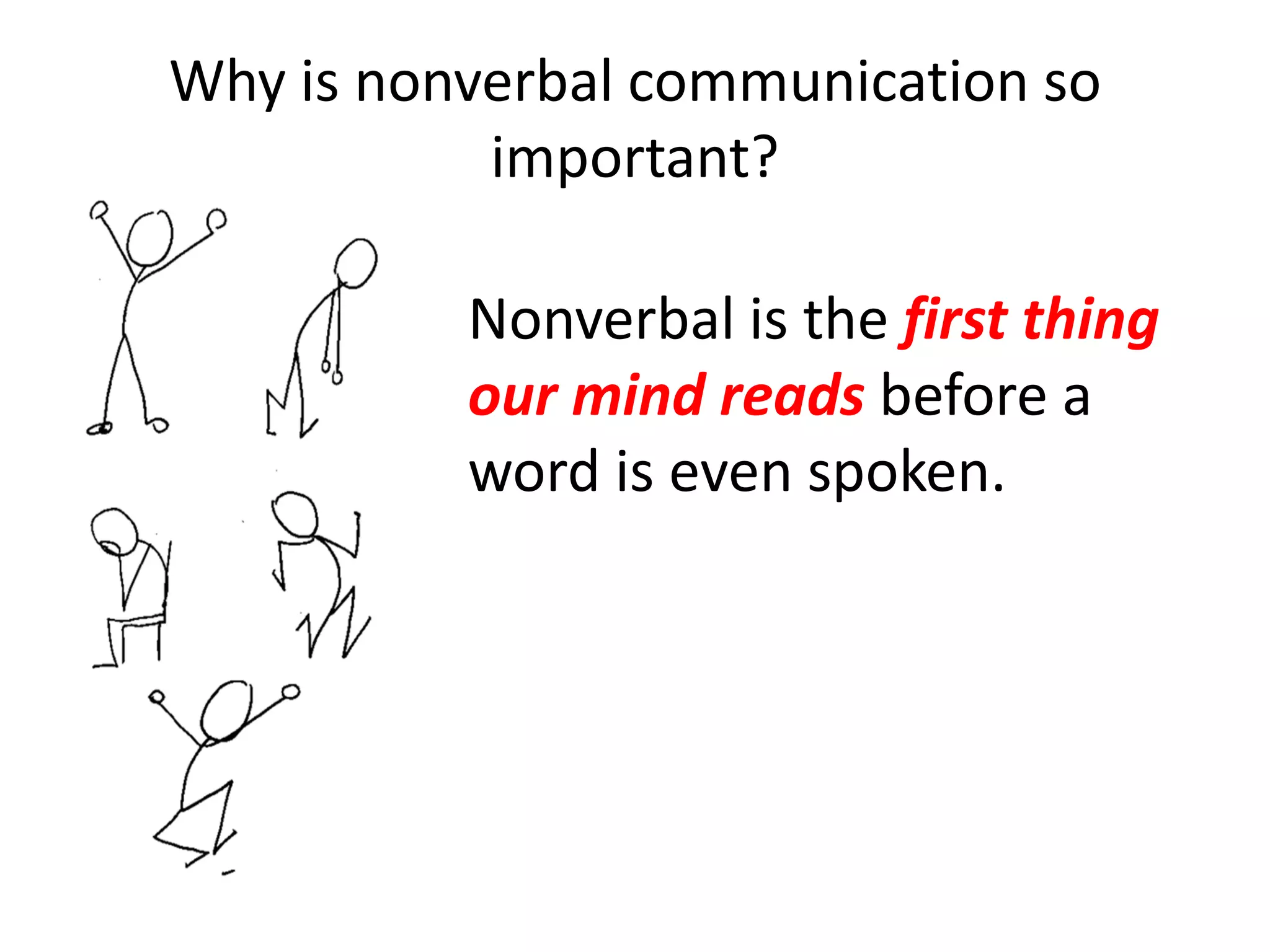
Why is nonverbal communication so
           important?

          Nonverbal is the first thing
          our mind reads before a
          word is even spoken.
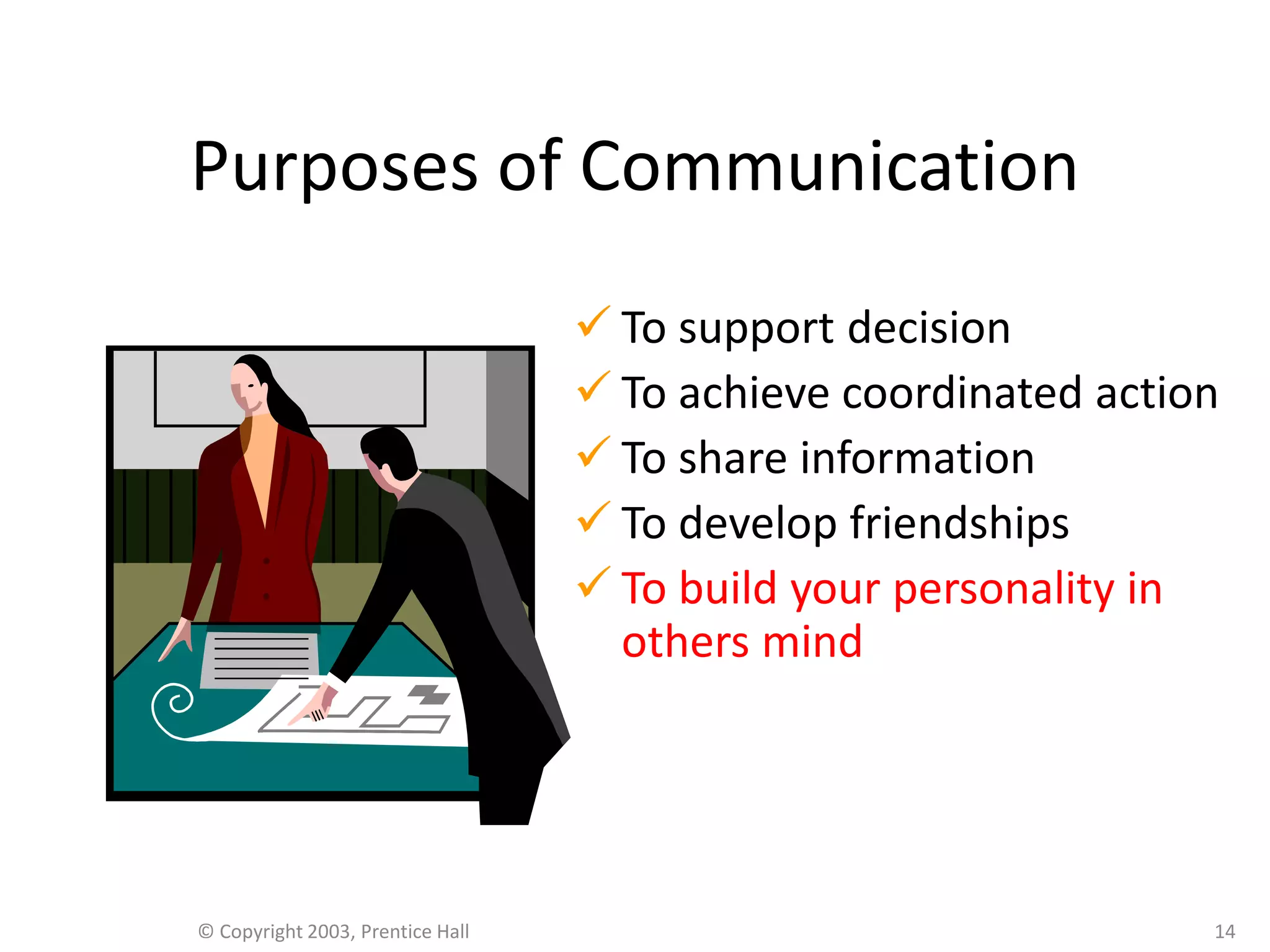
Purposes of Communication
                                   To support decision
                                   To achieve coordinated action
                                   To share information
                                   To develop friendships
                                   To build your personality in
                                    others mind


© Copyright 2003, Prentice Hall                                 14
The Model
Communication Concepts
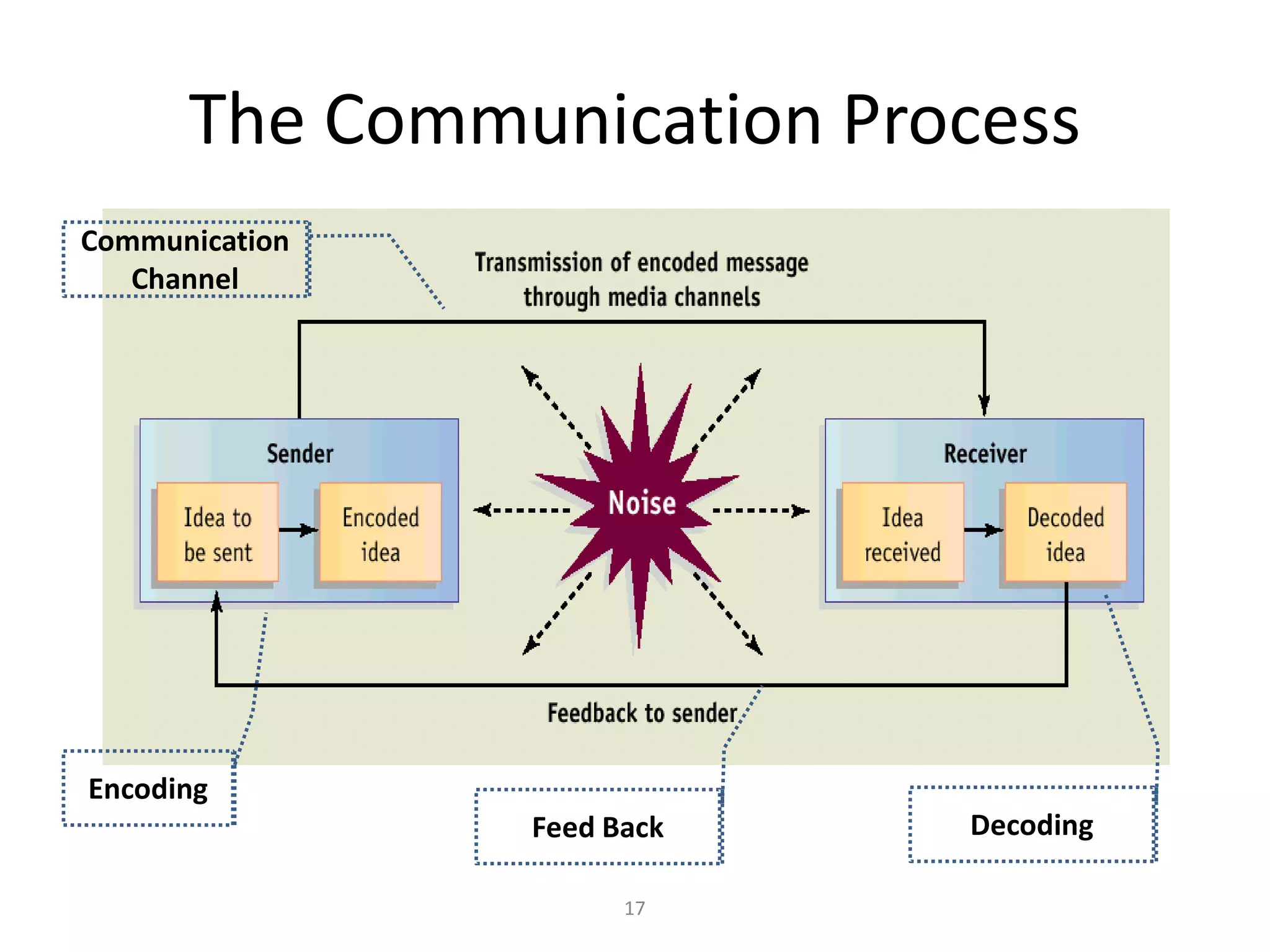
1- Encoding: process where idea is transformed so that it
can be transmitted to a receiver (e.g., a written or spoken
message).
2- Communication Channels: pathways over which
messages are transmitted (e.g., telephone lines, mail).
3- Decoding: process by which a receiver of messages
transforms them back into the sender’s ideas.
4- Feedback: the impact of messages on receivers.
5- Noise: Factors capable of distorting the clarity of
messages at any point during the communication
process.
© Copyright 2003, Prentice
                             16
Hall
The Communication Process
Communication
   Channel


Encoding
                Feed Back   Decoding

                      17
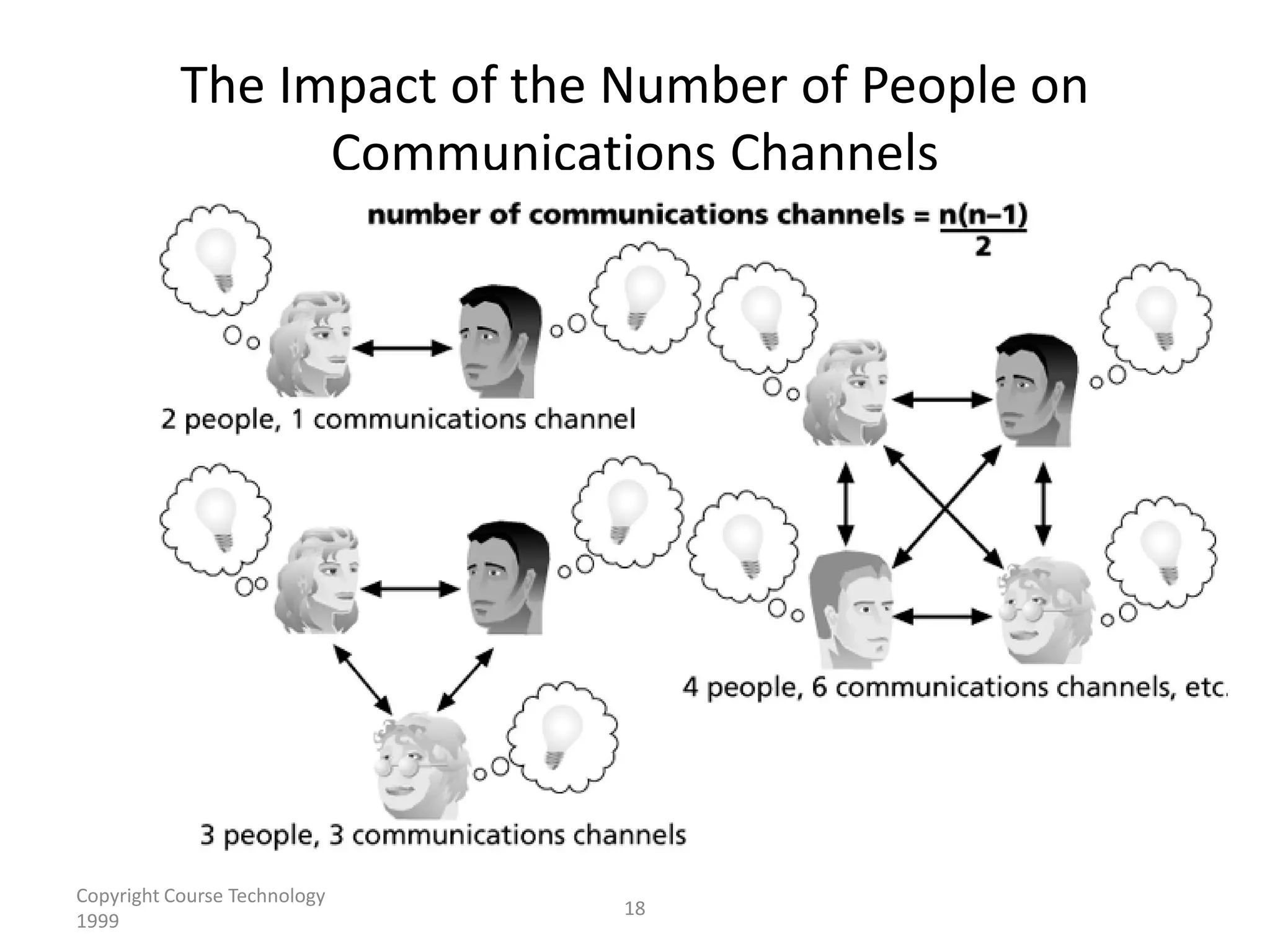
The Impact of the Number of People on
                 Communications Channels


Copyright Course Technology
                              18
1999
Sender
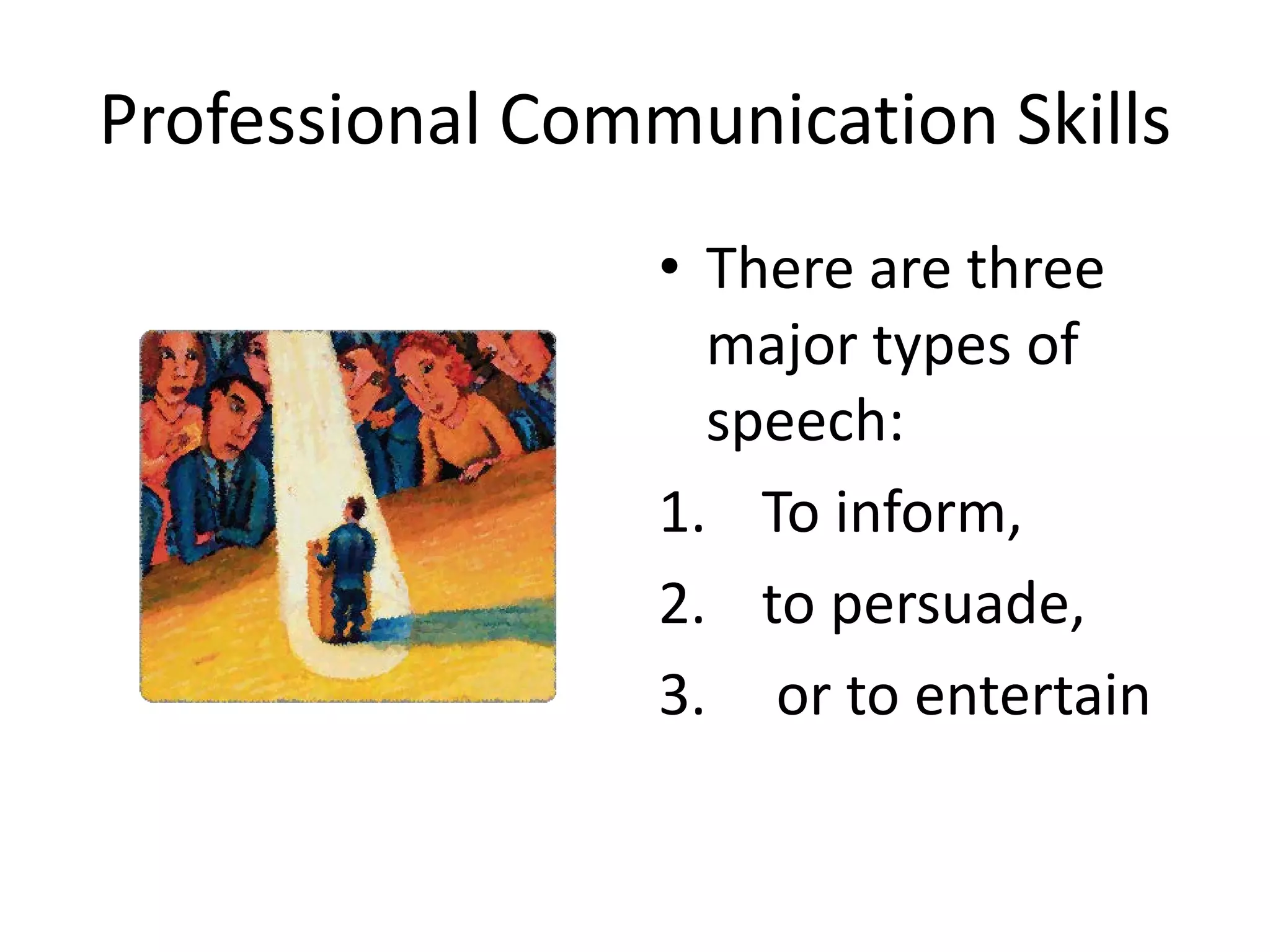
Professional Communication Skills
                 • There are three
                   major types of
                   speech:
                 1. To inform,
                 2. to persuade,
                 3. or to entertain
Tips for Sender
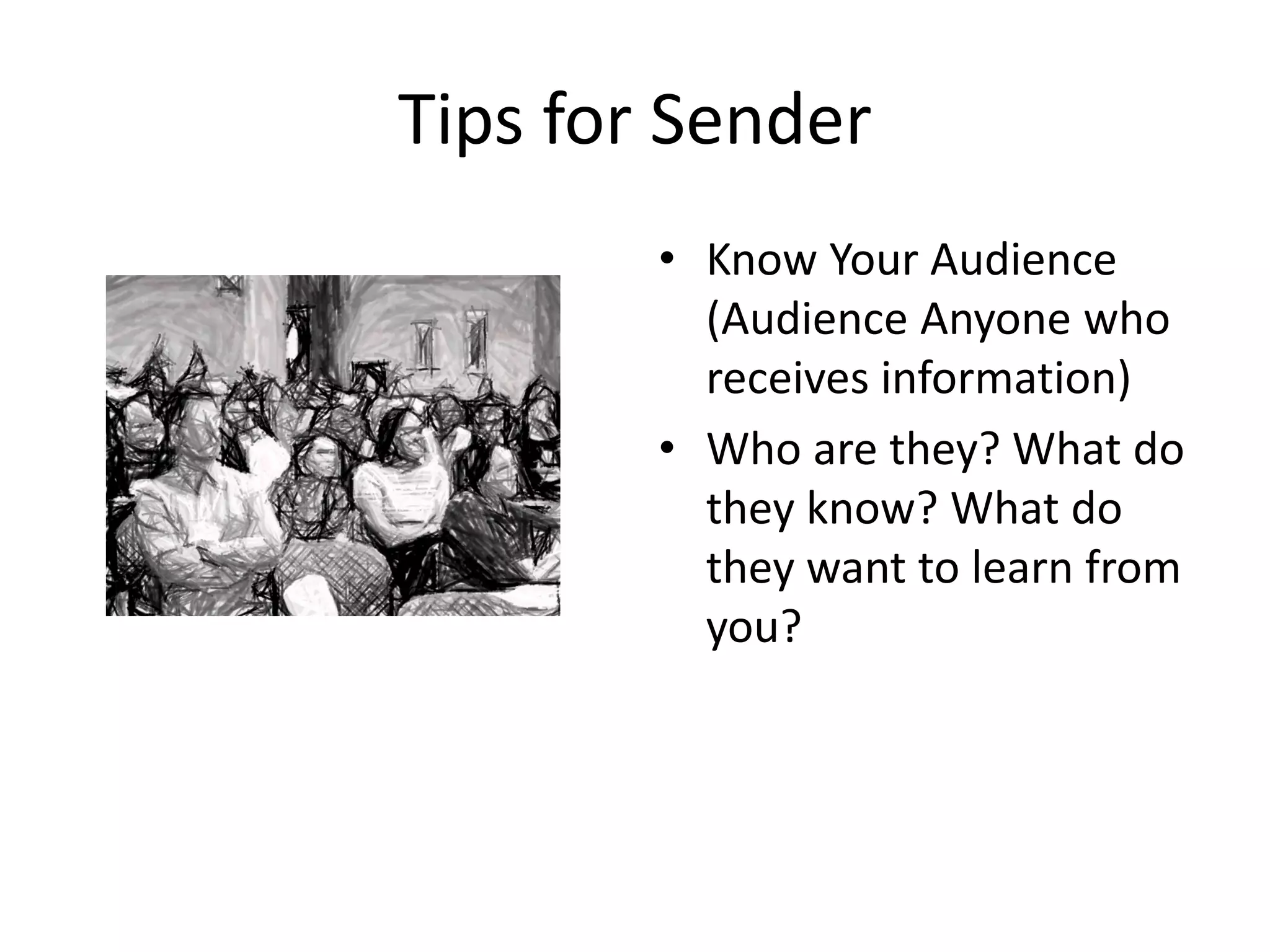
        • Know Your Audience
          (Audience Anyone who
          receives information)
        • Who are they? What do
          they know? What do
          they want to learn from
          you?
Tips for Sender
• Select your Subject (The main
  topic or key idea)
   – How does my subject relate to my
     listeners needs?
   – What is my most important point?
   – How can I make this point clearly?
   – What facts and examples can I use?
Professional Communication Skills
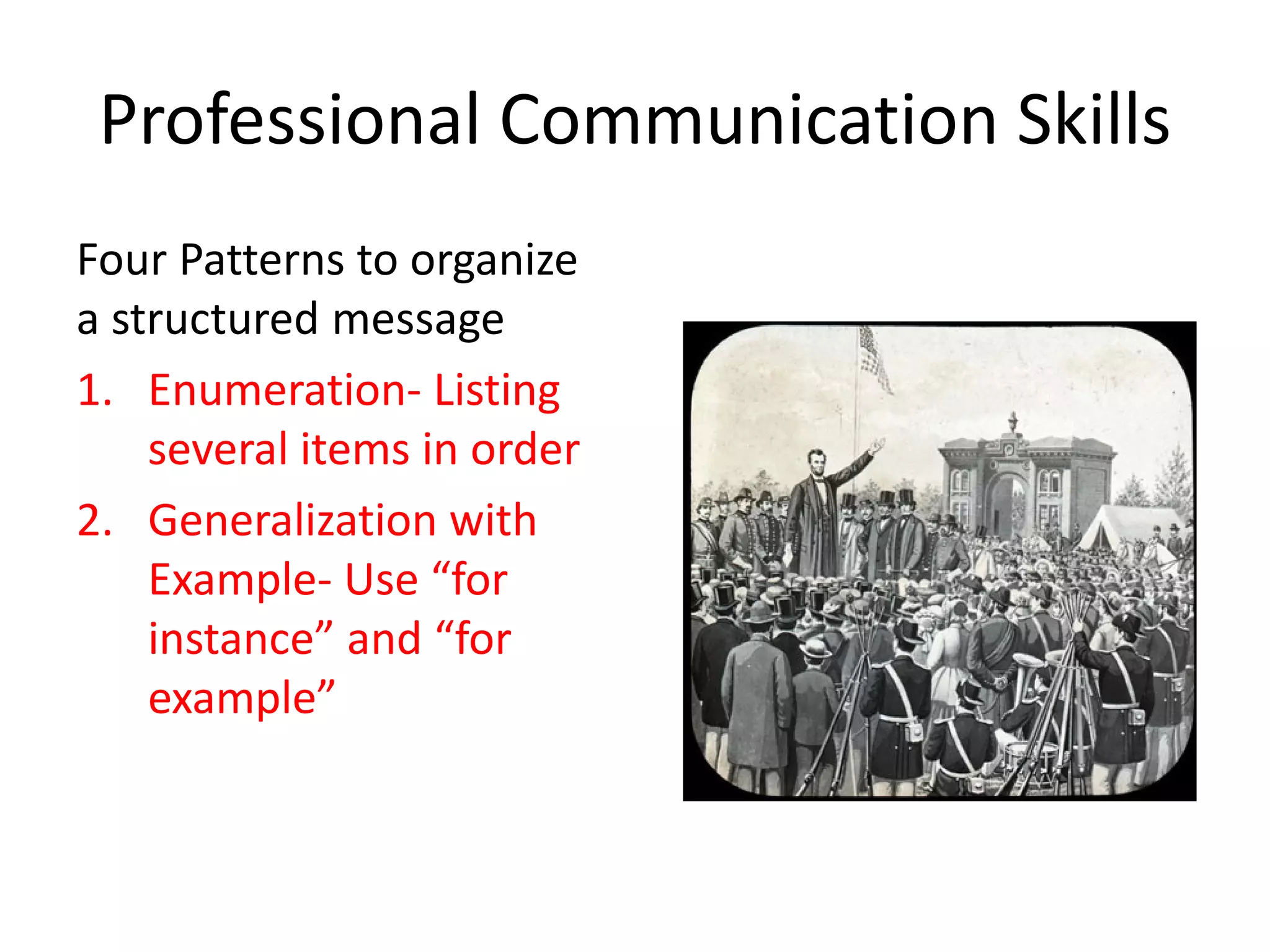
Four Patterns to organize
a structured message
1. Enumeration- Listing
    several items in order
2. Generalization with
    Example- Use “for
    instance” and “for
    example”
Professional Communication Skills
                 3- Cause and Effect-
                 “Therefore,”
                 “Consequently,” and “As a
                 result”
                 4- Compare and Contrast-
                 “However,”
                 “Nevertheless,” and “On
                 the other hand”
Tips for Sender
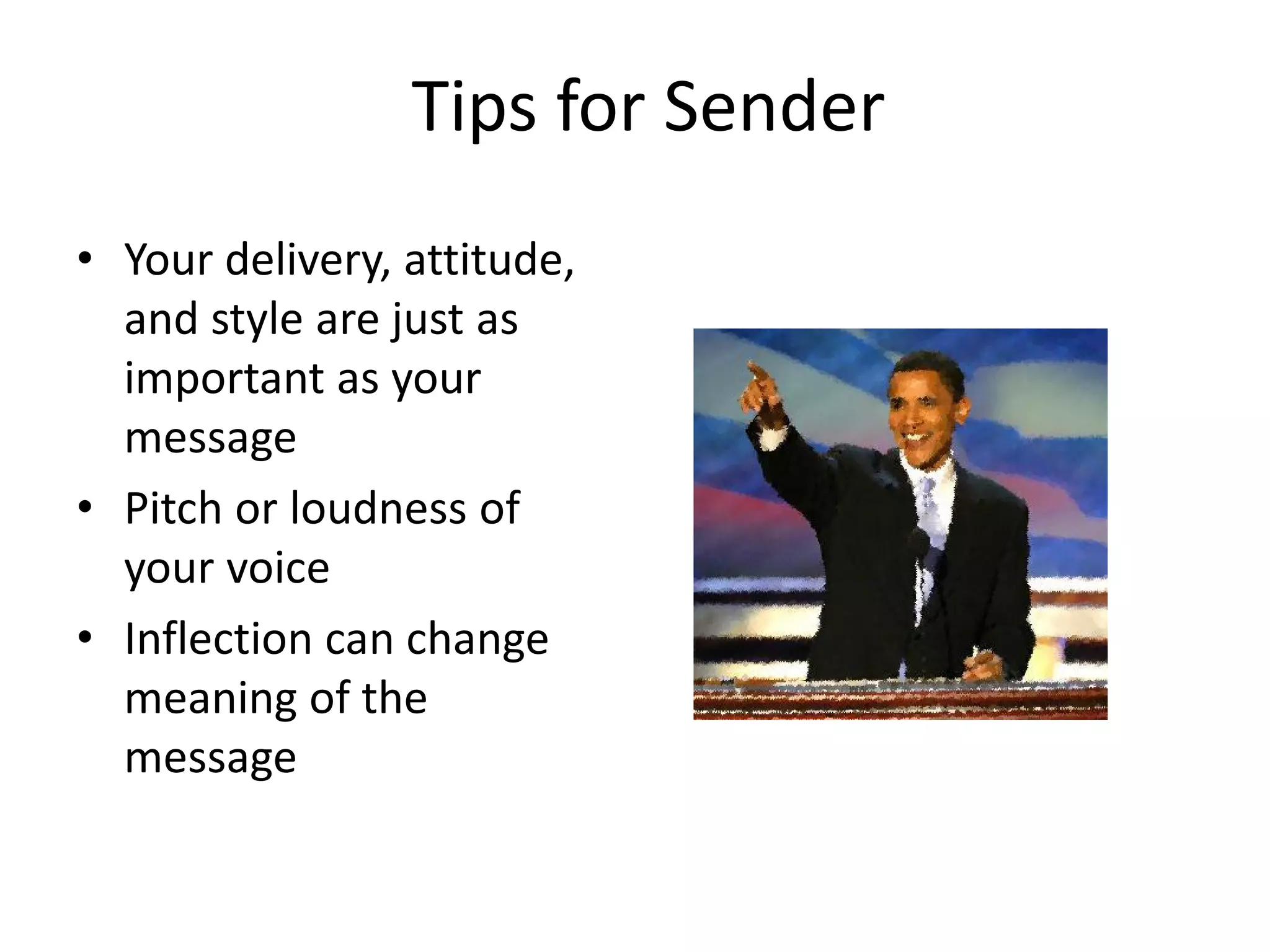
• Your delivery, attitude,
  and style are just as
  important as your
  message
• Pitch or loudness of
  your voice
• Inflection can change
  meaning of the
  message
Professional Communication Skills

                  • Make emotional
                    contacts, address
                    people by name, use
                    eye contact
                  • Use posture and body
                    language that match
                    the message
                  • Avoid the “umm’s”
                    and “uhhh’s”
Communication Skills
• Using Your Voice
• Pleasant, Not too high
  or low, Loudly not
  booming
• Variations of speed and
  loudness will help your
  message be
  entertaining
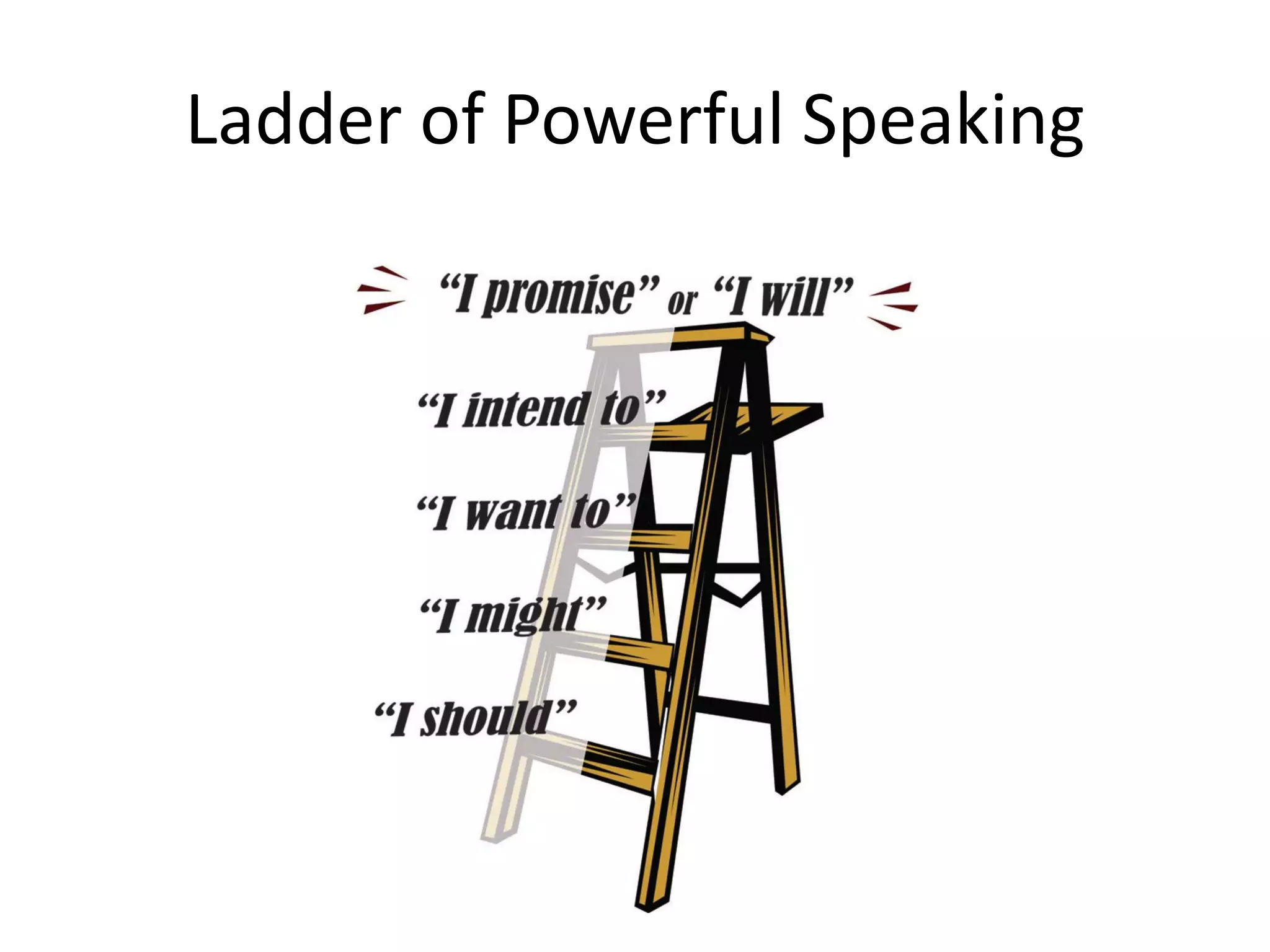
Ladder of Powerful Speaking
For example, if I loan you the money,
        will you pay it back?
I should pay it back.
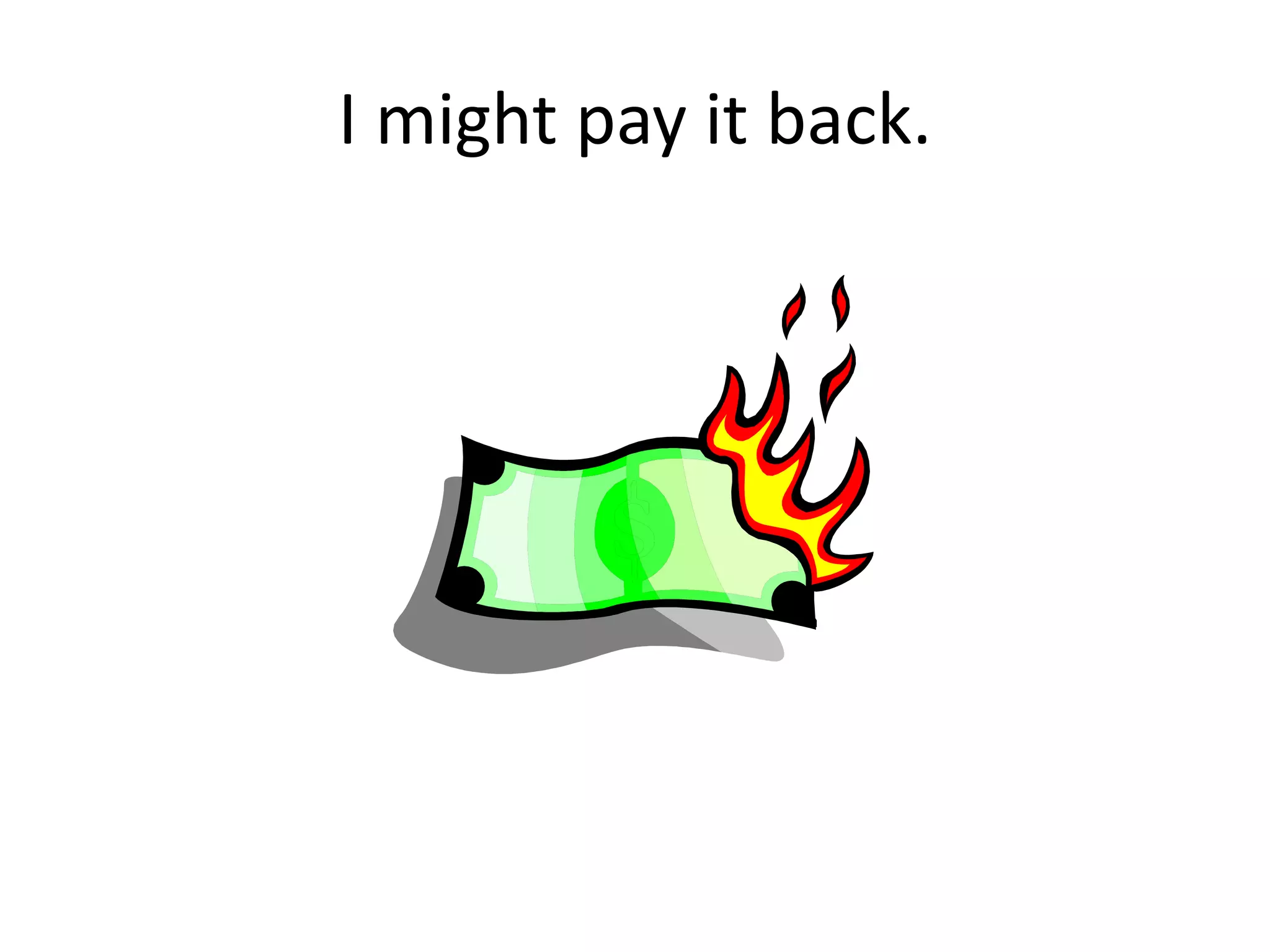
I might pay it back.
I want to pay it back.
I intend to pay it back.
I promise to pay it back.
Be Aware of Negative Self-Talk. Do You
      Recognize any of These?
•   I have to be perfect
•   I need the approval of everyone
•   That’s always the way it is.
•   I’m helpless in this situation.
•   If something bad can happen, it will
    happen.
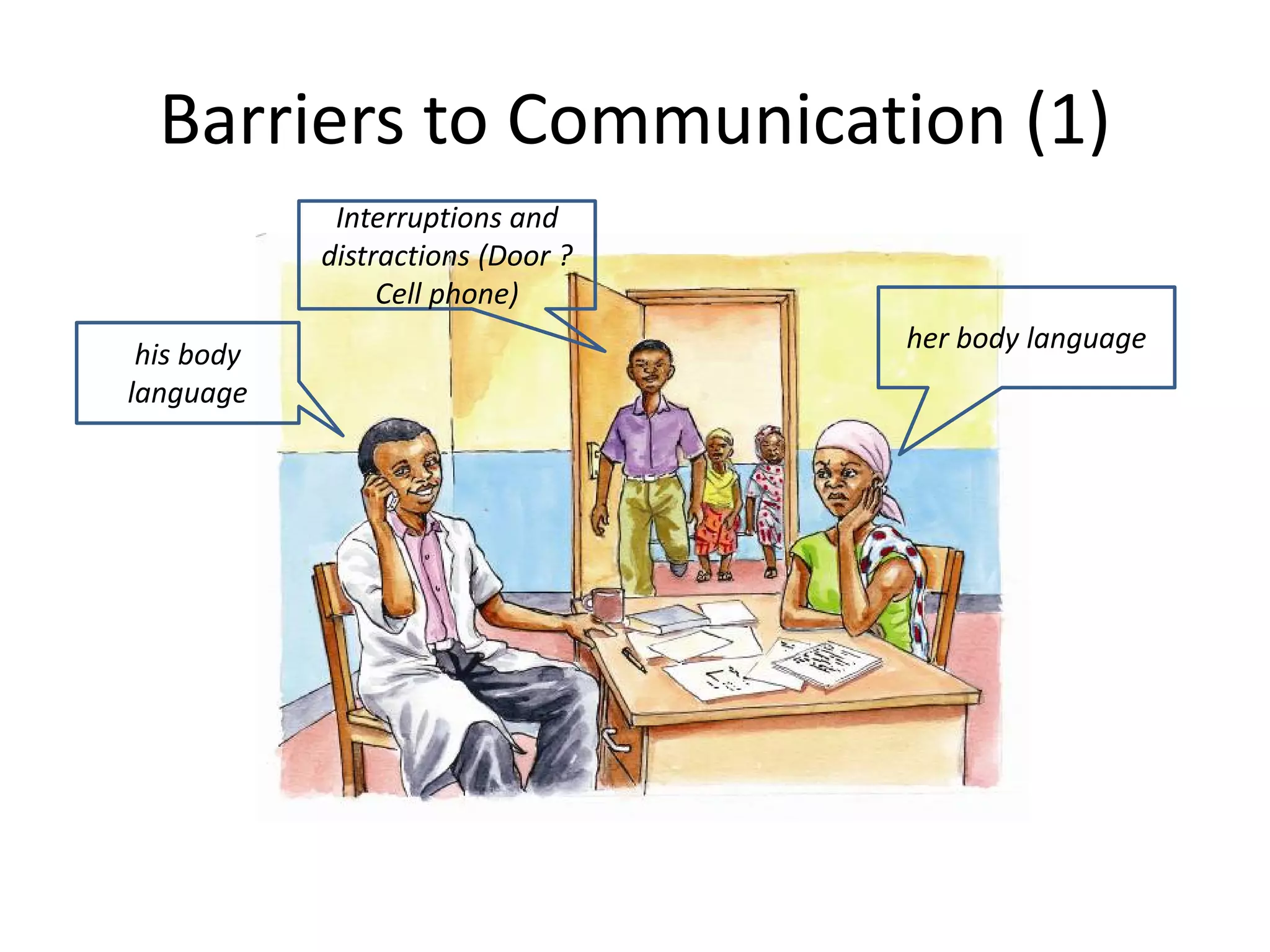
Barriers to Communication
Barriers to Communication (1)
             Interruptions and
            distractions (Door ?
                 Cell phone)
                                   her body language
 his body
language
Barriers to Communication (2)
Other barriers include:
• Talking too much, not giving speaker time to express him or
  herself
• Being critical and/or judgmental
• Laughing at or humiliating
• Contradicting or arguing with speaker
• Being disrespectful of speaker beliefs, way of life
• Lack of trust
Receiver
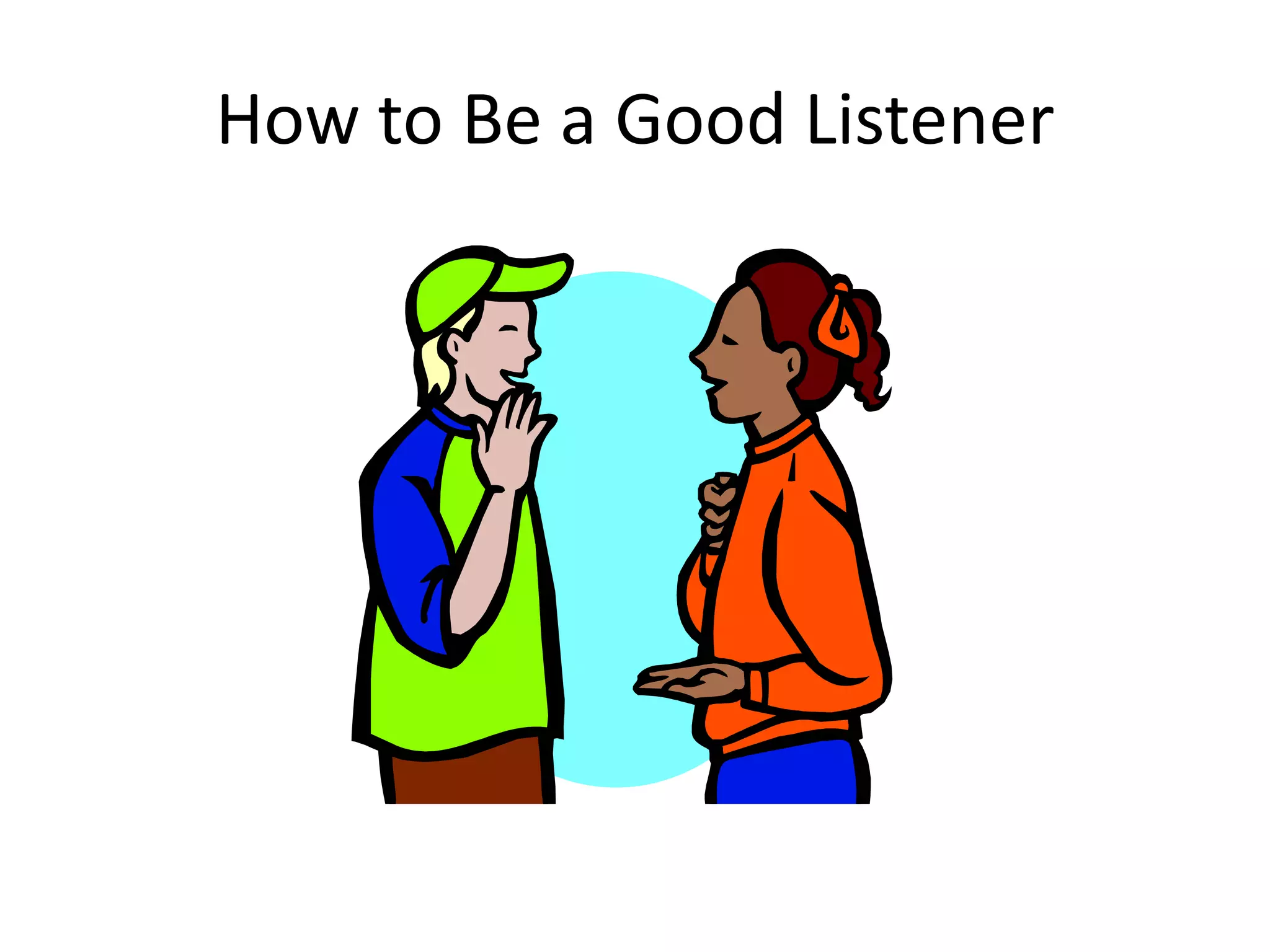
How to Be a Good Listener
Let the guy talk. Talking helps to
         clarify thinking.
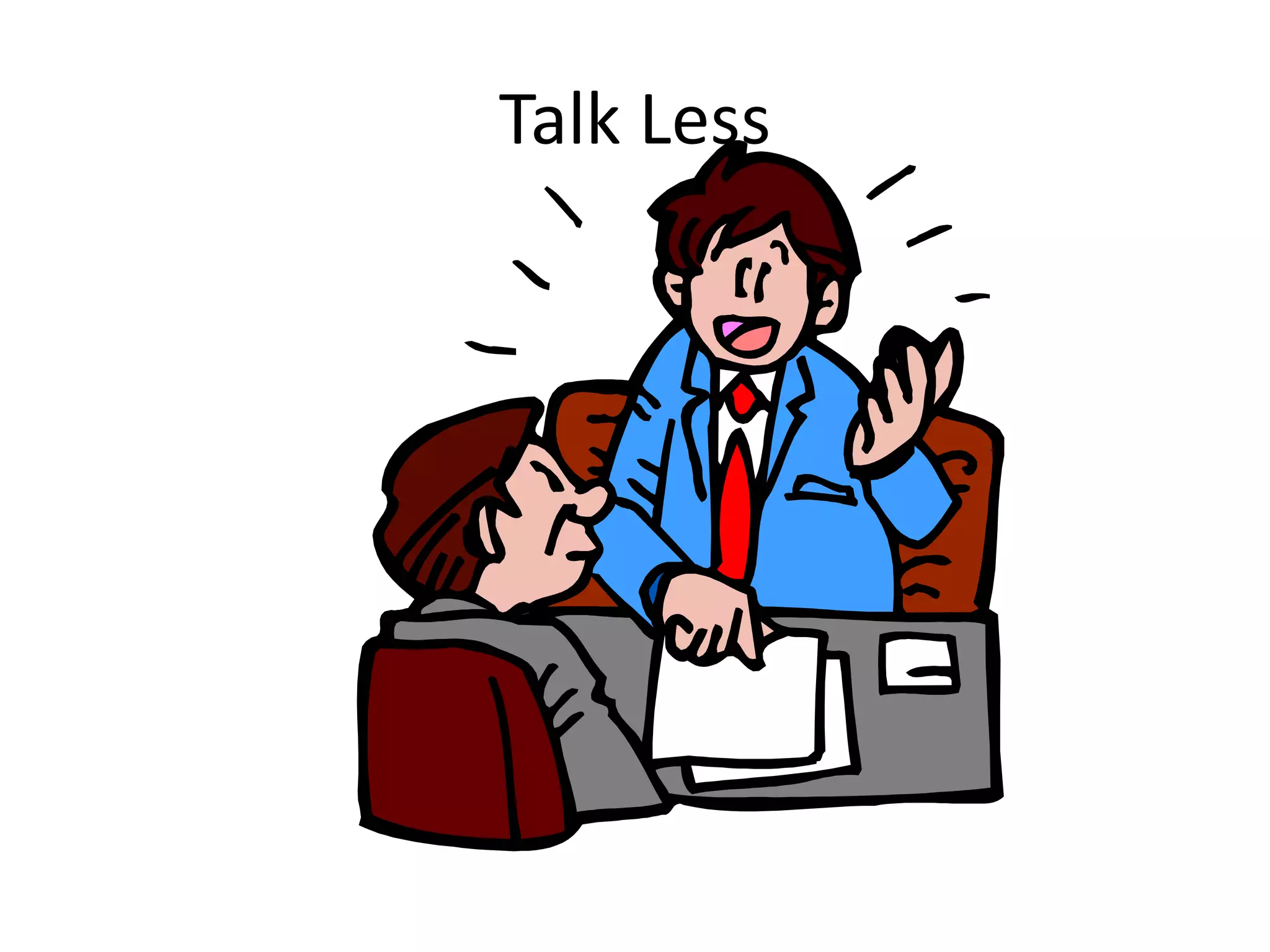
Talk Less
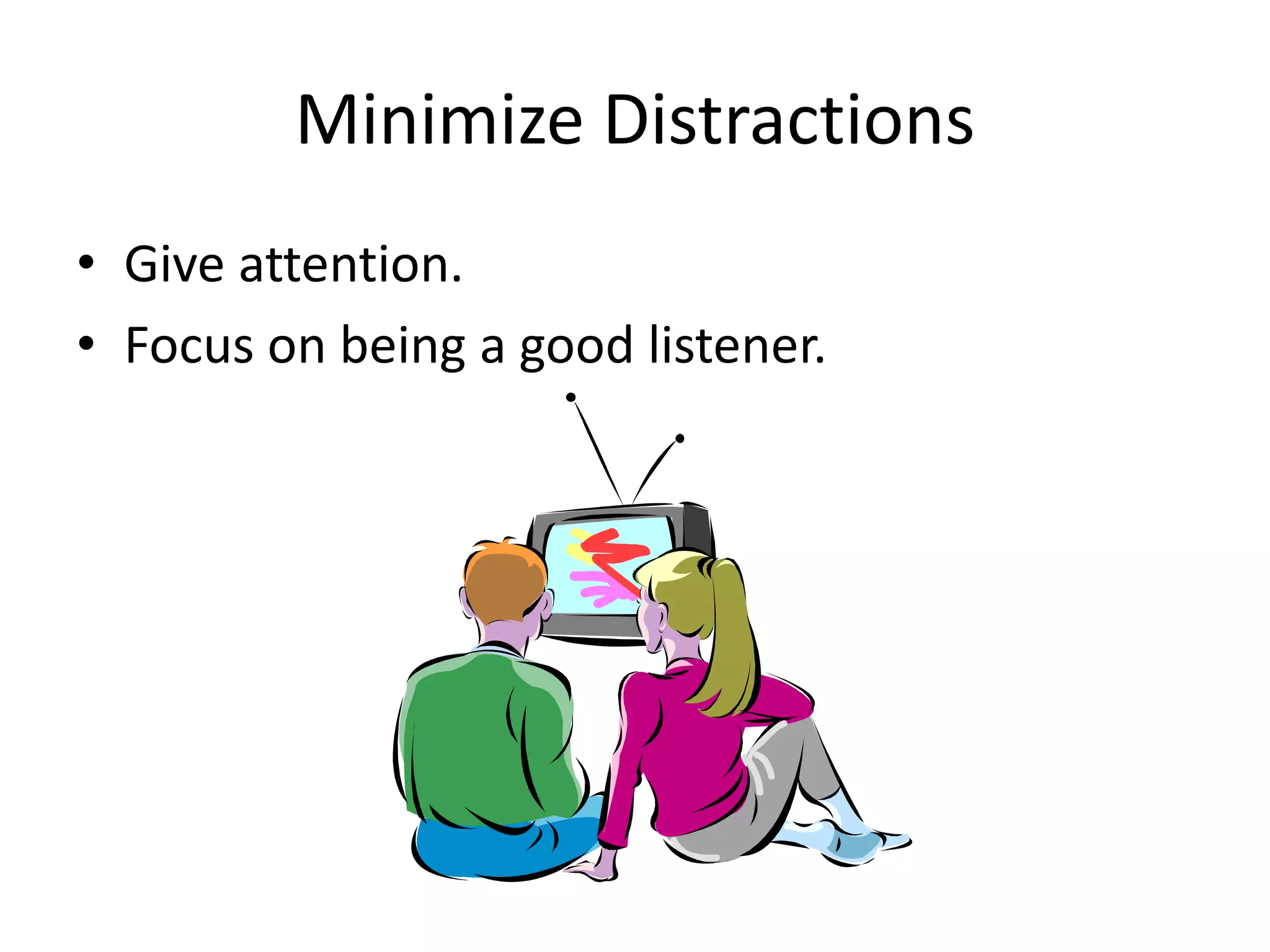
Minimize Distractions
• Give attention.
• Focus on being a good listener.
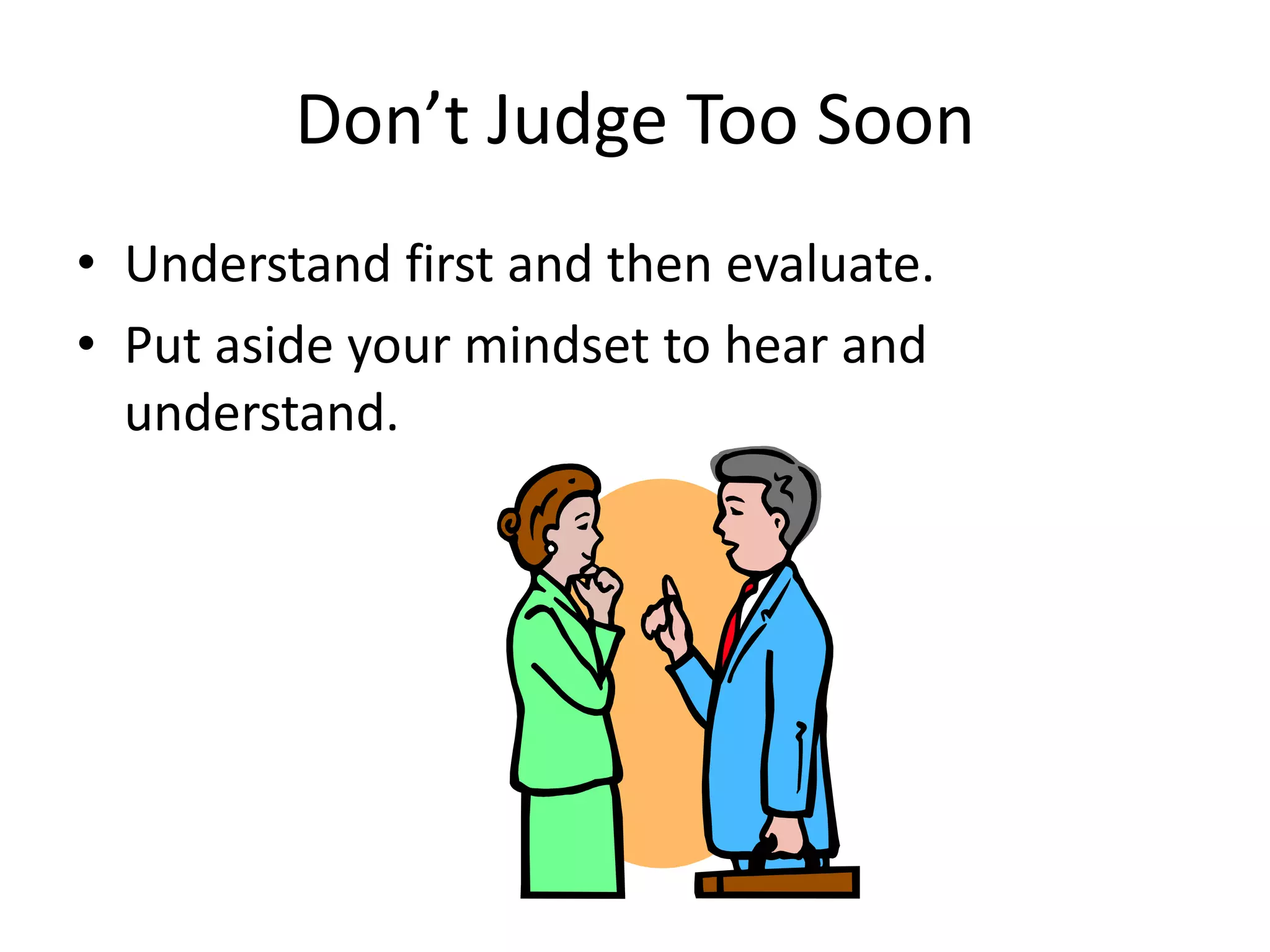
Don’t Judge Too Soon
• Understand first and then evaluate.
• Put aside your mindset to hear and
  understand.
Listen for the Main Point
Ask Questions
Feed Back
Feedback.. WHY
• Speakers often:
  – Say one thing and mean another.
  – Say something and not mean it.
  – Speak in a way that causes confusion.
Feedback: Basic (1)
• Ask permission or identify that you are giving
  feedback.
• Examples:
  – “Can I give you some feedback on that follow-up
    patient visit?”
  – “I’d like to provide some feedback on what I
    observed during my visit today.”
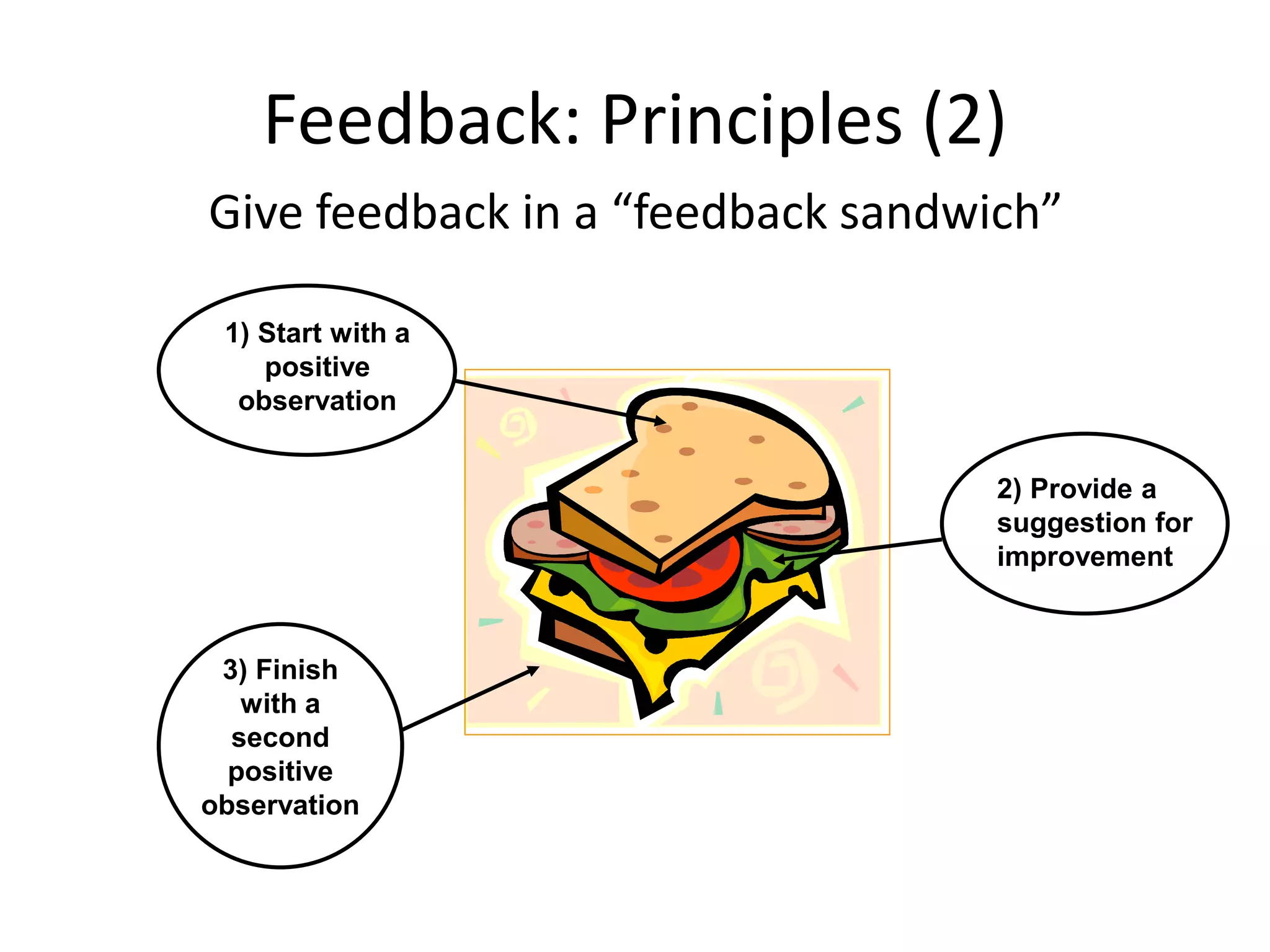
Feedback: Principles (2)
Give feedback in a “feedback sandwich”

 1) Start with a
    positive
  observation


                                   2) Provide a
                                   suggestion for
                                   improvement


 3) Finish
   with a
  second
  positive
observation
Feedback: Principles (3)
• Don’t be judgmental or use labels:
  – Avoid words like “lazy,” “careless,” or
    “forgetful”
• Don’t exaggerate or generalize:
  – Avoid terms such as, “you always,” or
    “you never”
Don’t minimize the situation. It’s only
              a _____.
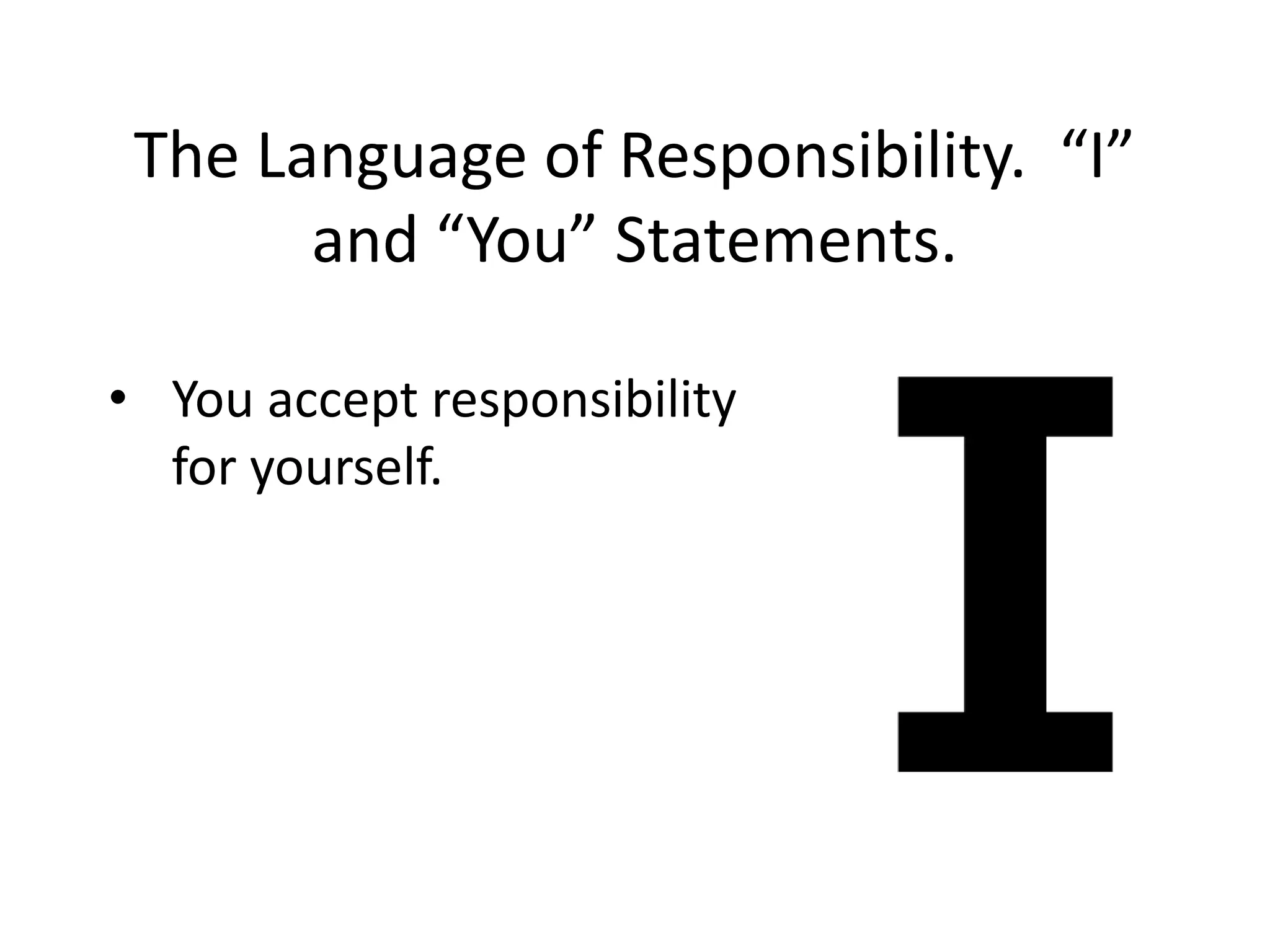
The Language of Responsibility. “I”
       and “You” Statements.

• You accept responsibility
  for yourself.
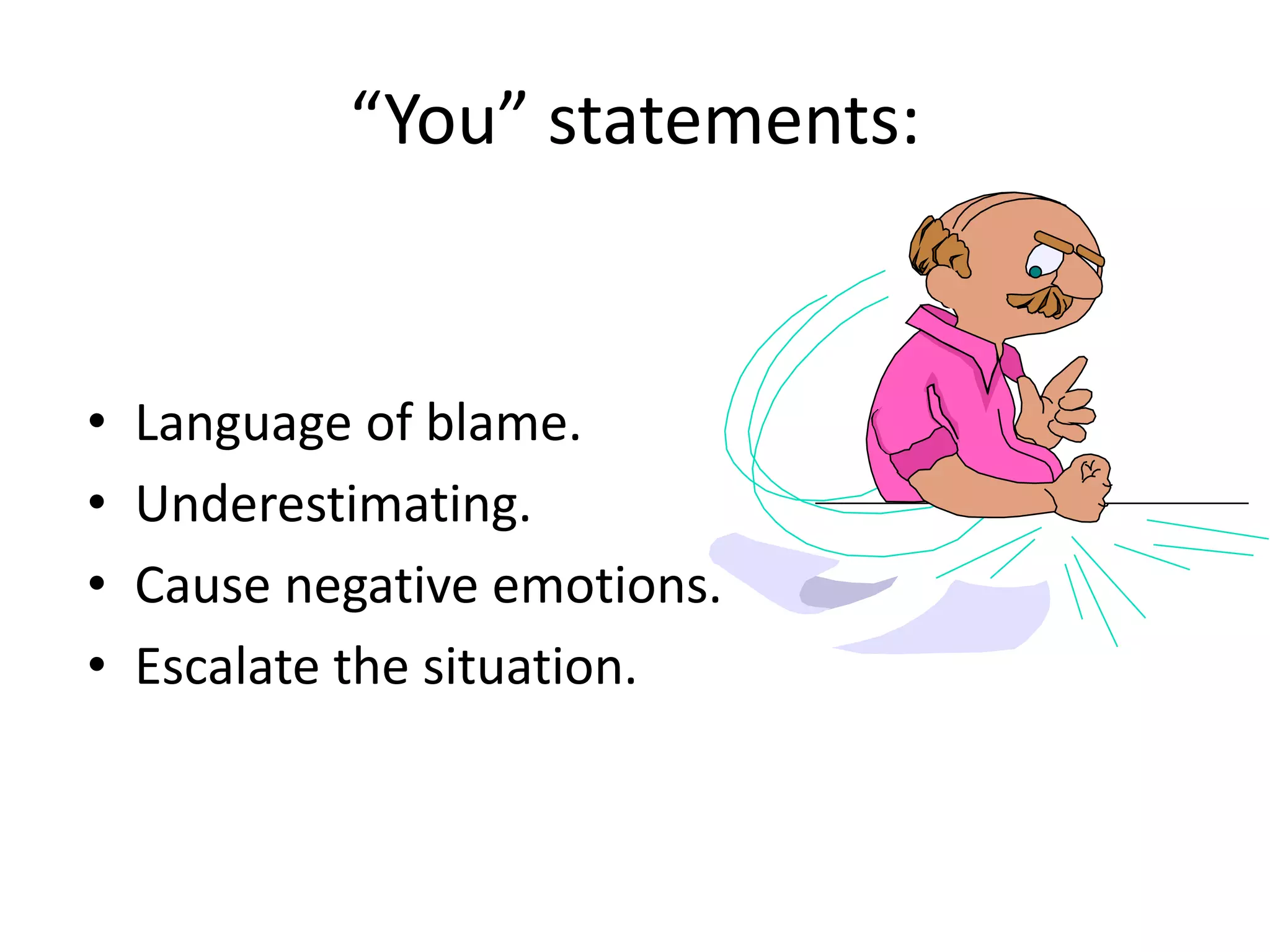
“You” statements:


•   Language of blame.
•   Underestimating.
•   Cause negative emotions.
•   Escalate the situation.
“I” Statement:
Instead of: You must be crazy.

     I don’t understand.
How to Feedback
•   Restate what has been said
•   Ask for clarification
•   Reword the message to check understanding
•   Use your own words to rephrase the message
    to check understanding
Thank you

Communication Skills

  • 1.
  • 2.
    Objectives By the endof the session, participants will know 1. What is communication 2. Why it is so important 3. How Communication Model works 4. Tips for sender / Receiver 5. Tips for Giving Feedback
  • 3.
    3 In the Beginning... • There was a chaos...
  • 4.
    4 In the Beginning... • Projects were like a battlefield
  • 5.
    5 A lot ofwork was being done... But it was not always productive
  • 6.
  • 7.
    Communication The process bywhich a person, group, or organization (the sender) transmits information (the message) to another person, group, or organization (the receiver) © Copyright 2003, Prentice Hall 7
  • 9.
    Major types ofCommunication 1. Verbal 2. Nonverbal 3. Written
  • 10.
    Verbal • Communicating usinglanguage, a structured system of sounds that is used and understood to express ideas among people. – Verbal communication includes… volume level, tone, etc.
  • 11.
    Listening Skills • Listeningis not a “passive” skill but a “receptive” skill. It requires as much attention and mental activity as speaking. • That of the time an individual is engaged in communication, approximately 9 % is devoted to writing, 16 % to reading, 30 % to speaking, and 45 % to listening.
  • 12.
    Nonverbal • What percentof how we communicate with others is through nonverbal communication (facial expressions, body language)? 70%
  • 13.
    Why is nonverbalcommunication so important? Nonverbal is the first thing our mind reads before a word is even spoken.
  • 14.
    Purposes of Communication  To support decision  To achieve coordinated action  To share information  To develop friendships  To build your personality in others mind © Copyright 2003, Prentice Hall 14
  • 15.
  • 16.
    Communication Concepts 1- Encoding:process where idea is transformed so that it can be transmitted to a receiver (e.g., a written or spoken message). 2- Communication Channels: pathways over which messages are transmitted (e.g., telephone lines, mail). 3- Decoding: process by which a receiver of messages transforms them back into the sender’s ideas. 4- Feedback: the impact of messages on receivers. 5- Noise: Factors capable of distorting the clarity of messages at any point during the communication process. © Copyright 2003, Prentice 16 Hall
  • 17.
    The Communication Process Communication Channel Encoding Feed Back Decoding 17
  • 18.
    The Impact ofthe Number of People on Communications Channels Copyright Course Technology 18 1999
  • 19.
  • 20.
    Professional Communication Skills • There are three major types of speech: 1. To inform, 2. to persuade, 3. or to entertain
  • 21.
    Tips for Sender • Know Your Audience (Audience Anyone who receives information) • Who are they? What do they know? What do they want to learn from you?
  • 22.
    Tips for Sender •Select your Subject (The main topic or key idea) – How does my subject relate to my listeners needs? – What is my most important point? – How can I make this point clearly? – What facts and examples can I use?
  • 23.
    Professional Communication Skills FourPatterns to organize a structured message 1. Enumeration- Listing several items in order 2. Generalization with Example- Use “for instance” and “for example”
  • 24.
    Professional Communication Skills 3- Cause and Effect- “Therefore,” “Consequently,” and “As a result” 4- Compare and Contrast- “However,” “Nevertheless,” and “On the other hand”
  • 25.
    Tips for Sender •Your delivery, attitude, and style are just as important as your message • Pitch or loudness of your voice • Inflection can change meaning of the message
  • 26.
    Professional Communication Skills • Make emotional contacts, address people by name, use eye contact • Use posture and body language that match the message • Avoid the “umm’s” and “uhhh’s”
  • 27.
    Communication Skills • UsingYour Voice • Pleasant, Not too high or low, Loudly not booming • Variations of speed and loudness will help your message be entertaining
  • 28.
  • 29.
    For example, ifI loan you the money, will you pay it back?
  • 30.
    I should payit back.
  • 31.
    I might payit back.
  • 32.
    I want topay it back.
  • 33.
    I intend topay it back.
  • 34.
    I promise topay it back.
  • 35.
    Be Aware ofNegative Self-Talk. Do You Recognize any of These? • I have to be perfect • I need the approval of everyone • That’s always the way it is. • I’m helpless in this situation. • If something bad can happen, it will happen.
  • 36.
  • 37.
    Barriers to Communication(1) Interruptions and distractions (Door ? Cell phone) her body language his body language
  • 38.
    Barriers to Communication(2) Other barriers include: • Talking too much, not giving speaker time to express him or herself • Being critical and/or judgmental • Laughing at or humiliating • Contradicting or arguing with speaker • Being disrespectful of speaker beliefs, way of life • Lack of trust
  • 39.
  • 40.
    How to Bea Good Listener
  • 41.
    Let the guytalk. Talking helps to clarify thinking.
  • 42.
  • 43.
    Minimize Distractions • Giveattention. • Focus on being a good listener.
  • 44.
    Don’t Judge TooSoon • Understand first and then evaluate. • Put aside your mindset to hear and understand.
  • 45.
    Listen for theMain Point
  • 46.
  • 47.
  • 48.
    Feedback.. WHY • Speakersoften: – Say one thing and mean another. – Say something and not mean it. – Speak in a way that causes confusion.
  • 49.
    Feedback: Basic (1) •Ask permission or identify that you are giving feedback. • Examples: – “Can I give you some feedback on that follow-up patient visit?” – “I’d like to provide some feedback on what I observed during my visit today.”
  • 50.
    Feedback: Principles (2) Givefeedback in a “feedback sandwich” 1) Start with a positive observation 2) Provide a suggestion for improvement 3) Finish with a second positive observation
  • 51.
    Feedback: Principles (3) •Don’t be judgmental or use labels: – Avoid words like “lazy,” “careless,” or “forgetful” • Don’t exaggerate or generalize: – Avoid terms such as, “you always,” or “you never”
  • 52.
    Don’t minimize thesituation. It’s only a _____.
  • 53.
    The Language ofResponsibility. “I” and “You” Statements. • You accept responsibility for yourself.
  • 54.
    “You” statements: • Language of blame. • Underestimating. • Cause negative emotions. • Escalate the situation.
  • 55.
    “I” Statement: Instead of:You must be crazy. I don’t understand.
  • 56.
    How to Feedback • Restate what has been said • Ask for clarification • Reword the message to check understanding • Use your own words to rephrase the message to check understanding
  • 57.