COMMUNICATION PROCESS
• Define effective communication
• Explain the elements of the
communication process
• Explain the barriers to effective
communication.
• Describe the value of effective
communication and its various
elements.
Introduction
•Think of how a radio message is sent from a person
in the radio studio to you listening in your car.
•Or
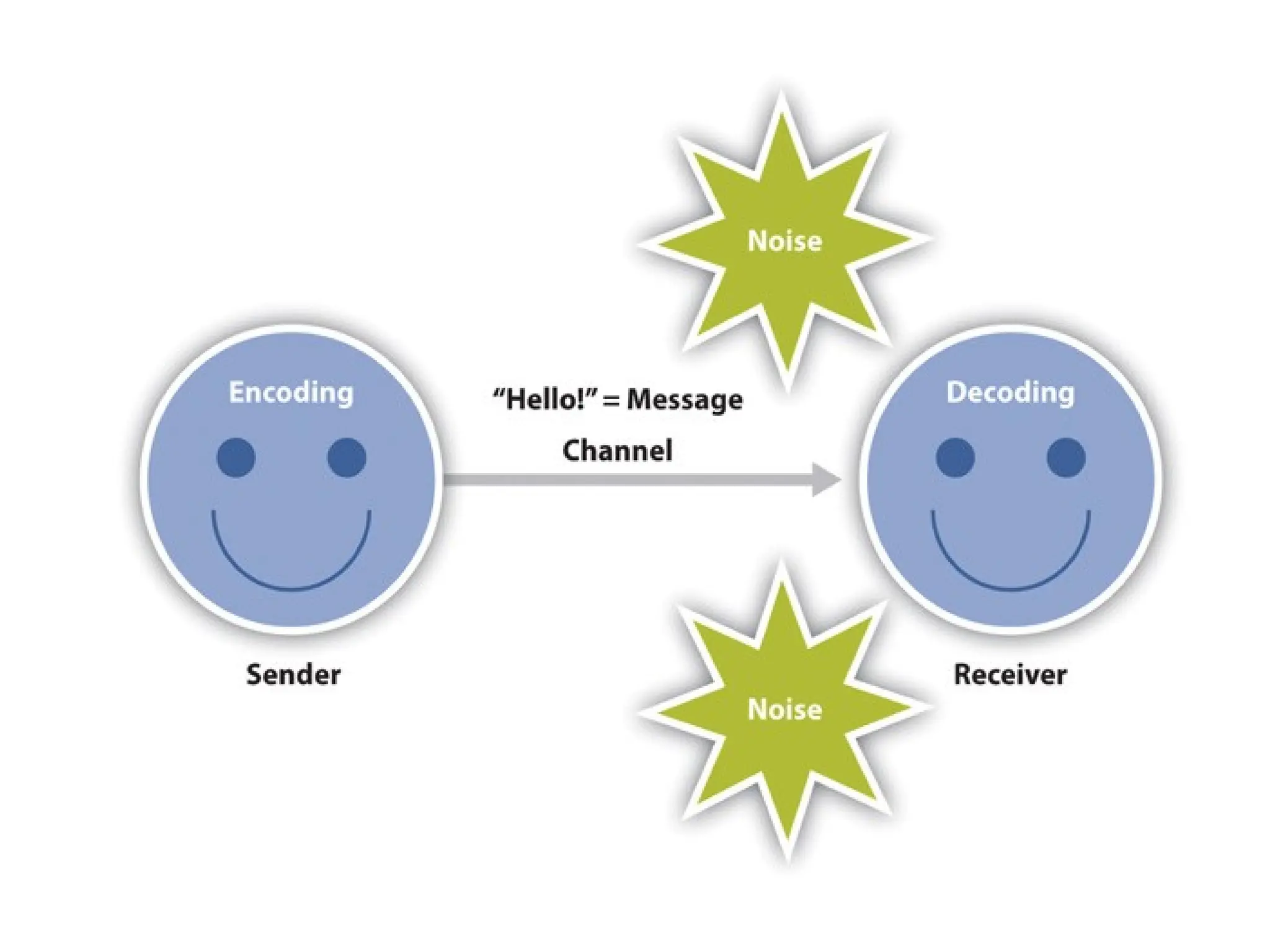
•For example, when you say “Hello!” to your friend,
you are sending a message of greeting that will be
received by your friend.
Introduction
•The sender is the radio announcer /friend who
encodes a verbal message that is transmitted by a
radio tower through electromagnetic waves (the
channel) and eventually reaches your (the receiver’s)
ears via an antenna and speakers in order to be
decoded.
•The radio announcer doesn’t really know if you
receive his or her message or not, but if the
equipment is working and the channel is free of
static, then there is a good chance that the message
was successfully received.
Introduction
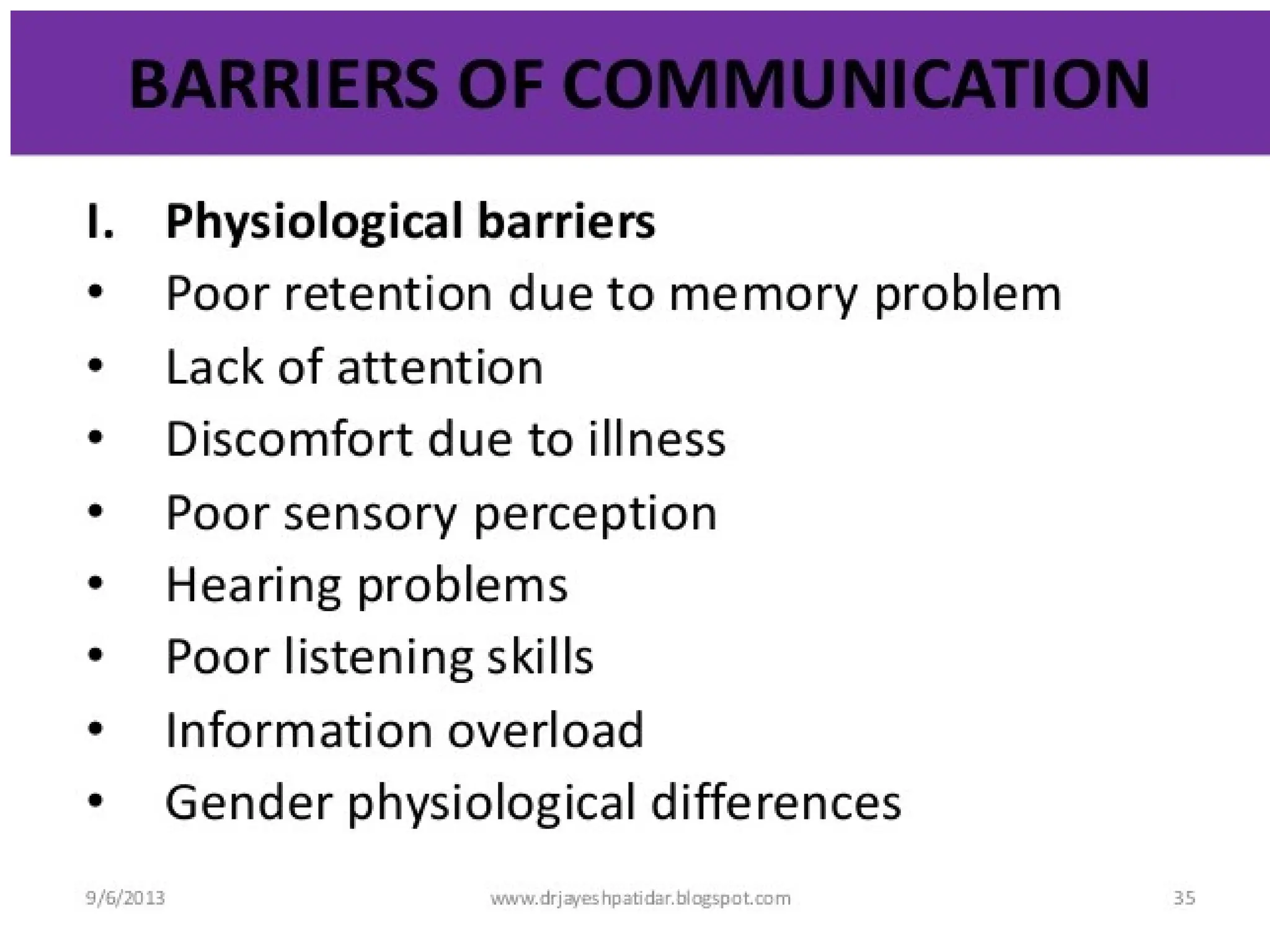
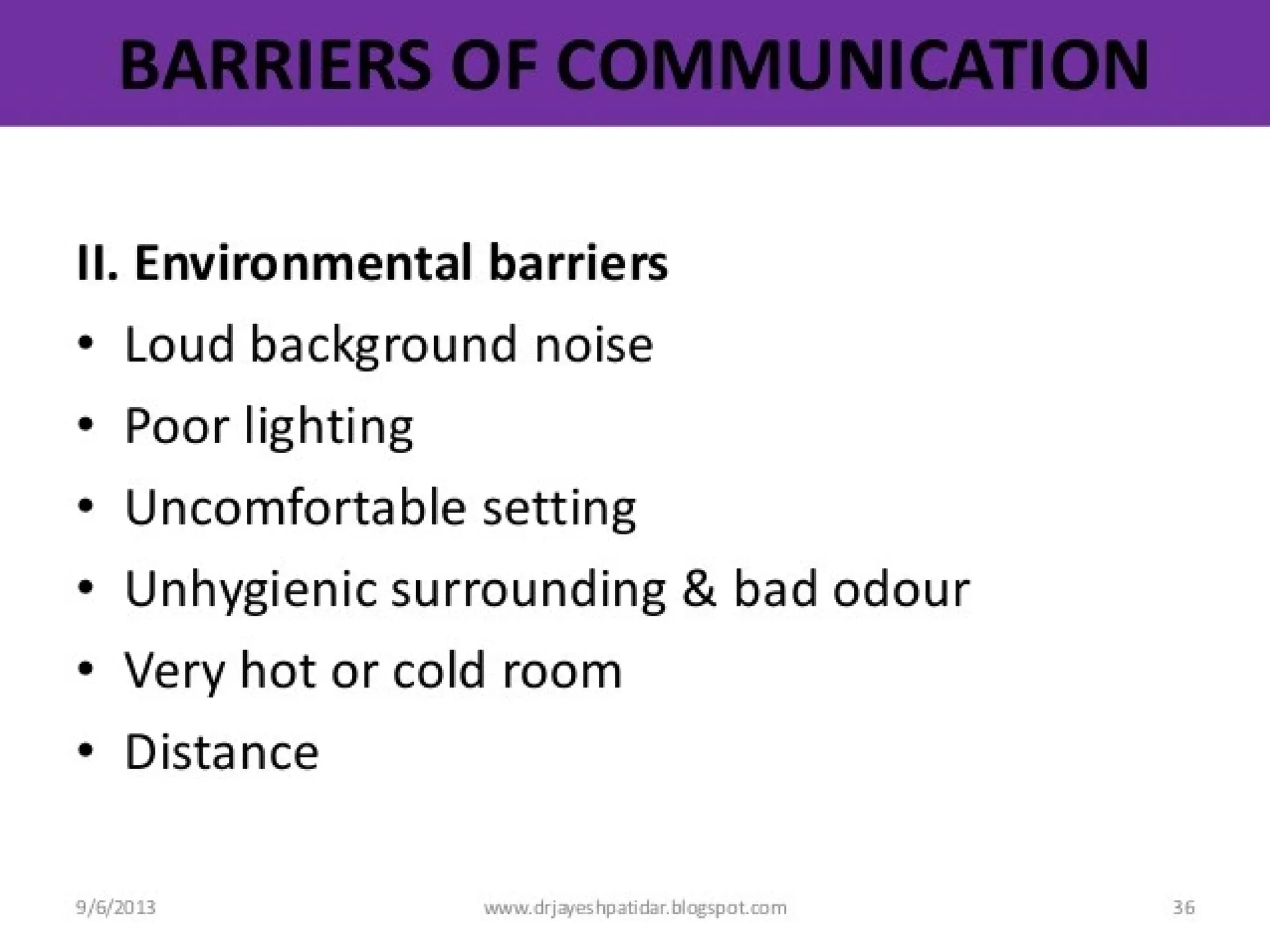
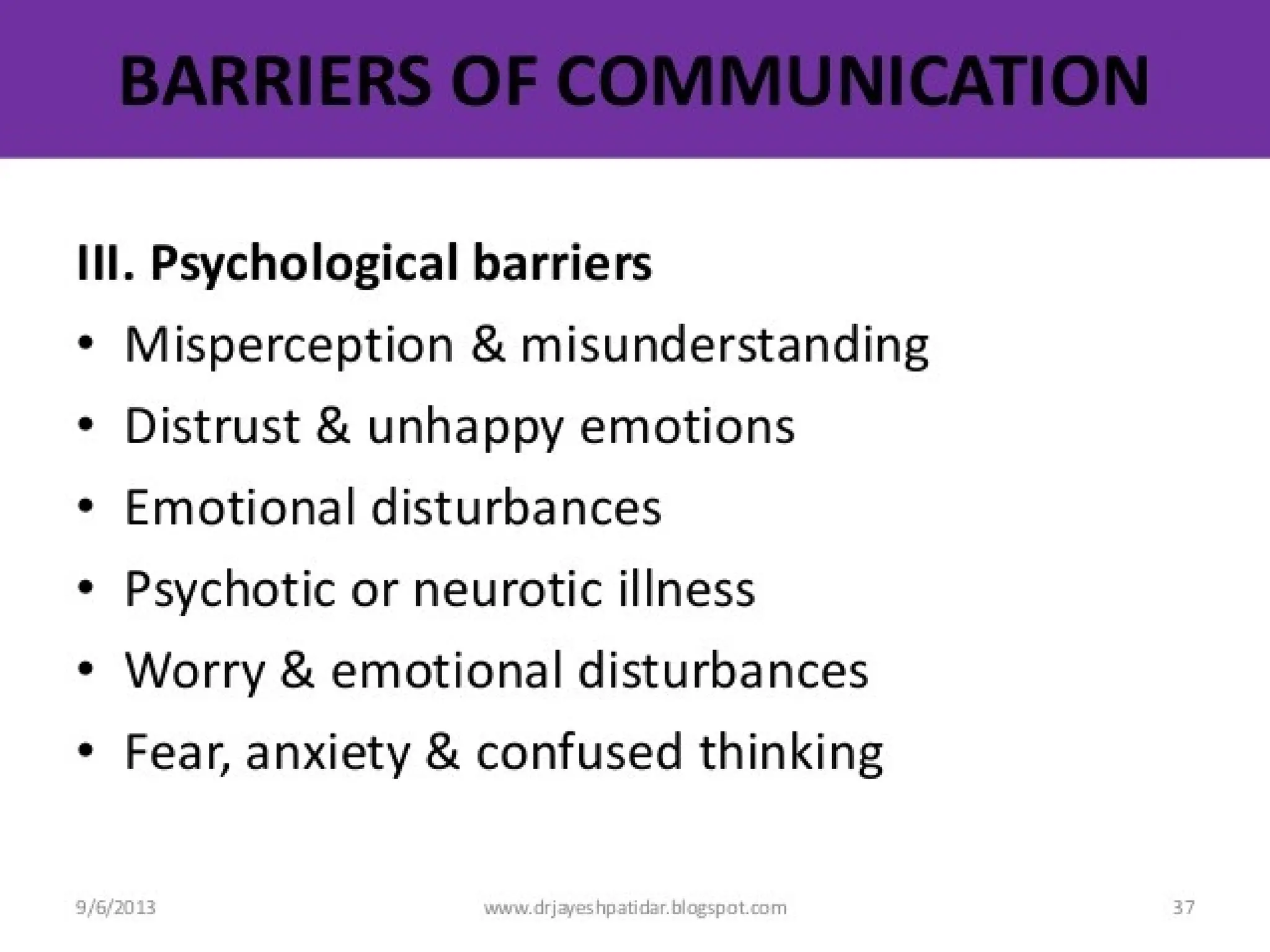
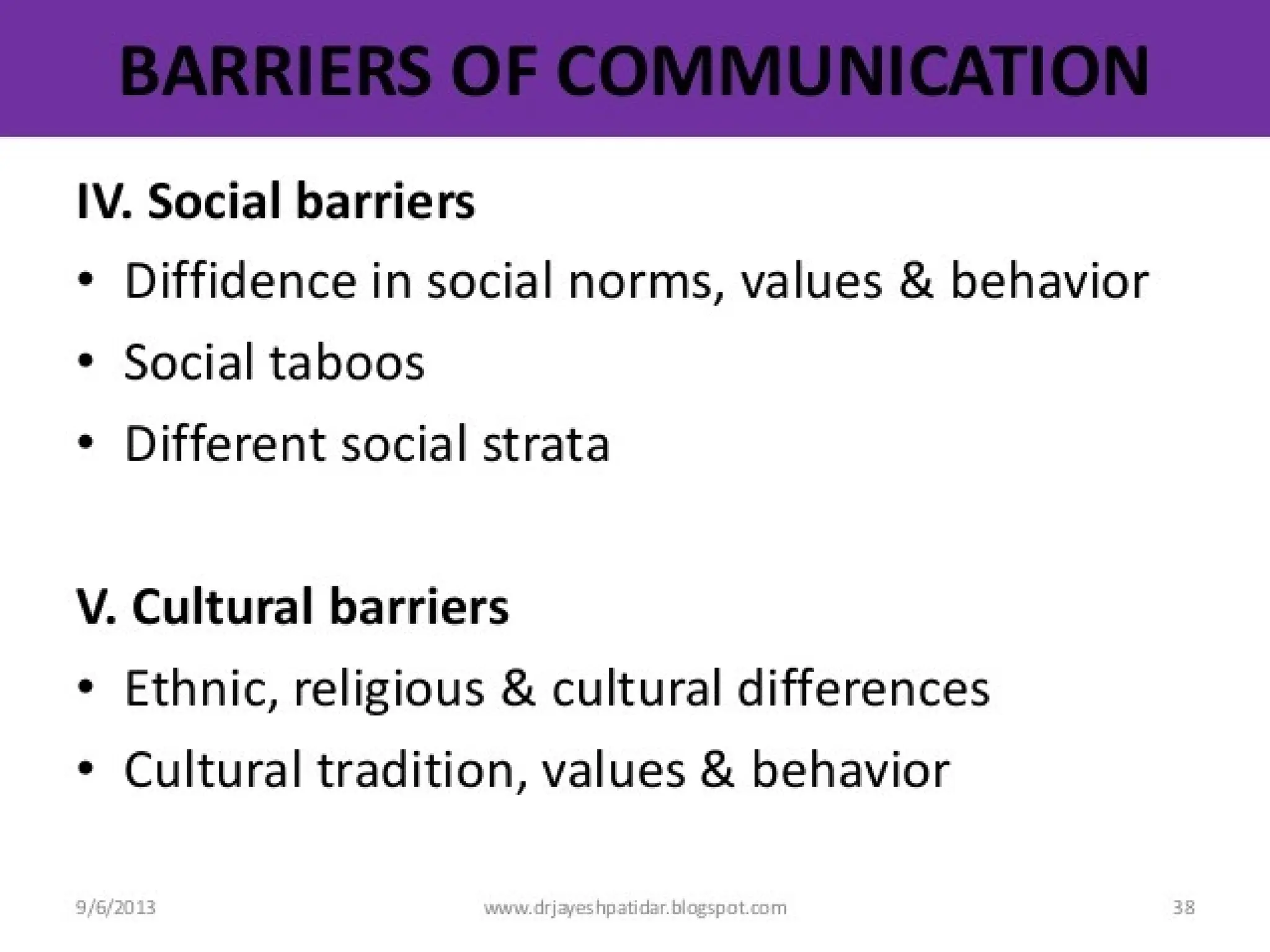
• NOISE/BARRIERS
• Noise is anything that interferes
with a message being sent between
participants in a communication
process
Introduction
• Communication is the process of sharing
our ideas, thoughts, and feelings with other
people and having those ideas, thoughts,
and feelings understood by the people we
are talking with.
• When we communicate we speak, listen,
and observe.
• The way we communicate is a learned style
Introduction
• Poor communication can waste time
and energy and cause conflict between
people.
• You can benefit by improving your
communication skills:
• You will have a clearer understanding of
what people are saying to you, others
will be less likely to misunderstand you,
problems will be solved quickly, you will
be able to identify others’ needs and
you will be able to resolve conflict.
Introduction cont’
• Communicating involves several
skills. For example, speaking involves
not only getting your message across
but also being able to listen and
understand what others are saying
• (active listening) and observing the
verbal and nonverbal clues in order
to monitor the effectiveness of your
message.
• Writing skills, reading, reporting skills
Definitions
• Communication: the transmission of a
message from a sender to a receiver in an
understandable manner.
• Communication is a process by which
information is exchanged between
individuals through a common system of
symbols, and signs of behaviour. Webster’s
Dictionary
• Communication is interchange of thoughts,
opinions or information by speech, writing
or signs. ROBERT ANDERSON
Definition
• Communication is derived from the Latin
word communis meaning common
• The term communication process refers
to the exchange of information (a
message) between two or more people.
• The goal of communication is to convey
information—and the understanding of
that information—from one person or
group to another person or group
Definition
• The critical factor in measuring the effectiveness
of communication is common understanding.
• Understanding exists when all parties involved
have a mutual agreement as to not only the
information, but also the meaning of the
information.
• Effective communication, therefore, occurs
when the intended message of the sender and
the interpreted message of the receiver are one
and the same.
• Although this should be the goal in any
communication, it is not always achieved.
Components/elements
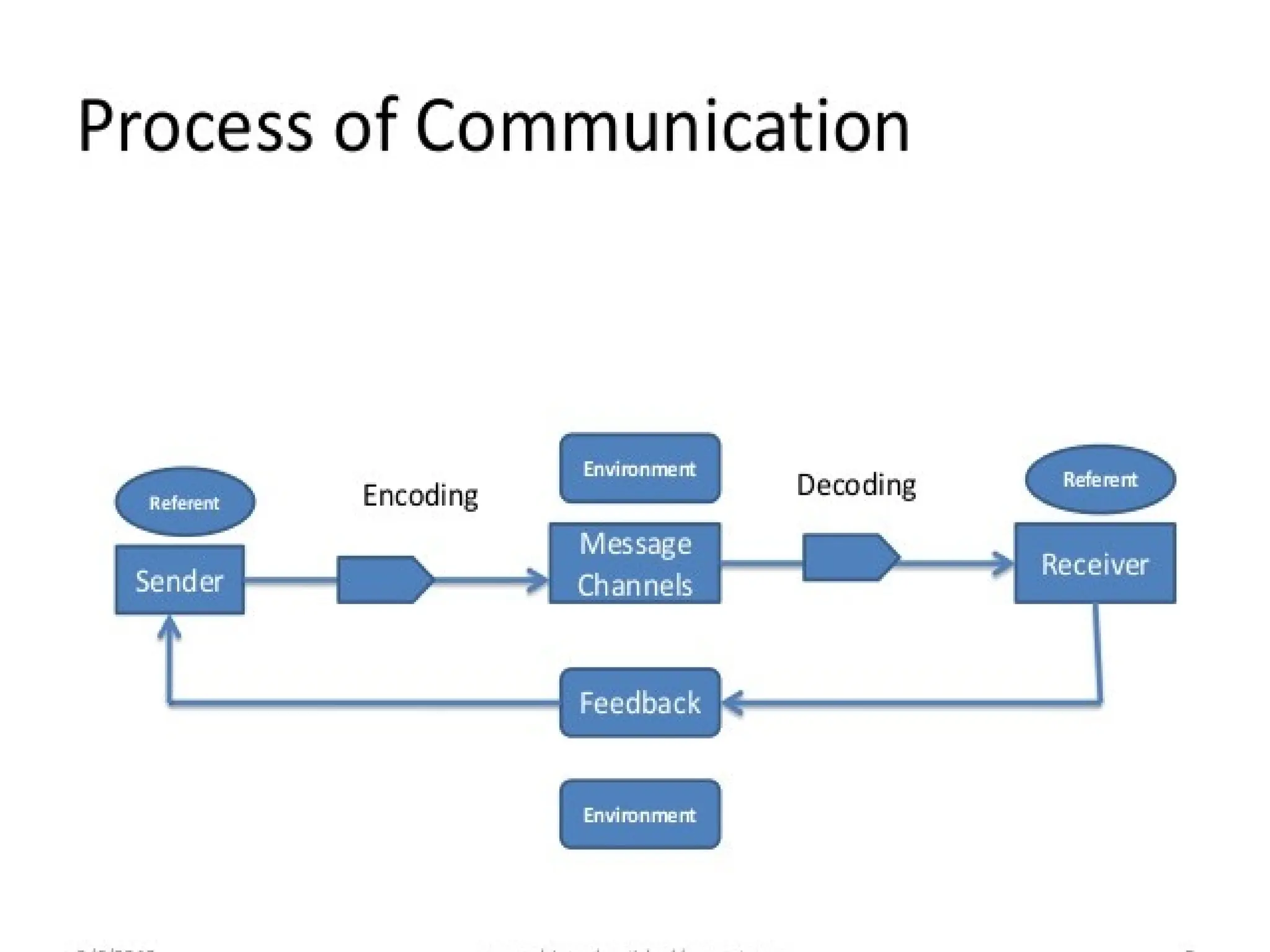
• Four key components.
• Include encoding, medium of
transmission, decoding, and feedback.
• There are also two factors present in
the form of the sender and the
receiver.
• The communication process begins
with
the sender and ends with the receiver.
The Sender
• The communication process begins with
the sender, who is also called the
communicator or source.
• The sender has some kind of information
—a command, request, or idea —that he
or she wants to share with others.
• In order for that message to be received,
the sender must first encode/translating
the message in a form that can be
understood and then transmit it. E.g
symbols, words, gestures
Encoding
• Encoding: the sender begins by deciding
what he/she wants to transmit.
• This decision is based on what he/she
believes about the receivers knowledge and
assumptions, along with what additional
information he/she wants the receiver to
have.
• It is important to use symbols that are
familiar to the intended receiver.
• Its good for the sender to improve encoding
the message, by mentally visualizing the
communication from the receiver's point of
The Message
• The message or content is the
information that the sender wants to
relay to the receiver.
• the sender encoded, which means
translated information into a message
in the form of symbols that represent
ideas or concepts.
• It is then relayed/transmitted through
an appropriate channel.
The Medium
• Also called the channel, the medium is the
means by which a message is transmitted.
• Text messages, for example, are
transmitted through the medium of cell
phones. Other common channels include
a variety of written forms such as memos,
letters, and reports
• Effectiveness of various channels
fluctuates depending on the
characteristics of the communication
• Example
Medium
• E.g when immediate feedback is necessary,
oral communication channels are more
effective because any uncertainties can be
cleared up on the spot.
• In a situation where the message must be
delivered to more than a small group of
people, written channels are often more
effective.
• Although in many cases, both oral and
written channels should be used because
one supplements the other.
Medium
• If a sender relays a message through
an inappropriate channel, its message
may not reach the right receivers.
• That is why senders need to keep in
mind that selecting the appropriate
channel will greatly assist in the
effectiveness of the receiver's
understanding
Medium
•The sender should ask him or herself different questions,
so that they can select the appropriate channel.
•Is the message urgent?
•Is immediate feedback needed?
•Is documentation or a permanent record required?
•Is the content complicated, controversial, or private?
•Is the message going to someone inside or outside the
organization?
•What oral and written communication skills does the
receiver possess?
•Once the sender has answered all of these questions,
they will be able to choose an effective channel.
Decoding
• After the appropriate channel is selected, the
message enters the decoding stage of the
communication process.
• Decoding is conducted by the receiver.
• Once message is received and examined, stimulus is
sent to the brain for interpreting, in order to assign
some type of meaning to it.
• It is this processing stage that constitutes decoding.
• The receiver begins to interpret the symbols sent by
the sender, translating the message to their own set
of experiences to make the symbols meaningful.
• Successful communication takes place when the
receiver correctly interprets the sender's message.
The Receiver
• The person to whom a message is directed is called the
receiver or the interpreter.
• In order to comprehend the information from the sender,
the receiver must first be able to receive the sender's
information and then decode or interpret it.
• Comprehension of the message will depend on a number
of factors, which include: how much the individual or
individuals know about the topic, their receptivity to the
message, and the relationship and trust that exists
between sender and receiver.
• All interpretations by the receiver are influenced by their
experiences, attitudes, knowledge, skills, perceptions, and
culture.
• It is similar to the sender's relationship with encoding.
Feedback
• The communication process reaches
its final point when the message has
been successfully transmitted,
received, and understood.
• The receiver, in turn, responds to the
sender, indicating comprehension.
Feedback may be direct, such as a
written or verbal response, or it may
take the form of an act or deed in
response.
Feed back
• Without feedback, the sender cannot
confirm that the receiver has
interpreted the message correctly.
• Feedback is a key component in the
communication process because it
allows the sender to evaluate the
effectiveness of the message.
Feed back
• Feedback ultimately provides an
opportunity for the sender to take
corrective action to clarify a
misunderstood message.
• "Feedback plays an important role by
indicating significant communication
barriers: differences in background,
different interpretations of words, and
differing emotional reactions" (Bovee
& Thill, 1992).
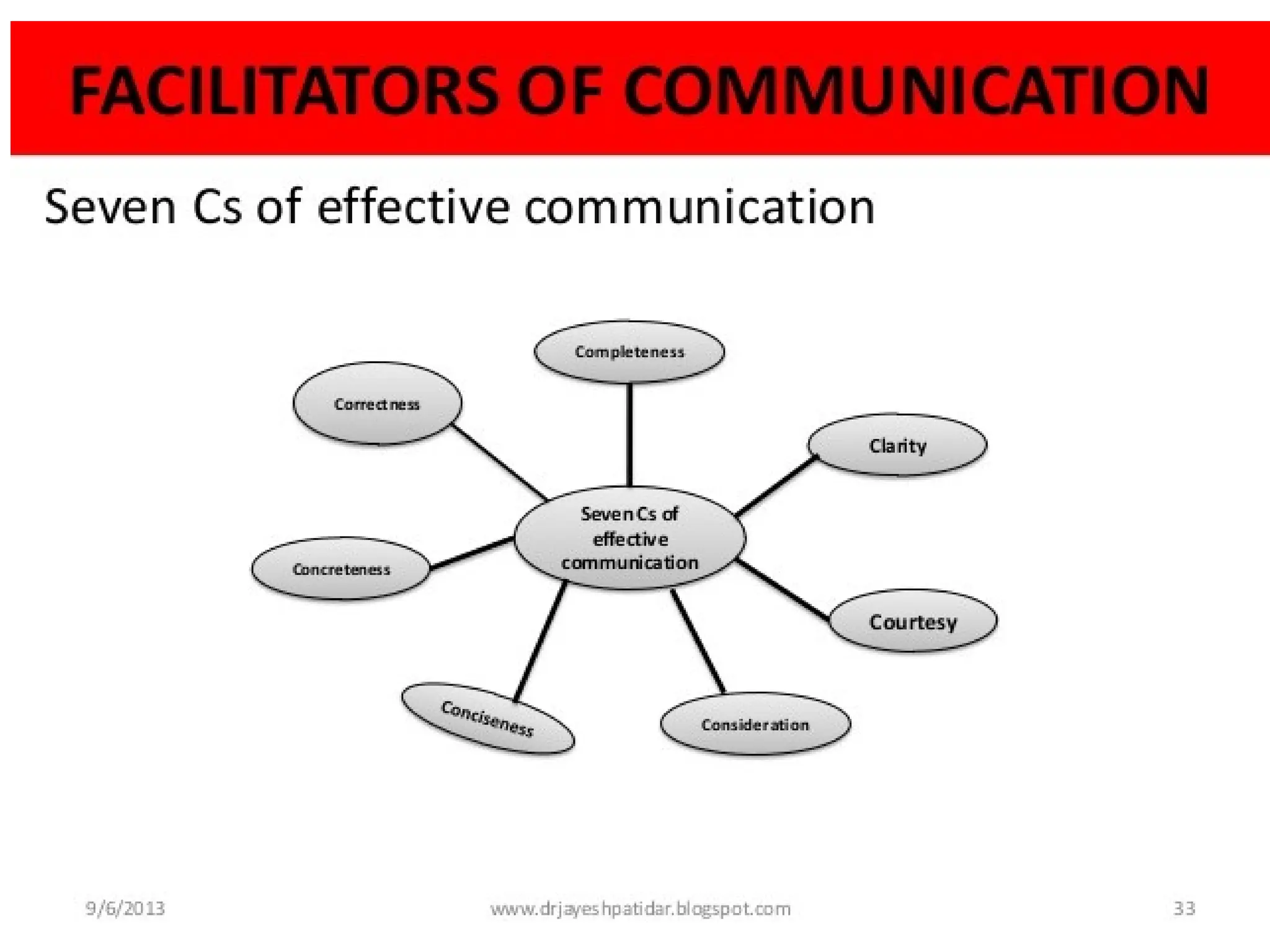
7 Cs
1. COMPLETENESS-wholeness/totality
2. CLARITY- clearness/transparency
3. COURTESY- politeness/manners
4. CONSIDERATION-
concern/reflection/respect
5. CONCISENESS- shortness/to the point
6. CONCRETENESS-compactness/
concentrated
7. CORRECTNESS-perfectness/accuracy/
exactness
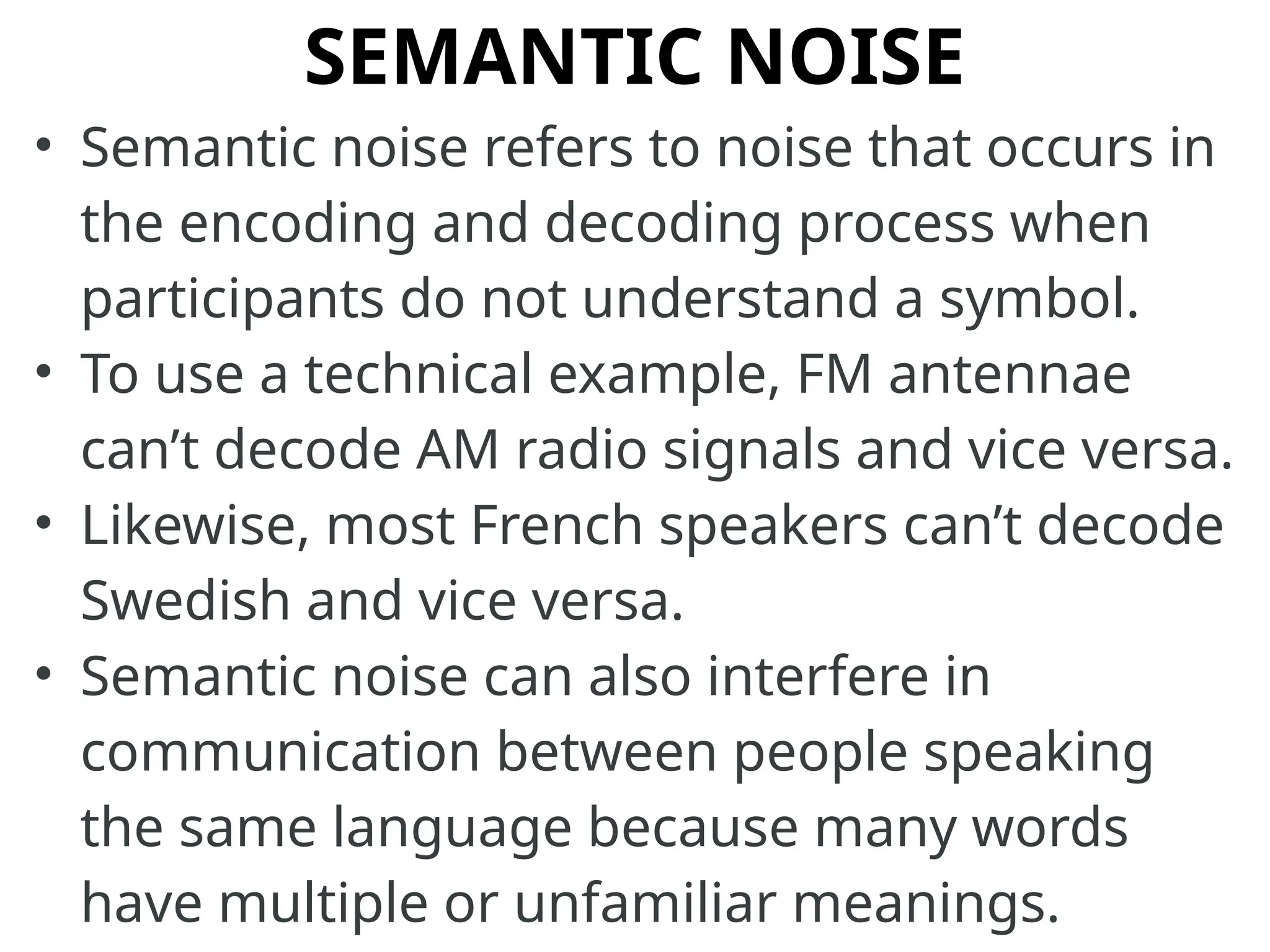
SEMANTIC NOISE
• Semantic noise refers to noise that occurs in
the encoding and decoding process when
participants do not understand a symbol.
• To use a technical example, FM antennae
can’t decode AM radio signals and vice versa.
• Likewise, most French speakers can’t decode
Swedish and vice versa.
• Semantic noise can also interfere in
communication between people speaking
the same language because many words
have multiple or unfamiliar meanings.
CONCLUSION
•The communication process is the guide toward
realizing effective communication.
•It is through the communication process that the
sharing of a common meaning between the
sender and the receiver takes place.
•Professionals that follow the communication
process will have the opportunity to become
more productive in every aspect of their
profession.
•Effective communication leads to understanding.
CONCLUSION
• Effective communication is an absolute
must, because it commonly accounts for the
difference between success and failure or
profit and loss.
• It has become clear that effective business
communication is critical to the successful
operation of PH
THE END
• QUESTIONS
• YHANK YOU

COMMUNICATION PROCESS .pptx For the public health

  • 1.
    COMMUNICATION PROCESS • Defineeffective communication • Explain the elements of the communication process • Explain the barriers to effective communication. • Describe the value of effective communication and its various elements.
  • 2.
    Introduction •Think of howa radio message is sent from a person in the radio studio to you listening in your car. •Or •For example, when you say “Hello!” to your friend, you are sending a message of greeting that will be received by your friend.
  • 3.
    Introduction •The sender isthe radio announcer /friend who encodes a verbal message that is transmitted by a radio tower through electromagnetic waves (the channel) and eventually reaches your (the receiver’s) ears via an antenna and speakers in order to be decoded. •The radio announcer doesn’t really know if you receive his or her message or not, but if the equipment is working and the channel is free of static, then there is a good chance that the message was successfully received.
  • 5.
    Introduction • NOISE/BARRIERS • Noiseis anything that interferes with a message being sent between participants in a communication process
  • 6.
    Introduction • Communication isthe process of sharing our ideas, thoughts, and feelings with other people and having those ideas, thoughts, and feelings understood by the people we are talking with. • When we communicate we speak, listen, and observe. • The way we communicate is a learned style
  • 7.
    Introduction • Poor communicationcan waste time and energy and cause conflict between people. • You can benefit by improving your communication skills: • You will have a clearer understanding of what people are saying to you, others will be less likely to misunderstand you, problems will be solved quickly, you will be able to identify others’ needs and you will be able to resolve conflict.
  • 8.
    Introduction cont’ • Communicatinginvolves several skills. For example, speaking involves not only getting your message across but also being able to listen and understand what others are saying • (active listening) and observing the verbal and nonverbal clues in order to monitor the effectiveness of your message. • Writing skills, reading, reporting skills
  • 9.
    Definitions • Communication: thetransmission of a message from a sender to a receiver in an understandable manner. • Communication is a process by which information is exchanged between individuals through a common system of symbols, and signs of behaviour. Webster’s Dictionary • Communication is interchange of thoughts, opinions or information by speech, writing or signs. ROBERT ANDERSON
  • 10.
    Definition • Communication isderived from the Latin word communis meaning common • The term communication process refers to the exchange of information (a message) between two or more people. • The goal of communication is to convey information—and the understanding of that information—from one person or group to another person or group
  • 11.
    Definition • The criticalfactor in measuring the effectiveness of communication is common understanding. • Understanding exists when all parties involved have a mutual agreement as to not only the information, but also the meaning of the information. • Effective communication, therefore, occurs when the intended message of the sender and the interpreted message of the receiver are one and the same. • Although this should be the goal in any communication, it is not always achieved.
  • 13.
    Components/elements • Four keycomponents. • Include encoding, medium of transmission, decoding, and feedback. • There are also two factors present in the form of the sender and the receiver. • The communication process begins with the sender and ends with the receiver.
  • 14.
    The Sender • Thecommunication process begins with the sender, who is also called the communicator or source. • The sender has some kind of information —a command, request, or idea —that he or she wants to share with others. • In order for that message to be received, the sender must first encode/translating the message in a form that can be understood and then transmit it. E.g symbols, words, gestures
  • 15.
    Encoding • Encoding: thesender begins by deciding what he/she wants to transmit. • This decision is based on what he/she believes about the receivers knowledge and assumptions, along with what additional information he/she wants the receiver to have. • It is important to use symbols that are familiar to the intended receiver. • Its good for the sender to improve encoding the message, by mentally visualizing the communication from the receiver's point of
  • 16.
    The Message • Themessage or content is the information that the sender wants to relay to the receiver. • the sender encoded, which means translated information into a message in the form of symbols that represent ideas or concepts. • It is then relayed/transmitted through an appropriate channel.
  • 17.
    The Medium • Alsocalled the channel, the medium is the means by which a message is transmitted. • Text messages, for example, are transmitted through the medium of cell phones. Other common channels include a variety of written forms such as memos, letters, and reports • Effectiveness of various channels fluctuates depending on the characteristics of the communication • Example
  • 18.
    Medium • E.g whenimmediate feedback is necessary, oral communication channels are more effective because any uncertainties can be cleared up on the spot. • In a situation where the message must be delivered to more than a small group of people, written channels are often more effective. • Although in many cases, both oral and written channels should be used because one supplements the other.
  • 19.
    Medium • If asender relays a message through an inappropriate channel, its message may not reach the right receivers. • That is why senders need to keep in mind that selecting the appropriate channel will greatly assist in the effectiveness of the receiver's understanding
  • 20.
    Medium •The sender shouldask him or herself different questions, so that they can select the appropriate channel. •Is the message urgent? •Is immediate feedback needed? •Is documentation or a permanent record required? •Is the content complicated, controversial, or private? •Is the message going to someone inside or outside the organization? •What oral and written communication skills does the receiver possess? •Once the sender has answered all of these questions, they will be able to choose an effective channel.
  • 21.
    Decoding • After theappropriate channel is selected, the message enters the decoding stage of the communication process. • Decoding is conducted by the receiver. • Once message is received and examined, stimulus is sent to the brain for interpreting, in order to assign some type of meaning to it. • It is this processing stage that constitutes decoding. • The receiver begins to interpret the symbols sent by the sender, translating the message to their own set of experiences to make the symbols meaningful. • Successful communication takes place when the receiver correctly interprets the sender's message.
  • 22.
    The Receiver • Theperson to whom a message is directed is called the receiver or the interpreter. • In order to comprehend the information from the sender, the receiver must first be able to receive the sender's information and then decode or interpret it. • Comprehension of the message will depend on a number of factors, which include: how much the individual or individuals know about the topic, their receptivity to the message, and the relationship and trust that exists between sender and receiver. • All interpretations by the receiver are influenced by their experiences, attitudes, knowledge, skills, perceptions, and culture. • It is similar to the sender's relationship with encoding.
  • 23.
    Feedback • The communicationprocess reaches its final point when the message has been successfully transmitted, received, and understood. • The receiver, in turn, responds to the sender, indicating comprehension. Feedback may be direct, such as a written or verbal response, or it may take the form of an act or deed in response.
  • 24.
    Feed back • Withoutfeedback, the sender cannot confirm that the receiver has interpreted the message correctly. • Feedback is a key component in the communication process because it allows the sender to evaluate the effectiveness of the message.
  • 25.
    Feed back • Feedbackultimately provides an opportunity for the sender to take corrective action to clarify a misunderstood message. • "Feedback plays an important role by indicating significant communication barriers: differences in background, different interpretations of words, and differing emotional reactions" (Bovee & Thill, 1992).
  • 27.
    7 Cs 1. COMPLETENESS-wholeness/totality 2.CLARITY- clearness/transparency 3. COURTESY- politeness/manners 4. CONSIDERATION- concern/reflection/respect 5. CONCISENESS- shortness/to the point 6. CONCRETENESS-compactness/ concentrated 7. CORRECTNESS-perfectness/accuracy/ exactness
  • 34.
    SEMANTIC NOISE • Semanticnoise refers to noise that occurs in the encoding and decoding process when participants do not understand a symbol. • To use a technical example, FM antennae can’t decode AM radio signals and vice versa. • Likewise, most French speakers can’t decode Swedish and vice versa. • Semantic noise can also interfere in communication between people speaking the same language because many words have multiple or unfamiliar meanings.
  • 45.
    CONCLUSION •The communication processis the guide toward realizing effective communication. •It is through the communication process that the sharing of a common meaning between the sender and the receiver takes place. •Professionals that follow the communication process will have the opportunity to become more productive in every aspect of their profession. •Effective communication leads to understanding.
  • 46.
    CONCLUSION • Effective communicationis an absolute must, because it commonly accounts for the difference between success and failure or profit and loss. • It has become clear that effective business communication is critical to the successful operation of PH
  • 47.