Alumni Association, Department of English
organizes
NET/SET Coaching Programme
7T H
SEPT. 2025
Communication
MS. JHEEL D. BARAD
A S S I S TA N T P R O F E S S O R
S I L V E R O A K C O L L E G E O F C O M P U T E R A P P L I C AT I O N ,
S I L V E R O A K U N I V E R S I T Y, A H M E D A B A D
Syllabus content:
o Communication: Meaning, types and characteristics of
communication
o Effective communication: Verbal and Non-verbal, Inter-
Cultural and group communications, Classroom
communication
o Barriers to effective communication
o Mass-Media and Society
Definition
Communication is usually understood as the transmission of information, a message (Unit
of communication) is conveyed from a sender to a receiver using some medium, such as
sound, written signs, bodily movements, or electricity
Communication is the process of exchanging information between individuals or groups.
It involves the transmission of ideas, feelings, or facts from one person (the sender) to
another (the receiver). It can be verbal or non-verbal and plays a crucial role in human
interaction.
The word communication has its root in the Latin verb ‘communicare’, which means 'to
share' or 'to make common
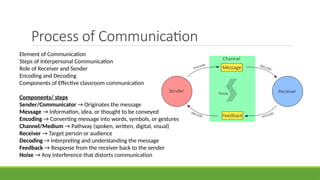
Process of Communication
Element of Communication
Steps of Interpersonal Communication
Role of Receiver and Sender
Encoding and Decoding
Components of Effective classroom communication
Components/ steps
Sender/Communicator → Originates the message
Message → Information, idea, or thought to be conveyed
Encoding → Converting message into words, symbols, or gestures
Channel/Medium → Pathway (spoken, written, digital, visual)
Receiver → Target person or audience
Decoding → Interpreting and understanding the message
Feedback → Response from the receiver back to the sender
Noise → Any interference that distorts communication
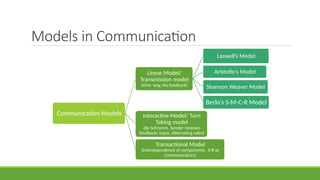
Models in Communication
Communication Models
Linear Model/
Transmission model
(One- way, No feedback)
Laswell’s Model
Aristotle’s Model
Shannon Weaver Model
Berlo’s S-M-C-R Model
Interactive Model/ Turn
Taking model
(By Schramm, Sender receives
feedback/ input, Alternating roles)
Transactional Model
(Interdependence of components, S-R as
Communicators)
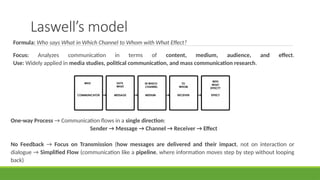
Laswell’s model
Formula: Who says What in Which Channel to Whom with What Effect?
Focus: Analyzes communication in terms of content, medium, audience, and effect.
Use: Widely applied in media studies, political communication, and mass communication research.
One-way Process → Communication flows in a single direction:
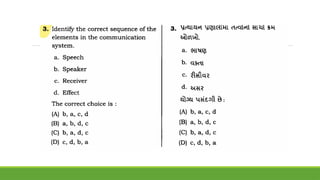
Sender → Message → Channel → Receiver → Effect
No Feedback → Focus on Transmission (how messages are delivered and their impact, not on interaction or
dialogue → Simplified Flow (communication like a pipeline, where information moves step by step without looping
back)
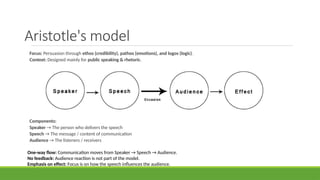
Aristotle's model
Focus: Persuasion through ethos (credibility), pathos (emotions), and logos (logic).
Context: Designed mainly for public speaking & rhetoric.
Components:
Speaker → The person who delivers the speech
Speech → The message / content of communication
Audience → The listeners / receivers
One-way flow: Communication moves from Speaker → Speech → Audience.
No feedback: Audience reaction is not part of the model.
Emphasis on effect: Focus is on how the speech influences the audience.
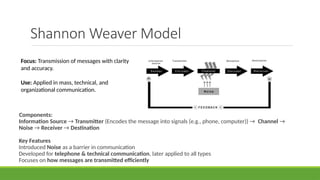
Shannon Weaver Model
Components:
Information Source → Transmitter (Encodes the message into signals (e.g., phone, computer)) → Channel →
Noise → Receiver → Destination
Key Features
Introduced Noise as a barrier in communication
Developed for telephone & technical communication, later applied to all types
Focuses on how messages are transmitted efficiently
Focus: Transmission of messages with clarity
and accuracy.
Use: Applied in mass, technical, and
organizational communication.
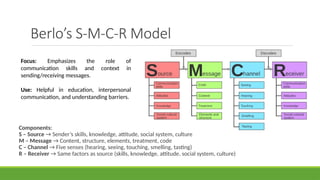
Berlo’s S-M-C-R Model
Components:
S – Source → Sender’s skills, knowledge, attitude, social system, culture
M – Message → Content, structure, elements, treatment, code
C – Channel → Five senses (hearing, seeing, touching, smelling, tasting)
R – Receiver → Same factors as source (skills, knowledge, attitude, social system, culture)
Focus: Emphasizes the role of
communication skills and context in
sending/receiving messages.
Use: Helpful in education, interpersonal
communication, and understanding barriers.
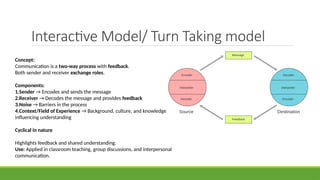
Interactive Model/ Turn Taking model
Concept:
Communication is a two-way process with feedback.
Both sender and receiver exchange roles.
Components:
1.Sender → Encodes and sends the message
2.Receiver → Decodes the message and provides feedback
3.Noise → Barriers in the process
4.Context/Field of Experience → Background, culture, and knowledge
influencing understanding
Cyclical in nature
Highlights feedback and shared understanding.
Use: Applied in classroom teaching, group discussions, and interpersonal
communication.
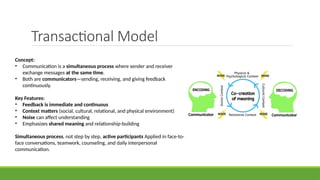
Transactional Model
Concept:
• Communication is a simultaneous process where sender and receiver
exchange messages at the same time.
• Both are communicators—sending, receiving, and giving feedback
continuously.
Key Features:
• Feedback is immediate and continuous
• Context matters (social, cultural, relational, and physical environment)
• Noise can affect understanding
• Emphasizes shared meaning and relationship-building
Simultaneous process, not step by step, active participants Applied in face-to-
face conversations, teamwork, counseling, and daily interpersonal
communication.
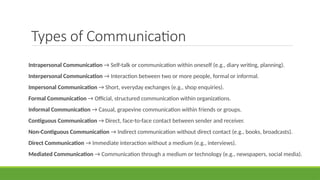
Types of Communication
Intrapersonal Communication → Self-talk or communication within oneself (e.g., diary writing, planning).
Interpersonal Communication → Interaction between two or more people, formal or informal.
Impersonal Communication → Short, everyday exchanges (e.g., shop enquiries).
Formal Communication → Official, structured communication within organizations.
Informal Communication → Casual, grapevine communication within friends or groups.
Contiguous Communication → Direct, face-to-face contact between sender and receiver.
Non-Contiguous Communication → Indirect communication without direct contact (e.g., books, broadcasts).
Direct Communication → Immediate interaction without a medium (e.g., interviews).
Mediated Communication → Communication through a medium or technology (e.g., newspapers, social media).
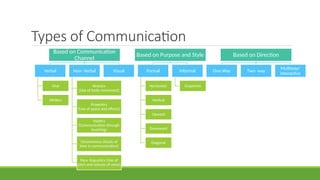
Types of Communication
Based on Communication
Channel
Verbal
Oral
Written
Non- Verbal
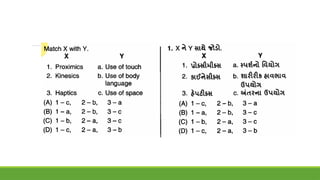
Kinesics
(Use of body movement)
Proxemics
(Use of space and effects)
Haptics
(Communication through
touching)
Chronemincs (Study of
time in communication)
Para- linguistics (Use of
pitch and volume of voice)
Visual
Based on Purpose and Style
Formal
Horizontal
Vertical
Upward
Downward
Diagonal
Informal
Grapevine
Based on Direction
One-Way Two- way
Multiway/
Interactive
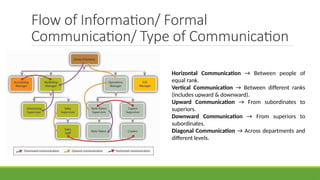
Flow of Information/ Formal
Communication/ Type of Communication
Horizontal Communication → Between people of
equal rank.
Vertical Communication → Between different ranks
(includes upward & downward).
Upward Communication → From subordinates to
superiors.
Downward Communication → From superiors to
subordinates.
Diagonal Communication → Across departments and
different levels.
Objectives of Communication
Creating Awareness
Imparting Knowledge
Projecting an Image
Shaping Attitude
Stimulating a Desire
Effecting Outcome
Good Decision Making
Maintaining Workflow
Developing Relationship
Educational Requirements
Providing Counselling
Moral Development
Categories of Communication
Written → Messages in written form (letters, reports).
Verbal → Spoken communication (conversations, broadcasts).
Non-Verbal → Signs, gestures, tone, posture.
Inter-Cultural → Between people of different cultures.
Group → Within or between groups (debates, seminars).
Mass → To large audiences not physically present (radio, TV).
Public → Large audience physically present (rallies, speeches).
Classroom Communication
Effective Management of Classroom Communication
1. Be clear about what you want to say.
2. Keep it Short and Simple (K.I.S.S).
3. Use pauses, humor, empathy, and equity.
4. Encourage questions and participation.
5. Motivate students and respect them.
6. Plan activities and break monotony with teaching aids.
7. Reinforce learning with queries and discussions.
8. Do not tolerate bad behavior, but maintain fairness.
Classroom Communication
• Interaction between teacher and students, and among
students.
• Effective when two-way with sharing of knowledge and
feedback.
• Teacher plays multiple roles: facilitator, mentor, motivator,
and guide.
• Feedback is used for continuous improvement.
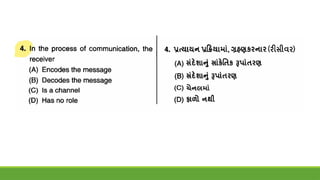
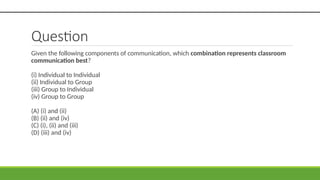
Question
Given the following components of communication, which combination represents classroom
communication best?
(i) Individual to Individual
(ii) Individual to Group
(iii) Group to Individual
(iv) Group to Group
(A) (i) and (ii)
(B) (ii) and (iv)
(C) (i), (ii) and (iii)
(D) (iii) and (iv)
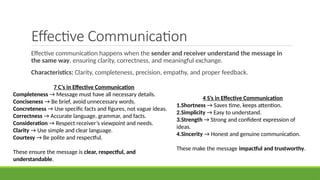
Effective Communication
Effective communication happens when the sender and receiver understand the message in
the same way, ensuring clarity, correctness, and meaningful exchange.
Characteristics: Clarity, completeness, precision, empathy, and proper feedback.
7 C’s in Effective Communication
Completeness → Message must have all necessary details.
Conciseness → Be brief, avoid unnecessary words.
Concreteness → Use specific facts and figures, not vague ideas.
Correctness → Accurate language, grammar, and facts.
Consideration → Respect receiver’s viewpoint and needs.
Clarity → Use simple and clear language.
Courtesy → Be polite and respectful.
These ensure the message is clear, respectful, and
understandable.
4 S’s in Effective Communication
1.Shortness → Saves time, keeps attention.
2.Simplicity → Easy to understand.
3.Strength → Strong and confident expression of
ideas.
4.Sincerity → Honest and genuine communication.
These make the message impactful and trustworthy.
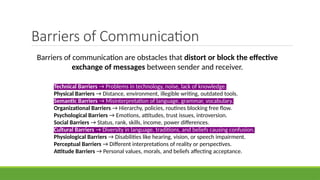
Barriers of Communication
Technical Barriers → Problems in technology, noise, lack of knowledge.
Physical Barriers → Distance, environment, illegible writing, outdated tools.
Semantic Barriers → Misinterpretation of language, grammar, vocabulary.
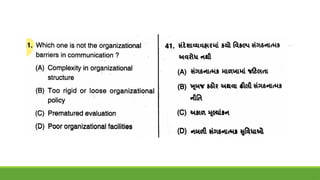
Organizational Barriers → Hierarchy, policies, routines blocking free flow.
Psychological Barriers → Emotions, attitudes, trust issues, introversion.
Social Barriers → Status, rank, skills, income, power differences.
Cultural Barriers → Diversity in language, traditions, and beliefs causing confusion.
Physiological Barriers → Disabilities like hearing, vision, or speech impairment.
Perceptual Barriers → Different interpretations of reality or perspectives.
Attitude Barriers → Personal values, morals, and beliefs affecting acceptance.
Barriers of communication are obstacles that distort or block the effective
exchange of messages between sender and receiver.
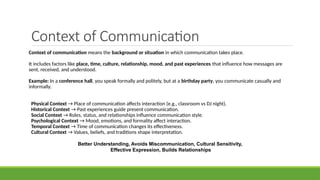
Context of Communication
Context of communication means the background or situation in which communication takes place.
It includes factors like place, time, culture, relationship, mood, and past experiences that influence how messages are
sent, received, and understood.
Example: In a conference hall, you speak formally and politely, but at a birthday party, you communicate casually and
informally.
Physical Context → Place of communication affects interaction (e.g., classroom vs DJ night).
Historical Context → Past experiences guide present communication.
Social Context → Roles, status, and relationships influence communication style.
Psychological Context → Mood, emotions, and formality affect interaction.
Temporal Context → Time of communication changes its effectiveness.
Cultural Context → Values, beliefs, and traditions shape interpretation.
Better Understanding, Avoids Miscommunication, Cultural Sensitivity,
Effective Expression, Builds Relationships
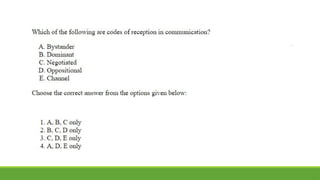
Question
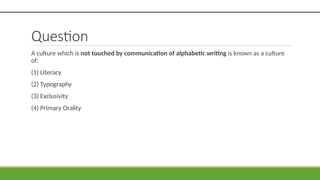
A culture which is not touched by communication of alphabetic writing is known as a culture
of:
(1) Literacy
(2) Typography
(3) Exclusivity
(4) Primary Orality
Mass Media and Communication
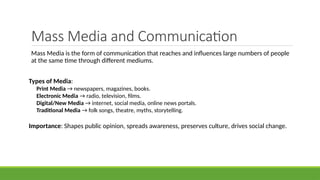
Mass Media is the form of communication that reaches and influences large numbers of people
at the same time through different mediums.
Types of Media:
Print Media → newspapers, magazines, books.
Electronic Media → radio, television, films.
Digital/New Media → internet, social media, online news portals.
Traditional Media → folk songs, theatre, myths, storytelling.
Importance: Shapes public opinion, spreads awareness, preserves culture, drives social change.
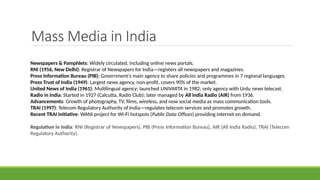
Mass Media in India
Newspapers & Pamphlets: Widely circulated, including online news portals.
RNI (1956, New Delhi): Registrar of Newspapers for India—registers all newspapers and magazines.
Press Information Bureau (PIB): Government’s main agency to share policies and programmes in 7 regional languages.
Press Trust of India (1949): Largest news agency, non-profit, covers 90% of the market.
United News of India (1961): Multilingual agency; launched UNIVARTA in 1982; only agency with Urdu news telecast.
Radio in India: Started in 1927 (Calcutta, Radio Club); later managed by All India Radio (AIR) from 1936.
Advancements: Growth of photography, TV, films, wireless, and now social media as mass communication tools.
TRAI (1997): Telecom Regulatory Authority of India—regulates telecom services and promotes growth.
Recent TRAI Initiative: WANI project for Wi-Fi hotspots (Public Data Offices) providing internet on demand.
Regulation in India: RNI (Registrar of Newspapers), PIB (Press Information Bureau), AIR (All India Radio), TRAI (Telecom
Regulatory Authority).
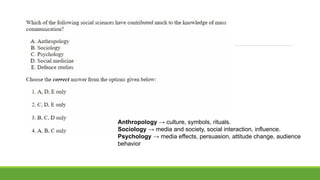
Anthropology → culture, symbols, rituals.
Sociology → media and society, social interaction, influence.
Psychology → media effects, persuasion, attitude change, audience
behavior
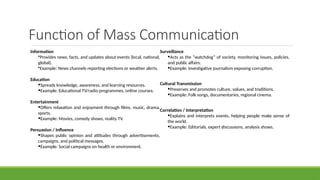
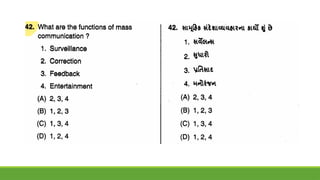
Function of Mass Communication
Information
•Provides news, facts, and updates about events (local, national,
global).
•Example: News channels reporting elections or weather alerts.
Education
•Spreads knowledge, awareness, and learning resources.
•Example: Educational TV/radio programmes, online courses.
Entertainment
•Offers relaxation and enjoyment through films, music, drama,
sports.
•Example: Movies, comedy shows, reality TV.
Persuasion / Influence
•Shapes public opinion and attitudes through advertisements,
campaigns, and political messages.
•Example: Social campaigns on health or environment.
Surveillance
•Acts as the “watchdog” of society, monitoring issues, policies,
and public affairs.
•Example: Investigative journalism exposing corruption.
Cultural Transmission
•Preserves and promotes culture, values, and traditions.
•Example: Folk songs, documentaries, regional cinema.
Correlation / Interpretation
•Explains and interprets events, helping people make sense of
the world.
•Example: Editorials, expert discussions, analysis shows.
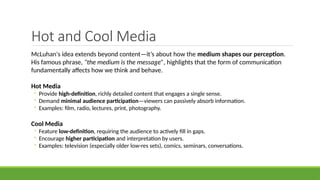
Hot and Cool Media
McLuhan's idea extends beyond content—it’s about how the medium shapes our perception.
His famous phrase, “the medium is the message”, highlights that the form of communication
fundamentally affects how we think and behave.
Hot Media
◦ Provide high-definition, richly detailed content that engages a single sense.
◦ Demand minimal audience participation—viewers can passively absorb information.
◦ Examples: film, radio, lectures, print, photography.
Cool Media
◦ Feature low-definition, requiring the audience to actively fill in gaps.
◦ Encourage higher participation and interpretation by users.
◦ Examples: television (especially older low-res sets), comics, seminars, conversations.
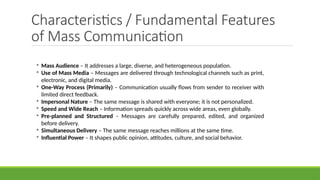
Characteristics / Fundamental Features
of Mass Communication
◦ Mass Audience – It addresses a large, diverse, and heterogeneous population.
◦ Use of Mass Media – Messages are delivered through technological channels such as print,
electronic, and digital media.
◦ One-Way Process (Primarily) – Communication usually flows from sender to receiver with
limited direct feedback.
◦ Impersonal Nature – The same message is shared with everyone; it is not personalized.
◦ Speed and Wide Reach – Information spreads quickly across wide areas, even globally.
◦ Pre-planned and Structured – Messages are carefully prepared, edited, and organized
before delivery.
◦ Simultaneous Delivery – The same message reaches millions at the same time.
◦ Influential Power – It shapes public opinion, attitudes, culture, and social behavior.
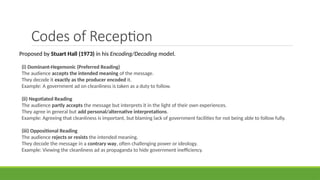
Codes of Reception
Proposed by Stuart Hall (1973) in his Encoding/Decoding model.
(i) Dominant-Hegemonic (Preferred Reading)
The audience accepts the intended meaning of the message.
They decode it exactly as the producer encoded it.
Example: A government ad on cleanliness is taken as a duty to follow.
(ii) Negotiated Reading
The audience partly accepts the message but interprets it in the light of their own experiences.
They agree in general but add personal/alternative interpretations.
Example: Agreeing that cleanliness is important, but blaming lack of government facilities for not being able to follow fully.
(iii) Oppositional Reading
The audience rejects or resists the intended meaning.
They decode the message in a contrary way, often challenging power or ideology.
Example: Viewing the cleanliness ad as propaganda to hide government inefficiency.
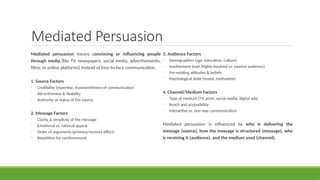
Mediated Persuasion
Mediated persuasion means convincing or influencing people
through media (like TV, newspapers, social media, advertisements,
films, or online platforms) instead of face-to-face communication.
1. Source Factors
◦ Credibility (expertise, trustworthiness of communicator)
◦ Attractiveness & likability
◦ Authority or status of the source
2. Message Factors
◦ Clarity & simplicity of the message
◦ Emotional vs. rational appeal
◦ Order of arguments (primacy/recency effect)
◦ Repetition for reinforcement
3. Audience Factors
◦ Demographics (age, education, culture)
◦ Involvement level (highly involved vs. passive audience)
◦ Pre-existing attitudes & beliefs
◦ Psychological state (mood, motivation)
4. Channel/Medium Factors
◦ Type of medium (TV, print, social media, digital ads)
◦ Reach and accessibility
◦ Interactive vs. one-way communication
Mediated persuasion is influenced by who is delivering the
message (source), how the message is structured (message), who
is receiving it (audience), and the medium used (channel).
Important factors in Communication-
Framing, Priming, Immediacy
Along with Framing, Priming, and Immediacy, communication
effectiveness is shaped by Credibility, Context, Channel Richness,
Feedback, Noise, and Culture.
1. Framing
◦ Refers to how information is presented.
◦ The same message can create different meanings depending on the
words, images, or angle used.
◦ Example: Saying “90% fat-free” vs. “10% fat” — both are true, but the
frame changes audience perception.
2. Priming
◦ Refers to preparing the audience’s mind to think in a certain way
before the main message is delivered.
◦ Media or communication highlights certain issues so that people use
them as a reference point in judgment.
◦ Example: News repeatedly focusing on inflation primes people to
evaluate government performance mainly on economic grounds.
3. Immediacy
◦ Refers to the sense of closeness, warmth, and direct connection in
communication.
◦ It reduces psychological distance between speaker and audience.
◦ Achieved through eye contact, body language, tone of voice, and even
interactive digital communication.
◦ Example: A teacher smiling, using students’ names, and giving quick
responses increases immediacy and learning.
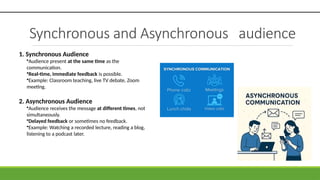
Synchronous and Asynchronous audience
1. Synchronous Audience
•Audience present at the same time as the
communication.
•Real-time, immediate feedback is possible.
•Example: Classroom teaching, live TV debate, Zoom
meeting.
2. Asynchronous Audience
•Audience receives the message at different times, not
simultaneously.
•Delayed feedback or sometimes no feedback.
•Example: Watching a recorded lecture, reading a blog,
listening to a podcast later.
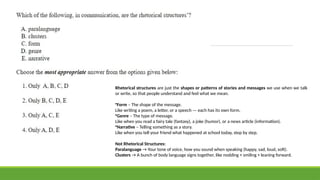
Rhetorical structures are just the shapes or patterns of stories and messages we use when we talk
or write, so that people understand and feel what we mean.
•Form – The shape of the message.
Like writing a poem, a letter, or a speech — each has its own form.
•Genre – The type of message.
Like when you read a fairy tale (fantasy), a joke (humor), or a news article (information).
•Narrative – Telling something as a story.
Like when you tell your friend what happened at school today, step by step.
Not Rhetorical Structures:
Paralanguage → Your tone of voice, how you sound when speaking (happy, sad, loud, soft).
Clusters → A bunch of body language signs together, like nodding + smiling + leaning forward.
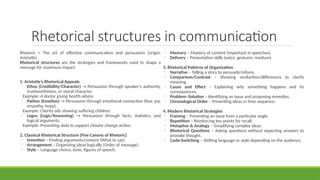
Rhetorical structures in communication
Rhetoric = The art of effective communication and persuasion (origin:
Aristotle).
Rhetorical structures are the strategies and frameworks used to shape a
message for maximum impact
1. Aristotle’s Rhetorical Appeals
◦ Ethos (Credibility/Character) → Persuasion through speaker’s authority,
trustworthiness, or moral character.
Example: A doctor giving health advice.
◦ Pathos (Emotion) → Persuasion through emotional connection (fear, joy,
empathy, hope).
Example: Charity ads showing suffering children.
◦ Logos (Logic/Reasoning) → Persuasion through facts, statistics, and
logical arguments.
Example: Presenting data to support climate change action.
2. Classical Rhetorical Structure (Five Canons of Rhetoric)
◦ Invention – Finding arguments/content (What to say).
◦ Arrangement – Organizing ideas logically (Order of message).
◦ Style – Language choice, tone, figures of speech.
◦ Memory – Mastery of content (important in speeches).
◦ Delivery – Presentation skills (voice, gestures, medium).
3. Rhetorical Patterns of Organization
◦ Narrative – Telling a story to persuade/inform.
◦ Comparison/Contrast – Showing similarities/differences to clarify
meaning.
◦ Cause and Effect – Explaining why something happens and its
consequences.
◦ Problem–Solution – Identifying an issue and proposing remedies.
◦ Chronological Order – Presenting ideas in time sequence.
4. Modern Rhetorical Strategies
◦ Framing – Presenting an issue from a particular angle.
◦ Repetition – Reinforcing key points for recall.
◦ Metaphor & Analogy – Simplifying complex ideas.
◦ Rhetorical Questions – Asking questions without expecting answers to
provoke thought.
◦ Code-Switching – Shifting language or style depending on the audience.
Scan for the Quiz

Communication (NET-SET) Paper 1 | PYQs based

  • 1.
    Alumni Association, Departmentof English organizes NET/SET Coaching Programme 7T H SEPT. 2025 Communication MS. JHEEL D. BARAD A S S I S TA N T P R O F E S S O R S I L V E R O A K C O L L E G E O F C O M P U T E R A P P L I C AT I O N , S I L V E R O A K U N I V E R S I T Y, A H M E D A B A D
  • 2.
    Syllabus content: o Communication:Meaning, types and characteristics of communication o Effective communication: Verbal and Non-verbal, Inter- Cultural and group communications, Classroom communication o Barriers to effective communication o Mass-Media and Society
  • 3.
    Definition Communication is usuallyunderstood as the transmission of information, a message (Unit of communication) is conveyed from a sender to a receiver using some medium, such as sound, written signs, bodily movements, or electricity Communication is the process of exchanging information between individuals or groups. It involves the transmission of ideas, feelings, or facts from one person (the sender) to another (the receiver). It can be verbal or non-verbal and plays a crucial role in human interaction. The word communication has its root in the Latin verb ‘communicare’, which means 'to share' or 'to make common
  • 4.
    Process of Communication Elementof Communication Steps of Interpersonal Communication Role of Receiver and Sender Encoding and Decoding Components of Effective classroom communication Components/ steps Sender/Communicator → Originates the message Message → Information, idea, or thought to be conveyed Encoding → Converting message into words, symbols, or gestures Channel/Medium → Pathway (spoken, written, digital, visual) Receiver → Target person or audience Decoding → Interpreting and understanding the message Feedback → Response from the receiver back to the sender Noise → Any interference that distorts communication
  • 6.
    Models in Communication CommunicationModels Linear Model/ Transmission model (One- way, No feedback) Laswell’s Model Aristotle’s Model Shannon Weaver Model Berlo’s S-M-C-R Model Interactive Model/ Turn Taking model (By Schramm, Sender receives feedback/ input, Alternating roles) Transactional Model (Interdependence of components, S-R as Communicators)
  • 7.
    Laswell’s model Formula: Whosays What in Which Channel to Whom with What Effect? Focus: Analyzes communication in terms of content, medium, audience, and effect. Use: Widely applied in media studies, political communication, and mass communication research. One-way Process → Communication flows in a single direction: Sender → Message → Channel → Receiver → Effect No Feedback → Focus on Transmission (how messages are delivered and their impact, not on interaction or dialogue → Simplified Flow (communication like a pipeline, where information moves step by step without looping back)
  • 8.
    Aristotle's model Focus: Persuasionthrough ethos (credibility), pathos (emotions), and logos (logic). Context: Designed mainly for public speaking & rhetoric. Components: Speaker → The person who delivers the speech Speech → The message / content of communication Audience → The listeners / receivers One-way flow: Communication moves from Speaker → Speech → Audience. No feedback: Audience reaction is not part of the model. Emphasis on effect: Focus is on how the speech influences the audience.
  • 9.
    Shannon Weaver Model Components: InformationSource → Transmitter (Encodes the message into signals (e.g., phone, computer)) → Channel → Noise → Receiver → Destination Key Features Introduced Noise as a barrier in communication Developed for telephone & technical communication, later applied to all types Focuses on how messages are transmitted efficiently Focus: Transmission of messages with clarity and accuracy. Use: Applied in mass, technical, and organizational communication.
  • 10.
    Berlo’s S-M-C-R Model Components: S– Source → Sender’s skills, knowledge, attitude, social system, culture M – Message → Content, structure, elements, treatment, code C – Channel → Five senses (hearing, seeing, touching, smelling, tasting) R – Receiver → Same factors as source (skills, knowledge, attitude, social system, culture) Focus: Emphasizes the role of communication skills and context in sending/receiving messages. Use: Helpful in education, interpersonal communication, and understanding barriers.
  • 11.
    Interactive Model/ TurnTaking model Concept: Communication is a two-way process with feedback. Both sender and receiver exchange roles. Components: 1.Sender → Encodes and sends the message 2.Receiver → Decodes the message and provides feedback 3.Noise → Barriers in the process 4.Context/Field of Experience → Background, culture, and knowledge influencing understanding Cyclical in nature Highlights feedback and shared understanding. Use: Applied in classroom teaching, group discussions, and interpersonal communication.
  • 12.
    Transactional Model Concept: • Communicationis a simultaneous process where sender and receiver exchange messages at the same time. • Both are communicators—sending, receiving, and giving feedback continuously. Key Features: • Feedback is immediate and continuous • Context matters (social, cultural, relational, and physical environment) • Noise can affect understanding • Emphasizes shared meaning and relationship-building Simultaneous process, not step by step, active participants Applied in face-to- face conversations, teamwork, counseling, and daily interpersonal communication.
  • 14.
    Types of Communication IntrapersonalCommunication → Self-talk or communication within oneself (e.g., diary writing, planning). Interpersonal Communication → Interaction between two or more people, formal or informal. Impersonal Communication → Short, everyday exchanges (e.g., shop enquiries). Formal Communication → Official, structured communication within organizations. Informal Communication → Casual, grapevine communication within friends or groups. Contiguous Communication → Direct, face-to-face contact between sender and receiver. Non-Contiguous Communication → Indirect communication without direct contact (e.g., books, broadcasts). Direct Communication → Immediate interaction without a medium (e.g., interviews). Mediated Communication → Communication through a medium or technology (e.g., newspapers, social media).
  • 15.
    Types of Communication Basedon Communication Channel Verbal Oral Written Non- Verbal Kinesics (Use of body movement) Proxemics (Use of space and effects) Haptics (Communication through touching) Chronemincs (Study of time in communication) Para- linguistics (Use of pitch and volume of voice) Visual Based on Purpose and Style Formal Horizontal Vertical Upward Downward Diagonal Informal Grapevine Based on Direction One-Way Two- way Multiway/ Interactive
  • 16.
    Flow of Information/Formal Communication/ Type of Communication Horizontal Communication → Between people of equal rank. Vertical Communication → Between different ranks (includes upward & downward). Upward Communication → From subordinates to superiors. Downward Communication → From superiors to subordinates. Diagonal Communication → Across departments and different levels.
  • 18.
    Objectives of Communication CreatingAwareness Imparting Knowledge Projecting an Image Shaping Attitude Stimulating a Desire Effecting Outcome Good Decision Making Maintaining Workflow Developing Relationship Educational Requirements Providing Counselling Moral Development
  • 19.
    Categories of Communication Written→ Messages in written form (letters, reports). Verbal → Spoken communication (conversations, broadcasts). Non-Verbal → Signs, gestures, tone, posture. Inter-Cultural → Between people of different cultures. Group → Within or between groups (debates, seminars). Mass → To large audiences not physically present (radio, TV). Public → Large audience physically present (rallies, speeches).
  • 20.
    Classroom Communication Effective Managementof Classroom Communication 1. Be clear about what you want to say. 2. Keep it Short and Simple (K.I.S.S). 3. Use pauses, humor, empathy, and equity. 4. Encourage questions and participation. 5. Motivate students and respect them. 6. Plan activities and break monotony with teaching aids. 7. Reinforce learning with queries and discussions. 8. Do not tolerate bad behavior, but maintain fairness. Classroom Communication • Interaction between teacher and students, and among students. • Effective when two-way with sharing of knowledge and feedback. • Teacher plays multiple roles: facilitator, mentor, motivator, and guide. • Feedback is used for continuous improvement.
  • 21.
    Question Given the followingcomponents of communication, which combination represents classroom communication best? (i) Individual to Individual (ii) Individual to Group (iii) Group to Individual (iv) Group to Group (A) (i) and (ii) (B) (ii) and (iv) (C) (i), (ii) and (iii) (D) (iii) and (iv)
  • 22.
    Effective Communication Effective communicationhappens when the sender and receiver understand the message in the same way, ensuring clarity, correctness, and meaningful exchange. Characteristics: Clarity, completeness, precision, empathy, and proper feedback. 7 C’s in Effective Communication Completeness → Message must have all necessary details. Conciseness → Be brief, avoid unnecessary words. Concreteness → Use specific facts and figures, not vague ideas. Correctness → Accurate language, grammar, and facts. Consideration → Respect receiver’s viewpoint and needs. Clarity → Use simple and clear language. Courtesy → Be polite and respectful. These ensure the message is clear, respectful, and understandable. 4 S’s in Effective Communication 1.Shortness → Saves time, keeps attention. 2.Simplicity → Easy to understand. 3.Strength → Strong and confident expression of ideas. 4.Sincerity → Honest and genuine communication. These make the message impactful and trustworthy.
  • 24.
    Barriers of Communication TechnicalBarriers → Problems in technology, noise, lack of knowledge. Physical Barriers → Distance, environment, illegible writing, outdated tools. Semantic Barriers → Misinterpretation of language, grammar, vocabulary. Organizational Barriers → Hierarchy, policies, routines blocking free flow. Psychological Barriers → Emotions, attitudes, trust issues, introversion. Social Barriers → Status, rank, skills, income, power differences. Cultural Barriers → Diversity in language, traditions, and beliefs causing confusion. Physiological Barriers → Disabilities like hearing, vision, or speech impairment. Perceptual Barriers → Different interpretations of reality or perspectives. Attitude Barriers → Personal values, morals, and beliefs affecting acceptance. Barriers of communication are obstacles that distort or block the effective exchange of messages between sender and receiver.
  • 26.
    Context of Communication Contextof communication means the background or situation in which communication takes place. It includes factors like place, time, culture, relationship, mood, and past experiences that influence how messages are sent, received, and understood. Example: In a conference hall, you speak formally and politely, but at a birthday party, you communicate casually and informally. Physical Context → Place of communication affects interaction (e.g., classroom vs DJ night). Historical Context → Past experiences guide present communication. Social Context → Roles, status, and relationships influence communication style. Psychological Context → Mood, emotions, and formality affect interaction. Temporal Context → Time of communication changes its effectiveness. Cultural Context → Values, beliefs, and traditions shape interpretation. Better Understanding, Avoids Miscommunication, Cultural Sensitivity, Effective Expression, Builds Relationships
  • 27.
    Question A culture whichis not touched by communication of alphabetic writing is known as a culture of: (1) Literacy (2) Typography (3) Exclusivity (4) Primary Orality
  • 28.
    Mass Media andCommunication Mass Media is the form of communication that reaches and influences large numbers of people at the same time through different mediums. Types of Media: Print Media → newspapers, magazines, books. Electronic Media → radio, television, films. Digital/New Media → internet, social media, online news portals. Traditional Media → folk songs, theatre, myths, storytelling. Importance: Shapes public opinion, spreads awareness, preserves culture, drives social change.
  • 29.
    Mass Media inIndia Newspapers & Pamphlets: Widely circulated, including online news portals. RNI (1956, New Delhi): Registrar of Newspapers for India—registers all newspapers and magazines. Press Information Bureau (PIB): Government’s main agency to share policies and programmes in 7 regional languages. Press Trust of India (1949): Largest news agency, non-profit, covers 90% of the market. United News of India (1961): Multilingual agency; launched UNIVARTA in 1982; only agency with Urdu news telecast. Radio in India: Started in 1927 (Calcutta, Radio Club); later managed by All India Radio (AIR) from 1936. Advancements: Growth of photography, TV, films, wireless, and now social media as mass communication tools. TRAI (1997): Telecom Regulatory Authority of India—regulates telecom services and promotes growth. Recent TRAI Initiative: WANI project for Wi-Fi hotspots (Public Data Offices) providing internet on demand. Regulation in India: RNI (Registrar of Newspapers), PIB (Press Information Bureau), AIR (All India Radio), TRAI (Telecom Regulatory Authority).
  • 30.
    Anthropology → culture,symbols, rituals. Sociology → media and society, social interaction, influence. Psychology → media effects, persuasion, attitude change, audience behavior
  • 31.
    Function of MassCommunication Information •Provides news, facts, and updates about events (local, national, global). •Example: News channels reporting elections or weather alerts. Education •Spreads knowledge, awareness, and learning resources. •Example: Educational TV/radio programmes, online courses. Entertainment •Offers relaxation and enjoyment through films, music, drama, sports. •Example: Movies, comedy shows, reality TV. Persuasion / Influence •Shapes public opinion and attitudes through advertisements, campaigns, and political messages. •Example: Social campaigns on health or environment. Surveillance •Acts as the “watchdog” of society, monitoring issues, policies, and public affairs. •Example: Investigative journalism exposing corruption. Cultural Transmission •Preserves and promotes culture, values, and traditions. •Example: Folk songs, documentaries, regional cinema. Correlation / Interpretation •Explains and interprets events, helping people make sense of the world. •Example: Editorials, expert discussions, analysis shows.
  • 33.
    Hot and CoolMedia McLuhan's idea extends beyond content—it’s about how the medium shapes our perception. His famous phrase, “the medium is the message”, highlights that the form of communication fundamentally affects how we think and behave. Hot Media ◦ Provide high-definition, richly detailed content that engages a single sense. ◦ Demand minimal audience participation—viewers can passively absorb information. ◦ Examples: film, radio, lectures, print, photography. Cool Media ◦ Feature low-definition, requiring the audience to actively fill in gaps. ◦ Encourage higher participation and interpretation by users. ◦ Examples: television (especially older low-res sets), comics, seminars, conversations.
  • 34.
    Characteristics / FundamentalFeatures of Mass Communication ◦ Mass Audience – It addresses a large, diverse, and heterogeneous population. ◦ Use of Mass Media – Messages are delivered through technological channels such as print, electronic, and digital media. ◦ One-Way Process (Primarily) – Communication usually flows from sender to receiver with limited direct feedback. ◦ Impersonal Nature – The same message is shared with everyone; it is not personalized. ◦ Speed and Wide Reach – Information spreads quickly across wide areas, even globally. ◦ Pre-planned and Structured – Messages are carefully prepared, edited, and organized before delivery. ◦ Simultaneous Delivery – The same message reaches millions at the same time. ◦ Influential Power – It shapes public opinion, attitudes, culture, and social behavior.
  • 36.
    Codes of Reception Proposedby Stuart Hall (1973) in his Encoding/Decoding model. (i) Dominant-Hegemonic (Preferred Reading) The audience accepts the intended meaning of the message. They decode it exactly as the producer encoded it. Example: A government ad on cleanliness is taken as a duty to follow. (ii) Negotiated Reading The audience partly accepts the message but interprets it in the light of their own experiences. They agree in general but add personal/alternative interpretations. Example: Agreeing that cleanliness is important, but blaming lack of government facilities for not being able to follow fully. (iii) Oppositional Reading The audience rejects or resists the intended meaning. They decode the message in a contrary way, often challenging power or ideology. Example: Viewing the cleanliness ad as propaganda to hide government inefficiency.
  • 37.
    Mediated Persuasion Mediated persuasionmeans convincing or influencing people through media (like TV, newspapers, social media, advertisements, films, or online platforms) instead of face-to-face communication. 1. Source Factors ◦ Credibility (expertise, trustworthiness of communicator) ◦ Attractiveness & likability ◦ Authority or status of the source 2. Message Factors ◦ Clarity & simplicity of the message ◦ Emotional vs. rational appeal ◦ Order of arguments (primacy/recency effect) ◦ Repetition for reinforcement 3. Audience Factors ◦ Demographics (age, education, culture) ◦ Involvement level (highly involved vs. passive audience) ◦ Pre-existing attitudes & beliefs ◦ Psychological state (mood, motivation) 4. Channel/Medium Factors ◦ Type of medium (TV, print, social media, digital ads) ◦ Reach and accessibility ◦ Interactive vs. one-way communication Mediated persuasion is influenced by who is delivering the message (source), how the message is structured (message), who is receiving it (audience), and the medium used (channel).
  • 38.
    Important factors inCommunication- Framing, Priming, Immediacy Along with Framing, Priming, and Immediacy, communication effectiveness is shaped by Credibility, Context, Channel Richness, Feedback, Noise, and Culture. 1. Framing ◦ Refers to how information is presented. ◦ The same message can create different meanings depending on the words, images, or angle used. ◦ Example: Saying “90% fat-free” vs. “10% fat” — both are true, but the frame changes audience perception. 2. Priming ◦ Refers to preparing the audience’s mind to think in a certain way before the main message is delivered. ◦ Media or communication highlights certain issues so that people use them as a reference point in judgment. ◦ Example: News repeatedly focusing on inflation primes people to evaluate government performance mainly on economic grounds. 3. Immediacy ◦ Refers to the sense of closeness, warmth, and direct connection in communication. ◦ It reduces psychological distance between speaker and audience. ◦ Achieved through eye contact, body language, tone of voice, and even interactive digital communication. ◦ Example: A teacher smiling, using students’ names, and giving quick responses increases immediacy and learning.
  • 39.
    Synchronous and Asynchronousaudience 1. Synchronous Audience •Audience present at the same time as the communication. •Real-time, immediate feedback is possible. •Example: Classroom teaching, live TV debate, Zoom meeting. 2. Asynchronous Audience •Audience receives the message at different times, not simultaneously. •Delayed feedback or sometimes no feedback. •Example: Watching a recorded lecture, reading a blog, listening to a podcast later.
  • 40.
    Rhetorical structures arejust the shapes or patterns of stories and messages we use when we talk or write, so that people understand and feel what we mean. •Form – The shape of the message. Like writing a poem, a letter, or a speech — each has its own form. •Genre – The type of message. Like when you read a fairy tale (fantasy), a joke (humor), or a news article (information). •Narrative – Telling something as a story. Like when you tell your friend what happened at school today, step by step. Not Rhetorical Structures: Paralanguage → Your tone of voice, how you sound when speaking (happy, sad, loud, soft). Clusters → A bunch of body language signs together, like nodding + smiling + leaning forward.
  • 41.
    Rhetorical structures incommunication Rhetoric = The art of effective communication and persuasion (origin: Aristotle). Rhetorical structures are the strategies and frameworks used to shape a message for maximum impact 1. Aristotle’s Rhetorical Appeals ◦ Ethos (Credibility/Character) → Persuasion through speaker’s authority, trustworthiness, or moral character. Example: A doctor giving health advice. ◦ Pathos (Emotion) → Persuasion through emotional connection (fear, joy, empathy, hope). Example: Charity ads showing suffering children. ◦ Logos (Logic/Reasoning) → Persuasion through facts, statistics, and logical arguments. Example: Presenting data to support climate change action. 2. Classical Rhetorical Structure (Five Canons of Rhetoric) ◦ Invention – Finding arguments/content (What to say). ◦ Arrangement – Organizing ideas logically (Order of message). ◦ Style – Language choice, tone, figures of speech. ◦ Memory – Mastery of content (important in speeches). ◦ Delivery – Presentation skills (voice, gestures, medium). 3. Rhetorical Patterns of Organization ◦ Narrative – Telling a story to persuade/inform. ◦ Comparison/Contrast – Showing similarities/differences to clarify meaning. ◦ Cause and Effect – Explaining why something happens and its consequences. ◦ Problem–Solution – Identifying an issue and proposing remedies. ◦ Chronological Order – Presenting ideas in time sequence. 4. Modern Rhetorical Strategies ◦ Framing – Presenting an issue from a particular angle. ◦ Repetition – Reinforcing key points for recall. ◦ Metaphor & Analogy – Simplifying complex ideas. ◦ Rhetorical Questions – Asking questions without expecting answers to provoke thought. ◦ Code-Switching – Shifting language or style depending on the audience.
  • 42.