Communication is the art of transmitting
information, ideas and opinions from one person
to another. Communication is the process of
meaningful interaction among human beings.
What is
Communication?
SENDER RECEIVER
Steps in Communication Process
What are the most common
ways
we communicate?
Written Word
Listening
 An average employee spends
 32.7 % time listening
 25.8 % time speaking
 22.6 % Writing.
 Top executives spend even more time listening than
other employees.
 Improved work quality
 Boosts productivity
 Help employees update and revise the facts, skills and
attitudes.
 Improves speaking ability
Types of Communication
 Formal - the official
communication that travels
through the structured (formal)
organization.
 It takes place through official path.
 Scalar chain- (senior subordinate
relationship)
Types of Communication
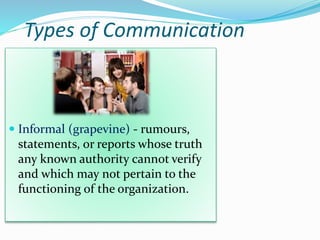
 Informal (grapevine) - rumours,
statements, or reports whose truth
any known authority cannot verify
and which may not pertain to the
functioning of the organization.
Communication between persons
occupying position at the same level
of authority.
Exchange between departmental
heads.
Executive Director
Vice President
A.G.M.
Manager
Supervisor
Forman
Supervisor 3Supervisor 1 Supervisor 2
Manager
Horizontal Comm.
Types of
People communicate with each other in a number of
ways that depend upon the message and its context in
which it is being sent.
Types of communication based on the communication
channels used are –
Verbal Communication
Nonverbal Communication
29-09-2016 16:55:45 16
Verbal
 It refers to the form of communication in which message
is transmitted verbally.
 Communication is done by word of mouth and a piece of
writing.
 In verbal communication remember the acronym “KISS”
(keep it short and simple).
Verbal Communication is divided into:
Oral Communication
Written Communication
29-09-2016 16:55:45 17
Oral
In oral communication, Spoken words
are used.
It includes face-to-face conversations,
speech, telephonic conversation, video,
radio, television, voice over internet.
Communication is influence by pitch,
volume, speed and clarity of speaking.
19
Oral Communication
Advantages
 Immediate Feedback
 Time Saving
 Economical
 Personal Touch
 Flexibility
 Secrecy
 Effectiveness
Disadvantages
 Poor Retention
 No Record
 Time Consuming
 Misunderstanding
 Lack of Responsibility
• Be Motivated to Listen
• Be Prepared to Listen
• Be Objective
• Be Alert to All Cues
• Make Good Use of the Thinking-Speaking Time Difference
• Use Feedback
• Practice Listening
HOW TO BE A GOOD LISTENER
Speaker Must
 Try to Empathize
 Adjust Your Delivery
 Utilize Feedback
 Be Clear
 Be Interesting
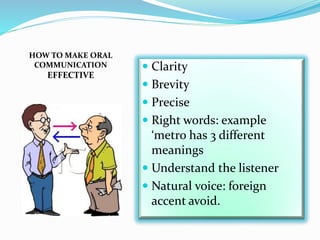
HOW TO MAKE ORAL
COMMUNICATION
EFFECTIVE
 Clarity
 Brevity
 Precise
 Right words: example
‘metro has 3 different
meanings
 Understand the listener
 Natural voice: foreign
accent avoid.
Written
 In written communication, written signs or
symbols are used to communicate.
 In written communication message can be
transmitted via email, letter, report, memo etc.
 Written Communication is most common
form of communication being used in
business.
25
Written Communication
Advantages
• Can be edited and
revised many times
• provides record
• enables receiver to fully
understand it and send
suitable feedback.
Disadvantages
• doesn’t bring
instant feedback.
• ‰‰takes more time in
writing a message
• writing ability.
Nonverbal
 Nonverbal communication is the
sending or receiving of wordless
messages. Such as gesture, body
language, posture, tone of
voice or facial expressions, is
called nonverbal communication.
 Nonverbal communication is all
about the body language of
speaker.
29-09-2016 16:55:45 29
Messages you give out using Body Language.
Aggressive ~
showing
physical
threat
Attentive ~
showing
interest
Bored~
showing lack
of interest.
Emotion~
fear,
affection,
general
feelings
Greetings~
correct ways
of meeting
people
Relaxed~
showing you
are
comfortable.
Non Verbal Communication
Three Elements
Appearance
Body
Language
Sounds
Five Roles
• Repetition
• Contradiction
• Substitution
• Complementing
• Accenting
Body posture.
Proximity.
Eye movements.
Dress and appearance.
Eye contact.
Three Elements
Sounds
Voice Tone, Volume, Speech rate
Body Language
facial expressions, gestures, postures
Appearance
Speaker – clothing, hairstyle, neatness, use of cosmetics
Types of Non Verbal Communication
KINESICS
PERSONAL APPEARANCE
KINESICS
KINESICS
CHRONEMICS
CHARLIE CHAPLIN
PARALANGUAGE refers to
the verbalized form of non-
verbal communication.
It consists of :
 Voice quality
 Rate of speech
 Non- fluencies- ‘ah’ ‘um’ ‘oh’
PROXEMICS
Use of the inter-personal space
(space between the communicator
and the communicatee).
In this two persons purposefully
maintains distance between them
while speaking
Visual communication
 These are visual means of communication which are
convincing and appealing to the people
 Examples diagrams , maps, graphs and other pictorial
methods
 Pictorial presentation of data helps in the
proper understanding of data
 It is more attracting to the eye ( charts
create great interest & diagrams are
popular in exhibitions , fairs and meetings
 it creates long lasting impression
 They have more visual appeal as tables etc
are much more difficult to interpret
• Noise
• Inappropriate medium
• Assumptions/Misconceptio
ns
• Emotions
• Language differences
• Poor listening skills
• Distractions
Noise as a Barrier
Noise” is the
disruption or
hindrance in
communication
process
anywhere along
the way.
Perceptual Differences
Perception is in general how
each individual interprets
the world around him. A
same event may be taken
differently by different
individuals.
INATTENTION
NOT GIVING
PROPER
ATTENTION-
message is likely
to be
misunderstood
Poor Retention
 Human memory cannot function outside a limit. One can’t
always retain what is being told especially if he is not interested
or not attentive. This leads to communication collapse.
 Complexity in Organizational Structure
 Greater the power structure in an organization (i.e. more the
number of managerial levels), more are the chances of
communication getting lost.
unclarified
Unclarified assumption
 On Monday Mr. Richard’s announced to his class, “I
will be out of the town from Tuesday until Friday.
There will be no classes while I’M gone.
 On Tuesday 80 % of the student came to class but
Mr. Richard’s failed to appear.
 On Friday 20 % came along and Prof Richard’s was
also present.
 Mr. Richard’s got irritated and said
 STUDENTS NOT PRESENT TODAY WILL HAVE
THEIR TUCK CANCELLED ON COMING SATURDAY
AND SUNDAY
Emotions
Emotional state at a
peculiar point of time
also affects
communication.
56
• Attitude
• Message overload
Barriers to Superior
Barriers to Subordinate
• Lack of incentives
• Lack of encouragement
• Unwilling to communicate
INTER-PERSONAL SKILSS IN COMMUNICATION
 Know your subject
 Know your audience
 Adopt right posture
 Involve your audience
 Be Emphatetic
 Use humour
 practice
 Positive attitude (no ego)
 Concentration
 Quiet atmosphere
 Full attention (not
undivided)
 No talking
 Body language
 Improve vocabulary
Hearing – Physical process,
natural, passive.
Listening – Physical as well as
mental process, active ,a skill
Listening is hard.
You must choose to participate in the
process of listening.
 Eye contact Analyze your audience-
Interact with audience Incorporate humor
Communication for presentation

Communication for presentation

  • 4.
    Communication is theart of transmitting information, ideas and opinions from one person to another. Communication is the process of meaningful interaction among human beings. What is Communication?
  • 5.
  • 6.
  • 7.
  • 8.
    What are themost common ways we communicate? Written Word
  • 9.
    Listening  An averageemployee spends  32.7 % time listening  25.8 % time speaking  22.6 % Writing.  Top executives spend even more time listening than other employees.  Improved work quality  Boosts productivity  Help employees update and revise the facts, skills and attitudes.  Improves speaking ability
  • 10.
    Types of Communication Formal - the official communication that travels through the structured (formal) organization.  It takes place through official path.  Scalar chain- (senior subordinate relationship)
  • 11.
    Types of Communication Informal (grapevine) - rumours, statements, or reports whose truth any known authority cannot verify and which may not pertain to the functioning of the organization.
  • 14.
    Communication between persons occupyingposition at the same level of authority. Exchange between departmental heads.
  • 15.
    Executive Director Vice President A.G.M. Manager Supervisor Forman Supervisor3Supervisor 1 Supervisor 2 Manager Horizontal Comm.
  • 16.
    Types of People communicatewith each other in a number of ways that depend upon the message and its context in which it is being sent. Types of communication based on the communication channels used are – Verbal Communication Nonverbal Communication 29-09-2016 16:55:45 16
  • 17.
    Verbal  It refersto the form of communication in which message is transmitted verbally.  Communication is done by word of mouth and a piece of writing.  In verbal communication remember the acronym “KISS” (keep it short and simple). Verbal Communication is divided into: Oral Communication Written Communication 29-09-2016 16:55:45 17
  • 19.
    Oral In oral communication,Spoken words are used. It includes face-to-face conversations, speech, telephonic conversation, video, radio, television, voice over internet. Communication is influence by pitch, volume, speed and clarity of speaking. 19
  • 20.
    Oral Communication Advantages  ImmediateFeedback  Time Saving  Economical  Personal Touch  Flexibility  Secrecy  Effectiveness Disadvantages  Poor Retention  No Record  Time Consuming  Misunderstanding  Lack of Responsibility
  • 22.
    • Be Motivatedto Listen • Be Prepared to Listen • Be Objective • Be Alert to All Cues • Make Good Use of the Thinking-Speaking Time Difference • Use Feedback • Practice Listening HOW TO BE A GOOD LISTENER
  • 23.
    Speaker Must  Tryto Empathize  Adjust Your Delivery  Utilize Feedback  Be Clear  Be Interesting
  • 24.
    HOW TO MAKEORAL COMMUNICATION EFFECTIVE  Clarity  Brevity  Precise  Right words: example ‘metro has 3 different meanings  Understand the listener  Natural voice: foreign accent avoid.
  • 25.
    Written  In writtencommunication, written signs or symbols are used to communicate.  In written communication message can be transmitted via email, letter, report, memo etc.  Written Communication is most common form of communication being used in business. 25
  • 26.
    Written Communication Advantages • Canbe edited and revised many times • provides record • enables receiver to fully understand it and send suitable feedback. Disadvantages • doesn’t bring instant feedback. • ‰‰takes more time in writing a message • writing ability.
  • 29.
    Nonverbal  Nonverbal communicationis the sending or receiving of wordless messages. Such as gesture, body language, posture, tone of voice or facial expressions, is called nonverbal communication.  Nonverbal communication is all about the body language of speaker. 29-09-2016 16:55:45 29
  • 30.
    Messages you giveout using Body Language. Aggressive ~ showing physical threat Attentive ~ showing interest Bored~ showing lack of interest. Emotion~ fear, affection, general feelings Greetings~ correct ways of meeting people Relaxed~ showing you are comfortable.
  • 31.
    Non Verbal Communication ThreeElements Appearance Body Language Sounds Five Roles • Repetition • Contradiction • Substitution • Complementing • Accenting
  • 32.
  • 33.
    Three Elements Sounds Voice Tone,Volume, Speech rate Body Language facial expressions, gestures, postures Appearance Speaker – clothing, hairstyle, neatness, use of cosmetics
  • 34.
    Types of NonVerbal Communication KINESICS PERSONAL APPEARANCE KINESICS KINESICS CHRONEMICS CHARLIE CHAPLIN
  • 35.
    PARALANGUAGE refers to theverbalized form of non- verbal communication. It consists of :  Voice quality  Rate of speech  Non- fluencies- ‘ah’ ‘um’ ‘oh’
  • 36.
    PROXEMICS Use of theinter-personal space (space between the communicator and the communicatee). In this two persons purposefully maintains distance between them while speaking
  • 39.
    Visual communication  Theseare visual means of communication which are convincing and appealing to the people  Examples diagrams , maps, graphs and other pictorial methods
  • 41.
     Pictorial presentationof data helps in the proper understanding of data  It is more attracting to the eye ( charts create great interest & diagrams are popular in exhibitions , fairs and meetings  it creates long lasting impression  They have more visual appeal as tables etc are much more difficult to interpret
  • 42.
    • Noise • Inappropriatemedium • Assumptions/Misconceptio ns • Emotions • Language differences • Poor listening skills • Distractions
  • 43.
    Noise as aBarrier Noise” is the disruption or hindrance in communication process anywhere along the way.
  • 44.
    Perceptual Differences Perception isin general how each individual interprets the world around him. A same event may be taken differently by different individuals.
  • 45.
  • 46.
    Poor Retention  Humanmemory cannot function outside a limit. One can’t always retain what is being told especially if he is not interested or not attentive. This leads to communication collapse.
  • 48.
     Complexity inOrganizational Structure  Greater the power structure in an organization (i.e. more the number of managerial levels), more are the chances of communication getting lost.
  • 51.
  • 53.
    Unclarified assumption  OnMonday Mr. Richard’s announced to his class, “I will be out of the town from Tuesday until Friday. There will be no classes while I’M gone.  On Tuesday 80 % of the student came to class but Mr. Richard’s failed to appear.  On Friday 20 % came along and Prof Richard’s was also present.  Mr. Richard’s got irritated and said  STUDENTS NOT PRESENT TODAY WILL HAVE THEIR TUCK CANCELLED ON COMING SATURDAY AND SUNDAY
  • 55.
    Emotions Emotional state ata peculiar point of time also affects communication.
  • 56.
    56 • Attitude • Messageoverload Barriers to Superior Barriers to Subordinate • Lack of incentives • Lack of encouragement • Unwilling to communicate
  • 59.
  • 61.
     Know yoursubject  Know your audience  Adopt right posture  Involve your audience  Be Emphatetic  Use humour  practice  Positive attitude (no ego)  Concentration  Quiet atmosphere  Full attention (not undivided)  No talking  Body language  Improve vocabulary
  • 62.
    Hearing – Physicalprocess, natural, passive. Listening – Physical as well as mental process, active ,a skill Listening is hard. You must choose to participate in the process of listening.
  • 63.
     Eye contactAnalyze your audience- Interact with audience Incorporate humor