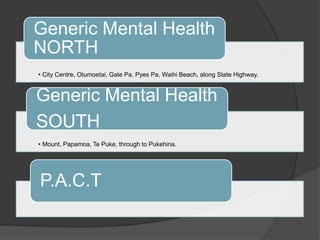
Generic Mental Health
NORTH
• City Centre, Otumoetai, Gate Pa, Pyes Pa, Waihi Beach, along State Highway.


Generic Mental Health
SOUTH
• Mount, Papamoa, Te Puke, through to Pukehina.


P.A.C.T
Michelle Loury
 Clinical Team Leader -
NORTH
   What is Michelle responsible for?

   To generally oversight all of the work in the
    P.A.C.T. team.
   Ensuring the right processes and systems are in
    place to provide practice is safe.
   Monitoring the community is receiving and
    benefiting from the service.
   Dealing with complaints and issues that arise
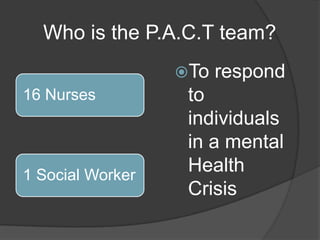
Who is the P.A.C.T team?
                  To   respond
16 Nurses          to
                   individuals
                   in a mental
1 Social Worker
                   Health
                   Crisis
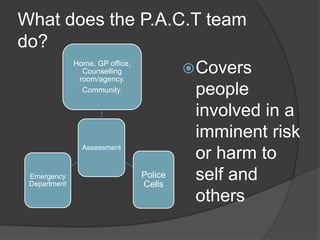
What does the P.A.C.T team
do?
      Home, GP office,
        Counselling            Covers
       room/agency.
        Community.              people
                                involved in a
                                imminent risk
              Assessment
                                or harm to
 Emergency
 Department
                       Police
                       Cells
                                self and
                                others
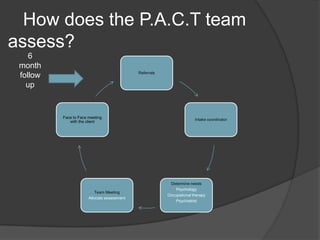
How does the P.A.C.T team
assess?
    6
 month
                                             Referrals
 follow
   up


          Face to Face meeting
                                                                       Intake coordinator
             with the client


                                                          Determine needs
                                                             Psychology
                           Team Meeting
                                                         Occupational therapy
                       Allocate assessment
                                                             Psychiatrist
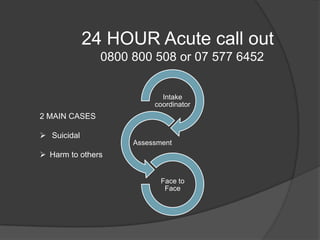
24 HOUR Acute call out
               0800 800 508 or 07 577 6452


                           Intake
                         coordinator
2 MAIN CASES

 Suicidal
                    Assessment
 Harm to others


                           Face to
                            Face
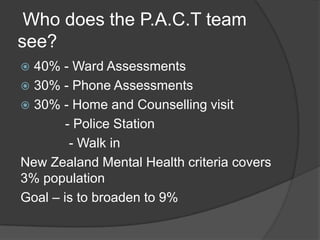
Who does the P.A.C.T team
see?
 40% - Ward Assessments
 30% - Phone Assessments
 30% - Home and Counselling visit
        - Police Station
         - Walk in
New Zealand Mental Health criteria covers
3% population
Goal – is to broaden to 9%
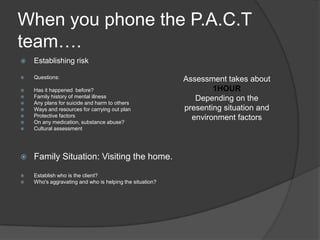
When you phone the P.A.C.T
team….
   Establishing risk

   Questions:                                            Assessment takes about
   Has it happened before?                                       1HOUR
   Family history of mental illness                         Depending on the
   Any plans for suicide and harm to others
   Ways and resources for carrying out plan              presenting situation and
   Protective factors                                      environment factors
   On any medication, substance abuse?
   Cultural assessment


   Family Situation: Visiting the home.

   Establish who is the client?
   Who's aggravating and who is helping the situation?
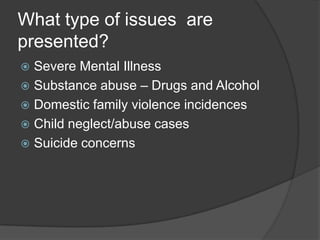
What type of issues are
presented?
 Severe Mental Illness
 Substance abuse – Drugs and Alcohol
 Domestic family violence incidences
 Child neglect/abuse cases
 Suicide concerns
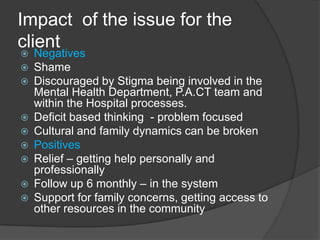
Impact of the issue for the
client
   Negatives
   Shame
   Discouraged by Stigma being involved in the
    Mental Health Department, P.A.CT team and
    within the Hospital processes.
   Deficit based thinking - problem focused
   Cultural and family dynamics can be broken
   Positives
   Relief – getting help personally and
    professionally
   Follow up 6 monthly – in the system
   Support for family concerns, getting access to
    other resources in the community
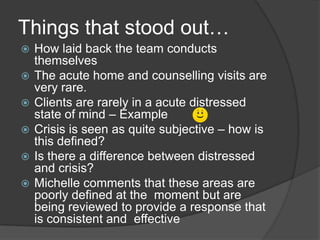
Things that stood out…
   How laid back the team conducts
    themselves
   The acute home and counselling visits are
    very rare.
   Clients are rarely in a acute distressed
    state of mind – Example
   Crisis is seen as quite subjective – how is
    this defined?
   Is there a difference between distressed
    and crisis?
   Michelle comments that these areas are
    poorly defined at the moment but are
    being reviewed to provide a response that
    is consistent and effective

Common issues powerpoint presentation

  • 2.
    Generic Mental Health NORTH •City Centre, Otumoetai, Gate Pa, Pyes Pa, Waihi Beach, along State Highway. Generic Mental Health SOUTH • Mount, Papamoa, Te Puke, through to Pukehina. P.A.C.T
  • 3.
    Michelle Loury ClinicalTeam Leader - NORTH  What is Michelle responsible for?  To generally oversight all of the work in the P.A.C.T. team.  Ensuring the right processes and systems are in place to provide practice is safe.  Monitoring the community is receiving and benefiting from the service.  Dealing with complaints and issues that arise
  • 4.
    Who is theP.A.C.T team? To respond 16 Nurses to individuals in a mental 1 Social Worker Health Crisis
  • 5.
    What does theP.A.C.T team do? Home, GP office, Counselling  Covers room/agency. Community. people involved in a imminent risk Assessment or harm to Emergency Department Police Cells self and others
  • 6.
    How does theP.A.C.T team assess? 6 month Referrals follow up Face to Face meeting Intake coordinator with the client Determine needs Psychology Team Meeting Occupational therapy Allocate assessment Psychiatrist
  • 7.
    24 HOUR Acutecall out 0800 800 508 or 07 577 6452 Intake coordinator 2 MAIN CASES  Suicidal Assessment  Harm to others Face to Face
  • 8.
    Who does theP.A.C.T team see?  40% - Ward Assessments  30% - Phone Assessments  30% - Home and Counselling visit - Police Station - Walk in New Zealand Mental Health criteria covers 3% population Goal – is to broaden to 9%
  • 9.
    When you phonethe P.A.C.T team….  Establishing risk  Questions: Assessment takes about  Has it happened before? 1HOUR  Family history of mental illness Depending on the  Any plans for suicide and harm to others  Ways and resources for carrying out plan presenting situation and  Protective factors environment factors  On any medication, substance abuse?  Cultural assessment  Family Situation: Visiting the home.  Establish who is the client?  Who's aggravating and who is helping the situation?
  • 10.
    What type ofissues are presented?  Severe Mental Illness  Substance abuse – Drugs and Alcohol  Domestic family violence incidences  Child neglect/abuse cases  Suicide concerns
  • 11.
    Impact of theissue for the client  Negatives  Shame  Discouraged by Stigma being involved in the Mental Health Department, P.A.CT team and within the Hospital processes.  Deficit based thinking - problem focused  Cultural and family dynamics can be broken  Positives  Relief – getting help personally and professionally  Follow up 6 monthly – in the system  Support for family concerns, getting access to other resources in the community
  • 12.
    Things that stoodout…  How laid back the team conducts themselves  The acute home and counselling visits are very rare.  Clients are rarely in a acute distressed state of mind – Example  Crisis is seen as quite subjective – how is this defined?  Is there a difference between distressed and crisis?  Michelle comments that these areas are poorly defined at the moment but are being reviewed to provide a response that is consistent and effective