Colitis
Dr Sami
Definition:
 Colitis is inflammation of the inner lining of the colon or Large Intestine.
Large Intestine
 Large Intestine.
 The large intestine, also known as the large bowel, is the last part of the
gastrointestinal tract and of the digestive system
 Water and other nutrients is absorbed here and the remaining waste
material is stored as feces before being removed by defecation.
 large intestine is about five feet (or 1.5 meters) long
 It's about 3 inches (around 7.6 centimeters) wide.
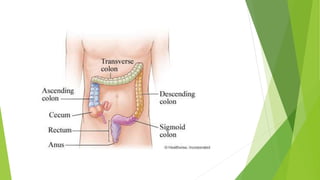
Sections of Colon
 the colon consists of six sections:
 the cecum,
 the ascending colon,
 the transverse colon,
 the descending colon,
 the sigmoid colon,
 the rectum.
Colitis:
 Inflammation of the lining of the large intestine.
Types and Causes:
 1. Ulcerative colitis.
 UC is a lifelong disease that causes inflammation and bleeding ulcers within
the inner lining of your large intestine. It generally begins in the rectum and
spreads to the colon.
 UC is the most commonly diagnosed type of colitis. It occurs when the
immune system overreacts to bacteria and other substances in the
digestive tract (Crohn’s Disease)
 Common types of UC include:
 proctosigmoiditis, which affects the rectum and lower portion of the colon
 left-sided ulcerative colitis, which affects the left side of the colon
beginning at the rectum
 pancolitis, which affects the entire large intestine
 2. Pseudomembranous colitis
 Pseudomembranous colitis (PC) occurs from overgrowth of the bacterium
Clostridium difficile (C. diff). This kind of bacteria normally lives in the
intestine, but it doesn’t cause problems because it’s balanced by the
presence of “good” bacteria.
 Certain medications, especially antibiotics, may destroy healthy bacteria.
This allows C. diff to take over, releasing toxins that cause inflammation.
 Ischemic colitis
 Ischemic colitis (IC) occurs when blood flow to the colon is suddenly cut off
or restricted. Blood clots can be a reason for sudden blockage.
Atherosclerosis, or buildup of fatty deposits in the blood vessels that supply
the colon, is usually the reason for returning IC.
 (the superior mesenteric artery (SMA) and inferior mesenteric artery
(IMA)
 This type of colitis is often the result of underlying conditions. These may include:
 vasculitis, an inflammatory disease of the blood vessels
 diabetes
 colon cancer
 dehydration
 blood loss
 heart failure
 obstruction or blockage
 trauma or injury
 Microscopic colitis –
 a colitis diagnosed by microscopic examination of colonic tissue;
macroscopically ("to the eye") it appears normal.
 Lymphocytic colitis
 Collagenous colitis
 Lymphocytic colitis.
 Lymphocytic colitis is a subtype of microscopic colitis, a condition
characterized by chronic non-bloody watery diarrhea.
 The colonoscopy is normal but histology of the mucosal biopsy reveals an
accumulation of lymphocytes in the colonic epithelium and connective tissue
(lamina propria)
 Collagenous colitis
 occurs when the colon’s lining becomes thicker than usual due to a buildup of
collagen under the outermost layer of tissue
 Microscopic colitis causes chronic watery diarrhea with greater than 10
bowel movements per day. Some patients report nocturnal diarrhea,
abdominal pain, urgency, fecal incontinence, fatigue, dehydration and weight
loss.
Sings and Symptoms:
 abdominal pain or cramping
 bloating in your abdomen
 unexpected weight loss
 diarrhea with or without blood
 Mucus and/or blood in stool and rectal bleeding
 chills or fever
 Vomiting
 Erythema (redness) of the surface of the colon
 Fatigue
 Joint pain or soreness
 Eye pain when you look at a bright light
Complications:
 Severe bleeding
 A hole in the colon (perforated colon)
 Severe dehydration
 Bone loss (osteoporosis)
 Inflammation of your skin, joints and eyes
 An increased risk of colon cancer
 A rapidly swelling colon (toxic megacolon)
 Increased risk of blood clots in veins and arteries
Diagnosed:
 CBC
 colonoscopy, which involves threading a camera on a flexible tube through
the anus to view the rectum and colon
 sigmoidoscopy, which is similar to a colonoscopy but shows only the rectum
and lower colon
 stool samples
 abdominal imaging such as MRI or CT scans
 ultrasound, which can be useful depending on the area being scanned
 barium enema, an X-ray of the colon after it’s injected with barium, which
helps make images more visible
Treatment:
 Anti-inflammatory drugs
 Anti-inflammatory drugs are often the first step in the treatment of
ulcerative colitis and are appropriate for the majority of people with this
condition. These drugs include:
 5-aminosalicylates. Examples of this type of medication include sulfasalazine
(Azulfidine), mesalamine (Asacol HD, Delzicol, others), balsalazide (Colazal)
and olsalazine (Dipentum). Which one you take, and whether it is taken by
mouth or as an enema or suppository, depends on the area of your colon that's
affected.
 Corticosteroids. These drugs, which include prednisone and budesonide, are
generally reserved for moderate to severe ulcerative colitis that doesn't
respond to other treatments. Due to the side effects, they are not usually
given long term
 Immune system suppressors
 These drugs also reduce inflammation, but they do so by suppressing the
immune system response that starts the process of inflammation
 Immunosuppressant drugs include:
 Azathioprine (Azasan, Imuran) and mercaptopurine (Purinethol, Purixan).
These are the most widely used immunosuppressants for the treatment of
inflammatory bowel disease. Taking them requires that you follow up closely
with your doctor and have your blood checked regularly to look for side
effects, including effects on the liver and pancreas.
 Cyclosporine (Gengraf, Neoral, Sandimmune). This drug is normally reserved
for people who haven't responded well to other medications. Cyclosporine has
the potential for serious side effects and is not for long-term use.
 Tofacitinib (Xeljanz). This is called a "small molecule" and works by stopping
the process of inflammation. Tofacitinib is effective when other therapies
don't work. Main side effects include the increased risk of blood clots.
 Biologics
 These are made from proteins in living cells instead of chemicals. Types of
biologics used to treat ulcerative colitis include:
 Infliximab (Remicade), adalimumab (Humira) and golimumab (Simponi).
These drugs, called tumor necrosis factor (TNF) inhibitors, or biologics,
work by neutralizing a protein produced by your immune system. They are for
people with severe ulcerative colitis who don't respond to or can't tolerate
other treatments.
 Vedolizumab (Entyvio). This medication is approved for treatment of
ulcerative colitis for people who don't respond to or can't tolerate other
treatments. It works by blocking inflammatory cells from getting to the site
of inflammation.
 Ustekinumab (Stelara). This medication is approved for treatment of
ulcerative colitis for people who don't respond to or can't tolerate other
treatments. It works by blocking a different protein that causes
inflammation.
 Antibiotics
 Anti-diarrheal medications
 Pain relievers. For mild pain, acetaminophen (Tylenol,
 Antispasmodics
 Iron supplements.
 Surgery.
 If other treatments don’t work or your UC is severe, you might need surgery
to remove your colon (colectomy) or colon and rectum (proctocolectomy). If
you have a proctocolectomy, your doctor might make a small pouch out of
your small intestine and attach it to your anus. This is called ileal pouch-anal
anastomosis (IPAA). It lets your body expel waste normally, so you don’t need
to wear a bag to collect stool.

Colitis

  • 1.
  • 2.
    Definition:  Colitis isinflammation of the inner lining of the colon or Large Intestine.
  • 3.
    Large Intestine  LargeIntestine.  The large intestine, also known as the large bowel, is the last part of the gastrointestinal tract and of the digestive system  Water and other nutrients is absorbed here and the remaining waste material is stored as feces before being removed by defecation.  large intestine is about five feet (or 1.5 meters) long  It's about 3 inches (around 7.6 centimeters) wide.
  • 5.
    Sections of Colon the colon consists of six sections:  the cecum,  the ascending colon,  the transverse colon,  the descending colon,  the sigmoid colon,  the rectum.
  • 6.
    Colitis:  Inflammation ofthe lining of the large intestine.
  • 7.
    Types and Causes: 1. Ulcerative colitis.  UC is a lifelong disease that causes inflammation and bleeding ulcers within the inner lining of your large intestine. It generally begins in the rectum and spreads to the colon.  UC is the most commonly diagnosed type of colitis. It occurs when the immune system overreacts to bacteria and other substances in the digestive tract (Crohn’s Disease)
  • 8.
     Common typesof UC include:  proctosigmoiditis, which affects the rectum and lower portion of the colon  left-sided ulcerative colitis, which affects the left side of the colon beginning at the rectum  pancolitis, which affects the entire large intestine
  • 9.
     2. Pseudomembranouscolitis  Pseudomembranous colitis (PC) occurs from overgrowth of the bacterium Clostridium difficile (C. diff). This kind of bacteria normally lives in the intestine, but it doesn’t cause problems because it’s balanced by the presence of “good” bacteria.  Certain medications, especially antibiotics, may destroy healthy bacteria. This allows C. diff to take over, releasing toxins that cause inflammation.
  • 10.
     Ischemic colitis Ischemic colitis (IC) occurs when blood flow to the colon is suddenly cut off or restricted. Blood clots can be a reason for sudden blockage. Atherosclerosis, or buildup of fatty deposits in the blood vessels that supply the colon, is usually the reason for returning IC.  (the superior mesenteric artery (SMA) and inferior mesenteric artery (IMA)
  • 11.
     This typeof colitis is often the result of underlying conditions. These may include:  vasculitis, an inflammatory disease of the blood vessels  diabetes  colon cancer  dehydration  blood loss  heart failure  obstruction or blockage  trauma or injury
  • 12.
     Microscopic colitis–  a colitis diagnosed by microscopic examination of colonic tissue; macroscopically ("to the eye") it appears normal.  Lymphocytic colitis  Collagenous colitis
  • 13.
     Lymphocytic colitis. Lymphocytic colitis is a subtype of microscopic colitis, a condition characterized by chronic non-bloody watery diarrhea.  The colonoscopy is normal but histology of the mucosal biopsy reveals an accumulation of lymphocytes in the colonic epithelium and connective tissue (lamina propria)
  • 14.
     Collagenous colitis occurs when the colon’s lining becomes thicker than usual due to a buildup of collagen under the outermost layer of tissue  Microscopic colitis causes chronic watery diarrhea with greater than 10 bowel movements per day. Some patients report nocturnal diarrhea, abdominal pain, urgency, fecal incontinence, fatigue, dehydration and weight loss.
  • 15.
    Sings and Symptoms: abdominal pain or cramping  bloating in your abdomen  unexpected weight loss  diarrhea with or without blood  Mucus and/or blood in stool and rectal bleeding  chills or fever  Vomiting  Erythema (redness) of the surface of the colon  Fatigue  Joint pain or soreness  Eye pain when you look at a bright light
  • 16.
    Complications:  Severe bleeding A hole in the colon (perforated colon)  Severe dehydration  Bone loss (osteoporosis)  Inflammation of your skin, joints and eyes  An increased risk of colon cancer  A rapidly swelling colon (toxic megacolon)  Increased risk of blood clots in veins and arteries
  • 17.
    Diagnosed:  CBC  colonoscopy,which involves threading a camera on a flexible tube through the anus to view the rectum and colon  sigmoidoscopy, which is similar to a colonoscopy but shows only the rectum and lower colon  stool samples  abdominal imaging such as MRI or CT scans  ultrasound, which can be useful depending on the area being scanned  barium enema, an X-ray of the colon after it’s injected with barium, which helps make images more visible
  • 18.
    Treatment:  Anti-inflammatory drugs Anti-inflammatory drugs are often the first step in the treatment of ulcerative colitis and are appropriate for the majority of people with this condition. These drugs include:  5-aminosalicylates. Examples of this type of medication include sulfasalazine (Azulfidine), mesalamine (Asacol HD, Delzicol, others), balsalazide (Colazal) and olsalazine (Dipentum). Which one you take, and whether it is taken by mouth or as an enema or suppository, depends on the area of your colon that's affected.  Corticosteroids. These drugs, which include prednisone and budesonide, are generally reserved for moderate to severe ulcerative colitis that doesn't respond to other treatments. Due to the side effects, they are not usually given long term
  • 19.
     Immune systemsuppressors  These drugs also reduce inflammation, but they do so by suppressing the immune system response that starts the process of inflammation  Immunosuppressant drugs include:  Azathioprine (Azasan, Imuran) and mercaptopurine (Purinethol, Purixan). These are the most widely used immunosuppressants for the treatment of inflammatory bowel disease. Taking them requires that you follow up closely with your doctor and have your blood checked regularly to look for side effects, including effects on the liver and pancreas.
  • 20.
     Cyclosporine (Gengraf,Neoral, Sandimmune). This drug is normally reserved for people who haven't responded well to other medications. Cyclosporine has the potential for serious side effects and is not for long-term use.  Tofacitinib (Xeljanz). This is called a "small molecule" and works by stopping the process of inflammation. Tofacitinib is effective when other therapies don't work. Main side effects include the increased risk of blood clots.
  • 21.
     Biologics  Theseare made from proteins in living cells instead of chemicals. Types of biologics used to treat ulcerative colitis include:  Infliximab (Remicade), adalimumab (Humira) and golimumab (Simponi). These drugs, called tumor necrosis factor (TNF) inhibitors, or biologics, work by neutralizing a protein produced by your immune system. They are for people with severe ulcerative colitis who don't respond to or can't tolerate other treatments.
  • 22.
     Vedolizumab (Entyvio).This medication is approved for treatment of ulcerative colitis for people who don't respond to or can't tolerate other treatments. It works by blocking inflammatory cells from getting to the site of inflammation.  Ustekinumab (Stelara). This medication is approved for treatment of ulcerative colitis for people who don't respond to or can't tolerate other treatments. It works by blocking a different protein that causes inflammation.
  • 23.
     Antibiotics  Anti-diarrhealmedications  Pain relievers. For mild pain, acetaminophen (Tylenol,  Antispasmodics  Iron supplements.
  • 24.
     Surgery.  Ifother treatments don’t work or your UC is severe, you might need surgery to remove your colon (colectomy) or colon and rectum (proctocolectomy). If you have a proctocolectomy, your doctor might make a small pouch out of your small intestine and attach it to your anus. This is called ileal pouch-anal anastomosis (IPAA). It lets your body expel waste normally, so you don’t need to wear a bag to collect stool.