Cold-Hardy Winter Vegetables
©Pam Dawling 2021
Twin Oaks Community, Virginia
Author of
Sustainable Market Farming,
2nd Edition and
The Year-Round Hoophouse
SustainableMarketFarming.com
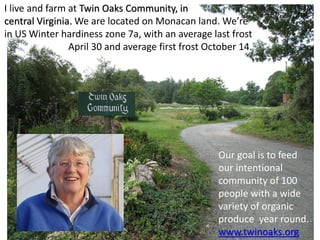
I live and farm at Twin Oaks Community, in
central Virginia. We are located on Monacan land. We’re
in US Winter hardiness zone 7a, with an average last frost
April 30 and average first frost October 14.
Our goal is to feed
our intentional
community of 100
people with a wide
variety of organic
produce year round.
www.twinoaks.org
What’s in this Presentation
• Why grow winter vegetables?
• Cold weather crop protection
• Tables of cold-hardiness of various vegetable
crops
• Three ranges for cold-hardy crops
• Details of suitable winter crops
• Crop storage methods
• Resources
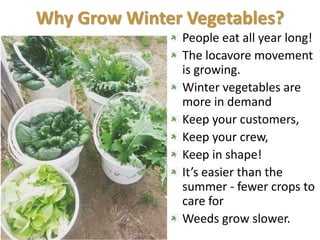
Why Grow Winter Vegetables?
People eat all year long!
The locavore movement
is growing.
Winter vegetables are
more in demand
Keep your customers,
Keep your crew,
Keep in shape!
It’s easier than the
summer - fewer crops to
care for
Weeds grow slower.
Pondering Season Extension
❖Extend the season without
overworking yourself, your
crew, or your soil.
❖It’s easier to get extra
harvests for a month or
two in fall from mature
plants, than to get harvests
a week earlier in the
spring.
❖Compare the costs and
benefits of various types of
cold weather crop
protection.
❖Before investing a lot of
money, talk with other
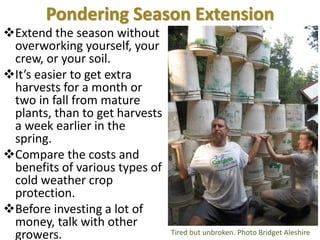
growers. Tired but unbroken. Photo Bridget Aleshire
Economics of Season Extension
• Season extension requires putting in more time and/or
money than main season growing, to gain extra
production.
• Find the balance point at which time, money and
energy put in are still definitely worthwhile.
• Beyond that point, the diminishing returns aren’t
worth the extra energy put in.
For details, see my slideshow
Season Extension
on SlideShare.net
Cold Weather Crop Protection
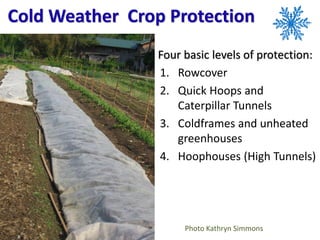
Four basic levels of protection:
1. Rowcover
2. Quick Hoops and
Caterpillar Tunnels
3. Coldframes and unheated
greenhouses
4. Hoophouses (High Tunnels)
Photo Kathryn Simmons
1. Rowcover
• Wonderful rowcover : lightweight, easy to use, easy to store.
• Keep crops alive and productive beyond their normal winter-kill
temperatures. Keep early spring crops alive and growing faster.
• Better quality produce – reduced weather and pest damage
• The microclimate under hooped rowcovers is very pleasant in chilly,
windy weather.
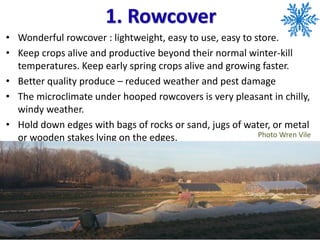
• Hold down edges with bags of rocks or sand, jugs of water, or metal
or wooden stakes lying on the edges. Photo Wren Vile
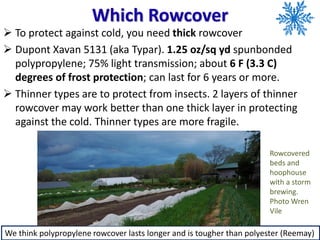
Which Rowcover
➢ To protect against cold, you need thick rowcover
➢ Dupont Xavan 5131 (aka Typar). 1.25 oz/sq yd spunbonded
polypropylene; 75% light transmission; about 6 F (3.3 C)
degrees of frost protection; can last for 6 years or more.
➢ Thinner types are to protect from insects. 2 layers of thinner
rowcover may work better than one thick layer in protecting
against the cold. Thinner types are more fragile.
We think polypropylene rowcover lasts longer and is tougher than polyester (Reemay)
Rowcovered
beds and
hoophouse
with a storm
brewing.
Photo Wren
Vile
Avoiding Pitfalls of Rowcover
➢ Weeds grow secretly, out of sight.
➢ Rowcover does reduce light levels.
➢ Ventilate covered crops in mild
weather, so they don’t lose their
cold tolerance.
➢ Hoops keep rowcover from
sticking to frozen leaves and
reduce abrasion.
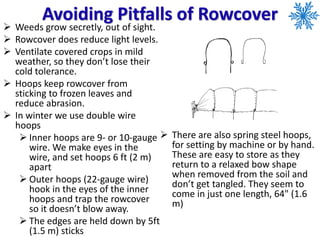
➢ In winter we use double wire
hoops
➢ Inner hoops are 9- or 10-gauge
wire. We make eyes in the
wire, and set hoops 6 ft (2 m)
apart
➢ Outer hoops (22-gauge wire)
hook in the eyes of the inner
hoops and trap the rowcover
so it doesn’t blow away.
➢ The edges are held down by 5ft
(1.5 m) sticks
➢ There are also spring steel hoops,
for setting by machine or by hand.
These are easy to store as they
return to a relaxed bow shape
when removed from the soil and
don’t get tangled. They seem to
come in just one length, 64" (1.6
m)
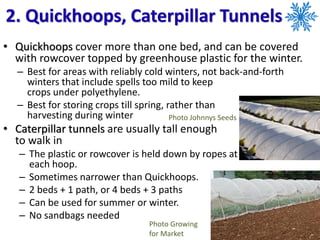
2. Quickhoops, Caterpillar Tunnels
• Quickhoops cover more than one bed, and can be covered
with rowcover topped by greenhouse plastic for the winter.
– Best for areas with reliably cold winters, not back-and-forth
winters that include spells too mild to keep
crops under polyethylene.
– Best for storing crops till spring, rather than
harvesting during winter
• Caterpillar tunnels are usually tall enough
to walk in
– The plastic or rowcover is held down by ropes at
each hoop.
– Sometimes narrower than Quickhoops.
– 2 beds + 1 path, or 4 beds + 3 paths
– Can be used for summer or winter.
– No sandbags needed
Photo Growing
for Market
Photo Johnnys Seeds
3. Coldframes and Unheated
Greenhouses
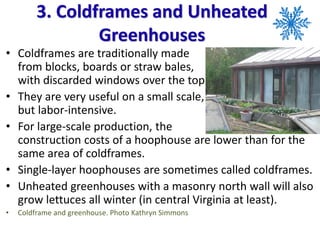
• Coldframes are traditionally made
from blocks, boards or straw bales,
with discarded windows over the top.
• They are very useful on a small scale, but
but labor-intensive.
• For large-scale production, the
construction costs of a hoophouse are lower than for the
same area of coldframes.
• Single-layer hoophouses are sometimes called coldframes.
• Unheated greenhouses with a masonry north wall will also
grow lettuces all winter (in central Virginia at least).
• Coldframe and greenhouse. Photo Kathryn Simmons
4. Hoophouses (High Tunnels)
For more details, see my slideshows
• Hoophouse Production of Cool Season
Crops
• Sequential Planting of Cool Season Crops in
a High Tunnel
• Hoophouse in Spring and Summer
• Hoophouse in Fall and Winter
• Many Crops, Many Plantings, to Maximize
High Tunnel Production Efficiency
on SlideShare.net
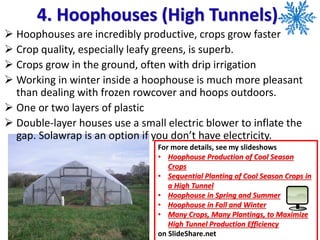
➢ Hoophouses are incredibly productive, crops grow faster
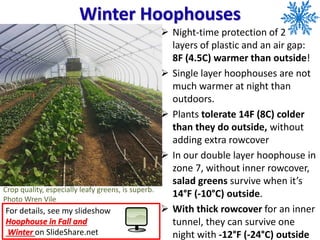
➢ Crop quality, especially leafy greens, is superb.
➢ Crops grow in the ground, often with drip irrigation
➢ Working in winter inside a hoophouse is much more pleasant
than dealing with frozen rowcover and hoops outdoors.
➢ One or two layers of plastic
➢ Double-layer houses use a small electric blower to inflate the
gap. Solawrap is an option if you don’t have electricity.
Winter Hoophouses
➢ Night-time protection of 2
layers of plastic and an air gap:
8F (4.5C) warmer than outside!
➢ Single layer hoophouses are not
much warmer at night than
outdoors.
➢ Plants tolerate 14F (8C) colder
than they do outside, without
adding extra rowcover
➢ In our double layer hoophouse in
zone 7, without inner rowcover,
salad greens survive when it’s
14°F (-10°C) outside.
➢ With thick rowcover for an inner
tunnel, they can survive one
night with -12°F (-24°C) outside
For details, see my slideshow
Hoophouse in Fall and
Winter on SlideShare.net
Crop quality, especially leafy greens, is superb.
Photo Wren Vile
➢ .
Winter-Kill Temperatures –
Frosty Weather: 35° to 25°F (2°C to -4°C)
Some starting numbers of killing temperatures outdoors (without row-
cover unless otherwise stated). Your experience may vary! Snow cover
helps keep plants alive. Wind, sudden or repeated cold spells kill them.
In a double-layer hoophouse (8F/5C warmer than outside) plants can
survive 14F/8C colder than outside, without extra rowcover; at least
21F/12C colder than outside with thick rowcover (1.25 ozTypar/Xavan).
• 35°F (2°C): Basil.
• 32°F (0°C): Cucumbers, eggplant, melons, okra, peppers, tomatoes.
• 27°F (–3°C): Many cabbage, Sugarloaf chicory.
• 25°F (–4°C): Some cabbage, chervil, chicory roots for chicons and
hearts, Chinese Napa cabbage, dill, some fava beans, annual fennel,
some Asian greens (Maruba Santoh, mizuna, most pak choy, Tokyo
Bekana), some onion scallions (many varieties are hardier), radicchio,
rhubarb stems and leaves.
Colder
from 22°F down to 15°F
• 22°F (–6°C): Some arugula (some varieties are hardier),
Bright Lights chard, endive (Escarole may be a little more frost-hardy
than Frisée), large leaves of lettuce (protected hearts and small plants
will survive colder temperatures).
• 20°F (–7°C): Some beets, broccoli heads (maybe OK to 15°F/-9.5°C),
some Brussels sprouts, some cabbages (the insides may still be good
even if the outer leaves are damaged), celeriac, celtuce (stem
lettuce), some collards (Georgia Cabbage Collards, variegated
collards),some head lettuce, some mustards/Asian greens, flat leaf
parsley, radicchio, radishes, most turnips.
• 15°F (–9.5°C): Some beets, beet greens, some broccoli, some
cabbage, rowcovered celery, red chard, cilantro, some fava beans,
Russian kales, kohlrabi, some lettuce, especially small and plants with
4-10 leaves, curly parsley, rutabagas, broad leaf sorrel, most covered
turnips, winter cress.
Colder Still
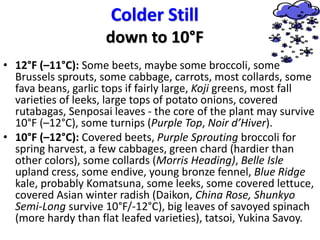
down to 10°F
• 12°F (–11°C): Some beets, maybe some broccoli, some
Brussels sprouts, some cabbage, carrots, most collards, some
fava beans, garlic tops if fairly large, Koji greens, most fall
varieties of leeks, large tops of potato onions, covered
rutabagas, Senposai leaves - the core of the plant may survive
10°F (–12°C), some turnips (Purple Top, Noir d’Hiver).
• 10°F (–12°C): Covered beets, Purple Sprouting broccoli for
spring harvest, a few cabbages, green chard (hardier than
other colors), some collards (Morris Heading), Belle Isle
upland cress, some endive, young bronze fennel, Blue Ridge
kale, probably Komatsuna, some leeks, some covered lettuce,
covered Asian winter radish (Daikon, China Rose, Shunkyo
Semi-Long survive 10°F/-12°C), big leaves of savoyed spinach
(more hardy than flat leafed varieties), tatsoi, Yukina Savoy.
Coldest
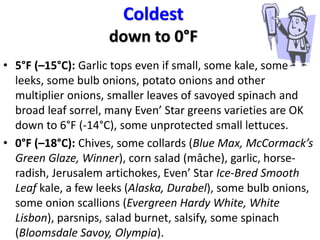
down to 0°F
• 5°F (–15°C): Garlic tops even if small, some kale, some
leeks, some bulb onions, potato onions and other
multiplier onions, smaller leaves of savoyed spinach and
broad leaf sorrel, many Even’ Star greens varieties are OK
down to 6°F (-14°C), some unprotected small lettuces.
• 0°F (–18°C): Chives, some collards (Blue Max, McCormack’s
Green Glaze, Winner), corn salad (mâche), garlic, horse-
radish, Jerusalem artichokes, Even’ Star Ice-Bred Smooth
Leaf kale, a few leeks (Alaska, Durabel), some bulb onions,
some onion scallions (Evergreen Hardy White, White
Lisbon), parsnips, salad burnet, salsify, some spinach
(Bloomsdale Savoy, Olympia).
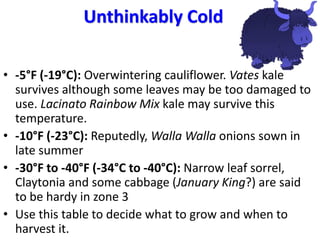
Unthinkably Cold
• -5°F (-19°C): Overwintering cauliflower. Vates kale
survives although some leaves may be too damaged to
use. Lacinato Rainbow Mix kale may survive this
temperature.
• -10°F (-23°C): Reputedly, Walla Walla onions sown in
late summer
• -30°F to -40°F (-34°C to -40°C): Narrow leaf sorrel,
Claytonia and some cabbage (January King?) are said
to be hardy in zone 3
• Use this table to decide what to grow and when to
harvest it.
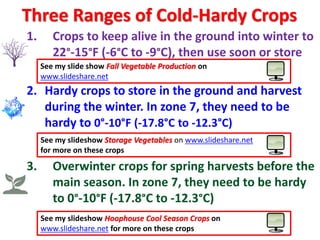
1. Crops to keep alive in the ground into winter to
22°-15°F (-6°C to -9°C), then use soon or store
2. Hardy crops to store in the ground and harvest
during the winter. In zone 7, they need to be
hardy to 0°-10°F (-17.8°C to -12.3°C)
3. Overwinter crops for spring harvests before the
main season. In zone 7, they need to be hardy
to 0°-10°F (-17.8°C to -12.3°C)
See my slideshow Hoophouse Cool Season Crops on
www.slideshare.net for more on these crops
Three Ranges of Cold-Hardy Crops
See my slideshow Storage Vegetables on www.slideshare.net
for more on these crops
See my slide show Fall Vegetable Production on
www.slideshare.net
For details, see my slide shows
Fall Vegetable Production and
Storage Vegetables for Off-Season Sales
on SlideShare.net
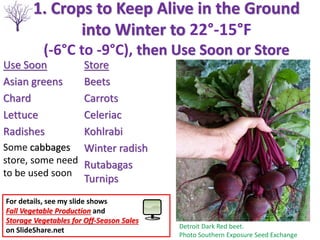
1. Crops to Keep Alive in the Ground
into Winter to 22°-15°F
(-6°C to -9°C), then Use Soon or Store
Use Soon
Asian greens
Chard
Lettuce
Radishes
Some cabbages
store, some need
to be used soon
Store
Beets
Carrots
Celeriac
Kohlrabi
Winter radish
Rutabagas
Turnips
Detroit Dark Red beet.
Photo Southern Exposure Seed Exchange
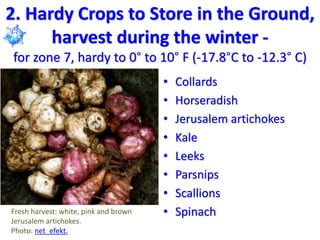
2. Hardy Crops to Store in the Ground,
harvest during the winter -
for zone 7, hardy to 0° to 10° F (-17.8°C to -12.3° C)
• Collards
• Horseradish
• Jerusalem artichokes
• Kale
• Leeks
• Parsnips
• Scallions
• Spinach
Fresh harvest: white, pink and brown
Jerusalem artichokes.
Photo: net_efekt.
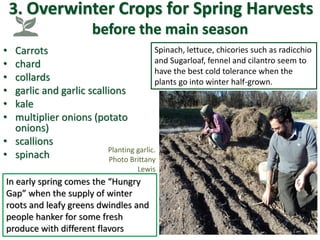
3. Overwinter Crops for Spring Harvests
before the main season
• Carrots
• chard
• collards
• garlic and garlic scallions
• kale
• multiplier onions (potato
onions)
• scallions
• spinach
Spinach, lettuce, chicories such as radicchio
and Sugarloaf, fennel and cilantro seem to
have the best cold tolerance when the
plants go into winter half-grown.
In early spring comes the “Hungry
Gap” when the supply of winter
roots and leafy greens dwindles and
people hanker for some fresh
produce with different flavors
Planting garlic.
Photo Brittany
Lewis
Crops by Family or Type
Leafy cooking
greens
Salad greens
Roots Alliums
Cold-hardy Asian Greens
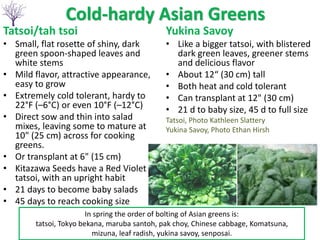
Tatsoi/tah tsoi
• Small, flat rosette of shiny, dark
green spoon-shaped leaves and
white stems
• Mild flavor, attractive appearance,
easy to grow
• Extremely cold tolerant, hardy to
22°F (–6°C) or even 10°F (–12°C)
• Direct sow and thin into salad
mixes, leaving some to mature at
10" (25 cm) across for cooking
greens.
• Or transplant at 6" (15 cm)
• Kitazawa Seeds have a Red Violet
tatsoi, with an upright habit
• 21 days to become baby salads
• 45 days to reach cooking size
Yukina Savoy
• Like a bigger tatsoi, with blistered
dark green leaves, greener stems
and delicious flavor
• About 12“ (30 cm) tall
• Both heat and cold tolerant
• Can transplant at 12" (30 cm)
• 21 d to baby size, 45 d to full size
Tatsoi, Photo Kathleen Slattery
Yukina Savoy, Photo Ethan Hirsh
In spring the order of bolting of Asian greens is:
tatsoi, Tokyo bekana, maruba santoh, pak choy, Chinese cabbage, Komatsuna,
mizuna, leaf radish, yukina savoy, senposai.
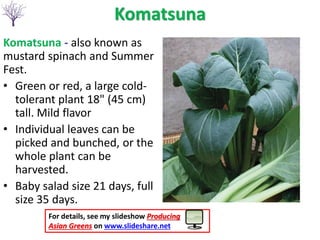
Komatsuna
Komatsuna - also known as
mustard spinach and Summer
Fest.
• Green or red, a large cold-
tolerant plant 18" (45 cm)
tall. Mild flavor
• Individual leaves can be
picked and bunched, or the
whole plant can be
harvested.
• Baby salad size 21 days, full
size 35 days.
For details, see my slideshow Producing
Asian Greens on www.slideshare.net
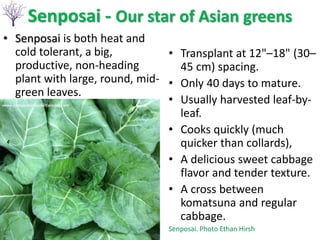
Senposai - Our star of Asian greens
• Transplant at 12"–18" (30–
45 cm) spacing.
• Only 40 days to mature.
• Usually harvested leaf-by-
leaf.
• Cooks quickly (much
quicker than collards),
• A delicious sweet cabbage
flavor and tender texture.
• A cross between
komatsuna and regular
cabbage.
Senposai. Photo Ethan Hirsh
• Senposai is both heat and
cold tolerant, a big,
productive, non-heading
plant with large, round, mid-
green leaves.
Scheduling Asian Greens
The most cold hardy Asian greens can be harvested all winter in
milder climates or kept alive until they revive in the spring to provide
early harvests. (They will bolt early in spring)
We start sowing our fall Asian greens for outdoor planting the same
dates we sow fall broccoli and cabbage. The last date for sowing is 3
months before the first fall frost date. For us, that means July 14–20.
Rowcovers on hoops will help keep them in marketable condition,
with better growth rate when it’s cold.
Wild Garden Seeds and Even’ Star Farm specialize in very cold-
tolerant varieties. Best - Green in Snow mustard (Shi-Li-Hon)
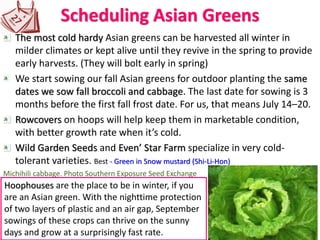
Michihili cabbage. Photo Southern Exposure Seed Exchange
Hoophouses are the place to be in winter, if you
are an Asian green. With the nighttime protection
of two layers of plastic and an air gap, September
sowings of these crops can thrive on the sunny
days and grow at a surprisingly fast rate.
Cabbage
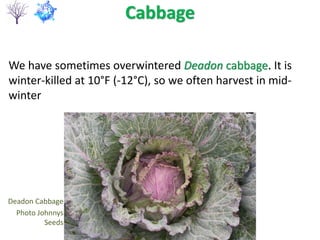
Deadon Cabbage
Photo Johnnys
Seeds
We have sometimes overwintered Deadon cabbage. It is
winter-killed at 10°F (-12°C), so we often harvest in mid-
winter
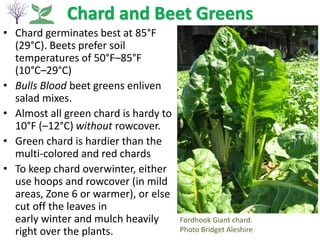
Chard and Beet Greens
• Chard germinates best at 85°F
(29°C). Beets prefer soil
temperatures of 50°F–85°F
(10°C–29°C)
• Bulls Blood beet greens enliven
salad mixes.
• Almost all green chard is hardy to
10°F (–12°C) without rowcover.
• Green chard is hardier than the
multi-colored and red chards
• To keep chard overwinter, either
use hoops and rowcover (in mild
areas, Zone 6 or warmer), or else
cut off the leaves in
early winter and mulch heavily
right over the plants.
Fordhook Giant chard.
Photo Bridget Aleshire
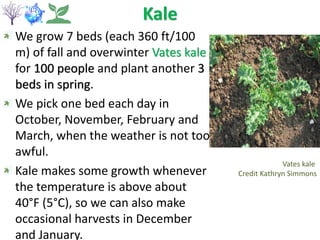
Kale
We grow 7 beds (each 360 ft/100
m) of fall and overwinter Vates kale
for 100 people and plant another 3
beds in spring.
We pick one bed each day in
October, November, February and
March, when the weather is not too
awful.
Kale makes some growth whenever
the temperature is above about
40°F (5°C), so we can also make
occasional harvests in December
and January.
Vates kale
Credit Kathryn Simmons
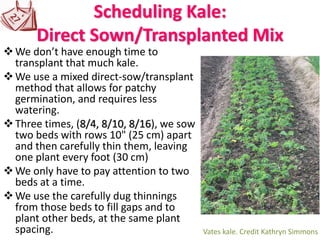
Scheduling Kale:
Direct Sown/Transplanted Mix
❖We don’t have enough time to
transplant that much kale.
❖We use a mixed direct-sow/transplant
method that allows for patchy
germination, and requires less
watering.
❖Three times, (8/4, 8/10, 8/16), we sow
two beds with rows 10" (25 cm) apart
and then carefully thin them, leaving
one plant every foot (30 cm)
❖We only have to pay attention to two
beds at a time.
❖We use the carefully dug thinnings
from those beds to fill gaps and to
plant other beds, at the same plant
spacing. Vates kale. Credit Kathryn Simmons
Spinach
Cold hardy to 0°F (–18°C) outdoors
We grow Escalade, Reflect, Acadia and
smooth leaf Renegade
Renegade makes good Nov/Dec growth
Acadia, Escalade yield well Jan–April
January sown Reflect does well, resists bolting
Spinach Photo
Pam Dawling
Spinach in Fall and Winter
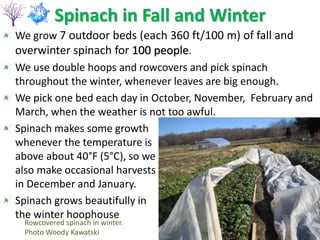
We grow 7 outdoor beds (each 360 ft/100 m) of fall and
overwinter spinach for 100 people.
We use double hoops and rowcovers and pick spinach
throughout the winter, whenever leaves are big enough.
We pick one bed each day in October, November, February and
March, when the weather is not too awful.
Spinach makes some growth
whenever the temperature is
above about 40°F (5°C), so we
also make occasional harvests
in December and January.
Spinach grows beautifully in
the winter hoophouse
Rowcovered spinach in winter.
Photo Woody Kawatski
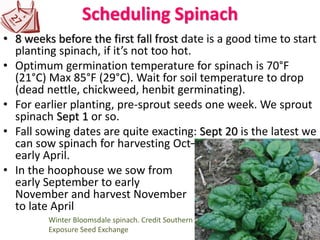
Scheduling Spinach
• 8 weeks before the first fall frost date is a good time to start
planting spinach, if it’s not too hot.
• Optimum germination temperature for spinach is 70°F
(21°C) Max 85°F (29°C). Wait for soil temperature to drop
(dead nettle, chickweed, henbit germinating).
• For earlier planting, pre-sprout seeds one week. We sprout
spinach Sept 1 or so.
• Fall sowing dates are quite exacting: Sept 20 is the latest we
can sow spinach for harvesting Oct–
early April.
• In the hoophouse we sow from
early September to early
November and harvest November
to late April
Winter Bloomsdale spinach. Credit Southern
Exposure Seed Exchange
Scheduling Spinach for Spring
• We sow 2 beds of spinach Sept
20–30 or early October, to harvest
from late February.
• It overwinters as adolescents, with
hoops and covers for the winter.
• It bolts later than the spinach we
harvest all winter; earlier than
spring-sown beds – bridging our
supply.
• On March 1 we sow snap peas in
the center of the bed, benefitting
from the same rowcover.
Over-wintered spinach inter-
planted with snap peas
Photo Kathryn Simmons
Collards
We regularly overwinter
Morris Heading collards in
zone 7a (low 0° to 10°F (-
17.8°C to -12.3°C) outdoors
without rowcover.
Most collard varieties are
hardy to 12°F (–11°C)
Some varieties (Blue Max,
Winner), are hardy to 0°F (–
18°C)
We harvest small amounts
throughout the winter, and
when spring arrives, the
plants give us big harvests
sooner than the new spring-
sown crops.
Collards Photo Pam Dawling
Lettuce
Heat-tolerant varieties also tolerate cold.
There are also specialized cold-hardy
varieties that do not tolerate heat (they
have a relatively low water content). Sow
these in fall and winter only.
Lettuce may survive an occasional dip to
10°F (–12°C) with good rowcover — but
not 8°F (–13°C), I can tell you!
Adolescent lettuce are more cold-hardy
than full-sized plants.
See my slideshow Lettuce Year Round on
www.slideshare.net for a list of varieties
and more information
Worker with lettuce.
Photo Wren Vile
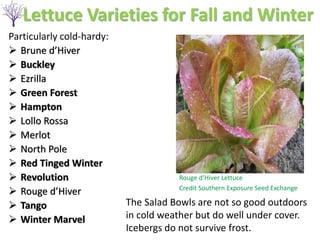
Particularly cold-hardy:
➢ Brune d’Hiver
➢ Buckley
➢ Ezrilla
➢ Green Forest
➢ Hampton
➢ Lollo Rossa
➢ Merlot
➢ North Pole
➢ Red Tinged Winter
➢ Revolution
➢ Rouge d’Hiver
➢ Tango
➢ Winter Marvel
Rouge d’Hiver Lettuce
Credit Southern Exposure Seed Exchange
The Salad Bowls are not so good outdoors
in cold weather but do well under cover.
Icebergs do not survive frost.
Lettuce Varieties for Fall and Winter
Scheduling Lettuce in Fall
The short version on when to
sow for outdoors:
• every 6-7 days in June and
July,
• every 5 days in early August,
• every 3 days in late August,
• every other day until Sept 21.
For coldframes sow in early
September.
For an unheated greenhouse,
sow in mid-September.
For planting in a hoophouse, sow
mid-late September
➢ Lettuce likes 40°F–80°F (4°C–27°C).
➢ Optimum 75°F (24°C) (germinates
in only 2 days).
➢ Max germination temperature is
85°F (29°C).
➢ Sow late afternoon or at nightfall -
better emergence than morning
sowings.
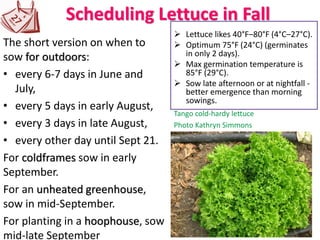
Tango cold-hardy lettuce
Photo Kathryn Simmons
Small Salad Crops
• Sylvetta, Surrey and Astro
varieties of arugula are
particularly cold-hardy.
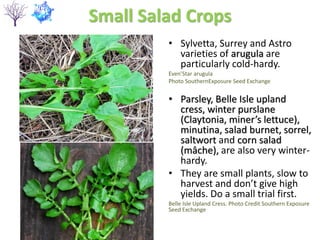
Even’Star arugula
Photo SouthernExposure Seed Exchange
• Parsley, Belle Isle upland
cress, winter purslane
(Claytonia, miner’s lettuce),
minutina, salad burnet, sorrel,
saltwort and corn salad
(mâche), are also very winter-
hardy.
• They are small plants, slow to
harvest and don’t give high
yields. Do a small trial first.
Belle Isle Upland Cress. Photo Credit Southern Exposure
Seed Exchange
Carrots
• Carrots prefer soil temperatures of 45°F–85°F (7°C–29°C),
• They germinate in 6 days at 80°F (27°C), their optimum.
• Keep the soil surface damp until they come through.
• Danvers 126 is our standard.
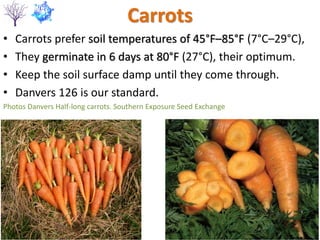
Photos Danvers Half-long carrots. Southern Exposure Seed Exchange
Carrots
• We flame the beds the day before the
carrots are due to emerge (using “indicator
beets”, which emerge the day before the
carrots).
• We hoe between the rows as soon as we
can see to do so.
• We weed and thin to 1” once the carrots
are 1” tall.
• Once the carrots are salad size, we weed
again and thin to 3”
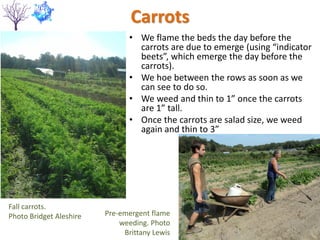
Pre-emergent flame
weeding. Photo
Brittany Lewis
Fall carrots.
Photo Bridget Aleshire
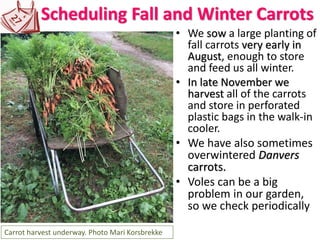
Scheduling Fall and Winter Carrots
• We sow a large planting of
fall carrots very early in
August, enough to store
and feed us all winter.
• In late November we
harvest all of the carrots
and store in perforated
plastic bags in the walk-in
cooler.
• We have also sometimes
overwintered Danvers
carrots.
• Voles can be a big
problem in our garden,
so we check periodically
Carrot harvest underway. Photo Mari Korsbrekke
Beets
• Beets prefer soil temperatures of 50°F–
85°F (10°C–29°C). We like Cylindra.
• Maintain a soil temperature below 85°F
(29°C) for a few days. Shade the soil for
several days before sowing
• We usually sow pre-soaked seed by hand.
• Or use an EarthWay with dry seed –
chard plate 2 passes.
• Sow 1/2″-1″ deep, tamp the soil, and
keep the surface damp with daily
watering until they emerge.
• Only 3.5 days to emerge at 86°F (30°C),
but 14.6 days at 50°F (10°C).
• To flame-weed, use radishes as an
indicator – they germinate 1-2 days
sooner
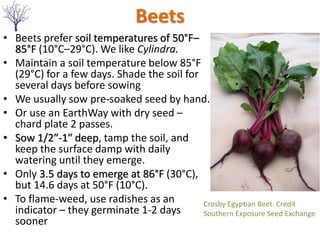
Crosby Egyptian Beet. Credit
Southern Exposure Seed Exchange
Scheduling Fall Beets
• For fall fresh eating and winter storage crops, we
sow beets on Aug 1 or so, dry or soaked for 1-2
hours in a little water. (Don’t soak too long, or in
a lot of water – beet seeds are easy to drown.)
• We have Aug 20 down as the last date - I think
we have done them later.
• Harvest Sept 20 – Nov 15
• Store in a walk-in cooler in
perforated plastic bags.
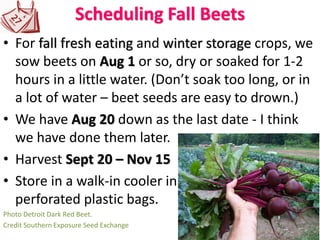
Photo Detroit Dark Red Beet.
Credit Southern Exposure Seed Exchange
Celeriac
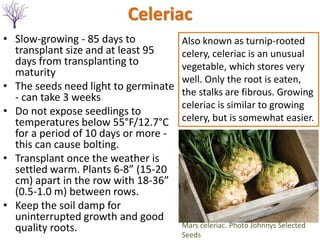
Mars celeriac. Photo Johnnys Selected
Seeds
Also known as turnip-rooted
celery, celeriac is an unusual
vegetable, which stores very
well. Only the root is eaten,
the stalks are fibrous. Growing
celeriac is similar to growing
celery, but is somewhat easier.
• Slow-growing - 85 days to
transplant size and at least 95
days from transplanting to
maturity
• The seeds need light to germinate
- can take 3 weeks
• Do not expose seedlings to
temperatures below 55°F/12.7°C
for a period of 10 days or more -
this can cause bolting.
• Transplant once the weather is
settled warm. Plants 6-8” (15-20
cm) apart in the row with 18-36”
(0.5-1.0 m) between rows.
• Keep the soil damp for
uninterrupted growth and good
quality roots.
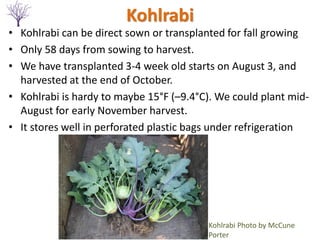
Kohlrabi
• Kohlrabi can be direct sown or transplanted for fall growing
• Only 58 days from sowing to harvest.
• We have transplanted 3-4 week old starts on August 3, and
harvested at the end of October.
• Kohlrabi is hardy to maybe 15°F (–9.4°C). We could plant mid-
August for early November harvest.
• It stores well in perforated plastic bags under refrigeration
Kohlrabi Photo by McCune
Porter
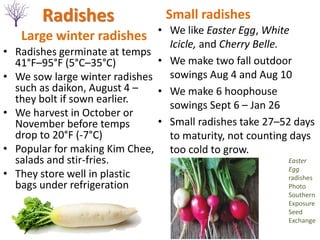
Radishes
Large winter radishes
• Radishes germinate at temps
41°F–95°F (5°C–35°C)
• We sow large winter radishes
such as daikon, August 4 –
they bolt if sown earlier.
• We harvest in October or
November before temps
drop to 20°F (-7°C)
• Popular for making Kim Chee,
salads and stir-fries.
• They store well in plastic
bags under refrigeration
Small radishes
• We like Easter Egg, White
Icicle, and Cherry Belle.
• We make two fall outdoor
sowings Aug 4 and Aug 10
• We make 6 hoophouse
sowings Sept 6 – Jan 26
• Small radishes take 27–52 days
to maturity, not counting days
too cold to grow.
Easter
Egg
radishes
Photo
Southern
Exposure
Seed
Exchange
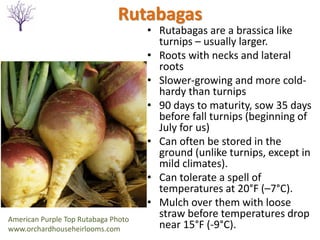
Rutabagas
• Rutabagas are a brassica like
turnips – usually larger.
• Roots with necks and lateral
roots
• Slower-growing and more cold-
hardy than turnips
• 90 days to maturity, sow 35 days
before fall turnips (beginning of
July for us)
• Can often be stored in the
ground (unlike turnips, except in
mild climates).
• Can tolerate a spell of
temperatures at 20°F (–7°C).
• Mulch over them with loose
straw before temperatures drop
near 15°F (-9°C).
American Purple Top Rutabaga Photo
www.orchardhouseheirlooms.com
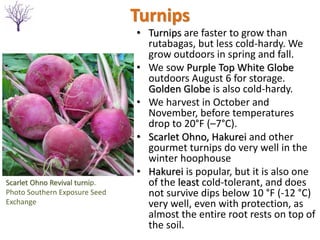
Turnips
• Turnips are faster to grow than
rutabagas, but less cold-hardy. We
grow outdoors in spring and fall.
• We sow Purple Top White Globe
outdoors August 6 for storage.
Golden Globe is also cold-hardy.
• We harvest in October and
November, before temperatures
drop to 20°F (–7°C).
• Scarlet Ohno, Hakurei and other
gourmet turnips do very well in the
winter hoophouse
• Hakurei is popular, but it is also one
of the least cold-tolerant, and does
not survive dips below 10 °F (-12 °C)
very well, even with protection, as
almost the entire root rests on top of
the soil.
Scarlet Ohno Revival turnip.
Photo Southern Exposure Seed
Exchange
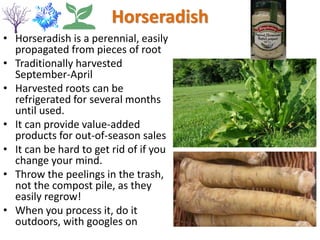
Horseradish
• Horseradish is a perennial, easily
propagated from pieces of root
• Traditionally harvested
September-April
• Harvested roots can be
refrigerated for several months
until used.
• It can provide value-added
products for out-of-season sales
• It can be hard to get rid of if you
change your mind.
• Throw the peelings in the trash,
not the compost pile, as they
easily regrow!
• When you process it, do it
outdoors, with googles on
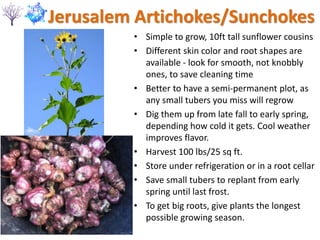
Jerusalem Artichokes/Sunchokes
• Simple to grow, 10ft tall sunflower cousins
• Different skin color and root shapes are
available - look for smooth, not knobbly
ones, to save cleaning time
• Better to have a semi-permanent plot, as
any small tubers you miss will regrow
• Dig them up from late fall to early spring,
depending how cold it gets. Cool weather
improves flavor.
• Harvest 100 lbs/25 sq ft.
• Store under refrigeration or in a root cellar
• Save small tubers to replant from early
spring until last frost.
• To get big roots, give plants the longest
possible growing season.
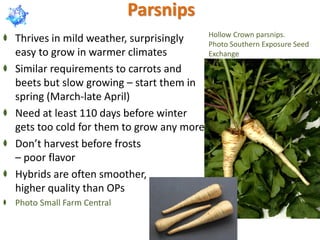
Parsnips
Thrives in mild weather, surprisingly
easy to grow in warmer climates
Similar requirements to carrots and
beets but slow growing – start them in
spring (March-late April)
Need at least 110 days before winter
gets too cold for them to grow any more
Don’t harvest before frosts
– poor flavor
Hybrids are often smoother,
higher quality than OPs
Photo Small Farm Central
Hollow Crown parsnips.
Photo Southern Exposure Seed
Exchange
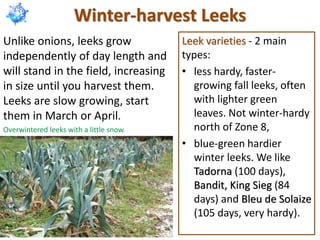
Winter-harvest Leeks
Unlike onions, leeks grow
independently of day length and
will stand in the field, increasing
in size until you harvest them.
Leeks are slow growing, start
them in March or April.
Overwintered leeks with a little snow.
Leek varieties - 2 main
types:
• less hardy, faster-
growing fall leeks, often
with lighter green
leaves. Not winter-hardy
north of Zone 8,
• blue-green hardier
winter leeks. We like
Tadorna (100 days),
Bandit, King Sieg (84
days) and Bleu de Solaize
(105 days, very hardy).
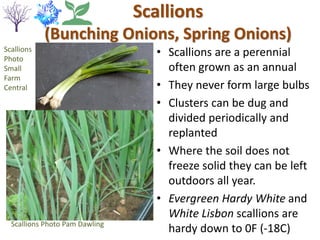
Scallions
(Bunching Onions, Spring Onions)
• Scallions are a perennial
often grown as an annual
• They never form large bulbs
• Clusters can be dug and
divided periodically and
replanted
• Where the soil does not
freeze solid they can be left
outdoors all year.
• Evergreen Hardy White and
White Lisbon scallions are
hardy down to 0F (-18C)
Scallions Photo Pam Dawling
Scallions
Photo
Small
Farm
Central
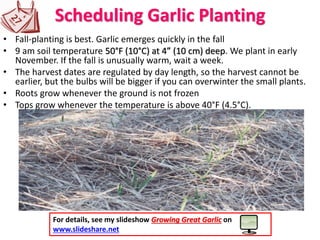
Scheduling Garlic Planting
• Fall-planting is best. Garlic emerges quickly in the fall
• 9 am soil temperature 50°F (10°C) at 4” (10 cm) deep. We plant in early
November. If the fall is unusually warm, wait a week.
• The harvest dates are regulated by day length, so the harvest cannot be
earlier, but the bulbs will be bigger if you can overwinter the small plants.
• Roots grow whenever the ground is not frozen
• Tops grow whenever the temperature is above 40°F (4.5°C).
For details, see my slideshow Growing Great Garlic on
www.slideshare.net
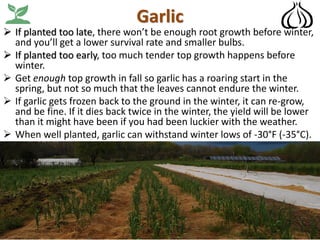
Garlic
➢ If planted too late, there won’t be enough root growth before winter,
and you’ll get a lower survival rate and smaller bulbs.
➢ If planted too early, too much tender top growth happens before
winter.
➢ Get enough top growth in fall so garlic has a roaring start in the
spring, but not so much that the leaves cannot endure the winter.
➢ If garlic gets frozen back to the ground in the winter, it can re-grow,
and be fine. If it dies back twice in the winter, the yield will be lower
than it might have been if you had been luckier with the weather.
➢ When well planted, garlic can withstand winter lows of -30°F (-35°C).
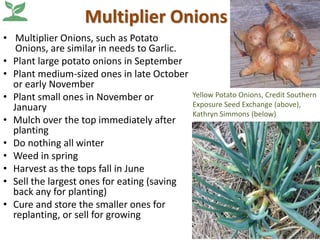
Multiplier Onions
• Multiplier Onions, such as Potato
Onions, are similar in needs to Garlic.
• Plant large potato onions in September
• Plant medium-sized ones in late October
or early November
• Plant small ones in November or
January
• Mulch over the top immediately after
planting
• Do nothing all winter
• Weed in spring
• Harvest as the tops fall in June
• Sell the largest ones for eating (saving
back any for planting)
• Cure and store the smaller ones for
replanting, or sell for growing
Yellow Potato Onions, Credit Southern
Exposure Seed Exchange (above),
Kathryn Simmons (below)
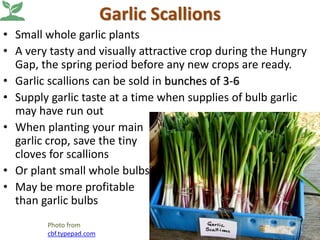
Garlic Scallions
• Small whole garlic plants
• A very tasty and visually attractive crop during the Hungry
Gap, the spring period before any new crops are ready.
• Garlic scallions can be sold in bunches of 3-6
• Supply garlic taste at a time when supplies of bulb garlic
may have run out
• When planting your main
garlic crop, save the tiny
cloves for scallions
• Or plant small whole bulbs
• May be more profitable
than garlic bulbs
Photo from
cbf.typepad.com
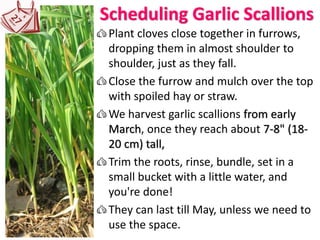
Scheduling Garlic Scallions
Plant cloves close together in furrows,
dropping them in almost shoulder to
shoulder, just as they fall.
Close the furrow and mulch over the top
with spoiled hay or straw.
We harvest garlic scallions from early
March, once they reach about 7-8" (18-
20 cm) tall,
Trim the roots, rinse, bundle, set in a
small bucket with a little water, and
you're done!
They can last till May, unless we need to
use the space.
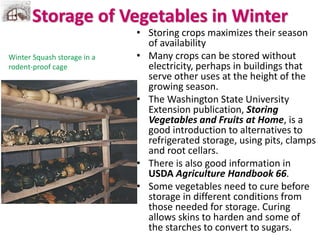
Storage of Vegetables in Winter
• Storing crops maximizes their season
of availability
• Many crops can be stored without
electricity, perhaps in buildings that
serve other uses at the height of the
growing season.
• The Washington State University
Extension publication, Storing
Vegetables and Fruits at Home, is a
good introduction to alternatives to
refrigerated storage, using pits, clamps
and root cellars.
• There is also good information in
USDA Agriculture Handbook 66.
• Some vegetables need to cure before
storage in different conditions from
those needed for storage. Curing
allows skins to harden and some of
the starches to convert to sugars.
Winter Squash storage in a
rodent-proof cage
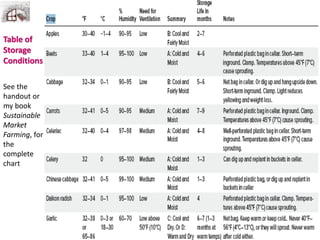
Four Sets of Storage Conditions
In my chart on the handout, the Summary column indicates the
general conditions needed for each crop, and allocates each crop to
one of 4 groups:
A= Cold and Moist : 32°F–40°F (0°C–5°C), 80%–95% humidity —
refrigerator or winter root cellar conditions. Most roots, greens, leeks
B= Cool and Fairly Moist: 40°F–50°F (5°C–10°C), 85%–90% humidity —
root cellar. Potatoes
C= Cool and Dry: 32°F–50°F (0°C–10°C), 60%–70% humidity — cooler
basements and barns. Garlic and onions
D= Warm and Dry to Fairly Moist: 50°F–60°F (10°C–15°C), 60%–70%
humidity — basements. Sweet potatoes and winter squash.
By providing storage spaces with these 4 types of conditions, 25 crops
can be stored.
Table of
Storage
Conditions
See the
handout or
my book
Sustainable
Market
Farming, for
the
complete
chart
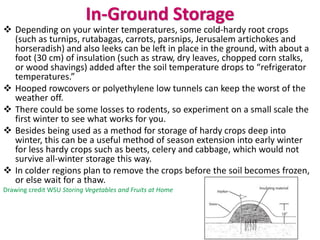
In-Ground Storage
❖ Depending on your winter temperatures, some cold-hardy root crops
(such as turnips, rutabagas, carrots, parsnips, Jerusalem artichokes and
horseradish) and also leeks can be left in place in the ground, with about a
foot (30 cm) of insulation (such as straw, dry leaves, chopped corn stalks,
or wood shavings) added after the soil temperature drops to “refrigerator
temperatures.”
❖ Hooped rowcovers or polyethylene low tunnels can keep the worst of the
weather off.
❖ There could be some losses to rodents, so experiment on a small scale the
first winter to see what works for you.
❖ Besides being used as a method for storage of hardy crops deep into
winter, this can be a useful method of season extension into early winter
for less hardy crops such as beets, celery and cabbage, which would not
survive all-winter storage this way.
❖ In colder regions plan to remove the crops before the soil becomes frozen,
or else wait for a thaw.
Drawing credit WSU Storing Vegetables and Fruits at Home
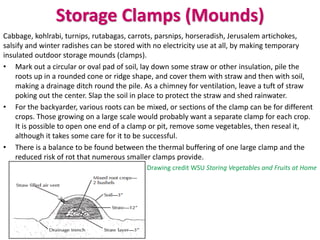
Storage Clamps (Mounds)
Cabbage, kohlrabi, turnips, rutabagas, carrots, parsnips, horseradish, Jerusalem artichokes,
salsify and winter radishes can be stored with no electricity use at all, by making temporary
insulated outdoor storage mounds (clamps).
• Mark out a circular or oval pad of soil, lay down some straw or other insulation, pile the
roots up in a rounded cone or ridge shape, and cover them with straw and then with soil,
making a drainage ditch round the pile. As a chimney for ventilation, leave a tuft of straw
poking out the center. Slap the soil in place to protect the straw and shed rainwater.
• For the backyarder, various roots can be mixed, or sections of the clamp can be for different
crops. Those growing on a large scale would probably want a separate clamp for each crop.
It is possible to open one end of a clamp or pit, remove some vegetables, then reseal it,
although it takes some care for it to be successful.
• There is a balance to be found between the thermal buffering of one large clamp and the
reduced risk of rot that numerous smaller clamps provide.
Drawing credit WSU Storing Vegetables and Fruits at Home
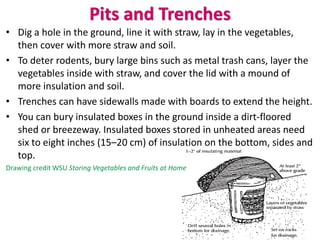
Pits and Trenches
• Dig a hole in the ground, line it with straw, lay in the vegetables,
then cover with more straw and soil.
• To deter rodents, bury large bins such as metal trash cans, layer the
vegetables inside with straw, and cover the lid with a mound of
more insulation and soil.
• Trenches can have sidewalls made with boards to extend the height.
• You can bury insulated boxes in the ground inside a dirt-floored
shed or breezeway. Insulated boxes stored in unheated areas need
six to eight inches (15–20 cm) of insulation on the bottom, sides and
top.
Drawing credit WSU Storing Vegetables and Fruits at Home
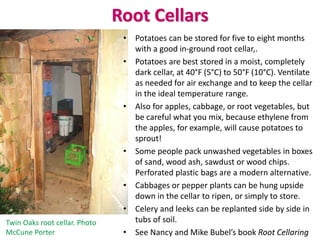
Root Cellars
• Potatoes can be stored for five to eight months
with a good in-ground root cellar,.
• Potatoes are best stored in a moist, completely
dark cellar, at 40°F (5°C) to 50°F (10°C). Ventilate
as needed for air exchange and to keep the cellar
in the ideal temperature range.
• Also for apples, cabbage, or root vegetables, but
be careful what you mix, because ethylene from
the apples, for example, will cause potatoes to
sprout!
• Some people pack unwashed vegetables in boxes
of sand, wood ash, sawdust or wood chips.
Perforated plastic bags are a modern alternative.
• Cabbages or pepper plants can be hung upside
down in the cellar to ripen, or simply to store.
• Celery and leeks can be replanted side by side in
tubs of soil.
• See Nancy and Mike Bubel’s book Root Cellaring
Twin Oaks root cellar. Photo
McCune Porter
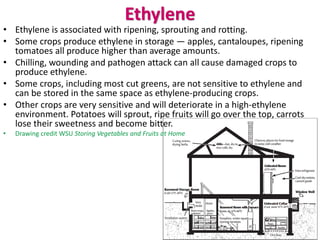
Ethylene
• Ethylene is associated with ripening, sprouting and rotting.
• Some crops produce ethylene in storage — apples, cantaloupes, ripening
tomatoes all produce higher than average amounts.
• Chilling, wounding and pathogen attack can all cause damaged crops to
produce ethylene.
• Some crops, including most cut greens, are not sensitive to ethylene and
can be stored in the same space as ethylene-producing crops.
• Other crops are very sensitive and will deteriorate in a high-ethylene
environment. Potatoes will sprout, ripe fruits will go over the top, carrots
lose their sweetness and become bitter.
• Drawing credit WSU Storing Vegetables and Fruits at Home
My Books
Resources – General (May 2021)
❑ATTRA attra.ncat.org/ Season Extension Techniques for Market Farmers, etc.
❑SARE www.sare.org/ A searchable database of research findings. See Season
Extension Topic Room
❑articles.extension.org/organic_production and eorganic.info Publications,
webinars, videos, trainings and support. Reliable information.
❑Growing Small Farms: growingsmallfarms.ces.ncsu.edu/ Farmer Resources.
❑ Jean-Paul Courtens, Roxbury Farm https://www.roxburyfarm.com/roxbury-
agriculture-institute-at-philia-farm Whole farm Approach; Biodynamic
Practices; Harvest Manual; Crop Manual; More Info for Farmers: Soil
Fertility Practices; 100 Member CSA plans: CSA Share List, Greenhouse Plan,
Field Plan.
❑ Johnnyseeds.com. Growers’ Library, Winter Growing Guide
https://www.johnnyseeds.com/growers-library/vegetables/winter-growing-
guide-high-tunnel-scheduling.html. The first two of 9 sections in the guide.
❑ https://weatherspark.com/ Weather records for your area. Fun!
❑ Soil temperatures www.greencastonline.com/tools/soil-temperature
Resources - Season Extension
❑ Extending the Season: Six Strategies for Improving Cash Flow Year-Round on
the Market Farm a free e-book for online subscribers to Growing for Market
magazine
❑ Janet Bachmann, Season Extension Techniques for Market Gardeners,
ATTRA, 2005. attra.ncat.org/attra-pub/summaries/summary.php?pub=366
❑ Fall and Winter Gardening Quick Reference, Southern Exposure Seed
Exchange, www.southernexposure.com/growing-guides/fall-winter-quick-
guide.pdf
❑www.motherofahubbard.com Winter Vegetable Gardening
❑ Solar Gardening: Growing Vegetables Year-Round the American Intensive
Way, Leandre Poisson, Gretchen Poisson and Robin Wimbiscus, 1994,
Chelsea Green – good book on making small structures.
❑ Greenhouse and Hoophouse Grower's Handbook – Organic Vegetable
Production Using Protected Culture, Andrew Mefferd, New Society
❑ Washington State University Extension, Storing Vegetables and Fruits at
Home pubs.extension.wsu.edu/storing-vegetables-and-fruits-at-home
❑ USDA Agriculture Handbook 66 (1986) hard to find old version.
Resources - Hoophouses
❑ University of Minnesota Deep Winter Greenhouse extension.umn.edu/growing-
systems/deep-winter-greenhouses
❑ U of MN High Tunnel Production Manual www.extension.umn.edu/garden/fruit-
vegetable/#high-tunnel
❑ U of MN Cold-Climate Greenhouse Resource
cura.umn.edu/publications/catalog/cap-186
❑ The Northlands Winter Greenhouse Manual, Carol Ford & Chuck Waibe
mosesorganic.net/product/northlands-winter-greenhouse-manual-the/
❑ HighTunnels.org: hightunnels.org/category/for-growers/growing-in-high-tunnels/
or hightunnels.org/for-growers/
❑ Penn State High Tunnel Production Manual, William Lamont, $25
extension.psu.edu/high-tunnel-manual
❑ High Tunnels: Using Low Cost Technology to Increase Yields, Improve Quality, and
Extend the Growing Season by Ted Blomgren, Tracy Frisch and Steve Moore.
University of Vermont Center for Sustainable Agriculture.
https://www.sare.org/resources/high-tunnels/
❑ High Tunnel Winter Cropping Systems, Lewis Jett, SARE. Slideshow and audio.
https://northeast.sare.org/resources/high-tunnel-winter-cropping-systems/
Resources – Asian Greens
❑ Grow Your Own Chinese Vegetables, Geri Harrington, 1984, Garden Way
Publishing. Includes the names for these crops in different cultures.
❑ Growing Unusual Vegetables, Simon Hickmott, 2006, Eco-Logic books, UK.
❑ Oriental Vegetables: The Complete Guide for the Garden and Kitchen, Joy
Larkham, revised edition 2008, Kodansha, USA
❑ Asian Vegetables, Sally Cunningham, Chelsea Green
❑ The Chinese Kitchen Garden, Wendy Kiang-Spray, 2017, Workman Publishing
❑ Kitazawa Seeds kitazawaseed.com/ & Evergreen Seeds have the most
choices.
❑ Evergreen’s helpful clickable list. evergreenseeds.com/asveglis.html
❑ Fedco Seeds fedcoseeds.com/ and Johnny’s johnnyseeds.com/ have a good
range.
❑ Wild Garden Seed has many interesting home-bred varieties. Search under
Mustard. wildgardenseed.com
❑ ATTRA Cole Crops and Other Brassicas: Organic Production
attra.ncat.org/attra-pub/summaries/summary.php?pub=27
Resources - Books
❑ The Market Gardener, Jean-Martin Fortier, New Society Publishers
❑ The Complete Know and Grow Vegetables, J K A Bleasdale, P J Salter et al.
❑ Knott’s Handbook for Vegetable Growers, Maynard and Hochmuth
extension.missouri.edu/sare/documents/KnottsHandbook2012.pdf
❑ The New Seed Starter’s Handbook, Nancy Bubel, Rodale Books
❑ The Organic Farmer’s Business Handbook, Richard Wiswall, Chelsea Green
❑ Sustainable Vegetable Production from Start-up to Market, Vern Grubinger,
host31.spidergraphics.com/nra/doc/fair%20use%20web%20pdfs/nraes-
104_web.pdf NRAES
❑ The New Organic Grower and The Winter Harvest Manual, Eliot Coleman,
❑ Crop Planning for Organic Vegetable Growers, Daniel Brisebois and Frédéric
Thériault (Canadian Organic Growers www.cog.ca)
❑ The Chinese Greenhouse: Design and Build a Low-Cost, Passive Solar
Greenhouse, Dan Chiras, New Society Publishers. Solar-heated, earth-
sheltered, well-insulated, plastic-glazed structures, making it possible to
grow warm weather crops in winter.
❑ Growing Great Garlic, Ron Engeland, 1991, Filaree
Resources – My Slideshows
www.slideshare.net/ Search for Pam Dawling. You’ll find:
❑ Cold-hardy Winter Vegetables
❑ Cover Crops for Vegetable Growers
❑ Crop Planning for Sustainable
Vegetable Production
❑ Crop Rotations for Vegetables and
Cover Crops
❑ Diversify your Vegetable Crops
❑ Fall and Winter Hoophouse
❑ Fall Vegetable Production
❑ Feeding the Soil
❑ Growing Great Garlic
❑ Growing Sweet Potatoes from Start to
Finish
❑ Hoophouse Production of Cool Season
Crops
❑ Lettuce Year Round
❑ Many Crops, Many Plantings, to
Maximize High Tunnel Efficiency
❑ Producing Asian Greens
❑ Production of Late Fall, Winter and
Early Spring Vegetable Crops
❑ Season Extension
❑ Sequential Planting of Cool Season
Crops in a High Tunnel
❑ Spring and Summer Hoophouses
❑ Storage Vegetables
❑ Succession Planting for Continuous
Vegetable Harvests
❑ Sustainable Farming Practices.
❑ The Seed Garden
❑ Year Round Vegetable Production
❑ Year Round Hoophouse Vegetables
Cold-Hardy Winter Vegetables
©Pam Dawling 2021
Twin Oaks Community, Virginia
Author of
Sustainable Market Farming,
2nd Edition and
The Year-Round Hoophouse
SustainableMarketFarming.com

Cold-Hardy Winter Vegetables 2021 60min.pdf

  • 1.
    Cold-Hardy Winter Vegetables ©PamDawling 2021 Twin Oaks Community, Virginia Author of Sustainable Market Farming, 2nd Edition and The Year-Round Hoophouse SustainableMarketFarming.com
  • 2.
    I live andfarm at Twin Oaks Community, in central Virginia. We are located on Monacan land. We’re in US Winter hardiness zone 7a, with an average last frost April 30 and average first frost October 14. Our goal is to feed our intentional community of 100 people with a wide variety of organic produce year round. www.twinoaks.org
  • 3.
    What’s in thisPresentation • Why grow winter vegetables? • Cold weather crop protection • Tables of cold-hardiness of various vegetable crops • Three ranges for cold-hardy crops • Details of suitable winter crops • Crop storage methods • Resources
  • 4.
    Why Grow WinterVegetables? People eat all year long! The locavore movement is growing. Winter vegetables are more in demand Keep your customers, Keep your crew, Keep in shape! It’s easier than the summer - fewer crops to care for Weeds grow slower.
  • 5.
    Pondering Season Extension ❖Extendthe season without overworking yourself, your crew, or your soil. ❖It’s easier to get extra harvests for a month or two in fall from mature plants, than to get harvests a week earlier in the spring. ❖Compare the costs and benefits of various types of cold weather crop protection. ❖Before investing a lot of money, talk with other growers. Tired but unbroken. Photo Bridget Aleshire
  • 6.
    Economics of SeasonExtension • Season extension requires putting in more time and/or money than main season growing, to gain extra production. • Find the balance point at which time, money and energy put in are still definitely worthwhile. • Beyond that point, the diminishing returns aren’t worth the extra energy put in. For details, see my slideshow Season Extension on SlideShare.net
  • 7.
    Cold Weather CropProtection Four basic levels of protection: 1. Rowcover 2. Quick Hoops and Caterpillar Tunnels 3. Coldframes and unheated greenhouses 4. Hoophouses (High Tunnels) Photo Kathryn Simmons
  • 8.
    1. Rowcover • Wonderfulrowcover : lightweight, easy to use, easy to store. • Keep crops alive and productive beyond their normal winter-kill temperatures. Keep early spring crops alive and growing faster. • Better quality produce – reduced weather and pest damage • The microclimate under hooped rowcovers is very pleasant in chilly, windy weather. • Hold down edges with bags of rocks or sand, jugs of water, or metal or wooden stakes lying on the edges. Photo Wren Vile
  • 9.
    Which Rowcover ➢ Toprotect against cold, you need thick rowcover ➢ Dupont Xavan 5131 (aka Typar). 1.25 oz/sq yd spunbonded polypropylene; 75% light transmission; about 6 F (3.3 C) degrees of frost protection; can last for 6 years or more. ➢ Thinner types are to protect from insects. 2 layers of thinner rowcover may work better than one thick layer in protecting against the cold. Thinner types are more fragile. We think polypropylene rowcover lasts longer and is tougher than polyester (Reemay) Rowcovered beds and hoophouse with a storm brewing. Photo Wren Vile
  • 10.
    Avoiding Pitfalls ofRowcover ➢ Weeds grow secretly, out of sight. ➢ Rowcover does reduce light levels. ➢ Ventilate covered crops in mild weather, so they don’t lose their cold tolerance. ➢ Hoops keep rowcover from sticking to frozen leaves and reduce abrasion. ➢ In winter we use double wire hoops ➢ Inner hoops are 9- or 10-gauge wire. We make eyes in the wire, and set hoops 6 ft (2 m) apart ➢ Outer hoops (22-gauge wire) hook in the eyes of the inner hoops and trap the rowcover so it doesn’t blow away. ➢ The edges are held down by 5ft (1.5 m) sticks ➢ There are also spring steel hoops, for setting by machine or by hand. These are easy to store as they return to a relaxed bow shape when removed from the soil and don’t get tangled. They seem to come in just one length, 64" (1.6 m)
  • 11.
    2. Quickhoops, CaterpillarTunnels • Quickhoops cover more than one bed, and can be covered with rowcover topped by greenhouse plastic for the winter. – Best for areas with reliably cold winters, not back-and-forth winters that include spells too mild to keep crops under polyethylene. – Best for storing crops till spring, rather than harvesting during winter • Caterpillar tunnels are usually tall enough to walk in – The plastic or rowcover is held down by ropes at each hoop. – Sometimes narrower than Quickhoops. – 2 beds + 1 path, or 4 beds + 3 paths – Can be used for summer or winter. – No sandbags needed Photo Growing for Market Photo Johnnys Seeds
  • 12.
    3. Coldframes andUnheated Greenhouses • Coldframes are traditionally made from blocks, boards or straw bales, with discarded windows over the top. • They are very useful on a small scale, but but labor-intensive. • For large-scale production, the construction costs of a hoophouse are lower than for the same area of coldframes. • Single-layer hoophouses are sometimes called coldframes. • Unheated greenhouses with a masonry north wall will also grow lettuces all winter (in central Virginia at least). • Coldframe and greenhouse. Photo Kathryn Simmons
  • 13.
    4. Hoophouses (HighTunnels) For more details, see my slideshows • Hoophouse Production of Cool Season Crops • Sequential Planting of Cool Season Crops in a High Tunnel • Hoophouse in Spring and Summer • Hoophouse in Fall and Winter • Many Crops, Many Plantings, to Maximize High Tunnel Production Efficiency on SlideShare.net ➢ Hoophouses are incredibly productive, crops grow faster ➢ Crop quality, especially leafy greens, is superb. ➢ Crops grow in the ground, often with drip irrigation ➢ Working in winter inside a hoophouse is much more pleasant than dealing with frozen rowcover and hoops outdoors. ➢ One or two layers of plastic ➢ Double-layer houses use a small electric blower to inflate the gap. Solawrap is an option if you don’t have electricity.
  • 14.
    Winter Hoophouses ➢ Night-timeprotection of 2 layers of plastic and an air gap: 8F (4.5C) warmer than outside! ➢ Single layer hoophouses are not much warmer at night than outdoors. ➢ Plants tolerate 14F (8C) colder than they do outside, without adding extra rowcover ➢ In our double layer hoophouse in zone 7, without inner rowcover, salad greens survive when it’s 14°F (-10°C) outside. ➢ With thick rowcover for an inner tunnel, they can survive one night with -12°F (-24°C) outside For details, see my slideshow Hoophouse in Fall and Winter on SlideShare.net Crop quality, especially leafy greens, is superb. Photo Wren Vile ➢ .
  • 15.
    Winter-Kill Temperatures – FrostyWeather: 35° to 25°F (2°C to -4°C) Some starting numbers of killing temperatures outdoors (without row- cover unless otherwise stated). Your experience may vary! Snow cover helps keep plants alive. Wind, sudden or repeated cold spells kill them. In a double-layer hoophouse (8F/5C warmer than outside) plants can survive 14F/8C colder than outside, without extra rowcover; at least 21F/12C colder than outside with thick rowcover (1.25 ozTypar/Xavan). • 35°F (2°C): Basil. • 32°F (0°C): Cucumbers, eggplant, melons, okra, peppers, tomatoes. • 27°F (–3°C): Many cabbage, Sugarloaf chicory. • 25°F (–4°C): Some cabbage, chervil, chicory roots for chicons and hearts, Chinese Napa cabbage, dill, some fava beans, annual fennel, some Asian greens (Maruba Santoh, mizuna, most pak choy, Tokyo Bekana), some onion scallions (many varieties are hardier), radicchio, rhubarb stems and leaves.
  • 16.
    Colder from 22°F downto 15°F • 22°F (–6°C): Some arugula (some varieties are hardier), Bright Lights chard, endive (Escarole may be a little more frost-hardy than Frisée), large leaves of lettuce (protected hearts and small plants will survive colder temperatures). • 20°F (–7°C): Some beets, broccoli heads (maybe OK to 15°F/-9.5°C), some Brussels sprouts, some cabbages (the insides may still be good even if the outer leaves are damaged), celeriac, celtuce (stem lettuce), some collards (Georgia Cabbage Collards, variegated collards),some head lettuce, some mustards/Asian greens, flat leaf parsley, radicchio, radishes, most turnips. • 15°F (–9.5°C): Some beets, beet greens, some broccoli, some cabbage, rowcovered celery, red chard, cilantro, some fava beans, Russian kales, kohlrabi, some lettuce, especially small and plants with 4-10 leaves, curly parsley, rutabagas, broad leaf sorrel, most covered turnips, winter cress.
  • 17.
    Colder Still down to10°F • 12°F (–11°C): Some beets, maybe some broccoli, some Brussels sprouts, some cabbage, carrots, most collards, some fava beans, garlic tops if fairly large, Koji greens, most fall varieties of leeks, large tops of potato onions, covered rutabagas, Senposai leaves - the core of the plant may survive 10°F (–12°C), some turnips (Purple Top, Noir d’Hiver). • 10°F (–12°C): Covered beets, Purple Sprouting broccoli for spring harvest, a few cabbages, green chard (hardier than other colors), some collards (Morris Heading), Belle Isle upland cress, some endive, young bronze fennel, Blue Ridge kale, probably Komatsuna, some leeks, some covered lettuce, covered Asian winter radish (Daikon, China Rose, Shunkyo Semi-Long survive 10°F/-12°C), big leaves of savoyed spinach (more hardy than flat leafed varieties), tatsoi, Yukina Savoy.
  • 18.
    Coldest down to 0°F •5°F (–15°C): Garlic tops even if small, some kale, some leeks, some bulb onions, potato onions and other multiplier onions, smaller leaves of savoyed spinach and broad leaf sorrel, many Even’ Star greens varieties are OK down to 6°F (-14°C), some unprotected small lettuces. • 0°F (–18°C): Chives, some collards (Blue Max, McCormack’s Green Glaze, Winner), corn salad (mâche), garlic, horse- radish, Jerusalem artichokes, Even’ Star Ice-Bred Smooth Leaf kale, a few leeks (Alaska, Durabel), some bulb onions, some onion scallions (Evergreen Hardy White, White Lisbon), parsnips, salad burnet, salsify, some spinach (Bloomsdale Savoy, Olympia).
  • 19.
    Unthinkably Cold • -5°F(-19°C): Overwintering cauliflower. Vates kale survives although some leaves may be too damaged to use. Lacinato Rainbow Mix kale may survive this temperature. • -10°F (-23°C): Reputedly, Walla Walla onions sown in late summer • -30°F to -40°F (-34°C to -40°C): Narrow leaf sorrel, Claytonia and some cabbage (January King?) are said to be hardy in zone 3 • Use this table to decide what to grow and when to harvest it.
  • 20.
    1. Crops tokeep alive in the ground into winter to 22°-15°F (-6°C to -9°C), then use soon or store 2. Hardy crops to store in the ground and harvest during the winter. In zone 7, they need to be hardy to 0°-10°F (-17.8°C to -12.3°C) 3. Overwinter crops for spring harvests before the main season. In zone 7, they need to be hardy to 0°-10°F (-17.8°C to -12.3°C) See my slideshow Hoophouse Cool Season Crops on www.slideshare.net for more on these crops Three Ranges of Cold-Hardy Crops See my slideshow Storage Vegetables on www.slideshare.net for more on these crops See my slide show Fall Vegetable Production on www.slideshare.net
  • 21.
    For details, seemy slide shows Fall Vegetable Production and Storage Vegetables for Off-Season Sales on SlideShare.net 1. Crops to Keep Alive in the Ground into Winter to 22°-15°F (-6°C to -9°C), then Use Soon or Store Use Soon Asian greens Chard Lettuce Radishes Some cabbages store, some need to be used soon Store Beets Carrots Celeriac Kohlrabi Winter radish Rutabagas Turnips Detroit Dark Red beet. Photo Southern Exposure Seed Exchange
  • 22.
    2. Hardy Cropsto Store in the Ground, harvest during the winter - for zone 7, hardy to 0° to 10° F (-17.8°C to -12.3° C) • Collards • Horseradish • Jerusalem artichokes • Kale • Leeks • Parsnips • Scallions • Spinach Fresh harvest: white, pink and brown Jerusalem artichokes. Photo: net_efekt.
  • 23.
    3. Overwinter Cropsfor Spring Harvests before the main season • Carrots • chard • collards • garlic and garlic scallions • kale • multiplier onions (potato onions) • scallions • spinach Spinach, lettuce, chicories such as radicchio and Sugarloaf, fennel and cilantro seem to have the best cold tolerance when the plants go into winter half-grown. In early spring comes the “Hungry Gap” when the supply of winter roots and leafy greens dwindles and people hanker for some fresh produce with different flavors Planting garlic. Photo Brittany Lewis
  • 24.
    Crops by Familyor Type Leafy cooking greens Salad greens Roots Alliums
  • 25.
    Cold-hardy Asian Greens Tatsoi/tahtsoi • Small, flat rosette of shiny, dark green spoon-shaped leaves and white stems • Mild flavor, attractive appearance, easy to grow • Extremely cold tolerant, hardy to 22°F (–6°C) or even 10°F (–12°C) • Direct sow and thin into salad mixes, leaving some to mature at 10" (25 cm) across for cooking greens. • Or transplant at 6" (15 cm) • Kitazawa Seeds have a Red Violet tatsoi, with an upright habit • 21 days to become baby salads • 45 days to reach cooking size Yukina Savoy • Like a bigger tatsoi, with blistered dark green leaves, greener stems and delicious flavor • About 12“ (30 cm) tall • Both heat and cold tolerant • Can transplant at 12" (30 cm) • 21 d to baby size, 45 d to full size Tatsoi, Photo Kathleen Slattery Yukina Savoy, Photo Ethan Hirsh In spring the order of bolting of Asian greens is: tatsoi, Tokyo bekana, maruba santoh, pak choy, Chinese cabbage, Komatsuna, mizuna, leaf radish, yukina savoy, senposai.
  • 26.
    Komatsuna Komatsuna - alsoknown as mustard spinach and Summer Fest. • Green or red, a large cold- tolerant plant 18" (45 cm) tall. Mild flavor • Individual leaves can be picked and bunched, or the whole plant can be harvested. • Baby salad size 21 days, full size 35 days. For details, see my slideshow Producing Asian Greens on www.slideshare.net
  • 27.
    Senposai - Ourstar of Asian greens • Transplant at 12"–18" (30– 45 cm) spacing. • Only 40 days to mature. • Usually harvested leaf-by- leaf. • Cooks quickly (much quicker than collards), • A delicious sweet cabbage flavor and tender texture. • A cross between komatsuna and regular cabbage. Senposai. Photo Ethan Hirsh • Senposai is both heat and cold tolerant, a big, productive, non-heading plant with large, round, mid- green leaves.
  • 28.
    Scheduling Asian Greens Themost cold hardy Asian greens can be harvested all winter in milder climates or kept alive until they revive in the spring to provide early harvests. (They will bolt early in spring) We start sowing our fall Asian greens for outdoor planting the same dates we sow fall broccoli and cabbage. The last date for sowing is 3 months before the first fall frost date. For us, that means July 14–20. Rowcovers on hoops will help keep them in marketable condition, with better growth rate when it’s cold. Wild Garden Seeds and Even’ Star Farm specialize in very cold- tolerant varieties. Best - Green in Snow mustard (Shi-Li-Hon) Michihili cabbage. Photo Southern Exposure Seed Exchange Hoophouses are the place to be in winter, if you are an Asian green. With the nighttime protection of two layers of plastic and an air gap, September sowings of these crops can thrive on the sunny days and grow at a surprisingly fast rate.
  • 29.
    Cabbage Deadon Cabbage Photo Johnnys Seeds Wehave sometimes overwintered Deadon cabbage. It is winter-killed at 10°F (-12°C), so we often harvest in mid- winter
  • 30.
    Chard and BeetGreens • Chard germinates best at 85°F (29°C). Beets prefer soil temperatures of 50°F–85°F (10°C–29°C) • Bulls Blood beet greens enliven salad mixes. • Almost all green chard is hardy to 10°F (–12°C) without rowcover. • Green chard is hardier than the multi-colored and red chards • To keep chard overwinter, either use hoops and rowcover (in mild areas, Zone 6 or warmer), or else cut off the leaves in early winter and mulch heavily right over the plants. Fordhook Giant chard. Photo Bridget Aleshire
  • 31.
    Kale We grow 7beds (each 360 ft/100 m) of fall and overwinter Vates kale for 100 people and plant another 3 beds in spring. We pick one bed each day in October, November, February and March, when the weather is not too awful. Kale makes some growth whenever the temperature is above about 40°F (5°C), so we can also make occasional harvests in December and January. Vates kale Credit Kathryn Simmons
  • 32.
    Scheduling Kale: Direct Sown/TransplantedMix ❖We don’t have enough time to transplant that much kale. ❖We use a mixed direct-sow/transplant method that allows for patchy germination, and requires less watering. ❖Three times, (8/4, 8/10, 8/16), we sow two beds with rows 10" (25 cm) apart and then carefully thin them, leaving one plant every foot (30 cm) ❖We only have to pay attention to two beds at a time. ❖We use the carefully dug thinnings from those beds to fill gaps and to plant other beds, at the same plant spacing. Vates kale. Credit Kathryn Simmons
  • 33.
    Spinach Cold hardy to0°F (–18°C) outdoors We grow Escalade, Reflect, Acadia and smooth leaf Renegade Renegade makes good Nov/Dec growth Acadia, Escalade yield well Jan–April January sown Reflect does well, resists bolting Spinach Photo Pam Dawling
  • 34.
    Spinach in Falland Winter We grow 7 outdoor beds (each 360 ft/100 m) of fall and overwinter spinach for 100 people. We use double hoops and rowcovers and pick spinach throughout the winter, whenever leaves are big enough. We pick one bed each day in October, November, February and March, when the weather is not too awful. Spinach makes some growth whenever the temperature is above about 40°F (5°C), so we also make occasional harvests in December and January. Spinach grows beautifully in the winter hoophouse Rowcovered spinach in winter. Photo Woody Kawatski
  • 35.
    Scheduling Spinach • 8weeks before the first fall frost date is a good time to start planting spinach, if it’s not too hot. • Optimum germination temperature for spinach is 70°F (21°C) Max 85°F (29°C). Wait for soil temperature to drop (dead nettle, chickweed, henbit germinating). • For earlier planting, pre-sprout seeds one week. We sprout spinach Sept 1 or so. • Fall sowing dates are quite exacting: Sept 20 is the latest we can sow spinach for harvesting Oct– early April. • In the hoophouse we sow from early September to early November and harvest November to late April Winter Bloomsdale spinach. Credit Southern Exposure Seed Exchange
  • 36.
    Scheduling Spinach forSpring • We sow 2 beds of spinach Sept 20–30 or early October, to harvest from late February. • It overwinters as adolescents, with hoops and covers for the winter. • It bolts later than the spinach we harvest all winter; earlier than spring-sown beds – bridging our supply. • On March 1 we sow snap peas in the center of the bed, benefitting from the same rowcover. Over-wintered spinach inter- planted with snap peas Photo Kathryn Simmons
  • 37.
    Collards We regularly overwinter MorrisHeading collards in zone 7a (low 0° to 10°F (- 17.8°C to -12.3°C) outdoors without rowcover. Most collard varieties are hardy to 12°F (–11°C) Some varieties (Blue Max, Winner), are hardy to 0°F (– 18°C) We harvest small amounts throughout the winter, and when spring arrives, the plants give us big harvests sooner than the new spring- sown crops. Collards Photo Pam Dawling
  • 38.
    Lettuce Heat-tolerant varieties alsotolerate cold. There are also specialized cold-hardy varieties that do not tolerate heat (they have a relatively low water content). Sow these in fall and winter only. Lettuce may survive an occasional dip to 10°F (–12°C) with good rowcover — but not 8°F (–13°C), I can tell you! Adolescent lettuce are more cold-hardy than full-sized plants. See my slideshow Lettuce Year Round on www.slideshare.net for a list of varieties and more information Worker with lettuce. Photo Wren Vile
  • 39.
    Particularly cold-hardy: ➢ Bruned’Hiver ➢ Buckley ➢ Ezrilla ➢ Green Forest ➢ Hampton ➢ Lollo Rossa ➢ Merlot ➢ North Pole ➢ Red Tinged Winter ➢ Revolution ➢ Rouge d’Hiver ➢ Tango ➢ Winter Marvel Rouge d’Hiver Lettuce Credit Southern Exposure Seed Exchange The Salad Bowls are not so good outdoors in cold weather but do well under cover. Icebergs do not survive frost. Lettuce Varieties for Fall and Winter
  • 40.
    Scheduling Lettuce inFall The short version on when to sow for outdoors: • every 6-7 days in June and July, • every 5 days in early August, • every 3 days in late August, • every other day until Sept 21. For coldframes sow in early September. For an unheated greenhouse, sow in mid-September. For planting in a hoophouse, sow mid-late September ➢ Lettuce likes 40°F–80°F (4°C–27°C). ➢ Optimum 75°F (24°C) (germinates in only 2 days). ➢ Max germination temperature is 85°F (29°C). ➢ Sow late afternoon or at nightfall - better emergence than morning sowings. Tango cold-hardy lettuce Photo Kathryn Simmons
  • 41.
    Small Salad Crops •Sylvetta, Surrey and Astro varieties of arugula are particularly cold-hardy. Even’Star arugula Photo SouthernExposure Seed Exchange • Parsley, Belle Isle upland cress, winter purslane (Claytonia, miner’s lettuce), minutina, salad burnet, sorrel, saltwort and corn salad (mâche), are also very winter- hardy. • They are small plants, slow to harvest and don’t give high yields. Do a small trial first. Belle Isle Upland Cress. Photo Credit Southern Exposure Seed Exchange
  • 42.
    Carrots • Carrots prefersoil temperatures of 45°F–85°F (7°C–29°C), • They germinate in 6 days at 80°F (27°C), their optimum. • Keep the soil surface damp until they come through. • Danvers 126 is our standard. Photos Danvers Half-long carrots. Southern Exposure Seed Exchange
  • 43.
    Carrots • We flamethe beds the day before the carrots are due to emerge (using “indicator beets”, which emerge the day before the carrots). • We hoe between the rows as soon as we can see to do so. • We weed and thin to 1” once the carrots are 1” tall. • Once the carrots are salad size, we weed again and thin to 3” Pre-emergent flame weeding. Photo Brittany Lewis Fall carrots. Photo Bridget Aleshire
  • 44.
    Scheduling Fall andWinter Carrots • We sow a large planting of fall carrots very early in August, enough to store and feed us all winter. • In late November we harvest all of the carrots and store in perforated plastic bags in the walk-in cooler. • We have also sometimes overwintered Danvers carrots. • Voles can be a big problem in our garden, so we check periodically Carrot harvest underway. Photo Mari Korsbrekke
  • 45.
    Beets • Beets prefersoil temperatures of 50°F– 85°F (10°C–29°C). We like Cylindra. • Maintain a soil temperature below 85°F (29°C) for a few days. Shade the soil for several days before sowing • We usually sow pre-soaked seed by hand. • Or use an EarthWay with dry seed – chard plate 2 passes. • Sow 1/2″-1″ deep, tamp the soil, and keep the surface damp with daily watering until they emerge. • Only 3.5 days to emerge at 86°F (30°C), but 14.6 days at 50°F (10°C). • To flame-weed, use radishes as an indicator – they germinate 1-2 days sooner Crosby Egyptian Beet. Credit Southern Exposure Seed Exchange
  • 46.
    Scheduling Fall Beets •For fall fresh eating and winter storage crops, we sow beets on Aug 1 or so, dry or soaked for 1-2 hours in a little water. (Don’t soak too long, or in a lot of water – beet seeds are easy to drown.) • We have Aug 20 down as the last date - I think we have done them later. • Harvest Sept 20 – Nov 15 • Store in a walk-in cooler in perforated plastic bags. Photo Detroit Dark Red Beet. Credit Southern Exposure Seed Exchange
  • 47.
    Celeriac Mars celeriac. PhotoJohnnys Selected Seeds Also known as turnip-rooted celery, celeriac is an unusual vegetable, which stores very well. Only the root is eaten, the stalks are fibrous. Growing celeriac is similar to growing celery, but is somewhat easier. • Slow-growing - 85 days to transplant size and at least 95 days from transplanting to maturity • The seeds need light to germinate - can take 3 weeks • Do not expose seedlings to temperatures below 55°F/12.7°C for a period of 10 days or more - this can cause bolting. • Transplant once the weather is settled warm. Plants 6-8” (15-20 cm) apart in the row with 18-36” (0.5-1.0 m) between rows. • Keep the soil damp for uninterrupted growth and good quality roots.
  • 48.
    Kohlrabi • Kohlrabi canbe direct sown or transplanted for fall growing • Only 58 days from sowing to harvest. • We have transplanted 3-4 week old starts on August 3, and harvested at the end of October. • Kohlrabi is hardy to maybe 15°F (–9.4°C). We could plant mid- August for early November harvest. • It stores well in perforated plastic bags under refrigeration Kohlrabi Photo by McCune Porter
  • 49.
    Radishes Large winter radishes •Radishes germinate at temps 41°F–95°F (5°C–35°C) • We sow large winter radishes such as daikon, August 4 – they bolt if sown earlier. • We harvest in October or November before temps drop to 20°F (-7°C) • Popular for making Kim Chee, salads and stir-fries. • They store well in plastic bags under refrigeration Small radishes • We like Easter Egg, White Icicle, and Cherry Belle. • We make two fall outdoor sowings Aug 4 and Aug 10 • We make 6 hoophouse sowings Sept 6 – Jan 26 • Small radishes take 27–52 days to maturity, not counting days too cold to grow. Easter Egg radishes Photo Southern Exposure Seed Exchange
  • 50.
    Rutabagas • Rutabagas area brassica like turnips – usually larger. • Roots with necks and lateral roots • Slower-growing and more cold- hardy than turnips • 90 days to maturity, sow 35 days before fall turnips (beginning of July for us) • Can often be stored in the ground (unlike turnips, except in mild climates). • Can tolerate a spell of temperatures at 20°F (–7°C). • Mulch over them with loose straw before temperatures drop near 15°F (-9°C). American Purple Top Rutabaga Photo www.orchardhouseheirlooms.com
  • 51.
    Turnips • Turnips arefaster to grow than rutabagas, but less cold-hardy. We grow outdoors in spring and fall. • We sow Purple Top White Globe outdoors August 6 for storage. Golden Globe is also cold-hardy. • We harvest in October and November, before temperatures drop to 20°F (–7°C). • Scarlet Ohno, Hakurei and other gourmet turnips do very well in the winter hoophouse • Hakurei is popular, but it is also one of the least cold-tolerant, and does not survive dips below 10 °F (-12 °C) very well, even with protection, as almost the entire root rests on top of the soil. Scarlet Ohno Revival turnip. Photo Southern Exposure Seed Exchange
  • 52.
    Horseradish • Horseradish isa perennial, easily propagated from pieces of root • Traditionally harvested September-April • Harvested roots can be refrigerated for several months until used. • It can provide value-added products for out-of-season sales • It can be hard to get rid of if you change your mind. • Throw the peelings in the trash, not the compost pile, as they easily regrow! • When you process it, do it outdoors, with googles on
  • 53.
    Jerusalem Artichokes/Sunchokes • Simpleto grow, 10ft tall sunflower cousins • Different skin color and root shapes are available - look for smooth, not knobbly ones, to save cleaning time • Better to have a semi-permanent plot, as any small tubers you miss will regrow • Dig them up from late fall to early spring, depending how cold it gets. Cool weather improves flavor. • Harvest 100 lbs/25 sq ft. • Store under refrigeration or in a root cellar • Save small tubers to replant from early spring until last frost. • To get big roots, give plants the longest possible growing season.
  • 54.
    Parsnips Thrives in mildweather, surprisingly easy to grow in warmer climates Similar requirements to carrots and beets but slow growing – start them in spring (March-late April) Need at least 110 days before winter gets too cold for them to grow any more Don’t harvest before frosts – poor flavor Hybrids are often smoother, higher quality than OPs Photo Small Farm Central Hollow Crown parsnips. Photo Southern Exposure Seed Exchange
  • 55.
    Winter-harvest Leeks Unlike onions,leeks grow independently of day length and will stand in the field, increasing in size until you harvest them. Leeks are slow growing, start them in March or April. Overwintered leeks with a little snow. Leek varieties - 2 main types: • less hardy, faster- growing fall leeks, often with lighter green leaves. Not winter-hardy north of Zone 8, • blue-green hardier winter leeks. We like Tadorna (100 days), Bandit, King Sieg (84 days) and Bleu de Solaize (105 days, very hardy).
  • 56.
    Scallions (Bunching Onions, SpringOnions) • Scallions are a perennial often grown as an annual • They never form large bulbs • Clusters can be dug and divided periodically and replanted • Where the soil does not freeze solid they can be left outdoors all year. • Evergreen Hardy White and White Lisbon scallions are hardy down to 0F (-18C) Scallions Photo Pam Dawling Scallions Photo Small Farm Central
  • 57.
    Scheduling Garlic Planting •Fall-planting is best. Garlic emerges quickly in the fall • 9 am soil temperature 50°F (10°C) at 4” (10 cm) deep. We plant in early November. If the fall is unusually warm, wait a week. • The harvest dates are regulated by day length, so the harvest cannot be earlier, but the bulbs will be bigger if you can overwinter the small plants. • Roots grow whenever the ground is not frozen • Tops grow whenever the temperature is above 40°F (4.5°C). For details, see my slideshow Growing Great Garlic on www.slideshare.net
  • 58.
    Garlic ➢ If plantedtoo late, there won’t be enough root growth before winter, and you’ll get a lower survival rate and smaller bulbs. ➢ If planted too early, too much tender top growth happens before winter. ➢ Get enough top growth in fall so garlic has a roaring start in the spring, but not so much that the leaves cannot endure the winter. ➢ If garlic gets frozen back to the ground in the winter, it can re-grow, and be fine. If it dies back twice in the winter, the yield will be lower than it might have been if you had been luckier with the weather. ➢ When well planted, garlic can withstand winter lows of -30°F (-35°C).
  • 59.
    Multiplier Onions • MultiplierOnions, such as Potato Onions, are similar in needs to Garlic. • Plant large potato onions in September • Plant medium-sized ones in late October or early November • Plant small ones in November or January • Mulch over the top immediately after planting • Do nothing all winter • Weed in spring • Harvest as the tops fall in June • Sell the largest ones for eating (saving back any for planting) • Cure and store the smaller ones for replanting, or sell for growing Yellow Potato Onions, Credit Southern Exposure Seed Exchange (above), Kathryn Simmons (below)
  • 60.
    Garlic Scallions • Smallwhole garlic plants • A very tasty and visually attractive crop during the Hungry Gap, the spring period before any new crops are ready. • Garlic scallions can be sold in bunches of 3-6 • Supply garlic taste at a time when supplies of bulb garlic may have run out • When planting your main garlic crop, save the tiny cloves for scallions • Or plant small whole bulbs • May be more profitable than garlic bulbs Photo from cbf.typepad.com
  • 61.
    Scheduling Garlic Scallions Plantcloves close together in furrows, dropping them in almost shoulder to shoulder, just as they fall. Close the furrow and mulch over the top with spoiled hay or straw. We harvest garlic scallions from early March, once they reach about 7-8" (18- 20 cm) tall, Trim the roots, rinse, bundle, set in a small bucket with a little water, and you're done! They can last till May, unless we need to use the space.
  • 62.
    Storage of Vegetablesin Winter • Storing crops maximizes their season of availability • Many crops can be stored without electricity, perhaps in buildings that serve other uses at the height of the growing season. • The Washington State University Extension publication, Storing Vegetables and Fruits at Home, is a good introduction to alternatives to refrigerated storage, using pits, clamps and root cellars. • There is also good information in USDA Agriculture Handbook 66. • Some vegetables need to cure before storage in different conditions from those needed for storage. Curing allows skins to harden and some of the starches to convert to sugars. Winter Squash storage in a rodent-proof cage
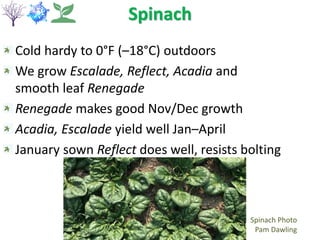
  • 63.
    Four Sets ofStorage Conditions In my chart on the handout, the Summary column indicates the general conditions needed for each crop, and allocates each crop to one of 4 groups: A= Cold and Moist : 32°F–40°F (0°C–5°C), 80%–95% humidity — refrigerator or winter root cellar conditions. Most roots, greens, leeks B= Cool and Fairly Moist: 40°F–50°F (5°C–10°C), 85%–90% humidity — root cellar. Potatoes C= Cool and Dry: 32°F–50°F (0°C–10°C), 60%–70% humidity — cooler basements and barns. Garlic and onions D= Warm and Dry to Fairly Moist: 50°F–60°F (10°C–15°C), 60%–70% humidity — basements. Sweet potatoes and winter squash. By providing storage spaces with these 4 types of conditions, 25 crops can be stored.
  • 64.
    Table of Storage Conditions See the handoutor my book Sustainable Market Farming, for the complete chart
  • 65.
    In-Ground Storage ❖ Dependingon your winter temperatures, some cold-hardy root crops (such as turnips, rutabagas, carrots, parsnips, Jerusalem artichokes and horseradish) and also leeks can be left in place in the ground, with about a foot (30 cm) of insulation (such as straw, dry leaves, chopped corn stalks, or wood shavings) added after the soil temperature drops to “refrigerator temperatures.” ❖ Hooped rowcovers or polyethylene low tunnels can keep the worst of the weather off. ❖ There could be some losses to rodents, so experiment on a small scale the first winter to see what works for you. ❖ Besides being used as a method for storage of hardy crops deep into winter, this can be a useful method of season extension into early winter for less hardy crops such as beets, celery and cabbage, which would not survive all-winter storage this way. ❖ In colder regions plan to remove the crops before the soil becomes frozen, or else wait for a thaw. Drawing credit WSU Storing Vegetables and Fruits at Home
  • 66.
    Storage Clamps (Mounds) Cabbage,kohlrabi, turnips, rutabagas, carrots, parsnips, horseradish, Jerusalem artichokes, salsify and winter radishes can be stored with no electricity use at all, by making temporary insulated outdoor storage mounds (clamps). • Mark out a circular or oval pad of soil, lay down some straw or other insulation, pile the roots up in a rounded cone or ridge shape, and cover them with straw and then with soil, making a drainage ditch round the pile. As a chimney for ventilation, leave a tuft of straw poking out the center. Slap the soil in place to protect the straw and shed rainwater. • For the backyarder, various roots can be mixed, or sections of the clamp can be for different crops. Those growing on a large scale would probably want a separate clamp for each crop. It is possible to open one end of a clamp or pit, remove some vegetables, then reseal it, although it takes some care for it to be successful. • There is a balance to be found between the thermal buffering of one large clamp and the reduced risk of rot that numerous smaller clamps provide. Drawing credit WSU Storing Vegetables and Fruits at Home
  • 67.
    Pits and Trenches •Dig a hole in the ground, line it with straw, lay in the vegetables, then cover with more straw and soil. • To deter rodents, bury large bins such as metal trash cans, layer the vegetables inside with straw, and cover the lid with a mound of more insulation and soil. • Trenches can have sidewalls made with boards to extend the height. • You can bury insulated boxes in the ground inside a dirt-floored shed or breezeway. Insulated boxes stored in unheated areas need six to eight inches (15–20 cm) of insulation on the bottom, sides and top. Drawing credit WSU Storing Vegetables and Fruits at Home
  • 68.
    Root Cellars • Potatoescan be stored for five to eight months with a good in-ground root cellar,. • Potatoes are best stored in a moist, completely dark cellar, at 40°F (5°C) to 50°F (10°C). Ventilate as needed for air exchange and to keep the cellar in the ideal temperature range. • Also for apples, cabbage, or root vegetables, but be careful what you mix, because ethylene from the apples, for example, will cause potatoes to sprout! • Some people pack unwashed vegetables in boxes of sand, wood ash, sawdust or wood chips. Perforated plastic bags are a modern alternative. • Cabbages or pepper plants can be hung upside down in the cellar to ripen, or simply to store. • Celery and leeks can be replanted side by side in tubs of soil. • See Nancy and Mike Bubel’s book Root Cellaring Twin Oaks root cellar. Photo McCune Porter
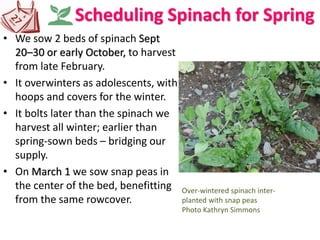
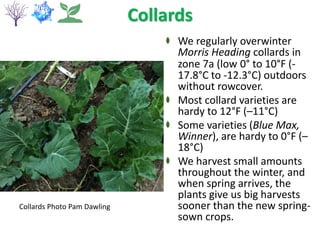
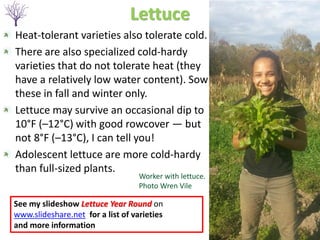
  • 69.
    Ethylene • Ethylene isassociated with ripening, sprouting and rotting. • Some crops produce ethylene in storage — apples, cantaloupes, ripening tomatoes all produce higher than average amounts. • Chilling, wounding and pathogen attack can all cause damaged crops to produce ethylene. • Some crops, including most cut greens, are not sensitive to ethylene and can be stored in the same space as ethylene-producing crops. • Other crops are very sensitive and will deteriorate in a high-ethylene environment. Potatoes will sprout, ripe fruits will go over the top, carrots lose their sweetness and become bitter. • Drawing credit WSU Storing Vegetables and Fruits at Home
  • 70.
  • 71.
    Resources – General(May 2021) ❑ATTRA attra.ncat.org/ Season Extension Techniques for Market Farmers, etc. ❑SARE www.sare.org/ A searchable database of research findings. See Season Extension Topic Room ❑articles.extension.org/organic_production and eorganic.info Publications, webinars, videos, trainings and support. Reliable information. ❑Growing Small Farms: growingsmallfarms.ces.ncsu.edu/ Farmer Resources. ❑ Jean-Paul Courtens, Roxbury Farm https://www.roxburyfarm.com/roxbury- agriculture-institute-at-philia-farm Whole farm Approach; Biodynamic Practices; Harvest Manual; Crop Manual; More Info for Farmers: Soil Fertility Practices; 100 Member CSA plans: CSA Share List, Greenhouse Plan, Field Plan. ❑ Johnnyseeds.com. Growers’ Library, Winter Growing Guide https://www.johnnyseeds.com/growers-library/vegetables/winter-growing- guide-high-tunnel-scheduling.html. The first two of 9 sections in the guide. ❑ https://weatherspark.com/ Weather records for your area. Fun! ❑ Soil temperatures www.greencastonline.com/tools/soil-temperature
  • 72.
    Resources - SeasonExtension ❑ Extending the Season: Six Strategies for Improving Cash Flow Year-Round on the Market Farm a free e-book for online subscribers to Growing for Market magazine ❑ Janet Bachmann, Season Extension Techniques for Market Gardeners, ATTRA, 2005. attra.ncat.org/attra-pub/summaries/summary.php?pub=366 ❑ Fall and Winter Gardening Quick Reference, Southern Exposure Seed Exchange, www.southernexposure.com/growing-guides/fall-winter-quick- guide.pdf ❑www.motherofahubbard.com Winter Vegetable Gardening ❑ Solar Gardening: Growing Vegetables Year-Round the American Intensive Way, Leandre Poisson, Gretchen Poisson and Robin Wimbiscus, 1994, Chelsea Green – good book on making small structures. ❑ Greenhouse and Hoophouse Grower's Handbook – Organic Vegetable Production Using Protected Culture, Andrew Mefferd, New Society ❑ Washington State University Extension, Storing Vegetables and Fruits at Home pubs.extension.wsu.edu/storing-vegetables-and-fruits-at-home ❑ USDA Agriculture Handbook 66 (1986) hard to find old version.
  • 73.
    Resources - Hoophouses ❑University of Minnesota Deep Winter Greenhouse extension.umn.edu/growing- systems/deep-winter-greenhouses ❑ U of MN High Tunnel Production Manual www.extension.umn.edu/garden/fruit- vegetable/#high-tunnel ❑ U of MN Cold-Climate Greenhouse Resource cura.umn.edu/publications/catalog/cap-186 ❑ The Northlands Winter Greenhouse Manual, Carol Ford & Chuck Waibe mosesorganic.net/product/northlands-winter-greenhouse-manual-the/ ❑ HighTunnels.org: hightunnels.org/category/for-growers/growing-in-high-tunnels/ or hightunnels.org/for-growers/ ❑ Penn State High Tunnel Production Manual, William Lamont, $25 extension.psu.edu/high-tunnel-manual ❑ High Tunnels: Using Low Cost Technology to Increase Yields, Improve Quality, and Extend the Growing Season by Ted Blomgren, Tracy Frisch and Steve Moore. University of Vermont Center for Sustainable Agriculture. https://www.sare.org/resources/high-tunnels/ ❑ High Tunnel Winter Cropping Systems, Lewis Jett, SARE. Slideshow and audio. https://northeast.sare.org/resources/high-tunnel-winter-cropping-systems/
  • 74.
    Resources – AsianGreens ❑ Grow Your Own Chinese Vegetables, Geri Harrington, 1984, Garden Way Publishing. Includes the names for these crops in different cultures. ❑ Growing Unusual Vegetables, Simon Hickmott, 2006, Eco-Logic books, UK. ❑ Oriental Vegetables: The Complete Guide for the Garden and Kitchen, Joy Larkham, revised edition 2008, Kodansha, USA ❑ Asian Vegetables, Sally Cunningham, Chelsea Green ❑ The Chinese Kitchen Garden, Wendy Kiang-Spray, 2017, Workman Publishing ❑ Kitazawa Seeds kitazawaseed.com/ & Evergreen Seeds have the most choices. ❑ Evergreen’s helpful clickable list. evergreenseeds.com/asveglis.html ❑ Fedco Seeds fedcoseeds.com/ and Johnny’s johnnyseeds.com/ have a good range. ❑ Wild Garden Seed has many interesting home-bred varieties. Search under Mustard. wildgardenseed.com ❑ ATTRA Cole Crops and Other Brassicas: Organic Production attra.ncat.org/attra-pub/summaries/summary.php?pub=27
  • 75.
    Resources - Books ❑The Market Gardener, Jean-Martin Fortier, New Society Publishers ❑ The Complete Know and Grow Vegetables, J K A Bleasdale, P J Salter et al. ❑ Knott’s Handbook for Vegetable Growers, Maynard and Hochmuth extension.missouri.edu/sare/documents/KnottsHandbook2012.pdf ❑ The New Seed Starter’s Handbook, Nancy Bubel, Rodale Books ❑ The Organic Farmer’s Business Handbook, Richard Wiswall, Chelsea Green ❑ Sustainable Vegetable Production from Start-up to Market, Vern Grubinger, host31.spidergraphics.com/nra/doc/fair%20use%20web%20pdfs/nraes- 104_web.pdf NRAES ❑ The New Organic Grower and The Winter Harvest Manual, Eliot Coleman, ❑ Crop Planning for Organic Vegetable Growers, Daniel Brisebois and Frédéric Thériault (Canadian Organic Growers www.cog.ca) ❑ The Chinese Greenhouse: Design and Build a Low-Cost, Passive Solar Greenhouse, Dan Chiras, New Society Publishers. Solar-heated, earth- sheltered, well-insulated, plastic-glazed structures, making it possible to grow warm weather crops in winter. ❑ Growing Great Garlic, Ron Engeland, 1991, Filaree
  • 76.
    Resources – MySlideshows www.slideshare.net/ Search for Pam Dawling. You’ll find: ❑ Cold-hardy Winter Vegetables ❑ Cover Crops for Vegetable Growers ❑ Crop Planning for Sustainable Vegetable Production ❑ Crop Rotations for Vegetables and Cover Crops ❑ Diversify your Vegetable Crops ❑ Fall and Winter Hoophouse ❑ Fall Vegetable Production ❑ Feeding the Soil ❑ Growing Great Garlic ❑ Growing Sweet Potatoes from Start to Finish ❑ Hoophouse Production of Cool Season Crops ❑ Lettuce Year Round ❑ Many Crops, Many Plantings, to Maximize High Tunnel Efficiency ❑ Producing Asian Greens ❑ Production of Late Fall, Winter and Early Spring Vegetable Crops ❑ Season Extension ❑ Sequential Planting of Cool Season Crops in a High Tunnel ❑ Spring and Summer Hoophouses ❑ Storage Vegetables ❑ Succession Planting for Continuous Vegetable Harvests ❑ Sustainable Farming Practices. ❑ The Seed Garden ❑ Year Round Vegetable Production ❑ Year Round Hoophouse Vegetables
  • 77.
    Cold-Hardy Winter Vegetables ©PamDawling 2021 Twin Oaks Community, Virginia Author of Sustainable Market Farming, 2nd Edition and The Year-Round Hoophouse SustainableMarketFarming.com