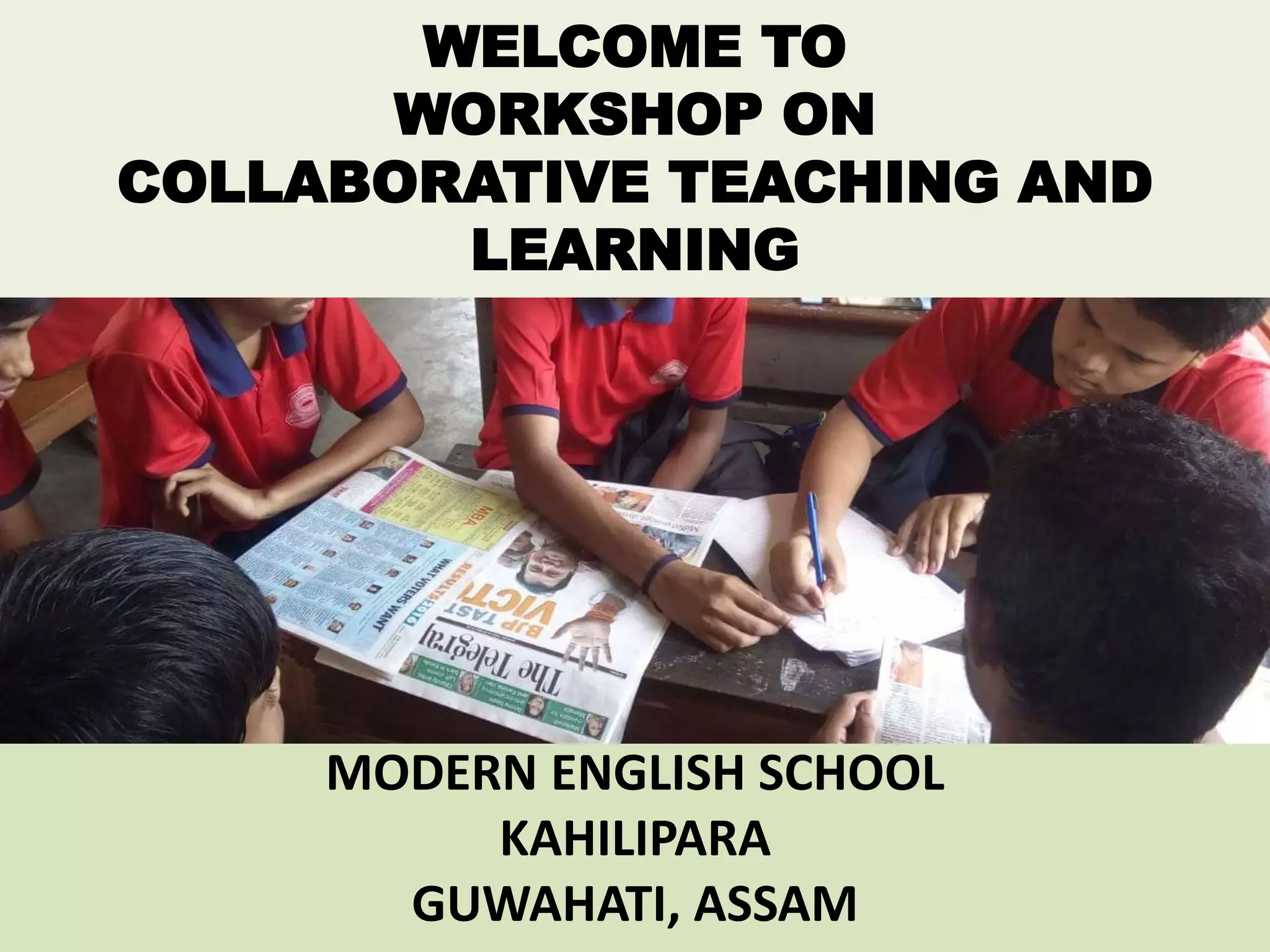
WELCOME TO
WORKSHOP ON
COLLABORATIVE TEACHING AND
LEARNING
MODERN ENGLISH SCHOOL
KAHILIPARA
GUWAHATI, ASSAM
OBJECTIVE
• "If you have an apple and I have an
apple and we exchange these apples
then you and I will still each have
one apple. But if you have an idea
and I have an idea and we exchange
these ideas, then each of us will
have two ideas.”
- George Bernard Shaw
Pankaj Saikia-2021
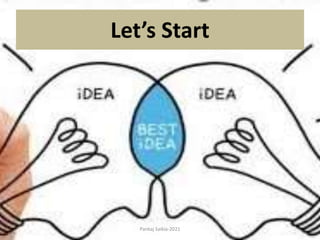
Let’s Start
Pankaj Saikia-2021
EXPECTED TAKEAWAY FROM THIS
SESSION
• A clear view on collaborative learning.
• Its difference with traditional approaches of
teaching and learning.
• Reasons for growing popularity.
• SWOT Analysis of Collaborative Teaching and
Learning.
• Prerequisites for effective collaborative
Learning.
• Dimensions of Collaboration.
Pankaj Saikia-2021
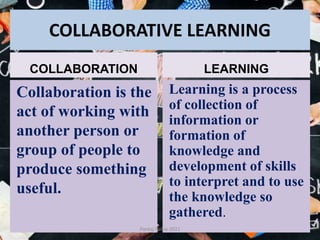
COLLABORATIVE LEARNING
COLLABORATION
Collaboration is the
act of working with
another person or
group of people to
produce something
useful.
LEARNING
Learning is a process
of collection of
information or
formation of
knowledge and
development of skills
to interpret and to use
the knowledge so
gathered.
Pankaj Saikia-2021
Collaborative Learning
• Collaborative learning is an
educational approach to teaching and
learning that involves groups of
learners working together to collect
information on a topic or object,
solve a problem, analyse or
investigate a situation, or create an
opinion. (Think-Pair-Share)
Pankaj Saikia-2021
From Traditional to Collaborative
Classrooms
Shift from……….
• Listener, observer, and note
taker
• Low or moderate expectations
of preparation for class
• Private presence in the
classroom with few or no risks
• Attendance dictated by
personal choice
• Competition with peers
• Seeing teachers and texts as the
sole sources of authority and
knowledge
To.......
• Active problem solver,
contributor, and discussant
• High expectations of
preparation for class
• Public presence with many
risks
• Attendance dictated by
community expectation.
• Collaborative work with peers
• Seeing peers, self, and the
community as important
sources .
Pankaj Saikia-2021
Benefits of Collaborative Learning
• https://www.researchgate.net/publication/25908
1649_What_do_we_Achieve_from_Learning_in_
Collaboration
• Johnsons (1989) and Pantiz (1999) in their
Research paper presented in the 3rd World
Conference on Learning, Teaching and
Educational Leadership listed over 50 benefits for
CL. They summarize them into four major
categories of; social, psychological, academic and
assessment.
Pankaj Saikia-2021
Social Benefit of CL
• CL helps to develop a social support system
for learners, increases positive social
behaviors such as honor, unity, friendliness
and reduces violence.
• CL leads to build diversity understanding
among students and staff;
• CL establishes a positive atmosphere for
modeling and practicing cooperation,
• CL develops learning communities.
Pankaj Saikia-2021
Psychological Benefit of CL
• Student-centered instruction increases
students' self esteem;
• Cooperation reduces anxiety, and;
• CL develops positive attitudes towards
teachers.
• CL increases self-esteem in students
• Ready to accept tougher challenge.
Pankaj Saikia-2021
Academic Benefit of CL
• CL Promotes critical thinking skills
• Involves students actively in the learning process
• Classroom results are improved
• Models appropriate student problem solving
techniques
• CL is especially helpful in motivating students in
specific curriculum
• Increase in student retention and improves
regularity.
Pankaj Saikia-2021
Assessment Benefit of CL
• In current educational framework,
competition is valued over cooperation which
is being reversed here.
• Diversified assessment techniques improves
efficacy of Assessment.
• Students can take the assessment with ease
without pressure.
• Detection of learning gap with higher level of
accuracy.
Pankaj Saikia-2021
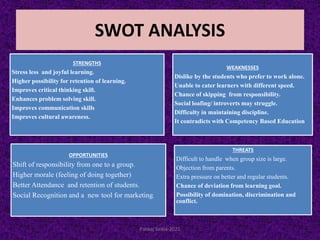
SWOT ANALYSIS
STRENGTHS
Stress less and joyful learning.
Higher possibility for retention of learning.
Improves critical thinking skill.
Enhances problem solving skill.
Improves communication skills
Improves cultural awareness.
WEAKNESSES
Dislike by the students who prefer to work alone.
Unable to cater learners with different speed.
Chance of skipping from responsibility.
Social loafing/ introverts may struggle.
Difficulty in maintaining discipline.
It contradicts with Competency Based Education
OPPORTUNITIES
Shift of responsibility from one to a group.
Higher morale (feeling of doing together)
Better Attendance and retention of students.
Social Recognition and a new tool for marketing.
THREATS
Difficult to handle when group size is large.
Objection from parents.
Extra pressure on better and regular students.
Chance of deviation from learning goal.
Possibility of domination, discrimination and
conflict.
Pankaj Saikia-2021
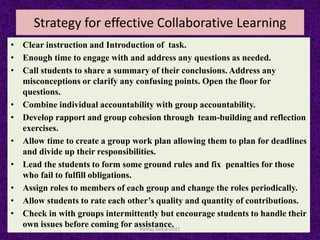
Strategy for effective Collaborative Learning
• Clear instruction and Introduction of task.
• Enough time to engage with and address any questions as needed.
• Call students to share a summary of their conclusions. Address any
misconceptions or clarify any confusing points. Open the floor for
questions.
• Combine individual accountability with group accountability.
• Develop rapport and group cohesion through team-building and reflection
exercises.
• Allow time to create a group work plan allowing them to plan for deadlines
and divide up their responsibilities.
• Lead the students to form some ground rules and fix penalties for those
who fail to fulfill obligations.
• Assign roles to members of each group and change the roles periodically.
• Allow students to rate each other’s quality and quantity of contributions.
• Check in with groups intermittently but encourage students to handle their
own issues before coming for assistance.
Pankaj Saikia-2021
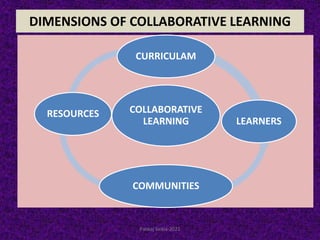
DIMENSIONS OF COLLABORATIVE LEARNING
COLLABORATIVE
LEARNING
CURRICULAM
LEARNERS
COMMUNITIES
RESOURCES
Pankaj Saikia-2021
A FEW USEFUL LINKS
• https://www.youtube.com/watch?v=8EXuYDa
tTEk
• https://www.edutopia.org/video/collaborativ
e-learning-builds-deeper-understanding
• https://www.educationworld.in/importance-
of-collaborative-learning-in-the-classroom/
• https://www.lidolearning.com/blog/5-key-
benefits-of-collaborative-learning/
Pankaj Saikia-2021
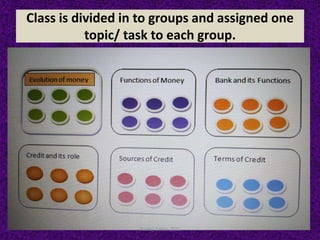
Class is divided in to groups and assigned one
topic/ task to each group.
Pankaj Saikia-2021
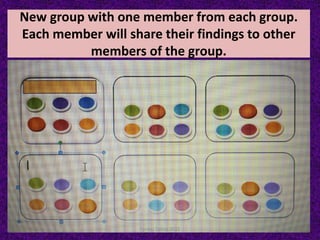
New group with one member from each group.
Each member will share their findings to other
members of the group.
Pankaj Saikia-2021
LETS COLLABORATE
Pankaj Saikia-2021

Colaborative Teaching and Learning.pptx

  • 1.
    WELCOME TO WORKSHOP ON COLLABORATIVETEACHING AND LEARNING MODERN ENGLISH SCHOOL KAHILIPARA GUWAHATI, ASSAM
  • 2.
    OBJECTIVE • "If youhave an apple and I have an apple and we exchange these apples then you and I will still each have one apple. But if you have an idea and I have an idea and we exchange these ideas, then each of us will have two ideas.” - George Bernard Shaw Pankaj Saikia-2021
  • 3.
  • 4.
    EXPECTED TAKEAWAY FROMTHIS SESSION • A clear view on collaborative learning. • Its difference with traditional approaches of teaching and learning. • Reasons for growing popularity. • SWOT Analysis of Collaborative Teaching and Learning. • Prerequisites for effective collaborative Learning. • Dimensions of Collaboration. Pankaj Saikia-2021
  • 5.
    COLLABORATIVE LEARNING COLLABORATION Collaboration isthe act of working with another person or group of people to produce something useful. LEARNING Learning is a process of collection of information or formation of knowledge and development of skills to interpret and to use the knowledge so gathered. Pankaj Saikia-2021
  • 6.
    Collaborative Learning • Collaborativelearning is an educational approach to teaching and learning that involves groups of learners working together to collect information on a topic or object, solve a problem, analyse or investigate a situation, or create an opinion. (Think-Pair-Share) Pankaj Saikia-2021
  • 7.
    From Traditional toCollaborative Classrooms Shift from………. • Listener, observer, and note taker • Low or moderate expectations of preparation for class • Private presence in the classroom with few or no risks • Attendance dictated by personal choice • Competition with peers • Seeing teachers and texts as the sole sources of authority and knowledge To....... • Active problem solver, contributor, and discussant • High expectations of preparation for class • Public presence with many risks • Attendance dictated by community expectation. • Collaborative work with peers • Seeing peers, self, and the community as important sources . Pankaj Saikia-2021
  • 8.
    Benefits of CollaborativeLearning • https://www.researchgate.net/publication/25908 1649_What_do_we_Achieve_from_Learning_in_ Collaboration • Johnsons (1989) and Pantiz (1999) in their Research paper presented in the 3rd World Conference on Learning, Teaching and Educational Leadership listed over 50 benefits for CL. They summarize them into four major categories of; social, psychological, academic and assessment. Pankaj Saikia-2021
  • 9.
    Social Benefit ofCL • CL helps to develop a social support system for learners, increases positive social behaviors such as honor, unity, friendliness and reduces violence. • CL leads to build diversity understanding among students and staff; • CL establishes a positive atmosphere for modeling and practicing cooperation, • CL develops learning communities. Pankaj Saikia-2021
  • 10.
    Psychological Benefit ofCL • Student-centered instruction increases students' self esteem; • Cooperation reduces anxiety, and; • CL develops positive attitudes towards teachers. • CL increases self-esteem in students • Ready to accept tougher challenge. Pankaj Saikia-2021
  • 11.
    Academic Benefit ofCL • CL Promotes critical thinking skills • Involves students actively in the learning process • Classroom results are improved • Models appropriate student problem solving techniques • CL is especially helpful in motivating students in specific curriculum • Increase in student retention and improves regularity. Pankaj Saikia-2021
  • 12.
    Assessment Benefit ofCL • In current educational framework, competition is valued over cooperation which is being reversed here. • Diversified assessment techniques improves efficacy of Assessment. • Students can take the assessment with ease without pressure. • Detection of learning gap with higher level of accuracy. Pankaj Saikia-2021
  • 13.
    SWOT ANALYSIS STRENGTHS Stress lessand joyful learning. Higher possibility for retention of learning. Improves critical thinking skill. Enhances problem solving skill. Improves communication skills Improves cultural awareness. WEAKNESSES Dislike by the students who prefer to work alone. Unable to cater learners with different speed. Chance of skipping from responsibility. Social loafing/ introverts may struggle. Difficulty in maintaining discipline. It contradicts with Competency Based Education OPPORTUNITIES Shift of responsibility from one to a group. Higher morale (feeling of doing together) Better Attendance and retention of students. Social Recognition and a new tool for marketing. THREATS Difficult to handle when group size is large. Objection from parents. Extra pressure on better and regular students. Chance of deviation from learning goal. Possibility of domination, discrimination and conflict. Pankaj Saikia-2021
  • 14.
    Strategy for effectiveCollaborative Learning • Clear instruction and Introduction of task. • Enough time to engage with and address any questions as needed. • Call students to share a summary of their conclusions. Address any misconceptions or clarify any confusing points. Open the floor for questions. • Combine individual accountability with group accountability. • Develop rapport and group cohesion through team-building and reflection exercises. • Allow time to create a group work plan allowing them to plan for deadlines and divide up their responsibilities. • Lead the students to form some ground rules and fix penalties for those who fail to fulfill obligations. • Assign roles to members of each group and change the roles periodically. • Allow students to rate each other’s quality and quantity of contributions. • Check in with groups intermittently but encourage students to handle their own issues before coming for assistance. Pankaj Saikia-2021
  • 15.
    DIMENSIONS OF COLLABORATIVELEARNING COLLABORATIVE LEARNING CURRICULAM LEARNERS COMMUNITIES RESOURCES Pankaj Saikia-2021
  • 16.
    A FEW USEFULLINKS • https://www.youtube.com/watch?v=8EXuYDa tTEk • https://www.edutopia.org/video/collaborativ e-learning-builds-deeper-understanding • https://www.educationworld.in/importance- of-collaborative-learning-in-the-classroom/ • https://www.lidolearning.com/blog/5-key- benefits-of-collaborative-learning/ Pankaj Saikia-2021
  • 17.
    Class is dividedin to groups and assigned one topic/ task to each group. Pankaj Saikia-2021
  • 18.
    New group withone member from each group. Each member will share their findings to other members of the group. Pankaj Saikia-2021
  • 19.