Cognitive	
  Functioning	
  and	
  
Functional	
  Abilities	
  in	
  
Borderline	
  Personality	
  Disorder	
  
Anthony	
  C.	
  Ruocco,	
  Ph.D.	
  
Department	
  of	
  Psychology,	
  University	
  of	
  Toronto	
  
1	
  
Topics	
  In	
  This	
  Presentation:	
  
1. What	
  Is	
  Cognition?	
  
2. Examples	
  Of	
  Cognitive	
  Tests	
  Used	
  By	
  
Neuropsychologists	
  
3. Why	
  Evaluate	
  Cognition	
  In	
  BPD?	
  
4. Cognitive	
  Functions	
  In	
  BPD	
  
5. Functional	
  Abilities	
  In	
  People	
  With	
  BPD	
  And	
  Their	
  
Relatives	
  
6. Summary	
  and	
  Future	
  Directions	
  
2	
  
What	
  Is	
  Cognition?	
  
§ The	
  term	
  cognition	
  refers	
  to	
  thinking	
  abilities	
  (e.g.,	
  attention,	
  
concentration,	
  memory,	
  and	
  problem-­‐solving	
  skills).	
  
§ Neuropsychologists	
  are	
  trained	
  to	
  assess	
  cognition	
  in	
  people	
  
with	
  mental	
  and	
  neurological	
  disorders.	
  They	
  use	
  carefully	
  
designed	
  instruments,	
  which	
  have	
  been	
  validated	
  on	
  very	
  large	
  
groups	
  of	
  individuals,	
  to	
  measure	
  various	
  types	
  of	
  thinking	
  
abilities.	
  
3	
  
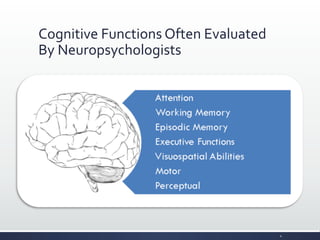
Cognitive	
  Functions	
  Often	
  Evaluated	
  
By	
  Neuropsychologists	
  
4	
  
Examples	
  of	
  Cognitive	
  
Tests	
  Used	
  By	
  
Neuropsychologists	
  
5	
  
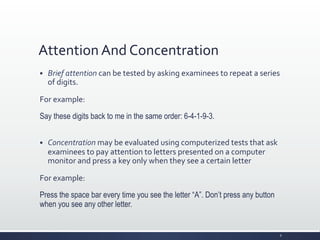
Attention	
  And	
  Concentration	
  
§ Brief	
  attention	
  can	
  be	
  tested	
  by	
  asking	
  examinees	
  to	
  repeat	
  a	
  series	
  
of	
  digits.	
  
For	
  example:	
  
Say these digits back to me in the same order: 6-4-1-9-3.
§ Concentration	
  may	
  be	
  evaluated	
  using	
  computerized	
  tests	
  that	
  ask	
  
examinees	
  to	
  pay	
  attention	
  to	
  letters	
  presented	
  on	
  a	
  computer	
  
monitor	
  and	
  press	
  a	
  key	
  only	
  when	
  they	
  see	
  a	
  certain	
  letter	
  
For	
  example:	
  
Press the space bar every time you see the letter “A”. Don’t press any button
when you see any other letter.
6	
  
Working	
  Memory	
  
§ Working	
  memory	
  is	
  the	
  ability	
  to	
  maintain	
  and	
  manipulate	
  
information	
  “online”	
  for	
  brief	
  periods	
  of	
  time.	


For	
  example:	
  
Remember these three words—apple, table, and mouse. Now count
backward by five from the number 76. [Time 10 seconds.] Tell me the three
words that I asked you to remember.
7	
  
Verbal	
  and	
  Visual	
  Memory	
  
§ Verbal	
  and	
  visual	
  memory	
  reflect	
  the	
  ability	
  to	
  learn	
  and	
  recall	
  
different	
  types	
  of	
  information.	
  
For	
  example,	
  verbal	
  memory	
  can	
  be	
  tested	
  in	
  this	
  way:	
  
Remember this list of 10 words. [Read examinee the list of words.] After 20
minutes, I’m going to ask you to repeat the same list of words.
For	
  example,	
  visual	
  memory	
  can	
  be	
  tested	
  in	
  this	
  way:	
  
I’d like you to remember these 10 designs. [Show examinee a page with
10 designs.] After 20 minutes, I’m going to ask you to draw each of these
designs from memory.
8	
  
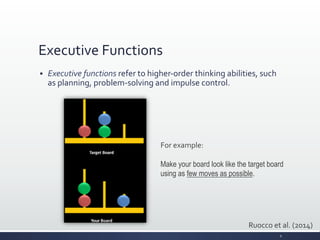
Executive	
  Functions	
  
§ Executive	
  functions	
  refer	
  to	
  higher-­‐order	
  thinking	
  abilities,	
  such	
  
as	
  planning,	
  problem-­‐solving	
  and	
  impulse	
  control.	
  
For	
  example:	


Make your board look like the target board
using as few moves as possible.
Ruocco	
  et	
  al.	
  (2014)	
  
9	
  
How	
  Is	
  Neuropsychological	
  Testing	
  
Used	
  in	
  Clinical	
  Practice?	
  
§ To	
  aid	
  in	
  making	
  a	
  diagnosis	
  (for	
  example,	
  diagnosing	
  ADHD,	
  a	
  
learning	
  disorder,	
  or	
  dementia).	
  
§ To	
  assist	
  in	
  treatment	
  planning	
  (for	
  example,	
  identifying	
  a	
  need	
  
for	
  memory	
  aids	
  during	
  psychotherapy	
  or	
  to	
  remember	
  to	
  take	
  
medications).	
  
10	
  
Why	
  Evaluate	
  Cognition	
  
in	
  Borderline	
  Personality	
  
Disorder?	
  
11	
  
Why	
  Evaluate	
  Cognition	
  in	
  BPD?	
  
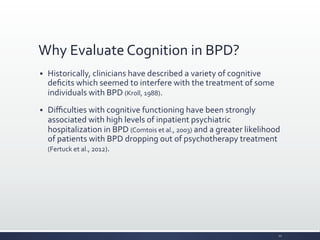
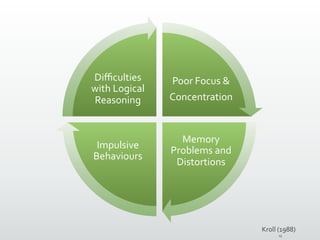
§ Historically,	
  clinicians	
  have	
  described	
  a	
  variety	
  of	
  cognitive	
  
deficits	
  which	
  seemed	
  to	
  interfere	
  with	
  the	
  treatment	
  of	
  some	
  
individuals	
  with	
  BPD	
  (Kroll,	
  1988).	
  
§ Difficulties	
  with	
  cognitive	
  functioning	
  have	
  been	
  strongly	
  
associated	
  with	
  high	
  levels	
  of	
  inpatient	
  psychiatric	
  
hospitalization	
  in	
  BPD	
  (Comtois	
  et	
  al.,	
  2003)	
  and	
  a	
  greater	
  likelihood	
  
of	
  patients	
  with	
  BPD	
  dropping	
  out	
  of	
  psychotherapy	
  treatment	
  
(Fertuck	
  et	
  al.,	
  2012).	
  
12	
  
Poor	
  Focus	
  &	
  
Concentration	
  
Memory	
  
Problems	
  and	
  
Distortions	
  
Impulsive	
  
Behaviours	
  
Difficulties	
  
with	
  Logical	
  
Reasoning	
  
Kroll	
  (1988)	
  
13	
  
People	
  With	
  Childhood	
  ADHD	
  Have	
  A	
  
High	
  Risk	
  Of	
  Developing	
  BPD	
  As	
  Adults	
  
§ Attention-­‐deficit	
  hyperactivity	
  disorder	
  (ADHD)	
  and	
  BPD	
  
appear	
  to	
  share	
  several	
  symptoms,	
  including	
  impulsiveness,	
  
emotional	
  instability,	
  and	
  difficulty	
  controlling	
  anger.	
  
§ Children	
  with	
  ADHD	
  are	
  5	
  times	
  more	
  likely	
  than	
  children	
  
without	
  ADHD	
  to	
  develop	
  BPD	
  later	
  in	
  adulthood	
  (Fischer	
  et	
  al.,	
  
2002).	
  
14	
  
Cognitive	
  Function	
  In	
  
Borderline	
  Personality	
  
Disorder	
  
15	
  
Precautions	
  When	
  Interpreting	
  Results	
  Of	
  
Cognitive	
  Functioning	
  In	
  BPD	
  
ü Not	
  all	
  people	
  with	
  BPD	
  have	
  cognitive	
  difficulties.	
  	
  
ü These	
  results	
  present	
  the	
  averages	
  of	
  how	
  people	
  with	
  BPD	
  
perform	
  on	
  standardized	
  tests	
  of	
  cognition.	
  
ü Some	
  people	
  with	
  BPD	
  have	
  difficulties	
  with	
  many	
  cognitive	
  
abilities,	
  whereas	
  others	
  perform	
  in	
  the	
  average	
  or	
  even	
  
superior	
  range.	
  
ü There	
  may	
  be	
  many	
  reasons	
  that	
  a	
  person	
  with	
  BPD	
  may	
  
experience	
  cognitive	
  difficulties—for	
  example,	
  due	
  to	
  
sedating	
  medications,	
  fatigue	
  caused	
  by	
  poor	
  sleep,	
  and	
  
other	
  physical	
  and	
  mental	
  disorders.	
  
ü Understanding	
  what	
  might	
  be	
  a	
  significant	
  or	
  problematic	
  
weakness	
  in	
  cognition	
  for	
  any	
  one	
  individual	
  should	
  be	
  made	
  
in	
  consultation	
  with	
  a	
  psychologist	
  with	
  expertise	
  in	
  
neuropsychology.	
  
16	
  
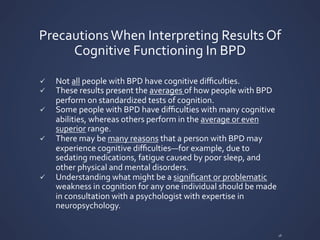
People	
  With	
  BPD	
  And	
  Their	
  Relatives	
  
Report	
  Many	
  Cognitive	
  Limitations	
  
0	
  
1	
  
2	
  
3	
  
4	
  
Inattention	
  
Hyperactivity	
  
Impulsivity	
  
Self-­‐Concept	
  
Z-­‐
S
CORE	
  
Proband	
  (n=26)	
   Relative	
  (n=17)	
   Control	
  (n=31)	
  
Ruocco	
  et	
  al.	
  (2014)	
  
Weakness	
  
17	
  
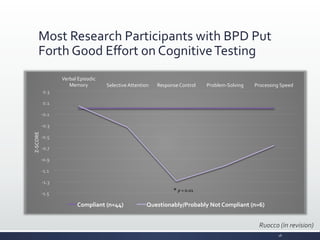
Most	
  Research	
  Participants	
  with	
  BPD	
  Put	
  
Forth	
  Good	
  Effort	
  on	
  Cognitive	
  Testing	
  
Ruocco	
  (in	
  revision)	
  
-­‐1.5	
  
-­‐1.3	
  
-­‐1.1	
  
-­‐0.9	
  
-­‐0.7	
  
-­‐0.5	
  
-­‐0.3	
  
-­‐0.1	
  
0.1	
  
0.3	
  
Verbal	
  Episodic	
  
Memory	
   Selective	
  Attention	
   Response	
  Control	
   Problem-­‐Solving	
   Processing	
  Speed	
  
Z-­‐
S
CORE	
  
Compliant	
  (n=44)	
   Questionably/Probably	
  Not	
  Compliant	
  (n=6)	
  
*	
  p	
  =	
  0.01	
  
18	
  
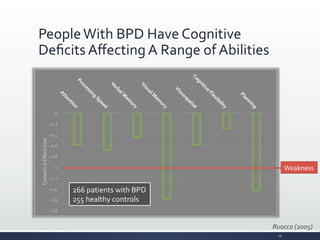
People	
  With	
  BPD	
  Have	
  Cognitive	
  
Deficits	
  Affecting	
  A	
  Range	
  of	
  Abilities	
  
-­‐1.8	
  
-­‐1.6	
  
-­‐1.4	
  
-­‐1.2	
  
-­‐1	
  
-­‐0.8	
  
-­‐0.6	
  
-­‐0.4	
  
-­‐0.2	
  
0	
  
Cohen’s	
  
d
	
  
E
ffect	
  
S
ize	
  
Ruocco	
  (2005)	
  
Weakness	
  
266	
  patients	
  with	
  BPD	
  
255	
  healthy	
  controls	
  
19	
  
People	
  With	
  BPD	
  May	
  Also	
  Have	
  Greater	
  
Variability	
  In	
  Their	
  Cognitive	
  Abilities	
  
§ Some	
  research	
  suggests	
  that	
  patients	
  with	
  BPD	
  (as	
  well	
  as	
  
those	
  with	
  schizophrenia	
  and	
  depression)	
  may	
  show	
  high	
  
degrees	
  of	
  variability	
  in	
  how	
  quickly	
  they	
  respond	
  to	
  visual	
  
information	
  (e.g.,	
  press	
  a	
  button	
  to	
  a	
  specific	
  letter	
  of	
  the	
  
alphabet)	
  (Kaiser	
  et	
  al.,	
  2008).	
  
§ Ruocco	
  and	
  Bahl	
  (2014)	
  extended	
  this	
  research	
  to	
  memory	
  
functioning	
  in	
  patients	
  with	
  BPD.	
  They	
  showed	
  that	
  patients	
  
showed	
  larger	
  than	
  average	
  discrepancies	
  in	
  their	
  verbal	
  and	
  
visual	
  memory	
  abilities,	
  but	
  neither	
  one	
  was	
  consistently	
  better	
  
or	
  worse	
  than	
  the	
  other.	
  
20	
  
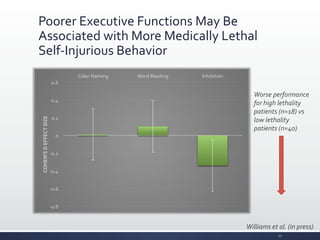
Poorer	
  Executive	
  Functions	
  May	
  Be	
  
Associated	
  with	
  More	
  Medically	
  Lethal	
  
Self-­‐Injurious	
  Behavior	
  
Williams	
  et	
  al.	
  (in	
  press)	
  
-­‐0.8	
  
-­‐0.6	
  
-­‐0.4	
  
-­‐0.2	
  
0	
  
0.2	
  
0.4	
  
0.6	
  
Color	
  Naming	
   Word	
  Reading	
   Inhibition	
  
COHEN'S	
  
D
	
  
E
FFECT	
  
S
IZE	
  
Worse	
  performance	
  	
  
for	
  high	
  lethality	
  	
  
patients	
  (n=18)	
  vs	
  
low	
  lethality	
  
patients	
  (n=40)	
  
21	
  
Cognitive	
  Deficits	
  May	
  Run	
  In	
  Families	
  
With	
  BPD	
  
§ We	
  recently	
  showed	
  that	
  subjective	
  complaints	
  of	
  cognitive	
  
disturbance	
  run	
  in	
  families	
  with	
  BPD	
  and	
  co-­‐segregate	
  with	
  the	
  
disorder	
  (Ruocco,	
  Hudson,	
  Zanarini,	
  &	
  Gunderson,	
  2015).	
  
§ First-­‐degree	
  relatives	
  of	
  patients	
  with	
  BPD	
  may	
  also	
  be	
  at	
  risk	
  
for	
  deficits	
  in	
  executive	
  functions,	
  especially	
  planning	
  and	
  
response	
  inhibition	
  (i.e.,	
  impulse	
  control	
  ability)	
  (Gvirts	
  et	
  al.,	
  2012;	
  
Ruocco	
  et	
  al.,	
  2012).	
  
22	
  
Functional	
  Abilities	
  In	
  
People	
  With	
  BPD	
  And	
  
Their	
  Relatives	
  
23	
  
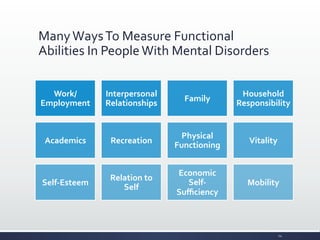
Many	
  Ways	
  To	
  Measure	
  Functional	
  
Abilities	
  In	
  People	
  With	
  Mental	
  Disorders	
  
Work/
Employment	
  
Interpersonal	
  
Relationships	
  
Family	
  
Household	
  
Responsibility	
  
Academics	
   Recreation	
  
Physical	
  
Functioning	
  
Vitality	
  
Self-­‐Esteem	
  
Relation	
  to	
  
Self	
  
Economic	
  
Self-­‐
Sufficiency	
  
Mobility	
  
24	
  
Functional	
  Limitations	
  Are	
  Commonly	
  
Reported	
  By	
  People	
  With	
  BPD	
  
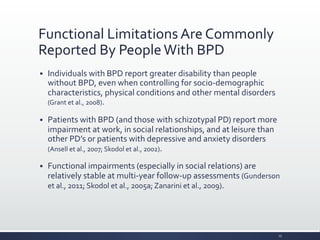
§ Individuals	
  with	
  BPD	
  report	
  greater	
  disability	
  than	
  people	
  
without	
  BPD,	
  even	
  when	
  controlling	
  for	
  socio-­‐demographic	
  
characteristics,	
  physical	
  conditions	
  and	
  other	
  mental	
  disorders	
  
(Grant	
  et	
  al.,	
  2008).	
  
§ Patients	
  with	
  BPD	
  (and	
  those	
  with	
  schizotypal	
  PD)	
  report	
  more	
  
impairment	
  at	
  work,	
  in	
  social	
  relationships,	
  and	
  at	
  leisure	
  than	
  
other	
  PD’s	
  or	
  patients	
  with	
  depressive	
  and	
  anxiety	
  disorders	
  
(Ansell	
  et	
  al.,	
  2007;	
  Skodol	
  et	
  al.,	
  2002).	
  
§ Functional	
  impairments	
  (especially	
  in	
  social	
  relations)	
  are	
  
relatively	
  stable	
  at	
  multi-­‐year	
  follow-­‐up	
  assessments	
  (Gunderson	
  
et	
  al.,	
  2011;	
  Skodol	
  et	
  al.,	
  2005a;	
  Zanarini	
  et	
  al.,	
  2009).	
  
25	
  
World	
  Health	
  Organization	
  Disability	
  
Assessment	
  Schedule,	
  Version	
  2.0	
  
(WHODAS	
  2.0)	
  
Understanding	
  
and	
  
communicating	
  
Getting	
  around	
   Self-­‐care	
  
Getting	
  along	
  
with	
  people	
  
Life	
  activities	
  
(e.g.,	
  
household,	
  
work/school)	
  
Participation	
  in	
  
society	
  
26	
  
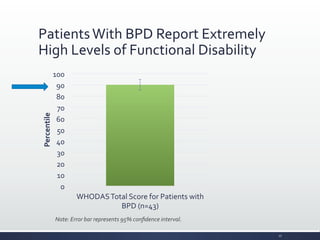
Patients	
  With	
  BPD	
  Report	
  Extremely	
  
High	
  Levels	
  of	
  Functional	
  Disability	
  
0	
  
10	
  
20	
  
30	
  
40	
  
50	
  
60	
  
70	
  
80	
  
90	
  
100	
  
WHODAS	
  Total	
  Score	
  for	
  Patients	
  with	
  
BPD	
  (n=43)	
  
Percentile	
  
Note:	
  Error	
  bar	
  represents	
  95%	
  confidence	
  interval.	
  
27	
  
How	
  Might	
  Cognitive	
  Deficits	
  Affect	
  
Someone’s	
  Life?	
  
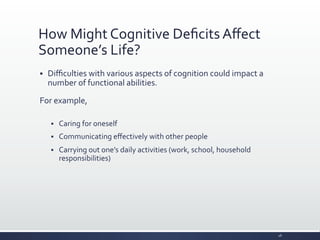
§ Difficulties	
  with	
  various	
  aspects	
  of	
  cognition	
  could	
  impact	
  a	
  
number	
  of	
  functional	
  abilities.	
  
For	
  example,	


§ Caring	
  for	
  oneself	
  
§ Communicating	
  effectively	
  with	
  other	
  people	
  
§ Carrying	
  out	
  one’s	
  daily	
  activities	
  (work,	
  school,	
  household	
  
responsibilities)	
  
28	
  
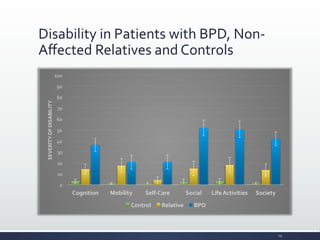
Disability	
  in	
  Patients	
  with	
  BPD,	
  Non-­‐
Affected	
  Relatives	
  and	
  Controls	
  
0	
  
10	
  
20	
  
30	
  
40	
  
50	
  
60	
  
70	
  
80	
  
90	
  
100	
  
Cognition	
   Mobility	
   Self-­‐Care	
   Social	
   Life	
  Activities	
   Society	
  
SEVERITY	
  
O
F	
  
D
ISABILITY	
  
Control	
   Relative	
   BPD	
  
29	
  
Problems	
  With	
  Attention	
  And	
  Memory	
  Are	
  Linked	
  To	
  
Difficulties	
  With	
  Activities	
  Of	
  Daily	
  Living	
  In	
  BPD	
  
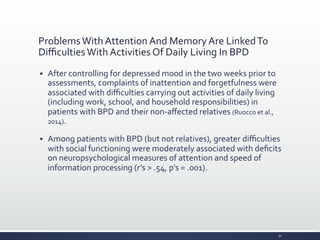
§ After	
  controlling	
  for	
  depressed	
  mood	
  in	
  the	
  two	
  weeks	
  prior	
  to	
  
assessments,	
  complaints	
  of	
  inattention	
  and	
  forgetfulness	
  were	
  
associated	
  with	
  difficulties	
  carrying	
  out	
  activities	
  of	
  daily	
  living	
  
(including	
  work,	
  school,	
  and	
  household	
  responsibilities)	
  in	
  
patients	
  with	
  BPD	
  and	
  their	
  non-­‐affected	
  relatives	
  (Ruocco	
  et	
  al.,	
  
2014).	
  
§ Among	
  patients	
  with	
  BPD	
  (but	
  not	
  relatives),	
  greater	
  difficulties	
  
with	
  social	
  functioning	
  were	
  moderately	
  associated	
  with	
  deficits	
  
on	
  neuropsychological	
  measures	
  of	
  attention	
  and	
  speed	
  of	
  
information	
  processing	
  (r’s	
  >	
  .54,	
  p’s	
  =	
  .001).	
  
30	
  
Conclusions	
  And	
  	
  
Future	
  Directions	
  
31	
  
Summary	
  
§ On	
  average,	
  people	
  with	
  BPD	
  show	
  subtle	
  weaknesses	
  in	
  
certain	
  cognitive	
  functions,	
  especially	
  attention/concentration,	
  
memory,	
  and	
  executive	
  functions	
  (e.g.,	
  planning,	
  problem-­‐
solving,	
  and	
  impulse	
  control).	
  
§ In	
  addition	
  to	
  weaknesses	
  in	
  specific	
  cognitive	
  functions,	
  when	
  
comparing	
  different	
  people	
  with	
  BPD,	
  there	
  appears	
  to	
  be	
  a	
  
high	
  degree	
  of	
  variability	
  in	
  cognitive	
  abilities	
  (e.g.,	
  some	
  
people	
  have	
  strong	
  verbal	
  memory	
  but	
  weak	
  visual	
  memory,	
  
and	
  vice	
  versa).	
  This	
  is	
  consistent	
  with	
  findings	
  in	
  other	
  mental	
  
disorders,	
  such	
  as	
  schizophrenia,	
  depression,	
  and	
  ADHD.	
  
§ More	
  severe	
  deficits	
  in	
  impulse	
  control	
  and	
  problem-­‐solving	
  
may	
  underlie	
  more	
  severely	
  lethal	
  self-­‐injurious	
  behaviours	
  in	
  
people	
  with	
  BPD.	
  
32	
  
Summary	
  
§ Individuals	
  with	
  BPD	
  and	
  their	
  relatives	
  report	
  elevated	
  
functional	
  limitations	
  across	
  a	
  wide	
  range	
  of	
  life	
  areas.	
  
§ Limitations	
  in	
  attention	
  and	
  memory	
  may	
  be	
  linked	
  to	
  
difficulties	
  carrying	
  out	
  activities	
  of	
  daily	
  living	
  (e.g.,	
  work,	
  
school,	
  and	
  household	
  responsibilities)	
  in	
  people	
  with	
  BPD	
  and	
  
their	
  relatives.	
  
33	
  
Implications	
  for	
  Treatment	
  
§ To	
  effectively	
  engage	
  in	
  psychotherapy,	
  attention,	
  
concentration,	
  memory	
  and	
  executive	
  functions	
  (e.g.,	
  planning,	
  
problem-­‐solving	
  and	
  impulse	
  control)	
  must	
  be	
  intact.	
  
§ Problems	
  may	
  arise	
  when	
  any	
  one	
  of	
  these	
  cognitive	
  functions	
  
are	
  affected	
  in	
  individuals	
  with	
  BPD,	
  and	
  in	
  turn,	
  these	
  
difficulties	
  could	
  have	
  downstream	
  influences	
  on	
  therapy	
  
outcomes	
  and	
  functional	
  abilities.	
  
34	
  
How	
  Can	
  Mindfulness-­‐Based	
  
Psychotherapy	
  Improve	
  Cognition	
  In	
  BPD?	
  
Practice	
  in	
  
mindful	
  
awareness	
  and	
  
acceptance	
  
Improved	
  
attention,	
  
concentration	
  
and	
  impulse	
  
control	
  
Better	
  
capacity	
  to	
  
benefit	
  from	
  
treatments,	
  
and	
  improved	
  
functional	
  
abilities	
  
35	
  
Future	
  Directions	
  
Promising	
  New	
  Research	
  Is	
  Underway	
  To	
  Investigate	
  
Many	
  Compelling	
  Questions	
  About	
  Cognition	
  And	
  BPD	
  
• How	
  and	
  in	
  what	
  ways	
  do	
  cognitive	
  limitations	
  impact	
  
psychotherapy	
  outcomes	
  for	
  patients	
  with	
  BPD?	
  
• Can	
  we	
  use	
  cognitive	
  deficits	
  as	
  potential	
  biomarkers	
  to	
  identify	
  
genetic	
  factors	
  involved	
  in	
  BPD?	
  
• Are	
  cognitive	
  deficits	
  inherited	
  in	
  families	
  affected	
  with	
  BPD?	
  
• How	
  might	
  cognitive	
  limitations	
  impact	
  functional	
  abilities	
  in	
  
patients	
  with	
  BPD	
  and	
  their	
  relatives?	
  
• Do	
  brain	
  stimulation	
  therapies	
  to	
  improve	
  depression	
  in	
  BPD	
  
impact	
  cognitive	
  abilities?	
  
36	
  
Acknowledgements	
  
University	
  of	
  Toronto	
  
Clinical	
  Neurosciences	
  
Laboratory	
  
Western	
  University	
  
Paul	
  Links,	
  M.D.	


Centre	
  for	
  Addiction	
  &	
  Mental	
  
Health	
  
Shelley	
  McMain,	
  Ph.D.	
  
McLean	
  Hospital	
  
John	
  Gunderson,	
  M.D.	
  
Mary	
  Zanarini,	
  Ed.D.	
  
37	
  

Cognitive Functioning and Functional Abilities

  • 1.
    Cognitive  Functioning  and   Functional  Abilities  in   Borderline  Personality  Disorder   Anthony  C.  Ruocco,  Ph.D.   Department  of  Psychology,  University  of  Toronto   1  
  • 2.
    Topics  In  This  Presentation:   1. What  Is  Cognition?   2. Examples  Of  Cognitive  Tests  Used  By   Neuropsychologists   3. Why  Evaluate  Cognition  In  BPD?   4. Cognitive  Functions  In  BPD   5. Functional  Abilities  In  People  With  BPD  And  Their   Relatives   6. Summary  and  Future  Directions   2  
  • 3.
    What  Is  Cognition?   § The  term  cognition  refers  to  thinking  abilities  (e.g.,  attention,   concentration,  memory,  and  problem-­‐solving  skills).   § Neuropsychologists  are  trained  to  assess  cognition  in  people   with  mental  and  neurological  disorders.  They  use  carefully   designed  instruments,  which  have  been  validated  on  very  large   groups  of  individuals,  to  measure  various  types  of  thinking   abilities.   3  
  • 4.
    Cognitive  Functions  Often  Evaluated   By  Neuropsychologists   4  
  • 5.
    Examples  of  Cognitive   Tests  Used  By   Neuropsychologists   5  
  • 6.
    Attention  And  Concentration   § Brief  attention  can  be  tested  by  asking  examinees  to  repeat  a  series   of  digits.   For  example:   Say these digits back to me in the same order: 6-4-1-9-3. § Concentration  may  be  evaluated  using  computerized  tests  that  ask   examinees  to  pay  attention  to  letters  presented  on  a  computer   monitor  and  press  a  key  only  when  they  see  a  certain  letter   For  example:   Press the space bar every time you see the letter “A”. Don’t press any button when you see any other letter. 6  
  • 7.
    Working  Memory   §Working  memory  is  the  ability  to  maintain  and  manipulate   information  “online”  for  brief  periods  of  time.     For  example:   Remember these three words—apple, table, and mouse. Now count backward by five from the number 76. [Time 10 seconds.] Tell me the three words that I asked you to remember. 7  
  • 8.
    Verbal  and  Visual  Memory   § Verbal  and  visual  memory  reflect  the  ability  to  learn  and  recall   different  types  of  information.   For  example,  verbal  memory  can  be  tested  in  this  way:   Remember this list of 10 words. [Read examinee the list of words.] After 20 minutes, I’m going to ask you to repeat the same list of words. For  example,  visual  memory  can  be  tested  in  this  way:   I’d like you to remember these 10 designs. [Show examinee a page with 10 designs.] After 20 minutes, I’m going to ask you to draw each of these designs from memory. 8  
  • 9.
    Executive  Functions   §Executive  functions  refer  to  higher-­‐order  thinking  abilities,  such   as  planning,  problem-­‐solving  and  impulse  control.   For  example:     Make your board look like the target board using as few moves as possible. Ruocco  et  al.  (2014)   9  
  • 10.
    How  Is  Neuropsychological  Testing   Used  in  Clinical  Practice?   § To  aid  in  making  a  diagnosis  (for  example,  diagnosing  ADHD,  a   learning  disorder,  or  dementia).   § To  assist  in  treatment  planning  (for  example,  identifying  a  need   for  memory  aids  during  psychotherapy  or  to  remember  to  take   medications).   10  
  • 11.
    Why  Evaluate  Cognition   in  Borderline  Personality   Disorder?   11  
  • 12.
    Why  Evaluate  Cognition  in  BPD?   § Historically,  clinicians  have  described  a  variety  of  cognitive   deficits  which  seemed  to  interfere  with  the  treatment  of  some   individuals  with  BPD  (Kroll,  1988).   § Difficulties  with  cognitive  functioning  have  been  strongly   associated  with  high  levels  of  inpatient  psychiatric   hospitalization  in  BPD  (Comtois  et  al.,  2003)  and  a  greater  likelihood   of  patients  with  BPD  dropping  out  of  psychotherapy  treatment   (Fertuck  et  al.,  2012).   12  
  • 13.
    Poor  Focus  &   Concentration   Memory   Problems  and   Distortions   Impulsive   Behaviours   Difficulties   with  Logical   Reasoning   Kroll  (1988)   13  
  • 14.
    People  With  Childhood  ADHD  Have  A   High  Risk  Of  Developing  BPD  As  Adults   § Attention-­‐deficit  hyperactivity  disorder  (ADHD)  and  BPD   appear  to  share  several  symptoms,  including  impulsiveness,   emotional  instability,  and  difficulty  controlling  anger.   § Children  with  ADHD  are  5  times  more  likely  than  children   without  ADHD  to  develop  BPD  later  in  adulthood  (Fischer  et  al.,   2002).   14  
  • 15.
    Cognitive  Function  In   Borderline  Personality   Disorder   15  
  • 16.
    Precautions  When  Interpreting  Results  Of   Cognitive  Functioning  In  BPD   ü Not  all  people  with  BPD  have  cognitive  difficulties.     ü These  results  present  the  averages  of  how  people  with  BPD   perform  on  standardized  tests  of  cognition.   ü Some  people  with  BPD  have  difficulties  with  many  cognitive   abilities,  whereas  others  perform  in  the  average  or  even   superior  range.   ü There  may  be  many  reasons  that  a  person  with  BPD  may   experience  cognitive  difficulties—for  example,  due  to   sedating  medications,  fatigue  caused  by  poor  sleep,  and   other  physical  and  mental  disorders.   ü Understanding  what  might  be  a  significant  or  problematic   weakness  in  cognition  for  any  one  individual  should  be  made   in  consultation  with  a  psychologist  with  expertise  in   neuropsychology.   16  
  • 17.
    People  With  BPD  And  Their  Relatives   Report  Many  Cognitive  Limitations   0   1   2   3   4   Inattention   Hyperactivity   Impulsivity   Self-­‐Concept   Z-­‐ S CORE   Proband  (n=26)   Relative  (n=17)   Control  (n=31)   Ruocco  et  al.  (2014)   Weakness   17  
  • 18.
    Most  Research  Participants  with  BPD  Put   Forth  Good  Effort  on  Cognitive  Testing   Ruocco  (in  revision)   -­‐1.5   -­‐1.3   -­‐1.1   -­‐0.9   -­‐0.7   -­‐0.5   -­‐0.3   -­‐0.1   0.1   0.3   Verbal  Episodic   Memory   Selective  Attention   Response  Control   Problem-­‐Solving   Processing  Speed   Z-­‐ S CORE   Compliant  (n=44)   Questionably/Probably  Not  Compliant  (n=6)   *  p  =  0.01   18  
  • 19.
    People  With  BPD  Have  Cognitive   Deficits  Affecting  A  Range  of  Abilities   -­‐1.8   -­‐1.6   -­‐1.4   -­‐1.2   -­‐1   -­‐0.8   -­‐0.6   -­‐0.4   -­‐0.2   0   Cohen’s   d   E ffect   S ize   Ruocco  (2005)   Weakness   266  patients  with  BPD   255  healthy  controls   19  
  • 20.
    People  With  BPD  May  Also  Have  Greater   Variability  In  Their  Cognitive  Abilities   § Some  research  suggests  that  patients  with  BPD  (as  well  as   those  with  schizophrenia  and  depression)  may  show  high   degrees  of  variability  in  how  quickly  they  respond  to  visual   information  (e.g.,  press  a  button  to  a  specific  letter  of  the   alphabet)  (Kaiser  et  al.,  2008).   § Ruocco  and  Bahl  (2014)  extended  this  research  to  memory   functioning  in  patients  with  BPD.  They  showed  that  patients   showed  larger  than  average  discrepancies  in  their  verbal  and   visual  memory  abilities,  but  neither  one  was  consistently  better   or  worse  than  the  other.   20  
  • 21.
    Poorer  Executive  Functions  May  Be   Associated  with  More  Medically  Lethal   Self-­‐Injurious  Behavior   Williams  et  al.  (in  press)   -­‐0.8   -­‐0.6   -­‐0.4   -­‐0.2   0   0.2   0.4   0.6   Color  Naming   Word  Reading   Inhibition   COHEN'S   D   E FFECT   S IZE   Worse  performance     for  high  lethality     patients  (n=18)  vs   low  lethality   patients  (n=40)   21  
  • 22.
    Cognitive  Deficits  May  Run  In  Families   With  BPD   § We  recently  showed  that  subjective  complaints  of  cognitive   disturbance  run  in  families  with  BPD  and  co-­‐segregate  with  the   disorder  (Ruocco,  Hudson,  Zanarini,  &  Gunderson,  2015).   § First-­‐degree  relatives  of  patients  with  BPD  may  also  be  at  risk   for  deficits  in  executive  functions,  especially  planning  and   response  inhibition  (i.e.,  impulse  control  ability)  (Gvirts  et  al.,  2012;   Ruocco  et  al.,  2012).   22  
  • 23.
    Functional  Abilities  In   People  With  BPD  And   Their  Relatives   23  
  • 24.
    Many  Ways  To  Measure  Functional   Abilities  In  People  With  Mental  Disorders   Work/ Employment   Interpersonal   Relationships   Family   Household   Responsibility   Academics   Recreation   Physical   Functioning   Vitality   Self-­‐Esteem   Relation  to   Self   Economic   Self-­‐ Sufficiency   Mobility   24  
  • 25.
    Functional  Limitations  Are  Commonly   Reported  By  People  With  BPD   § Individuals  with  BPD  report  greater  disability  than  people   without  BPD,  even  when  controlling  for  socio-­‐demographic   characteristics,  physical  conditions  and  other  mental  disorders   (Grant  et  al.,  2008).   § Patients  with  BPD  (and  those  with  schizotypal  PD)  report  more   impairment  at  work,  in  social  relationships,  and  at  leisure  than   other  PD’s  or  patients  with  depressive  and  anxiety  disorders   (Ansell  et  al.,  2007;  Skodol  et  al.,  2002).   § Functional  impairments  (especially  in  social  relations)  are   relatively  stable  at  multi-­‐year  follow-­‐up  assessments  (Gunderson   et  al.,  2011;  Skodol  et  al.,  2005a;  Zanarini  et  al.,  2009).   25  
  • 26.
    World  Health  Organization  Disability   Assessment  Schedule,  Version  2.0   (WHODAS  2.0)   Understanding   and   communicating   Getting  around   Self-­‐care   Getting  along   with  people   Life  activities   (e.g.,   household,   work/school)   Participation  in   society   26  
  • 27.
    Patients  With  BPD  Report  Extremely   High  Levels  of  Functional  Disability   0   10   20   30   40   50   60   70   80   90   100   WHODAS  Total  Score  for  Patients  with   BPD  (n=43)   Percentile   Note:  Error  bar  represents  95%  confidence  interval.   27  
  • 28.
    How  Might  Cognitive  Deficits  Affect   Someone’s  Life?   § Difficulties  with  various  aspects  of  cognition  could  impact  a   number  of  functional  abilities.   For  example,     § Caring  for  oneself   § Communicating  effectively  with  other  people   § Carrying  out  one’s  daily  activities  (work,  school,  household   responsibilities)   28  
  • 29.
    Disability  in  Patients  with  BPD,  Non-­‐ Affected  Relatives  and  Controls   0   10   20   30   40   50   60   70   80   90   100   Cognition   Mobility   Self-­‐Care   Social   Life  Activities   Society   SEVERITY   O F   D ISABILITY   Control   Relative   BPD   29  
  • 30.
    Problems  With  Attention  And  Memory  Are  Linked  To   Difficulties  With  Activities  Of  Daily  Living  In  BPD   § After  controlling  for  depressed  mood  in  the  two  weeks  prior  to   assessments,  complaints  of  inattention  and  forgetfulness  were   associated  with  difficulties  carrying  out  activities  of  daily  living   (including  work,  school,  and  household  responsibilities)  in   patients  with  BPD  and  their  non-­‐affected  relatives  (Ruocco  et  al.,   2014).   § Among  patients  with  BPD  (but  not  relatives),  greater  difficulties   with  social  functioning  were  moderately  associated  with  deficits   on  neuropsychological  measures  of  attention  and  speed  of   information  processing  (r’s  >  .54,  p’s  =  .001).   30  
  • 31.
    Conclusions  And     Future  Directions   31  
  • 32.
    Summary   § On  average,  people  with  BPD  show  subtle  weaknesses  in   certain  cognitive  functions,  especially  attention/concentration,   memory,  and  executive  functions  (e.g.,  planning,  problem-­‐ solving,  and  impulse  control).   § In  addition  to  weaknesses  in  specific  cognitive  functions,  when   comparing  different  people  with  BPD,  there  appears  to  be  a   high  degree  of  variability  in  cognitive  abilities  (e.g.,  some   people  have  strong  verbal  memory  but  weak  visual  memory,   and  vice  versa).  This  is  consistent  with  findings  in  other  mental   disorders,  such  as  schizophrenia,  depression,  and  ADHD.   § More  severe  deficits  in  impulse  control  and  problem-­‐solving   may  underlie  more  severely  lethal  self-­‐injurious  behaviours  in   people  with  BPD.   32  
  • 33.
    Summary   § Individuals  with  BPD  and  their  relatives  report  elevated   functional  limitations  across  a  wide  range  of  life  areas.   § Limitations  in  attention  and  memory  may  be  linked  to   difficulties  carrying  out  activities  of  daily  living  (e.g.,  work,   school,  and  household  responsibilities)  in  people  with  BPD  and   their  relatives.   33  
  • 34.
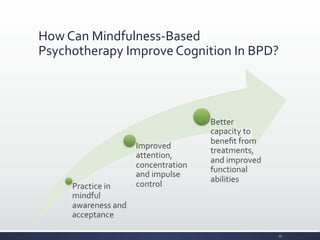
    Implications  for  Treatment   § To  effectively  engage  in  psychotherapy,  attention,   concentration,  memory  and  executive  functions  (e.g.,  planning,   problem-­‐solving  and  impulse  control)  must  be  intact.   § Problems  may  arise  when  any  one  of  these  cognitive  functions   are  affected  in  individuals  with  BPD,  and  in  turn,  these   difficulties  could  have  downstream  influences  on  therapy   outcomes  and  functional  abilities.   34  
  • 35.
    How  Can  Mindfulness-­‐Based   Psychotherapy  Improve  Cognition  In  BPD?   Practice  in   mindful   awareness  and   acceptance   Improved   attention,   concentration   and  impulse   control   Better   capacity  to   benefit  from   treatments,   and  improved   functional   abilities   35  
  • 36.
    Future  Directions   Promising  New  Research  Is  Underway  To  Investigate   Many  Compelling  Questions  About  Cognition  And  BPD   • How  and  in  what  ways  do  cognitive  limitations  impact   psychotherapy  outcomes  for  patients  with  BPD?   • Can  we  use  cognitive  deficits  as  potential  biomarkers  to  identify   genetic  factors  involved  in  BPD?   • Are  cognitive  deficits  inherited  in  families  affected  with  BPD?   • How  might  cognitive  limitations  impact  functional  abilities  in   patients  with  BPD  and  their  relatives?   • Do  brain  stimulation  therapies  to  improve  depression  in  BPD   impact  cognitive  abilities?   36  
  • 37.
    Acknowledgements   University  of  Toronto   Clinical  Neurosciences   Laboratory   Western  University   Paul  Links,  M.D.         Centre  for  Addiction  &  Mental   Health   Shelley  McMain,  Ph.D.   McLean  Hospital   John  Gunderson,  M.D.   Mary  Zanarini,  Ed.D.   37