Creating an Effective Developer
Experience on Kubernetes
Daniel Bryant
@danielbryantuk | @datawireio
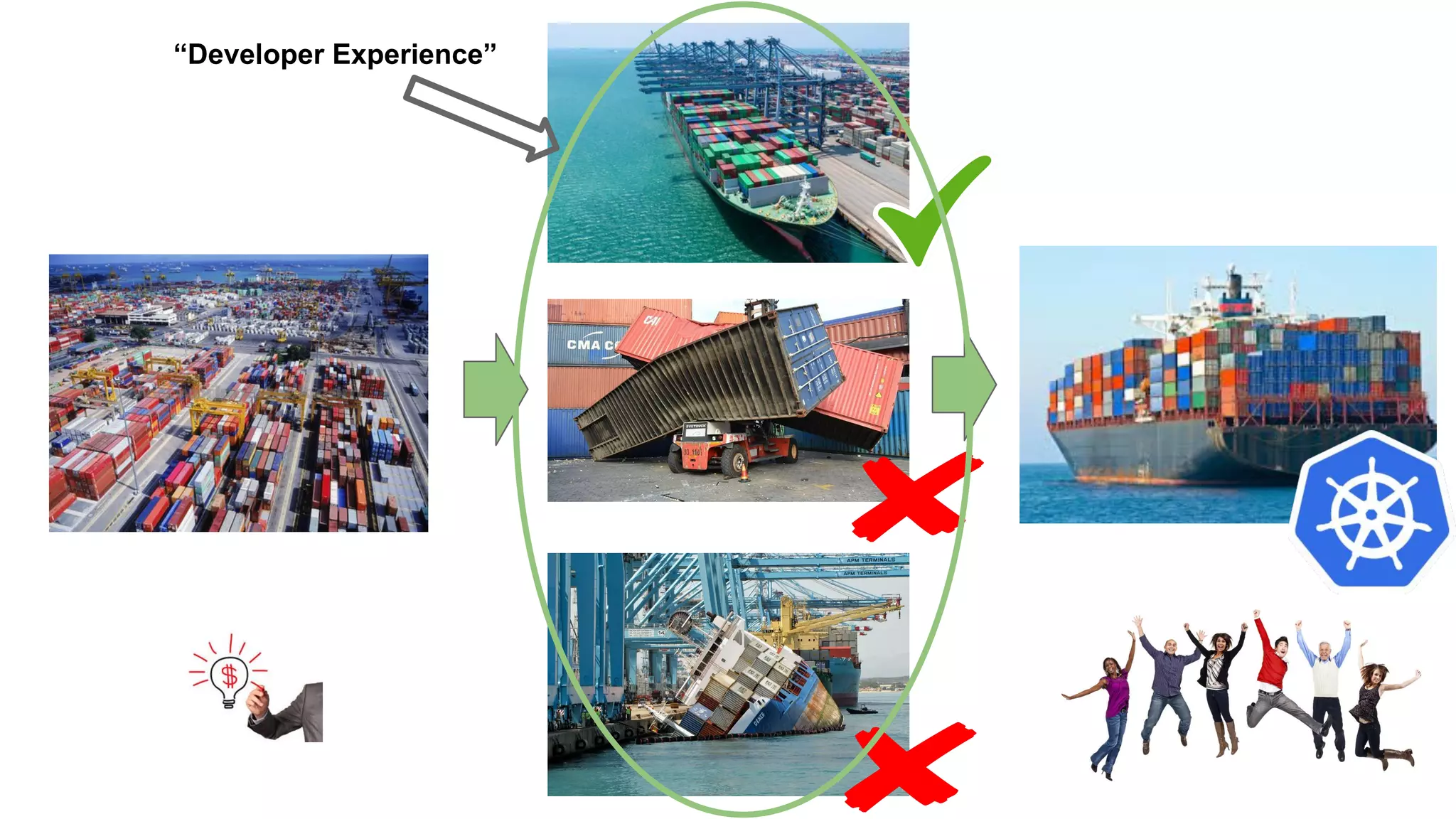
“Developer Experience”
tl;dr
The developer experience is primarily about minimising the friction from idea to
code to delivering observable business value
How you construct your ‘platform’ impacts the developer experience greatly
High productivity (and fun) comes from intentionally designing experience of: local
development, packaging apps, CI/CD, deployment control, and observability
@danielbryantuk
Independent Technical Consultant, Product Architect at Datawire
Previously: Academic, software developer (from startups to gov),
consultant, CTO, trainer…
Leading change through technology and teams
Setting the
Scene
What is Cloud Native?
https://www.cncf.io/about/charter/
https://www.slideshare.net/spnewman/what-is-this-cloud-native-thing-anyway
https://www.datawire.io/what-is-cloud-native/
Infrastructure, Platforms, Workflow
❏ Infrastructure
❏ Compute, network, IAM
❏ Platform
❏ System building blocks
❏ Workflow
❏ Design, build, test, deploy
Infrastructure, Platforms, Workflow
https://dzone.com/articles/creating-a-positive-developer-experience-for-conta
Focusing on Platform and Workflow
What is workflow?
The platform heavily influences the workflow
Diving deeper: patterns of good practice
What is
“Workflow”?
The Ideal Workflow
https://speakerdeck.com/stilkov/microservices-patterns-and-antipatterns-1
The Platform
Drives DevEx
CNCF Vision: Macro-Level Guidance
https://articles.microservices.com/developer-workflow-trail-for-cl
oud-native-applications-request-for-feedback-a9365b64c790
https://github.com/cncf/landscape#trail-map
https://twitter.com/kelseyhightower/status/851935087532945409
https://www.infoq.com/news/2017/06/paved-paas-netflix
https://www.infoq.com/news/2018/07/shopify-kubernetes-paas
Should I Build a
PaaS on k8s?
Key Questions to Ask...
Develop and test services locally, or
within the cluster (or both)?
● Working locally has many advantages
○ Reduce ops cost of multi-cluster
● Some want to maintain minimal dev envs
○ Or hide Docker/k8s from devs
● Local/remote container dev tools like
Telepresence and Squash allow hybrid
How quick do you need user feedback?
● Canary testing is very powerful
● Needs app and platform support
● Some teams can be nervous about
testing in production
Do you have a strong opinion on code
repository structure?
● Monorepo:
○ Coordination of integration and testing
across services is generally easier,
○ Service dependency management easier
● Multi-repo:
○ Clearer ownership
○ Can promote loose coupling
○ Refactoring and code-level standardization
can be challenging
http://blog.shippable.com/our-journey-to-microservices-and-a-mono-repository
Do you want to implement “guide rails”
for your development teams?
● Larger teams often want to provide
comprehensive guide rails
● Startups and SMEs may instead value
team independence
● Hybrid? Offer platform, but allow service
teams freedom and responsibility
https://blog.openshift.com/multiple-deployment-methods-openshift/
How much platform should we build?
https://blog.gardeviance.org/2015/03/on-pioneers-settlers-town-planners-and.html
Some thoughts on this...
Prototype Production Mission Critical
Dev and test Local / hybrid Local / hybrid Hybrid / local
Deployment Canary Canary / pre-prod test Pre-prod test / Canary
Code repo Mono / multi Multi / Mono Multi
Guide rails YOLO Limited Strong
Where to focus? CI/CD Scaffolding Testing (env creation)
Workflow
Tooling and
Techniques
Pattern: K8s for Ops
● Kubernetes becoming de facto CoaaS (the new cloud broker?)
○ Lots of hosted options
● Highly extensible
○ Custom Controllers
○ Operators
○ CloudBuddies
● Extension enables custom workflow
○ “Kubernetes Custom Resource, Controller and Operator Development Tools”
Pattern: Development and Deployment
https://blog.hasura.io/draft-vs-gitkube-vs-helm-vs-
ksonnet-vs-metaparticle-vs-skaffold-f5aa9561f948
https://codeengineered.com/blog/2018/kuberne
tes-helm-related-tools/
● Draft
○ Automates “inner loop” build-push-deploy
○ Utilises Helm
● Gitkube
○ Automates build-push-deploy
○ Provides heroku / CF like experience
● Skaffold
○ Automates build-push-deploy
○ Watches source code
○ Provides “dev” and “run” (CD) modes
● Forge
○ Automates build-push-deploy
○ Templates k8s/Ambassador config
Pattern: Development and Deployment
● Helm
○ Package manager for k8s
○ Deploy and manage (ready-made) charts
● Ksonnet
○ Define k8s manifests in jsonnet
○ Create composable config/services
● Metaparticle
○ “Standard library for cloud native apps”
○ Language-specific binding
● Ballerina
○ “Microservice programming language”
○ Annotations for package and deploy
Pattern: Development and Deployment
Pattern: CI/CD
● Make is easy to do the right thing
○ Self-service pipeline creations
○ Bake-in hooks/slots for platform
● Testing of NFRs is vital
○ Security
○ Performance
○ Quality
https://www.slideshare.net/dbryant_uk/codemotion-rome-2018-continuous-d
elivery-with-containers-the-good-the-bad-and-the-ugly
Pattern: Layer 7 Deployment Control
● Allows fine-grained control
● Envoy is de facto proxy data plane
● Many control planes
○ Ambassador
○ Gloo
○ Istio
Pattern: Observability
● Essential part of the platform and developer
workflow/experience
○ Monitoring, logging and tracing
○ Bake-in hooks to skaffolding
● Global/service dashboards
● “Observability and Avoiding Alert Overload
from Microservices at the Financial Times”
Conclusion
In Summary
The developer experience is primarily about minimising the friction from idea to
code to delivering observable business value
How you construct your ‘platform’ impacts the developer experience greatly
You must intentionally curate the experience of: local development, packaging
apps, CI/CD, deployment control, and observability
Thanks for Listening!
Questions, comments, thoughts…
db@datawire.io
@danielbryantuk
More info: dzone.com/articles/creating-a-positive-developer-experience-for-conta
datawire.io/what-is-cloud-native | getambassador.io | istio.io | telepresence.io,
prometheus.io | “Kubernetes Up and Running”

CNCF Webinar Series: "Creating an Effective Developer Experience on Kubernetes"

  • 1.
    Creating an EffectiveDeveloper Experience on Kubernetes Daniel Bryant @danielbryantuk | @datawireio
  • 2.
  • 3.
    tl;dr The developer experienceis primarily about minimising the friction from idea to code to delivering observable business value How you construct your ‘platform’ impacts the developer experience greatly High productivity (and fun) comes from intentionally designing experience of: local development, packaging apps, CI/CD, deployment control, and observability
  • 4.
    @danielbryantuk Independent Technical Consultant,Product Architect at Datawire Previously: Academic, software developer (from startups to gov), consultant, CTO, trainer… Leading change through technology and teams
  • 5.
  • 6.
    What is CloudNative? https://www.cncf.io/about/charter/ https://www.slideshare.net/spnewman/what-is-this-cloud-native-thing-anyway https://www.datawire.io/what-is-cloud-native/
  • 7.
    Infrastructure, Platforms, Workflow ❏Infrastructure ❏ Compute, network, IAM ❏ Platform ❏ System building blocks ❏ Workflow ❏ Design, build, test, deploy
  • 8.
  • 9.
    Focusing on Platformand Workflow What is workflow? The platform heavily influences the workflow Diving deeper: patterns of good practice
  • 10.
  • 11.
  • 12.
  • 14.
  • 15.
    CNCF Vision: Macro-LevelGuidance https://articles.microservices.com/developer-workflow-trail-for-cl oud-native-applications-request-for-feedback-a9365b64c790 https://github.com/cncf/landscape#trail-map
  • 16.
  • 17.
  • 18.
    Should I Builda PaaS on k8s?
  • 19.
  • 20.
    Develop and testservices locally, or within the cluster (or both)? ● Working locally has many advantages ○ Reduce ops cost of multi-cluster ● Some want to maintain minimal dev envs ○ Or hide Docker/k8s from devs ● Local/remote container dev tools like Telepresence and Squash allow hybrid
  • 21.
    How quick doyou need user feedback? ● Canary testing is very powerful ● Needs app and platform support ● Some teams can be nervous about testing in production
  • 22.
    Do you havea strong opinion on code repository structure? ● Monorepo: ○ Coordination of integration and testing across services is generally easier, ○ Service dependency management easier ● Multi-repo: ○ Clearer ownership ○ Can promote loose coupling ○ Refactoring and code-level standardization can be challenging http://blog.shippable.com/our-journey-to-microservices-and-a-mono-repository
  • 23.
    Do you wantto implement “guide rails” for your development teams? ● Larger teams often want to provide comprehensive guide rails ● Startups and SMEs may instead value team independence ● Hybrid? Offer platform, but allow service teams freedom and responsibility https://blog.openshift.com/multiple-deployment-methods-openshift/
  • 24.
    How much platformshould we build?
  • 25.
  • 26.
    Some thoughts onthis... Prototype Production Mission Critical Dev and test Local / hybrid Local / hybrid Hybrid / local Deployment Canary Canary / pre-prod test Pre-prod test / Canary Code repo Mono / multi Multi / Mono Multi Guide rails YOLO Limited Strong Where to focus? CI/CD Scaffolding Testing (env creation)
  • 27.
  • 28.
    Pattern: K8s forOps ● Kubernetes becoming de facto CoaaS (the new cloud broker?) ○ Lots of hosted options ● Highly extensible ○ Custom Controllers ○ Operators ○ CloudBuddies ● Extension enables custom workflow ○ “Kubernetes Custom Resource, Controller and Operator Development Tools”
  • 29.
    Pattern: Development andDeployment https://blog.hasura.io/draft-vs-gitkube-vs-helm-vs- ksonnet-vs-metaparticle-vs-skaffold-f5aa9561f948 https://codeengineered.com/blog/2018/kuberne tes-helm-related-tools/
  • 30.
    ● Draft ○ Automates“inner loop” build-push-deploy ○ Utilises Helm ● Gitkube ○ Automates build-push-deploy ○ Provides heroku / CF like experience ● Skaffold ○ Automates build-push-deploy ○ Watches source code ○ Provides “dev” and “run” (CD) modes ● Forge ○ Automates build-push-deploy ○ Templates k8s/Ambassador config Pattern: Development and Deployment ● Helm ○ Package manager for k8s ○ Deploy and manage (ready-made) charts ● Ksonnet ○ Define k8s manifests in jsonnet ○ Create composable config/services ● Metaparticle ○ “Standard library for cloud native apps” ○ Language-specific binding ● Ballerina ○ “Microservice programming language” ○ Annotations for package and deploy
  • 31.
  • 32.
    Pattern: CI/CD ● Makeis easy to do the right thing ○ Self-service pipeline creations ○ Bake-in hooks/slots for platform ● Testing of NFRs is vital ○ Security ○ Performance ○ Quality https://www.slideshare.net/dbryant_uk/codemotion-rome-2018-continuous-d elivery-with-containers-the-good-the-bad-and-the-ugly
  • 33.
    Pattern: Layer 7Deployment Control ● Allows fine-grained control ● Envoy is de facto proxy data plane ● Many control planes ○ Ambassador ○ Gloo ○ Istio
  • 34.
    Pattern: Observability ● Essentialpart of the platform and developer workflow/experience ○ Monitoring, logging and tracing ○ Bake-in hooks to skaffolding ● Global/service dashboards ● “Observability and Avoiding Alert Overload from Microservices at the Financial Times”
  • 35.
  • 36.
    In Summary The developerexperience is primarily about minimising the friction from idea to code to delivering observable business value How you construct your ‘platform’ impacts the developer experience greatly You must intentionally curate the experience of: local development, packaging apps, CI/CD, deployment control, and observability
  • 37.
    Thanks for Listening! Questions,comments, thoughts… db@datawire.io @danielbryantuk More info: dzone.com/articles/creating-a-positive-developer-experience-for-conta datawire.io/what-is-cloud-native | getambassador.io | istio.io | telepresence.io, prometheus.io | “Kubernetes Up and Running”