Unit 6: Additive
Manufacturing
Types of Manufacturing?
1. Formative Manufacturing
2. Subtractive Manufacturing
3. Additive Manufacturing
Types of Manufacturing?
1. Formative Manufacturing
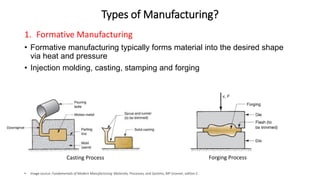
• Formative manufacturing typically forms material into the desired shape
via heat and pressure
• Injection molding, casting, stamping and forging
• Image source: Fundamentals of Modern Manufacturing: Materials, Processes, and Systems, MP Groover, edition 5.
Casting Process Forging Process
Types of Manufacturing?
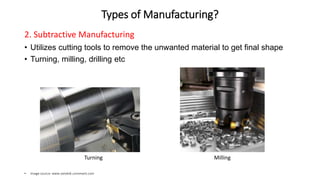
2. Subtractive Manufacturing
• Utilizes cutting tools to remove the unwanted material to get final shape
• Turning, milling, drilling etc
• Image source: www.sandvik.coromant.com
Turning Milling
Types of Manufacturing?
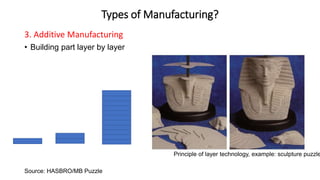
3. Additive Manufacturing
• Building part layer by layer
Source: HASBRO/MB Puzzle
Principle of layer technology, example: sculpture puzzle
Types of Manufacturing?
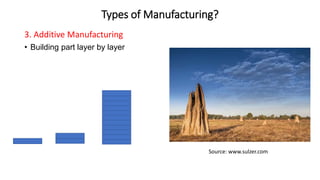
3. Additive Manufacturing
• Building part layer by layer
Source: www.sulzer.com
Types of Manufacturing?
3. Additive Manufacturing (AM)
Building up the part layer by layer
• A process of joining materials to make objects from 3D model data, usually layer
upon layer, as opposed to subtractive manufacturing methodologies [1].
[1] ISO/ASTM 52900:2015 Standard Terminology for Additive Manufacturing Technologies
CAD File Slicing 3D Printing Final physical object
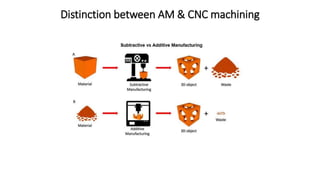
Distinction between AM & CNC machining
• Materials
• Speed
• Ease of use
• Accuracy, Size limitations & Geometric Complexity
• Programming
• Cost
• Environmentally Friendly
Advantages of AM
• Elimination of design constraints
• Allow parts to be produced with complex geometry with no additional
costs related to complexity
• Build speed; reduction of lead time
• Flexibility in design
• No expensive tooling requirements
• Dimensional accuracy
• Wide range of materials (polymers, metals, ceramics)
• Well suited to the manufacture of high value replacement and repair parts
• Green manufacturing, clean, minimal waste
Limitations of AM
• Part size
• Production series: Generally suitable for unitary or small series and is not
relevant for mass production. For small sized parts, series up to 25000
parts/year are already possible
• Material choice: Non weldable metals cannot be processed by additive
manufacturing and difficult-to-weld alloys require specific approaches.
Material properties: Parts made by additive manufacturing tend to show
anisotropy in the Z axis (construction direction).
• The densities of 99.9% can be reached, there can be some residual internal
porosities.
• Mechanical properties are usually superior to cast parts but in general
inferior to wrought parts
• 3D Printing—the fabrication of objects through the deposition of a
material using a print head, nozzle, or another printer technology.
• Additive manufacturing (AM)—a process of joining materials to make
objects from 3D model data, usually layer upon layer, as opposed to
subtractive manufacturing methodologies. Synonyms: additive
fabrication, additive processes, additive techniques, additive layer
manufacturing, layer manufacturing, and freeform fabrication.
• Rapid prototyping—additive manufacturing of a design, often
iterative, for form, fit, or functional testing, or combination thereof
• STEP, n—Standard for the Exchange of Product Model Data
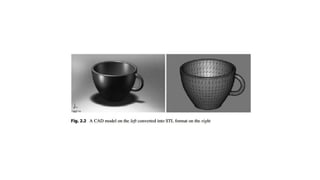
• STL, n—in additive manufacturing, file format for 3D model data used by
machines to build physical parts; STL is the de facto standard interface for
additive manufacturing systems. STL originated from the term
stereolithography
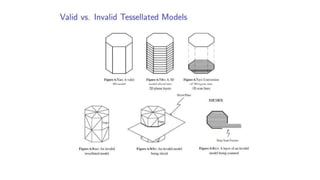
• DISCUSSION—The STL format, in binary and ASCII forms, uses triangular
facets to approximate the shape of an object. The format lists the vertices,
ordered by the right-hand rule, and unit normals of the triangles, and
excludes CAD model attributes.
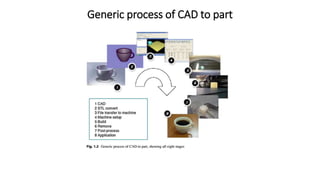
Generic process of CAD to part
STL format
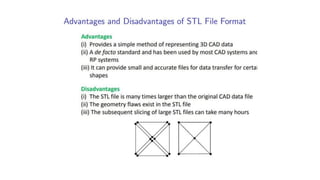
• STL (STereoLithography) is a file format native to the
stereolithography CAD software.
• I It is widely used for rapid prototyping, 3D printing and computer-
aided manufacturing.
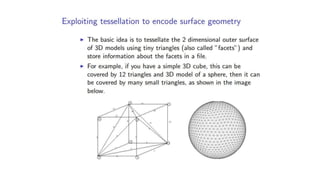
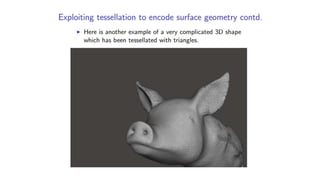
• I The main purpose of the STL file format is to encode the surface
geometry of a 3D object.
• I It encodes this information using a simple concept called
“tessellation”.
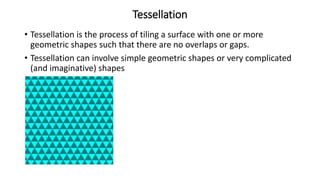
Tessellation
• Tessellation is the process of tiling a surface with one or more
geometric shapes such that there are no overlaps or gaps.
• Tessellation can involve simple geometric shapes or very complicated
(and imaginative) shapes
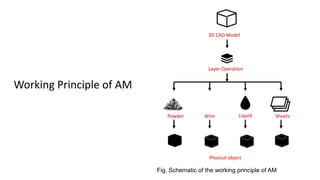
3D CAD Model
Layer Operation
Powder Wire Liquid Sheets
Physical object
Working Principle of AM
Fig. Schematic of the working principle of AM
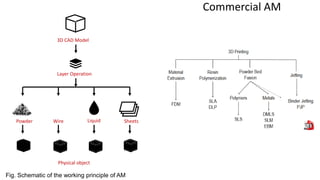
3D CAD Model
Layer Operation
Powder Wire Liquid Sheets
Physical object
Commercial AM
Fig. Schematic of the working principle of AM
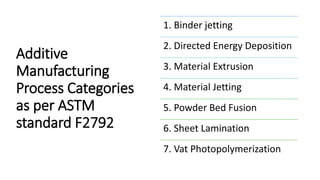
Additive
Manufacturing
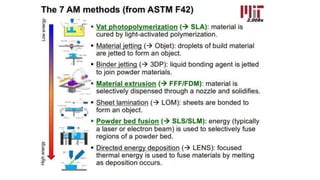
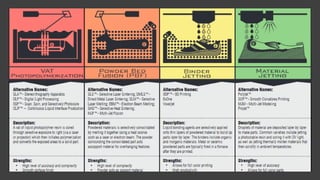
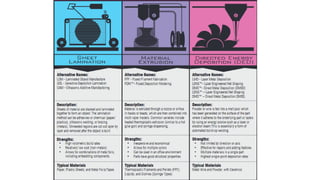
Process Categories
as per ASTM
standard F2792
1. Binder jetting
2. Directed Energy Deposition
3. Material Extrusion
4. Material Jetting
5. Powder Bed Fusion
6. Sheet Lamination
7. Vat Photopolymerization
Fused
Deposition
Modelling
http://youtube.com/watch
?v=ik39_sv-wgQ
Vat Photopolymerization (SLA)
• https://www.youtube.com/watch?v=jeCHKDxQQh0
Powder Bed Fusion
• https://www.youtube.com/watch?v=ruvRijM7f50
How Does Selective Laser Sintering (SLS) Work?
Material Jetting
• https://www.youtube.com/watch?v=sUjyKOiIhwg
How Does Multi Jet Fusion (MJF) Work?
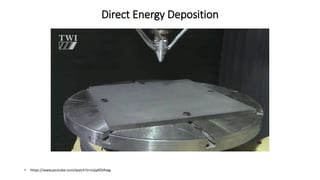
Direct Energy Deposition
• https://www.youtube.com/watch?v=sUjyKOiIhwg

CNC Technology.pptx

  • 1.
  • 2.
    Types of Manufacturing? 1.Formative Manufacturing 2. Subtractive Manufacturing 3. Additive Manufacturing
  • 3.
    Types of Manufacturing? 1.Formative Manufacturing • Formative manufacturing typically forms material into the desired shape via heat and pressure • Injection molding, casting, stamping and forging • Image source: Fundamentals of Modern Manufacturing: Materials, Processes, and Systems, MP Groover, edition 5. Casting Process Forging Process
  • 4.
    Types of Manufacturing? 2.Subtractive Manufacturing • Utilizes cutting tools to remove the unwanted material to get final shape • Turning, milling, drilling etc • Image source: www.sandvik.coromant.com Turning Milling
  • 5.
    Types of Manufacturing? 3.Additive Manufacturing • Building part layer by layer Source: HASBRO/MB Puzzle Principle of layer technology, example: sculpture puzzle
  • 6.
    Types of Manufacturing? 3.Additive Manufacturing • Building part layer by layer Source: www.sulzer.com
  • 7.
    Types of Manufacturing? 3.Additive Manufacturing (AM) Building up the part layer by layer • A process of joining materials to make objects from 3D model data, usually layer upon layer, as opposed to subtractive manufacturing methodologies [1]. [1] ISO/ASTM 52900:2015 Standard Terminology for Additive Manufacturing Technologies CAD File Slicing 3D Printing Final physical object
  • 8.
    Distinction between AM& CNC machining
  • 9.
    Distinction between AM& CNC machining • Materials • Speed • Ease of use • Accuracy, Size limitations & Geometric Complexity • Programming • Cost • Environmentally Friendly
  • 10.
    Advantages of AM •Elimination of design constraints • Allow parts to be produced with complex geometry with no additional costs related to complexity • Build speed; reduction of lead time • Flexibility in design • No expensive tooling requirements • Dimensional accuracy • Wide range of materials (polymers, metals, ceramics) • Well suited to the manufacture of high value replacement and repair parts • Green manufacturing, clean, minimal waste
  • 11.
    Limitations of AM •Part size • Production series: Generally suitable for unitary or small series and is not relevant for mass production. For small sized parts, series up to 25000 parts/year are already possible • Material choice: Non weldable metals cannot be processed by additive manufacturing and difficult-to-weld alloys require specific approaches. Material properties: Parts made by additive manufacturing tend to show anisotropy in the Z axis (construction direction). • The densities of 99.9% can be reached, there can be some residual internal porosities. • Mechanical properties are usually superior to cast parts but in general inferior to wrought parts
  • 12.
    • 3D Printing—thefabrication of objects through the deposition of a material using a print head, nozzle, or another printer technology. • Additive manufacturing (AM)—a process of joining materials to make objects from 3D model data, usually layer upon layer, as opposed to subtractive manufacturing methodologies. Synonyms: additive fabrication, additive processes, additive techniques, additive layer manufacturing, layer manufacturing, and freeform fabrication. • Rapid prototyping—additive manufacturing of a design, often iterative, for form, fit, or functional testing, or combination thereof
  • 13.
    • STEP, n—Standardfor the Exchange of Product Model Data • STL, n—in additive manufacturing, file format for 3D model data used by machines to build physical parts; STL is the de facto standard interface for additive manufacturing systems. STL originated from the term stereolithography • DISCUSSION—The STL format, in binary and ASCII forms, uses triangular facets to approximate the shape of an object. The format lists the vertices, ordered by the right-hand rule, and unit normals of the triangles, and excludes CAD model attributes.
  • 14.
    Generic process ofCAD to part
  • 16.
    STL format • STL(STereoLithography) is a file format native to the stereolithography CAD software. • I It is widely used for rapid prototyping, 3D printing and computer- aided manufacturing. • I The main purpose of the STL file format is to encode the surface geometry of a 3D object. • I It encodes this information using a simple concept called “tessellation”.
  • 17.
    Tessellation • Tessellation isthe process of tiling a surface with one or more geometric shapes such that there are no overlaps or gaps. • Tessellation can involve simple geometric shapes or very complicated (and imaginative) shapes
  • 22.
    3D CAD Model LayerOperation Powder Wire Liquid Sheets Physical object Working Principle of AM Fig. Schematic of the working principle of AM
  • 23.
    3D CAD Model LayerOperation Powder Wire Liquid Sheets Physical object Commercial AM Fig. Schematic of the working principle of AM
  • 24.
    Additive Manufacturing Process Categories as perASTM standard F2792 1. Binder jetting 2. Directed Energy Deposition 3. Material Extrusion 4. Material Jetting 5. Powder Bed Fusion 6. Sheet Lamination 7. Vat Photopolymerization
  • 28.
  • 29.
    Vat Photopolymerization (SLA) •https://www.youtube.com/watch?v=jeCHKDxQQh0
  • 31.
    Powder Bed Fusion •https://www.youtube.com/watch?v=ruvRijM7f50 How Does Selective Laser Sintering (SLS) Work?
  • 33.
  • 34.
    Direct Energy Deposition •https://www.youtube.com/watch?v=sUjyKOiIhwg

Editor's Notes

  • #4 Formative manufacturing typically forms material into the desired shape via heat and pressure. The raw material can be melted down and extruded under pressure into a mold (injection molding/die casting), melted and then poured into a mold (casting) or pressed .
  • #5 Formative manufacturing typically forms material into the desired shape via heat and pressure. The raw material can be melted down and extruded under pressure into a mold (injection molding/die casting), melted and then poured into a mold (casting) or pressed .
  • #6 It shows the so-called sculpture puzzle, in which a three-dimensional (3D) object has to be assembled from more than 100 slices. Therefore the layers have to be arranged vertically in the right sequence using a supporting stick. Additive manufacturing (AM) is an automated fabrication process based on layer technology. AM integrates two main subprocesses: the physical making of each single layer and the joining of subsequent layers in sequence to form the part. Both processes are done simultaneously. The AM build process just requires the 3D data of the part, commonly called the virtual product model.
  • #8 AM refers to a broad family of techniques that turn 3D digital designs into actual functional parts in the same way an office printer places two dimensional (2D) digital files onto pieces of paper. ASTM defines Am as …