Evidence Based
Practice
INTRODUCTION
Evidence-based practice (EBP) is a problem-solving approach to the
delivery of health care that integrates the best evidence from
studies and patient care data with clinician expertise and patient
preferences and values. (Fineout-Overholt E, 2010)
.
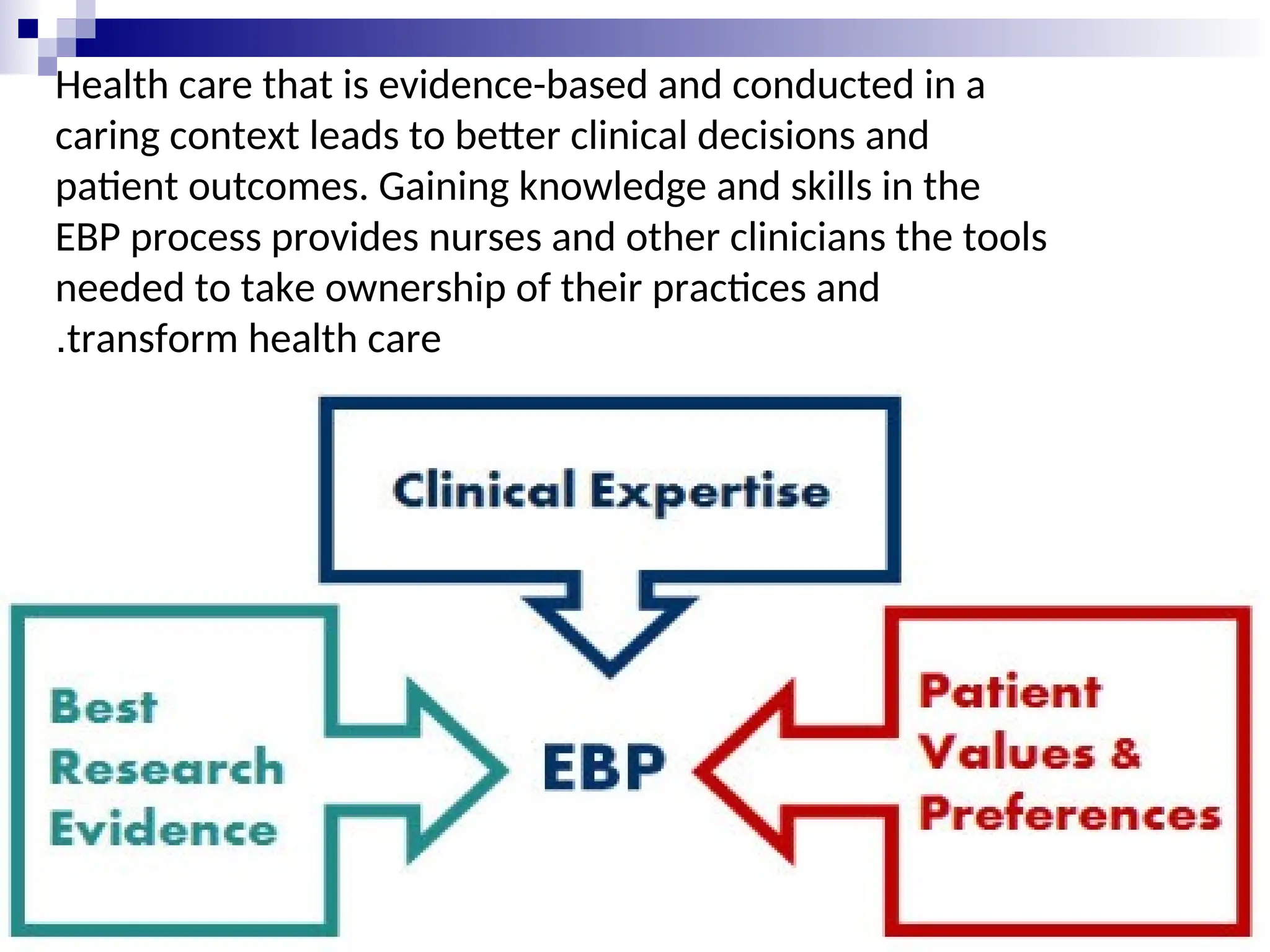
EBP is the integration of clinical expertise, patient values, and the
best research evidence into the decision making process for
patient care
.
Clinical expertise refers to the clinician’s cumulated experience,
education and clinical skills
.
The patient brings to the encounter his or her own personal
preferences and unique concerns, expectations, and values
.
Health care that is evidence-based and conducted in a
caring context leads to better clinical decisions and
patient outcomes. Gaining knowledge and skills in the
EBP process provides nurses and other clinicians the tools
needed to take ownership of their practices and
transform health care
.
KEY COMPONENTS OF EBP
A. Research evidence
.
B. Clinical expertise, judicious use
.
C. Patient values and circumstances
.
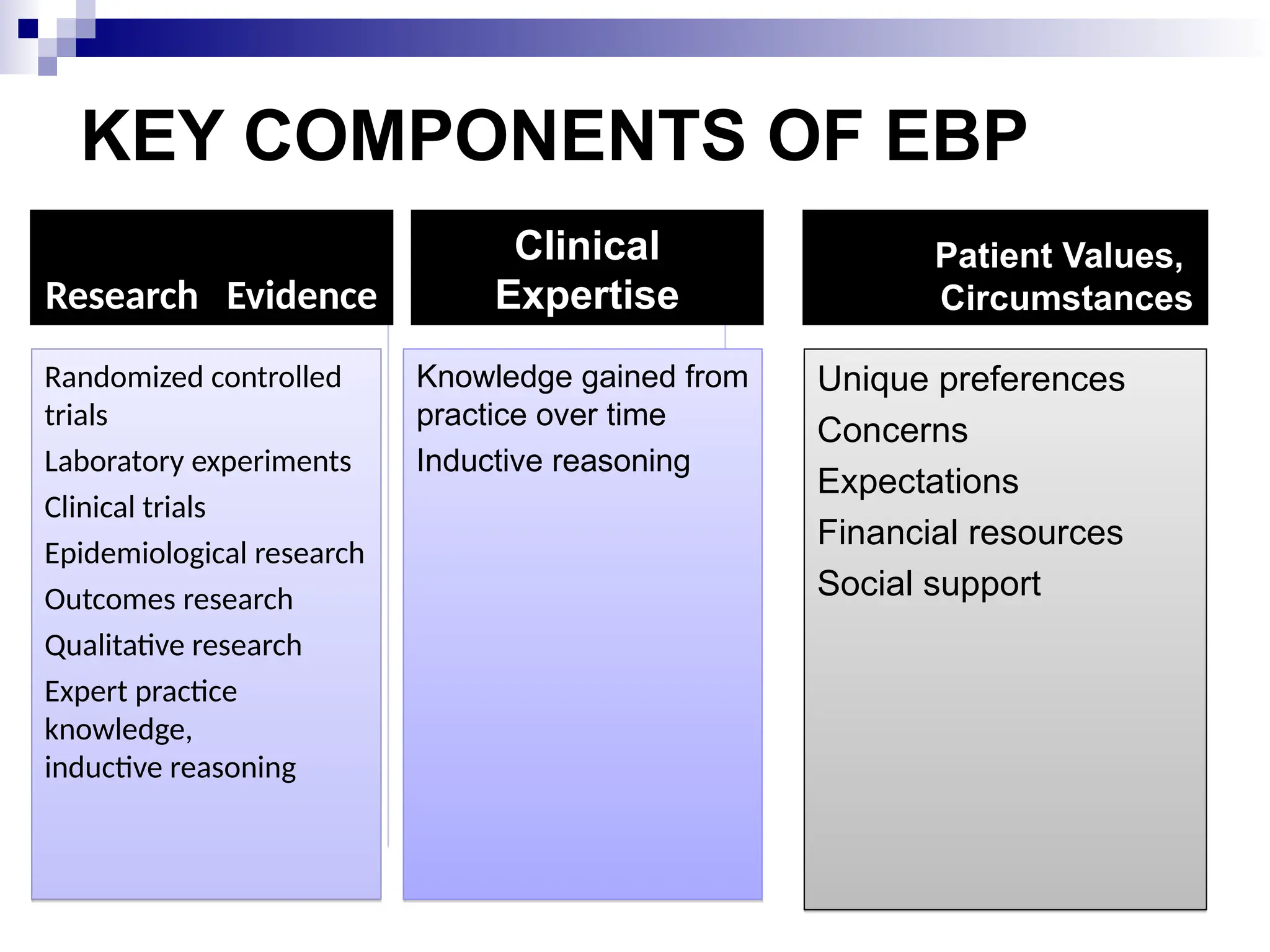
KEY COMPONENTS OF EBP
Research Evidence
Clinical
Expertise
Patient Values,
Circumstances
Randomized controlled
trials
Laboratory experiments
Clinical trials
Epidemiological research
Outcomes research
Qualitative research
Expert practice
knowledge,
inductive reasoning
Knowledge gained from
practice over time
Inductive reasoning
Unique preferences
Concerns
Expectations
Financial resources
Social support
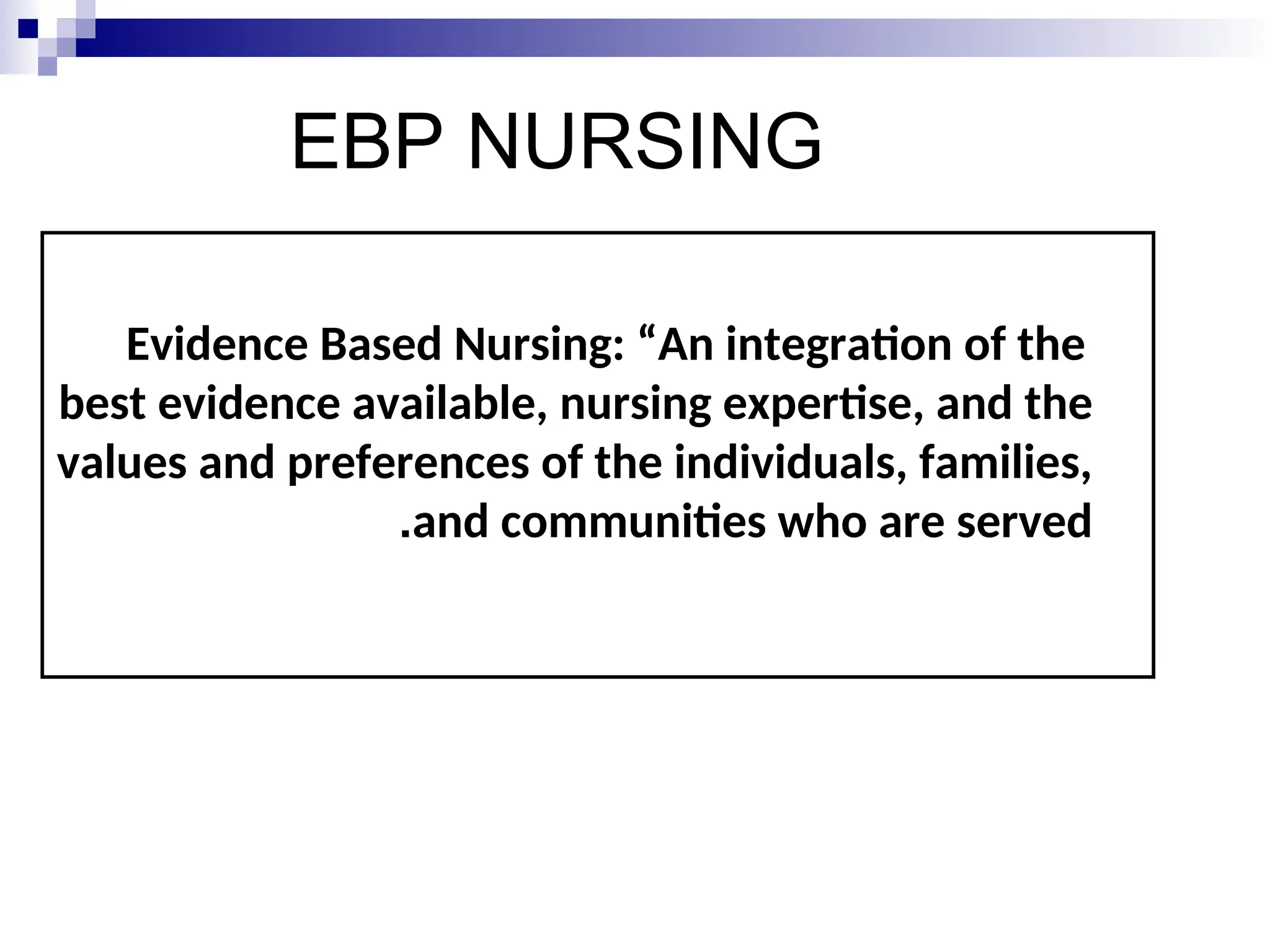
EBP NURSING
Evidence Based Nursing: “An integration of the
best evidence available, nursing expertise, and the
values and preferences of the individuals, families,
and communities who are served
.
AIMS OF EVIDENCE BASED
PRACTICE
To provide the high quality and most cost-efficient nursing care
possible
.
To advance quality of care provided by nurses
.
To increase satisfaction among patients
.
To focus on nursing practice away from habits and tradition to
evidence and research
.
It results in better patient outcomes
.
It contributes to the science of nursing
.
It keeps practices current and relevant
.
It increases confidence in decision-making
.
FEATURES of EBP
Problem based and within the scope of the practitioners experience
.
It brings together the best available evidence and current practice by
combining research with knowledge and theory. So it narrows the
research practice gap. It facilitates application of research into
practice by including both primary and secondary research findings
.
It concerned with quality of service and is therefore a Quality assurance
activity
.
EBP projects are team projects and therefore require team support and
collaborative action
.
It support research projects and outcomes that are cost effective EBP
de-emphasizes ritual, isolated and unsystematic clinical experiences
ungrounded opinions and tradition as a basis of practice. It stresses
the use of research findings
.
WHY IS EBP RELEVANT TO
THE NURSING PRACTICE
?
There is a gap between what we know and what
we do. Nursing practice can and must be
changed from tradition-based to science-
based
:
Research-practice gap: Much of what is known
from research has not been applied in
practice. This is known as Research-Practice
Gap
.
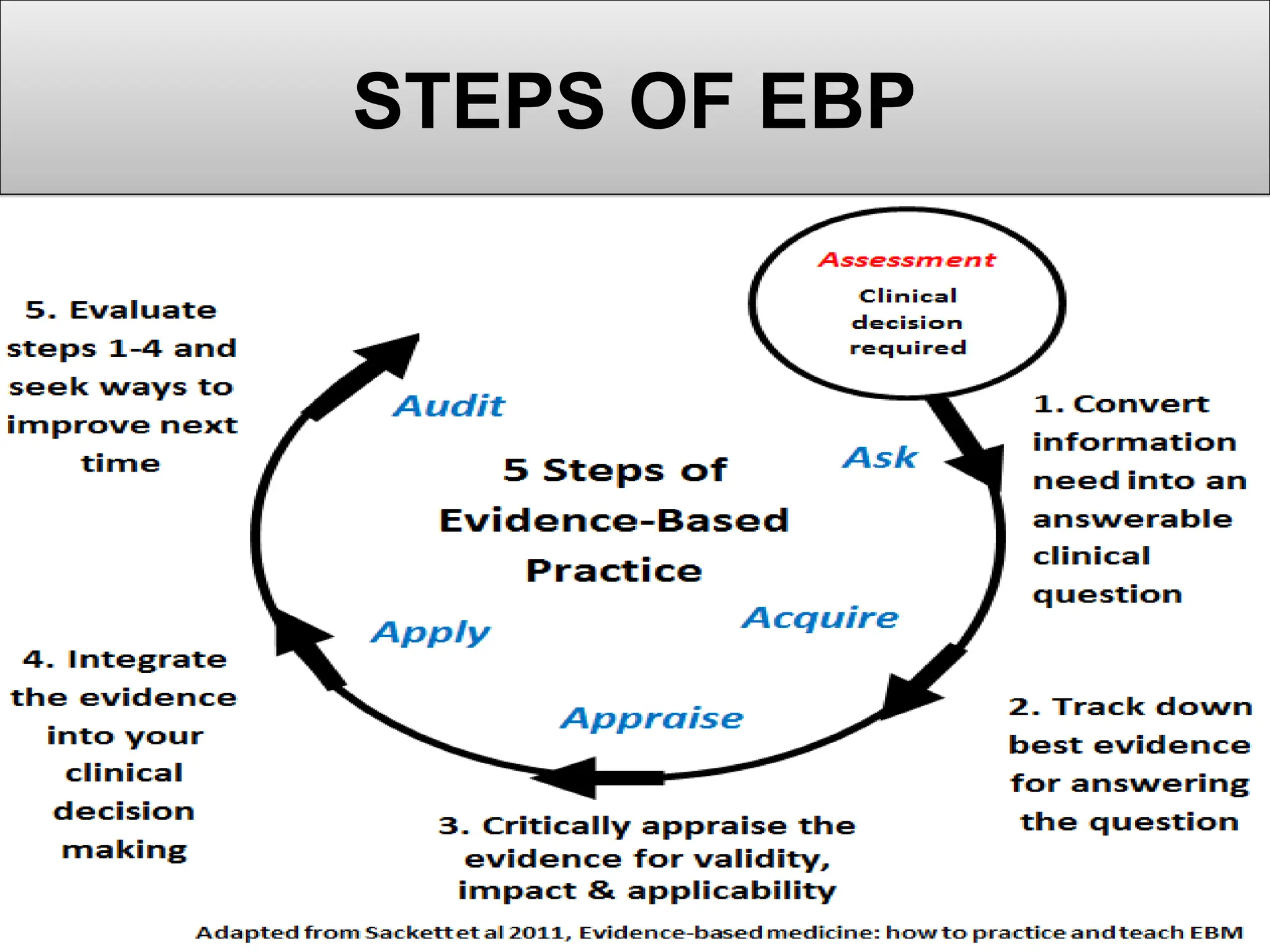
STEPS OF EBP
STEPS OF EVIDENCE BASED
PRACTICE
Step 1: formulating a well built question
Step 2: collecting the most relevant and best
evidence to answer the clinical question
including searching for systematic
reviews/identifying articles
Step 3: Critically appraising the evidence that has
been collected for its validity, relevance and
applicability
.
Step 4: integrating the evidence with ones
clinical expertise, assessment of patient’s
condition and available health care
resources along with the patients
preferences and values to implement the
evidence
.
Step 5: Evaluating the change resulting from
application of evidence in practice.
Determine the areas for improvement
.
Step1: FORMULATING THE
QUESTION
With clinical areas ,there is often a barrage of details to
digest. a well built question includes the following
components
the patients disorder or disease
the intervention or finding under review
a comparison intervention
the question should be in PICOT or PICO format
PICOT FORMAT
Patient, Population or Problem
What are the characteristics of the patient or population
?
What is the condition or disease you are interested in
?
(
i.e. age, gender, ethnicity, with a certain disorder
)
Intervention or exposure
What do you want to do with this patient (e.g. treat, diagnose, observe)
?
(
exposure to a disease, risk behavior, prognostic factor
)
Comparison
What is the alternative to the intervention (e.g. placebo, different drug,
surgery)
?
(
could be a placebo or "business as usual" as in no disease, absence of
risk factor, Prognostic factor B
)
Outcome
What are the relevant outcomes (e.g.
morbidity, death, complications, risk of
disease, accuracy of a diagnosis, rate
of occurrence of adverse outcome)
Time
What time it takes to demonstrate an
outcome (e.g. the time it takes for the
intervention to achieve an outcome or
how long participants are observed)
.
Are insulin pumps more effective than
conventional therapies in managing type 2
diabetes in pregnant women
?
Patient/Population - Pregnant women with type
2 diabetes
Intervention - Insulin pump therapy
Comparison - Conventional insulin therapy
Outcome - Improved management of glucose
levels
SEARCH STRATEGIES BACKGROUND
INFORMATION
Background information may be found in sources such as
:
reference book entries
textbooks, chapters, appendices
drug monographs, guides to diagnostic tests
the library’s Bobcat catalog
selected electronic Reference Tools for Background
information in the health science
.
Clinical Evidence
.
Clinical Evidence describes the best available
evidence from systematic reviews, RCTs, and
observational studies when appropriate for
assessing the benefits and harms of treatments
.
Dynamed
.
Dynamed is a point-of-care reference resource
designed to provide clinicians with current,
evidence-based information to support clinical
decision-making
.
Essential Evidence
.
Essential Evidence is a one-stop reference that
includes evidence-based answers to clinical
questions concerning symptoms, diseases, and
treatment
.
FPIN Clinical Inquiries
.
Clinical Inquiries provides answers to clinical
questions by using a structured search,
critical appraisal, clinical perspective, and
rigorous peer review. FPIN Clinical Inquiries
deliver evidence for point of care use
.
UpToDate
.
UpToDate is an evidence-based, peer
reviewed information resource available via
the Web, desktop/laptop computer, and
PDA/mobile device
.
Step 4. APPLYING THE EVIDENCE/INTEGRATING EVIDENCE
WITH ONES CLINICAL
EXPERTISE
If the implementation criteria are met the team can design and
plot the innovation. To reach your conclusion you may
consult questions related to diagnosis ,therapy, harm and
prognosis keep in mind that you must interpret the
information based on a number of criteria and depending on
your skill and experience ,you may need to confer with a
peer
.
example- Sample evidence practice e.g. consider a nine
year old girl present in the ER with abdominal pain and
you suspect appendicitis. which imaging modality is
best for making the diagnosis CT or ultrasound
.
Step 5. EVALUATING THE CHANGE
The fifth step of the process, outcome evaluation, attempts
to interpret the results and evaluate the outcomes of the
applied evidence (intervention). Outcome measures
may be psychosocial (quality of life, improved patient
perception of care, reduction in depressive and anxiety
symptoms), physiologic
(
improved health, reduced complications
,)
or functional
improvement. Evaluation of the process and the results
may occur through peer assessment, audit, or even self
reflection. Depending on the type of outcomes
achieved, it may be possible to compare the outcomes
of a study with similar outcomes on a local, regional,
national, or international level
.
NURSE ROLE IN EVIDENCE-
BASED PRACTICE
1
.
A nurse can be a decision-maker and coordinator of care
.
2
)
As a scientist: A nurse ensures his or her practice is evidence-
based and that institution approved protocols are utilized
.
3
)
As a transferor of knowledge: This important role is invoked
when discussing the plan of care with patients, their loved
ones, and with other members of the healthcare team
.
4
)
Manage resources and facilitate the success of unit-based EBP
workgroups
5
)
Support EBP by communicating with unit staff the
expectations for participation and available resources
Encourage broad staff participation to promote collaborative
teamwork
7
)
Become a primary vehicle for recognition of
staff nurses' success
8
)
Encourage research and research uses
.
9
)
Offer emotional and moral support to senior
staffs for evidence based practice
.
10
)
Foster a climate of intellectual curiosity
.
11
)
Attend and encourage junior staffs to
conference
12
)
The registered nurse participates, as
appropriate to education level and position, in
the formulation evidence-based practice
through research
”.
13
)
The registered nurse utilizes current
evidence- based nursing knowledge, including
research findings, to guide practice
.
14
)
Know basis for nursing practice
15
)
Expect that evidence is the foundation of
practice
16
)
Participate in EBP projects
17
)
Disseminate project findings in various
forums
18
)
Collaborate with the healthcare team to
provide quality care
CNA Class 05. nursing fundamentals EBP basics

CNA Class 05. nursing fundamentals EBP basics

  • 1.
  • 2.
    INTRODUCTION Evidence-based practice (EBP)is a problem-solving approach to the delivery of health care that integrates the best evidence from studies and patient care data with clinician expertise and patient preferences and values. (Fineout-Overholt E, 2010) . EBP is the integration of clinical expertise, patient values, and the best research evidence into the decision making process for patient care . Clinical expertise refers to the clinician’s cumulated experience, education and clinical skills . The patient brings to the encounter his or her own personal preferences and unique concerns, expectations, and values .
  • 3.
    Health care thatis evidence-based and conducted in a caring context leads to better clinical decisions and patient outcomes. Gaining knowledge and skills in the EBP process provides nurses and other clinicians the tools needed to take ownership of their practices and transform health care .
  • 4.
    KEY COMPONENTS OFEBP A. Research evidence . B. Clinical expertise, judicious use . C. Patient values and circumstances .
  • 5.
    KEY COMPONENTS OFEBP Research Evidence Clinical Expertise Patient Values, Circumstances Randomized controlled trials Laboratory experiments Clinical trials Epidemiological research Outcomes research Qualitative research Expert practice knowledge, inductive reasoning Knowledge gained from practice over time Inductive reasoning Unique preferences Concerns Expectations Financial resources Social support
  • 6.
    EBP NURSING Evidence BasedNursing: “An integration of the best evidence available, nursing expertise, and the values and preferences of the individuals, families, and communities who are served .
  • 7.
    AIMS OF EVIDENCEBASED PRACTICE To provide the high quality and most cost-efficient nursing care possible . To advance quality of care provided by nurses . To increase satisfaction among patients . To focus on nursing practice away from habits and tradition to evidence and research . It results in better patient outcomes . It contributes to the science of nursing . It keeps practices current and relevant . It increases confidence in decision-making .
  • 8.
    FEATURES of EBP Problembased and within the scope of the practitioners experience . It brings together the best available evidence and current practice by combining research with knowledge and theory. So it narrows the research practice gap. It facilitates application of research into practice by including both primary and secondary research findings . It concerned with quality of service and is therefore a Quality assurance activity . EBP projects are team projects and therefore require team support and collaborative action . It support research projects and outcomes that are cost effective EBP de-emphasizes ritual, isolated and unsystematic clinical experiences ungrounded opinions and tradition as a basis of practice. It stresses the use of research findings .
  • 9.
    WHY IS EBPRELEVANT TO THE NURSING PRACTICE ? There is a gap between what we know and what we do. Nursing practice can and must be changed from tradition-based to science- based : Research-practice gap: Much of what is known from research has not been applied in practice. This is known as Research-Practice Gap .
  • 10.
  • 11.
    STEPS OF EVIDENCEBASED PRACTICE Step 1: formulating a well built question Step 2: collecting the most relevant and best evidence to answer the clinical question including searching for systematic reviews/identifying articles Step 3: Critically appraising the evidence that has been collected for its validity, relevance and applicability .
  • 12.
    Step 4: integratingthe evidence with ones clinical expertise, assessment of patient’s condition and available health care resources along with the patients preferences and values to implement the evidence . Step 5: Evaluating the change resulting from application of evidence in practice. Determine the areas for improvement .
  • 13.
    Step1: FORMULATING THE QUESTION Withclinical areas ,there is often a barrage of details to digest. a well built question includes the following components the patients disorder or disease the intervention or finding under review a comparison intervention the question should be in PICOT or PICO format
  • 14.
    PICOT FORMAT Patient, Populationor Problem What are the characteristics of the patient or population ? What is the condition or disease you are interested in ? ( i.e. age, gender, ethnicity, with a certain disorder ) Intervention or exposure What do you want to do with this patient (e.g. treat, diagnose, observe) ? ( exposure to a disease, risk behavior, prognostic factor ) Comparison What is the alternative to the intervention (e.g. placebo, different drug, surgery) ? ( could be a placebo or "business as usual" as in no disease, absence of risk factor, Prognostic factor B )
  • 15.
    Outcome What are therelevant outcomes (e.g. morbidity, death, complications, risk of disease, accuracy of a diagnosis, rate of occurrence of adverse outcome) Time What time it takes to demonstrate an outcome (e.g. the time it takes for the intervention to achieve an outcome or how long participants are observed) .
  • 16.
    Are insulin pumpsmore effective than conventional therapies in managing type 2 diabetes in pregnant women ? Patient/Population - Pregnant women with type 2 diabetes Intervention - Insulin pump therapy Comparison - Conventional insulin therapy Outcome - Improved management of glucose levels
  • 17.
    SEARCH STRATEGIES BACKGROUND INFORMATION Backgroundinformation may be found in sources such as : reference book entries textbooks, chapters, appendices drug monographs, guides to diagnostic tests the library’s Bobcat catalog selected electronic Reference Tools for Background information in the health science .
  • 18.
    Clinical Evidence . Clinical Evidencedescribes the best available evidence from systematic reviews, RCTs, and observational studies when appropriate for assessing the benefits and harms of treatments . Dynamed . Dynamed is a point-of-care reference resource designed to provide clinicians with current, evidence-based information to support clinical decision-making . Essential Evidence . Essential Evidence is a one-stop reference that includes evidence-based answers to clinical questions concerning symptoms, diseases, and treatment .
  • 19.
    FPIN Clinical Inquiries . ClinicalInquiries provides answers to clinical questions by using a structured search, critical appraisal, clinical perspective, and rigorous peer review. FPIN Clinical Inquiries deliver evidence for point of care use . UpToDate . UpToDate is an evidence-based, peer reviewed information resource available via the Web, desktop/laptop computer, and PDA/mobile device .
  • 20.
    Step 4. APPLYINGTHE EVIDENCE/INTEGRATING EVIDENCE WITH ONES CLINICAL EXPERTISE If the implementation criteria are met the team can design and plot the innovation. To reach your conclusion you may consult questions related to diagnosis ,therapy, harm and prognosis keep in mind that you must interpret the information based on a number of criteria and depending on your skill and experience ,you may need to confer with a peer . example- Sample evidence practice e.g. consider a nine year old girl present in the ER with abdominal pain and you suspect appendicitis. which imaging modality is best for making the diagnosis CT or ultrasound .
  • 21.
    Step 5. EVALUATINGTHE CHANGE The fifth step of the process, outcome evaluation, attempts to interpret the results and evaluate the outcomes of the applied evidence (intervention). Outcome measures may be psychosocial (quality of life, improved patient perception of care, reduction in depressive and anxiety symptoms), physiologic ( improved health, reduced complications ,) or functional improvement. Evaluation of the process and the results may occur through peer assessment, audit, or even self reflection. Depending on the type of outcomes achieved, it may be possible to compare the outcomes of a study with similar outcomes on a local, regional, national, or international level .
  • 22.
    NURSE ROLE INEVIDENCE- BASED PRACTICE 1 . A nurse can be a decision-maker and coordinator of care . 2 ) As a scientist: A nurse ensures his or her practice is evidence- based and that institution approved protocols are utilized . 3 ) As a transferor of knowledge: This important role is invoked when discussing the plan of care with patients, their loved ones, and with other members of the healthcare team . 4 ) Manage resources and facilitate the success of unit-based EBP workgroups 5 ) Support EBP by communicating with unit staff the expectations for participation and available resources Encourage broad staff participation to promote collaborative teamwork
  • 23.
    7 ) Become a primaryvehicle for recognition of staff nurses' success 8 ) Encourage research and research uses . 9 ) Offer emotional and moral support to senior staffs for evidence based practice . 10 ) Foster a climate of intellectual curiosity . 11 ) Attend and encourage junior staffs to conference 12 ) The registered nurse participates, as appropriate to education level and position, in the formulation evidence-based practice through research ”.
  • 24.
    13 ) The registered nurseutilizes current evidence- based nursing knowledge, including research findings, to guide practice . 14 ) Know basis for nursing practice 15 ) Expect that evidence is the foundation of practice 16 ) Participate in EBP projects 17 ) Disseminate project findings in various forums 18 ) Collaborate with the healthcare team to provide quality care