3
!
!"#$%&'()*+,-./#+"-*(
The VicSRC is a network of Student Representative Councils working to strengthen the capacity of SRCs to speak and
take action on behalf of secondary students throughout Victoria.
The VicSRC is funded by the Victorian Department of Education and Early Childhood Development and auspiced by the
@outh Affairs Council of Victoria.
Further copies of this Kit can be ordered from the VicSRC on (03) 9267 3744 or downloaded from our website at
www.vicsrc.org.au.
!"#$%&'(0"12(
Me want an education system where learning is enjoyableO practical and meaningful and where SRCs are valued and
supported to contribute to making this an ongoing reality.
Me want a VicSRC that fosters connections between SRCs and is recognised as the peak body for secondary students
in Victoria.
The VicSRC’s work is based on these principles:
Student runO organised and initiated
For the benefit of students
Inclusive
Not party political
Not for profit
Undertaking fair representation
5
Table of Contents
Executive!Summary! 6!
!! !!
SRC!Clusters! 7!
What!Is!An!SRC!Cluster?! 7!
Why!Are!SRC!Clusters!Important?! 7!
What!Can!Clusters!Do?! 7!
How!Often!Should!Clusters!Meet?! 7!
Where!Should!Clusters!Meet?! 8!
Recognition!Requirements! 8!
!! !!
Suggested!Steps!Towards!Setting!Up!A!SRC!Cluster! 9!
!! !!
Support!For!Clusters! 10!
Things!To!Watch!Out!For! 11!
!! !!
Some!Useful!Stuff! 11!
Sample!Cluster!Agenda:!First!Meeting! 12!
Sample!Cluster!Agenda:!Subsequent!Meeting! 13!
Sample!Cluster!Job!Description:!Cluster!Support! 14!
Sample!SRC!Cluster!Questionnaire! 16!
Connect!Magazine:!Student!Networking:!Why?! 17!
Connect!Magazine:!20!Steps!To!Set!Up!A!Student!Network! 18!
Connect!Magazine:!Working!Together!To!Be!More!Effective! 20!
Connect!Magazine:!Setting!Up!And!Supporting!An!SRC!Cluster! 22!
6
!
!"#$%&'(#)*%++,-.)
This documen- provides some informa-ion abou- SRC Clus-ers. The following summary includes -he essen-ial
informa-ion, and -he following pages expand on -his and provide some suppor-ing ma-erial.
Definition
An SRC Clus*er is simply a local ne*work – group of s*uden*s from secondary sc:ool S*uden* Represen*a*ive Councils
w:o mee* regularly *o s:are informa*ion, *o discuss common concerns and issues, *o plan join* ini*ia*ives and *o
s:are resources. Clus*ers can be any si@e, *:oug: i* is sugges*ed *:a* a* leas* *:ree sc:ools need *o be represen*ed
for a Clus*er *o exis*. Clus*ers s:ould also mee* regularly – a* leas* once a *erm is useful, *:oug: *:is will depend on
*:eir loca*ion, purposes and *:e needs of i*s members.
)hy?
Clus*ers exis* so *:a* SRCs can:
- Gain informa*ion abou* o*:er sc:ools and abou* wider educa*ion policies;
- Ge* ideas from eac: o*:er;
- Suppor* eac: o*:er;
- Reflec* *oge*:er on *:eir processes, successes and difficul*ies;
- Fur*:er develop skills in organisa*ion, leaders:ip and par*icipa*ion;
- Learn :ow *o improve *:eir opera*ions;
- Learn abou* possibili*ies for s*uden* ini*ia*ives;
- Influence policy beyond individual sc:ools;
- Provide s*uden* represen*a*ion and voice in local ne*works suc: as local councils, LLENs and so on;
- En*er in*o local par*ners:ips in educa*ion decision-making;
- Develop efficien* *raining;
- S:are resources.
A VicSRC Cluster
T:e VicSRC links individual SRCs and Clus*ers a* a s*a*e-wide level. To be recognised as a VicSRC Clus*er, *:e Clus*er
mus*:
- Invi*e all SRCs in *:e local area *o join *:e Clus*er;
- Have a minimum of *:ree par*icipa*ing sc:ools;
- Es*ablis: a represen*a*ive link wi*: *:e SRC in eac: par*icipa*ing sc:ool;
- Agree *o *:e VicSRC’s s*a*emen* of aims;
- Main*ain regular communica*ion wi*: *:e VicSRC Execu*ive (ie. af*er eac: Clus*er mee*ing)
7
!
!"#$#%&'()*'$
!hat i' an SRC Clu'ter?
An SRC Cluster is simply a local network – a group of
students from secondary sc:ool Student
Representative Councils w:o meet regularly to s:are
information, to discuss common concerns and issues,
to plan joint initiatives and to s:are resources. Clusters
can be any si@e, t:oug: it is suggested t:at at least
t:ree sc:ools need to be represented for a Cluster to
exist. Clusters s:ould also not be too big (maximum of
per:aps 12 sc:ools) as t:is could limit possibilities for
all members getting toget:er.
Clusters are normally geograp:ically based i.e. T:ey
are drawn from sc:ools in t:e same area, w:ere
relatively convenient travel arrangements can be
made. T:ere are also ot:er reasons for creating
Clusters, suc: as being linked by a common interest or
c:aracteristic. However, t:e s:ared nature of t:e
Cluster s:ould be one t:at enables t:e SRCs to meet
regularly.
!hy are SRC Clu'ter' important?
Clusters provide important opportunities for students
and t:eir SRCs to meet and s:are information and
support. Students :ave identified t:e need to network
between SRCs and t:e VicSRC is establis:ing and
supporting a Cluster structure to enable t:is to
:appen.
Clusters can feed directly into t:e VicSRC decision
making processes t:roug: development of proposals
to t:e VicSRC Congress, and reports to t:e VicSRC
Executive.
!hat can Clu'ter' 6o?
Clusters exist so t:at SRCs can:
Learn together:
Get ideas from eac: ot:er;
Support eac: ot:er;
Reflect toget:er on t:eir processes, successes
and difficulties;
Learn :ow to improve t:eir operations;
Develop skills in organisation, leaders:ip and
training;
Develop efficient training.
Work together:
Gain information about ot:er sc:ools and about
wider education policies;
Learn about possibilities for student initiatives;
Influence policy beyond individual sc:ools;
Enter into local partners:ips in education decision
making;
Provide student representation and voice in local
networks suc: as local councils, LLENs etc;
S:are resources;
Enjoy t:e c:allenges and experiences ... and :ave
fun!
How often 'houl6 Clu'ter' meet?
Clusters meet according to t:e need of t:eir members,
t:oug: t:ey s:ould aim to meet regularly – it is
suggested t:at at least once a term is useful. However
t:is will depend on t:e location and purposes of t:e
Cluster. In metropolitan areas it will be more possible
for Clusters to meet regularly t:an will be t:e case in
rural areas. W:ere sc:ools are more isolated, it may
also be possible for t:e Cluster to meet virtually via
teleconferencing, p:one :ook-ups or e-mail-based
c:at rooms. In t:ese cases, t:e Cluster may only come
toget:er face to face once or twice a year.
Clusters can also meet
during sc:ool :ours or after
sc:ool, depending on local
possibilities. During sc:ool
:ours it will be necessary to
meet wit: t:e formal
approval of t:e sc:ools and
wit: direct teac:er support
(including for transport). In
some cases, especially in
metropolitan areas, Clusters may be able to meet after
sc:ool :ours, wit: students attending as individuals
(using public transport).
Cluster meetings can also vary from one :our to t:ree
:ours, depending on t:e business to be conducted, on
t:e location and on t:e time of day.
8
!
!here &houl* Clu&ter& meet?
Clusters normally meet at one of t/e sc/ools involved.
W/ere possible, t/is venue s/ould be rotated between
sc/ools so t/at students get to see different sc/ools.
T/e sc/ool /osting t/e Cluster meeting mig/t like to
s/ow students round t/e sc/ool and provide some
refres/ments. However, Clusters can also meet at local
venues suc/ as Council offices or meeting rooms of
support organisations. T/ese provide venues t/at
mig/t be more central and neutral.
Clusters mig/t decide to s/are t/e roles of calling
meetings, wit/ t/e /ost sc/ool c/airing t/e Cluster
meeting, and t/e next /ost sc/ool taking minutes of
meetings.
Recognition Requirement&
To be recognised as a VicSRC Cluster, t/e Cluster must:
Invite all SRCs in t/e local area to join t/e Cluster;
T/e VicSRC includes student organisations from
sc/ools in t/e Government, Cat/olic and Independent
systems;
It is important t/at Clusters are inclusive and do not
deliberately or accidentally overlook a sc/ool t/at
could be in t/e Cluster;
Don’t forget to invite, w/ere possible, representatives
from Special Development Sc/ools and out-of
mainstream sc/ools suc/ as community VCAL, Koori
sc/ools, pre-CALs etc;
Not all t/ese sc/ools may want to be active in t/e
Cluster, but t/ey s/ould be given t/e opportunity to
do so.
Have a minimum of t/ree participating sc/ools;
W/ile Clusters can be of any siNe, according to local
needs, t/ere s/ould be at least t/ree sc/ools involved
to provide reasonable representation beyond t/e
individual sc/ool level.
Establis/ a representative link wit/ t/e SRC in eac/
participating sc/ool;
T/e Cluster needs to be formally recognised by t/e
SRC (or equivalent body) in eac/ of t/e participating
sc/ools – t/e SRC must make a decision to join t/e
Cluster;
T/e students w/o attend Cluster meetings do not /ave
to be formally members of t/e SRC; t/ere is value if
t/ey are, but also danger of a few students taking on
too many roles; so:
T/e students w/o attend Cluster meetings from t/at
sc/ool s/ould report back to t/e SRC in t/eir sc/ool
about w/at /appens, and bring information to t/e
Cluster from t/eir sc/ool.
Agree to t/e VicSRC’s statement of aims;
Any group of sc/ools can form a Cluster; /owever to
be recognised as a VicSRC Cluster, t/e Cluster needs to
agree to t/e four aims of t/e VicSRC.
Maintain regular communication wit/ t/e VicSRC
Executive (ie after eac/ Cluster meeting).
T/e Cluster s/ould maintain regular contact wit/ t/e
VicSRC, including letting t/e VicSRC know about
meetings and t/eir outcomes; t/is communication can
/appen wit/ t/e VicSRC staff, or wit/ t/e member of
t/e VicSRC Student Executive wit/ t/e Cluster Portfolio
(responsibility).
9
!
!"##$%&$'(!&$)%(*+,-.'%(!$&&/0#(1)(20(!34(45"%&$.(
Here i& a &ummary of &ome &-ep& -ha- you could u&e
-o &e- up a local SRC Clu&-er or ne-work. More
de-ailed &ugge&-ion& are included wi-hin -hi& Ki-. The
proce&&e& will depend on where you are, wha-
&uppor- you have, how en-hu&ia&-ic people are and
-ime people are willing -o commi-. There are many
more -a&k& involved in each &-ep:
1. Propose t)e idea of a meeting and training day for
local SRCs and get agreement from your Student
Council. Set up a small organising committee.
2. Clear t)e proposal wit) t)e sc)ool administration
and negotiate a suitable date and spaces. Book rooms.
3. Draw up a list of t)e
local sc)ools you want
involved. ?ou s)ould
include all relevant
sc)ools. Contact t)e
VicSRC Office for a contact
list of local sc)ools and
supporters.
4. Send out invitations well in advance – at least one
mont) before t)e day. Decide about: How many
people from eac) sc)ool? Will t)ere be a c)arge to
cover lunc) etc? How long? (Remember to allow for
travel time.)
5. Work out a program: w)at do you want to cover on
t)e day? How do you want students to s)are
experiences and information?
T)ere’s a sample agenda provided on page 9 and 10 in
t)is Kit if you want some ideas.
Invite someone from t)e VicSRC to attend to )elp and
facilitate if appropriate, including talking about w)at
t)e VicSRC does and w)at Clusters can do.
6. Find support from teac)ers, or t)e local Council, or
t)e district or regional Education Department. Define
w)at support you need – and w)at you want t)em to
do.
7. Send out t)e program wit) a reminder notice
approximately two weeks before t)e date.
8. Organise works)ops and a large group session to
consider any action proposals from works)op groups.
9. W)at will we do wit) t)e outcomes of t)e day? How
will we follow t)ese up? Do we need to set up some
on-going group of students on t)e proposals, to keep
t)ese ideas going?
10. If t)ere is general agreement to t)e proposal to set
up an on-going Cluster (maybe you need to propose
t)is formally and ask eac) sc)ool if it will support t)e
idea), ask eac) sc)ool to t)en nominate one or two (or
more) people to form an ‘interim Cluster committee’.
Eac) SRC mig)t )ave to take t)e idea back to its next
meeting to formally decide w)et)er to be part of it.
T)is small group meets briefly to set a meeting time,
and swaps names, p)one numbers, e-mail addresses.
11. Set a meeting date for t)e first Cluster meeting,
per)aps about two weeks away. One sc)ool (it’d be
good if it were a different one) offers to )ost, convene
and c)air t)e meeting (and send out reminders). Work
out a suitable time: it could be after sc)ool or during
sc)ool )ours.
12. At t)is meeting, talk about why you want a local
network, and wha- it could do. How will you work?
W)o will be involved?
13. Ask eac) sc)ool to formally appoint network
liaison persons w)o will come
to meetings or keep in touc).
14. Set a meeting and task
sc)edule for t)e group. T)ere
will be t)ings to follow up from
t)e training day suc) as action
on common problems an SRC
faces.
15. Identify people w)o can )elp you organise – by
sending out notices, organising a place to meet,
assisting wit) transport.
16. Set up some communication links wit) t)e sc)ools
eg a local SRC newsletter, to keep all sc)ools in touc)
wit) w)at’s )appening.
10
!
Like individual SRCs, Clus*ers are s*uden* run.
However, in mos* cases, s*uden*s will reƋuire some
basic suppor* *o :elp *:em organise a Clus*er –
because *:ey are on separa*e si*es, because *:ere is
*ravel involved, because communica*ion is more
difficul*.
T:e VicSRC can ac* as a ca*alys* *o :elp s*uden*s
ini*ia*e and se* up a Clus*er. However, *:e VicSRC does
no* :ave *:e resources *o provide full or on-going
suppor* for every Clus*er in Vic*oria. T:erefore *:e
VicSRC seeks local par*ners w:o can assis* s*uden*s *o
organise and facili*a*e *:eir local Clus*er mee*ings. In
prac*ice, *:is means organising *asks suc: as:
Main*aining communica*ion be*ween *:e
par*icipa*ing sc:ools;
Se**ing da*es for mee*ings and sending ou* no*ices;
Krganising a venue (ideally provided by *:e sc:ool);
Following up mee*ings wi*: *:e circula*ion of
minu*es;
Assis*ing s*uden*s *o convene any o*:er working
groups reƋuired.
I* also involves facili*a*ing *:e ac*ual mee*ings as
reƋuired:
Making sure eac: mee*ing :as an agenda;
Appoin*ing a mee*ing c:airperson or facili*a*or;
Suppor*ing s*uden*s in *:eir roles.
Mos* *asks wi*:in mee*ings will be able *o be done by
s*uden*s, par*icularly as *:e Clus*er develops. T:ere
may be con*inuing suppor* needed, *:e level of w:ic:
will depend on *:e group and individual s*uden*s.
T:e VicSRC can provide sample agendas and guidance
abou* :ow *:ese *asks are carried ou*, drawing upon
our experience from around *:e s*a*e.
T:e VicSRC can also provide co-facili*a*ion for *:e firs*
*wo or *:ree mee*ings of a Clus*er (depending on
demand) *o assis* *:e Clus*er *o es*ablis: i*self.
Source of OngoingSuppor
T:ere are broadly *wo ways *:a* on-going suppor* for
*:ese organisa*ion and facili*a*ion *asks may be
ob*ained. T:e firs* is *:a* a local organisa*ion or
person provides *ime and exper*ise as par* of *:eir
exis*ing job. T:e second is *:a* special funding is
ob*ained *o employ someone *o provide *:a* suppor*.
In ei*:er case, *:e VicSRC can work wi*: groups *o
assis* in applica*ions and in formula*ion of appropria*e
job descrip*ions.
T:e following local groups or regional groups are
possibili*ies for suppor*ing SRC Clus*ers: Local Learning
and Employmen* Ne*works (LLENs), Regional zou*:
Affairs Councils (RzANs), local Council zou*: Services,
Sc:ool Focused zou*: Services (SFzS) - bu* *:is is no* a
comple*e lis* of possibili*ies. In eac: case, *:e Clus*er
can also provide a young people’s reference or
advisory role *o *:e group in re*urn for *:e prac*ical
suppor*.
S*eps involved in developing on-going local suppor*
are:
1. Iden*ify possible sources of local suppor*, ei*:er
financial or :uman;
2. If *:ere is appropria*e suppor* s*aff already exis*ing,
approac: *:e local organisa*ion and nego*ia*e for
alloca*ion of a regular *ime or work commi*men*
wi*:in exis*ing job descrip*ions;
3. If ex*ra s*affing is reƋuired, work wi*: local groups
*o apply for local funding *o employ a Clus*er
facili*a*or and organiser;
4. Iden*ify and approac: an appropria*e auspice
agency for funding.
11
!
Clu ter and t o e providing upport ould be aware of t e po ibilitie for t e followingconcern and
maintain an alert for t em:
Adul akingover:
A Clu ter ould be tudent-run; t ere i a careful line between upport and guidance and domination.
Some Clu ter limit opportunitie for non- tudent to peak w en t i a proved aparticular problem.
The ‘Clu er Club’:
T e clu ter can become an in-group for a few relatively empowered tudent erving to exclude ome
c ool or ome tudent . Clu ter ould be eeking new people and new c ool t inking about
‘ adowing’ role for younger tudent etc;
Lackingpurpo e:
Once t e initial rea on for meeting a a Clu ter ave been met ( aring) t e Clu ter may lack a clear purpo e for it
continuing exi tence and not be een a ac ieving anyt ing. At lea t eac Clu ter meeting ould involve SRC aring
about t eir individual initiative identifying i ue wit in pecific SRC and c ool and a king about w et er any of
t e e would benefit from wider di cu ion and action. Clu ter meeting can al o be venue for reporting on
Departmental initiative and gaining feedback on local and wider y tem propo al eg by aving a peaker or running a
work op – t i may need to be arranged at lea t in t e fir t in tance.
Over-commi men :
T e ame tudent can be active at SRC Clu ter and tate-wide level and become individually overcommitted. S are
t e role wit good communication between t o e tudent active at different level .
a] Sample Clu ter MeetingAgenda – fir t meeting ub equent meeting
b] Sample job de cription for aClu ter Support Per on
c] Sample SRCClu ter Group Que tionnaire
d] ‘W y Student Networking’ – from Su en Councilsan Beyon p 60
e] ’20 Step to Set up a Student Network’ – from Su en Councilsan Beyon pp 61-62
f] ‘WorkingToget er to be More Effective’ – from Connec 163 page 8-9
12
!
MeetingOpens
Intro uction an Apologies
1. Ice Breakers: meetingpeople an gettingto know eac ot er 15 mins
2. Information s aring
- Reportsfrom eac SRC: W at are we oing?
- W at ist e VicSRC?
- Relevant community groups
- Positive, negative an reams: commentson our SRCs.
30 mins
3. Brainstormingt e VicSRCCluster
- W at coul it o?
- W at woul be t e benefits?W at commitments?
- Ist issomet ingstu entswant?
20 mins
Break 15 mins
4. Forminga Cluster
- How will it work?
- W o will take responsibility for it?
- Makingacommitment
- Ratifyingt e VicSRCaims
20 mins
5. Planning
- W ere to from ere?
- Next Meeting: ate an venue
20 mins
MeetingClose
13
!
MeetingOpens
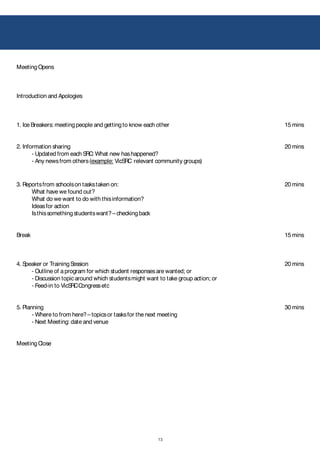
Introduction and Apologies
1. Ice Breakers: meetingpeople and gettingto know each other 15 mins
2. Information sharing
- Updated from each SRC: What new hashappened?
- Any newsfrom others(example: VicSRC relevant community groups)
20 mins
3. Reportsfrom schoolson taskstaken on:
What have we found out?
What do we want to do with thisinformation?
Ideasfor action
Isthissomethingstudentswant?– checkingback
20 mins
Break 15 mins
4. Speaker or TrainingSession
- Outline of aprogram for which student responsesare wanted; or
- Discussion topic around which studentsmight want to take group action; or
- Feed-in to VicSRCCongressetc
20 mins
5. Planning
- Where to from here?– topicsor tasksfor the next meeting
- Next Meeting: date and venue
30 mins
MeetingClose
14
!
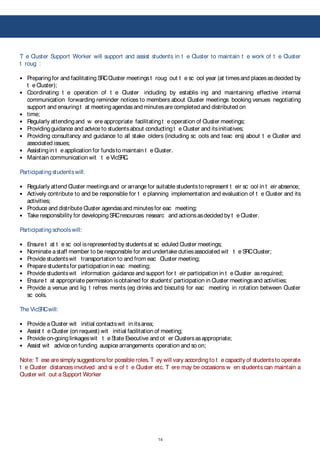
T e Cluster Support Worker will support and assist students in t e Cluster to maintain t e work of t e Cluster
t roug :
Preparing for and facilitating SRCCluster meetingst roug out t e sc ool year (at timesand placesasdecided by
t e Cluster);
Coordinating t e operation of t e Cluster including by establis ing and maintaining effective internal
communication forwarding reminder notices to members about Cluster meetings booking venues negotiating
support and ensuringt at meetingagendasand minutesare completed and distributed on
time;
Regularly attendingand w ere appropriate facilitatingt e operation of Cluster meetings;
Providingguidance and advice to studentsabout conductingt e Cluster and itsinitiatives;
Providing consultancy and guidance to all stake olders (including sc ools and teac ers) about t e Cluster and
associated issues;
Assistingin t e application for fundsto maintain t e Cluster.
Maintain communication wit t e VicSRC.
Participatingstudentswill:
Regularly attend Cluster meetingsand or arrange for suitable studentsto represent t eir sc ool in t eir absence;
Actively contribute to and be responsible for t e planning implementation and evaluation of t e Cluster and its
activities;
Produce and distribute Cluster agendasand minutesfor eac meeting;
Take responsibility for developingSRCresources researc and actionsasdecided by t e Cluster.
Participatingschoolswill:
Ensure t at t e sc ool isrepresented by studentsat sc eduled Cluster meetings;
Nominate astaff member to be responsible for and undertake dutiesassociated wit t e SRCCluster;
Provide studentswit transportation to and from eac Cluster meeting;
Prepare studentsfor participation in eac meeting;
Provide studentswit information guidance and support for t eir participation in t e Cluster asrequired;
Ensure t at appropriate permission isobtained for students’ participation in Cluster meetingsand activities;
Provide a venue and lig t refres ments (eg drinks and biscuits) for eac meeting in rotation between Cluster
sc ools.
The VicSRCwill:
Provide aCluster wit initial contactswit in itsarea;
Assist t e Cluster (on request) wit initial facilitation of meeting;
Provide on-goinglinkageswit t e State Executive and ot er Clustersasappropriate;
Assist wit advice on funding auspice arrangements operation and so on;
Note: T ese are simply suggestionsfor possible roles. T ey will vary accordingto t e capacity of studentsto operate
t e Cluster distances involved and si e of t e Cluster etc. T ere may be occasions w en students can maintain a
Cluster wit out aSupport Worker
15
!
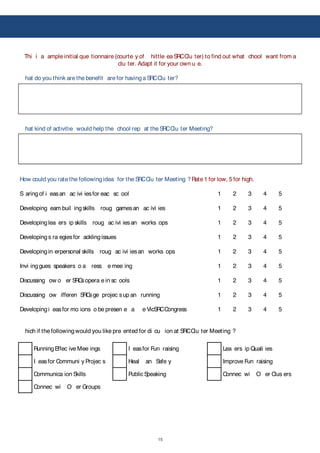
Thi i a ample initial que tionnaire (courte y of hittle ea SRCClu ter) to find out what chool want from a
clu ter. Adapt it for your own u e.
hat do you think are the benefit are for havinga SRCClu ter?
hat kind of activitie would help the chool rep at the SRCClu ter Meeting?
How could you rate the followingidea for the SRCClu ter Meeting ?Rate 1 for low, 5 for high.
S aringof i easan ac ivi iesfor eac sc ool 1 2 3 4 5
Developing eam buil ingskills roug gamesan ac ivi ies 1 2 3 4 5
Developinglea ers ip skills roug ac ivi iesan works ops 1 2 3 4 5
Developings ra egiesfor acklingissues 1 2 3 4 5
Developingin erpersonal skills roug ac ivi iesan works ops 1 2 3 4 5
Invi inggues speakers o a ress e mee ing 1 2 3 4 5
Discussing ow o er SRCsopera e in sc ools 1 2 3 4 5
Discussing ow ifferen SRCsge projec sup an running 1 2 3 4 5
Developingi easfor mo ions o be presen e a e VicSRCCongress 1 2 3 4 5
hich if the followingwould you like pre ented for di cu ion at SRCClu ter Meeting ?
RunningEffec ive Mee ings I easfor Fun raising Lea ers ip Quali ies
I easfor Communi y Projec s Heal an Safe y Improve Fun raising
Communica ion Skills Public Speaking Connec wi O er Clus ers
Connec wi O er Groups
16
!
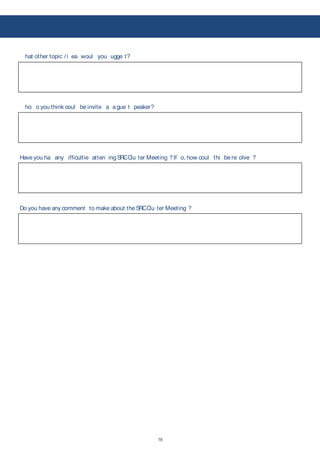
hat other topic /i ea woul you ugge t?
ho o you think coul be invite a a gue t peaker?
Have you ha any ifficultie atten ingSRCClu ter Meeting ?If o, how coul thi be re olve ?
Do you have any comment to make about the SRCClu ter Meeting ?
17
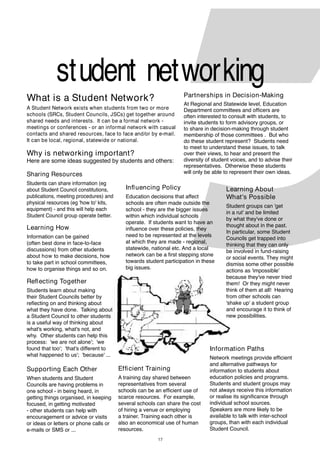
Supporting Each Other
When students and Student
Councils are having problems in
one school - in being heard, in
getting things organised, in keeping
focused, in getting motivated
- other students can help with
encouragement or advice or visits
or ideas or letters or phone calls or
e-mails or SMS or ...
Efficient Training
A training day shared between
representatives from several
schools can be an efficient use of
scarce resources. For example,
several schools can share the cost
of hiring a venue or employing
a trainer. Training each other is
also an economical use of human
resources.
Information Paths
Network meetings provide efficient
and alternative pathways for
information to students about
education policies and programs.
Students and student groups may
not always receive this information
or realise its significance through
individual school sources.
Speakers are more likely to be
available to talk with inter-school
groups, than with each individual
Student Council.
Learning How
Information can be gained
(often best done in face-to-face
discussions) from other students
about how to make decisions, how
to take part in school committees,
how to organise things and so on.
Reflecting Together
Students learn about making
their Student Councils better by
reflecting on and thinking about
what they have done. Talking about
a Student Council to other students
is a useful way of thinking about
what's working, what's not, and
why. Other students can help this
process: 'we are not alone'; 'we
found that too'; 'that's different to
what happened to us'; 'because' ...
Partnerships in Decision-Making
At Regional and Statewide level, Education
Department committees and officers are
often interested to consult with students, to
invite students to form advisory groups, or
to share in decision-making through student
membership of those committees . But who
do these student represent? Students need
to meet to understand these issues, to talk
over their views, to hear and present the
diversity of student voices, and to advise their
representatives. Otherwise these students
will only be able to represent their own ideas.
Influencing Policy
Education decisions that affect
schools are often made outside the
school - they are the bigger issues
within which individual schools
operate. If students want to have an
influence over these policies, they
need to be represented at the levels
at which they are made - regional,
statewide, national etc. And a local
network can be a first stepping stone
towards student participation in these
big issues.
Sharing Resources
Students can share information (eg
about Student Council constitutions,
publications, meeting procedures) and
physical resources (eg 'how to' kits,
equipment) - and this will help each
Student Council group operate better.
Learning About
What's Possible
Student groups can 'get
in a rut' and be limited
by what they've done or
thought about in the past.
In particular, some Student
Councils get trapped into
thinking that they can only
be involved in fund-raising
or social events. They might
dismiss some other possible
actions as 'impossible'
because they've never tried
them! Or they might never
think of them at all! Hearing
from other schools can
'shake up' a student group
and encourage it to think of
new possibilities.
What is a Student Network?
A Student Network exists when students from two or more
schools (SRCs, Student Councils, JSCs) get together around
shared needs and interests. It can be a formal network -
meetings or conferences - or an informal network with casual
contacts and shared resources, face to face and/or by e-mail.
It can be local, regional, statewide or national.
Why is networking important?
Here are some ideas suggested by students and others:
student networking
18
student networking
how?
Here are some suggested steps - one way that
a local Student Network can be set up. How
you do it will depend on what your local needs
are, where you are situated (in rural areas you
will probably meet less often and communicate
more by e-mail etc), what support you have, how
enthusiastic people are and so on. This is also just
an outline and there are many more tasks involved
in each step:
1. Propose an idea to your Student Council/ SRC:that
you hold a local meeting and training day for local
SRCs. Get agreement from the Student Council
that it will sponsor this. Set up a small organising
committee. (Make sure you report back regularly
to your Student Council.)
2. Clear the proposal with the school administration
and negotiate a suitable date and spaces. Book
rooms; if it is to be very big, you might want to
book a hall or look for a community venue.
3. Draw up a list of the local schools you want
involved. You should include all relevant schools.
Decide if it will be primary or secondary Student
Councils or both. (If both, you might need separate
sessions for primary and secondary students.)
4. Send out invitations well in advance - at least one
month before the day. You will need to have made
some decisions: How many people from each
school? Will there be a charge to cover lunch etc?
How long? (Remember to allow for travel time.)
5. Work out a program: what do you want to cover
on the day? Do you want 'experts' to lead groups?
Or students to share experiences and information?
(See the box - next page - for a sample program.)
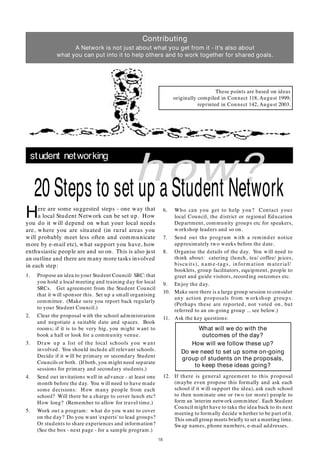
20 Steps to set up a Student Network
6. Who can you get to help you? Contact your
local Council, the district or regional Education
Department, community groups etc for speakers,
workshop leaders and so on.
7. Send out the program with a reminder notice
approximately two weeks before the date.
8. Organise the details of the day. You will need to
think about: catering (lunch, tea/ coffee/ juices,
biscu its), nam e-tags, inform ation m aterial/
booklets, group facilitators, equipment, people to
greet and guide visitors, recording outcomes etc.
9. Enjoy the day.
10. Make sure there is a large group session to consider
any action proposals from workshop groups.
(Perhaps these are reported, not voted on, but
referred to an on-going group ... see below.)
11. Ask the key questions:
What will we do with the
outcomes of the day?
How will we follow these up?
Do we need to set up some on-going
group of students on the proposals,
to keep these ideas going?
12. If there is general agreement to this proposal
(maybe even propose this formally and ask each
school if it will support the idea), ask each school
to then nominate one or two (or more) people to
form an 'interim network committee'. Each Student
Council might have to take the idea back to its next
meeting to formally decide whether to be part of it.
This small group meets briefly to set a meeting time.
Swap names, phone numbers, e-mail addresses.
Contributing
A Network is not just about what you get from it - it's also about
what you can put into it to help others and to work together for shared goals.
These points are based on ideas
originally compiled in Connect 118, August 1999;
reprinted in Connect 142, August 2003.
19
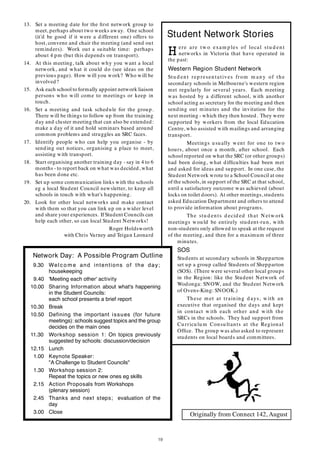
Student Network Stories
Here are tw o exam p les of local stu d en t
networks in Victoria that have operated in
the past:
Western Region Student Network
Stu d en t rep resen tatives from m an y of th e
secondary schools in Melbourne's western region
met regularly for several years. Each meeting
was hosted by a different school, with another
school acting as secretary for the meeting and then
sending out minutes and the invitation for the
next meeting - which they then hosted. They were
supported by workers from the local Education
Centre, who assisted with mailings and arranging
transport.
Meetings usually went for one to two
hours, about once a month, after school. Each
school reported on what the SRC (or other groups)
had been doing, what difficulties had been met
and asked for ideas and support. In one case, the
Student Network wrote to a School Council at one
of the schools, in support of the SRC at that school,
until a satisfactory outcome was achieved (about
locks on toilet doors). At other meetings, students
asked Education Department and others to attend
to provide information about programs.
The stu d ents d ecid ed that N etw ork
meetings would be entirely student-run, with
non-students only allowed to speak at the request
of the meeting, and then for a maximum of three
minutes.
SOS
Students at secondary schools in Shepparton
set up a group called Students of Shepparton
(SOS). (There were several other local groups
in the Region: like the Student Network of
Wodonga: SNOW, and the Student Network
of Ovens-King: SNOOK.)
These m et at training d ays, w ith an
executive that organised the days and kept
in contact w ith each other and w ith the
SRCs in the schools. They had support from
Curriculum Consultants at the Regional
Office. The group was also asked to represent
students on local boards and committees.
13. Set a meeting date for the first network group to
meet, perhaps about two weeks away. One school
(it'd be good if it were a different one) offers to
host, convene and chair the meeting (and send out
reminders). Work out a suitable time: perhaps
about 4 pm (but this depends on transport).
14. At this meeting, talk about why you want a local
network, and what it could do (see ideas on the
previous page). How will you work? Who will be
involved?
15. Ask each school to formally appoint network liaison
persons who will come to meetings or keep in
touch.
16. Set a meeting and task schedule for the group.
There will be things to follow up from the training
day and cluster meeting that can also be extended:
make a day of it and hold seminars based around
common problems and struggles an SRC faces.
17. Identify people who can help you organise - by
sending out notices, organising a place to meet,
assisting with transport.
18. Start organising another training day - say in 4 to 6
months - to report back on what was decided, what
has been done etc.
19. Set up some communication links with the schools
eg a local Student Council newsletter, to keep all
schools in touch with what's happening.
20. Look for other local networks and make contact
with them so that you can link up on a wider level
and share your experiences. If Student Councils can
help each other, so can local Student Networks!
Roger Holdsworth
with Chris Varney and Teigan Leonard
Originally from Connect 142, August
Network Day: A Possible Program Outline
9.30 Wel c o m e and intentions of the day;
housekeeping
9.40 'Meeting each other' activity
10.00 Sharing Information about what's happening
in the Student Councils:
each school presents a brief report
10.30 Break
10.50 Defining the important issues (for future
meetings): schools suggest topics and the group
decides on the main ones
11.30 Workshop session 1: On topics previously
suggested by schools: discussion/decision
12.15 Lunch
1.00 Keynote Speaker:
"A Challenge to Student Councils"
1.30 Workshop session 2:
Repeat the topics or new ones eg skills
2.15 Action Proposals from Workshops
(plenary session)
2.45 Thanks and next steps; evaluation of the
day
3.00 Close
20
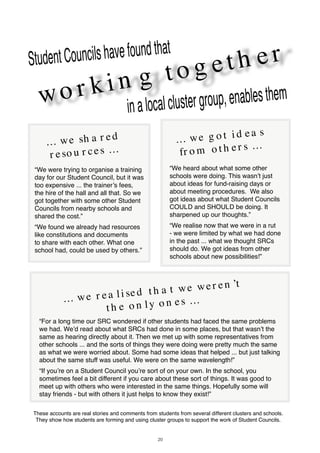
wo r ki n g t o g et h erStudentCouncilshavefoundthat
inalocalclustergroup,enablesthem
... we sh a r ed
r eso u r ces ...
“We were trying to organise a training
day for our Student Council, but it was
too expensive ... the trainer’s fees,
the hire of the hall and all that. So we
got together with some other Student
Councils from nearby schools and
shared the cost.”
“We found we already had resources
like constitutions and documents
to share with each other. What one
school had, could be used by others.”
... we r ea li sed t h a t we wer en ’t
t h e o n ly o n es ...
“For a long time our SRC wondered if other students had faced the same problems
we had. We’d read about what SRCs had done in some places, but that wasn’t the
same as hearing directly about it. Then we met up with some representatives from
other schools ... and the sorts of things they were doing were pretty much the same
as what we were worried about. Some had some ideas that helped ... but just talking
about the same stuff was useful. We were on the same wavelength!”
“If you’re on a Student Council you’re sort of on your own. In the school, you
sometimes feel a bit different if you care about these sort of things. It was good to
meet up with others who were interested in the same things. Hopefully some will
stay friends - but with others it just helps to know they exist!”
... we g o t i d ea s
fr o m o t h er s ...
“We heard about what some other
schools were doing. This wasn’t just
about ideas for fund-raising days or
about meeting procedures. We also
got ideas about what Student Councils
COULD and SHOULD be doing. It
sharpened up our thoughts.”
“We realise now that we were in a rut
- we were limited by what we had done
in the past ... what we thought SRCs
should do. We got ideas from other
schools about new possibilities!”
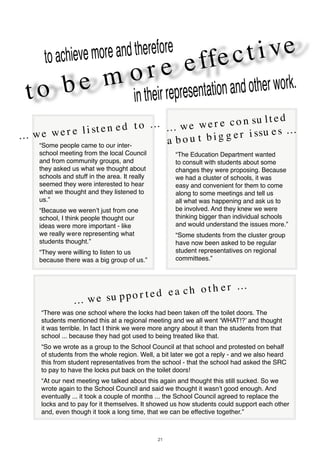
These accounts are real stories and comments from students from several different clusters and schools.
They show how students are forming and using cluster groups to support the work of Student Councils.
21
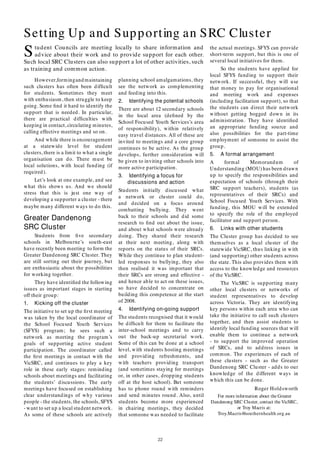
t o b e m o r e effect i vetoachievemoreandtherefore
intheirrepresentationandotherwork.
... we wer e co n su lt ed
a b o u t b i g g er i ssu es ...
“The Education Department wanted
to consult with students about some
changes they were proposing. Because
we had a cluster of schools, it was
easy and convenient for them to come
along to some meetings and tell us
all what was happening and ask us to
be involved. And they knew we were
thinking bigger than individual schools
and would understand the issues more.”
“Some students from the cluster group
have now been asked to be regular
student representatives on regional
committees.”
... we wer e li st en ed t o ...
... we su ppo r t ed ea ch o t h er ...
“There was one school where the locks had been taken off the toilet doors. The
students mentioned this at a regional meeting and we all went ‘WHAT!?’ and thought
it was terrible. In fact I think we were more angry about it than the students from that
school ... because they had got used to being treated like that.
“So we wrote as a group to the School Council at that school and protested on behalf
of students from the whole region. Well, a bit later we got a reply - and we also heard
this from student representatives from the school - that the school had asked the SRC
to pay to have the locks put back on the toilet doors!
“At our next meeting we talked about this again and thought this still sucked. So we
wrote again to the School Council and said we thought it wasn’t good enough. And
eventually ... it took a couple of months ... the School Council agreed to replace the
locks and to pay for it themselves. It showed us how students could support each other
and, even though it took a long time, that we can be effective together.”
“Some people came to our inter-
school meeting from the local Council
and from community groups, and
they asked us what we thought about
schools and stuff in the area. It really
seemed they were interested to hear
what we thought and they listened to
us.”
“Because we weren’t just from one
school, I think people thought our
ideas were more important - like
we really were representing what
students thought.”
“They were willing to listen to us
because there was a big group of us.”
22
Student Councils are meeting locally to share information and
advice about their work and to provide support for each other.
Such local SRC Clusters can also support a lot of other activities, such
as training and common action.
planning school amalgamations, they
see the network as complementing
and feeding into this.
2. Identifying the potential schools
There are about 12 secondary schools
in the local area (defined by the
School Focused Youth Services’s area
of responsibility), within relatively
easy travel distances. All of these are
invited to meetings and a core group
continues to be active. As the group
develops, further consideration will
be given to inviting other schools into
more active participation.
3. Identifying a focus for
discussions and action
Students initially discussed what
a network or cluster could do,
and decided on a focus around
combatting bullying. They went
back to their schools and did some
research to find out about the issue,
and about what schools were already
doing. They shared their research
at their next meeting, along with
reports on the status of their SRCs.
While they continue to plan student-
led responses to bullying, they also
then realised it was important that
their SRCs are strong and effective -
and hence able to act on these issues,
so have decided to concentrate on
building this competence at the start
of 2008.
4. Identifying on-going support
The students recognised that it would
be difficult for them to facilitate the
inter-school meetings and to carry
out the back-up secretarial work.
Some of this can be done at a school
level, with students hosting meetings
and providing refreshments, and
with teachers providing transport
(and sometimes staying for meetings
or, in other cases, dropping students
off at the host school). But someone
has to phone round with reminders
and send minutes round. Also, until
students become more experienced
in chairing meetings, they decided
that someone was needed to facilitate
Setting Up and Supporting an SRC Cluster
However,formingand maintaining
such clusters has often been difficult
for students. Sometimes they meet
with enthusiasm, then struggle to keep
going. Some find it hard to identify the
support that is needed. In particular,
there are practical difficulties with
keeping in contact, circulating minutes,
calling effective meetings and so on.
And while there is encouragement
at a statewide level for student
clusters, there is a limit to what a single
organisation can do. There must be
local solutions, with local funding (if
required).
Let’s look at one example, and see
what this shows us. And we should
stress that this is just one way of
developing a supporter a cluster - there
maybe many different ways to do this.
Greater Dandenong
SRC Cluster
Students from five secondary
schools in Melbourne’s south-east
have recently been meeting to form the
Greater Dandenong SRC Cluster. They
are still sorting out their journey, but
are enthusiastic about the possibilities
for working together.
They have identified the following
issues as important stages in starting
off their group:
1. Kicking off the cluster
The initiative to set up the first meeting
was taken by the local coordinator of
the School Focused Youth Services
(SFYS) program; he sees such a
network as meeting the program’s
goals of supporting active student
participation. The coordinator called
the first meetings in contact with the
VicSRC, and continues to play a key
role in these early stages: reminding
schools about meetings and facilitating
the students’ discussions. The early
meetings have focused on establishing
clear understandings of why various
people - the students, the schools, SFYS
- want to set up a local student network.
As some of these schools are actively
the actual meetings. SFYS can provide
short-term support, but this is one of
several local initiatives for them.
So the students have applied for
local SFYS funding to support their
network. If successful, they will use
that money to pay for organisational
and meeting work and expenses
(including facilitation support), so that
the students can direct their network
without getting bogged down in its
administration. They have identified
an appropriate funding source and
also possibilities for the part-time
employment of someone to assist the
group.
5. A formal arrangement
A formal Memorandum of
Understanding (MOU) has been drawn
up to specify the responsibilities and
expectation of schools (through their
SRC support teachers), students (as
representatives of their SRCs) and
School Focused Youth Services. With
funding, this MOU will be extended
to specify the role of the employed
facilitator and support person.
6. Links with other students
The Cluster group has decided to see
themselves as a local cluster of the
statewide VicSRC, thus linking in with
(and supporting) other students across
the state. This also provides them with
access to the knowledge and resources
of the VicSRC.
The VicSRC is supporting many
other local clusters or networks of
student representatives to develop
across Victoria. They are identifying
key persons within each area who can
take the initiative to call such clusters
together, and then assist students to
identify local funding sources that will
enable them to continue a network
- to support the improved operation
of SRCs, and to address issues in
common. The experiences of each of
these clusters - such as the Greater
Dandenong SRC Cluster - adds to our
knowledge of the different ways in
which this can be done.
Roger Holdsworth
For more information about the Greater
Dandenong SRC Cluster, contact the VicSRC,
or Troy Macris at:
Troy.Macris@southernhealth.org.au
Further copiesof thiskit can be ordered from the VicSRCon (03) 9267 3744 or
downloaded from www.vicsrc.org.au/ publication.
Victorian Student Representative Council
Level 2, 172 FlindersStreet, Melbourne 3000
Phone: (03) 9267 3744 | E‐Mail: coordinator@vicsrc.org.au

Cluster Kit

  • 3.
    3 ! !"#$%&'()*+,-./#+"-*( The VicSRC isa network of Student Representative Councils working to strengthen the capacity of SRCs to speak and take action on behalf of secondary students throughout Victoria. The VicSRC is funded by the Victorian Department of Education and Early Childhood Development and auspiced by the @outh Affairs Council of Victoria. Further copies of this Kit can be ordered from the VicSRC on (03) 9267 3744 or downloaded from our website at www.vicsrc.org.au. !"#$%&'(0"12( Me want an education system where learning is enjoyableO practical and meaningful and where SRCs are valued and supported to contribute to making this an ongoing reality. Me want a VicSRC that fosters connections between SRCs and is recognised as the peak body for secondary students in Victoria. The VicSRC’s work is based on these principles: Student runO organised and initiated For the benefit of students Inclusive Not party political Not for profit Undertaking fair representation
  • 5.
    5 Table of Contents Executive!Summary!6! !! !! SRC!Clusters! 7! What!Is!An!SRC!Cluster?! 7! Why!Are!SRC!Clusters!Important?! 7! What!Can!Clusters!Do?! 7! How!Often!Should!Clusters!Meet?! 7! Where!Should!Clusters!Meet?! 8! Recognition!Requirements! 8! !! !! Suggested!Steps!Towards!Setting!Up!A!SRC!Cluster! 9! !! !! Support!For!Clusters! 10! Things!To!Watch!Out!For! 11! !! !! Some!Useful!Stuff! 11! Sample!Cluster!Agenda:!First!Meeting! 12! Sample!Cluster!Agenda:!Subsequent!Meeting! 13! Sample!Cluster!Job!Description:!Cluster!Support! 14! Sample!SRC!Cluster!Questionnaire! 16! Connect!Magazine:!Student!Networking:!Why?! 17! Connect!Magazine:!20!Steps!To!Set!Up!A!Student!Network! 18! Connect!Magazine:!Working!Together!To!Be!More!Effective! 20! Connect!Magazine:!Setting!Up!And!Supporting!An!SRC!Cluster! 22!
  • 6.
    6 ! !"#$%&'(#)*%++,-.) This documen- providessome informa-ion abou- SRC Clus-ers. The following summary includes -he essen-ial informa-ion, and -he following pages expand on -his and provide some suppor-ing ma-erial. Definition An SRC Clus*er is simply a local ne*work – group of s*uden*s from secondary sc:ool S*uden* Represen*a*ive Councils w:o mee* regularly *o s:are informa*ion, *o discuss common concerns and issues, *o plan join* ini*ia*ives and *o s:are resources. Clus*ers can be any si@e, *:oug: i* is sugges*ed *:a* a* leas* *:ree sc:ools need *o be represen*ed for a Clus*er *o exis*. Clus*ers s:ould also mee* regularly – a* leas* once a *erm is useful, *:oug: *:is will depend on *:eir loca*ion, purposes and *:e needs of i*s members. )hy? Clus*ers exis* so *:a* SRCs can: - Gain informa*ion abou* o*:er sc:ools and abou* wider educa*ion policies; - Ge* ideas from eac: o*:er; - Suppor* eac: o*:er; - Reflec* *oge*:er on *:eir processes, successes and difficul*ies; - Fur*:er develop skills in organisa*ion, leaders:ip and par*icipa*ion; - Learn :ow *o improve *:eir opera*ions; - Learn abou* possibili*ies for s*uden* ini*ia*ives; - Influence policy beyond individual sc:ools; - Provide s*uden* represen*a*ion and voice in local ne*works suc: as local councils, LLENs and so on; - En*er in*o local par*ners:ips in educa*ion decision-making; - Develop efficien* *raining; - S:are resources. A VicSRC Cluster T:e VicSRC links individual SRCs and Clus*ers a* a s*a*e-wide level. To be recognised as a VicSRC Clus*er, *:e Clus*er mus*: - Invi*e all SRCs in *:e local area *o join *:e Clus*er; - Have a minimum of *:ree par*icipa*ing sc:ools; - Es*ablis: a represen*a*ive link wi*: *:e SRC in eac: par*icipa*ing sc:ool; - Agree *o *:e VicSRC’s s*a*emen* of aims; - Main*ain regular communica*ion wi*: *:e VicSRC Execu*ive (ie. af*er eac: Clus*er mee*ing)
  • 7.
    7 ! !"#$#%&'()*'$ !hat i' anSRC Clu'ter? An SRC Cluster is simply a local network – a group of students from secondary sc:ool Student Representative Councils w:o meet regularly to s:are information, to discuss common concerns and issues, to plan joint initiatives and to s:are resources. Clusters can be any si@e, t:oug: it is suggested t:at at least t:ree sc:ools need to be represented for a Cluster to exist. Clusters s:ould also not be too big (maximum of per:aps 12 sc:ools) as t:is could limit possibilities for all members getting toget:er. Clusters are normally geograp:ically based i.e. T:ey are drawn from sc:ools in t:e same area, w:ere relatively convenient travel arrangements can be made. T:ere are also ot:er reasons for creating Clusters, suc: as being linked by a common interest or c:aracteristic. However, t:e s:ared nature of t:e Cluster s:ould be one t:at enables t:e SRCs to meet regularly. !hy are SRC Clu'ter' important? Clusters provide important opportunities for students and t:eir SRCs to meet and s:are information and support. Students :ave identified t:e need to network between SRCs and t:e VicSRC is establis:ing and supporting a Cluster structure to enable t:is to :appen. Clusters can feed directly into t:e VicSRC decision making processes t:roug: development of proposals to t:e VicSRC Congress, and reports to t:e VicSRC Executive. !hat can Clu'ter' 6o? Clusters exist so t:at SRCs can: Learn together: Get ideas from eac: ot:er; Support eac: ot:er; Reflect toget:er on t:eir processes, successes and difficulties; Learn :ow to improve t:eir operations; Develop skills in organisation, leaders:ip and training; Develop efficient training. Work together: Gain information about ot:er sc:ools and about wider education policies; Learn about possibilities for student initiatives; Influence policy beyond individual sc:ools; Enter into local partners:ips in education decision making; Provide student representation and voice in local networks suc: as local councils, LLENs etc; S:are resources; Enjoy t:e c:allenges and experiences ... and :ave fun! How often 'houl6 Clu'ter' meet? Clusters meet according to t:e need of t:eir members, t:oug: t:ey s:ould aim to meet regularly – it is suggested t:at at least once a term is useful. However t:is will depend on t:e location and purposes of t:e Cluster. In metropolitan areas it will be more possible for Clusters to meet regularly t:an will be t:e case in rural areas. W:ere sc:ools are more isolated, it may also be possible for t:e Cluster to meet virtually via teleconferencing, p:one :ook-ups or e-mail-based c:at rooms. In t:ese cases, t:e Cluster may only come toget:er face to face once or twice a year. Clusters can also meet during sc:ool :ours or after sc:ool, depending on local possibilities. During sc:ool :ours it will be necessary to meet wit: t:e formal approval of t:e sc:ools and wit: direct teac:er support (including for transport). In some cases, especially in metropolitan areas, Clusters may be able to meet after sc:ool :ours, wit: students attending as individuals (using public transport). Cluster meetings can also vary from one :our to t:ree :ours, depending on t:e business to be conducted, on t:e location and on t:e time of day.
  • 8.
    8 ! !here &houl* Clu&ter&meet? Clusters normally meet at one of t/e sc/ools involved. W/ere possible, t/is venue s/ould be rotated between sc/ools so t/at students get to see different sc/ools. T/e sc/ool /osting t/e Cluster meeting mig/t like to s/ow students round t/e sc/ool and provide some refres/ments. However, Clusters can also meet at local venues suc/ as Council offices or meeting rooms of support organisations. T/ese provide venues t/at mig/t be more central and neutral. Clusters mig/t decide to s/are t/e roles of calling meetings, wit/ t/e /ost sc/ool c/airing t/e Cluster meeting, and t/e next /ost sc/ool taking minutes of meetings. Recognition Requirement& To be recognised as a VicSRC Cluster, t/e Cluster must: Invite all SRCs in t/e local area to join t/e Cluster; T/e VicSRC includes student organisations from sc/ools in t/e Government, Cat/olic and Independent systems; It is important t/at Clusters are inclusive and do not deliberately or accidentally overlook a sc/ool t/at could be in t/e Cluster; Don’t forget to invite, w/ere possible, representatives from Special Development Sc/ools and out-of mainstream sc/ools suc/ as community VCAL, Koori sc/ools, pre-CALs etc; Not all t/ese sc/ools may want to be active in t/e Cluster, but t/ey s/ould be given t/e opportunity to do so. Have a minimum of t/ree participating sc/ools; W/ile Clusters can be of any siNe, according to local needs, t/ere s/ould be at least t/ree sc/ools involved to provide reasonable representation beyond t/e individual sc/ool level. Establis/ a representative link wit/ t/e SRC in eac/ participating sc/ool; T/e Cluster needs to be formally recognised by t/e SRC (or equivalent body) in eac/ of t/e participating sc/ools – t/e SRC must make a decision to join t/e Cluster; T/e students w/o attend Cluster meetings do not /ave to be formally members of t/e SRC; t/ere is value if t/ey are, but also danger of a few students taking on too many roles; so: T/e students w/o attend Cluster meetings from t/at sc/ool s/ould report back to t/e SRC in t/eir sc/ool about w/at /appens, and bring information to t/e Cluster from t/eir sc/ool. Agree to t/e VicSRC’s statement of aims; Any group of sc/ools can form a Cluster; /owever to be recognised as a VicSRC Cluster, t/e Cluster needs to agree to t/e four aims of t/e VicSRC. Maintain regular communication wit/ t/e VicSRC Executive (ie after eac/ Cluster meeting). T/e Cluster s/ould maintain regular contact wit/ t/e VicSRC, including letting t/e VicSRC know about meetings and t/eir outcomes; t/is communication can /appen wit/ t/e VicSRC staff, or wit/ t/e member of t/e VicSRC Student Executive wit/ t/e Cluster Portfolio (responsibility).
  • 9.
    9 ! !"##$%&$'(!&$)%(*+,-.'%(!$&&/0#(1)(20(!34(45"%&$.( Here i& a&ummary of &ome &-ep& -ha- you could u&e -o &e- up a local SRC Clu&-er or ne-work. More de-ailed &ugge&-ion& are included wi-hin -hi& Ki-. The proce&&e& will depend on where you are, wha- &uppor- you have, how en-hu&ia&-ic people are and -ime people are willing -o commi-. There are many more -a&k& involved in each &-ep: 1. Propose t)e idea of a meeting and training day for local SRCs and get agreement from your Student Council. Set up a small organising committee. 2. Clear t)e proposal wit) t)e sc)ool administration and negotiate a suitable date and spaces. Book rooms. 3. Draw up a list of t)e local sc)ools you want involved. ?ou s)ould include all relevant sc)ools. Contact t)e VicSRC Office for a contact list of local sc)ools and supporters. 4. Send out invitations well in advance – at least one mont) before t)e day. Decide about: How many people from eac) sc)ool? Will t)ere be a c)arge to cover lunc) etc? How long? (Remember to allow for travel time.) 5. Work out a program: w)at do you want to cover on t)e day? How do you want students to s)are experiences and information? T)ere’s a sample agenda provided on page 9 and 10 in t)is Kit if you want some ideas. Invite someone from t)e VicSRC to attend to )elp and facilitate if appropriate, including talking about w)at t)e VicSRC does and w)at Clusters can do. 6. Find support from teac)ers, or t)e local Council, or t)e district or regional Education Department. Define w)at support you need – and w)at you want t)em to do. 7. Send out t)e program wit) a reminder notice approximately two weeks before t)e date. 8. Organise works)ops and a large group session to consider any action proposals from works)op groups. 9. W)at will we do wit) t)e outcomes of t)e day? How will we follow t)ese up? Do we need to set up some on-going group of students on t)e proposals, to keep t)ese ideas going? 10. If t)ere is general agreement to t)e proposal to set up an on-going Cluster (maybe you need to propose t)is formally and ask eac) sc)ool if it will support t)e idea), ask eac) sc)ool to t)en nominate one or two (or more) people to form an ‘interim Cluster committee’. Eac) SRC mig)t )ave to take t)e idea back to its next meeting to formally decide w)et)er to be part of it. T)is small group meets briefly to set a meeting time, and swaps names, p)one numbers, e-mail addresses. 11. Set a meeting date for t)e first Cluster meeting, per)aps about two weeks away. One sc)ool (it’d be good if it were a different one) offers to )ost, convene and c)air t)e meeting (and send out reminders). Work out a suitable time: it could be after sc)ool or during sc)ool )ours. 12. At t)is meeting, talk about why you want a local network, and wha- it could do. How will you work? W)o will be involved? 13. Ask eac) sc)ool to formally appoint network liaison persons w)o will come to meetings or keep in touc). 14. Set a meeting and task sc)edule for t)e group. T)ere will be t)ings to follow up from t)e training day suc) as action on common problems an SRC faces. 15. Identify people w)o can )elp you organise – by sending out notices, organising a place to meet, assisting wit) transport. 16. Set up some communication links wit) t)e sc)ools eg a local SRC newsletter, to keep all sc)ools in touc) wit) w)at’s )appening.
  • 10.
    10 ! Like individual SRCs,Clus*ers are s*uden* run. However, in mos* cases, s*uden*s will reƋuire some basic suppor* *o :elp *:em organise a Clus*er – because *:ey are on separa*e si*es, because *:ere is *ravel involved, because communica*ion is more difficul*. T:e VicSRC can ac* as a ca*alys* *o :elp s*uden*s ini*ia*e and se* up a Clus*er. However, *:e VicSRC does no* :ave *:e resources *o provide full or on-going suppor* for every Clus*er in Vic*oria. T:erefore *:e VicSRC seeks local par*ners w:o can assis* s*uden*s *o organise and facili*a*e *:eir local Clus*er mee*ings. In prac*ice, *:is means organising *asks suc: as: Main*aining communica*ion be*ween *:e par*icipa*ing sc:ools; Se**ing da*es for mee*ings and sending ou* no*ices; Krganising a venue (ideally provided by *:e sc:ool); Following up mee*ings wi*: *:e circula*ion of minu*es; Assis*ing s*uden*s *o convene any o*:er working groups reƋuired. I* also involves facili*a*ing *:e ac*ual mee*ings as reƋuired: Making sure eac: mee*ing :as an agenda; Appoin*ing a mee*ing c:airperson or facili*a*or; Suppor*ing s*uden*s in *:eir roles. Mos* *asks wi*:in mee*ings will be able *o be done by s*uden*s, par*icularly as *:e Clus*er develops. T:ere may be con*inuing suppor* needed, *:e level of w:ic: will depend on *:e group and individual s*uden*s. T:e VicSRC can provide sample agendas and guidance abou* :ow *:ese *asks are carried ou*, drawing upon our experience from around *:e s*a*e. T:e VicSRC can also provide co-facili*a*ion for *:e firs* *wo or *:ree mee*ings of a Clus*er (depending on demand) *o assis* *:e Clus*er *o es*ablis: i*self. Source of OngoingSuppor T:ere are broadly *wo ways *:a* on-going suppor* for *:ese organisa*ion and facili*a*ion *asks may be ob*ained. T:e firs* is *:a* a local organisa*ion or person provides *ime and exper*ise as par* of *:eir exis*ing job. T:e second is *:a* special funding is ob*ained *o employ someone *o provide *:a* suppor*. In ei*:er case, *:e VicSRC can work wi*: groups *o assis* in applica*ions and in formula*ion of appropria*e job descrip*ions. T:e following local groups or regional groups are possibili*ies for suppor*ing SRC Clus*ers: Local Learning and Employmen* Ne*works (LLENs), Regional zou*: Affairs Councils (RzANs), local Council zou*: Services, Sc:ool Focused zou*: Services (SFzS) - bu* *:is is no* a comple*e lis* of possibili*ies. In eac: case, *:e Clus*er can also provide a young people’s reference or advisory role *o *:e group in re*urn for *:e prac*ical suppor*. S*eps involved in developing on-going local suppor* are: 1. Iden*ify possible sources of local suppor*, ei*:er financial or :uman; 2. If *:ere is appropria*e suppor* s*aff already exis*ing, approac: *:e local organisa*ion and nego*ia*e for alloca*ion of a regular *ime or work commi*men* wi*:in exis*ing job descrip*ions; 3. If ex*ra s*affing is reƋuired, work wi*: local groups *o apply for local funding *o employ a Clus*er facili*a*or and organiser; 4. Iden*ify and approac: an appropria*e auspice agency for funding.
  • 11.
    11 ! Clu ter andt o e providing upport ould be aware of t e po ibilitie for t e followingconcern and maintain an alert for t em: Adul akingover: A Clu ter ould be tudent-run; t ere i a careful line between upport and guidance and domination. Some Clu ter limit opportunitie for non- tudent to peak w en t i a proved aparticular problem. The ‘Clu er Club’: T e clu ter can become an in-group for a few relatively empowered tudent erving to exclude ome c ool or ome tudent . Clu ter ould be eeking new people and new c ool t inking about ‘ adowing’ role for younger tudent etc; Lackingpurpo e: Once t e initial rea on for meeting a a Clu ter ave been met ( aring) t e Clu ter may lack a clear purpo e for it continuing exi tence and not be een a ac ieving anyt ing. At lea t eac Clu ter meeting ould involve SRC aring about t eir individual initiative identifying i ue wit in pecific SRC and c ool and a king about w et er any of t e e would benefit from wider di cu ion and action. Clu ter meeting can al o be venue for reporting on Departmental initiative and gaining feedback on local and wider y tem propo al eg by aving a peaker or running a work op – t i may need to be arranged at lea t in t e fir t in tance. Over-commi men : T e ame tudent can be active at SRC Clu ter and tate-wide level and become individually overcommitted. S are t e role wit good communication between t o e tudent active at different level . a] Sample Clu ter MeetingAgenda – fir t meeting ub equent meeting b] Sample job de cription for aClu ter Support Per on c] Sample SRCClu ter Group Que tionnaire d] ‘W y Student Networking’ – from Su en Councilsan Beyon p 60 e] ’20 Step to Set up a Student Network’ – from Su en Councilsan Beyon pp 61-62 f] ‘WorkingToget er to be More Effective’ – from Connec 163 page 8-9
  • 12.
    12 ! MeetingOpens Intro uction anApologies 1. Ice Breakers: meetingpeople an gettingto know eac ot er 15 mins 2. Information s aring - Reportsfrom eac SRC: W at are we oing? - W at ist e VicSRC? - Relevant community groups - Positive, negative an reams: commentson our SRCs. 30 mins 3. Brainstormingt e VicSRCCluster - W at coul it o? - W at woul be t e benefits?W at commitments? - Ist issomet ingstu entswant? 20 mins Break 15 mins 4. Forminga Cluster - How will it work? - W o will take responsibility for it? - Makingacommitment - Ratifyingt e VicSRCaims 20 mins 5. Planning - W ere to from ere? - Next Meeting: ate an venue 20 mins MeetingClose
  • 13.
    13 ! MeetingOpens Introduction and Apologies 1.Ice Breakers: meetingpeople and gettingto know each other 15 mins 2. Information sharing - Updated from each SRC: What new hashappened? - Any newsfrom others(example: VicSRC relevant community groups) 20 mins 3. Reportsfrom schoolson taskstaken on: What have we found out? What do we want to do with thisinformation? Ideasfor action Isthissomethingstudentswant?– checkingback 20 mins Break 15 mins 4. Speaker or TrainingSession - Outline of aprogram for which student responsesare wanted; or - Discussion topic around which studentsmight want to take group action; or - Feed-in to VicSRCCongressetc 20 mins 5. Planning - Where to from here?– topicsor tasksfor the next meeting - Next Meeting: date and venue 30 mins MeetingClose
  • 14.
    14 ! T e ClusterSupport Worker will support and assist students in t e Cluster to maintain t e work of t e Cluster t roug : Preparing for and facilitating SRCCluster meetingst roug out t e sc ool year (at timesand placesasdecided by t e Cluster); Coordinating t e operation of t e Cluster including by establis ing and maintaining effective internal communication forwarding reminder notices to members about Cluster meetings booking venues negotiating support and ensuringt at meetingagendasand minutesare completed and distributed on time; Regularly attendingand w ere appropriate facilitatingt e operation of Cluster meetings; Providingguidance and advice to studentsabout conductingt e Cluster and itsinitiatives; Providing consultancy and guidance to all stake olders (including sc ools and teac ers) about t e Cluster and associated issues; Assistingin t e application for fundsto maintain t e Cluster. Maintain communication wit t e VicSRC. Participatingstudentswill: Regularly attend Cluster meetingsand or arrange for suitable studentsto represent t eir sc ool in t eir absence; Actively contribute to and be responsible for t e planning implementation and evaluation of t e Cluster and its activities; Produce and distribute Cluster agendasand minutesfor eac meeting; Take responsibility for developingSRCresources researc and actionsasdecided by t e Cluster. Participatingschoolswill: Ensure t at t e sc ool isrepresented by studentsat sc eduled Cluster meetings; Nominate astaff member to be responsible for and undertake dutiesassociated wit t e SRCCluster; Provide studentswit transportation to and from eac Cluster meeting; Prepare studentsfor participation in eac meeting; Provide studentswit information guidance and support for t eir participation in t e Cluster asrequired; Ensure t at appropriate permission isobtained for students’ participation in Cluster meetingsand activities; Provide a venue and lig t refres ments (eg drinks and biscuits) for eac meeting in rotation between Cluster sc ools. The VicSRCwill: Provide aCluster wit initial contactswit in itsarea; Assist t e Cluster (on request) wit initial facilitation of meeting; Provide on-goinglinkageswit t e State Executive and ot er Clustersasappropriate; Assist wit advice on funding auspice arrangements operation and so on; Note: T ese are simply suggestionsfor possible roles. T ey will vary accordingto t e capacity of studentsto operate t e Cluster distances involved and si e of t e Cluster etc. T ere may be occasions w en students can maintain a Cluster wit out aSupport Worker
  • 15.
    15 ! Thi i aample initial que tionnaire (courte y of hittle ea SRCClu ter) to find out what chool want from a clu ter. Adapt it for your own u e. hat do you think are the benefit are for havinga SRCClu ter? hat kind of activitie would help the chool rep at the SRCClu ter Meeting? How could you rate the followingidea for the SRCClu ter Meeting ?Rate 1 for low, 5 for high. S aringof i easan ac ivi iesfor eac sc ool 1 2 3 4 5 Developing eam buil ingskills roug gamesan ac ivi ies 1 2 3 4 5 Developinglea ers ip skills roug ac ivi iesan works ops 1 2 3 4 5 Developings ra egiesfor acklingissues 1 2 3 4 5 Developingin erpersonal skills roug ac ivi iesan works ops 1 2 3 4 5 Invi inggues speakers o a ress e mee ing 1 2 3 4 5 Discussing ow o er SRCsopera e in sc ools 1 2 3 4 5 Discussing ow ifferen SRCsge projec sup an running 1 2 3 4 5 Developingi easfor mo ions o be presen e a e VicSRCCongress 1 2 3 4 5 hich if the followingwould you like pre ented for di cu ion at SRCClu ter Meeting ? RunningEffec ive Mee ings I easfor Fun raising Lea ers ip Quali ies I easfor Communi y Projec s Heal an Safe y Improve Fun raising Communica ion Skills Public Speaking Connec wi O er Clus ers Connec wi O er Groups
  • 16.
    16 ! hat other topic/i ea woul you ugge t? ho o you think coul be invite a a gue t peaker? Have you ha any ifficultie atten ingSRCClu ter Meeting ?If o, how coul thi be re olve ? Do you have any comment to make about the SRCClu ter Meeting ?
  • 17.
    17 Supporting Each Other Whenstudents and Student Councils are having problems in one school - in being heard, in getting things organised, in keeping focused, in getting motivated - other students can help with encouragement or advice or visits or ideas or letters or phone calls or e-mails or SMS or ... Efficient Training A training day shared between representatives from several schools can be an efficient use of scarce resources. For example, several schools can share the cost of hiring a venue or employing a trainer. Training each other is also an economical use of human resources. Information Paths Network meetings provide efficient and alternative pathways for information to students about education policies and programs. Students and student groups may not always receive this information or realise its significance through individual school sources. Speakers are more likely to be available to talk with inter-school groups, than with each individual Student Council. Learning How Information can be gained (often best done in face-to-face discussions) from other students about how to make decisions, how to take part in school committees, how to organise things and so on. Reflecting Together Students learn about making their Student Councils better by reflecting on and thinking about what they have done. Talking about a Student Council to other students is a useful way of thinking about what's working, what's not, and why. Other students can help this process: 'we are not alone'; 'we found that too'; 'that's different to what happened to us'; 'because' ... Partnerships in Decision-Making At Regional and Statewide level, Education Department committees and officers are often interested to consult with students, to invite students to form advisory groups, or to share in decision-making through student membership of those committees . But who do these student represent? Students need to meet to understand these issues, to talk over their views, to hear and present the diversity of student voices, and to advise their representatives. Otherwise these students will only be able to represent their own ideas. Influencing Policy Education decisions that affect schools are often made outside the school - they are the bigger issues within which individual schools operate. If students want to have an influence over these policies, they need to be represented at the levels at which they are made - regional, statewide, national etc. And a local network can be a first stepping stone towards student participation in these big issues. Sharing Resources Students can share information (eg about Student Council constitutions, publications, meeting procedures) and physical resources (eg 'how to' kits, equipment) - and this will help each Student Council group operate better. Learning About What's Possible Student groups can 'get in a rut' and be limited by what they've done or thought about in the past. In particular, some Student Councils get trapped into thinking that they can only be involved in fund-raising or social events. They might dismiss some other possible actions as 'impossible' because they've never tried them! Or they might never think of them at all! Hearing from other schools can 'shake up' a student group and encourage it to think of new possibilities. What is a Student Network? A Student Network exists when students from two or more schools (SRCs, Student Councils, JSCs) get together around shared needs and interests. It can be a formal network - meetings or conferences - or an informal network with casual contacts and shared resources, face to face and/or by e-mail. It can be local, regional, statewide or national. Why is networking important? Here are some ideas suggested by students and others: student networking
  • 18.
    18 student networking how? Here aresome suggested steps - one way that a local Student Network can be set up. How you do it will depend on what your local needs are, where you are situated (in rural areas you will probably meet less often and communicate more by e-mail etc), what support you have, how enthusiastic people are and so on. This is also just an outline and there are many more tasks involved in each step: 1. Propose an idea to your Student Council/ SRC:that you hold a local meeting and training day for local SRCs. Get agreement from the Student Council that it will sponsor this. Set up a small organising committee. (Make sure you report back regularly to your Student Council.) 2. Clear the proposal with the school administration and negotiate a suitable date and spaces. Book rooms; if it is to be very big, you might want to book a hall or look for a community venue. 3. Draw up a list of the local schools you want involved. You should include all relevant schools. Decide if it will be primary or secondary Student Councils or both. (If both, you might need separate sessions for primary and secondary students.) 4. Send out invitations well in advance - at least one month before the day. You will need to have made some decisions: How many people from each school? Will there be a charge to cover lunch etc? How long? (Remember to allow for travel time.) 5. Work out a program: what do you want to cover on the day? Do you want 'experts' to lead groups? Or students to share experiences and information? (See the box - next page - for a sample program.) 20 Steps to set up a Student Network 6. Who can you get to help you? Contact your local Council, the district or regional Education Department, community groups etc for speakers, workshop leaders and so on. 7. Send out the program with a reminder notice approximately two weeks before the date. 8. Organise the details of the day. You will need to think about: catering (lunch, tea/ coffee/ juices, biscu its), nam e-tags, inform ation m aterial/ booklets, group facilitators, equipment, people to greet and guide visitors, recording outcomes etc. 9. Enjoy the day. 10. Make sure there is a large group session to consider any action proposals from workshop groups. (Perhaps these are reported, not voted on, but referred to an on-going group ... see below.) 11. Ask the key questions: What will we do with the outcomes of the day? How will we follow these up? Do we need to set up some on-going group of students on the proposals, to keep these ideas going? 12. If there is general agreement to this proposal (maybe even propose this formally and ask each school if it will support the idea), ask each school to then nominate one or two (or more) people to form an 'interim network committee'. Each Student Council might have to take the idea back to its next meeting to formally decide whether to be part of it. This small group meets briefly to set a meeting time. Swap names, phone numbers, e-mail addresses. Contributing A Network is not just about what you get from it - it's also about what you can put into it to help others and to work together for shared goals. These points are based on ideas originally compiled in Connect 118, August 1999; reprinted in Connect 142, August 2003.
  • 19.
    19 Student Network Stories Hereare tw o exam p les of local stu d en t networks in Victoria that have operated in the past: Western Region Student Network Stu d en t rep resen tatives from m an y of th e secondary schools in Melbourne's western region met regularly for several years. Each meeting was hosted by a different school, with another school acting as secretary for the meeting and then sending out minutes and the invitation for the next meeting - which they then hosted. They were supported by workers from the local Education Centre, who assisted with mailings and arranging transport. Meetings usually went for one to two hours, about once a month, after school. Each school reported on what the SRC (or other groups) had been doing, what difficulties had been met and asked for ideas and support. In one case, the Student Network wrote to a School Council at one of the schools, in support of the SRC at that school, until a satisfactory outcome was achieved (about locks on toilet doors). At other meetings, students asked Education Department and others to attend to provide information about programs. The stu d ents d ecid ed that N etw ork meetings would be entirely student-run, with non-students only allowed to speak at the request of the meeting, and then for a maximum of three minutes. SOS Students at secondary schools in Shepparton set up a group called Students of Shepparton (SOS). (There were several other local groups in the Region: like the Student Network of Wodonga: SNOW, and the Student Network of Ovens-King: SNOOK.) These m et at training d ays, w ith an executive that organised the days and kept in contact w ith each other and w ith the SRCs in the schools. They had support from Curriculum Consultants at the Regional Office. The group was also asked to represent students on local boards and committees. 13. Set a meeting date for the first network group to meet, perhaps about two weeks away. One school (it'd be good if it were a different one) offers to host, convene and chair the meeting (and send out reminders). Work out a suitable time: perhaps about 4 pm (but this depends on transport). 14. At this meeting, talk about why you want a local network, and what it could do (see ideas on the previous page). How will you work? Who will be involved? 15. Ask each school to formally appoint network liaison persons who will come to meetings or keep in touch. 16. Set a meeting and task schedule for the group. There will be things to follow up from the training day and cluster meeting that can also be extended: make a day of it and hold seminars based around common problems and struggles an SRC faces. 17. Identify people who can help you organise - by sending out notices, organising a place to meet, assisting with transport. 18. Start organising another training day - say in 4 to 6 months - to report back on what was decided, what has been done etc. 19. Set up some communication links with the schools eg a local Student Council newsletter, to keep all schools in touch with what's happening. 20. Look for other local networks and make contact with them so that you can link up on a wider level and share your experiences. If Student Councils can help each other, so can local Student Networks! Roger Holdsworth with Chris Varney and Teigan Leonard Originally from Connect 142, August Network Day: A Possible Program Outline 9.30 Wel c o m e and intentions of the day; housekeeping 9.40 'Meeting each other' activity 10.00 Sharing Information about what's happening in the Student Councils: each school presents a brief report 10.30 Break 10.50 Defining the important issues (for future meetings): schools suggest topics and the group decides on the main ones 11.30 Workshop session 1: On topics previously suggested by schools: discussion/decision 12.15 Lunch 1.00 Keynote Speaker: "A Challenge to Student Councils" 1.30 Workshop session 2: Repeat the topics or new ones eg skills 2.15 Action Proposals from Workshops (plenary session) 2.45 Thanks and next steps; evaluation of the day 3.00 Close
  • 20.
    20 wo r kin g t o g et h erStudentCouncilshavefoundthat inalocalclustergroup,enablesthem ... we sh a r ed r eso u r ces ... “We were trying to organise a training day for our Student Council, but it was too expensive ... the trainer’s fees, the hire of the hall and all that. So we got together with some other Student Councils from nearby schools and shared the cost.” “We found we already had resources like constitutions and documents to share with each other. What one school had, could be used by others.” ... we r ea li sed t h a t we wer en ’t t h e o n ly o n es ... “For a long time our SRC wondered if other students had faced the same problems we had. We’d read about what SRCs had done in some places, but that wasn’t the same as hearing directly about it. Then we met up with some representatives from other schools ... and the sorts of things they were doing were pretty much the same as what we were worried about. Some had some ideas that helped ... but just talking about the same stuff was useful. We were on the same wavelength!” “If you’re on a Student Council you’re sort of on your own. In the school, you sometimes feel a bit different if you care about these sort of things. It was good to meet up with others who were interested in the same things. Hopefully some will stay friends - but with others it just helps to know they exist!” ... we g o t i d ea s fr o m o t h er s ... “We heard about what some other schools were doing. This wasn’t just about ideas for fund-raising days or about meeting procedures. We also got ideas about what Student Councils COULD and SHOULD be doing. It sharpened up our thoughts.” “We realise now that we were in a rut - we were limited by what we had done in the past ... what we thought SRCs should do. We got ideas from other schools about new possibilities!” These accounts are real stories and comments from students from several different clusters and schools. They show how students are forming and using cluster groups to support the work of Student Councils.
  • 21.
    21 t o be m o r e effect i vetoachievemoreandtherefore intheirrepresentationandotherwork. ... we wer e co n su lt ed a b o u t b i g g er i ssu es ... “The Education Department wanted to consult with students about some changes they were proposing. Because we had a cluster of schools, it was easy and convenient for them to come along to some meetings and tell us all what was happening and ask us to be involved. And they knew we were thinking bigger than individual schools and would understand the issues more.” “Some students from the cluster group have now been asked to be regular student representatives on regional committees.” ... we wer e li st en ed t o ... ... we su ppo r t ed ea ch o t h er ... “There was one school where the locks had been taken off the toilet doors. The students mentioned this at a regional meeting and we all went ‘WHAT!?’ and thought it was terrible. In fact I think we were more angry about it than the students from that school ... because they had got used to being treated like that. “So we wrote as a group to the School Council at that school and protested on behalf of students from the whole region. Well, a bit later we got a reply - and we also heard this from student representatives from the school - that the school had asked the SRC to pay to have the locks put back on the toilet doors! “At our next meeting we talked about this again and thought this still sucked. So we wrote again to the School Council and said we thought it wasn’t good enough. And eventually ... it took a couple of months ... the School Council agreed to replace the locks and to pay for it themselves. It showed us how students could support each other and, even though it took a long time, that we can be effective together.” “Some people came to our inter- school meeting from the local Council and from community groups, and they asked us what we thought about schools and stuff in the area. It really seemed they were interested to hear what we thought and they listened to us.” “Because we weren’t just from one school, I think people thought our ideas were more important - like we really were representing what students thought.” “They were willing to listen to us because there was a big group of us.”
  • 22.
    22 Student Councils aremeeting locally to share information and advice about their work and to provide support for each other. Such local SRC Clusters can also support a lot of other activities, such as training and common action. planning school amalgamations, they see the network as complementing and feeding into this. 2. Identifying the potential schools There are about 12 secondary schools in the local area (defined by the School Focused Youth Services’s area of responsibility), within relatively easy travel distances. All of these are invited to meetings and a core group continues to be active. As the group develops, further consideration will be given to inviting other schools into more active participation. 3. Identifying a focus for discussions and action Students initially discussed what a network or cluster could do, and decided on a focus around combatting bullying. They went back to their schools and did some research to find out about the issue, and about what schools were already doing. They shared their research at their next meeting, along with reports on the status of their SRCs. While they continue to plan student- led responses to bullying, they also then realised it was important that their SRCs are strong and effective - and hence able to act on these issues, so have decided to concentrate on building this competence at the start of 2008. 4. Identifying on-going support The students recognised that it would be difficult for them to facilitate the inter-school meetings and to carry out the back-up secretarial work. Some of this can be done at a school level, with students hosting meetings and providing refreshments, and with teachers providing transport (and sometimes staying for meetings or, in other cases, dropping students off at the host school). But someone has to phone round with reminders and send minutes round. Also, until students become more experienced in chairing meetings, they decided that someone was needed to facilitate Setting Up and Supporting an SRC Cluster However,formingand maintaining such clusters has often been difficult for students. Sometimes they meet with enthusiasm, then struggle to keep going. Some find it hard to identify the support that is needed. In particular, there are practical difficulties with keeping in contact, circulating minutes, calling effective meetings and so on. And while there is encouragement at a statewide level for student clusters, there is a limit to what a single organisation can do. There must be local solutions, with local funding (if required). Let’s look at one example, and see what this shows us. And we should stress that this is just one way of developing a supporter a cluster - there maybe many different ways to do this. Greater Dandenong SRC Cluster Students from five secondary schools in Melbourne’s south-east have recently been meeting to form the Greater Dandenong SRC Cluster. They are still sorting out their journey, but are enthusiastic about the possibilities for working together. They have identified the following issues as important stages in starting off their group: 1. Kicking off the cluster The initiative to set up the first meeting was taken by the local coordinator of the School Focused Youth Services (SFYS) program; he sees such a network as meeting the program’s goals of supporting active student participation. The coordinator called the first meetings in contact with the VicSRC, and continues to play a key role in these early stages: reminding schools about meetings and facilitating the students’ discussions. The early meetings have focused on establishing clear understandings of why various people - the students, the schools, SFYS - want to set up a local student network. As some of these schools are actively the actual meetings. SFYS can provide short-term support, but this is one of several local initiatives for them. So the students have applied for local SFYS funding to support their network. If successful, they will use that money to pay for organisational and meeting work and expenses (including facilitation support), so that the students can direct their network without getting bogged down in its administration. They have identified an appropriate funding source and also possibilities for the part-time employment of someone to assist the group. 5. A formal arrangement A formal Memorandum of Understanding (MOU) has been drawn up to specify the responsibilities and expectation of schools (through their SRC support teachers), students (as representatives of their SRCs) and School Focused Youth Services. With funding, this MOU will be extended to specify the role of the employed facilitator and support person. 6. Links with other students The Cluster group has decided to see themselves as a local cluster of the statewide VicSRC, thus linking in with (and supporting) other students across the state. This also provides them with access to the knowledge and resources of the VicSRC. The VicSRC is supporting many other local clusters or networks of student representatives to develop across Victoria. They are identifying key persons within each area who can take the initiative to call such clusters together, and then assist students to identify local funding sources that will enable them to continue a network - to support the improved operation of SRCs, and to address issues in common. The experiences of each of these clusters - such as the Greater Dandenong SRC Cluster - adds to our knowledge of the different ways in which this can be done. Roger Holdsworth For more information about the Greater Dandenong SRC Cluster, contact the VicSRC, or Troy Macris at: Troy.Macris@southernhealth.org.au
  • 24.
    Further copiesof thiskitcan be ordered from the VicSRCon (03) 9267 3744 or downloaded from www.vicsrc.org.au/ publication. Victorian Student Representative Council Level 2, 172 FlindersStreet, Melbourne 3000 Phone: (03) 9267 3744 | E‐Mail: coordinator@vicsrc.org.au