CL O U D COMPUTING AWS TRAINING
1
ABOUT AWS
CERTIFICATIONS
2
 The popular AWS Certifications are –
1. SysOps Associate Certification
2. AWS Developer Associate Certification
3. AWS Solution Architect Certification
For those with atleast 5-8 years of experience in IT
industry, we recommend going for the AWS Solution
Architect Certification.
For those wishing to move to Cloud technology from
non-technical domain may consider SysOps Associate
Certification
WHAT WILL BE COVERED IN TRAINING …
 Introduction to Cloud Computing
 Why Cloud Computing?
 Benefits of Cloud Computing
Course Outline for Solution
Architect Associate
Training
3
TYPES OF CLOUD
COMPUTING
4
 Public Cloud
 Private Cloud
 Hybrid Cloud
 Community Cloud
 Software as a Service
 Platform as a Service
 Infrastructure as a Service
CLOUD COMPUTING
ISSUES
5
 Security
 Costing Model
 Service Level Agreement (SLA)
 Cloud Interoperability Issue
 What to migrate?
 Legal and compliance
VIRTUALIZAT
ION
6
 What is virtualization?
 Virtualization and cloud computing
 Types of virtualization
 Virtualization terminologies
 Hypervisor
 Benefits
 Vendors
AMAZON WEB SERVICES
(AWS)
7
 Introduction to AWS
 Elastic computing
 Introduction to the AWS products
 Regions and Availability Zones
 Signing up for AWS
 AWS Free usage tier
 Introduction AWS management console
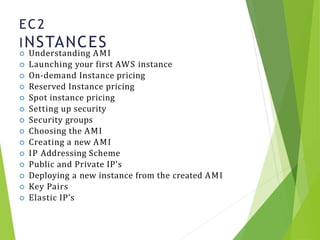
EC2
INSTANCES
8
 Understanding AMI
 Launching your first AWS instance
 On-demand Instance pricing
 Reserved Instance pricing
 Spot instance pricing
 Setting up security
 Security groups
 Choosing the AMI
 Creating a new AMI
 IP Addressing Scheme
 Public and Private IP’s
 Deploying a new instance from the created AMI
 Key Pairs
 Elastic IP’s
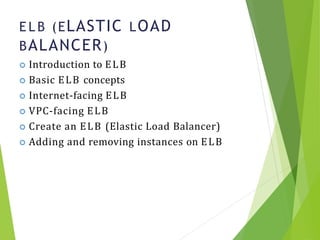
E L B (ELASTIC LOAD
BALANCER)
9
 Introduction to ELB
 Basic ELB concepts
 Internet-facing ELB
 VPC-facing ELB
 Create an ELB (Elastic Load Balancer)
 Adding and removing instances on ELB
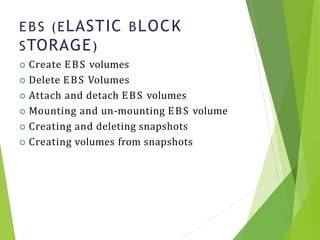
E BS (ELASTIC BLOCK
STORAGE)
10
 Create EBS volumes
 Delete EBS Volumes
 Attach and detach EBS volumes
 Mounting and un-mounting EBS volume
 Creating and deleting snapshots
 Creating volumes from snapshots
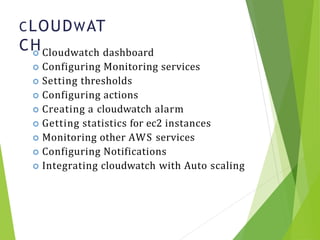
CLOUDWAT
CH
11
 Cloudwatch dashboard
 Configuring Monitoring services
 Setting thresholds
 Configuring actions
 Creating a cloudwatch alarm
 Getting statistics for ec2 instances
 Monitoring other AWS services
 Configuring Notifications
 Integrating cloudwatch with Auto scaling
SIMPLE NOTIFICATION
SERVICE (SNS)
12
 what is SNS?
 Creating a topic
 Create subscription
 Subscribed to the subscription
AUTO
SCALING
13
 Horizontal vs. vertical scaling
 Boot strapping
 Create a launch configuration
 Create an Auto Scaling group
 Create a policy for your Auto Scaling group
 set up an auto-scaled, load-balanced Amazon
EC2 application
IDENTITY ACCESS
MANAGEMENT (IAM)
14
 Creating Users and Groups
 Applying policies
 Password Policy
 Roles
 Command line management.
ELASTIC
BEANSTALK
15
 Creating environment
 Application versioning
 Deploying a sample app
S3 (SIMPLE STORAGE
SERVICE)
16
 What is S3?
 RRS (Reduced Redundancy storage)
 S3 durability and redundancy
 S3 Buckets
 S3 Uploading Downloading
 S3 Permissions
 S3 Object Versioning
 S3 Lifecycle Policies
GLACIER
STORAGE
17
 Route53
 Creating zones
 Hosting a website
 Understanding routing policies
 Weighted simple and failover policies
RELATIONAL DATABASE SE RV I C E (RDS)
18
 Selecting the Database type
 Configuring the database
 Creating database
 Configuring backups
 Configuring the maintenance windows
 Connecting to the database.
CLOUD
FORMATION
19
 What is cloud formation?
 Deploying template
 Create Stack
 Delete Stack
 Provisioning application resources with
CloudFormation
CLOUDFRO
NT
20
 Use of cloudfront
 Creating a cloudfront distribution
 Hosting a website of cloudfront distribution
 Implementing restrictions
 Configuring origins and behaviors
AMAZON VIRTUAL PRIVATE
CLOUD (VPC)
21
 What is VPC?
 VPC configuration
 VPC security
 Elastic IP’s
 Inbound and outbound ACL’s
DYNAMO
DB
22
 Creating a Dynamodb
 Configuring alarms
 Adding data manually
PROJECT AND AWS CASE
STUDY
23
 Creating and managing two tier application
(WEB and DB) on AWS.
 Creating and managing three tier application
(APP, WEB and DB) on AWS.
 Migrating On-Premise application to AWS Cloud.
AWS CERTIFICATION AND
COST STRATEGIES
24
 Best practices for AWS
 Cost control strategies
 Overview of AWS certification
AWS
TROUBLESHOOTIN
G
25
 Troubleshooting EC2 instances
 Troubleshooting using CloudWatch
 Troubleshooting using ELB
 Using CloudTrail
TRUSTED
ADVISOR
26
 Cost Optimization
 Performance
 Security
 Fault Tolerance
CONTACT
US
27
 For More Information about training
Website : www.paliumskills.com
Email
Phone
India -
: palium.skills@gmail.com
Kolkata Office – Barin @+91-9051092035
C hennai Office - Mr. Ari @+91-8610016116

CLOUD_COMPUTING_AWS_TRAINING.pptx

  • 1.
    CL O UD COMPUTING AWS TRAINING 1
  • 2.
    ABOUT AWS CERTIFICATIONS 2  Thepopular AWS Certifications are – 1. SysOps Associate Certification 2. AWS Developer Associate Certification 3. AWS Solution Architect Certification For those with atleast 5-8 years of experience in IT industry, we recommend going for the AWS Solution Architect Certification. For those wishing to move to Cloud technology from non-technical domain may consider SysOps Associate Certification
  • 3.
    WHAT WILL BECOVERED IN TRAINING …  Introduction to Cloud Computing  Introduction to Cloud Computing  Why Cloud Computing?  Benefits of Cloud Computing Course Outline for Solution Architect Associate Training 3
  • 4.
    TYPES OF CLOUD COMPUTING 4 Public Cloud  Private Cloud  Hybrid Cloud  Community Cloud  Software as a Service  Platform as a Service  Infrastructure as a Service
  • 5.
    CLOUD COMPUTING ISSUES 5  Security Costing Model  Service Level Agreement (SLA)  Cloud Interoperability Issue  What to migrate?  Legal and compliance
  • 6.
    VIRTUALIZAT ION 6  What isvirtualization?  Virtualization and cloud computing  Types of virtualization  Virtualization terminologies  Hypervisor  Benefits  Vendors
  • 7.
    AMAZON WEB SERVICES (AWS) 7 Introduction to AWS  Elastic computing  Introduction to the AWS products  Regions and Availability Zones  Signing up for AWS  AWS Free usage tier  Introduction AWS management console
  • 8.
    EC2 INSTANCES 8  Understanding AMI Launching your first AWS instance  On-demand Instance pricing  Reserved Instance pricing  Spot instance pricing  Setting up security  Security groups  Choosing the AMI  Creating a new AMI  IP Addressing Scheme  Public and Private IP’s  Deploying a new instance from the created AMI  Key Pairs  Elastic IP’s
  • 9.
    E L B(ELASTIC LOAD BALANCER) 9  Introduction to ELB  Basic ELB concepts  Internet-facing ELB  VPC-facing ELB  Create an ELB (Elastic Load Balancer)  Adding and removing instances on ELB
  • 10.
    E BS (ELASTICBLOCK STORAGE) 10  Create EBS volumes  Delete EBS Volumes  Attach and detach EBS volumes  Mounting and un-mounting EBS volume  Creating and deleting snapshots  Creating volumes from snapshots
  • 11.
    CLOUDWAT CH 11  Cloudwatch dashboard Configuring Monitoring services  Setting thresholds  Configuring actions  Creating a cloudwatch alarm  Getting statistics for ec2 instances  Monitoring other AWS services  Configuring Notifications  Integrating cloudwatch with Auto scaling
  • 12.
    SIMPLE NOTIFICATION SERVICE (SNS) 12 what is SNS?  Creating a topic  Create subscription  Subscribed to the subscription
  • 13.
    AUTO SCALING 13  Horizontal vs.vertical scaling  Boot strapping  Create a launch configuration  Create an Auto Scaling group  Create a policy for your Auto Scaling group  set up an auto-scaled, load-balanced Amazon EC2 application
  • 14.
    IDENTITY ACCESS MANAGEMENT (IAM) 14 Creating Users and Groups  Applying policies  Password Policy  Roles  Command line management.
  • 15.
    ELASTIC BEANSTALK 15  Creating environment Application versioning  Deploying a sample app
  • 16.
    S3 (SIMPLE STORAGE SERVICE) 16 What is S3?  RRS (Reduced Redundancy storage)  S3 durability and redundancy  S3 Buckets  S3 Uploading Downloading  S3 Permissions  S3 Object Versioning  S3 Lifecycle Policies
  • 17.
    GLACIER STORAGE 17  Route53  Creatingzones  Hosting a website  Understanding routing policies  Weighted simple and failover policies
  • 18.
    RELATIONAL DATABASE SERV I C E (RDS) 18  Selecting the Database type  Configuring the database  Creating database  Configuring backups  Configuring the maintenance windows  Connecting to the database.
  • 19.
    CLOUD FORMATION 19  What iscloud formation?  Deploying template  Create Stack  Delete Stack  Provisioning application resources with CloudFormation
  • 20.
    CLOUDFRO NT 20  Use ofcloudfront  Creating a cloudfront distribution  Hosting a website of cloudfront distribution  Implementing restrictions  Configuring origins and behaviors
  • 21.
    AMAZON VIRTUAL PRIVATE CLOUD(VPC) 21  What is VPC?  VPC configuration  VPC security  Elastic IP’s  Inbound and outbound ACL’s
  • 22.
    DYNAMO DB 22  Creating aDynamodb  Configuring alarms  Adding data manually
  • 23.
    PROJECT AND AWSCASE STUDY 23  Creating and managing two tier application (WEB and DB) on AWS.  Creating and managing three tier application (APP, WEB and DB) on AWS.  Migrating On-Premise application to AWS Cloud.
  • 24.
    AWS CERTIFICATION AND COSTSTRATEGIES 24  Best practices for AWS  Cost control strategies  Overview of AWS certification
  • 25.
    AWS TROUBLESHOOTIN G 25  Troubleshooting EC2instances  Troubleshooting using CloudWatch  Troubleshooting using ELB  Using CloudTrail
  • 26.
    TRUSTED ADVISOR 26  Cost Optimization Performance  Security  Fault Tolerance
  • 27.
    CONTACT US 27  For MoreInformation about training Website : www.paliumskills.com Email Phone India - : palium.skills@gmail.com Kolkata Office – Barin @+91-9051092035 C hennai Office - Mr. Ari @+91-8610016116