Allidm.com
Discovering Identity and Access Management Solutions

Identity and Access
Management Introduction
http://academy.allidm.com
Stay connected to Allidm

Find us on Facebook:
http: //www. facebook.com/allidm
Follow us on Twitter:
http: //twitter.com/aidy_idm
Look for us on LinkedIn:
http: //www. linkedin.com/allidm
Visit our blog:
http://www.allidm.com/blog
Disclaimer and Acknowledgments

The contents here are created as a own personal endeavor and
thus does not reflect any official stance of any Identity and
Access Management Vendor on any particular technology
Contact Us
On this presentation we’ll talk about some useful topics that
you can use no matter which identity and access management
solution or product you are working on.
If you know one that make a big difference please tell us to
include it in the future
aidy.allidm@gmail.com
News

This presentation might be updated on the weekly basis.
Visit our website to get the up-to-date version.

http://allidm.com/blog/training/
Contact Us

On this presentation we’ll talk about some useful topics that you
can use no matter which IAM solution or product you are working
on

If you know one that make a big difference please tell us to include
it in the future
aidy.allidm@gmail.com
What’s Cloud?

Cloud computing refers to applications and services
that run on a distributed network using virtualized
resources and accessed by common Internet
protocols and networking standards.
It is distinguished by the notion that resources are
virtual and limitless and that details of the physical
systems on which software runs are abstracted from
the user.
What’s Cloud?...

Cloud computing is based on five attributes
Multitenancy (shared resources)
Massive scalability
Elasticity
Pay as you go
Self-provisioning of resources
Concepts

Abstraction
Cloud computing abstracts the details of system implementation
from users and developers.
Applications run on physical systems that aren't specified, data is
stored in locations that are unknown, administration of systems
is outsourced to others, and access by users is ubiquitous

Virtualization
Cloud computing virtualizes systems by pooling and sharing
resources.
Systems and storage can be provisioned as needed from a
centralized infrastructure, costs are assessed on a metered basis,
multi-tenancy is enabled, and resources are scalable with agility
Classes of Cloud

Based on the deployment model
The deployment model tells you where the cloud is
located and for what purpose
Public, private, community, and hybrid clouds are
deployment models
Refers to the location and management of the cloud's
infrastructure
Classes of Cloud

Based on the service model.
Service models describe the type of service that the service
provider is offering.
The best-known service models are
Software as a Service
Platform as a Service
Infrastructure as a Service—the SPI model.

The service models build on one another and define what a
vendor must manage and what the client's responsibility is
Deployment models

Public cloud
The public cloud infrastructure is available for public use
alternatively for a large industry group and is owned by
an organization selling cloud services.

Private cloud
The private cloud infrastructure is operated for the
exclusive use of an organization. The cloud may be
managed by that organization or a third party. Private
clouds may be either on- or off-premises.
Deployment models

Hybrid cloud
A hybrid cloud combines multiple clouds (private,
community of public) where those clouds retain their
unique identities, but are bound together as a unit.
A hybrid cloud may offer standardized or proprietary
access to data and applications, as well as application
portability.

Community cloud
A community cloud is one where the cloud has been
organized to serve a common function or purpose
Service models

Infrastructure-As-a-Service Model
IaaS provides virtual machines, virtual storage, virtual infrastructure, and
other hardware assets as resources that clients can provision
The IaaS service provider manages all the infrastructure, while the client
is responsible for all other aspects of the deployment
This can include the operating system, applications, and user interactions
with the system.

The Platform-As-a-Service Model
PaaS provides virtual machines, operating systems, applications,
services, development frameworks, transactions, and control structures.
The client can deploy its applications on the cloud infrastructure or use
applications that were programmed using languages and tools that are
supported by the PaaS service provider.
Service models…

The Platform-As-a-Service Model
The service provider manages the cloud infrastructure, the operating
systems, and the enabling software.
The client is responsible for installing and managing the application that
it is deploying.

Software-As-a-Service Model
SaaS is a complete operating environment with applications,
management, and the user interface.
The application is provided to the client through a thin client interface (a
browser, usually), and the customer's responsibility begins and ends
with entering and managing its data and user interaction.
Everything from the application down to the infrastructure is the
vendor's responsibility.
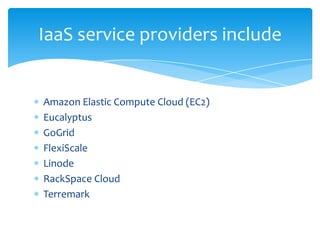
IaaS service providers include

Amazon Elastic Compute Cloud (EC2)
Eucalyptus
GoGrid
FlexiScale
Linode
RackSpace Cloud
Terremark
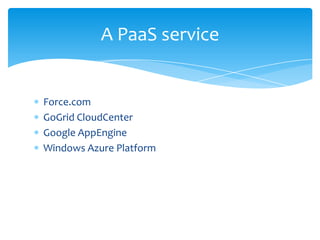
A PaaS service

Force.com
GoGrid CloudCenter
Google AppEngine
Windows Azure Platform
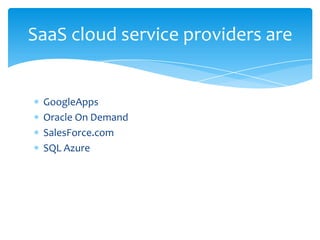
SaaS cloud service providers are

GoogleApps
Oracle On Demand
SalesForce.com
SQL Azure
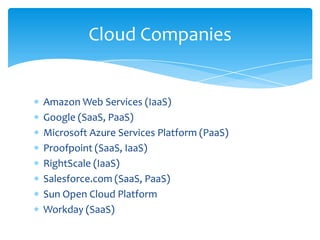
Cloud Companies

Amazon Web Services (IaaS)
Google (SaaS, PaaS)
Microsoft Azure Services Platform (PaaS)
Proofpoint (SaaS, IaaS)
RightScale (IaaS)
Salesforce.com (SaaS, PaaS)
Sun Open Cloud Platform
Workday (SaaS)
Allidm.com
Discovering Identity and Access Management Solutions

Allidm Academy
http://academy.allidm.com

Cloud introduction

  • 1.
    Allidm.com Discovering Identity andAccess Management Solutions Identity and Access Management Introduction http://academy.allidm.com
  • 2.
    Stay connected toAllidm Find us on Facebook: http: //www. facebook.com/allidm Follow us on Twitter: http: //twitter.com/aidy_idm Look for us on LinkedIn: http: //www. linkedin.com/allidm Visit our blog: http://www.allidm.com/blog
  • 3.
    Disclaimer and Acknowledgments Thecontents here are created as a own personal endeavor and thus does not reflect any official stance of any Identity and Access Management Vendor on any particular technology
  • 4.
    Contact Us On thispresentation we’ll talk about some useful topics that you can use no matter which identity and access management solution or product you are working on. If you know one that make a big difference please tell us to include it in the future aidy.allidm@gmail.com
  • 5.
    News This presentation mightbe updated on the weekly basis. Visit our website to get the up-to-date version. http://allidm.com/blog/training/
  • 6.
    Contact Us On thispresentation we’ll talk about some useful topics that you can use no matter which IAM solution or product you are working on If you know one that make a big difference please tell us to include it in the future aidy.allidm@gmail.com
  • 7.
    What’s Cloud? Cloud computingrefers to applications and services that run on a distributed network using virtualized resources and accessed by common Internet protocols and networking standards. It is distinguished by the notion that resources are virtual and limitless and that details of the physical systems on which software runs are abstracted from the user.
  • 8.
    What’s Cloud?... Cloud computingis based on five attributes Multitenancy (shared resources) Massive scalability Elasticity Pay as you go Self-provisioning of resources
  • 9.
    Concepts Abstraction Cloud computing abstractsthe details of system implementation from users and developers. Applications run on physical systems that aren't specified, data is stored in locations that are unknown, administration of systems is outsourced to others, and access by users is ubiquitous Virtualization Cloud computing virtualizes systems by pooling and sharing resources. Systems and storage can be provisioned as needed from a centralized infrastructure, costs are assessed on a metered basis, multi-tenancy is enabled, and resources are scalable with agility
  • 10.
    Classes of Cloud Basedon the deployment model The deployment model tells you where the cloud is located and for what purpose Public, private, community, and hybrid clouds are deployment models Refers to the location and management of the cloud's infrastructure
  • 11.
    Classes of Cloud Basedon the service model. Service models describe the type of service that the service provider is offering. The best-known service models are Software as a Service Platform as a Service Infrastructure as a Service—the SPI model. The service models build on one another and define what a vendor must manage and what the client's responsibility is
  • 12.
    Deployment models Public cloud Thepublic cloud infrastructure is available for public use alternatively for a large industry group and is owned by an organization selling cloud services. Private cloud The private cloud infrastructure is operated for the exclusive use of an organization. The cloud may be managed by that organization or a third party. Private clouds may be either on- or off-premises.
  • 13.
    Deployment models Hybrid cloud Ahybrid cloud combines multiple clouds (private, community of public) where those clouds retain their unique identities, but are bound together as a unit. A hybrid cloud may offer standardized or proprietary access to data and applications, as well as application portability. Community cloud A community cloud is one where the cloud has been organized to serve a common function or purpose
  • 14.
    Service models Infrastructure-As-a-Service Model IaaSprovides virtual machines, virtual storage, virtual infrastructure, and other hardware assets as resources that clients can provision The IaaS service provider manages all the infrastructure, while the client is responsible for all other aspects of the deployment This can include the operating system, applications, and user interactions with the system. The Platform-As-a-Service Model PaaS provides virtual machines, operating systems, applications, services, development frameworks, transactions, and control structures. The client can deploy its applications on the cloud infrastructure or use applications that were programmed using languages and tools that are supported by the PaaS service provider.
  • 15.
    Service models… The Platform-As-a-ServiceModel The service provider manages the cloud infrastructure, the operating systems, and the enabling software. The client is responsible for installing and managing the application that it is deploying. Software-As-a-Service Model SaaS is a complete operating environment with applications, management, and the user interface. The application is provided to the client through a thin client interface (a browser, usually), and the customer's responsibility begins and ends with entering and managing its data and user interaction. Everything from the application down to the infrastructure is the vendor's responsibility.
  • 16.
    IaaS service providersinclude Amazon Elastic Compute Cloud (EC2) Eucalyptus GoGrid FlexiScale Linode RackSpace Cloud Terremark
  • 17.
    A PaaS service Force.com GoGridCloudCenter Google AppEngine Windows Azure Platform
  • 18.
    SaaS cloud serviceproviders are GoogleApps Oracle On Demand SalesForce.com SQL Azure
  • 19.
    Cloud Companies Amazon WebServices (IaaS) Google (SaaS, PaaS) Microsoft Azure Services Platform (PaaS) Proofpoint (SaaS, IaaS) RightScale (IaaS) Salesforce.com (SaaS, PaaS) Sun Open Cloud Platform Workday (SaaS)
  • 20.
    Allidm.com Discovering Identity andAccess Management Solutions Allidm Academy http://academy.allidm.com