Created by
Nishant patel
Cloud computing
•What is cloud computing
•History of cloud computing
•Deployment models
•Security and privacy
•The future
What is cloud computing
• Cloud computing means storing and accessing data and
programs over the Internet instead of your computer's
hard drive.
• Cloud computing, also known as on-demand
computing, is a kind of internet-based computing,
where shared resources and information are provided to
computers and other devices on-demand.
• The cloud is just a metaphor for the Internet.
• Cloud providers typically use a "pay as you go" model.
• This can lead to unexpectedly high charges if administrators
do not adapt to the cloud pricing model.
• With cloud computing, multiple users can access a single
server to retrieve and update their data without purchasing
licenses for different applications.
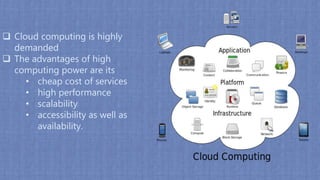
 Cloud computing is highly
demanded
 The advantages of high
computing power are its
• cheap cost of services
• high performance
• scalability
• accessibility as well as
availability.
History of cloud computing
• Origin of the term
• The 1970s
• The 1990s
Origin of the term
• The origin of the term cloud computing is still unclear.
• The expression cloud is commonly used in science to describe a large
agglomeration of objects that visually appear from a distance as a
cloud and describes any set of things whose details are not inspected
further in a given context.
• The cloud symbol was used to represent networks of computing
equipment in the original arpanet by as early as 1977
The 1970s and the 1990s
• During the mid-1970s, time-sharing was popularly
known as RJE (Remote Job Entry)
• In the 1990s, telecommunications companies, who
previously offered primarily dedicated point-to-point data
circuits, began offering virtual private network (VPN) services
with comparable quality of service, but at a lower cost.
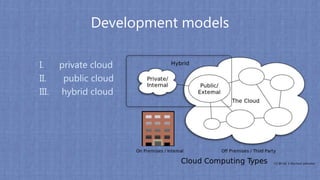
Development models
I. private cloud
II. public cloud
III. hybrid cloud
Private cloud
• Private cloud is cloud infrastructure operated solely for a single
organization, whether managed internally or by a third-party,
and hosted either internally or externally.
• Undertaking a private cloud project requires a significant level
and degree of engagement to virtualize the business
environment, and requires the organization to revaluate
decisions about existing resources.
Public and hybrid cloud
• A cloud is called a "public cloud" when the services are rendered
over a network that is open for public use
• Public cloud services may be free.
• Hybrid cloud is a composition of two or more clouds (private,
community or public) that remain distinct entities but are bound
together, offering the benefits of multiple deployment models.
• Hybrid cloud can also mean the ability to connect collocation,
managed and/or dedicated services with cloud resources.
Security and privacy
• Cloud computing poses privacy concerns because the service
provider can access the data that is on the cloud at any time.
• There is the problem of legal ownership of the data (If a user
stores some data in the cloud, can the cloud provider profit
from it?). Many Terms of Service agreements are silent on the
question of ownership.
• Fundamentally private cloud is seen as more secure with higher
levels of control for the owner, however public cloud is seen to
be more flexible and requires less time and money investment
from the user.
The future
• According to Gartner's Hype cycle, cloud computing has
reached a maturity that leads it into a productive phase.
• The major Cloud technology developers continue to invest
billions a year in Cloud R&D; for example, in 2011 Microsoft
committed 90% of its $9.6bn R&D budget to Cloud.
• Additionally, more industries are turning to cloud technology as
an efficient way to improve quality services due to its
capabilities to reduce overhead costs, downtime, and automate
infrastructure deployment.
Cloud computing
Cloud computing

Cloud computing

  • 1.
  • 2.
    Cloud computing •What iscloud computing •History of cloud computing •Deployment models •Security and privacy •The future
  • 3.
    What is cloudcomputing • Cloud computing means storing and accessing data and programs over the Internet instead of your computer's hard drive. • Cloud computing, also known as on-demand computing, is a kind of internet-based computing, where shared resources and information are provided to computers and other devices on-demand.
  • 4.
    • The cloudis just a metaphor for the Internet. • Cloud providers typically use a "pay as you go" model. • This can lead to unexpectedly high charges if administrators do not adapt to the cloud pricing model. • With cloud computing, multiple users can access a single server to retrieve and update their data without purchasing licenses for different applications.
  • 5.
     Cloud computingis highly demanded  The advantages of high computing power are its • cheap cost of services • high performance • scalability • accessibility as well as availability.
  • 6.
    History of cloudcomputing • Origin of the term • The 1970s • The 1990s
  • 7.
    Origin of theterm • The origin of the term cloud computing is still unclear. • The expression cloud is commonly used in science to describe a large agglomeration of objects that visually appear from a distance as a cloud and describes any set of things whose details are not inspected further in a given context. • The cloud symbol was used to represent networks of computing equipment in the original arpanet by as early as 1977
  • 8.
    The 1970s andthe 1990s • During the mid-1970s, time-sharing was popularly known as RJE (Remote Job Entry) • In the 1990s, telecommunications companies, who previously offered primarily dedicated point-to-point data circuits, began offering virtual private network (VPN) services with comparable quality of service, but at a lower cost.
  • 9.
    Development models I. privatecloud II. public cloud III. hybrid cloud
  • 10.
    Private cloud • Privatecloud is cloud infrastructure operated solely for a single organization, whether managed internally or by a third-party, and hosted either internally or externally. • Undertaking a private cloud project requires a significant level and degree of engagement to virtualize the business environment, and requires the organization to revaluate decisions about existing resources.
  • 11.
    Public and hybridcloud • A cloud is called a "public cloud" when the services are rendered over a network that is open for public use • Public cloud services may be free. • Hybrid cloud is a composition of two or more clouds (private, community or public) that remain distinct entities but are bound together, offering the benefits of multiple deployment models. • Hybrid cloud can also mean the ability to connect collocation, managed and/or dedicated services with cloud resources.
  • 12.
    Security and privacy •Cloud computing poses privacy concerns because the service provider can access the data that is on the cloud at any time. • There is the problem of legal ownership of the data (If a user stores some data in the cloud, can the cloud provider profit from it?). Many Terms of Service agreements are silent on the question of ownership. • Fundamentally private cloud is seen as more secure with higher levels of control for the owner, however public cloud is seen to be more flexible and requires less time and money investment from the user.
  • 13.
    The future • Accordingto Gartner's Hype cycle, cloud computing has reached a maturity that leads it into a productive phase. • The major Cloud technology developers continue to invest billions a year in Cloud R&D; for example, in 2011 Microsoft committed 90% of its $9.6bn R&D budget to Cloud. • Additionally, more industries are turning to cloud technology as an efficient way to improve quality services due to its capabilities to reduce overhead costs, downtime, and automate infrastructure deployment.