Imagine Having A Copy Of Yourself Identical Twin
AN EXACT REPLICA
www.layyous.com
What Is Cloning ?
www.layyous.com
Replication of certain type of cells
or certain part of the cell/ DNA from
a "parent" cell
To PROPAGATE
a certain DESIRABLE genetic
trait.
www.layyous.com
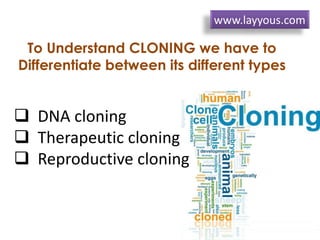
To Understand CLONING we have to
Differentiate between its different types
 DNA cloning
 Therapeutic cloning
 Reproductive cloning
www.layyous.com
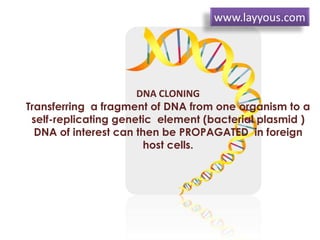
DNA CLONING
Transferring a fragment of DNA from one organism to a
self-replicating genetic element (bacterial plasmid )
DNA of interest can then be PROPAGATED in foreign
host cells.
www.layyous.com
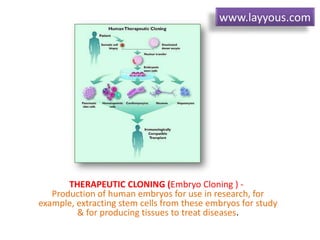
THERAPEUTIC CLONING (Embryo Cloning ) -
Production of human embryos for use in research, for
example, extracting stem cells from these embryos for study
& for producing tissues to treat diseases.
www.layyous.com
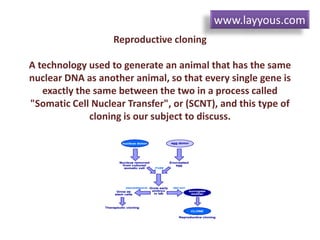
Reproductive cloning
A technology used to generate an animal that has the same
nuclear DNA as another animal, so that every single gene is
exactly the same between the two in a process called
"Somatic Cell Nuclear Transfer", or (SCNT), and this type of
cloning is our subject to discuss.
www.layyous.com
HISTORICAL VIEW
1952 – Trial On a tadpole.
1997 - Dolly The Sheep by a Scottish scientist at
Rosaline Institute ( first cloning of a live mammal)
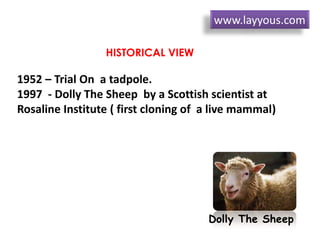
Dolly The Sheep
www.layyous.com
How does one go about
making an exact genetic
copy of an organism? It can
be done by different ways:
somatic cell nuclear transfer
and artificial embryo
twinning. What is the
difference between these
processes?
How Is Cloning Done?
www.layyous.com
Artificial embryo twinning (natural process of
creating identical twins)
 Occurs in a Petri dish
 Manual separation of a early embryo into separate
cells
 Allowing each cell to divide on its own
 Placement of Embryo into a surrogate mother
 Term Completion and delivery of Baby
www.layyous.com
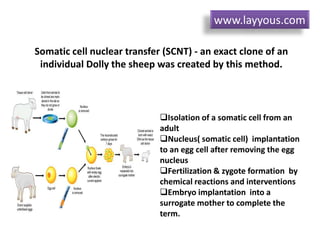
Somatic cell nuclear transfer (SCNT) - an exact clone of an
individual Dolly the sheep was created by this method.
Isolation of a somatic cell from an
adult
Nucleus( somatic cell) implantation
to an egg cell after removing the egg
nucleus
Fertilization & zygote formation by
chemical reactions and interventions
Embryo implantation into a
surrogate mother to complete the
term.
www.layyous.com
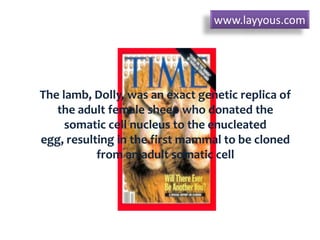
The lamb, Dolly, was an exact genetic replica of
the adult female sheep who donated the
somatic cell nucleus to the enucleated
egg, resulting in the first mammal to be cloned
from an adult somatic cell
www.layyous.com
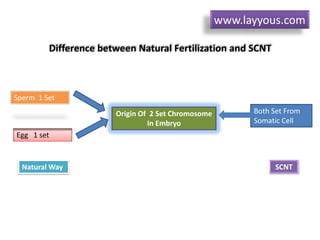
Difference between Natural Fertilization and SCNT
Origin Of 2 Set Chromosome
In Embryo
Sperm 1 Set
Egg 1 set
Both Set From
Somatic Cell
Natural Way SCNT
www.layyous.com
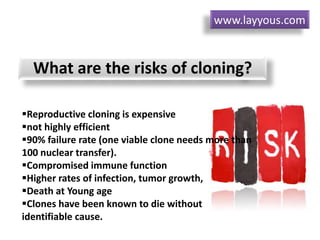
Reproductive cloning is expensive
not highly efficient
90% failure rate (one viable clone needs more than
100 nuclear transfer).
Compromised immune function
Higher rates of infection, tumor growth,
Death at Young age
Clones have been known to die without
identifiable cause.
What are the risks of cloning?
www.layyous.com
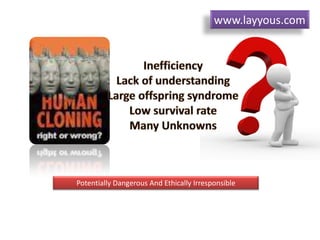
Potentially Dangerous And Ethically Irresponsible
www.layyous.com
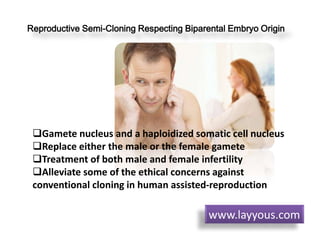
Gamete nucleus and a haploidized somatic cell nucleus
Replace either the male or the female gamete
Treatment of both male and female infertility
Alleviate some of the ethical concerns against
conventional cloning in human assisted-reproduction
Reproductive Semi-Cloning Respecting Biparental Embryo Origin
www.layyous.com
Learn More
To Get
World Class
Infertility IVF Gynecology and Obstetrics
Facilities
www.layyous.com
Dr Najeeb Layyous
Amman, Jordan
facebook.com/Layyouscenter

Cloning-Human Cloning

  • 1.
    Imagine Having ACopy Of Yourself Identical Twin AN EXACT REPLICA www.layyous.com
  • 2.
    What Is Cloning? www.layyous.com
  • 3.
    Replication of certaintype of cells or certain part of the cell/ DNA from a "parent" cell To PROPAGATE a certain DESIRABLE genetic trait. www.layyous.com
  • 4.
    To Understand CLONINGwe have to Differentiate between its different types  DNA cloning  Therapeutic cloning  Reproductive cloning www.layyous.com
  • 5.
    DNA CLONING Transferring afragment of DNA from one organism to a self-replicating genetic element (bacterial plasmid ) DNA of interest can then be PROPAGATED in foreign host cells. www.layyous.com
  • 6.
    THERAPEUTIC CLONING (EmbryoCloning ) - Production of human embryos for use in research, for example, extracting stem cells from these embryos for study & for producing tissues to treat diseases. www.layyous.com
  • 7.
    Reproductive cloning A technologyused to generate an animal that has the same nuclear DNA as another animal, so that every single gene is exactly the same between the two in a process called "Somatic Cell Nuclear Transfer", or (SCNT), and this type of cloning is our subject to discuss. www.layyous.com
  • 8.
    HISTORICAL VIEW 1952 –Trial On a tadpole. 1997 - Dolly The Sheep by a Scottish scientist at Rosaline Institute ( first cloning of a live mammal) Dolly The Sheep www.layyous.com
  • 9.
    How does onego about making an exact genetic copy of an organism? It can be done by different ways: somatic cell nuclear transfer and artificial embryo twinning. What is the difference between these processes? How Is Cloning Done? www.layyous.com
  • 10.
    Artificial embryo twinning(natural process of creating identical twins)  Occurs in a Petri dish  Manual separation of a early embryo into separate cells  Allowing each cell to divide on its own  Placement of Embryo into a surrogate mother  Term Completion and delivery of Baby www.layyous.com
  • 11.
    Somatic cell nucleartransfer (SCNT) - an exact clone of an individual Dolly the sheep was created by this method. Isolation of a somatic cell from an adult Nucleus( somatic cell) implantation to an egg cell after removing the egg nucleus Fertilization & zygote formation by chemical reactions and interventions Embryo implantation into a surrogate mother to complete the term. www.layyous.com
  • 12.
    The lamb, Dolly,was an exact genetic replica of the adult female sheep who donated the somatic cell nucleus to the enucleated egg, resulting in the first mammal to be cloned from an adult somatic cell www.layyous.com
  • 13.
    Difference between NaturalFertilization and SCNT Origin Of 2 Set Chromosome In Embryo Sperm 1 Set Egg 1 set Both Set From Somatic Cell Natural Way SCNT www.layyous.com
  • 14.
    Reproductive cloning isexpensive not highly efficient 90% failure rate (one viable clone needs more than 100 nuclear transfer). Compromised immune function Higher rates of infection, tumor growth, Death at Young age Clones have been known to die without identifiable cause. What are the risks of cloning? www.layyous.com
  • 15.
    Potentially Dangerous AndEthically Irresponsible www.layyous.com
  • 16.
    Gamete nucleus anda haploidized somatic cell nucleus Replace either the male or the female gamete Treatment of both male and female infertility Alleviate some of the ethical concerns against conventional cloning in human assisted-reproduction Reproductive Semi-Cloning Respecting Biparental Embryo Origin www.layyous.com
  • 17.
    Learn More To Get WorldClass Infertility IVF Gynecology and Obstetrics Facilities www.layyous.com Dr Najeeb Layyous Amman, Jordan facebook.com/Layyouscenter