CLEAN ROOMS & 
CLASSIFICATION OF CLEAN ROOMS 
by: Amna Saeed 
Pharm.D(2009-2014) (L.C.W.U)
CLEAN ROOM 
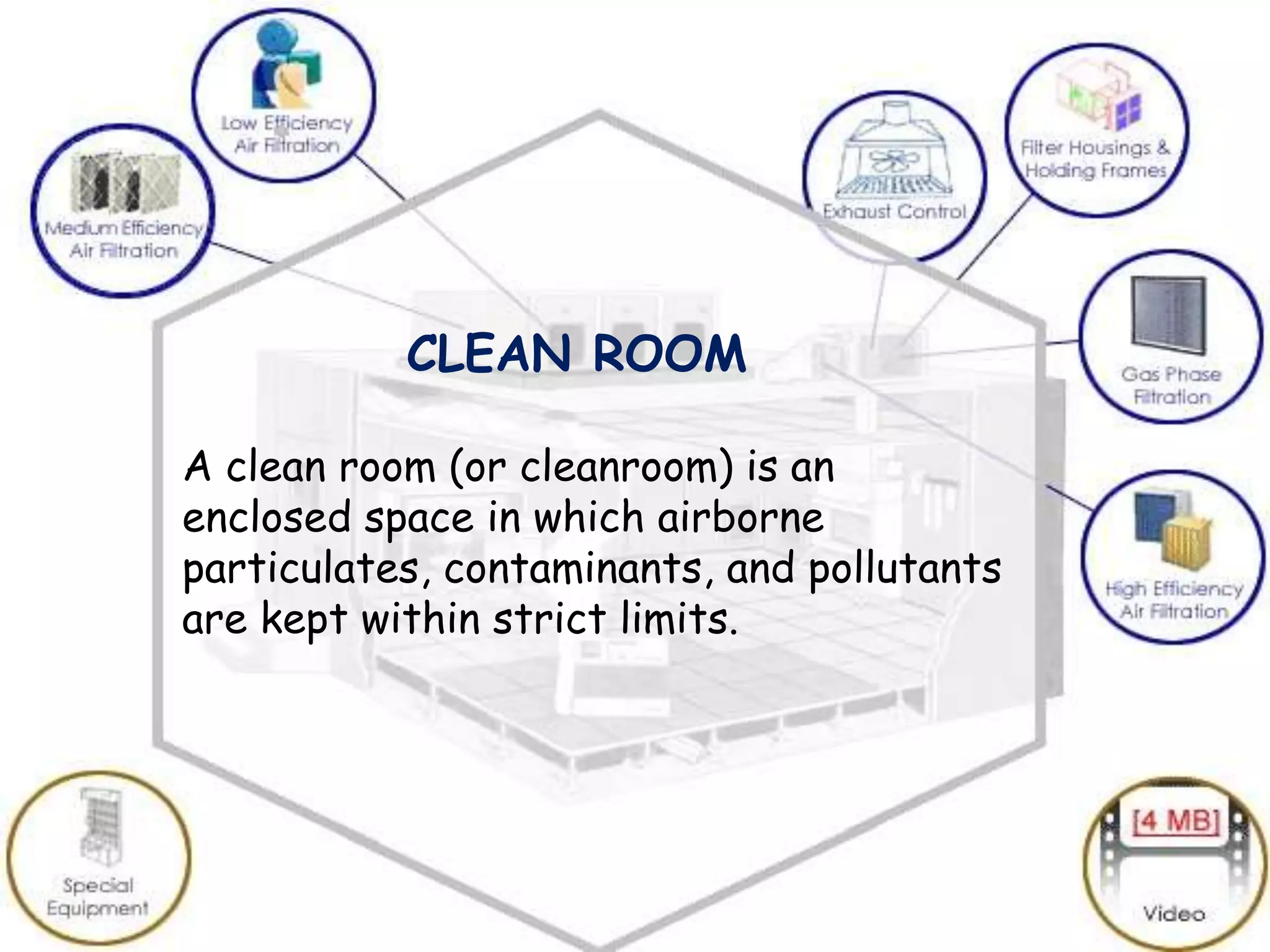
A clean room (or cleanroom) is an 
enclosed space in which airborne 
particulates, contaminants, and pollutants 
are kept within strict limits.
WHY WE 
NEED 
CLEAN 
ROOM???
TO AVOID 
“CONTAMINATION”
CONTAMINATION 
Contamination is a process or act that causes 
materials or surfaces to be soiled with 
contaminating substances. 
Sources of Contamination: 
1:Facilities 
2:People 
3:Tool generated 
4: Fluids 
5: Product generated
1. Facilities 
Walls, floors and ceilings 
Paint and coatings 
Construction material (sheet rock, saw dust etc.) 
Air conditioning debris 
Room air and vapors 
Spills and leaks 
2. People 
Skin flakes and oil 
Cosmetics and perfume 
Clothing debris (lint, fibers etc.) 
Hair
3. Tool Generated 
Friction and wear particles 
Lubricants and emissions 
Vibrations 
mops and dusters 
4. Fluids 
Particulates floating in air 
Bacteria, organics and moisture 
Floor finishes or coatings 
Cleaning chemicals 
Deionized water
5. Product generated 
Silicon chips 
Quartz flakes 
Cleanroom debris 
Aluminum particles
HOW TO CONTROL 
CONTAMINATION???
Key Elements of Contamination Control 
•HVAC system 
•HEPA 
•CLEANROOM ARCHITECTURE 
•LAMINAR FLOW CABINET 
•FILTERATION 
•CLEANING 
•CLEANROOM GARMENTS 
•HUMANS IN CLEANROOM 
•COMODITIES 
•COSMETICS 
•MEASUREMENTS & INSTRUMENTATION 
•ELECTROSTATIC DISCHARGE(ESD)
HVAC SYSTEM (heating, 
ventilation & air-conditioning) 
What can HVAC do? 
HVAC system performs four basic functions: 
1. Control airborne particles, dust and micro-organisms 
– Thru air filtration using high efficiency particulate 
air (HEPA) filters. 
They filter particles as small as 0.3 
microns with a 99.97% minimum 
particle-collective efficiency
2. Maintain room pressure (delta P) – 
Areas that must remain “cleaner” than 
surrounding areas must be kept under a 
“positive” pressurization, 
This is achieved by the HVAC system providing 
more air into the “cleaner” space than is 
mechanically removed from that same space.
3: Maintain space moisture (Relative 
Humidity) 
 Humidity is controlled by cooling air to dew 
point temperatures or by using desiccant 
dehumidifiers.
4. Maintain space temperature – 
Temperature can affect production directly or 
indirectly by fostering the growth of microbial 
contaminants on workers.
CLEANROOM ARCHITECTURE 
This air flow is called laminar flow. 
The more restriction of air flow the 
more turbulence. Turbulence can 
cause particle movement.
Laminar flow cabinet 
•Laminar flow principle involves double 
filteration of air through coarse Pre-filters 
(upto 5 microns) and HEPA filters 
(down to 0.3 microns) for filteration of 
Biological & Particulate contaminants. 
•A constant uni-directional air flows 
either Horizontally or Vertically, is 
drawn from atmosphere and passed 
through pre and Hepa filters on to the 
work surface.
COMPONENTS OF LAMINAR 
FLOW CABINET 
Prefilters : Made of Washable synthetic 
material. 
Hepa Filters : Made of Microglass fibre with 
corrugated aluminium foil separators. 
Blower Units : A motor,with dynamically 
balanced blowers making the unit least vibrant 
with minimum noise level. 
Lighting : Fluorescent tube lights. 
Sterilization : Germicidal Ultra Violet (UV) 
tube. 
manometer : Pressure measuring device
TYPES OF LAMINAR FLOW 
CABINETS
CLEANROOM GARMENTS 
The requirements for cleanroom garments will 
vary from location to location. 
Gloves, face masks and head covers are 
standard in nearly every cleanroom 
environment
HUMANS IN CLEANROOMS 
People are a major source of contamination in 
the cleanroom. 
1. Body Regenerative Processes-- Skin flakes, 
oils, perspiration and hair. 
2. Behavior-- Rate of movement, sneezing and 
coughing. 
3. Attitude-- Work habits and communciation 
between workers.
Notice the number of particles produced per 
minute during these activities. 
PEOPLE ACTIVITY NUMBER OF 
PARTICLES/MIN(0.3 micron 
and larger) 
Motionless (Standing or 
Seated) 
100,000 
Walking about 2 mph 5,000,000 
Walking about 3.5 mph 7,000,000 
Walking about 5 mph 10,000,000 
Horseplay 100,000,000
COMMODITIES - Care is taken when 
selecting and using commodity items in 
cleanrooms. Wipers, cleanroom paper and 
pencils and other supplies that service 
the cleanroom should be carefully 
screened and selected
COSMETICS - Many cosmetics contain 
sodium, magnesium, silicon, calcium, potassium 
or iron. 
These chemicals can create damaging particles. 
Cleanroom managers may ban or restrict 
cosmetics in the cleanroom 
A recent mirror on a space telescope was 
fogged up from the cologne that was present in 
the cleanroom.
MEASUREMENT AND INSTRUMENTATION - 
Some important measurements related to 
contamination control are particle count, air 
flow & velocity, humidity, temperature and 
surface cleanliness 
ELECTROSTATIC DISCHARGE (ESD) 
Moving air creates a charge. 
People touching surfaces or walking across the 
floor can create an electric charge. 
Special care is taken to use ESD protective 
materials to prevent damage from ESD. Cleaning 
managers should work with their personnel to 
understand where these conditions may be 
present and how to prevent them.
CLASSIFICATION OF 
CLEAN ROOMS 
Clean rooms are classified by the 
cleanliness of their air. 
•The method most easily understood and 
most universally applied is the one 
suggested in the earlier versions (A to 
D) of Federal Standard 209 of the USA. 
•In this old standard the number of 
particles equal to and greater than 0.5 m 
m is measured in one cubic foot of air 
and this count used to classify the room.
Federal Standard 209 
This standard was first published in 1963 in the 
USA and titled "Cleanroom and Work Station 
Requirements, Controlled Environments“
Pharmaceutical Clean Room 
Classification 
For the manufacture of sterile medicinal 
products four grades are given
Grade A: The local zone for high risk 
operations, e.g. 
filling zone, stopper bowls, open 
ampoules and vials, making aseptic 
connections. 
Normally such conditions are provided 
by a laminar air flow work station. 
Laminar air flow systems should provide 
an homogeneous air speed of 0.45 m/s 
+/- 20% at the working position.
Grade B: In case of aseptic 
preparation and filling, the background 
environment for grade A zone. 
Grades C and D: Clean areas 
for carrying out less critical 
stages in the manufacture of 
sterile products.
Examples of operations to be 
carried out in the various grades 
are given in the table below
Additional microbiological 
monitoring is also required 
outside production operations, e.g. 
after validation of systems, 
cleaning and sanitization. 
(NOTES: a) These are average values. 
(b) Individual settle plates may be exposed for less than 4 hours. 
(c) Appropriate alert and action limits should be set for the results of 
particulate and microbiological monitoring. If these limits are 
exceeded operating procedures should prescribe corrective action.
REFERENCES: 
1:http://www.mssl.ucl.ac.uk/www_cleanro 
om/cleanroom/cr_standards.html#pcc 
2:http://whatis.techtarget.com/definition 
/clean-room 
3:http://www.coastwidelabs.com/Technical 
%20Articles/Cleaning%20the%20Cleanroom 
.htm 
4:http://www.fda.gov/downloads/Drugs/.. 
./Guidances/ucm070342.pdf
Clean Rooms-Classification-by Amna Saeed

Clean Rooms-Classification-by Amna Saeed

  • 1.
    CLEAN ROOMS & CLASSIFICATION OF CLEAN ROOMS by: Amna Saeed Pharm.D(2009-2014) (L.C.W.U)
  • 2.
    CLEAN ROOM Aclean room (or cleanroom) is an enclosed space in which airborne particulates, contaminants, and pollutants are kept within strict limits.
  • 3.
    WHY WE NEED CLEAN ROOM???
  • 4.
  • 5.
    CONTAMINATION Contamination isa process or act that causes materials or surfaces to be soiled with contaminating substances. Sources of Contamination: 1:Facilities 2:People 3:Tool generated 4: Fluids 5: Product generated
  • 6.
    1. Facilities Walls,floors and ceilings Paint and coatings Construction material (sheet rock, saw dust etc.) Air conditioning debris Room air and vapors Spills and leaks 2. People Skin flakes and oil Cosmetics and perfume Clothing debris (lint, fibers etc.) Hair
  • 7.
    3. Tool Generated Friction and wear particles Lubricants and emissions Vibrations mops and dusters 4. Fluids Particulates floating in air Bacteria, organics and moisture Floor finishes or coatings Cleaning chemicals Deionized water
  • 8.
    5. Product generated Silicon chips Quartz flakes Cleanroom debris Aluminum particles
  • 9.
    HOW TO CONTROL CONTAMINATION???
  • 11.
    Key Elements ofContamination Control •HVAC system •HEPA •CLEANROOM ARCHITECTURE •LAMINAR FLOW CABINET •FILTERATION •CLEANING •CLEANROOM GARMENTS •HUMANS IN CLEANROOM •COMODITIES •COSMETICS •MEASUREMENTS & INSTRUMENTATION •ELECTROSTATIC DISCHARGE(ESD)
  • 12.
    HVAC SYSTEM (heating, ventilation & air-conditioning) What can HVAC do? HVAC system performs four basic functions: 1. Control airborne particles, dust and micro-organisms – Thru air filtration using high efficiency particulate air (HEPA) filters. They filter particles as small as 0.3 microns with a 99.97% minimum particle-collective efficiency
  • 13.
    2. Maintain roompressure (delta P) – Areas that must remain “cleaner” than surrounding areas must be kept under a “positive” pressurization, This is achieved by the HVAC system providing more air into the “cleaner” space than is mechanically removed from that same space.
  • 14.
    3: Maintain spacemoisture (Relative Humidity)  Humidity is controlled by cooling air to dew point temperatures or by using desiccant dehumidifiers.
  • 15.
    4. Maintain spacetemperature – Temperature can affect production directly or indirectly by fostering the growth of microbial contaminants on workers.
  • 16.
    CLEANROOM ARCHITECTURE Thisair flow is called laminar flow. The more restriction of air flow the more turbulence. Turbulence can cause particle movement.
  • 17.
    Laminar flow cabinet •Laminar flow principle involves double filteration of air through coarse Pre-filters (upto 5 microns) and HEPA filters (down to 0.3 microns) for filteration of Biological & Particulate contaminants. •A constant uni-directional air flows either Horizontally or Vertically, is drawn from atmosphere and passed through pre and Hepa filters on to the work surface.
  • 18.
    COMPONENTS OF LAMINAR FLOW CABINET Prefilters : Made of Washable synthetic material. Hepa Filters : Made of Microglass fibre with corrugated aluminium foil separators. Blower Units : A motor,with dynamically balanced blowers making the unit least vibrant with minimum noise level. Lighting : Fluorescent tube lights. Sterilization : Germicidal Ultra Violet (UV) tube. manometer : Pressure measuring device
  • 19.
    TYPES OF LAMINARFLOW CABINETS
  • 20.
    CLEANROOM GARMENTS Therequirements for cleanroom garments will vary from location to location. Gloves, face masks and head covers are standard in nearly every cleanroom environment
  • 22.
    HUMANS IN CLEANROOMS People are a major source of contamination in the cleanroom. 1. Body Regenerative Processes-- Skin flakes, oils, perspiration and hair. 2. Behavior-- Rate of movement, sneezing and coughing. 3. Attitude-- Work habits and communciation between workers.
  • 23.
    Notice the numberof particles produced per minute during these activities. PEOPLE ACTIVITY NUMBER OF PARTICLES/MIN(0.3 micron and larger) Motionless (Standing or Seated) 100,000 Walking about 2 mph 5,000,000 Walking about 3.5 mph 7,000,000 Walking about 5 mph 10,000,000 Horseplay 100,000,000
  • 24.
    COMMODITIES - Careis taken when selecting and using commodity items in cleanrooms. Wipers, cleanroom paper and pencils and other supplies that service the cleanroom should be carefully screened and selected
  • 25.
    COSMETICS - Manycosmetics contain sodium, magnesium, silicon, calcium, potassium or iron. These chemicals can create damaging particles. Cleanroom managers may ban or restrict cosmetics in the cleanroom A recent mirror on a space telescope was fogged up from the cologne that was present in the cleanroom.
  • 26.
    MEASUREMENT AND INSTRUMENTATION- Some important measurements related to contamination control are particle count, air flow & velocity, humidity, temperature and surface cleanliness ELECTROSTATIC DISCHARGE (ESD) Moving air creates a charge. People touching surfaces or walking across the floor can create an electric charge. Special care is taken to use ESD protective materials to prevent damage from ESD. Cleaning managers should work with their personnel to understand where these conditions may be present and how to prevent them.
  • 27.
    CLASSIFICATION OF CLEANROOMS Clean rooms are classified by the cleanliness of their air. •The method most easily understood and most universally applied is the one suggested in the earlier versions (A to D) of Federal Standard 209 of the USA. •In this old standard the number of particles equal to and greater than 0.5 m m is measured in one cubic foot of air and this count used to classify the room.
  • 28.
    Federal Standard 209 This standard was first published in 1963 in the USA and titled "Cleanroom and Work Station Requirements, Controlled Environments“
  • 29.
    Pharmaceutical Clean Room Classification For the manufacture of sterile medicinal products four grades are given
  • 30.
    Grade A: Thelocal zone for high risk operations, e.g. filling zone, stopper bowls, open ampoules and vials, making aseptic connections. Normally such conditions are provided by a laminar air flow work station. Laminar air flow systems should provide an homogeneous air speed of 0.45 m/s +/- 20% at the working position.
  • 31.
    Grade B: Incase of aseptic preparation and filling, the background environment for grade A zone. Grades C and D: Clean areas for carrying out less critical stages in the manufacture of sterile products.
  • 32.
    Examples of operationsto be carried out in the various grades are given in the table below
  • 33.
    Additional microbiological monitoringis also required outside production operations, e.g. after validation of systems, cleaning and sanitization. (NOTES: a) These are average values. (b) Individual settle plates may be exposed for less than 4 hours. (c) Appropriate alert and action limits should be set for the results of particulate and microbiological monitoring. If these limits are exceeded operating procedures should prescribe corrective action.
  • 34.
    REFERENCES: 1:http://www.mssl.ucl.ac.uk/www_cleanro om/cleanroom/cr_standards.html#pcc 2:http://whatis.techtarget.com/definition /clean-room 3:http://www.coastwidelabs.com/Technical %20Articles/Cleaning%20the%20Cleanroom .htm 4:http://www.fda.gov/downloads/Drugs/.. ./Guidances/ucm070342.pdf