


CLAUSES
agroup of words
with a subject and
a verb. 
   INDEPEDEPENDENT


   DEPENDENT
 Has a subject and a
  verb
 Can stand by itself as a
  complete sentence
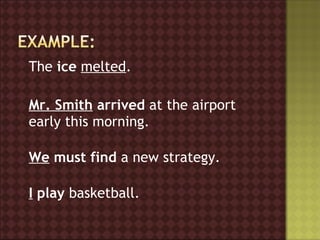
The ice melted.

Mr. Smith arrived at the airport
early this morning.

We must find a new strategy.

I play basketball.
Clauses are combined in three different ways:
  coordination, subordination, and by means of
  semicolon.

  COORDINATION
- Involves joining independent clauses with one of the
   coordinating conjunction: and, but, or, nor, for,
   and yet.
e.g.
For example:
   Mr. Smith arrived early this morning, but I didn’t
   meet him.
 SUBORDINATION
- It involves turning one of the clauses into a
  subordinate element through the use of
  subordinating conjunction or a relative pronoun.
e.g.
Although Ramonita often thought about joining the
  choir, she never talked to her friends about it.

 SEMICOLONS
- Can connect two independent clauses with or
  without the help of a conjunctive adverb
e.g.
Ramonita has such a beautiful voice; many couples
  have asked her to sing at their wedding.
Ramonita’s voice has a clear, angelic quality;
  furthermore, she clearly enjoys using it.
   functions not as a sentence but
    as a part of speech (a noun or
    an adjective or an adverb).  
    Therefore, it cannot stand alone
    as a sentence.
   It is attached to some part of an
    INDEPENDENT clause.
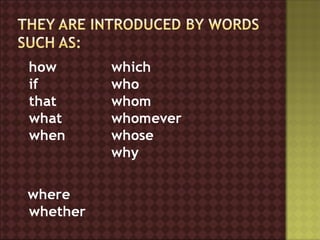
   Noun clauses

   Adjective clauses

   Adverb Clauses
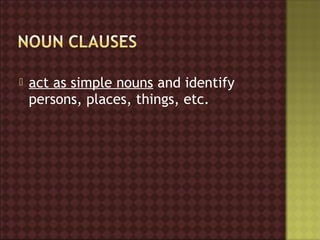
   act as simple nouns and identify
    persons, places, things, etc. 
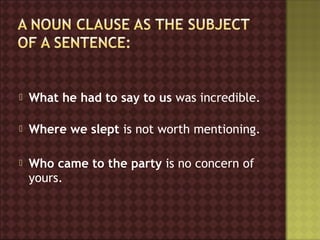
   What he had to say to us was incredible.

   Where we slept is not worth mentioning.

   Who came to the party is no concern of
    yours.
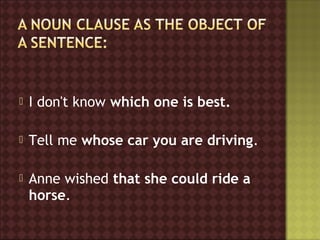
   I don't know which one is best.

   Tell me whose car you are driving.

   Anne wished that she could ride a
    horse.
   give information about nouns (people,
    things, places, etc.)

   They appear after the noun or pronoun
    they modify and usually begins with
    RELATIVE PRONOUNS such as:
    that, which, who, whom or whose
    or sentences with a RELATIVE ADVERB
    such as:
    before, since, when, where, or why
   As a Subject

e.g.
• Pavarotti, who sings at the Metropolitan
  Opera, is a tenor.

•   The job has been given to the man whom
    you recommended.
   As a Direct Object

e.g.
• Someone broke the window that I
  recently fixed.

•   The bat which you have used has been
    broken.
 As an Object of a Preposition
e.g.

    This is my aunt of whom I have spoken.

    We judge a man by what he does.
   As an Adjective

e.g.
• I have a friend whose witty remarks
  amuse me.

•   I listened to the song that you told me
    about.
  RESTRICTIVE CLAUSE
-it specifies or restrict the nouns. A relative
  clause begins with a relative pronoun like
  that or who.
e.g.
The building that they built in San
  Francisco sold a lot of money.
(in this case, it specifies which building the
  speaker is referring to.)
 NONRESTRICTIVE     CLAUSE
- It adds extra information about an
  already- specific noun. It begins with the
  relative pronoun like which or who.
e.g.
The building, which they built in San
  Francisco, sold a lot of money.
(in this case, there’s only one building to
  talk about, whereas the example for
  restrictive clause implies that there could
  be several buildings.)
   dependent clause that modify verb,
    adjective, adverb or verbal.

   It does this by pointing out where,
    when, in what manner, to what
    extent, under what condition, or
    why.
Dependent clauses can modify like adverbs.
Such clauses can express nine (9) important
relationships with certain subordinating
conjunctions:

oTIME:   when, before, while, since

I’ll do the laundry when I’m out of clothes.
o   PLACE: where, wherever

After finding the book where I had left it, I
 hurried back into the house.

o   MANNER: as, as if

He kicked the can as if it was a ball.
o   CONDITION: if, so, unless, provided that

Unless you make the payment, service will
 be cut off.

o   CAUSE: because, as, since

The train, three hours late because the
 locomotive had broken down, was full of
 angry passengers.
o   PURPOSE: in order that, so that

The officers worked hard all day so that
 the hall would be ready for the party.

o   RESULT: that, so that, so . . . that

We were so hungry that we ate stale
 crackers.
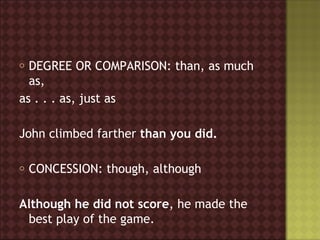
o DEGREE OR COMPARISON: than, as much
  as,
as . . . as, just as

John climbed farther than you did.

o   CONCESSION: though, although

Although he did not score, he made the
 best play of the game.
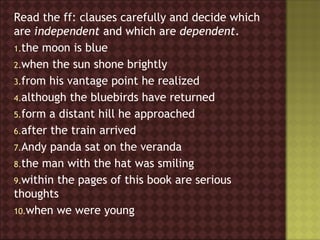
Read the ff: clauses carefully and decide which
are independent and which are dependent.
1.the moon is blue
2.when the sun shone brightly
3.from his vantage point he realized
4.although the bluebirds have returned
5.form a distant hill he approached
6.after the train arrived
7.Andy panda sat on the veranda
8.the man with the hat was smiling
9.within the pages of this book are serious
thoughts
10.when we were young

Clauses (revised)

  • 1.
  • 3.
    agroup of words witha subject and a verb. 
  • 4.
    INDEPEDEPENDENT  DEPENDENT
  • 5.
     Has asubject and a verb  Can stand by itself as a complete sentence
  • 6.
    The ice melted. Mr.Smith arrived at the airport early this morning. We must find a new strategy. I play basketball.
  • 7.
    Clauses are combinedin three different ways: coordination, subordination, and by means of semicolon.  COORDINATION - Involves joining independent clauses with one of the coordinating conjunction: and, but, or, nor, for, and yet. e.g. For example: Mr. Smith arrived early this morning, but I didn’t meet him.
  • 8.
     SUBORDINATION - Itinvolves turning one of the clauses into a subordinate element through the use of subordinating conjunction or a relative pronoun. e.g. Although Ramonita often thought about joining the choir, she never talked to her friends about it.  SEMICOLONS - Can connect two independent clauses with or without the help of a conjunctive adverb e.g. Ramonita has such a beautiful voice; many couples have asked her to sing at their wedding. Ramonita’s voice has a clear, angelic quality; furthermore, she clearly enjoys using it.
  • 9.
    functions not as a sentence but as a part of speech (a noun or an adjective or an adverb).   Therefore, it cannot stand alone as a sentence.  It is attached to some part of an INDEPENDENT clause.
  • 10.
    Noun clauses  Adjective clauses  Adverb Clauses
  • 11.
    act as simple nouns and identify persons, places, things, etc. 
  • 13.
    What he had to say to us was incredible.  Where we slept is not worth mentioning.  Who came to the party is no concern of yours.
  • 14.
    I don't know which one is best.  Tell me whose car you are driving.  Anne wished that she could ride a horse.
  • 15.
    give information about nouns (people, things, places, etc.)  They appear after the noun or pronoun they modify and usually begins with RELATIVE PRONOUNS such as: that, which, who, whom or whose or sentences with a RELATIVE ADVERB such as: before, since, when, where, or why
  • 16.
    As a Subject e.g. • Pavarotti, who sings at the Metropolitan Opera, is a tenor. • The job has been given to the man whom you recommended.
  • 17.
    As a Direct Object e.g. • Someone broke the window that I recently fixed. • The bat which you have used has been broken.
  • 18.
     As anObject of a Preposition e.g. This is my aunt of whom I have spoken. We judge a man by what he does.
  • 19.
    As an Adjective e.g. • I have a friend whose witty remarks amuse me. • I listened to the song that you told me about.
  • 20.
     RESTRICTIVECLAUSE -it specifies or restrict the nouns. A relative clause begins with a relative pronoun like that or who. e.g. The building that they built in San Francisco sold a lot of money. (in this case, it specifies which building the speaker is referring to.)
  • 21.
     NONRESTRICTIVE CLAUSE - It adds extra information about an already- specific noun. It begins with the relative pronoun like which or who. e.g. The building, which they built in San Francisco, sold a lot of money. (in this case, there’s only one building to talk about, whereas the example for restrictive clause implies that there could be several buildings.)
  • 22.
    dependent clause that modify verb, adjective, adverb or verbal.  It does this by pointing out where, when, in what manner, to what extent, under what condition, or why.
  • 23.
    Dependent clauses canmodify like adverbs. Such clauses can express nine (9) important relationships with certain subordinating conjunctions: oTIME: when, before, while, since I’ll do the laundry when I’m out of clothes.
  • 24.
    o PLACE: where, wherever After finding the book where I had left it, I hurried back into the house. o MANNER: as, as if He kicked the can as if it was a ball.
  • 25.
    o CONDITION: if, so, unless, provided that Unless you make the payment, service will be cut off. o CAUSE: because, as, since The train, three hours late because the locomotive had broken down, was full of angry passengers.
  • 26.
    o PURPOSE: in order that, so that The officers worked hard all day so that the hall would be ready for the party. o RESULT: that, so that, so . . . that We were so hungry that we ate stale crackers.
  • 27.
    o DEGREE ORCOMPARISON: than, as much as, as . . . as, just as John climbed farther than you did. o CONCESSION: though, although Although he did not score, he made the best play of the game.
  • 28.
    Read the ff:clauses carefully and decide which are independent and which are dependent. 1.the moon is blue 2.when the sun shone brightly 3.from his vantage point he realized 4.although the bluebirds have returned 5.form a distant hill he approached 6.after the train arrived 7.Andy panda sat on the veranda 8.the man with the hat was smiling 9.within the pages of this book are serious thoughts 10.when we were young