Classes and
Classes and
Objects
Objects
•Introduction
•Classes
•Data hiding and Encapsulation
•Functions in a class
•Using objects
•Static Class Members
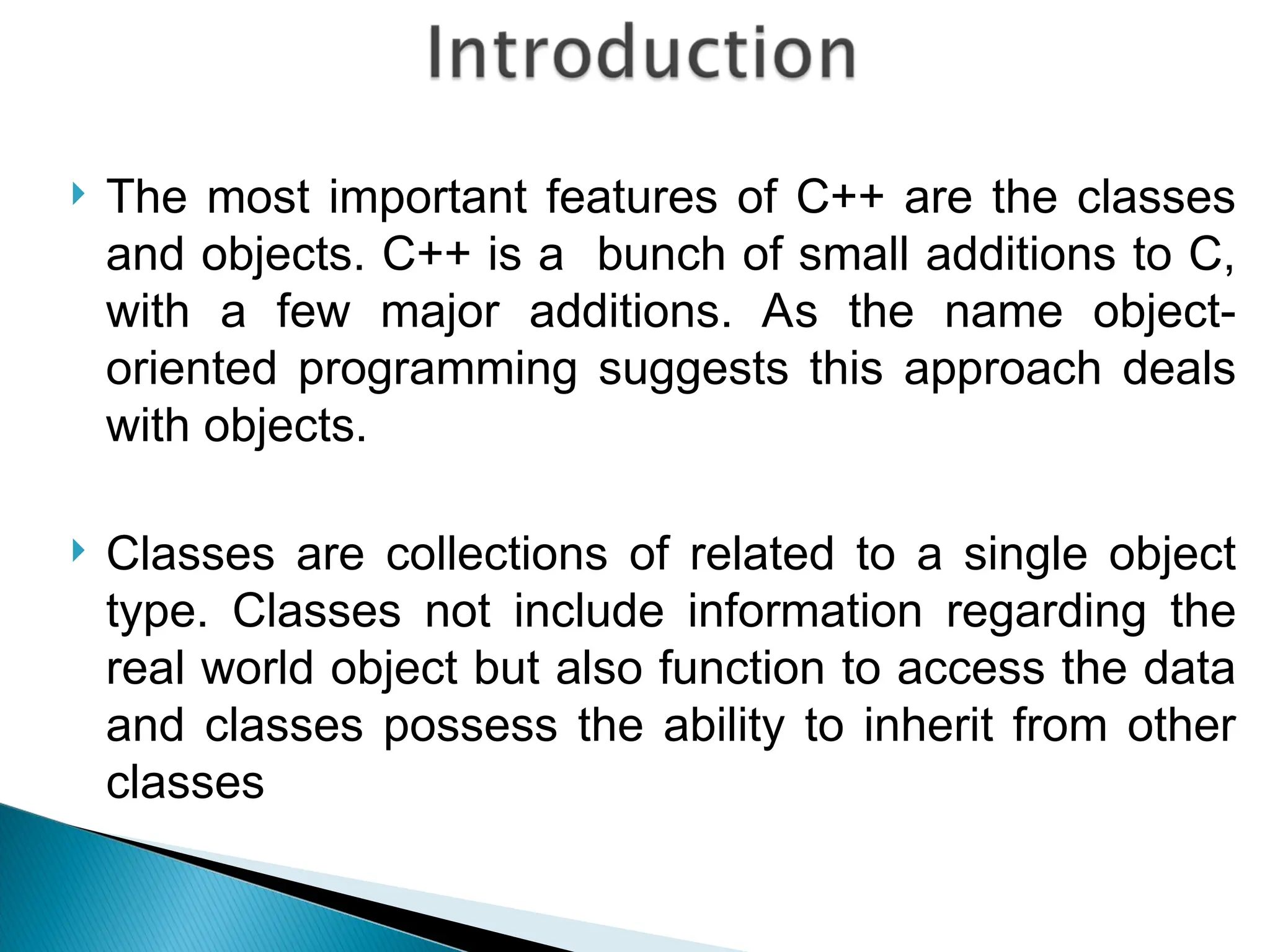
 The most important features of C++ are the classes
and objects. C++ is a bunch of small additions to C,
with a few major additions. As the name object-
oriented programming suggests this approach deals
with objects.
 Classes are collections of related to a single object
type. Classes not include information regarding the
real world object but also function to access the data
and classes possess the ability to inherit from other
classes
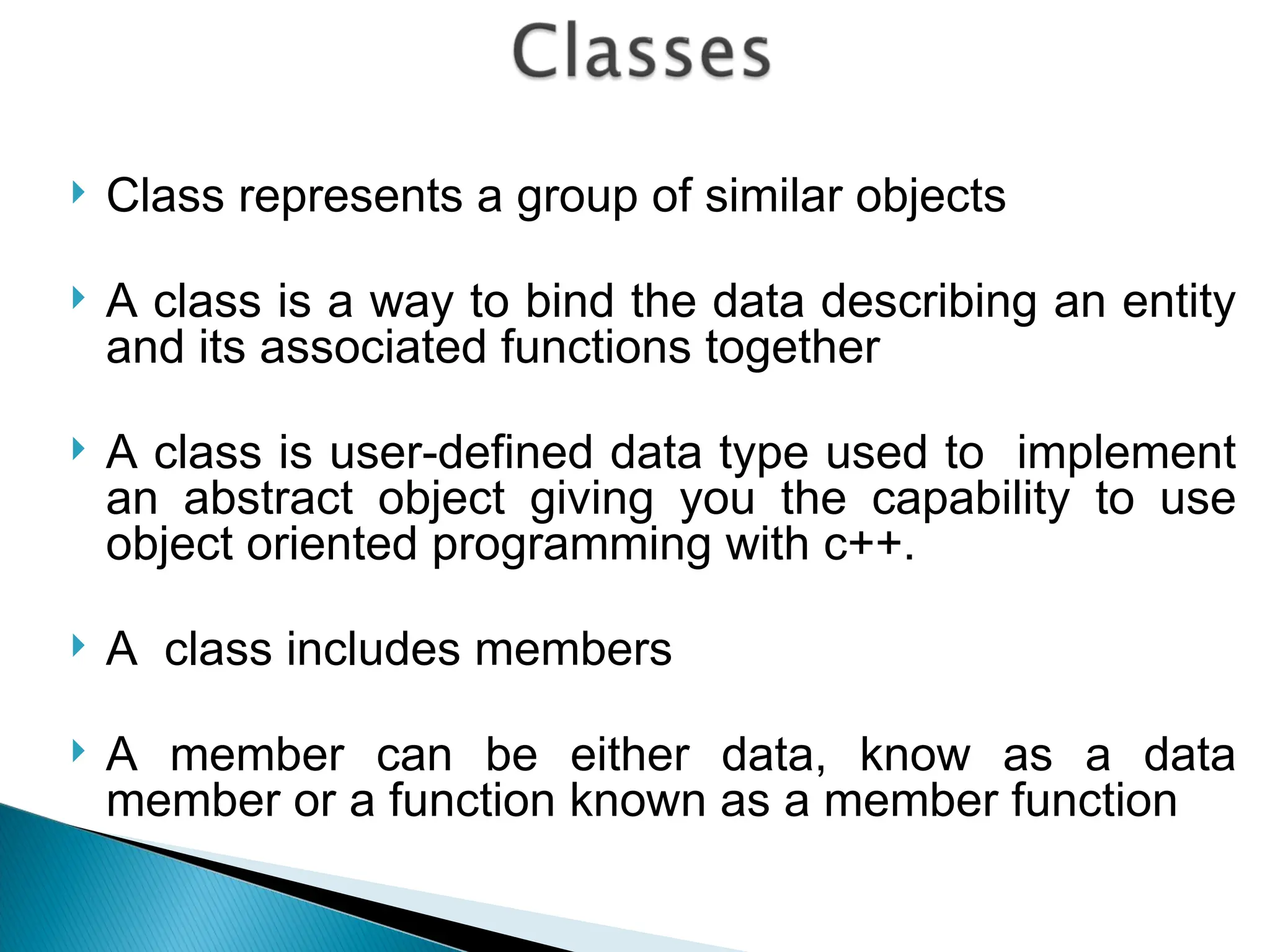
 Class represents a group of similar objects
 A class is a way to bind the data describing an entity
and its associated functions together
 A class is user-defined data type used to implement
an abstract object giving you the capability to use
object oriented programming with c++.
 A class includes members
 A member can be either data, know as a data
member or a function known as a member function
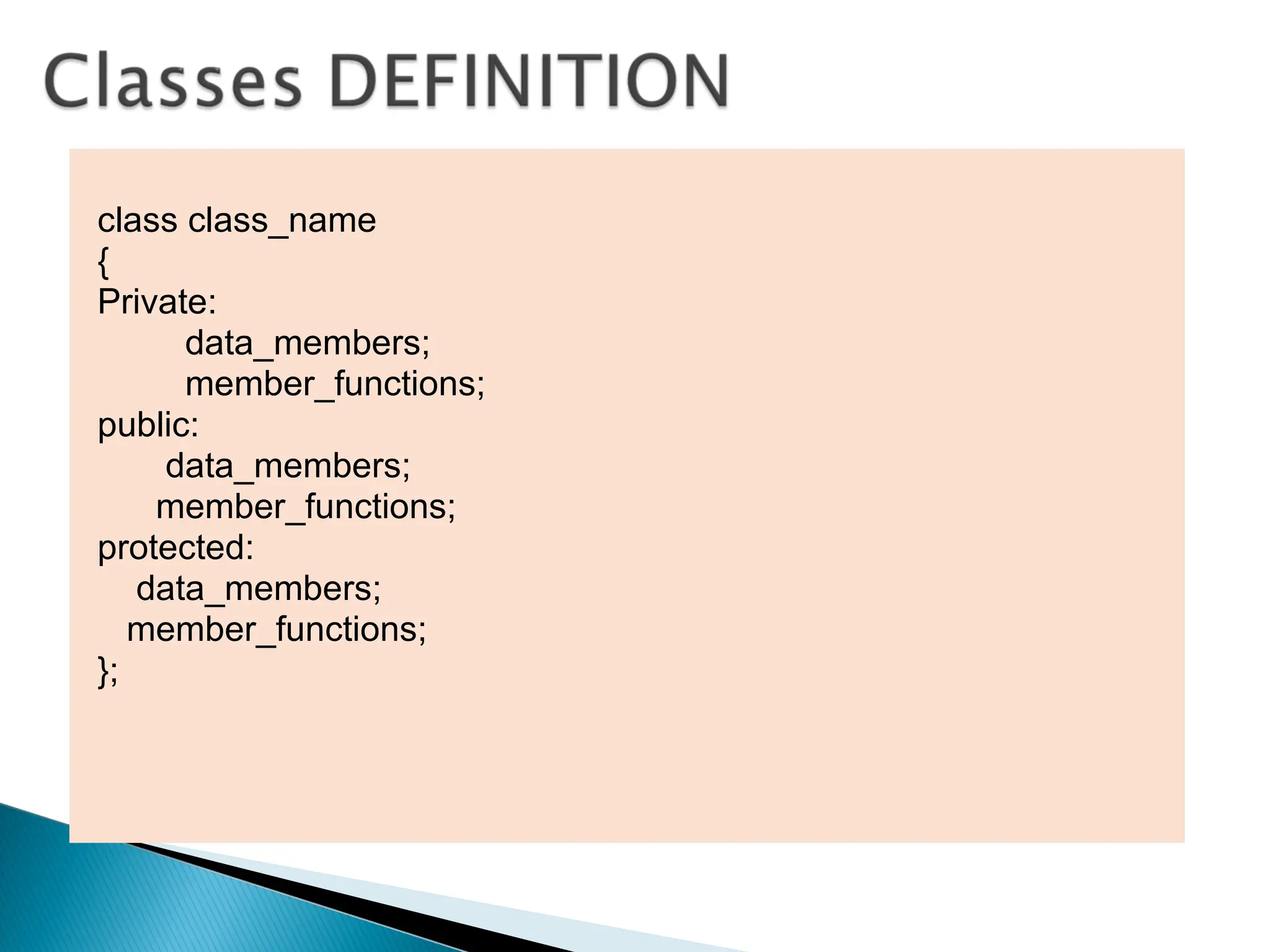
class class_name
{
Private:
data_members;
member_functions;
public:
data_members;
member_functions;
protected:
data_members;
member_functions;
};
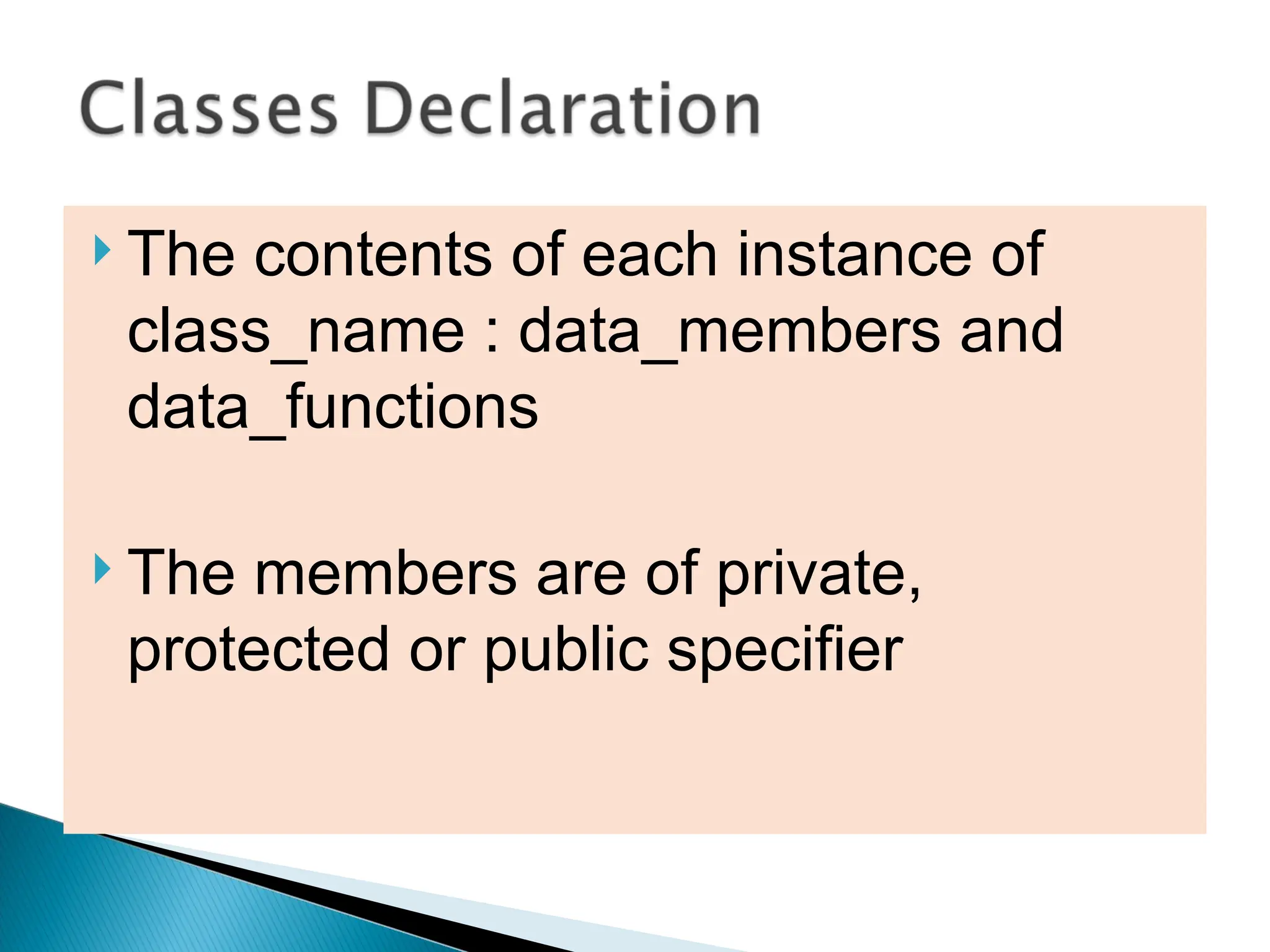
 The contents of each instance of
class_name : data_members and
data_functions
 The members are of private,
protected or public specifier
The declaration of a class involves declaration of its
four associated attributes
1) Data members are the data-type properties that describe the
characteristics of a class. There may be zero or more data members
of any type in a class
2) Member functions are set of operations that may be applied to
object of that class. There may be zero or more member functions
of a class. They are referred to as the class interface
3) Program Access Levels that control access to members from within
the program. These access levels are private, protected or
public .Depending upon the access level of a class member, access
to it allowed or denied
4) Class Tag name that serves as a type specifier for the class using
which objects of this class type can be created.
 The class specification takes place in two parts
=>Class definition: which describe the
component members (data member and
functions members) of the class
=>Class method definition : which describe how
certain class member function are
implemented.
=>Outside the class definition
=>Inside the class definition
 A member function definition outside the class definition is
much same as that of function definitions .
 The only difference is that the name of the function is the
full name of the function. the full name (also called
qualified-name) of the function is written as:
 Class-name::function-name
 Class-name:indicate that the function specified by
function_name Is a member of the class specified by class-
name.
 The symbol :: called the scope resolution operator specifies
that the scope of the function is restricted to the class
class-name
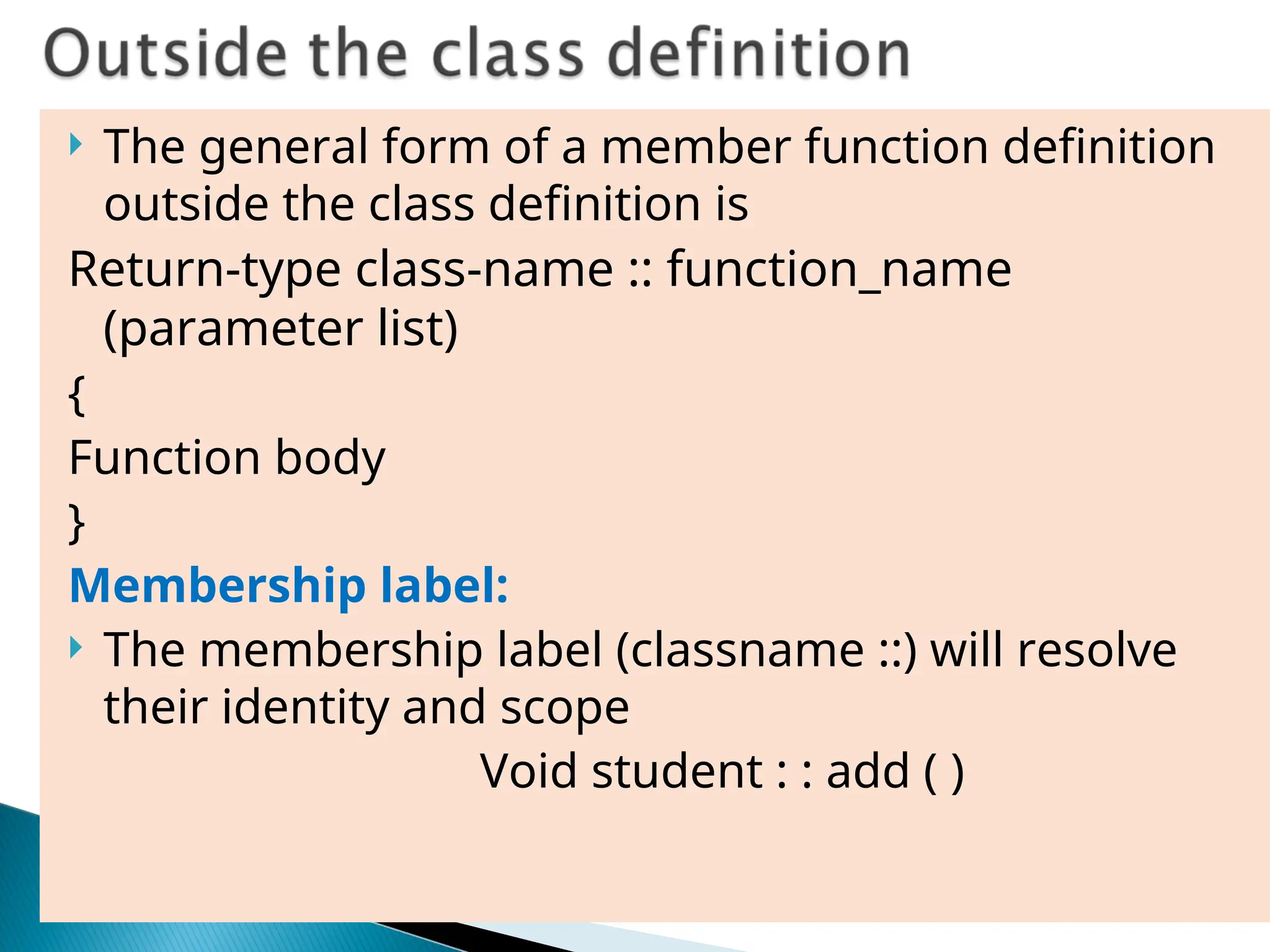
 The general form of a member function definition
outside the class definition is
Return-type class-name :: function_name
(parameter list)
{
Function body
}
Membership label:
 The membership label (classname ::) will resolve
their identity and scope
Void student : : add ( )
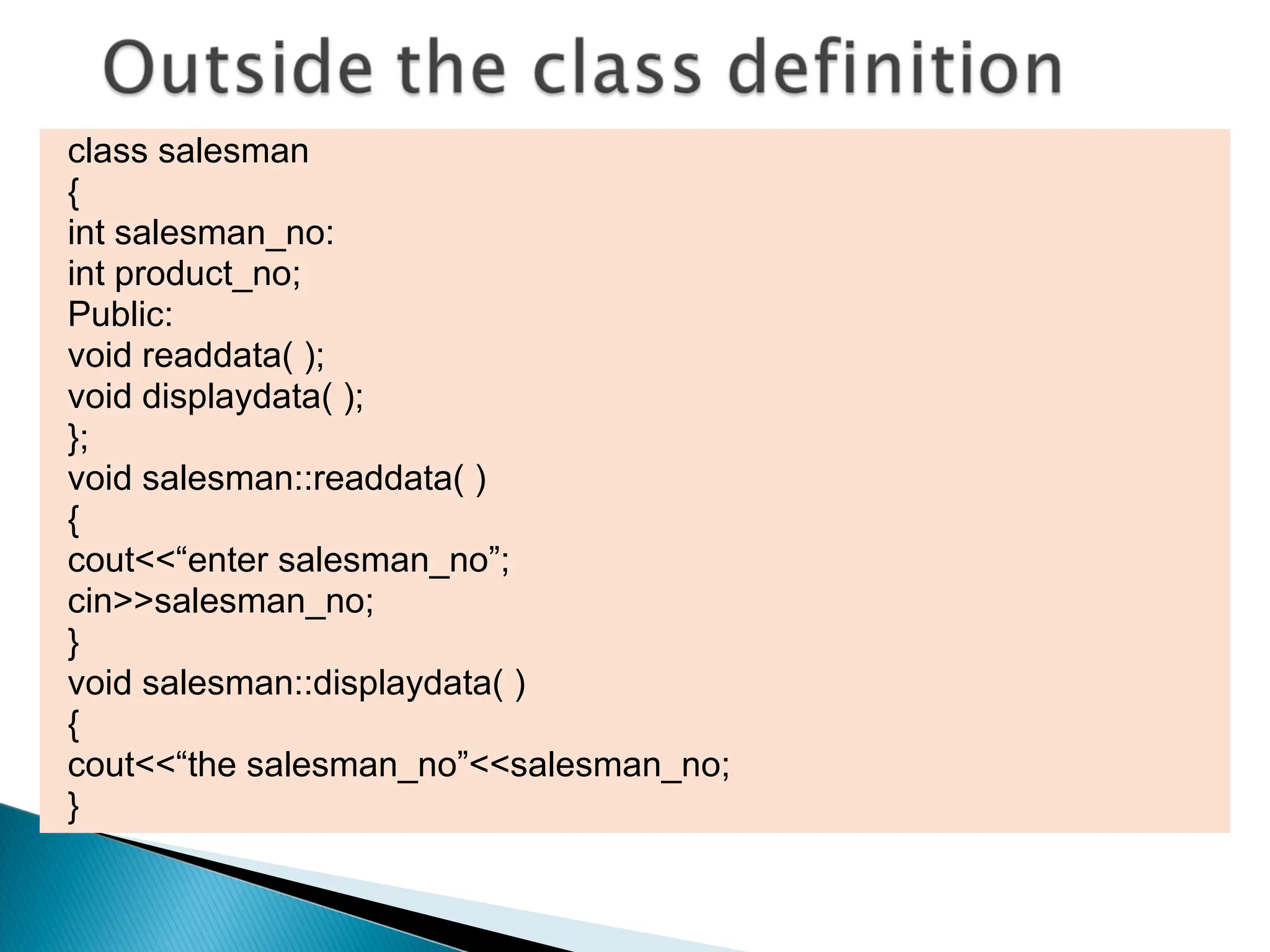
class salesman
{
int salesman_no:
int product_no;
Public:
void readdata( );
void displaydata( );
};
void salesman::readdata( )
{
cout<<“enter salesman_no”;
cin>>salesman_no;
}
void salesman::displaydata( )
{
cout<<“the salesman_no”<<salesman_no;
}
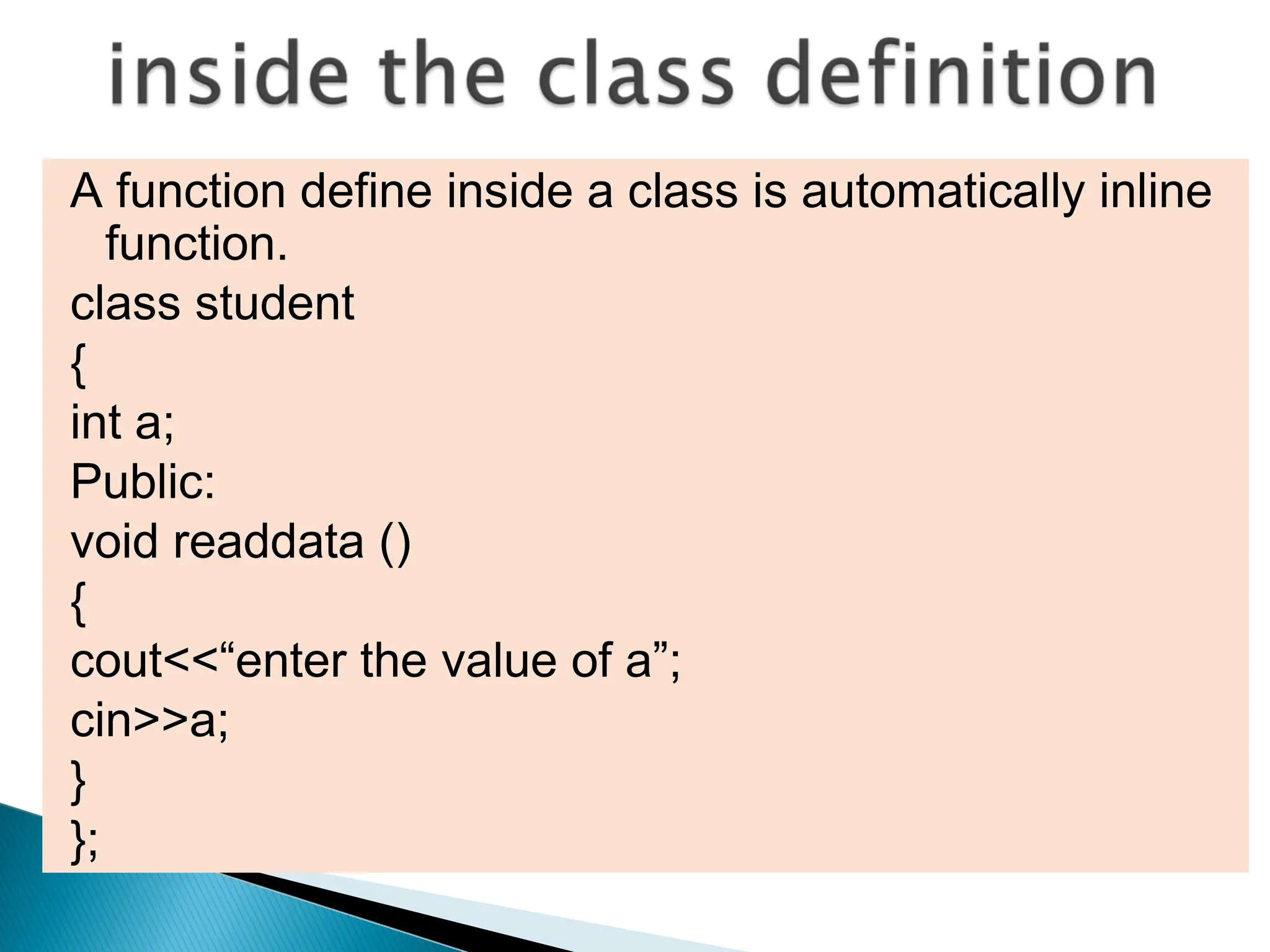
A function define inside a class is automatically inline
function.
class student
{
int a;
Public:
void readdata ()
{
cout<<“enter the value of a”;
cin>>a;
}
};
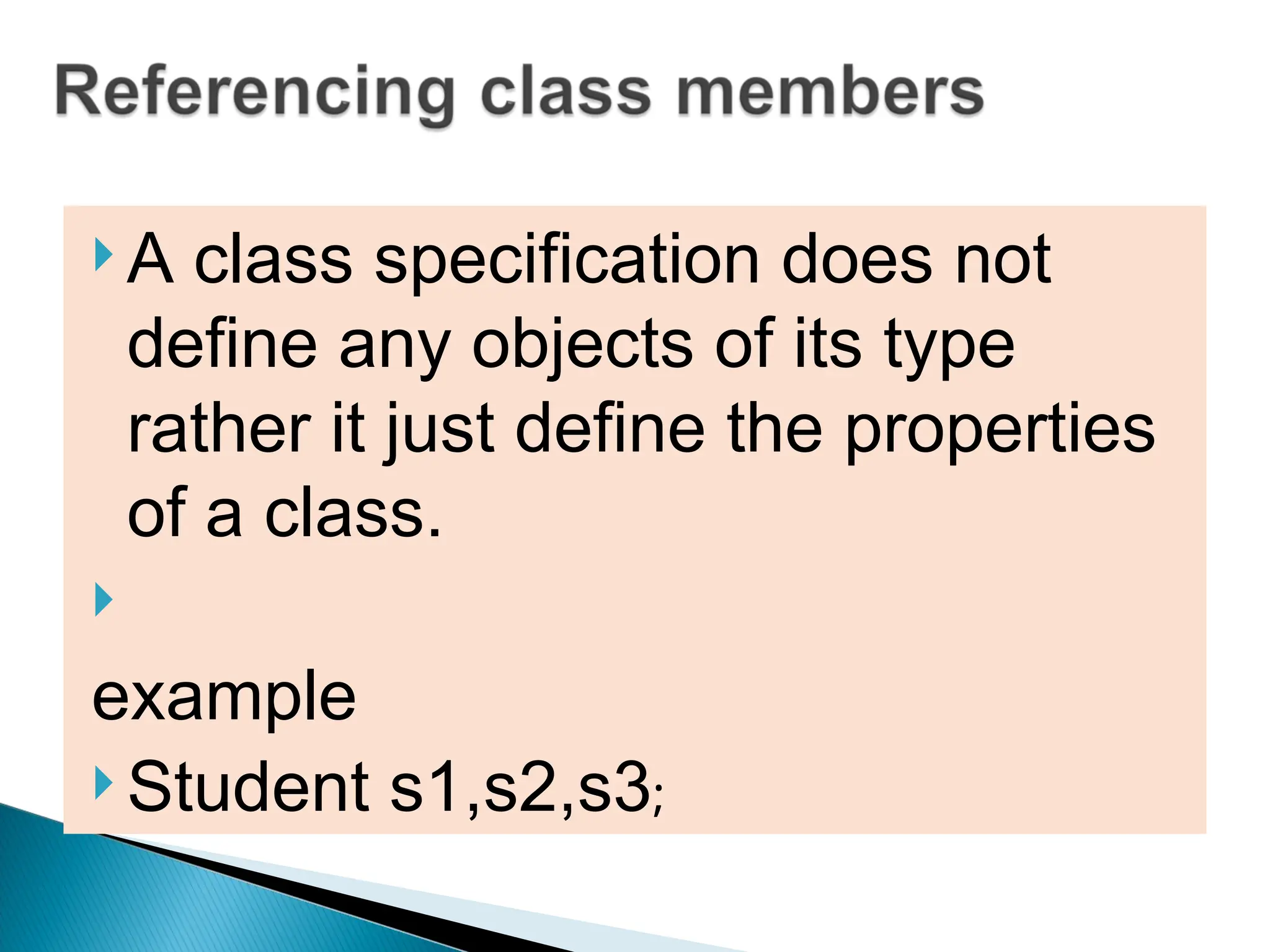
 A class specification does not
define any objects of its type
rather it just define the properties
of a class.

example
 Student s1,s2,s3;
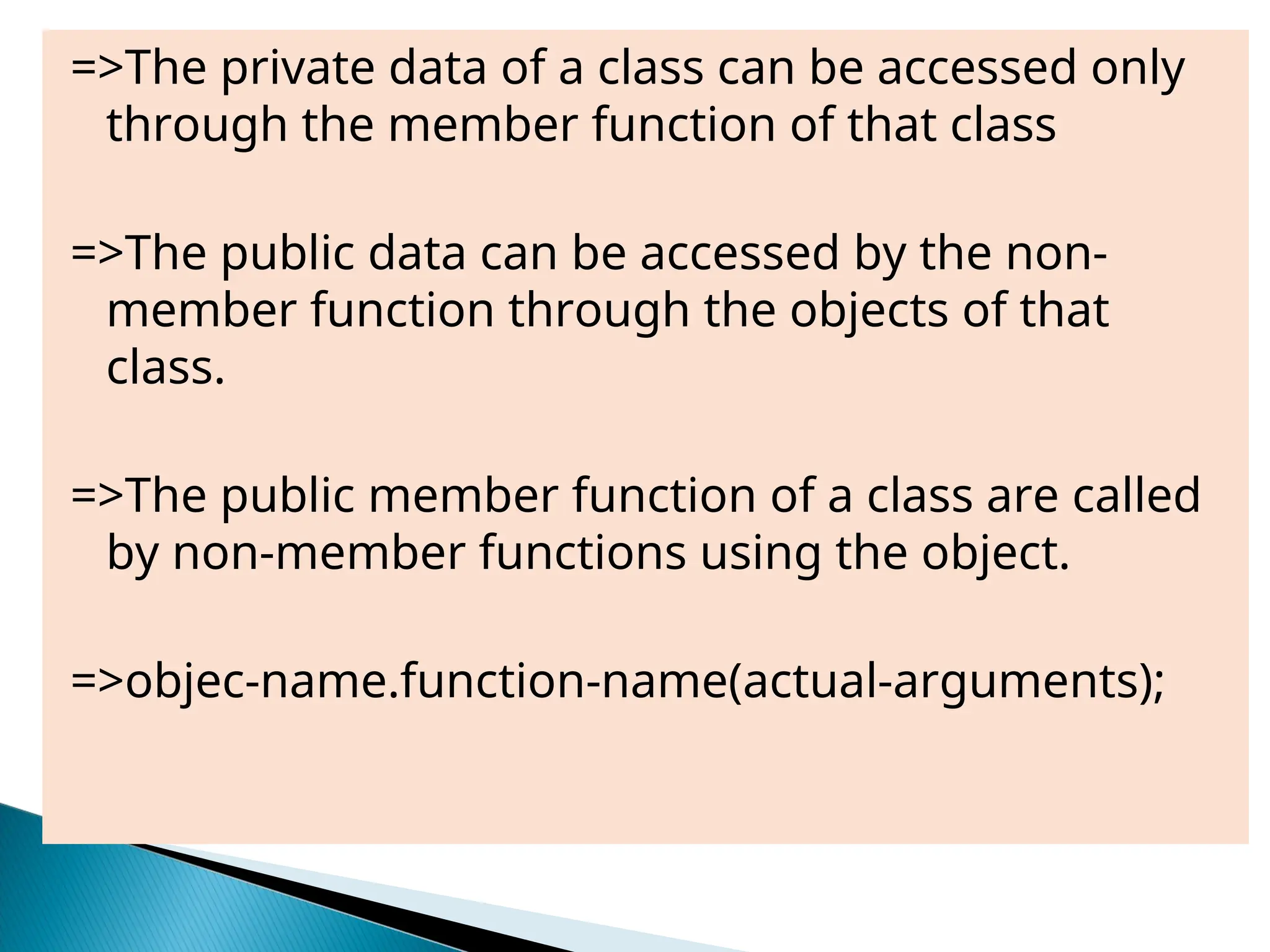
=>The private data of a class can be accessed only
through the member function of that class
=>The public data can be accessed by the non-
member function through the objects of that
class.
=>The public member function of a class are called
by non-member functions using the object.
=>objec-name.function-name(actual-arguments);
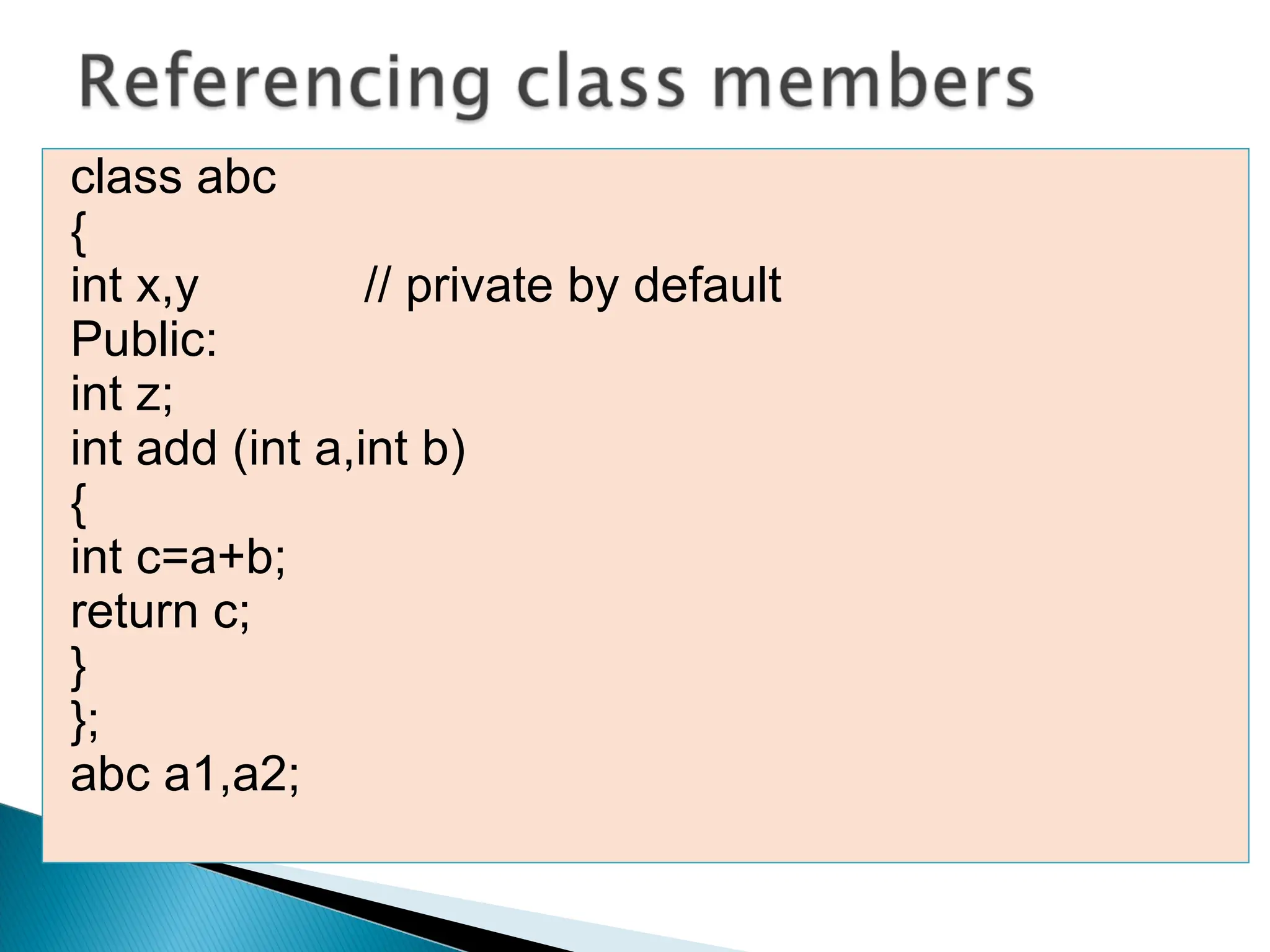
class abc
{
int x,y // private by default
Public:
int z;
int add (int a,int b)
{
int c=a+b;
return c;
}
};
abc a1,a2;
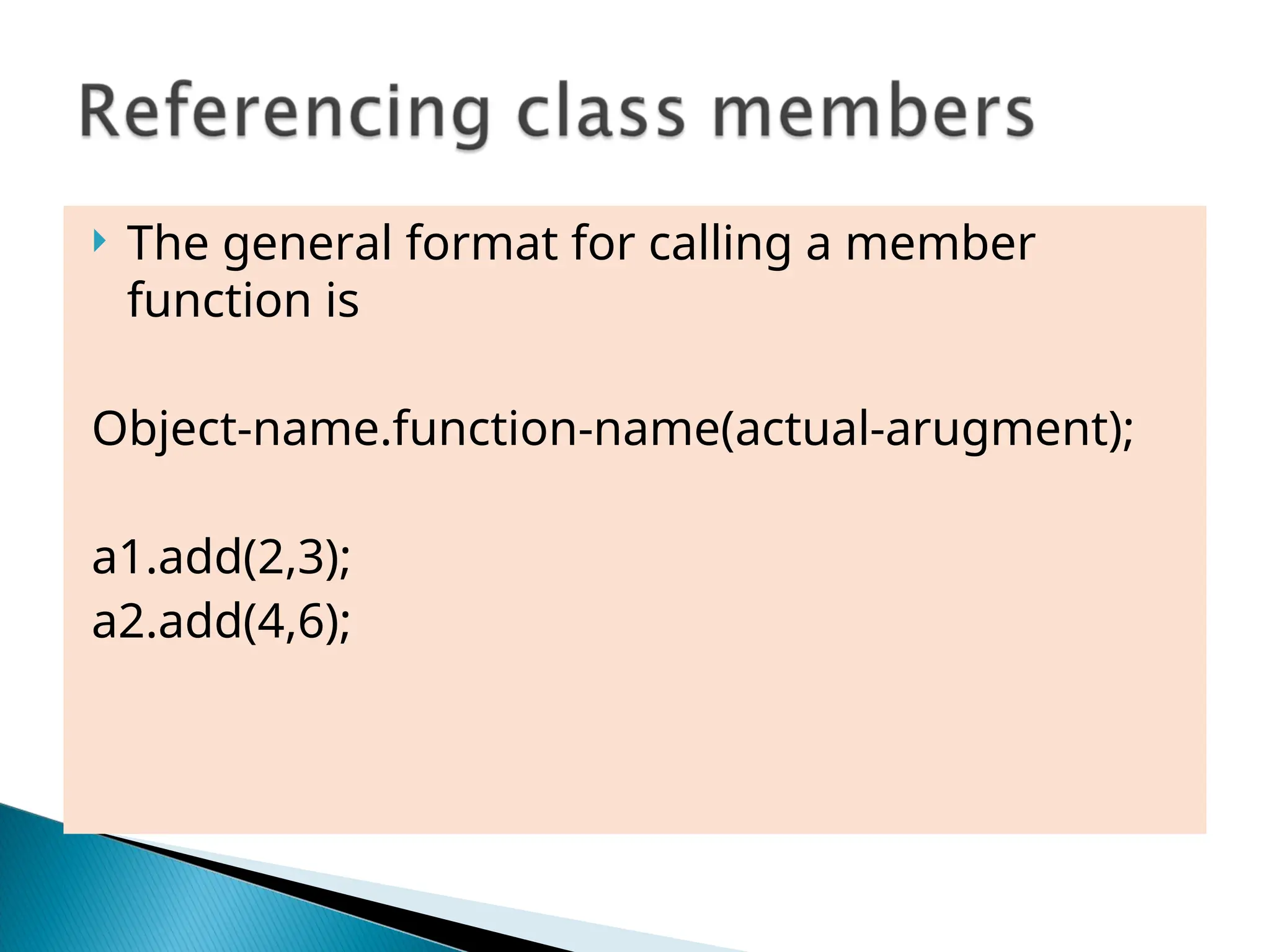
 The general format for calling a member
function is
Object-name.function-name(actual-arugment);
a1.add(2,3);
a2.add(4,6);
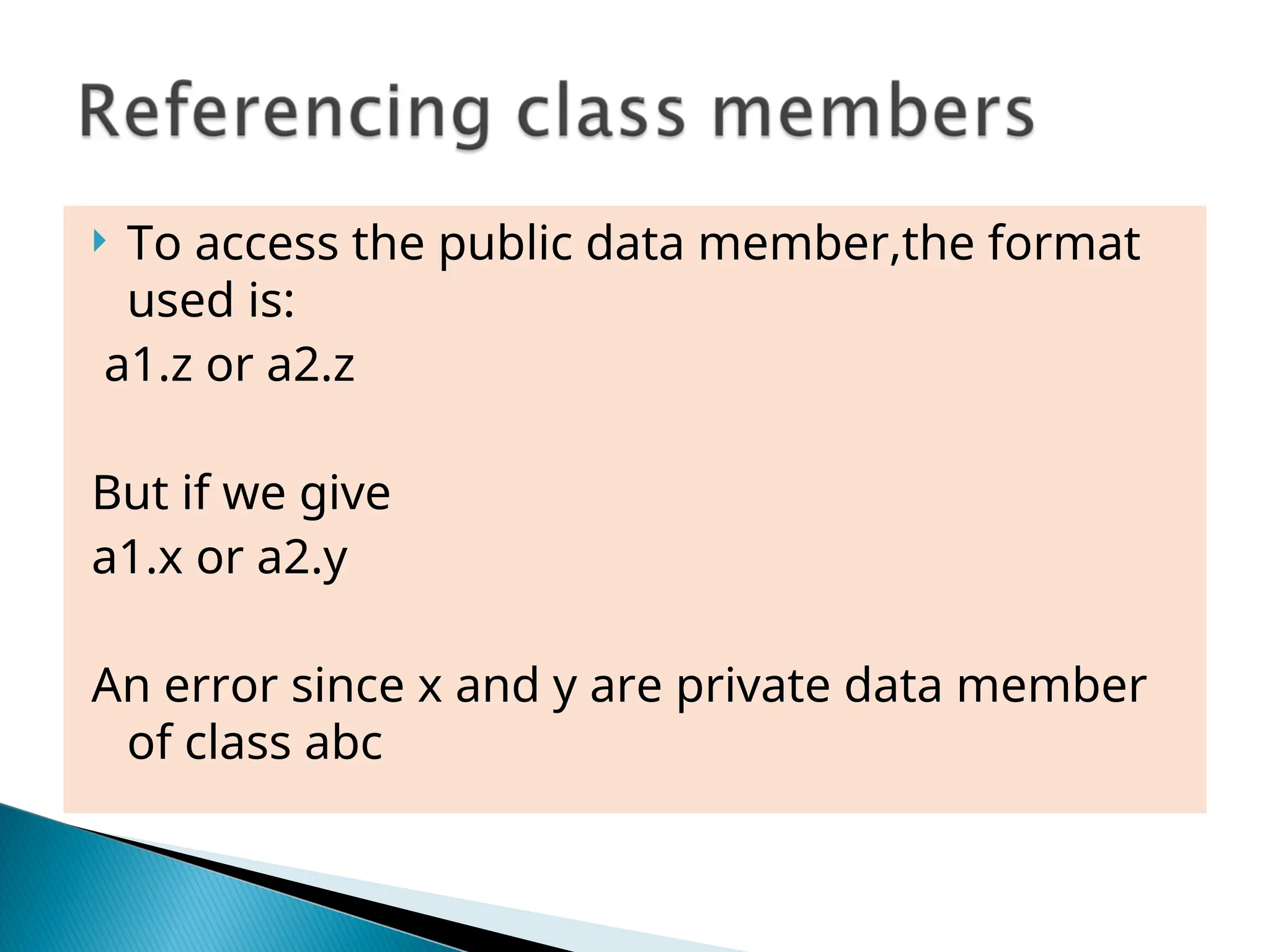
 To access the public data member,the format
used is:
a1.z or a2.z
But if we give
a1.x or a2.y
An error since x and y are private data member
of class abc
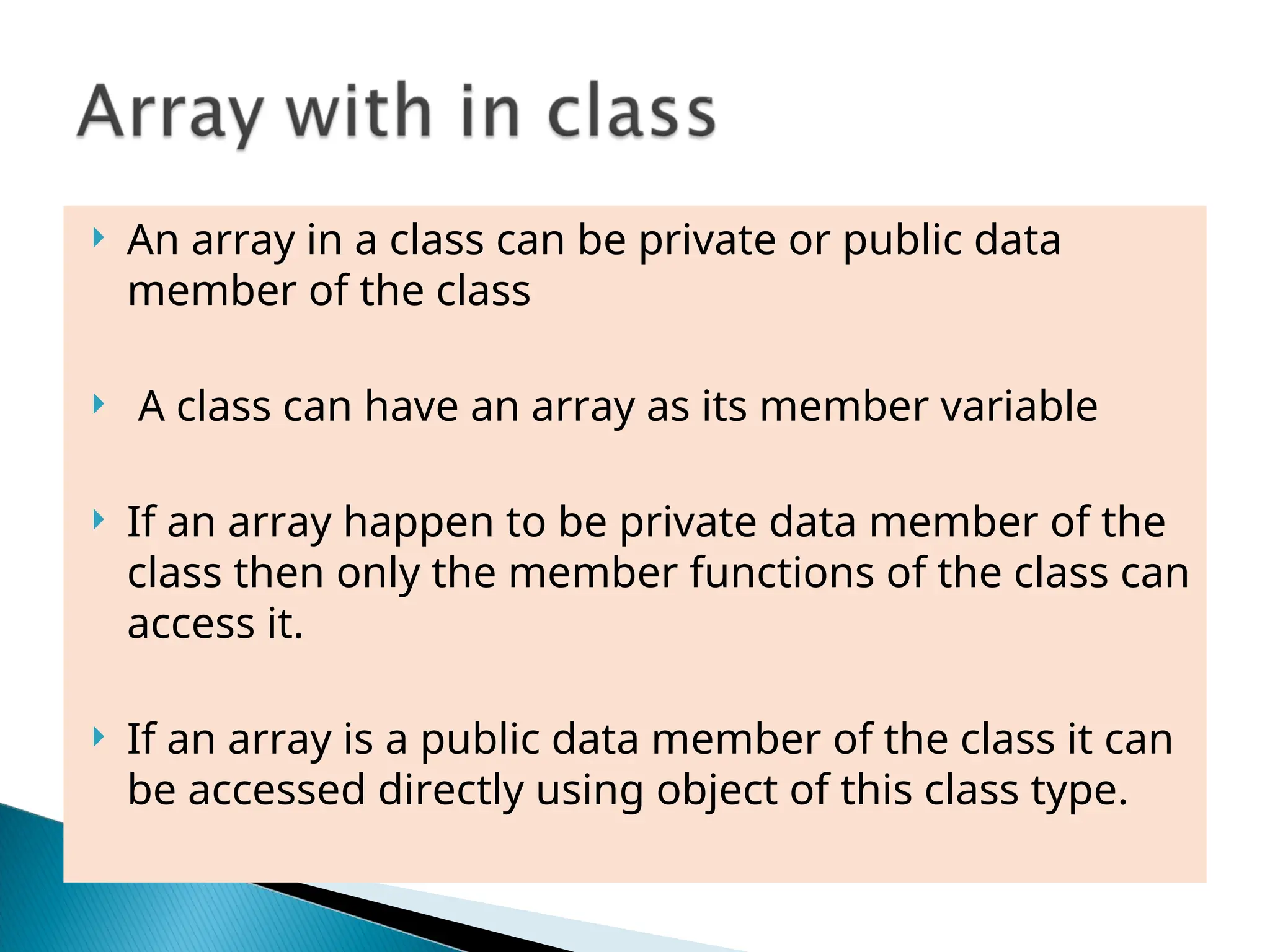
 An array in a class can be private or public data
member of the class
 A class can have an array as its member variable
 If an array happen to be private data member of the
class then only the member functions of the class can
access it.
 If an array is a public data member of the class it can
be accessed directly using object of this class type.
A class can have an array as its member variable. An
array in a class can be private or public data member
of the class. If an array happens to be a private data
member of the class, then, only the member functions
of the class can access it. On the other hand, if an
array is a public data member of the class, it can be
accessed directly using objects of this class type.
For example - Class ABC {
int arr [10]; // private by default
public :
int largest (void);
int sum (void);
};
Here the variable arr[10] is a private data member of the
class ABC. It can be accessed only through the
member function largest ( ) & sum ( ).
Class exarray
{
Int arr[10]; //private data member
Public:
Int largest(void);
Int sum(void);
};
The data member of class exarray accessed only
through the member function largest() and sum();
not directly by objects.
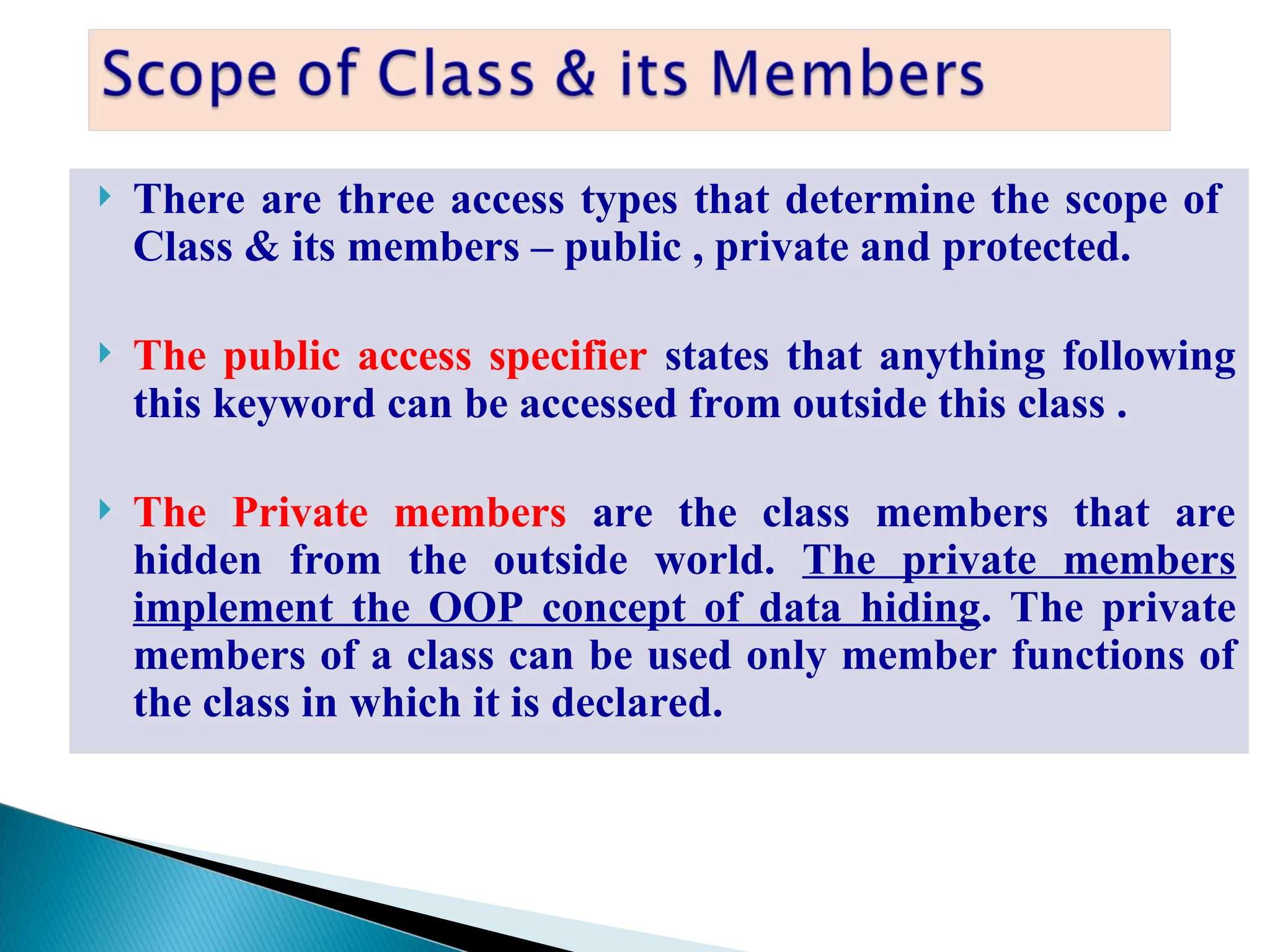
 There are three access types that determine the scope of
Class & its members – public , private and protected.
 The public access specifier states that anything following
this keyword can be accessed from outside this class .
 The Private members are the class members that are
hidden from the outside world. The private members
implement the OOP concept of data hiding. The private
members of a class can be used only member functions of
the class in which it is declared.
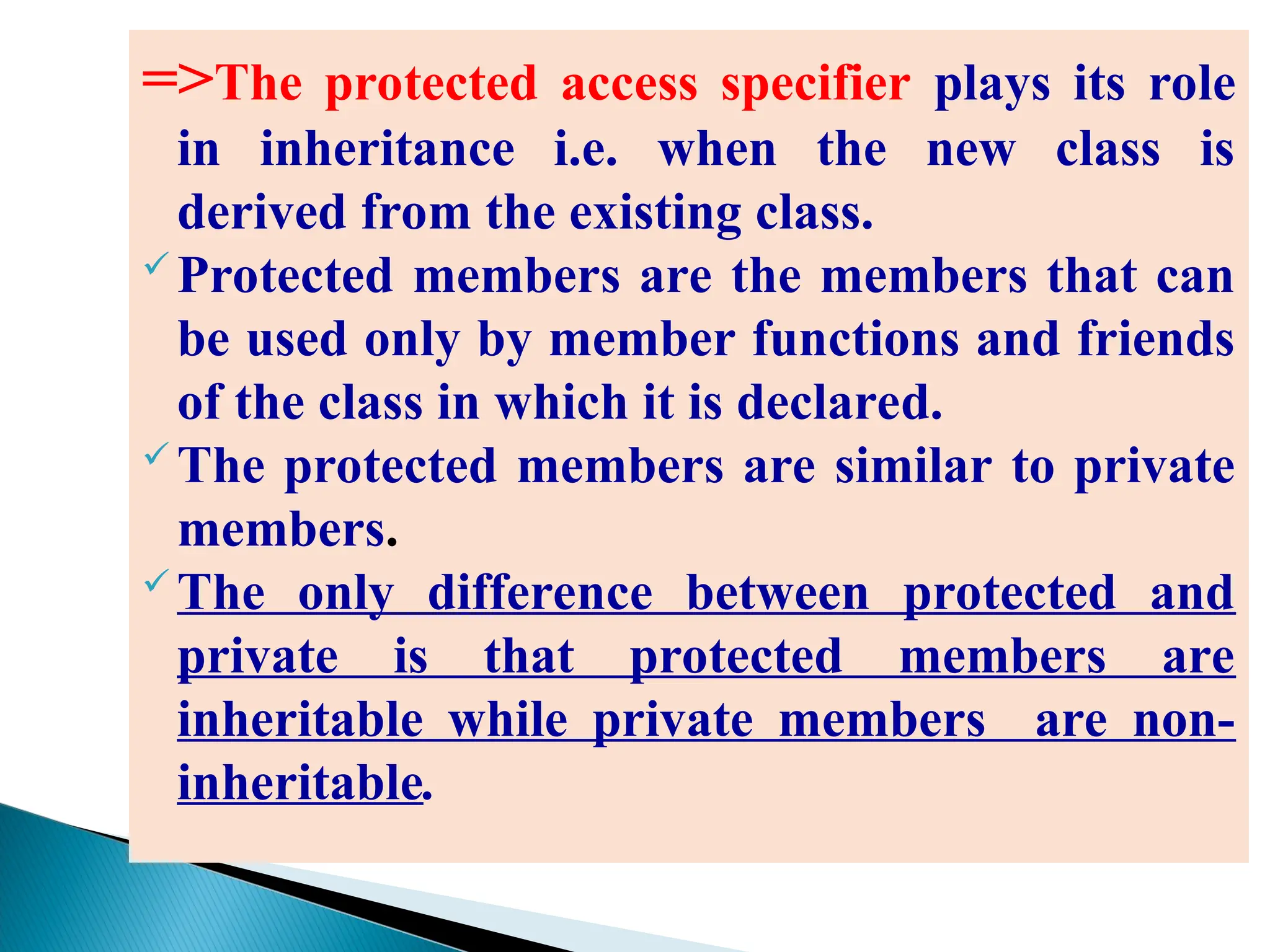
=>The protected access specifier plays its role
in inheritance i.e. when the new class is
derived from the existing class.
 Protected members are the members that can
be used only by member functions and friends
of the class in which it is declared.
 The protected members are similar to private
members.
 The only difference between protected and
private is that protected members are
inheritable while private members are non-
inheritable.
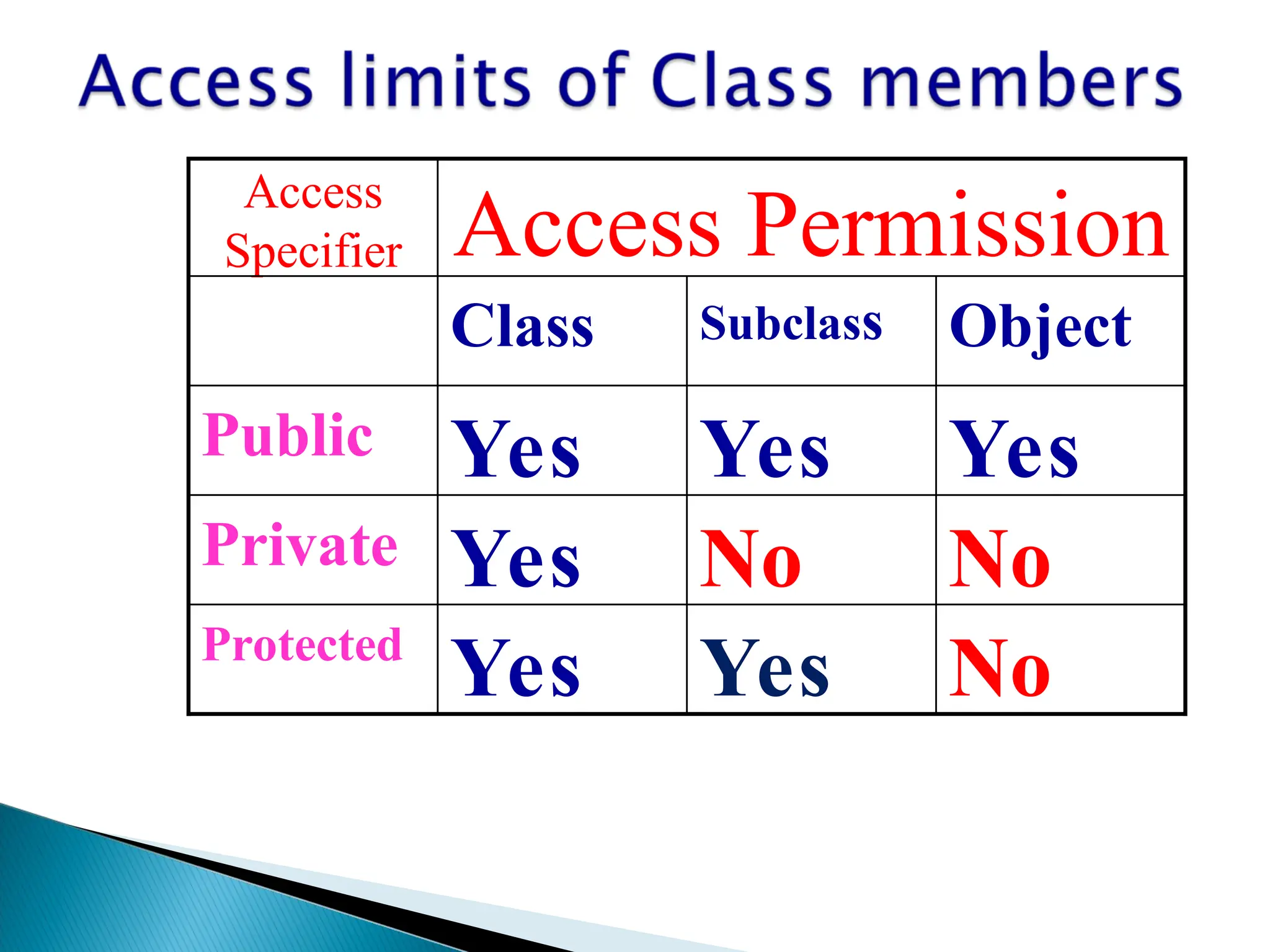
No
Yes
Yes
Protected
No
No
Yes
Private
Yes
Yes
Yes
Public
Object
Subclass
Class
Access Permission
Access
Specifier
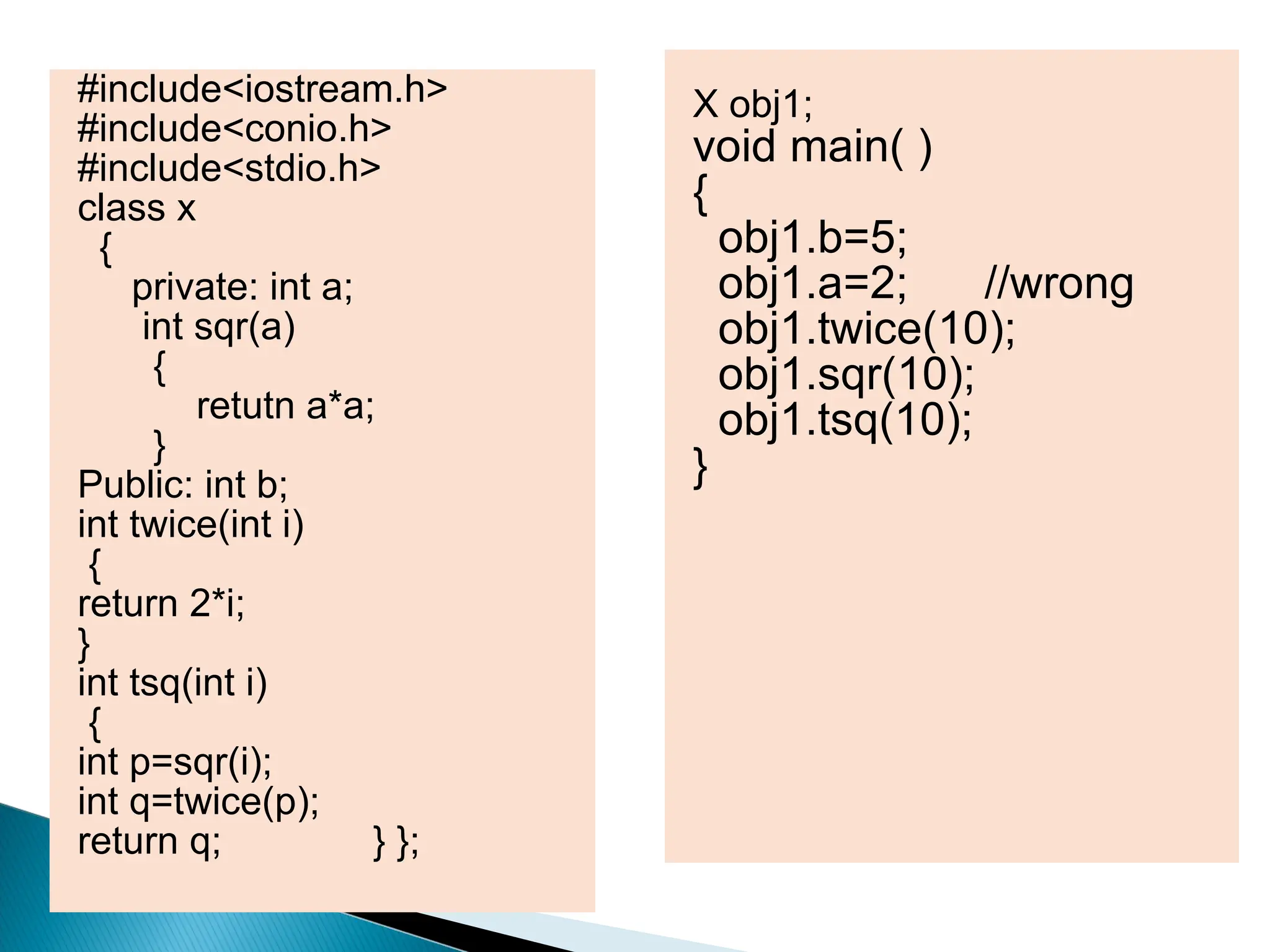
#include<iostream.h>
#include<conio.h>
#include<stdio.h>
class x
{
private: int a;
int sqr(a)
{
retutn a*a;
}
Public: int b;
int twice(int i)
{
return 2*i;
}
int tsq(int i)
{
int p=sqr(i);
int q=twice(p);
return q; } };
X obj1;
void main( )
{
obj1.b=5;
obj1.a=2; //wrong
obj1.twice(10);
obj1.sqr(10);
obj1.tsq(10);
}
#include<iostream.h>
#include<conio.h>
#include<stdio.h>
Class customer
{
private: char cust_name[25];
char address[25];
char city [15];
double balance ;
public : void input_data(void)
{ cout<<“Enter the Name “;
gets (cust_name);
cout<<“Enter Address”;
gets(address);
cout<<“Enter City”;
gets(city);
cout <<“Balance”;
cin >>balance; }
void print_data (void) {
cout<<“n Customer Name “<<Cust_name;
cout<<“n Address”<<address;
cout<<“n City “<<city;
cout<<“n Balance”<< balance ; } };
void main( ) { customer cust;
cust.input_data(); cust.print_data(); }
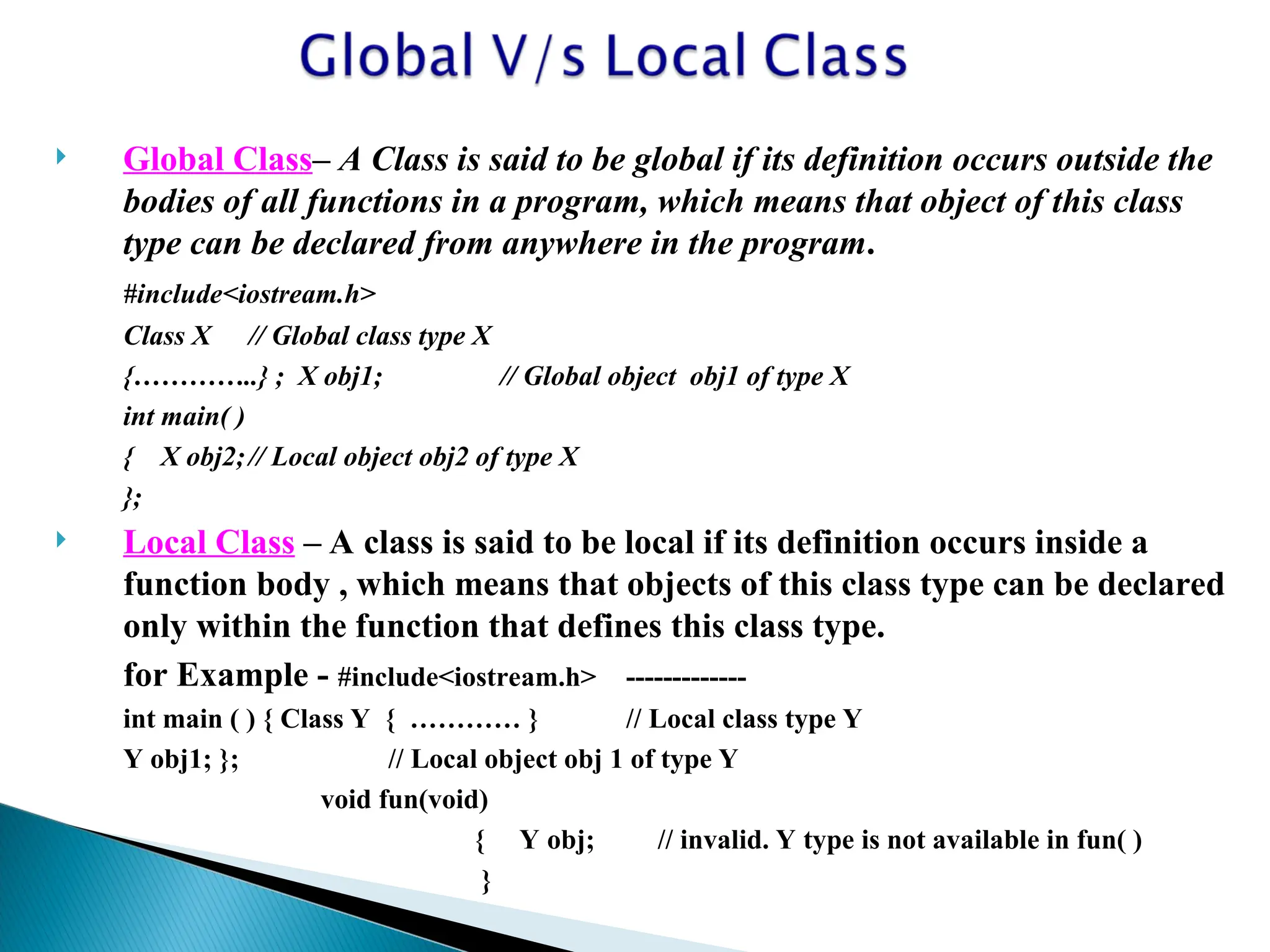
 Global Class– A Class is said to be global if its definition occurs outside the
bodies of all functions in a program, which means that object of this class
type can be declared from anywhere in the program.
#include<iostream.h>
Class X // Global class type X
{…………..} ; X obj1; // Global object obj1 of type X
int main( )
{ X obj2;// Local object obj2 of type X
};
 Local Class – A class is said to be local if its definition occurs inside a
function body , which means that objects of this class type can be declared
only within the function that defines this class type.
for Example - #include<iostream.h> -------------
int main ( ) { Class Y { ………… } // Local class type Y
Y obj1; }; // Local object obj 1 of type Y
void fun(void)
{ Y obj; // invalid. Y type is not available in fun( )
}
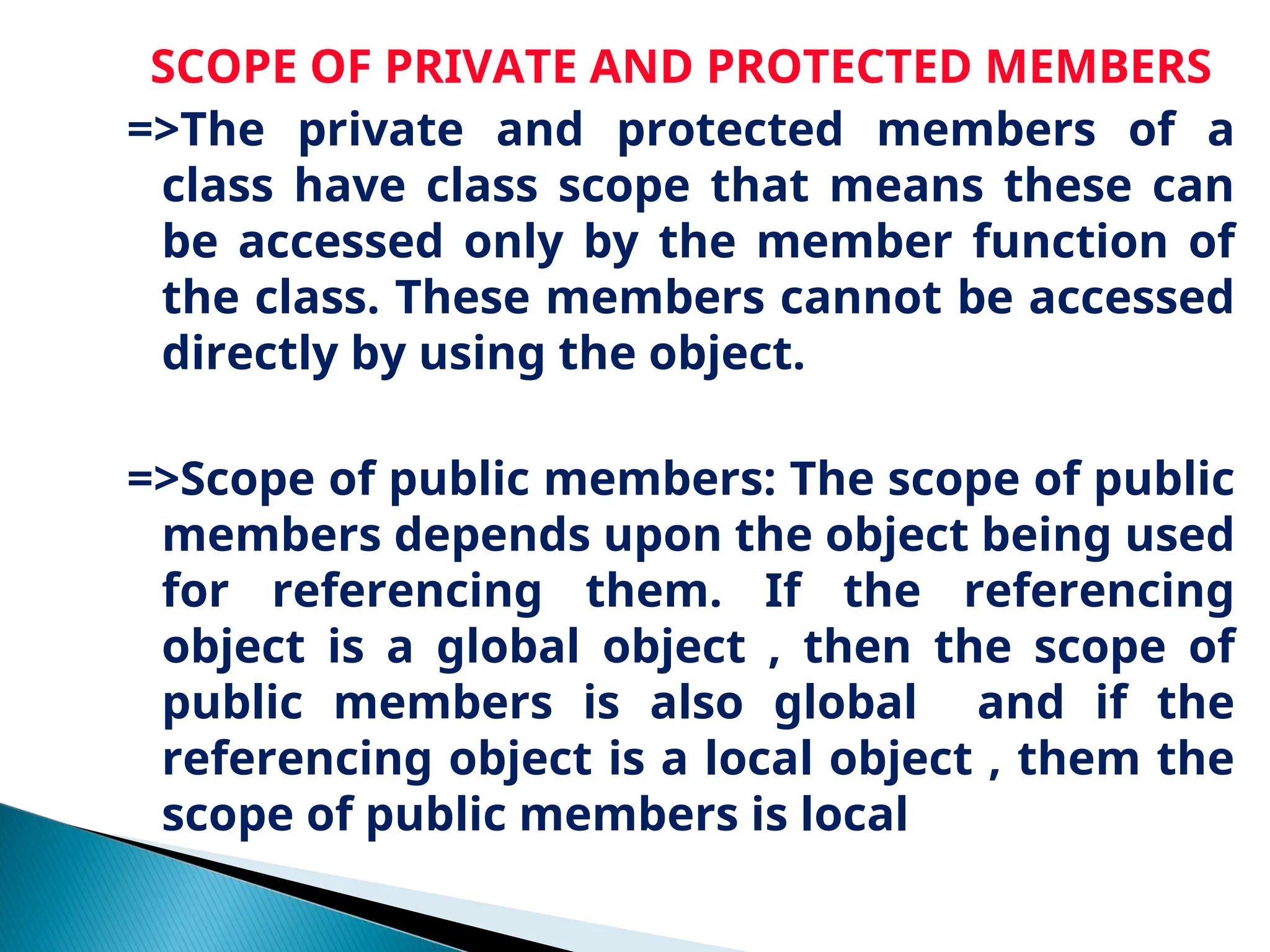
SCOPE OF PRIVATE AND PROTECTED MEMBERS
=>The private and protected members of a
class have class scope that means these can
be accessed only by the member function of
the class. These members cannot be accessed
directly by using the object.
=>Scope of public members: The scope of public
members depends upon the object being used
for referencing them. If the referencing
object is a global object , then the scope of
public members is also global and if the
referencing object is a local object , them the
scope of public members is local
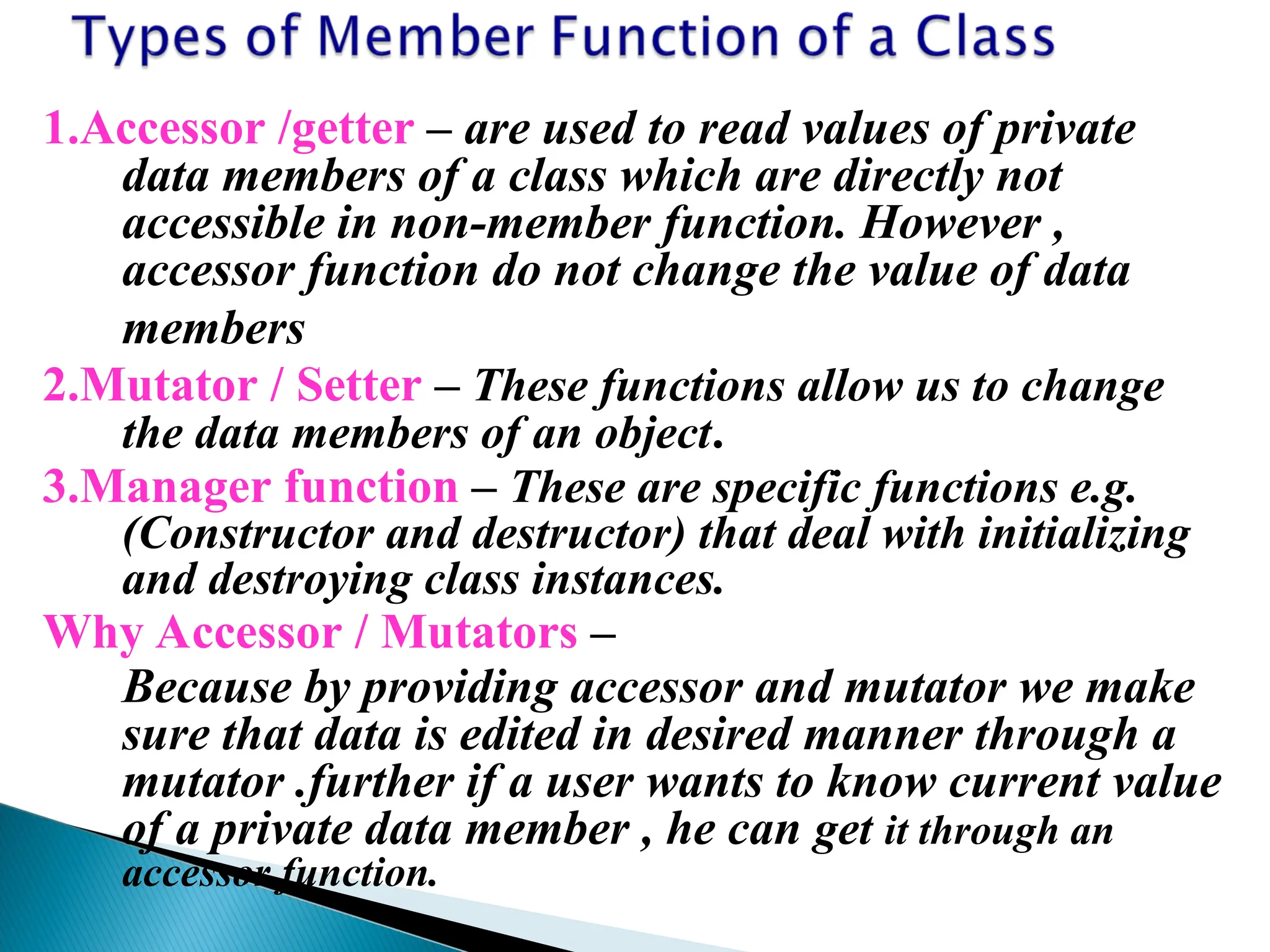
1.Accessor /getter – are used to read values of private
data members of a class which are directly not
accessible in non-member function. However ,
accessor function do not change the value of data
members
2.Mutator / Setter – These functions allow us to change
the data members of an object.
3.Manager function – These are specific functions e.g.
(Constructor and destructor) that deal with initializing
and destroying class instances.
Why Accessor / Mutators –
Because by providing accessor and mutator we make
sure that data is edited in desired manner through a
mutator .further if a user wants to know current value
of a private data member , he can get it through an
accessor function.
Class student
{ int rollno; char name[25]; float marks; char grade;
public:
void read_data();
void display_data():
int get rollno()
{ return rollno; }
float get marks()
{ return marks; } // accessor methods they have the return type.
void calgrade()
{
if marks>= 75 // Mutator method it is modyfying data member grade
grade = ‘A’
else if marks >= 60
grade= ‘B’
else if marks >=45
grade = ‘C’
}
};
=>Nested classes: A class declared within another
class is called a nested class. The outer class is known
as enclosing class and the inner class is known as
Nested class.
=> Data Hiding and Encapsulation:
Class->encapsulation
Private and protected members->Data hiding
Public members->abstraction
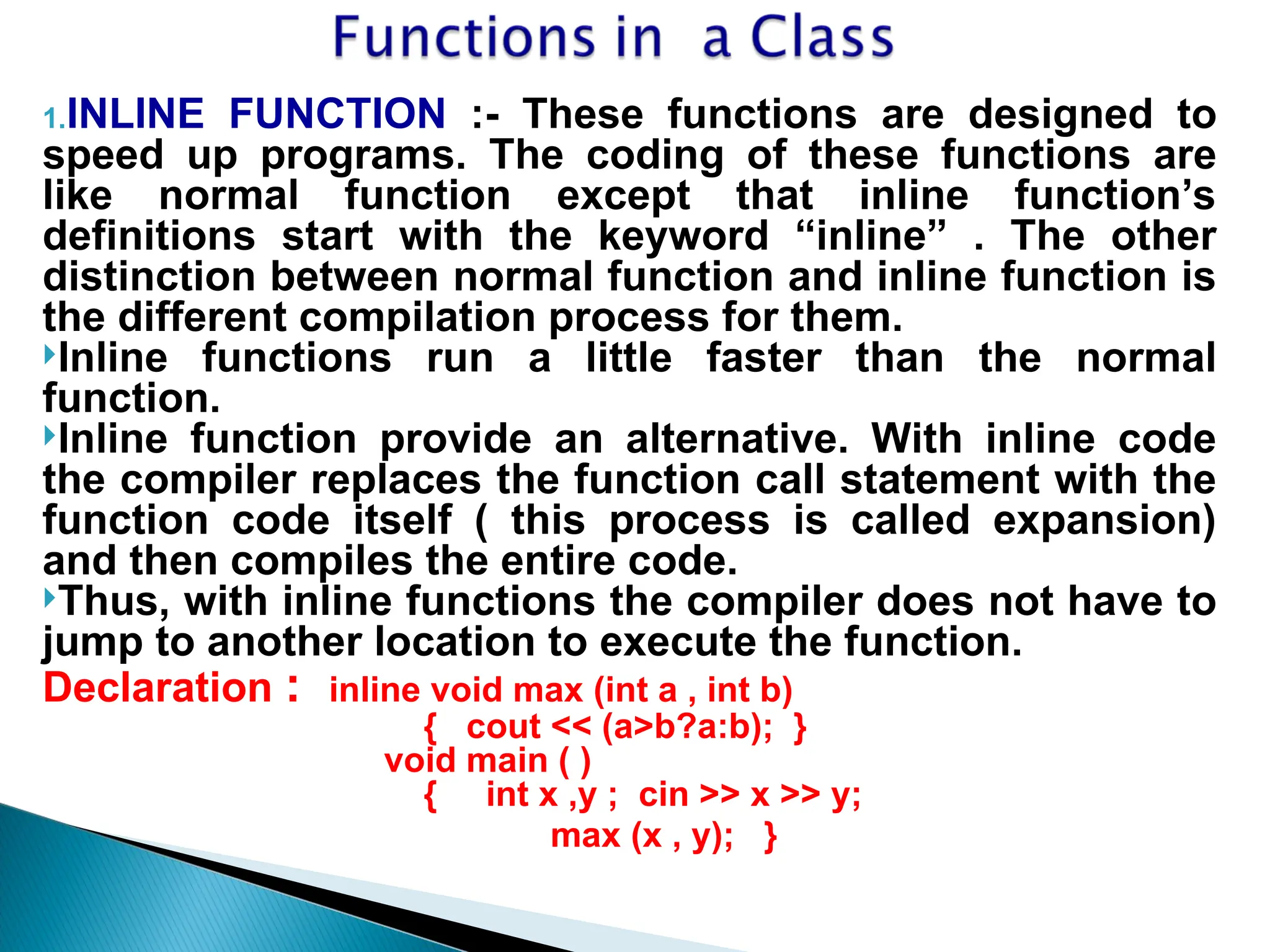
1.INLINE FUNCTION :- These functions are designed to
speed up programs. The coding of these functions are
like normal function except that inline function’s
definitions start with the keyword “inline” . The other
distinction between normal function and inline function is
the different compilation process for them.
Inline functions run a little faster than the normal
function.
Inline function provide an alternative. With inline code
the compiler replaces the function call statement with the
function code itself ( this process is called expansion)
and then compiles the entire code.
Thus, with inline functions the compiler does not have to
jump to another location to execute the function.
Declaration : inline void max (int a , int b)
{ cout << (a>b?a:b); }
void main ( )
{ int x ,y ; cin >> x >> y;
max (x , y); }
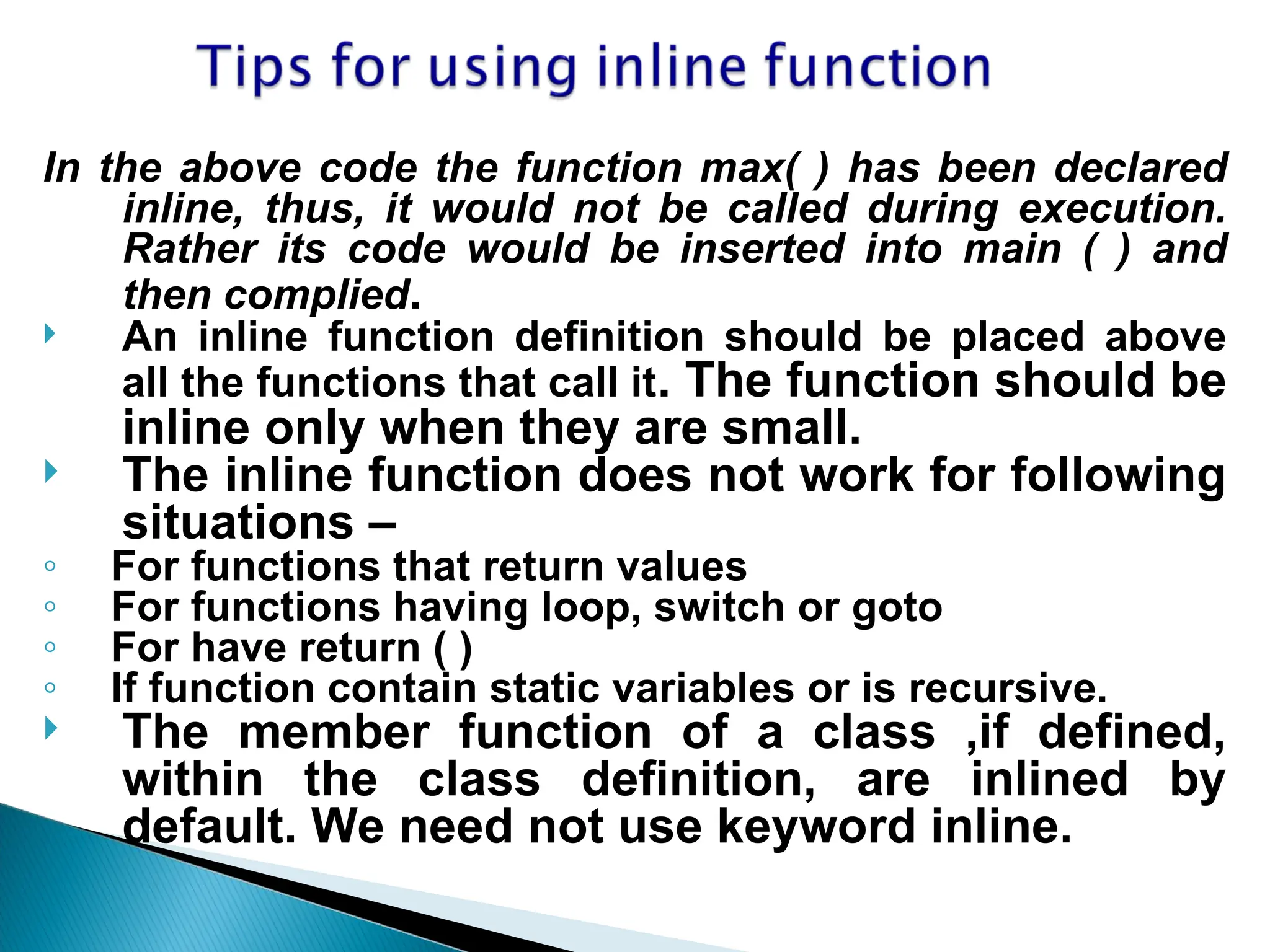
In the above code the function max( ) has been declared
inline, thus, it would not be called during execution.
Rather its code would be inserted into main ( ) and
then complied.
 An inline function definition should be placed above
all the functions that call it. The function should be
inline only when they are small.
 The inline function does not work for following
situations –
◦ For functions that return values
◦ For functions having loop, switch or goto
◦ For have return ( )
◦ If function contain static variables or is recursive.
 The member function of a class ,if defined,
within the class definition, are inlined by
default. We need not use keyword inline.
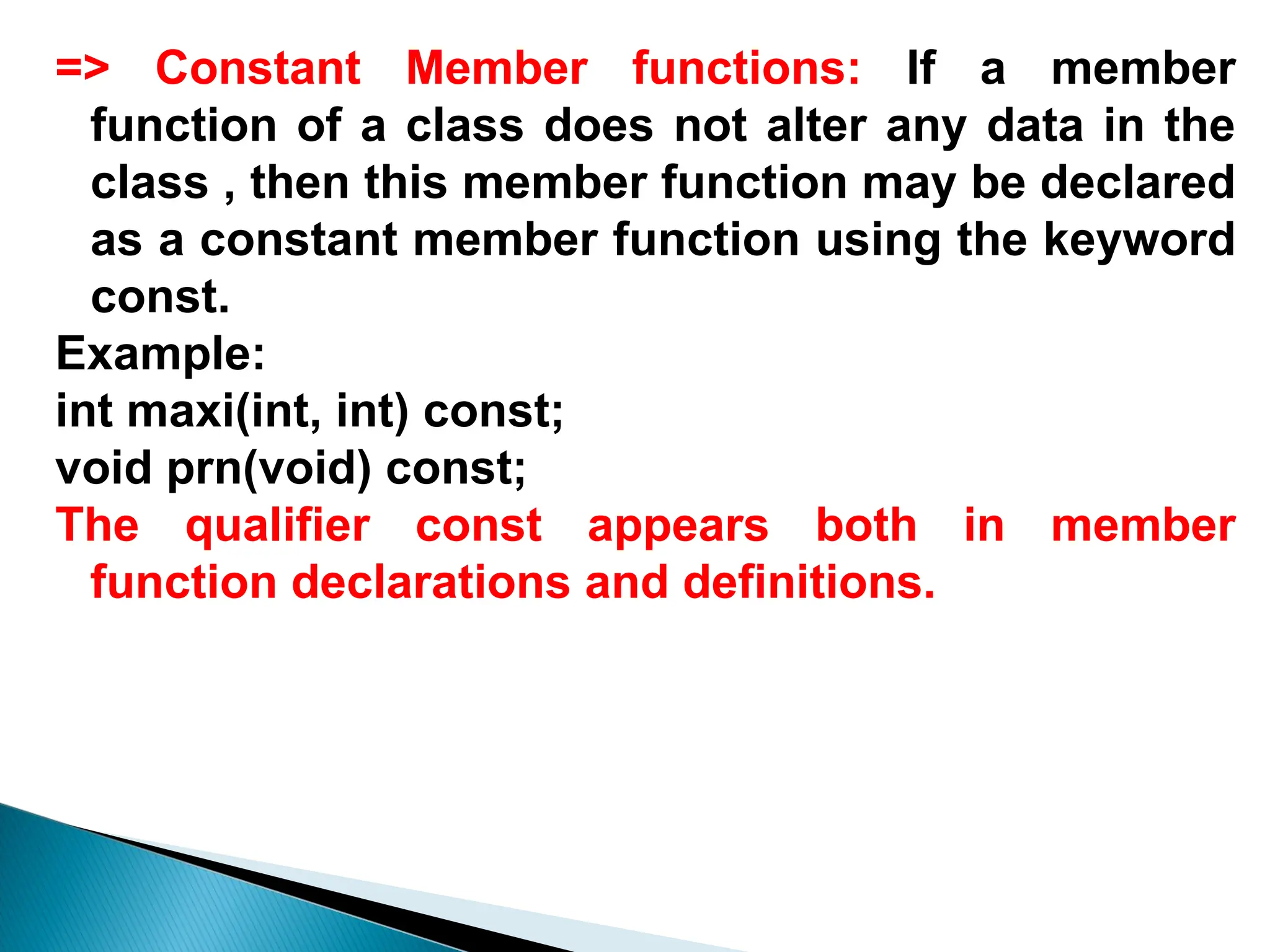
=> Constant Member functions: If a member
function of a class does not alter any data in the
class , then this member function may be declared
as a constant member function using the keyword
const.
Example:
int maxi(int, int) const;
void prn(void) const;
The qualifier const appears both in member
function declarations and definitions.
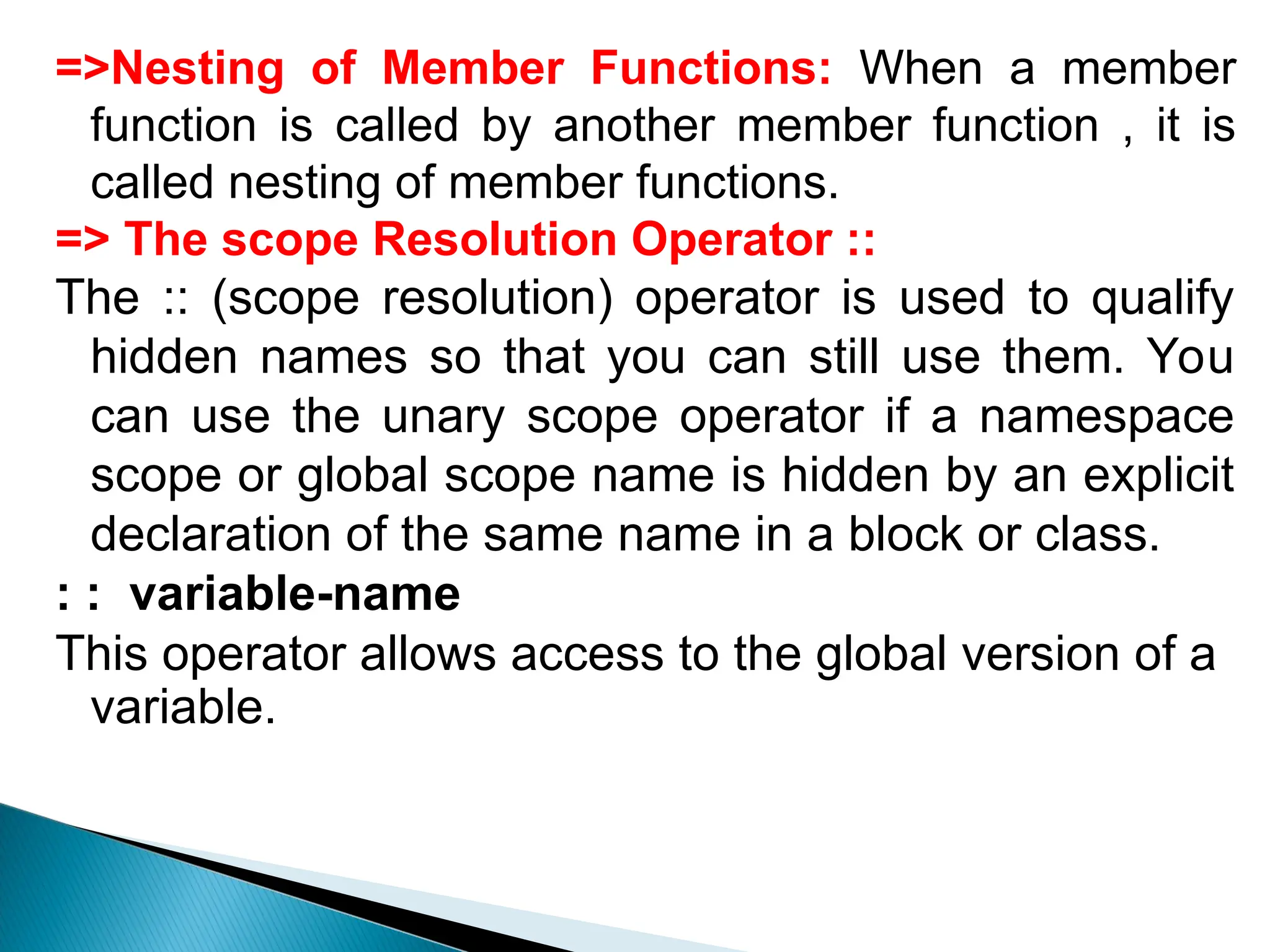
=>Nesting of Member Functions: When a member
function is called by another member function , it is
called nesting of member functions.
=> The scope Resolution Operator ::
The :: (scope resolution) operator is used to qualify
hidden names so that you can still use them. You
can use the unary scope operator if a namespace
scope or global scope name is hidden by an explicit
declaration of the same name in a block or class.
: : variable-name
This operator allows access to the global version of a
variable.
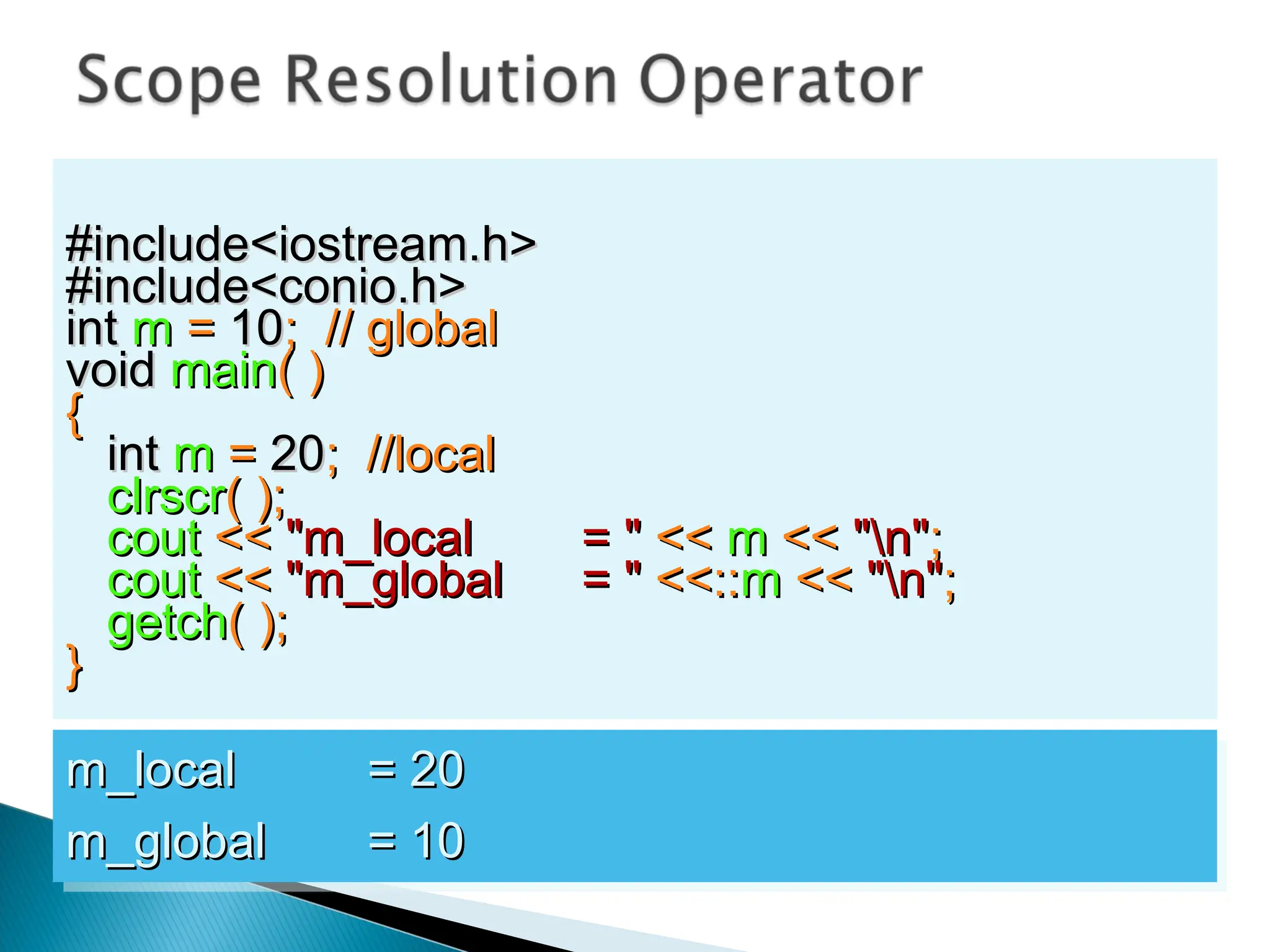
#include<iostream.h>
#include<conio.h>
#include<conio.h>
int
int m
m =
= 10
10; // global
; // global
void
void main
main( )
( )
{
{
int
int m
m =
= 20
20; //local
; //local
clrscr
clrscr( );
( );
cout
cout <<
<< "m_local
"m_local = "
= " <<
<< m
m <<
<< "n"
"n";
;
cout
cout <<
<< "m_global
"m_global = "
= " <<::
<<::m
m <<
<< "n"
"n";
;
getch
getch( );
( );
}
}
m_local
m_local = 20
= 20
m_global
m_global = 10
= 10
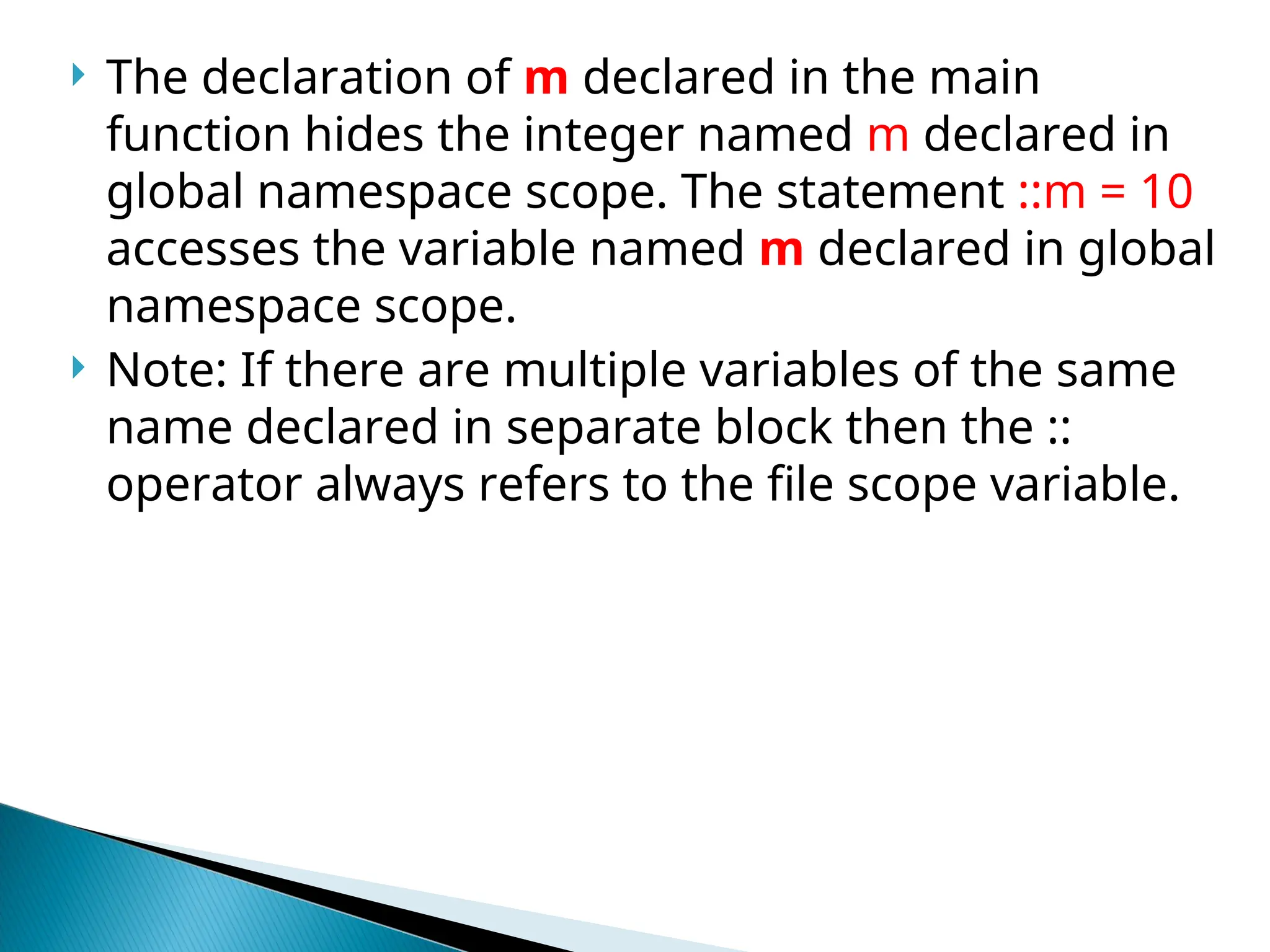
 The declaration of m declared in the main
function hides the integer named m declared in
global namespace scope. The statement ::m = 10
accesses the variable named m declared in global
namespace scope.
 Note: If there are multiple variables of the same
name declared in separate block then the ::
operator always refers to the file scope variable.
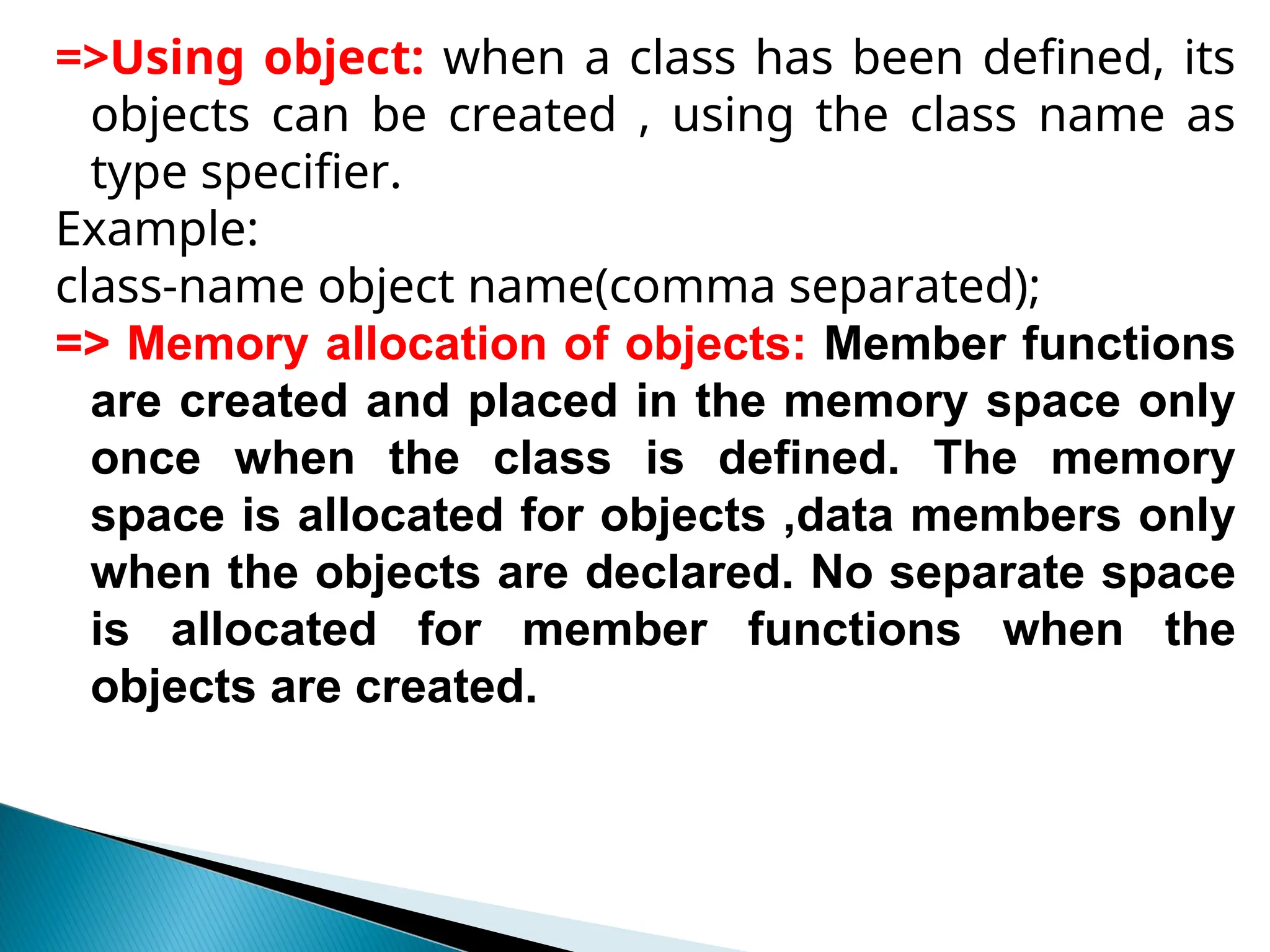
=>Using object: when a class has been defined, its
objects can be created , using the class name as
type specifier.
Example:
class-name object name(comma separated);
=> Memory allocation of objects: Member functions
are created and placed in the memory space only
once when the class is defined. The memory
space is allocated for objects ,data members only
when the objects are declared. No separate space
is allocated for member functions when the
objects are created.
An array having class type elements is known as Array of
objects. An array of objects is declared after the class
definition is over and it is defined in the same way as any
other type of array is defined.
For example - class item { public:
int itemno; float price;
void getdata (int i, float j)
{ itemno=I;price=j;}
};
item order[10];
Here the array order contains 10 objects.
To access data member itemno of 2nd
object in the array
we will give = order[1].itemno;
//for more detail see program 4.4 of text book.
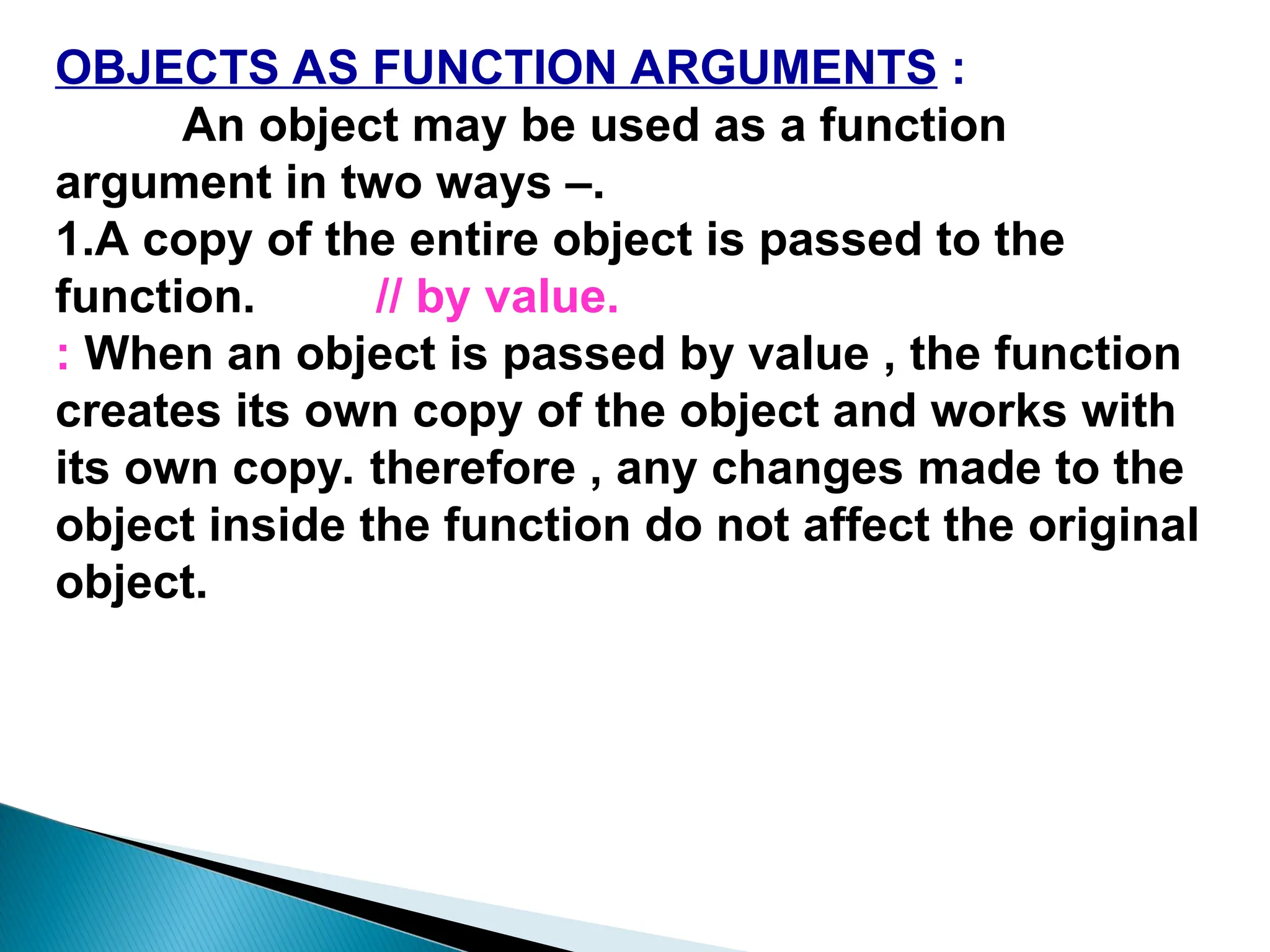
OBJECTS AS FUNCTION ARGUMENTS :
An object may be used as a function
argument in two ways –.
1.A copy of the entire object is passed to the
function. // by value.
: When an object is passed by value , the function
creates its own copy of the object and works with
its own copy. therefore , any changes made to the
object inside the function do not affect the original
object.
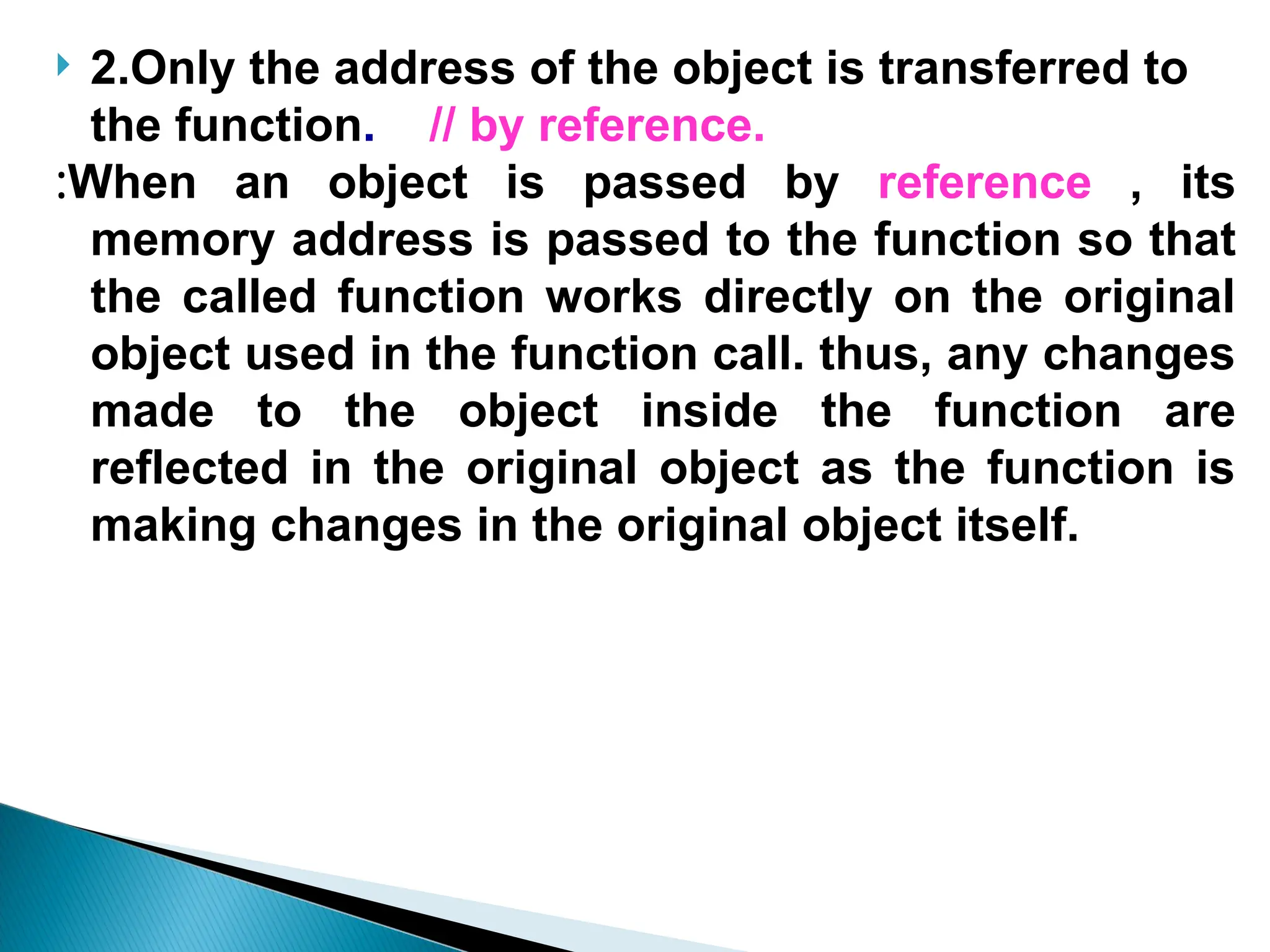
 2.Only the address of the object is transferred to
the function. // by reference.
:When an object is passed by reference , its
memory address is passed to the function so that
the called function works directly on the original
object used in the function call. thus, any changes
made to the object inside the function are
reflected in the original object as the function is
making changes in the original object itself.
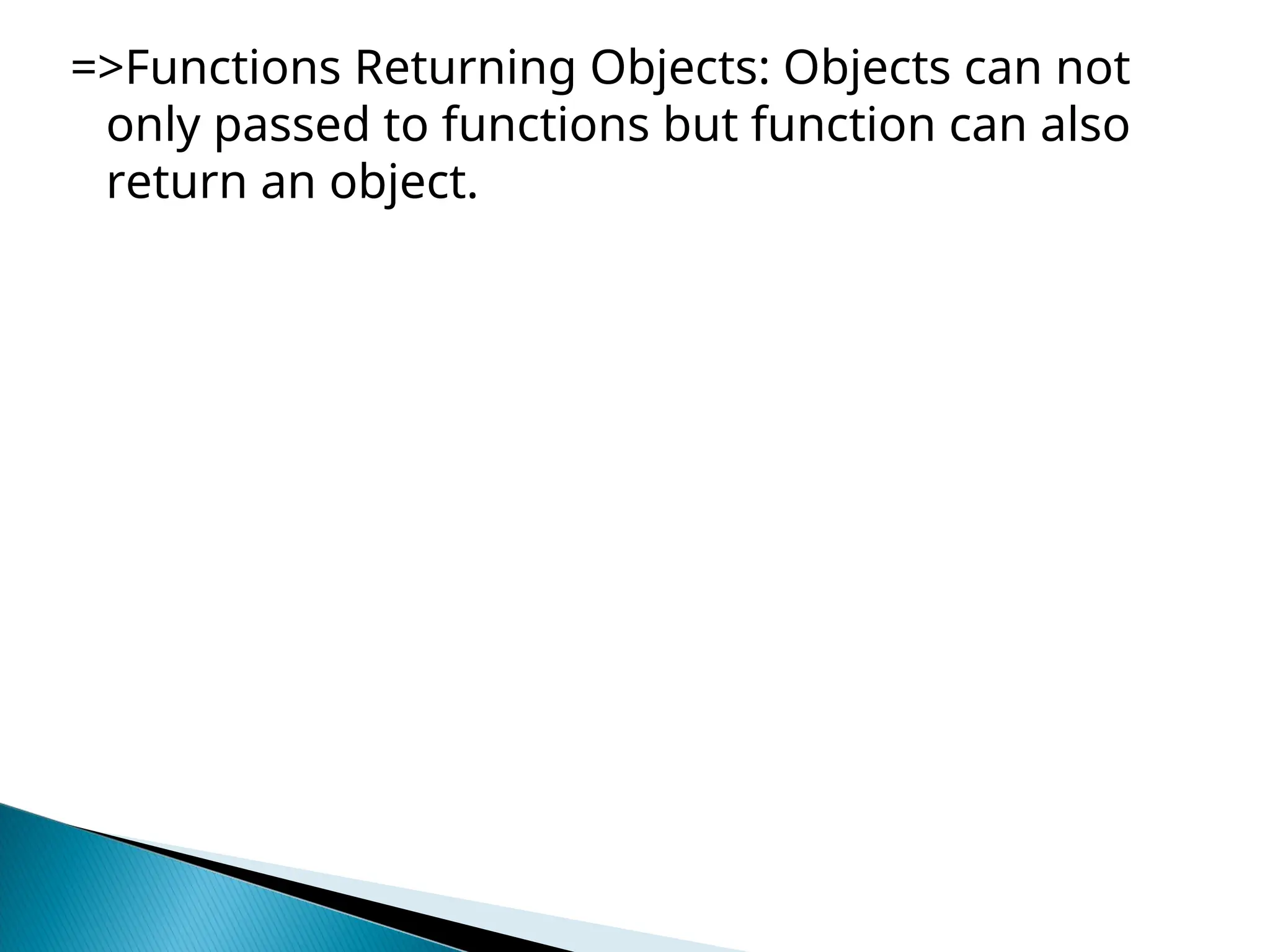
=>Functions Returning Objects: Objects can not
only passed to functions but function can also
return an object.
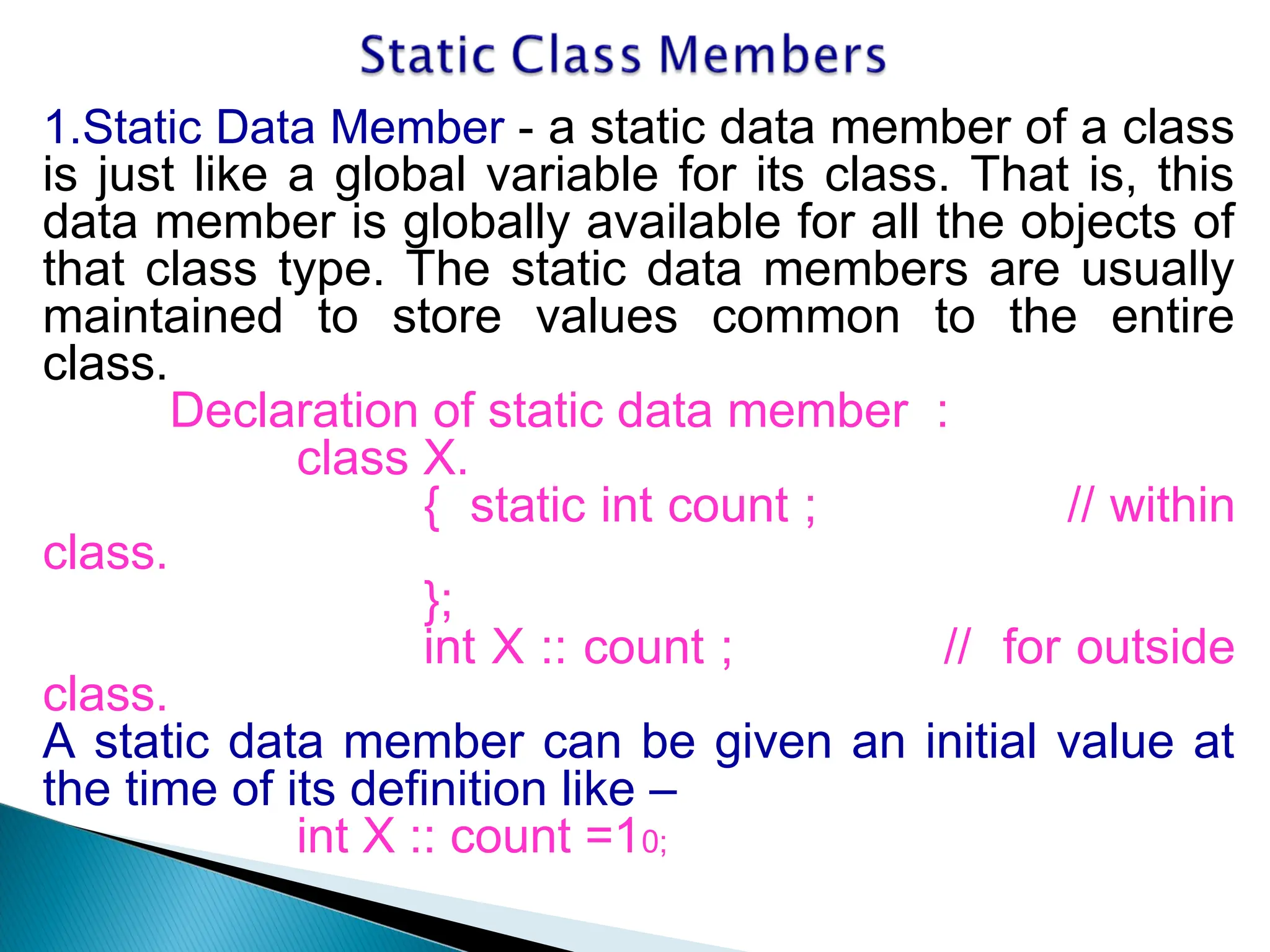
1.Static Data Member - a static data member of a class
is just like a global variable for its class. That is, this
data member is globally available for all the objects of
that class type. The static data members are usually
maintained to store values common to the entire
class.
Declaration of static data member :
class X.
{ static int count ; // within
class.
};
int X :: count ; // for outside
class.
A static data member can be given an initial value at
the time of its definition like –
int X :: count =10;
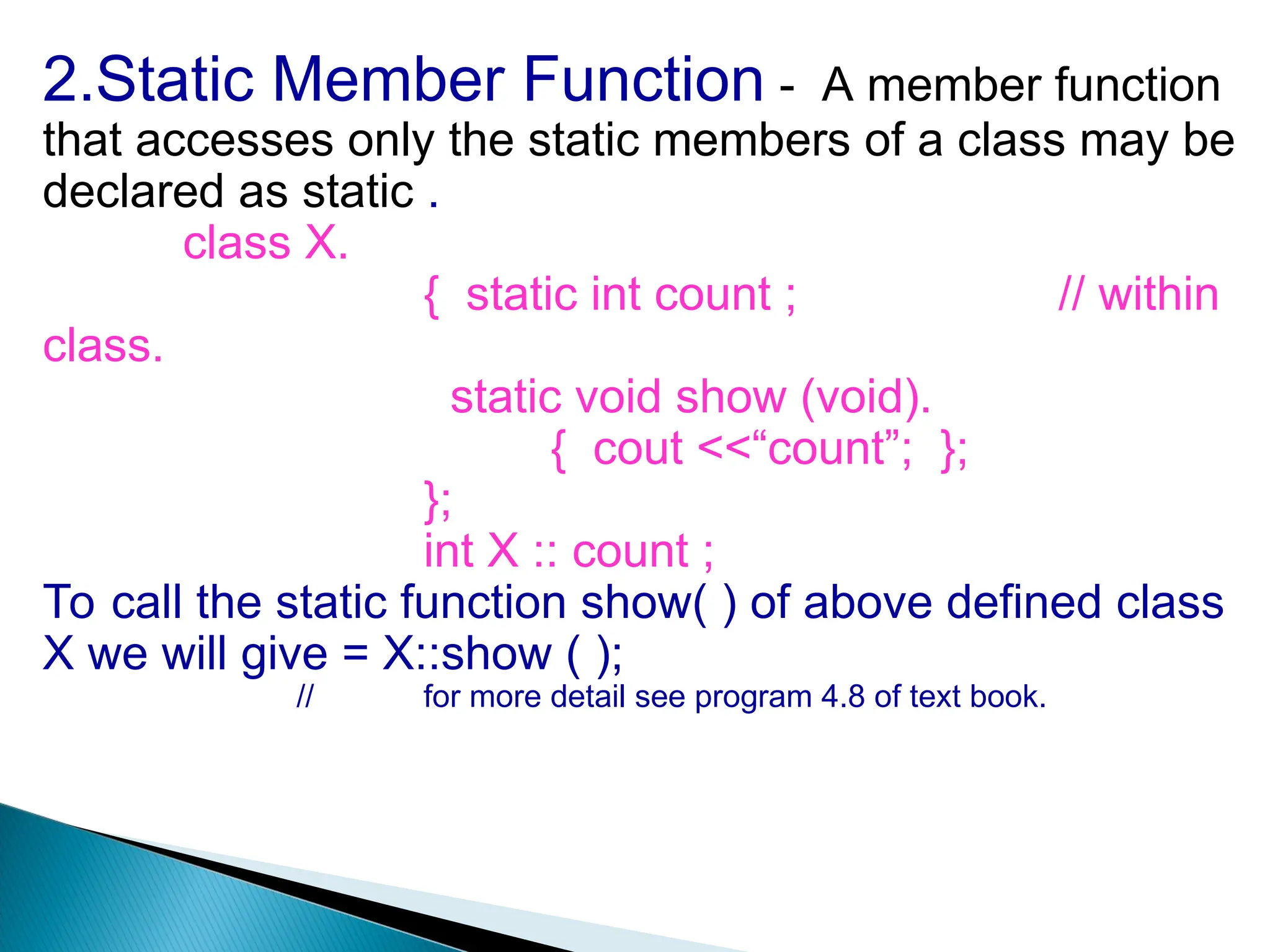
2.Static Member Function - A member function
that accesses only the static members of a class may be
declared as static .
class X.
{ static int count ; // within
class.
static void show (void).
{ cout <<“count”; };
};
int X :: count ;
To call the static function show( ) of above defined class
X we will give = X::show ( );
// for more detail see program 4.8 of text book.
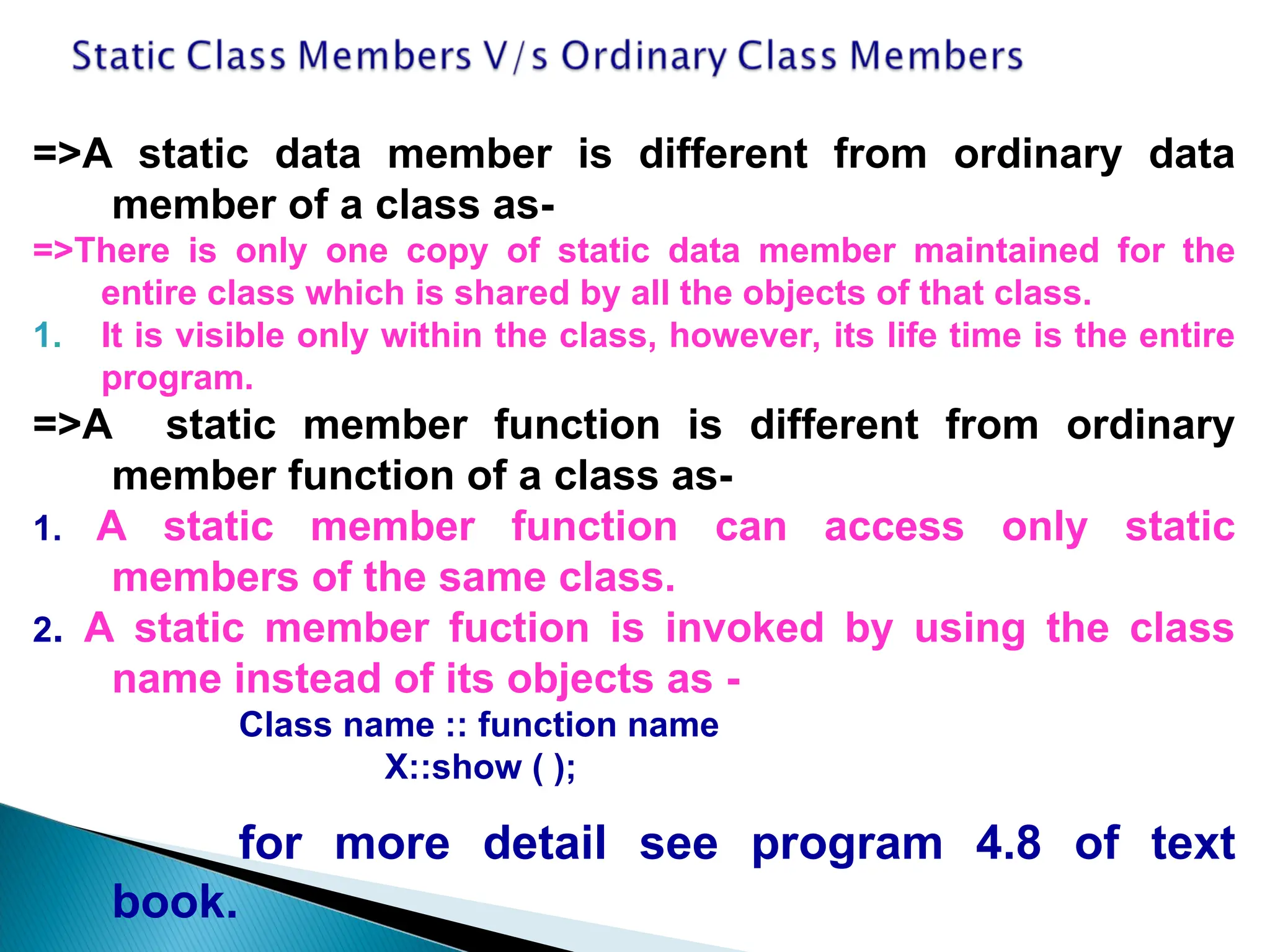
=>A static data member is different from ordinary data
member of a class as-
=>There is only one copy of static data member maintained for the
entire class which is shared by all the objects of that class.
1. It is visible only within the class, however, its life time is the entire
program.
=>A static member function is different from ordinary
member function of a class as-
1. A static member function can access only static
members of the same class.
2. A static member fuction is invoked by using the class
name instead of its objects as -
Class name :: function name
X::show ( );
for more detail see program 4.8 of text
book.
classes data type for Btech students.ppt

classes data type for Btech students.ppt

  • 1.
  • 2.
    •Introduction •Classes •Data hiding andEncapsulation •Functions in a class •Using objects •Static Class Members
  • 3.
     The mostimportant features of C++ are the classes and objects. C++ is a bunch of small additions to C, with a few major additions. As the name object- oriented programming suggests this approach deals with objects.  Classes are collections of related to a single object type. Classes not include information regarding the real world object but also function to access the data and classes possess the ability to inherit from other classes
  • 4.
     Class representsa group of similar objects  A class is a way to bind the data describing an entity and its associated functions together  A class is user-defined data type used to implement an abstract object giving you the capability to use object oriented programming with c++.  A class includes members  A member can be either data, know as a data member or a function known as a member function
  • 5.
  • 6.
     The contentsof each instance of class_name : data_members and data_functions  The members are of private, protected or public specifier
  • 7.
    The declaration ofa class involves declaration of its four associated attributes 1) Data members are the data-type properties that describe the characteristics of a class. There may be zero or more data members of any type in a class 2) Member functions are set of operations that may be applied to object of that class. There may be zero or more member functions of a class. They are referred to as the class interface 3) Program Access Levels that control access to members from within the program. These access levels are private, protected or public .Depending upon the access level of a class member, access to it allowed or denied 4) Class Tag name that serves as a type specifier for the class using which objects of this class type can be created.
  • 8.
     The classspecification takes place in two parts =>Class definition: which describe the component members (data member and functions members) of the class =>Class method definition : which describe how certain class member function are implemented.
  • 9.
    =>Outside the classdefinition =>Inside the class definition
  • 10.
     A memberfunction definition outside the class definition is much same as that of function definitions .  The only difference is that the name of the function is the full name of the function. the full name (also called qualified-name) of the function is written as:  Class-name::function-name  Class-name:indicate that the function specified by function_name Is a member of the class specified by class- name.  The symbol :: called the scope resolution operator specifies that the scope of the function is restricted to the class class-name
  • 11.
     The generalform of a member function definition outside the class definition is Return-type class-name :: function_name (parameter list) { Function body } Membership label:  The membership label (classname ::) will resolve their identity and scope Void student : : add ( )
  • 12.
    class salesman { int salesman_no: intproduct_no; Public: void readdata( ); void displaydata( ); }; void salesman::readdata( ) { cout<<“enter salesman_no”; cin>>salesman_no; } void salesman::displaydata( ) { cout<<“the salesman_no”<<salesman_no; }
  • 13.
    A function defineinside a class is automatically inline function. class student { int a; Public: void readdata () { cout<<“enter the value of a”; cin>>a; } };
  • 14.
     A classspecification does not define any objects of its type rather it just define the properties of a class.  example  Student s1,s2,s3;
  • 15.
    =>The private dataof a class can be accessed only through the member function of that class =>The public data can be accessed by the non- member function through the objects of that class. =>The public member function of a class are called by non-member functions using the object. =>objec-name.function-name(actual-arguments);
  • 16.
    class abc { int x,y// private by default Public: int z; int add (int a,int b) { int c=a+b; return c; } }; abc a1,a2;
  • 17.
     The generalformat for calling a member function is Object-name.function-name(actual-arugment); a1.add(2,3); a2.add(4,6);
  • 18.
     To accessthe public data member,the format used is: a1.z or a2.z But if we give a1.x or a2.y An error since x and y are private data member of class abc
  • 19.
     An arrayin a class can be private or public data member of the class  A class can have an array as its member variable  If an array happen to be private data member of the class then only the member functions of the class can access it.  If an array is a public data member of the class it can be accessed directly using object of this class type.
  • 20.
    A class canhave an array as its member variable. An array in a class can be private or public data member of the class. If an array happens to be a private data member of the class, then, only the member functions of the class can access it. On the other hand, if an array is a public data member of the class, it can be accessed directly using objects of this class type. For example - Class ABC { int arr [10]; // private by default public : int largest (void); int sum (void); }; Here the variable arr[10] is a private data member of the class ABC. It can be accessed only through the member function largest ( ) & sum ( ).
  • 21.
    Class exarray { Int arr[10];//private data member Public: Int largest(void); Int sum(void); }; The data member of class exarray accessed only through the member function largest() and sum(); not directly by objects.
  • 22.
     There arethree access types that determine the scope of Class & its members – public , private and protected.  The public access specifier states that anything following this keyword can be accessed from outside this class .  The Private members are the class members that are hidden from the outside world. The private members implement the OOP concept of data hiding. The private members of a class can be used only member functions of the class in which it is declared.
  • 23.
    =>The protected accessspecifier plays its role in inheritance i.e. when the new class is derived from the existing class.  Protected members are the members that can be used only by member functions and friends of the class in which it is declared.  The protected members are similar to private members.  The only difference between protected and private is that protected members are inheritable while private members are non- inheritable.
  • 24.
  • 25.
    #include<iostream.h> #include<conio.h> #include<stdio.h> class x { private: inta; int sqr(a) { retutn a*a; } Public: int b; int twice(int i) { return 2*i; } int tsq(int i) { int p=sqr(i); int q=twice(p); return q; } }; X obj1; void main( ) { obj1.b=5; obj1.a=2; //wrong obj1.twice(10); obj1.sqr(10); obj1.tsq(10); }
  • 26.
    #include<iostream.h> #include<conio.h> #include<stdio.h> Class customer { private: charcust_name[25]; char address[25]; char city [15]; double balance ; public : void input_data(void) { cout<<“Enter the Name “; gets (cust_name); cout<<“Enter Address”; gets(address); cout<<“Enter City”; gets(city); cout <<“Balance”; cin >>balance; } void print_data (void) { cout<<“n Customer Name “<<Cust_name; cout<<“n Address”<<address; cout<<“n City “<<city; cout<<“n Balance”<< balance ; } }; void main( ) { customer cust; cust.input_data(); cust.print_data(); }
  • 27.
     Global Class–A Class is said to be global if its definition occurs outside the bodies of all functions in a program, which means that object of this class type can be declared from anywhere in the program. #include<iostream.h> Class X // Global class type X {…………..} ; X obj1; // Global object obj1 of type X int main( ) { X obj2;// Local object obj2 of type X };  Local Class – A class is said to be local if its definition occurs inside a function body , which means that objects of this class type can be declared only within the function that defines this class type. for Example - #include<iostream.h> ------------- int main ( ) { Class Y { ………… } // Local class type Y Y obj1; }; // Local object obj 1 of type Y void fun(void) { Y obj; // invalid. Y type is not available in fun( ) }
  • 28.
    SCOPE OF PRIVATEAND PROTECTED MEMBERS =>The private and protected members of a class have class scope that means these can be accessed only by the member function of the class. These members cannot be accessed directly by using the object. =>Scope of public members: The scope of public members depends upon the object being used for referencing them. If the referencing object is a global object , then the scope of public members is also global and if the referencing object is a local object , them the scope of public members is local
  • 29.
    1.Accessor /getter –are used to read values of private data members of a class which are directly not accessible in non-member function. However , accessor function do not change the value of data members 2.Mutator / Setter – These functions allow us to change the data members of an object. 3.Manager function – These are specific functions e.g. (Constructor and destructor) that deal with initializing and destroying class instances. Why Accessor / Mutators – Because by providing accessor and mutator we make sure that data is edited in desired manner through a mutator .further if a user wants to know current value of a private data member , he can get it through an accessor function.
  • 30.
    Class student { introllno; char name[25]; float marks; char grade; public: void read_data(); void display_data(): int get rollno() { return rollno; } float get marks() { return marks; } // accessor methods they have the return type. void calgrade() { if marks>= 75 // Mutator method it is modyfying data member grade grade = ‘A’ else if marks >= 60 grade= ‘B’ else if marks >=45 grade = ‘C’ } };
  • 31.
    =>Nested classes: Aclass declared within another class is called a nested class. The outer class is known as enclosing class and the inner class is known as Nested class. => Data Hiding and Encapsulation: Class->encapsulation Private and protected members->Data hiding Public members->abstraction
  • 32.
    1.INLINE FUNCTION :-These functions are designed to speed up programs. The coding of these functions are like normal function except that inline function’s definitions start with the keyword “inline” . The other distinction between normal function and inline function is the different compilation process for them. Inline functions run a little faster than the normal function. Inline function provide an alternative. With inline code the compiler replaces the function call statement with the function code itself ( this process is called expansion) and then compiles the entire code. Thus, with inline functions the compiler does not have to jump to another location to execute the function. Declaration : inline void max (int a , int b) { cout << (a>b?a:b); } void main ( ) { int x ,y ; cin >> x >> y; max (x , y); }
  • 33.
    In the abovecode the function max( ) has been declared inline, thus, it would not be called during execution. Rather its code would be inserted into main ( ) and then complied.  An inline function definition should be placed above all the functions that call it. The function should be inline only when they are small.  The inline function does not work for following situations – ◦ For functions that return values ◦ For functions having loop, switch or goto ◦ For have return ( ) ◦ If function contain static variables or is recursive.  The member function of a class ,if defined, within the class definition, are inlined by default. We need not use keyword inline.
  • 34.
    => Constant Memberfunctions: If a member function of a class does not alter any data in the class , then this member function may be declared as a constant member function using the keyword const. Example: int maxi(int, int) const; void prn(void) const; The qualifier const appears both in member function declarations and definitions.
  • 35.
    =>Nesting of MemberFunctions: When a member function is called by another member function , it is called nesting of member functions. => The scope Resolution Operator :: The :: (scope resolution) operator is used to qualify hidden names so that you can still use them. You can use the unary scope operator if a namespace scope or global scope name is hidden by an explicit declaration of the same name in a block or class. : : variable-name This operator allows access to the global version of a variable.
  • 36.
    #include<iostream.h> #include<iostream.h> #include<conio.h> #include<conio.h> int int m m = =10 10; // global ; // global void void main main( ) ( ) { { int int m m = = 20 20; //local ; //local clrscr clrscr( ); ( ); cout cout << << "m_local "m_local = " = " << << m m << << "n" "n"; ; cout cout << << "m_global "m_global = " = " <<:: <<::m m << << "n" "n"; ; getch getch( ); ( ); } } m_local m_local = 20 = 20 m_global m_global = 10 = 10
  • 37.
     The declarationof m declared in the main function hides the integer named m declared in global namespace scope. The statement ::m = 10 accesses the variable named m declared in global namespace scope.  Note: If there are multiple variables of the same name declared in separate block then the :: operator always refers to the file scope variable.
  • 38.
    =>Using object: whena class has been defined, its objects can be created , using the class name as type specifier. Example: class-name object name(comma separated); => Memory allocation of objects: Member functions are created and placed in the memory space only once when the class is defined. The memory space is allocated for objects ,data members only when the objects are declared. No separate space is allocated for member functions when the objects are created.
  • 39.
    An array havingclass type elements is known as Array of objects. An array of objects is declared after the class definition is over and it is defined in the same way as any other type of array is defined. For example - class item { public: int itemno; float price; void getdata (int i, float j) { itemno=I;price=j;} }; item order[10]; Here the array order contains 10 objects. To access data member itemno of 2nd object in the array we will give = order[1].itemno; //for more detail see program 4.4 of text book.
  • 40.
    OBJECTS AS FUNCTIONARGUMENTS : An object may be used as a function argument in two ways –. 1.A copy of the entire object is passed to the function. // by value. : When an object is passed by value , the function creates its own copy of the object and works with its own copy. therefore , any changes made to the object inside the function do not affect the original object.
  • 41.
     2.Only theaddress of the object is transferred to the function. // by reference. :When an object is passed by reference , its memory address is passed to the function so that the called function works directly on the original object used in the function call. thus, any changes made to the object inside the function are reflected in the original object as the function is making changes in the original object itself.
  • 42.
    =>Functions Returning Objects:Objects can not only passed to functions but function can also return an object.
  • 43.
    1.Static Data Member- a static data member of a class is just like a global variable for its class. That is, this data member is globally available for all the objects of that class type. The static data members are usually maintained to store values common to the entire class. Declaration of static data member : class X. { static int count ; // within class. }; int X :: count ; // for outside class. A static data member can be given an initial value at the time of its definition like – int X :: count =10;
  • 44.
    2.Static Member Function- A member function that accesses only the static members of a class may be declared as static . class X. { static int count ; // within class. static void show (void). { cout <<“count”; }; }; int X :: count ; To call the static function show( ) of above defined class X we will give = X::show ( ); // for more detail see program 4.8 of text book.
  • 45.
    =>A static datamember is different from ordinary data member of a class as- =>There is only one copy of static data member maintained for the entire class which is shared by all the objects of that class. 1. It is visible only within the class, however, its life time is the entire program. =>A static member function is different from ordinary member function of a class as- 1. A static member function can access only static members of the same class. 2. A static member fuction is invoked by using the class name instead of its objects as - Class name :: function name X::show ( ); for more detail see program 4.8 of text book.