CLASS AND OBJECTS
Chapter 3
An Introduction to classes
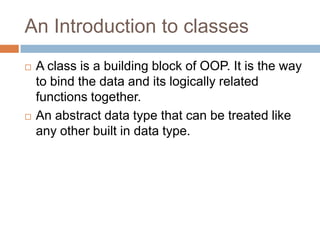
   A class is a building block of OOP. It is the way
    to bind the data and its logically related
    functions together.
   An abstract data type that can be treated like
    any other built in data type.
Class definition
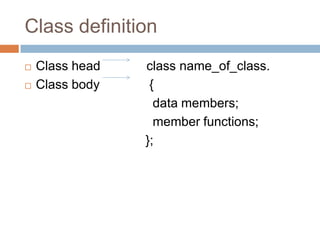
   Class head   class name_of_class.
   Class body    {
                   data members;
                   member functions;
                 };
Example
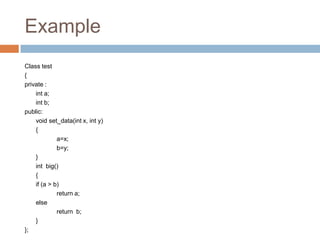
Class test
{
private :
    int a;
    int b;
public:
    void set_data(int x, int y)
    {
             a=x;
             b=y;
    }
    int big()
    {
    if (a > b)
             return a;
    else
             return b;
    }
};
Characteristics of access specifiers
(private,public and protected)
   Private section of a class can have both data
    members and member functions, usually data
    members are made private for data security.
   It is not mandatory that private section has to
    declared first in the class and then the public
    section.
   If no member access specifier is specified then by
    default the members are private for the class.
   There may be any number of private, public or
    protected section in a class declaration.
   Protected specifier is used for declaring the class
    members which can be accessed by its own class
    and its derived class.
Member Function
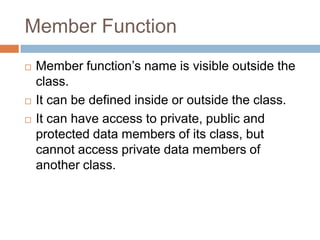
   Member function’s name is visible outside the
    class.
   It can be defined inside or outside the class.
   It can have access to private, public and
    protected data members of its class, but
    cannot access private data members of
    another class.
Introduction to objects
 Object is an abstraction of real wold entity.
 Objects are the variables/instances of classes.

 Syntax for declaring objects is as follows :

  <class name>
  <obj_name1>,<obj_name2>, …, <obj_name1>
  ;
Example: for class test the objects can be
  created as follows:
test t1,t2,…tn;
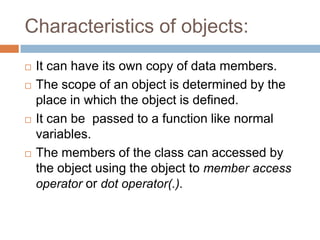
Characteristics of objects:
   It can have its own copy of data members.
   The scope of an object is determined by the
    place in which the object is defined.
   It can be passed to a function like normal
    variables.
   The members of the class can accessed by
    the object using the object to member access
    operator or dot operator(.).
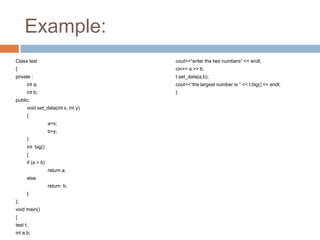
Example:
Class test                          cout<<“enter the two numbers” << endl;
{                                   cin>> a >> b;
private :                           t.set_data(a,b);
      int a;                        cout<<“the largest number is ” << t.big() << endl;
      int b;                        }
public:
      void set_data(int x, int y)
      {
                   a=x;
                   b=y;
      }
      int big()
      {
      if (a > b)
                   return a;
      else
                   return b;
      }
};
void main()
{
test t;
int a,b;
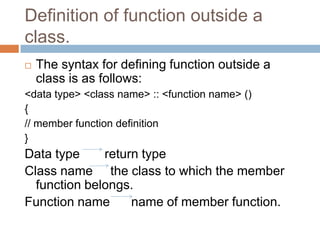
Definition of function outside a
class.
   The syntax for defining function outside a
    class is as follows:
<data type> <class name> :: <function name> ()
{
// member function definition
}
Data type     return type
Class name the class to which the member
  function belongs.
Function name      name of member function.
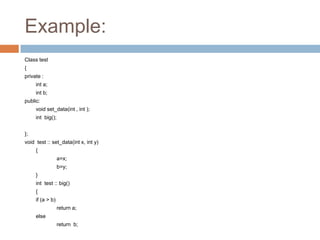
Example:
Class test
{
private :
     int a;
     int b;
public:
     void set_data(int , int );
     int big();


};
void test :: set_data(int x, int y)
     {
                  a=x;
                  b=y;
     }
     int test :: big()
     {
     if (a > b)
                  return a;
     else
                  return b;
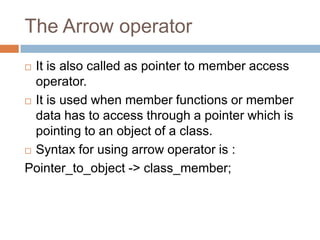
The Arrow operator
 It is also called as pointer to member access
  operator.
 It is used when member functions or member

  data has to access through a pointer which is
  pointing to an object of a class.
 Syntax for using arrow operator is :

Pointer_to_object -> class_member;
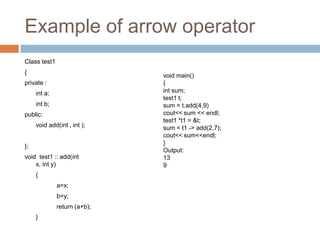
Example of arrow operator
Class test1
{
                              void main()
private :                     {
     int a;                   int sum;
                              test1 t;
     int b;                   sum = t.add(4,9)
public:                       cout<< sum << endl;
                              test1 *t1 = &t;
     void add(int , int );    sum = t1 -> add(2,7);
                              cout<< sum<<endl;
                              }
};
                              Output:
void test1 :: add(int         13
    x, int y)                 9
     {
              a=x;
              b=y;
              return (a+b);
     }
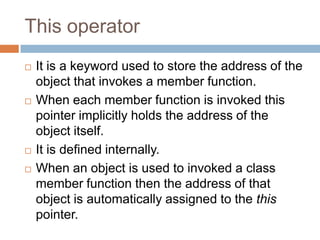
This operator
   It is a keyword used to store the address of the
    object that invokes a member function.
   When each member function is invoked this
    pointer implicitly holds the address of the
    object itself.
   It is defined internally.
   When an object is used to invoked a class
    member function then the address of that
    object is automatically assigned to the this
    pointer.
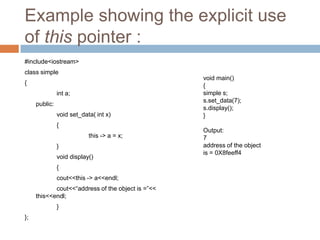
Example showing the explicit use
of this pointer :
#include<iostream>
class simple
                                                   void main()
{                                                  {
               int a;                              simple s;
                                                   s.set_data(7);
     public:
                                                   s.display();
               void set_data( int x)               }
               {
                                                   Output:
                           this -> a = x;          7
               }                                   address of the object
                                                   is = 0X8feeff4
               void display()
               {
               cout<<this -> a<<endl;
            cout<<“address of the object is =”<<
     this<<endl;
               }
};

class and objects

  • 1.
  • 2.
    An Introduction toclasses  A class is a building block of OOP. It is the way to bind the data and its logically related functions together.  An abstract data type that can be treated like any other built in data type.
  • 3.
    Class definition  Class head class name_of_class.  Class body { data members; member functions; };
  • 4.
    Example Class test { private : int a; int b; public: void set_data(int x, int y) { a=x; b=y; } int big() { if (a > b) return a; else return b; } };
  • 5.
    Characteristics of accessspecifiers (private,public and protected)  Private section of a class can have both data members and member functions, usually data members are made private for data security.  It is not mandatory that private section has to declared first in the class and then the public section.  If no member access specifier is specified then by default the members are private for the class.  There may be any number of private, public or protected section in a class declaration.  Protected specifier is used for declaring the class members which can be accessed by its own class and its derived class.
  • 6.
    Member Function  Member function’s name is visible outside the class.  It can be defined inside or outside the class.  It can have access to private, public and protected data members of its class, but cannot access private data members of another class.
  • 7.
    Introduction to objects Object is an abstraction of real wold entity.  Objects are the variables/instances of classes.  Syntax for declaring objects is as follows : <class name> <obj_name1>,<obj_name2>, …, <obj_name1> ; Example: for class test the objects can be created as follows: test t1,t2,…tn;
  • 8.
    Characteristics of objects:  It can have its own copy of data members.  The scope of an object is determined by the place in which the object is defined.  It can be passed to a function like normal variables.  The members of the class can accessed by the object using the object to member access operator or dot operator(.).
  • 9.
    Example: Class test cout<<“enter the two numbers” << endl; { cin>> a >> b; private : t.set_data(a,b); int a; cout<<“the largest number is ” << t.big() << endl; int b; } public: void set_data(int x, int y) { a=x; b=y; } int big() { if (a > b) return a; else return b; } }; void main() { test t; int a,b;
  • 10.
    Definition of functionoutside a class.  The syntax for defining function outside a class is as follows: <data type> <class name> :: <function name> () { // member function definition } Data type return type Class name the class to which the member function belongs. Function name name of member function.
  • 11.
    Example: Class test { private : int a; int b; public: void set_data(int , int ); int big(); }; void test :: set_data(int x, int y) { a=x; b=y; } int test :: big() { if (a > b) return a; else return b;
  • 12.
    The Arrow operator It is also called as pointer to member access operator.  It is used when member functions or member data has to access through a pointer which is pointing to an object of a class.  Syntax for using arrow operator is : Pointer_to_object -> class_member;
  • 13.
    Example of arrowoperator Class test1 { void main() private : { int a; int sum; test1 t; int b; sum = t.add(4,9) public: cout<< sum << endl; test1 *t1 = &t; void add(int , int ); sum = t1 -> add(2,7); cout<< sum<<endl; } }; Output: void test1 :: add(int 13 x, int y) 9 { a=x; b=y; return (a+b); }
  • 14.
    This operator  It is a keyword used to store the address of the object that invokes a member function.  When each member function is invoked this pointer implicitly holds the address of the object itself.  It is defined internally.  When an object is used to invoked a class member function then the address of that object is automatically assigned to the this pointer.
  • 15.
    Example showing theexplicit use of this pointer : #include<iostream> class simple void main() { { int a; simple s; s.set_data(7); public: s.display(); void set_data( int x) } { Output: this -> a = x; 7 } address of the object is = 0X8feeff4 void display() { cout<<this -> a<<endl; cout<<“address of the object is =”<< this<<endl; } };