Power Point Presentation
V. MURUGAN,
Assistant Professor of History,
Vivekananda College,
Tiruvedakam West,
Madurai District,
Tamil Nadu.
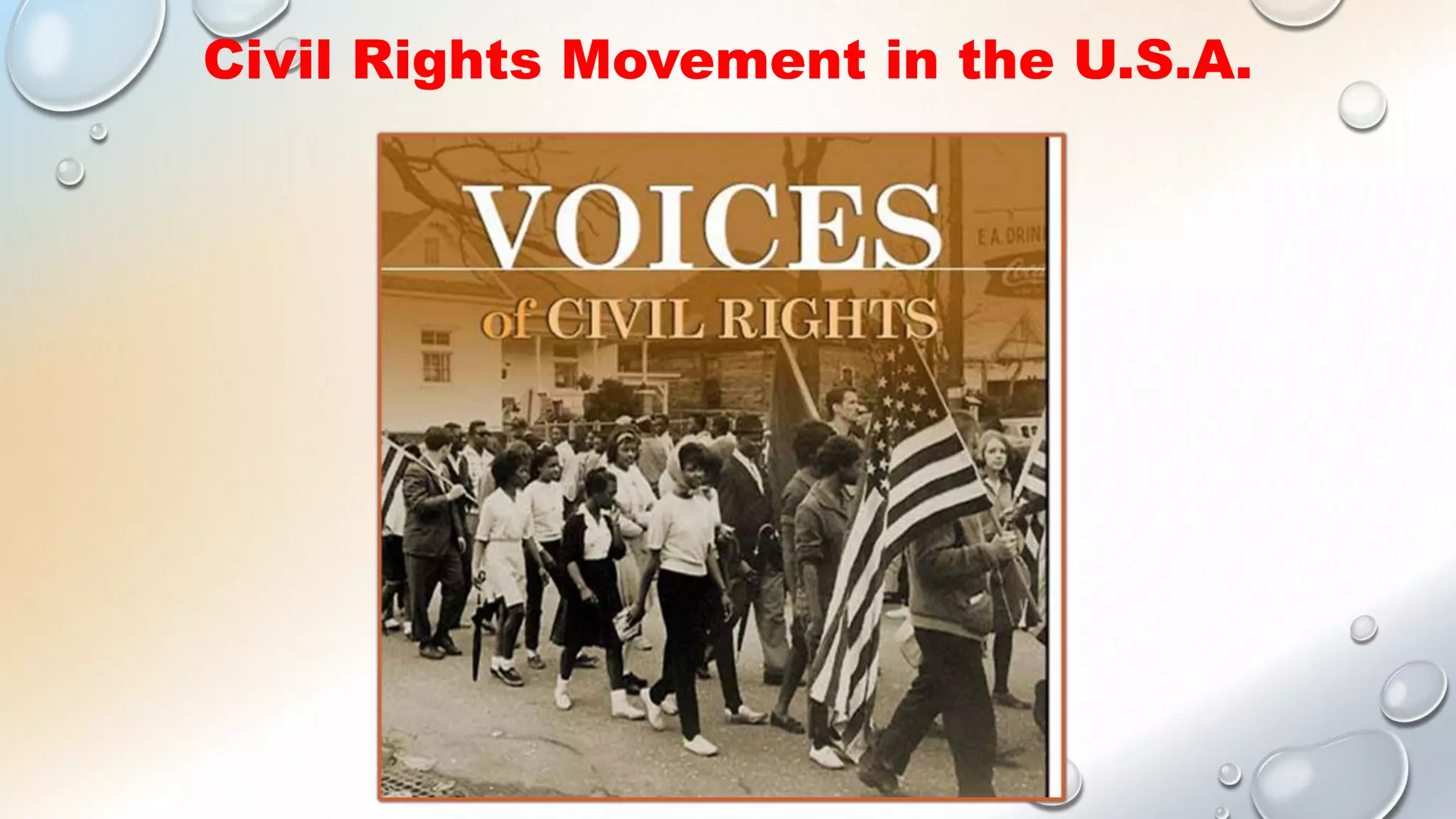
Civil Rights Movement in the U.S.A.
The condition of the U.S.A. after Second World War
 The African Americans were dissatisfied with their second class status after II World War.
 They risked their lives defending freedom.
 Civil Rights Movement was a broad and diverse effort to attain racial equality.
Segregation in the Southern U.S.A.
 Jim Crow Laws enforced strict separation of the races in the
Southern States.
 Schools, Hospitals, Transportations Restaurants and other public
places were separated.
 De jure segregation was imposed by laws.
 In 1896 – Separate but Equal was stated.
Segregation in the Northern U.S.A.
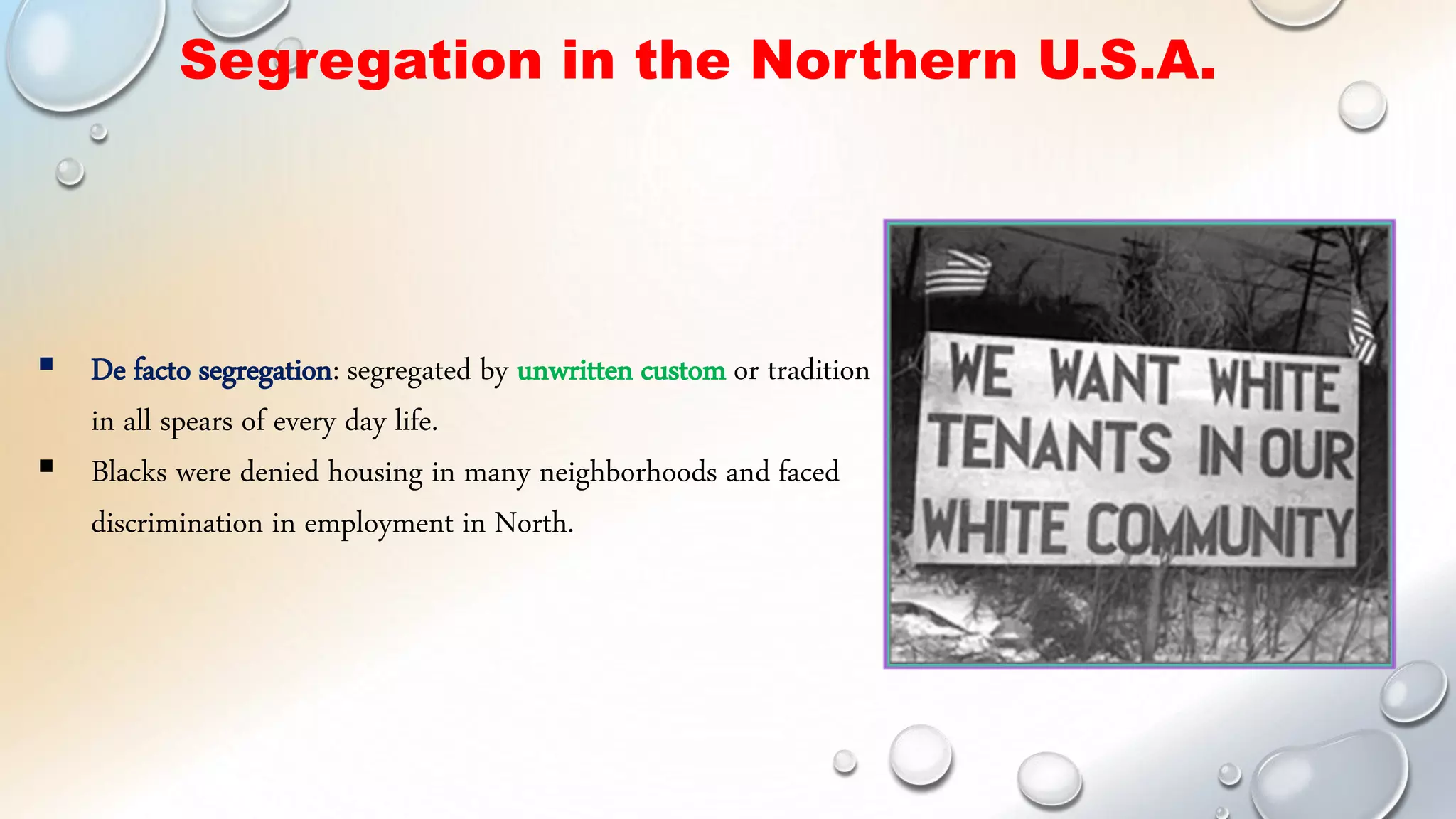
 De facto segregation: segregated by unwritten custom or tradition
in all spears of every day life.
 Blacks were denied housing in many neighborhoods and faced
discrimination in employment in North.
Impact of the Segregation in the U.S.A.
 African Americans received low-paying jobs.
 Higher rates of poverty and illiteracy.
 Lower rates of homeownership and life expectancy.
 Couldn’t vote in the south.
The growth of Civil Rights Movement
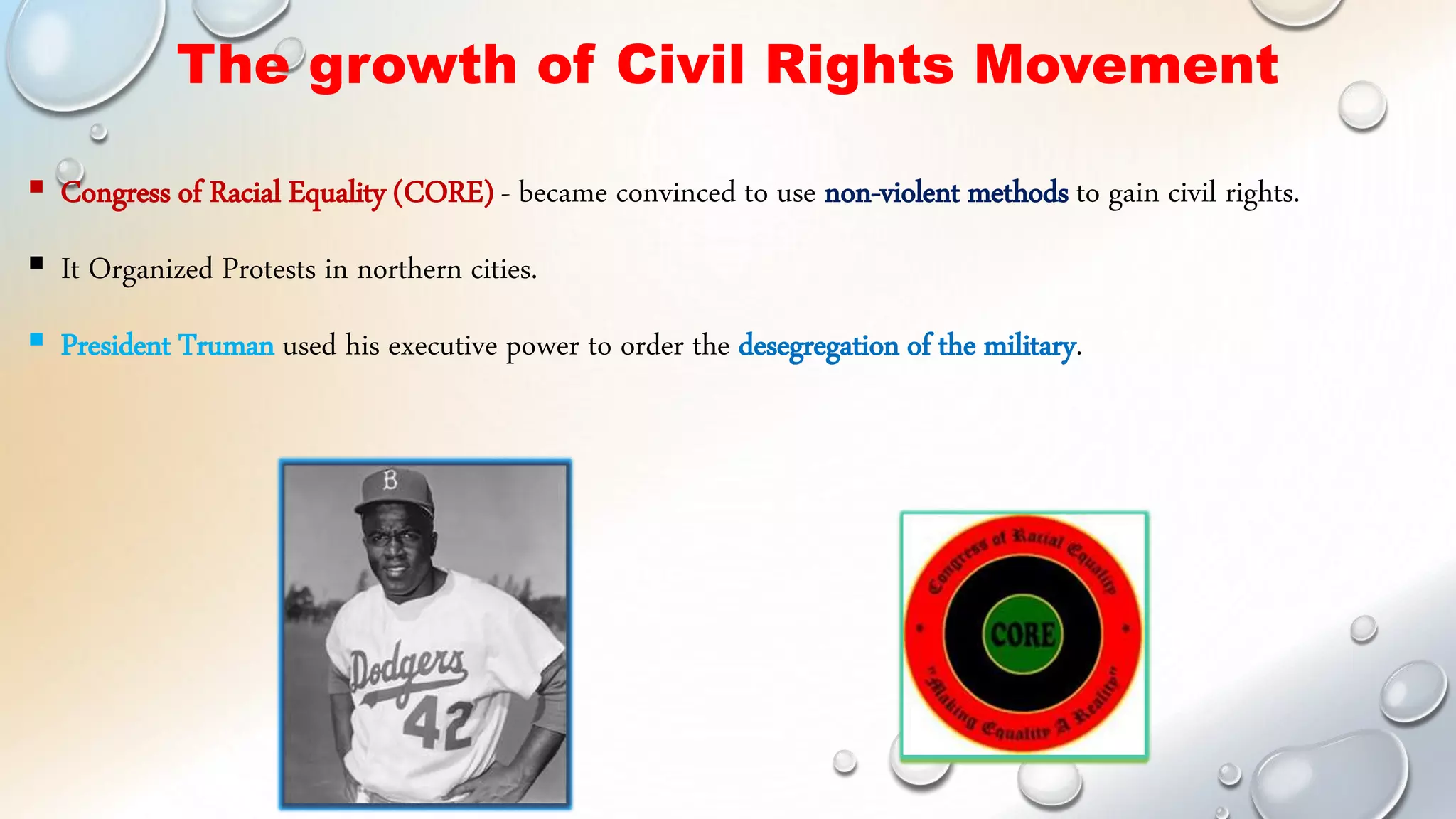
 Congress of Racial Equality (CORE) - became convinced to use non-violent methods to gain civil rights.
 It Organized Protests in northern cities.
 President Truman used his executive power to order the desegregation of the military.
NAACP
 National Association for the Advancement of Colored People
(NAACP) became the largest and most powerful civil rights
organization.
 Thurgood Marshal-headed the team that challenged the legality of
segregation.
NAACP
•NAACP challenged the “separate but equal” ruling.
•The Supreme Court agreed with NAACP argument that segregated public
education violated the U.S. Constitution.
Little Rock Nine
 President Eisenhower sent federal troops to Little Rock
Central High School to protect the African American students.
 For the entire school year, federal troops stayed in Little Rock
escorting the students to and from school.
 It demonstrated that the President would not tolerate open
defiance of the law.
 However, most southern states found ways to resist
desegregation and it would take years before black and white
children went to school together.
Montgomery Bus Boycott
•Rosa Parks actions transformed the movement.
•NAACP began preparing a legal challenge.
•Rise of Martin Luther King: urged non-violence.
•Boycott lasted a year.
•In 1956 the Supreme Court ruled the Montgomery
bus segregation law was unconstitutional.
Effects of the Montgomery Bus Boycott
 It Revealed the power African Americans could have if they joined together.
 Martin Luther King established the Southern Christian Leadership Conference (SCLC).
 SCLC - Advocated nonviolent resistance to fight injustice.
Freedom Ride
 Test the federal government’s willingness to enforce that
segregation on interstate buses was illegal.
 They defied segregation codes.
 In Alabama firebombed one bus and attacked the riders of
the second bus.
 Kennedy takes action.
 Federal Transportation Commission issued an order
mandating the desegregation of interstate transportation.
 Civil rights activists achieved their goal and that
intimidation would not defeat them.
Sit-ins
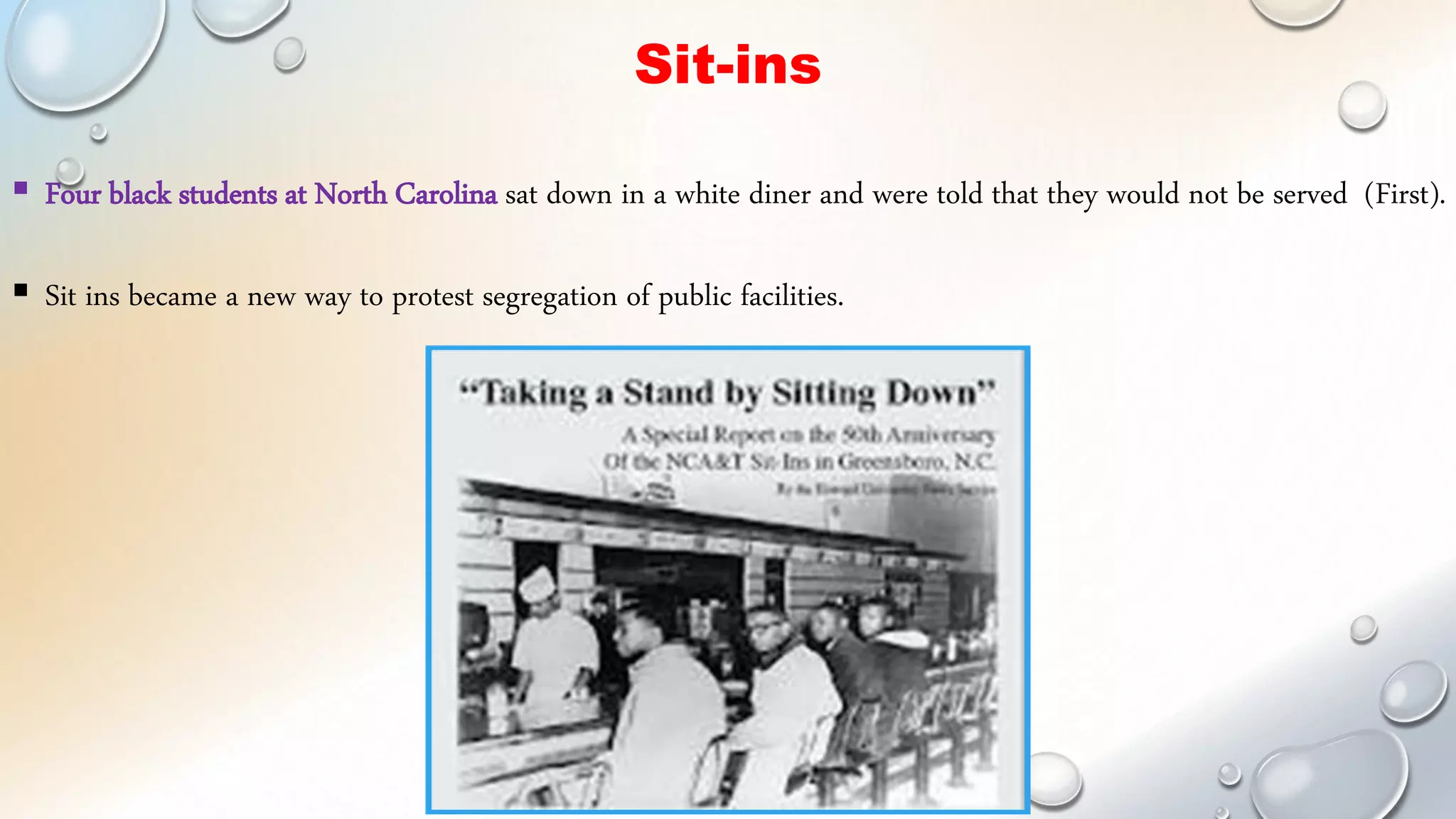
 Four black students at North Carolina sat down in a white diner and were told that they would not be served (First).
 Sit ins became a new way to protest segregation of public facilities.
Focus on Birmingham
•Letter from Birmingham jail by Martin Luther King on April 1963.
•“Injustice anywhere is a threat to justice”.
•Freedom marches: schoolchildren joined the demonstrations.
•Many Americans were shocked by the news coverage of nonviolent protestors set upon by dogs and jets of water.
•Kennedy approves civil rights bill.
March on Washington
•It was organized to put pressure on Congress to pass the new civil rights bill.
•More than 200,000 people participated.
•Martin Luther King gave a great speech called – “I have a dream”.
•One of the largest political demonstrations.
•A model for peaceful protest.
Civil Rights Act of 1964
•This act banned segregation in public accommodations.
•Gave the federal government the ability to desegregate schools.
•Prosecute individuals who violated people’s civil rights.
•Outlawed discrimination in employment.
•Established the Equal Employment Opportunity Commission (EEOC).
Voting Rights Act of 1965
 Spurred by actions of protesters and the President, Congress passed the act.
 It banned literacy tests and empower the federal government to oversee voting registration.
 By 1975, Congress extended to Hispanic voters
 Black participation jumped from 7% in 1964 to 70% in 1986.
The Riots
 Frustration, over discrimination and poverty leads to riots.
 The discrimination was very worst in New York, New Jersey Detroit and Michigan in the summer of 1967.
 Blacks using violence against police and white business owners in black neighborhoods.
The Kerner Commission
 The National Advisory Commission on Civil Disorders – also known as Kerner Commission.
 Otto Kerner – its chairman.
 It concluded racial discrimination as the cause of the violence.
 They recommended by extending federal programs to Urban black neighborhoods.
 Controversy surrounding the Commission.
 Johnson did not follow up.
The Black Power
 The Blacks move away from nonviolence to violence.
 Stokely Carmichael’s definition: it meant African Americans should collectively use their economic and political
muscle to gain equality.
 It is an Institutional Racism.
Black Panthers
 Symbol of young militant African Americans.
 Protected urban neighborhoods from police abuse.
 Created antipoverty programs.
 Stokely was “honorary Prime Minister”.
Martin Luther King’s Last Days
 He understood the anger and frustration of many urban African Americans.
 He disagreed with the call for “black power”.
 He was assassinated on Aril 4th 1968.
 His assassination triggered riots in more than 100 cities.
 Two months later Robert Kennedy was assassinated
The Results of the Civil Rights Movement
•It Eliminated legal or de jure segregation.
•It Knocked down barriers of voting and political participation for African Americans.
•Poverty rates fell.
•Increase in the number of African Americans high school graduates.
•Appointment of Thurgood Marshall as the first African American Supreme Court Justice in 1967.
•Fair Housing Act was passed.
•It prohibits discrimination in the buying, selling, renting or financing of housing.
Civil Rights Movements in the USA

Civil Rights Movements in the USA

  • 1.
    Power Point Presentation V.MURUGAN, Assistant Professor of History, Vivekananda College, Tiruvedakam West, Madurai District, Tamil Nadu.
  • 2.
    Civil Rights Movementin the U.S.A.
  • 3.
    The condition ofthe U.S.A. after Second World War  The African Americans were dissatisfied with their second class status after II World War.  They risked their lives defending freedom.  Civil Rights Movement was a broad and diverse effort to attain racial equality.
  • 4.
    Segregation in theSouthern U.S.A.  Jim Crow Laws enforced strict separation of the races in the Southern States.  Schools, Hospitals, Transportations Restaurants and other public places were separated.  De jure segregation was imposed by laws.  In 1896 – Separate but Equal was stated.
  • 5.
    Segregation in theNorthern U.S.A.  De facto segregation: segregated by unwritten custom or tradition in all spears of every day life.  Blacks were denied housing in many neighborhoods and faced discrimination in employment in North.
  • 6.
    Impact of theSegregation in the U.S.A.  African Americans received low-paying jobs.  Higher rates of poverty and illiteracy.  Lower rates of homeownership and life expectancy.  Couldn’t vote in the south.
  • 7.
    The growth ofCivil Rights Movement  Congress of Racial Equality (CORE) - became convinced to use non-violent methods to gain civil rights.  It Organized Protests in northern cities.  President Truman used his executive power to order the desegregation of the military.
  • 8.
    NAACP  National Associationfor the Advancement of Colored People (NAACP) became the largest and most powerful civil rights organization.  Thurgood Marshal-headed the team that challenged the legality of segregation.
  • 9.
    NAACP •NAACP challenged the“separate but equal” ruling. •The Supreme Court agreed with NAACP argument that segregated public education violated the U.S. Constitution.
  • 10.
    Little Rock Nine President Eisenhower sent federal troops to Little Rock Central High School to protect the African American students.  For the entire school year, federal troops stayed in Little Rock escorting the students to and from school.  It demonstrated that the President would not tolerate open defiance of the law.  However, most southern states found ways to resist desegregation and it would take years before black and white children went to school together.
  • 11.
    Montgomery Bus Boycott •RosaParks actions transformed the movement. •NAACP began preparing a legal challenge. •Rise of Martin Luther King: urged non-violence. •Boycott lasted a year. •In 1956 the Supreme Court ruled the Montgomery bus segregation law was unconstitutional.
  • 12.
    Effects of theMontgomery Bus Boycott  It Revealed the power African Americans could have if they joined together.  Martin Luther King established the Southern Christian Leadership Conference (SCLC).  SCLC - Advocated nonviolent resistance to fight injustice.
  • 13.
    Freedom Ride  Testthe federal government’s willingness to enforce that segregation on interstate buses was illegal.  They defied segregation codes.  In Alabama firebombed one bus and attacked the riders of the second bus.  Kennedy takes action.  Federal Transportation Commission issued an order mandating the desegregation of interstate transportation.  Civil rights activists achieved their goal and that intimidation would not defeat them.
  • 14.
    Sit-ins  Four blackstudents at North Carolina sat down in a white diner and were told that they would not be served (First).  Sit ins became a new way to protest segregation of public facilities.
  • 15.
    Focus on Birmingham •Letterfrom Birmingham jail by Martin Luther King on April 1963. •“Injustice anywhere is a threat to justice”. •Freedom marches: schoolchildren joined the demonstrations. •Many Americans were shocked by the news coverage of nonviolent protestors set upon by dogs and jets of water. •Kennedy approves civil rights bill.
  • 16.
    March on Washington •Itwas organized to put pressure on Congress to pass the new civil rights bill. •More than 200,000 people participated. •Martin Luther King gave a great speech called – “I have a dream”. •One of the largest political demonstrations. •A model for peaceful protest.
  • 17.
    Civil Rights Actof 1964 •This act banned segregation in public accommodations. •Gave the federal government the ability to desegregate schools. •Prosecute individuals who violated people’s civil rights. •Outlawed discrimination in employment. •Established the Equal Employment Opportunity Commission (EEOC).
  • 18.
    Voting Rights Actof 1965  Spurred by actions of protesters and the President, Congress passed the act.  It banned literacy tests and empower the federal government to oversee voting registration.  By 1975, Congress extended to Hispanic voters  Black participation jumped from 7% in 1964 to 70% in 1986.
  • 19.
    The Riots  Frustration,over discrimination and poverty leads to riots.  The discrimination was very worst in New York, New Jersey Detroit and Michigan in the summer of 1967.  Blacks using violence against police and white business owners in black neighborhoods.
  • 20.
    The Kerner Commission The National Advisory Commission on Civil Disorders – also known as Kerner Commission.  Otto Kerner – its chairman.  It concluded racial discrimination as the cause of the violence.  They recommended by extending federal programs to Urban black neighborhoods.  Controversy surrounding the Commission.  Johnson did not follow up.
  • 21.
    The Black Power The Blacks move away from nonviolence to violence.  Stokely Carmichael’s definition: it meant African Americans should collectively use their economic and political muscle to gain equality.  It is an Institutional Racism.
  • 22.
    Black Panthers  Symbolof young militant African Americans.  Protected urban neighborhoods from police abuse.  Created antipoverty programs.  Stokely was “honorary Prime Minister”.
  • 23.
    Martin Luther King’sLast Days  He understood the anger and frustration of many urban African Americans.  He disagreed with the call for “black power”.  He was assassinated on Aril 4th 1968.  His assassination triggered riots in more than 100 cities.  Two months later Robert Kennedy was assassinated
  • 24.
    The Results ofthe Civil Rights Movement •It Eliminated legal or de jure segregation. •It Knocked down barriers of voting and political participation for African Americans. •Poverty rates fell. •Increase in the number of African Americans high school graduates. •Appointment of Thurgood Marshall as the first African American Supreme Court Justice in 1967. •Fair Housing Act was passed. •It prohibits discrimination in the buying, selling, renting or financing of housing.