 Ehtisham Ali Hussain
 BAGF15E258
 University College Of Agriculture,
 University Of Sargodha, Sargodha
kingdom:
Animalia
Phylum:
Arthropoda
Class:
insecta
Order:
Hemiptera
A Family:
psyllidae
Genus:
diaphorina
Species:
Diaphorina citri
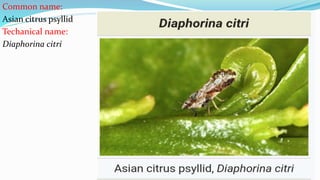
Common name:
Asian citrus psyllid
Techanical name:
Diaphorina citri
Distribution:
 Afghanistan
 China
 Hong kong
 India
 Indonesia
 Malaysia
 Nepal
 Pakistan
 Mexico
Identification:
Eggs
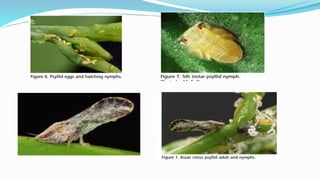
Female lay bright yellow orange, almond shaped eggs on the tips of growing shoots.
The number of laying eggs depends upon host plant .The eggs hatch in about 4 days.
Nymph
The nymph are flat, louse like and orange yellow , congregates in large numbers on
the young leaves and the buds.
Adults
Adults are brownish.
Adults live for 1 to 2 months.
Adult is 3mm long.
Life cycle:
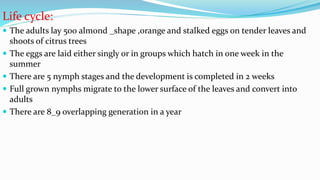
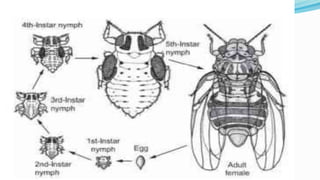
 The adults lay 500 almond _shape ,orange and stalked eggs on tender leaves and
shoots of citrus trees
 The eggs are laid either singly or in groups which hatch in one week in the
summer
 There are 5 nymph stages and the development is completed in 2 weeks
 Full grown nymphs migrate to the lower surface of the leaves and convert into
adults
 There are 8_9 overlapping generation in a year
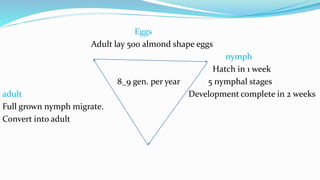
Eggs
Adult lay 500 almond shape eggs
nymph
Hatch in 1 week
8_9 gen. per year 5 nymphal stages
adult Development complete in 2 weeks
Full grown nymph migrate.
Convert into adult
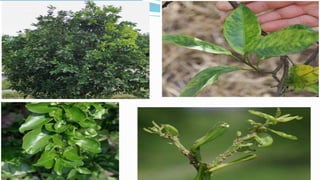
Damage:
 With the help of their sharp piercing sucking mouthpart they suck the cell sap.
 The vitality of the plants deteriorates and their young leaves and twigs stop
growing further.
 The leaf buds flower buds and the leaves may wilt and die.
 Moreover the nymph secrete drops of a sweet thick fluid on which a black fungus
develops adversely affecting photosynthesis.
 This insect is also responsible for spreading the greening virus.
 If the pest is not checked in time the entire orchard may be lost with in one or two
year of continuous damage,
Control:
Biological
 Lady bird beetles and lace wings are important natural enemies of citrus psylla.
 Chemical
 Spray trees with imidacloprid SL 40ml per 100 L of water
 Or endosulfan EC 200ml per 100 l of water
Cultural control
Hand picking
Citrus psylla
Citrus psylla

Citrus psylla

  • 2.
     Ehtisham AliHussain  BAGF15E258  University College Of Agriculture,  University Of Sargodha, Sargodha
  • 3.
  • 4.
    Common name: Asian citruspsyllid Techanical name: Diaphorina citri
  • 5.
    Distribution:  Afghanistan  China Hong kong  India  Indonesia  Malaysia  Nepal  Pakistan  Mexico
  • 6.
    Identification: Eggs Female lay brightyellow orange, almond shaped eggs on the tips of growing shoots. The number of laying eggs depends upon host plant .The eggs hatch in about 4 days. Nymph The nymph are flat, louse like and orange yellow , congregates in large numbers on the young leaves and the buds. Adults Adults are brownish. Adults live for 1 to 2 months. Adult is 3mm long.
  • 8.
    Life cycle:  Theadults lay 500 almond _shape ,orange and stalked eggs on tender leaves and shoots of citrus trees  The eggs are laid either singly or in groups which hatch in one week in the summer  There are 5 nymph stages and the development is completed in 2 weeks  Full grown nymphs migrate to the lower surface of the leaves and convert into adults  There are 8_9 overlapping generation in a year
  • 10.
    Eggs Adult lay 500almond shape eggs nymph Hatch in 1 week 8_9 gen. per year 5 nymphal stages adult Development complete in 2 weeks Full grown nymph migrate. Convert into adult
  • 11.
    Damage:  With thehelp of their sharp piercing sucking mouthpart they suck the cell sap.  The vitality of the plants deteriorates and their young leaves and twigs stop growing further.  The leaf buds flower buds and the leaves may wilt and die.  Moreover the nymph secrete drops of a sweet thick fluid on which a black fungus develops adversely affecting photosynthesis.  This insect is also responsible for spreading the greening virus.  If the pest is not checked in time the entire orchard may be lost with in one or two year of continuous damage,
  • 13.
    Control: Biological  Lady birdbeetles and lace wings are important natural enemies of citrus psylla.  Chemical  Spray trees with imidacloprid SL 40ml per 100 L of water  Or endosulfan EC 200ml per 100 l of water Cultural control Hand picking