CIRCULAR
TEXTILES
PROGRAM
ADDRESSING A GLOBAL PROBLEM
FASHION IS THE SECOND MOST
POLLUTING INDUSTRY IN THE WORLD
Upstream, the production of textile fibres is land, energy and water intensive and reliant on
finite resources. In the coming six years, global fibre demand is estimated to rise from 65 to
90 million tonnes*. This level of production is economically unstable and ecologically
unsustainable.
Downstream the impact of the booming textiles industry and a fast-fashion model of production
and consumption can be seen in the growing volume of low-quality, post-consumer textile
waste, for which there are now limited end-of-life solutions.
With a growing population demanding even more resources like food, clothing and energy
and an increasingly unstable climate driving downward pressure on productivity, it is apparent
that the industry needs to find a new way of working.
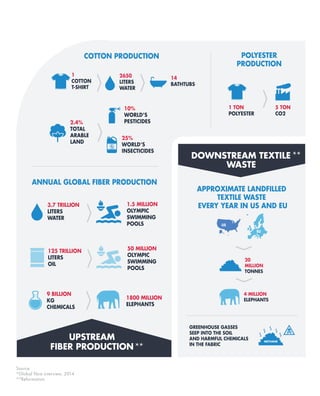
UPSTREAM
FIBER PRODUCTION
DOWNSTREAM TEXTILE
WASTE
2650
LITERS
WATER
COTTON PRODUCTION
1
COTTON
T-SHIRT
14
BATHTUBS
10%
WORLD’S
PESTICIDES
25%
WORLD’S
INSECTICIDES
2.4%
TOTAL
ARABLE
LAND
POLYESTER
PRODUCTION
1 TON
POLYESTER
5 TON
CO2
20
MILLION
TONNES
EU
4 MILLION
ELEPHANTS
APPROXIMATE LANDFILLED
TEXTILE WASTE
EVERY YEAR IN US AND EU
US
METHANE
GREENHOUSE GASSES
SEEP INTO THE SOIL
AND HARMFUL CHEMICALS
IN THE FABRIC
3.7 TRILLION
LITERS
WATER
1.5 MILLION
OLYMPIC
SWIMMING
POOLS
125 TRILLION
LITERS
OIL
50 MILLION
OLYMPIC
SWIMMING
POOLS
9 BILLION
KG
CHEMICALS
ANNUAL GLOBAL FIBER PRODUCTION
1800 MILLION
ELEPHANTS
Source
*Global fibre overview, 2014
**Reformation
**
**
OUR MISSION
CLOSING THE LOOP FOR TEXTILES
TO ENABLE RESOURCE SECURITY,
LONG TERM PRICE STABILITY AND
A THRIVING ENVIRONMENT
The Circular Textiles Program (CTP) is a sector specific initiative within Circle Economy.
Since its launch in 2014, the focus of the program has been to accelerate the
system innovation (e.g. circular business modelling, regulatory incentives, design
and marketing strategies, consumer engagement, market development) needed to
allow technological innovation in textile material recovery reach its full impact.
Our mission is to ‘close the loop’ for post-consumer textiles and create a system
whereby products, fabrics and fibres are infinitely and effectively cycled through
connected loops within and across industries in a transparent and economical way.
We envision a textiles industry where producers apply business practises that
enable circular use of textile resources and promote social justice, and consumers have
a healthy relationship with textiles, based on sustainable consumer practises.
Ultimately, a circular textile industry will enable continued fibre consumption without
the depletion or destruction of resources and ecosystems, on which we are dependent.
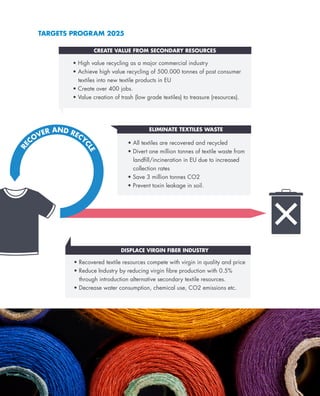
TARGETS PROGRAM 2025
RE
COVER AND RECY
CLE
DISPLACE VIRGIN FIBER INDUSTRY
ELIMINATE TEXTILES WASTE
• All textiles are recovered and recycled
• Divert one million tonnes of textile waste from
landfill/incineration in EU due to increased
collection rates
• Save 3 million tonnes CO2
• Prevent toxin leakage in soil.
CREATE VALUE FROM SECONDARY RESOURCES
• High value recycling as a major commercial industry
• Achieve high value recycling of 500.000 tonnes of post consumer
textiles into new textile products in EU
• Create over 400 jobs.
• Value creation of trash (low grade textiles) to treasure (resources).
• Recovered textile resources compete with virgin in quality and price
• Reduce Industry by reducing virgin fibre production with 0.5%
through introduction alternative secondary textile resources.
• Decrease water consumption, chemical use, CO2 emissions etc.
OUR APPROACH
ACHIEVING IMPACT THROUGH
BUILDING A NEW CIRCULAR
ECOSYSTEM
Through our Circular Textiles Program, Circle Economy is engaging in strategic
partnerships with Industry stakeholders to create the best practices that will
shape the textile industry of tomorrow. We work with companies that want to be
at the forefront of change, and pioneer in the Circular Textiles Movement.
Together with our members and partners, Circle Economy takes a leading role in
initiating, managing and implementing iconic pilot projects, that move
us closer to the end-goal of circularity.
We have identified three key stakeholder groups that are essential actors in
achieving circularity in the textile industry. Together, these three stakeholder groups
represent the global and local perspective and will shape the new circular
ecosystem that is needed to establish and upscale new closed loop processes.
TEXTILE
SORTING
PROJECT
CIRCULATOR
HIGH
VALUE
RECYCLING
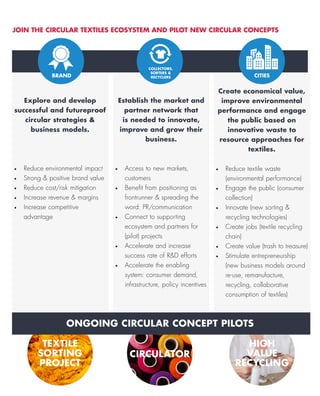
ONGOING CIRCULAR CONCEPT PILOTS
Explore and develop
successful and futureproof
circular strategies &
business models.
•	 Reduce environmental impact
•	 Strong & positive brand value
•	 Reduce cost/risk mitigation
•	 Increase revenue & margins
•	 Increase competitive
advantage
COLLECTORS,
SORTERS &
RECYCLERS CITIESBRAND
Establish the market and
partner network that
is needed to innovate,
improve and grow their
business.
•	 Access to new markets,
customers
•	 Benefit from positioning as
frontrunner & spreading the
word: PR/communication
•	 Connect to supporting
ecosystem and partners for
(pilot) projects
•	 Accelerate and increase
success rate of R&D efforts
•	 Accelerate the enabling
system: consumer demand,
infrastructure, policy incentives
Create economical value,
improve environmental
performance and engage
the public based on
innovative waste to
resource approaches for
textiles.
•	 Reduce textile waste
(environmental performance)
•	 Engage the public (consumer
collection)
•	 Innovate (new sorting &
recycling technologies)
•	 Create jobs (textile recycling
chain)
•	 Create value (trash to treasure)
•	 Stimulate entrepreneurship
(new business models around
re-use, remanufacture,
recycling, collaborative
consumption of textiles)
JOIN THE CIRCULAR TEXTILES ECOSYSTEM AND PILOT NEW CIRCULAR CONCEPTS
WE OFFER
Tools, materials and workshops to help you:
Learn from Industry best practises
Map concrete opportunities
Formulate circular design strategies
Set clear goals, make decisions and create actionable plans
Insights into latest industry innovations and technological developments
relevant for you.
Access to our global network and events that will allow you to:
Spar with like minded pioneers from a variety of industries
Benefit from mass adoption campaigns to create a circular movement
Create new successful linkages and partnerships
TEXTILE THURSDAY
“NEW INPUT,
NEW IDEAS,
ENTHUSIASTIC
PEOPLE WORKING
ON CLOSING THE
LOOP ON TEXTILES..
ENGAGING AND
INSPIRING”
OUR MEMBERS
“Recover joined the Circular Textiles Program because of a shared value and
mission. The team’s process and approach toward our strategic projects has been
extremely focused and organized throughout. Their expertise lies in centralizing,
organizing and connecting the right players from the industry for the facilitation
of the development of Closed Loop systems and a Circular Economy.”
Recover Textiles,
Strategic Partner High Value Recycling Project
“The fantastic project management has kept the momentum of the project going
and helped keep all partners on the same page and working effectively together.
It has made working on the project a really enjoyable experience. Furthermore, the
team’s comprehensive understanding of the challenges behind shifting from
a linear to circular model of resource use is imperative when realising practical
solutions.
The team are proactive, motivated and great project leaders giving the project the
best opportunity to succeed. CE aren’t just another talking shop,
they focus on identifying and developing projects that specifically work to enable
this shift.”
Worn Again,
Strategic Partner in The Textile Sorting Project
INTERESTED IN JOINING OUR MISSION AND BECOMING A MEMBER OF
THE CIRCULAR TEXTILE PROGRAM?
Circle Economy is looking for all brands, retailers, collectors, sorters, recyclers and
cities who want to be at the forefront of change, and part of the Circular Textiles
Movement.
Through a membership of the Circular Textiles Program you can engage in strategic
partnerships with industry stakeholders to create the best practices that will shape
the textile industry of tomorrow. Circle Economy’s strategic partners benefit from a
broad network of organisations working towards shared objectives, circular business
opportunities and alliances to jointly accelerate the transition towards a circular
economy.
CONTACT US
Please contact Circle Economy’s membership manager Vera Moll to learn more about
how your organisation can benefit from joining the Circular Textiles Program.
Membership manager
Vera Moll vera@circleeconomy.com
Lead Circular Textiles Program
Hélène Smits helene@circle-economy.com
Project Developer Circular Textiles Program
Gwen Cunningham gwen@circle-economy.com
Circle Economy
Nieuwe Herengracht 95
1011RX Amsterdam
The Netherlands
+31 88 4040440
Circular Textiles Program

Circular Textiles Program

  • 1.
    CIRCULAR TEXTILES PROGRAM ADDRESSING A GLOBALPROBLEM FASHION IS THE SECOND MOST POLLUTING INDUSTRY IN THE WORLD Upstream, the production of textile fibres is land, energy and water intensive and reliant on finite resources. In the coming six years, global fibre demand is estimated to rise from 65 to 90 million tonnes*. This level of production is economically unstable and ecologically unsustainable. Downstream the impact of the booming textiles industry and a fast-fashion model of production and consumption can be seen in the growing volume of low-quality, post-consumer textile waste, for which there are now limited end-of-life solutions. With a growing population demanding even more resources like food, clothing and energy and an increasingly unstable climate driving downward pressure on productivity, it is apparent that the industry needs to find a new way of working.
  • 2.
    UPSTREAM FIBER PRODUCTION DOWNSTREAM TEXTILE WASTE 2650 LITERS WATER COTTONPRODUCTION 1 COTTON T-SHIRT 14 BATHTUBS 10% WORLD’S PESTICIDES 25% WORLD’S INSECTICIDES 2.4% TOTAL ARABLE LAND POLYESTER PRODUCTION 1 TON POLYESTER 5 TON CO2 20 MILLION TONNES EU 4 MILLION ELEPHANTS APPROXIMATE LANDFILLED TEXTILE WASTE EVERY YEAR IN US AND EU US METHANE GREENHOUSE GASSES SEEP INTO THE SOIL AND HARMFUL CHEMICALS IN THE FABRIC 3.7 TRILLION LITERS WATER 1.5 MILLION OLYMPIC SWIMMING POOLS 125 TRILLION LITERS OIL 50 MILLION OLYMPIC SWIMMING POOLS 9 BILLION KG CHEMICALS ANNUAL GLOBAL FIBER PRODUCTION 1800 MILLION ELEPHANTS Source *Global fibre overview, 2014 **Reformation ** **
  • 3.
    OUR MISSION CLOSING THELOOP FOR TEXTILES TO ENABLE RESOURCE SECURITY, LONG TERM PRICE STABILITY AND A THRIVING ENVIRONMENT The Circular Textiles Program (CTP) is a sector specific initiative within Circle Economy. Since its launch in 2014, the focus of the program has been to accelerate the system innovation (e.g. circular business modelling, regulatory incentives, design and marketing strategies, consumer engagement, market development) needed to allow technological innovation in textile material recovery reach its full impact. Our mission is to ‘close the loop’ for post-consumer textiles and create a system whereby products, fabrics and fibres are infinitely and effectively cycled through connected loops within and across industries in a transparent and economical way. We envision a textiles industry where producers apply business practises that enable circular use of textile resources and promote social justice, and consumers have a healthy relationship with textiles, based on sustainable consumer practises. Ultimately, a circular textile industry will enable continued fibre consumption without the depletion or destruction of resources and ecosystems, on which we are dependent.
  • 4.
    TARGETS PROGRAM 2025 RE COVERAND RECY CLE DISPLACE VIRGIN FIBER INDUSTRY ELIMINATE TEXTILES WASTE • All textiles are recovered and recycled • Divert one million tonnes of textile waste from landfill/incineration in EU due to increased collection rates • Save 3 million tonnes CO2 • Prevent toxin leakage in soil. CREATE VALUE FROM SECONDARY RESOURCES • High value recycling as a major commercial industry • Achieve high value recycling of 500.000 tonnes of post consumer textiles into new textile products in EU • Create over 400 jobs. • Value creation of trash (low grade textiles) to treasure (resources). • Recovered textile resources compete with virgin in quality and price • Reduce Industry by reducing virgin fibre production with 0.5% through introduction alternative secondary textile resources. • Decrease water consumption, chemical use, CO2 emissions etc.
  • 5.
    OUR APPROACH ACHIEVING IMPACTTHROUGH BUILDING A NEW CIRCULAR ECOSYSTEM Through our Circular Textiles Program, Circle Economy is engaging in strategic partnerships with Industry stakeholders to create the best practices that will shape the textile industry of tomorrow. We work with companies that want to be at the forefront of change, and pioneer in the Circular Textiles Movement. Together with our members and partners, Circle Economy takes a leading role in initiating, managing and implementing iconic pilot projects, that move us closer to the end-goal of circularity. We have identified three key stakeholder groups that are essential actors in achieving circularity in the textile industry. Together, these three stakeholder groups represent the global and local perspective and will shape the new circular ecosystem that is needed to establish and upscale new closed loop processes.
  • 6.
    TEXTILE SORTING PROJECT CIRCULATOR HIGH VALUE RECYCLING ONGOING CIRCULAR CONCEPTPILOTS Explore and develop successful and futureproof circular strategies & business models. • Reduce environmental impact • Strong & positive brand value • Reduce cost/risk mitigation • Increase revenue & margins • Increase competitive advantage COLLECTORS, SORTERS & RECYCLERS CITIESBRAND Establish the market and partner network that is needed to innovate, improve and grow their business. • Access to new markets, customers • Benefit from positioning as frontrunner & spreading the word: PR/communication • Connect to supporting ecosystem and partners for (pilot) projects • Accelerate and increase success rate of R&D efforts • Accelerate the enabling system: consumer demand, infrastructure, policy incentives Create economical value, improve environmental performance and engage the public based on innovative waste to resource approaches for textiles. • Reduce textile waste (environmental performance) • Engage the public (consumer collection) • Innovate (new sorting & recycling technologies) • Create jobs (textile recycling chain) • Create value (trash to treasure) • Stimulate entrepreneurship (new business models around re-use, remanufacture, recycling, collaborative consumption of textiles) JOIN THE CIRCULAR TEXTILES ECOSYSTEM AND PILOT NEW CIRCULAR CONCEPTS
  • 7.
    WE OFFER Tools, materialsand workshops to help you: Learn from Industry best practises Map concrete opportunities Formulate circular design strategies Set clear goals, make decisions and create actionable plans Insights into latest industry innovations and technological developments relevant for you. Access to our global network and events that will allow you to: Spar with like minded pioneers from a variety of industries Benefit from mass adoption campaigns to create a circular movement Create new successful linkages and partnerships
  • 8.
    TEXTILE THURSDAY “NEW INPUT, NEWIDEAS, ENTHUSIASTIC PEOPLE WORKING ON CLOSING THE LOOP ON TEXTILES.. ENGAGING AND INSPIRING”
  • 9.
    OUR MEMBERS “Recover joinedthe Circular Textiles Program because of a shared value and mission. The team’s process and approach toward our strategic projects has been extremely focused and organized throughout. Their expertise lies in centralizing, organizing and connecting the right players from the industry for the facilitation of the development of Closed Loop systems and a Circular Economy.” Recover Textiles, Strategic Partner High Value Recycling Project
  • 10.
    “The fantastic projectmanagement has kept the momentum of the project going and helped keep all partners on the same page and working effectively together. It has made working on the project a really enjoyable experience. Furthermore, the team’s comprehensive understanding of the challenges behind shifting from a linear to circular model of resource use is imperative when realising practical solutions. The team are proactive, motivated and great project leaders giving the project the best opportunity to succeed. CE aren’t just another talking shop, they focus on identifying and developing projects that specifically work to enable this shift.” Worn Again, Strategic Partner in The Textile Sorting Project
  • 11.
    INTERESTED IN JOININGOUR MISSION AND BECOMING A MEMBER OF THE CIRCULAR TEXTILE PROGRAM? Circle Economy is looking for all brands, retailers, collectors, sorters, recyclers and cities who want to be at the forefront of change, and part of the Circular Textiles Movement. Through a membership of the Circular Textiles Program you can engage in strategic partnerships with industry stakeholders to create the best practices that will shape the textile industry of tomorrow. Circle Economy’s strategic partners benefit from a broad network of organisations working towards shared objectives, circular business opportunities and alliances to jointly accelerate the transition towards a circular economy. CONTACT US Please contact Circle Economy’s membership manager Vera Moll to learn more about how your organisation can benefit from joining the Circular Textiles Program. Membership manager Vera Moll vera@circleeconomy.com Lead Circular Textiles Program Hélène Smits helene@circle-economy.com Project Developer Circular Textiles Program Gwen Cunningham gwen@circle-economy.com Circle Economy Nieuwe Herengracht 95 1011RX Amsterdam The Netherlands +31 88 4040440