

CHRIST THE REDEEMERPrepared by:
Nikka Kaj – Ryle Tutor
History
• Mid 1850’s: Pedro Maria Boss laid eyes upon the
Corcovado Mountain in Rio de Janeiro
he imagined a monument to his faith placed
upon it for all to see
• 1889: Overthrow of the Brazilian
monarchy
 separation of church and state was
proclaimed
• 1921: New proposal emerged for the
construction of a religious monument atop
Corcovado
Archdiocese of Rio de Janeiro itself gave
voice to the new scheme
• Artist Carlos Oswaldo was commissioned to
design the statue
• A concept drawn up by Brazilian civil engineer
Heitor da Silva Costa was chosen
• 1926: Work on the Christ the Redeemer statue
began
French sculptor Paul Landowski (of Polish ancestry)
was placed in charge of construction
• Christ the Redeemer was built using reinforced
concrete, with the outer layers clad in soapstone
• 12 October 1931: the statue of Christ the Redeemer
in Rio de Janeiro was completed, opening
ceremony took place
• 2007: the statue of Christ the Redeemer was
selected as one of the New Seven Wonders of the
World.
Facts
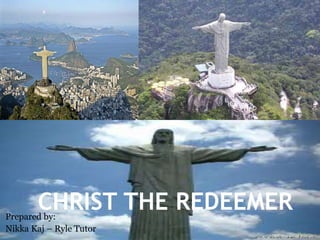
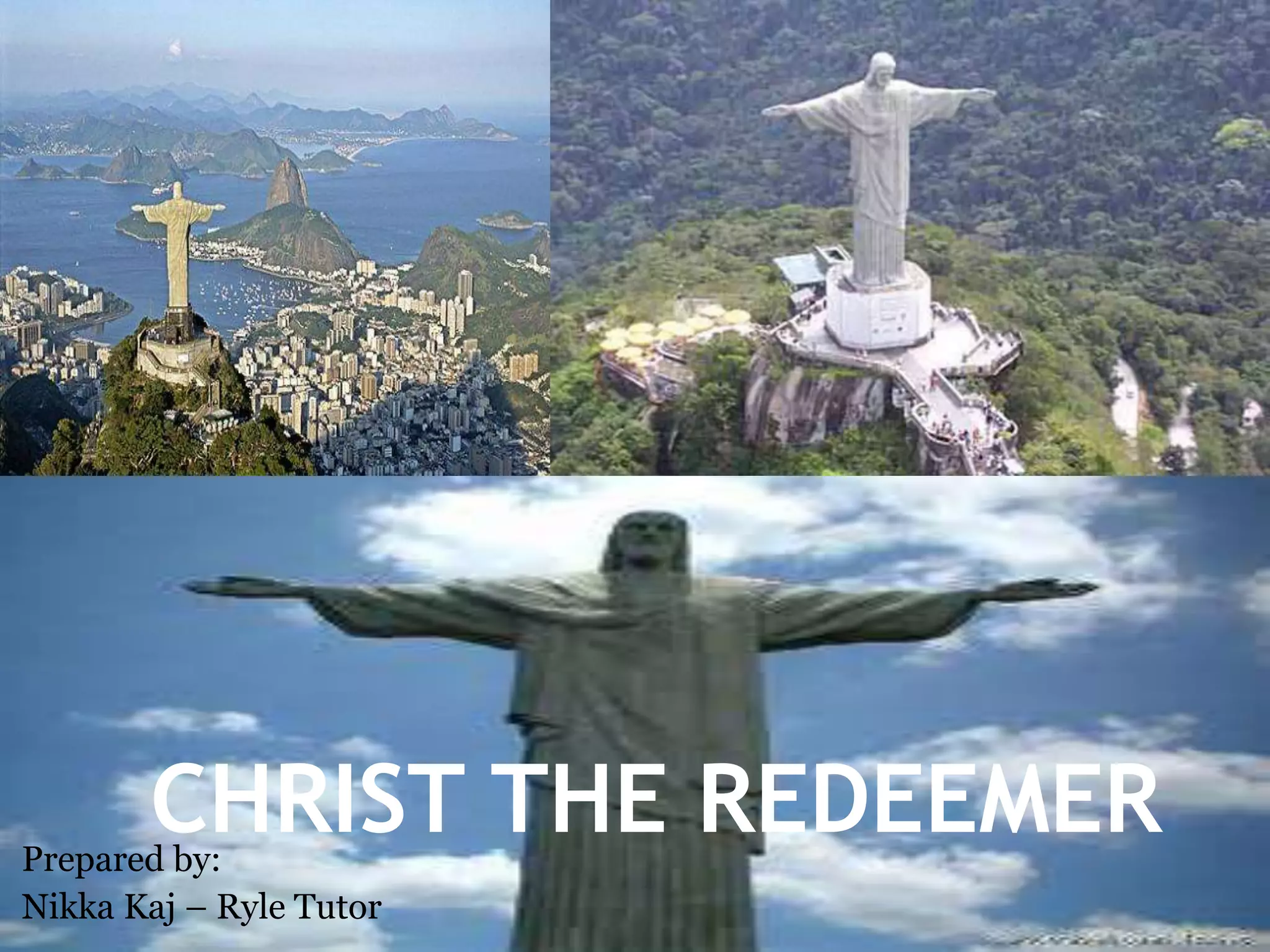
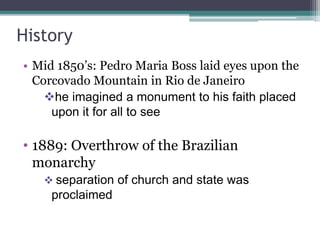
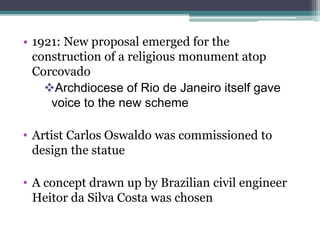
• Christ the Redeemer is the largest art deco
statue in the world. It is 98 feet tall (not
including the 26 foot pedestal), and the arms
stretch to 92 feet wide.
• The statue weighs approximately 635 tons.
• Christ the Redeemer is located in the Tijuca
Forest National Forest, at the top of the
Corcovado Mountain.
• The statue is considered an icon of Rio de
Janeiro and Brazil.
• The cost in 1931 was approximately $250,000
US. Today that would roughly be the equivalent
of $3.2 million US.
• The statue had to be constructed in pieces and
carried to the mountain top to be erected.
• The right arm points to south Rio de Janeiro and
the left arm points to north Rio de Janeiro.
• In 2008 a violent electrical storm resulted in a
lightning strike to the statue. The head,
eyebrows and fingers were damaged. The
soapstone exterior of the statue prevented severe
damage as it acted as an insulator. The Rio de
Janeiro state government began a restoration
effort. They replaced some layers of soapstone
and repaired the lightning rods on the statue.
• In 2003 there were escalators, elevators and
walkways installed. These made it possible to
access the platform that surrounds Christ the
Redeemer.
References
• Boris Fauste, A Concise History of Brazil, 1999
• www.suite.ico
• www.softschools.com
• www.googleimages.com
• adventure.howstuffworks.com

Christ the Redeemer

  • 1.
    CHRIST THE REDEEMERPreparedby: Nikka Kaj – Ryle Tutor
  • 2.
    History • Mid 1850’s:Pedro Maria Boss laid eyes upon the Corcovado Mountain in Rio de Janeiro he imagined a monument to his faith placed upon it for all to see • 1889: Overthrow of the Brazilian monarchy  separation of church and state was proclaimed
  • 3.
    • 1921: Newproposal emerged for the construction of a religious monument atop Corcovado Archdiocese of Rio de Janeiro itself gave voice to the new scheme • Artist Carlos Oswaldo was commissioned to design the statue • A concept drawn up by Brazilian civil engineer Heitor da Silva Costa was chosen
  • 4.
    • 1926: Workon the Christ the Redeemer statue began French sculptor Paul Landowski (of Polish ancestry) was placed in charge of construction • Christ the Redeemer was built using reinforced concrete, with the outer layers clad in soapstone • 12 October 1931: the statue of Christ the Redeemer in Rio de Janeiro was completed, opening ceremony took place • 2007: the statue of Christ the Redeemer was selected as one of the New Seven Wonders of the World.
  • 6.
    Facts • Christ theRedeemer is the largest art deco statue in the world. It is 98 feet tall (not including the 26 foot pedestal), and the arms stretch to 92 feet wide. • The statue weighs approximately 635 tons. • Christ the Redeemer is located in the Tijuca Forest National Forest, at the top of the Corcovado Mountain.
  • 7.
    • The statueis considered an icon of Rio de Janeiro and Brazil. • The cost in 1931 was approximately $250,000 US. Today that would roughly be the equivalent of $3.2 million US. • The statue had to be constructed in pieces and carried to the mountain top to be erected. • The right arm points to south Rio de Janeiro and the left arm points to north Rio de Janeiro.
  • 8.
    • In 2008a violent electrical storm resulted in a lightning strike to the statue. The head, eyebrows and fingers were damaged. The soapstone exterior of the statue prevented severe damage as it acted as an insulator. The Rio de Janeiro state government began a restoration effort. They replaced some layers of soapstone and repaired the lightning rods on the statue. • In 2003 there were escalators, elevators and walkways installed. These made it possible to access the platform that surrounds Christ the Redeemer.
  • 9.
    References • Boris Fauste,A Concise History of Brazil, 1999 • www.suite.ico • www.softschools.com • www.googleimages.com • adventure.howstuffworks.com