Migrating for Work Research 
Consortium (MiWORC) 
Project funded by the European Union EU-South Africa Dialogue Facility EuropeAid/132200/L/ACT/ZA. Coordinated by the African Centre for Migration & Society, University of the Witwatersrand 
Beyond Free Trade: 
Prospects for freeing human 
mobility in Southern Africa 
Chris C. Nshimbi 
Centre for the Study of Governance Innovation (GovInn) 
Department of Political Sciences 
University of Pretoria 
SIHMA 
THE CATHOLIC 
PARLIAMENTARY LIAISON 
OFFICE 
3 September 2014 
Department of Political Sciences, University of Pretoria, PRETORIA 0002, South Africa 
& 
T: +27 12 420 4486 F: +27 12 420 3886 | www.miworc.org.za/ www.governanceinnovation.org
Outline 
Beyond FT: prospects for freeing human 
 Introduction 
 Study objectives 
 Research questions 
 Methods 
mobility in southern Africa 
 Findings and discussion 
 Conclusions and policy recommendations
Beyond FT: Introduction 
 Globally, 214 million international migrants (2010) up from 155 million 
(1990) 
 Within Africa: 29.2 million migrants in 2010 were Africans; major 
destination was Africa itself 
 In Southern Africa international migration triggered by: liberalisation, 
SAPs, quest for better economic life, historical and ethnic ties 
 Liberalisation plus SADC Trade Protocol (informing 2001 tariff 
reduction schedule + the 2003 SADC RISDP) facilitated establishment 
of FTA in 2008 
 However, as one of four drivers of integration (including capital, 
labor, goods and services), human mobility is not free in southern 
Africa. What accounts for this? How can free movement of persons 
be realised in the region?
Beyond FT: Study objectives 
 Investigate existing regional and/or bilateral 
legislations and policy frameworks pertaining to 
migration in southern Africa, and particularly labour 
migration originating from Namibia, Botswana, 
Lesotho, Swaziland, Zimbabwe, Mozambique, and 
Malawi towards South Africa. 
 Analyse South Africa’s policy responses to inflows of 
migrants from the 7 cited countries
Beyond FT: Research questions 
 What are the most important features of labour migration 
frameworks at the global level? 
 What are the most relevant governance frameworks at the 
regional level and what provisions do they include? 
 What are the prevalent forms of labour migration governance in 
southern Africa and how do they compare to global standards 
and regional experiences? 
 What is the degree of ‘regionalization’ permeating national 
labour migration legislation in the SADC region? 
 How do specific bilateral agreements between South Africa and 
neighbouring countries impact labour migration in Southern 
Africa? 
 What is the degree of consistency between international 
instruments (e.g. ILO) and existing legislation and policy agendas 
dealing with labour migration in the SADC region?
Beyond FT: Methods 
 Primary data: relevant global and regional legislations; 
interviews and focus groups; correspondence with key policy 
makers. 
 Respondents chosen on the basis of policy portfolio and position 
within the relevant ministries. 
 Secondary data: policy reports and scientific publications. 
 Countries: selected based on geographical proximity and 
relevance to the SA labour market; have also traditionally 
supplied migrant labour to SA. 
 All, except Malawi, share borders with South Africa.
Global governance of migration: 
 How to more successfully govern migration? 
 International migration impacts PE of sending and 
receiving countries. 
 facilitates supply of human resources, etc. 
 lowers labour standards, strains social safety nets, leads to 
brain drain, etc. 
 No specific global agency for international migration. 
Governance is rather spread out at 3 levels 
 Formal multilateralism; 
 International principles, rules and norms 
 Informal networks, e.g. GFMD 
※Declarations and Treaties 
overview
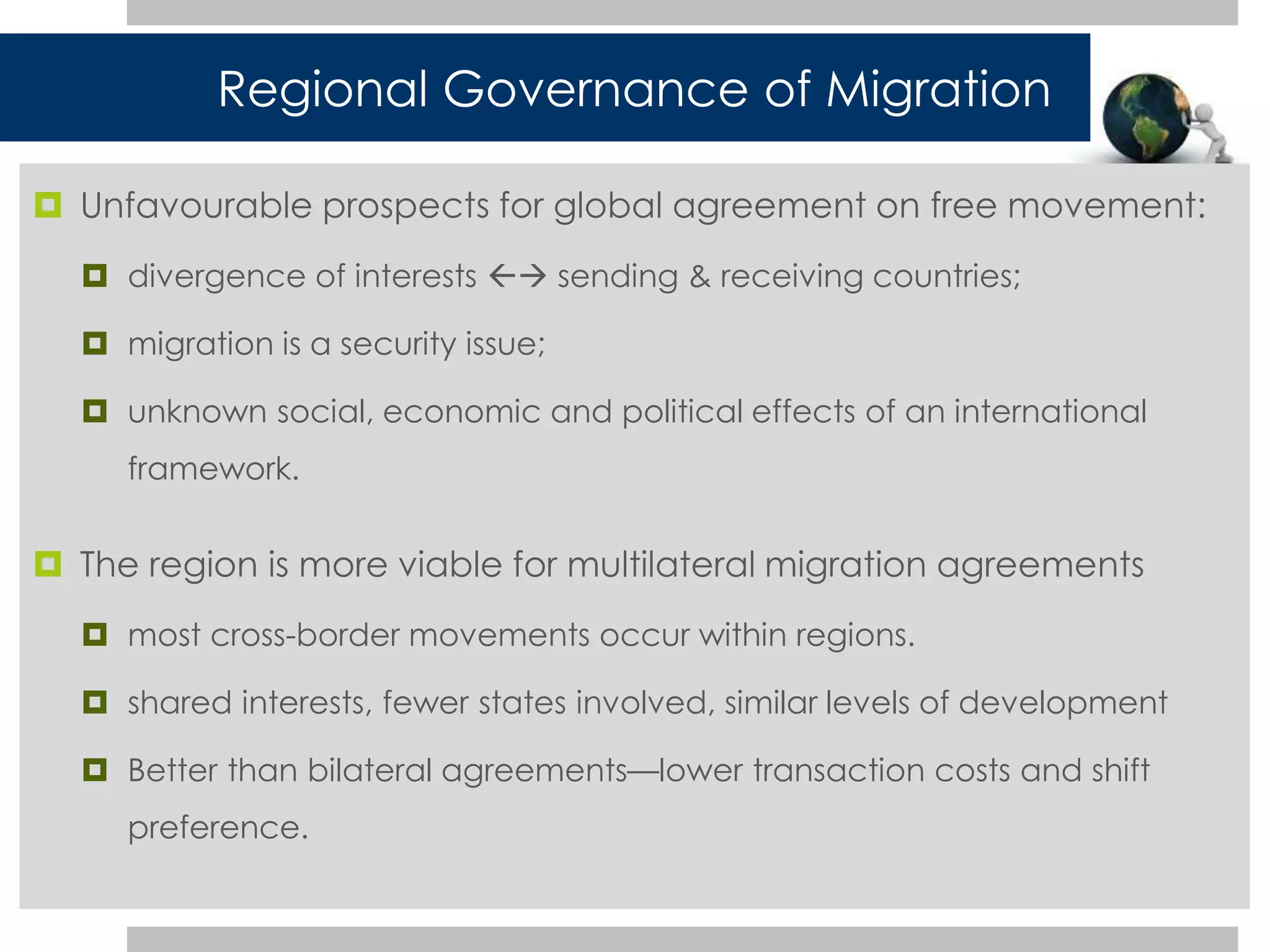
Regional Governance of Migration 
 Unfavourable prospects for global agreement on free movement: 
 divergence of interests  sending & receiving countries; 
 migration is a security issue; 
 unknown social, economic and political effects of an international 
framework. 
 The region is more viable for multilateral migration agreements 
 most cross-border movements occur within regions. 
 shared interests, fewer states involved, similar levels of development 
 Better than bilateral agreements—lower transaction costs and shift 
preference.
Regional Migration Governance 
in Africa 
 Two key policy frameworks define the AU’s approach to 
migration in Africa: 
 Migration Policy Framework for Africa 
 African Common Position on Migration and Development 
 Abuja Treaty envisages an African Economic Community built 
on 8 key African RECs 
 Have African RECs progressed towards achieving free 
movement of persons and Africa’s integration?
Regional labour mobility regimes: 
implications for regional integration and 
migration management in Africa 
 Level of economic development of a region and the degree of 
similarity of economic development of neighbouring countries 
shape the ease with which cross border labour mobility can be 
handled. 
 Some policies within a region clearly aim at complete free 
movement for citizens and others aim at managed migration of 
specific categories of workers. 
 Many regional labour market regimes focus on skilled migration 
and link this to the recognition of qualification.
Regional labour mobility regimes: 
implications for regional integration and 
migration management in Africa 
 The EU is exceptional in how it has evolved its regional migration 
governance policies and system from free movement of labour 
to EU citizenship and associated benefits and rights to work and 
establishment. 
 ASEAN is yet to officially implement its more restrictive managed 
migration regime 
 Mercosur states have indigenised their region’s ‘reactive’ labour 
migration legislation into national policies. 
 ECOWAS emerges as a best practice for SADC: categorical 
legislation, evident commitment to free movement of labour
Regional Migration Governance 
 Long history of migration: organised labour migration 
system by 1860s 
 1995 Draft Protocol on Free Movement of Persons – 
shot down 
 2005 Draft Protocol on Facilitation of Movement – 
more acceptable, adopted, signed, not in force 
 No formal regional labour migration framework 
 Other regional protocols, e.g., Protocol on Education 
 National laws regulate labour migration 
 Bilateral agreements between member states govern 
labour migration 
in Southern Africa
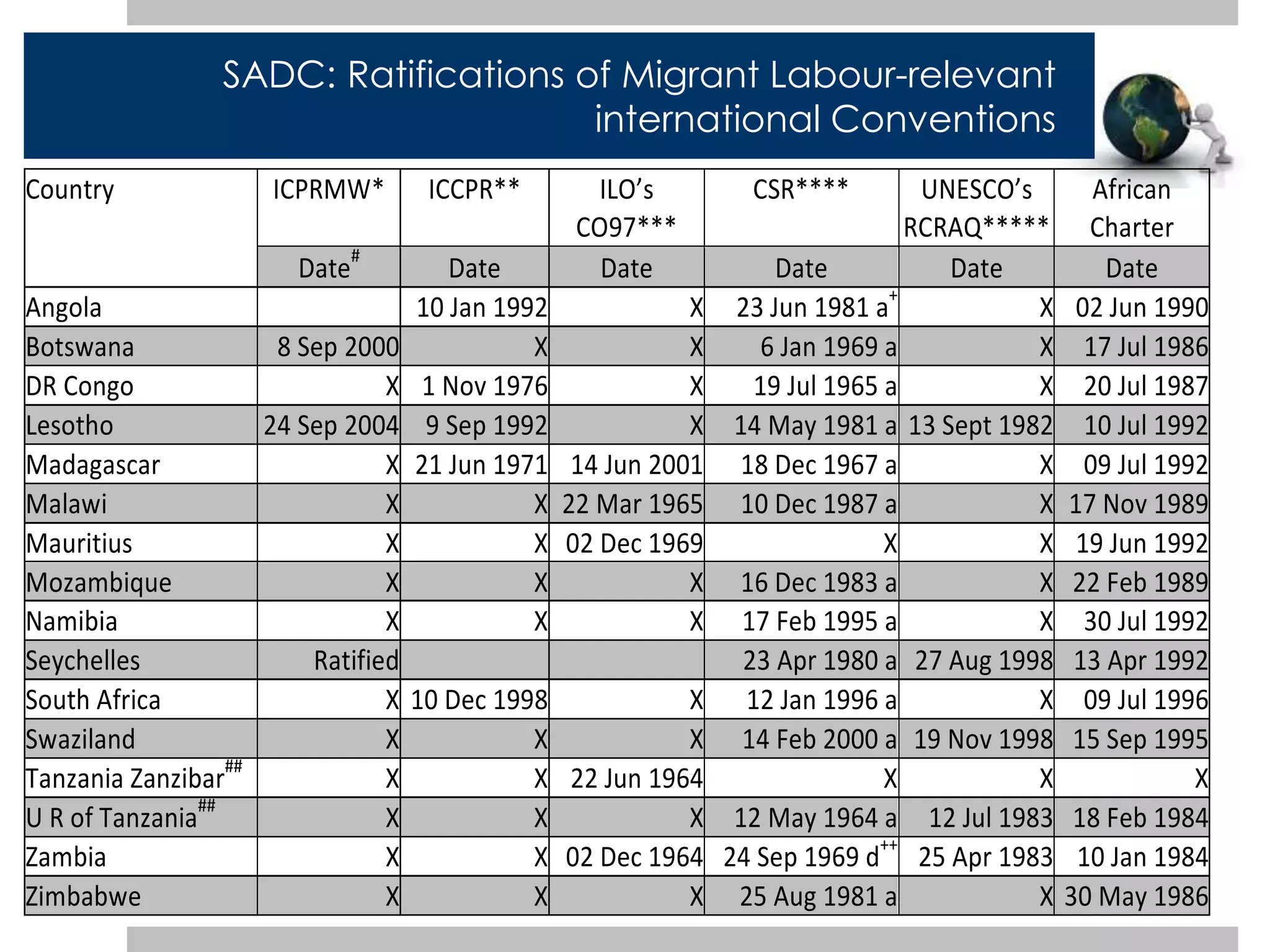
SADC: Ratifications of Migrant Labour-relevant 
international Conventions 
Country	 ICPRMW*	 ICCPR**	 ILO’s	 
CO97***	 
CSR****	 UNESCO’s	 
RCRAQ*****	 
African	 
Charter	 
Date#	 Date	 Date	 Date	 Date	 Date	 
Angola	 	10	Jan	1992	 X	 23	Jun	1981	a+	 X	 02	Jun	1990	 
Botswana	 8	Sep	2000	 X		 X	 6	Jan	1969	a	 X	 17	Jul	1986	 
DR	Congo	 X	 1	Nov	1976	 X	 19	Jul	1965	a	 X		 20	Jul	1987	 
Lesotho		 24	Sep	2004	 9	Sep	1992	 X	 14	May	1981	a	13	Sept	1982	 10	Jul	1992	 
Madagascar	 X	21	Jun	1971	 14	Jun	2001	 18	Dec	1967	a	 X		 09	Jul	1992	 
Malawi	 X	 X		22	Mar	1965	 10	Dec	1987	a	 X		17	Nov	1989	 
Mauritius	 X	 X		02	Dec	1969	 X	 X		19	Jun	1992	 
Mozambique		 X	 X		 X	 16	Dec	1983	a	 X		22	Feb	1989	 
Namibia	 X	 X		 X	 17	Feb	1995	a	 X		 30	Jul	1992	 
Seychelles		 Ratified	 	 	 23	Apr	1980	a	27	Aug	1998	 13	Apr	1992	 
South	Africa	 X	10	Dec	1998	 X	 12	Jan	1996	a	 X		 09	Jul	1996	 
Swaziland		 X	 X		 X	 14	Feb	2000	a	19	Nov	1998	 15	Sep	1995	 
Tanzania	Zanzibar##	 X	 X		22	Jun	1964	 X	 X		 X	 
U	R	of	Tanzania##	 X	 X	 X	 12	May	1964	a	 12	Jul	1983	 18	Feb	1984	 
Zambia	 X	 X		02	Dec	1964	 24	Sep	1969	d++	 25	Apr	1983	 10	Jan	1984	 
Zimbabwe		 X	 X		 X	 25	Aug	1981	a	 X		30	May	1986
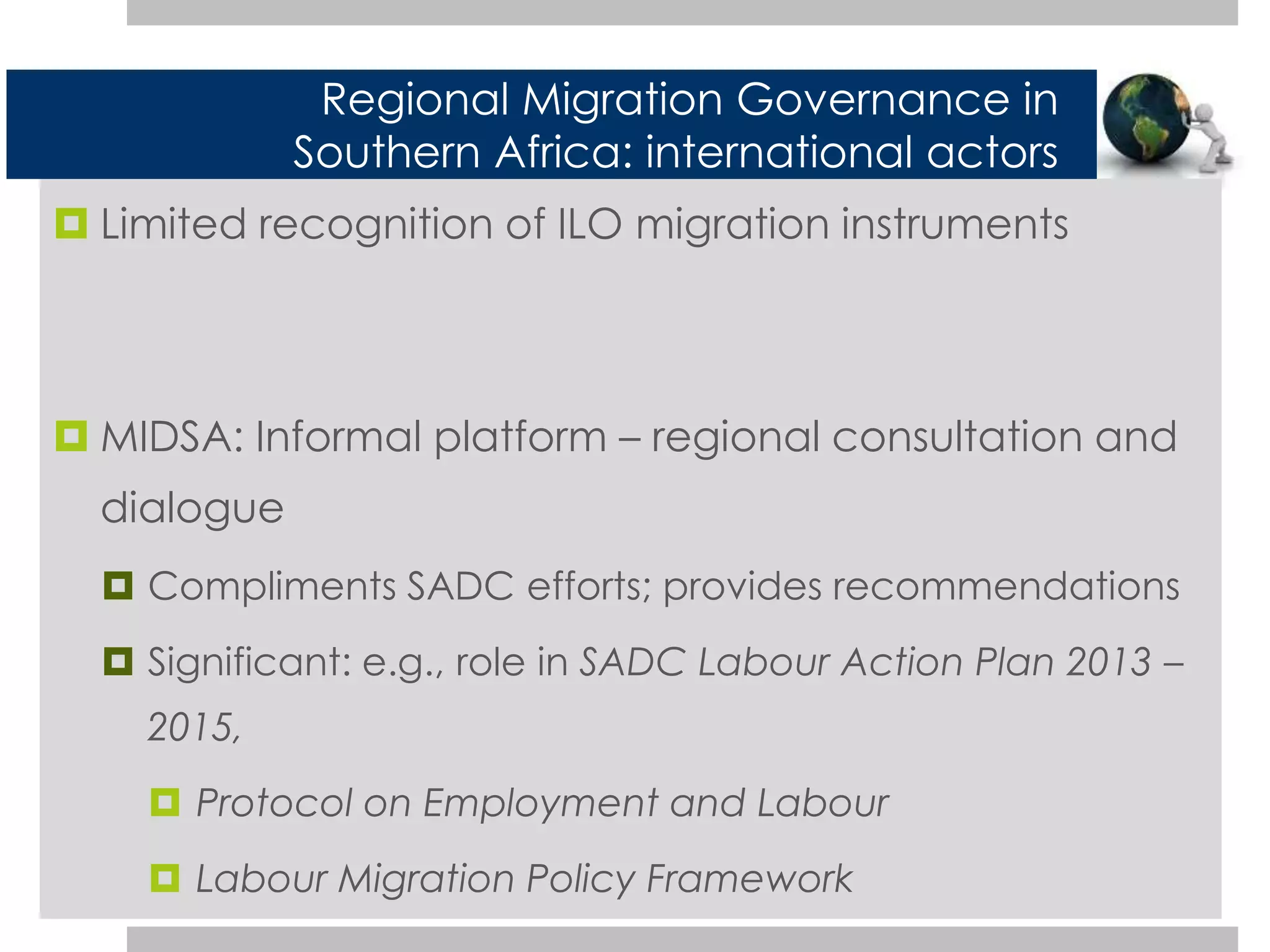
Regional Migration Governance in 
Southern Africa: international actors 
 Limited recognition of ILO migration instruments 
 MIDSA: Informal platform – regional consultation and 
dialogue 
 Compliments SADC efforts; provides recommendations 
 Significant: e.g., role in SADC Labour Action Plan 2013 – 
2015, 
 Protocol on Employment and Labour 
 Labour Migration Policy Framework
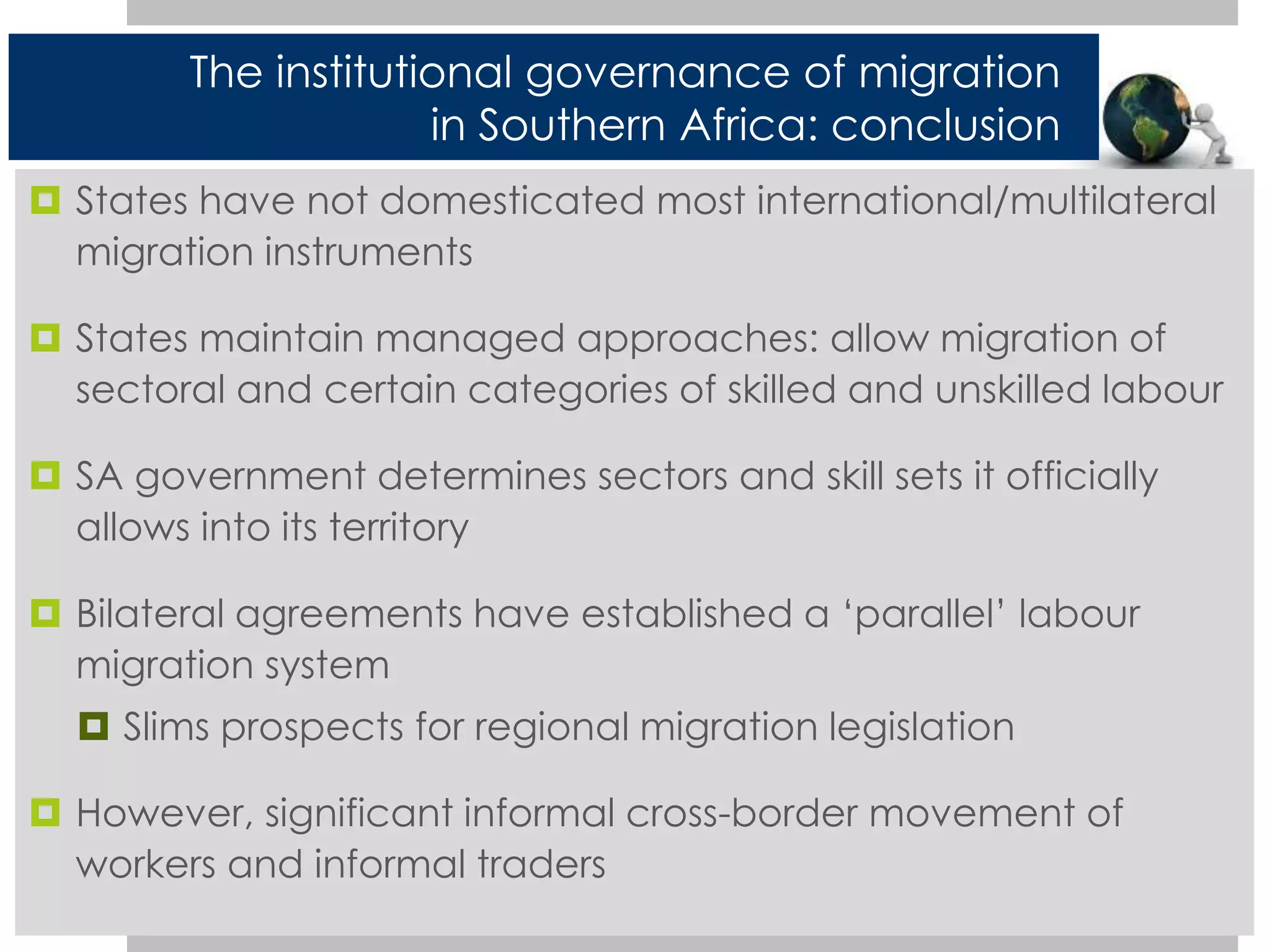
The institutional governance of migration 
in Southern Africa: conclusion 
 States have not domesticated most international/multilateral 
migration instruments 
 States maintain managed approaches: allow migration of 
sectoral and certain categories of skilled and unskilled labour 
 SA government determines sectors and skill sets it officially 
allows into its territory 
 Bilateral agreements have established a ‘parallel’ labour 
migration system 
 Slims prospects for regional migration legislation 
 However, significant informal cross-border movement of 
workers and informal traders
Beyond FT: Conclusions and policy 
recommendations
BACKGROUND 
Conclusions and policy 
recommendations 
 Labour migration is an historic component of regionalism in 
Southern Africa 
 Region has porous borders, with informal movement and 
random ‘repatriations’ 
 A regional economic and social integration outlook requires 
harmonisation and alignment of domestic policies and 
legislations to regional goals. 
 SADC states should formalise a regional mechanism to govern 
labour migration and establish regional standards for protection 
of migrant workers
Conclusions and policy 
recommendations 
 SACU states could formalise a SACU region labour migration system 
upon which they could harmonise migration and labour policies. 
 Labour MOUs between South Africa and each of other SACU states do 
not differ significantly in content. 
 A multi tiered regional cooperation framework might be a path to 
reconciling the conflicting interests and aspirations. The COMESA-EAC- 
SADC Tripartite FTA could provide only for the free movement 
of business persons (as currently stated) and, in the short term 
SACU might provide for the full free movement of workers within it 
 A staged process of free movement within the broader region 
(SADC?) could then be experimented, following the EU’s multi-tiered 
variable geometry, with country opt-outs
Conclusions and policy 
recommendations 
 Adopting and ratifying ILO C097, C143 and the ICPRMW would 
enhance SADC states’ attempts to establish a harmonised rights-based 
labour migration regime 
 South Africa should be encouraged to establish a SADC-based 
multi-lateral framework for the management of labour migration 
and social protection issues in line with the SADC Labour Action 
Plan. Further bi-lateral deals should be discouraged. 
 Otherwise SADC should revisit its integration goals and develop 
appropriate measures to achieve these goals. Consensual 
commitment is essential to achieving regional goals
Conclusions and policy 
recommendations 
 Policy making within South Africa on these issues needs to involve 
the DSD; Labour; Home Affairs; Health; Education; Police; Treasury 
 A clear focus on objective application of practical measures 
towards a Common Market helped the EU realise freedom of 
movement of persons and the other factors – capital, goods and 
services. 
 SADC states should harmonise and establish regionally uniform 
(length of stay) entry provisions for informal cross-border traders 
and other kinds of regional travellers (e.g., tourists).
Conclusions and policy 
recommendations 
 SADC States should investigate, with a view to implementing, the 
option of framing a regional agreement that would regularise 
undocumented migrants to grant them residence and work rights 
in host member states. 
 An operational and official multi-lateral migration governance 
mechanism would serve the SADC region better than ad hoc 
measures in times of crisis. SADC should decide on a timeframe for 
ratifying the Protocol on Facilitation of Movement and expediting 
enforcement, or whether to revise the protocol. 
 The multi-lateral framework suggested above should aspire to 
eventually embody the terms of the free movement protocol.
Thank you for listening

Chris Nshimbi - SIHMA Seminar 3: 3 September 2014

  • 1.
    Migrating for WorkResearch Consortium (MiWORC) Project funded by the European Union EU-South Africa Dialogue Facility EuropeAid/132200/L/ACT/ZA. Coordinated by the African Centre for Migration & Society, University of the Witwatersrand Beyond Free Trade: Prospects for freeing human mobility in Southern Africa Chris C. Nshimbi Centre for the Study of Governance Innovation (GovInn) Department of Political Sciences University of Pretoria SIHMA THE CATHOLIC PARLIAMENTARY LIAISON OFFICE 3 September 2014 Department of Political Sciences, University of Pretoria, PRETORIA 0002, South Africa & T: +27 12 420 4486 F: +27 12 420 3886 | www.miworc.org.za/ www.governanceinnovation.org
  • 2.
    Outline Beyond FT:prospects for freeing human  Introduction  Study objectives  Research questions  Methods mobility in southern Africa  Findings and discussion  Conclusions and policy recommendations
  • 3.
    Beyond FT: Introduction  Globally, 214 million international migrants (2010) up from 155 million (1990)  Within Africa: 29.2 million migrants in 2010 were Africans; major destination was Africa itself  In Southern Africa international migration triggered by: liberalisation, SAPs, quest for better economic life, historical and ethnic ties  Liberalisation plus SADC Trade Protocol (informing 2001 tariff reduction schedule + the 2003 SADC RISDP) facilitated establishment of FTA in 2008  However, as one of four drivers of integration (including capital, labor, goods and services), human mobility is not free in southern Africa. What accounts for this? How can free movement of persons be realised in the region?
  • 4.
    Beyond FT: Studyobjectives  Investigate existing regional and/or bilateral legislations and policy frameworks pertaining to migration in southern Africa, and particularly labour migration originating from Namibia, Botswana, Lesotho, Swaziland, Zimbabwe, Mozambique, and Malawi towards South Africa.  Analyse South Africa’s policy responses to inflows of migrants from the 7 cited countries
  • 5.
    Beyond FT: Researchquestions  What are the most important features of labour migration frameworks at the global level?  What are the most relevant governance frameworks at the regional level and what provisions do they include?  What are the prevalent forms of labour migration governance in southern Africa and how do they compare to global standards and regional experiences?  What is the degree of ‘regionalization’ permeating national labour migration legislation in the SADC region?  How do specific bilateral agreements between South Africa and neighbouring countries impact labour migration in Southern Africa?  What is the degree of consistency between international instruments (e.g. ILO) and existing legislation and policy agendas dealing with labour migration in the SADC region?
  • 6.
    Beyond FT: Methods  Primary data: relevant global and regional legislations; interviews and focus groups; correspondence with key policy makers.  Respondents chosen on the basis of policy portfolio and position within the relevant ministries.  Secondary data: policy reports and scientific publications.  Countries: selected based on geographical proximity and relevance to the SA labour market; have also traditionally supplied migrant labour to SA.  All, except Malawi, share borders with South Africa.
  • 7.
    Global governance ofmigration:  How to more successfully govern migration?  International migration impacts PE of sending and receiving countries.  facilitates supply of human resources, etc.  lowers labour standards, strains social safety nets, leads to brain drain, etc.  No specific global agency for international migration. Governance is rather spread out at 3 levels  Formal multilateralism;  International principles, rules and norms  Informal networks, e.g. GFMD ※Declarations and Treaties overview
  • 8.
    Regional Governance ofMigration  Unfavourable prospects for global agreement on free movement:  divergence of interests  sending & receiving countries;  migration is a security issue;  unknown social, economic and political effects of an international framework.  The region is more viable for multilateral migration agreements  most cross-border movements occur within regions.  shared interests, fewer states involved, similar levels of development  Better than bilateral agreements—lower transaction costs and shift preference.
  • 9.
    Regional Migration Governance in Africa  Two key policy frameworks define the AU’s approach to migration in Africa:  Migration Policy Framework for Africa  African Common Position on Migration and Development  Abuja Treaty envisages an African Economic Community built on 8 key African RECs  Have African RECs progressed towards achieving free movement of persons and Africa’s integration?
  • 10.
    Regional labour mobilityregimes: implications for regional integration and migration management in Africa  Level of economic development of a region and the degree of similarity of economic development of neighbouring countries shape the ease with which cross border labour mobility can be handled.  Some policies within a region clearly aim at complete free movement for citizens and others aim at managed migration of specific categories of workers.  Many regional labour market regimes focus on skilled migration and link this to the recognition of qualification.
  • 11.
    Regional labour mobilityregimes: implications for regional integration and migration management in Africa  The EU is exceptional in how it has evolved its regional migration governance policies and system from free movement of labour to EU citizenship and associated benefits and rights to work and establishment.  ASEAN is yet to officially implement its more restrictive managed migration regime  Mercosur states have indigenised their region’s ‘reactive’ labour migration legislation into national policies.  ECOWAS emerges as a best practice for SADC: categorical legislation, evident commitment to free movement of labour
  • 12.
    Regional Migration Governance  Long history of migration: organised labour migration system by 1860s  1995 Draft Protocol on Free Movement of Persons – shot down  2005 Draft Protocol on Facilitation of Movement – more acceptable, adopted, signed, not in force  No formal regional labour migration framework  Other regional protocols, e.g., Protocol on Education  National laws regulate labour migration  Bilateral agreements between member states govern labour migration in Southern Africa
  • 13.
    SADC: Ratifications ofMigrant Labour-relevant international Conventions Country ICPRMW* ICCPR** ILO’s CO97*** CSR**** UNESCO’s RCRAQ***** African Charter Date# Date Date Date Date Date Angola 10 Jan 1992 X 23 Jun 1981 a+ X 02 Jun 1990 Botswana 8 Sep 2000 X X 6 Jan 1969 a X 17 Jul 1986 DR Congo X 1 Nov 1976 X 19 Jul 1965 a X 20 Jul 1987 Lesotho 24 Sep 2004 9 Sep 1992 X 14 May 1981 a 13 Sept 1982 10 Jul 1992 Madagascar X 21 Jun 1971 14 Jun 2001 18 Dec 1967 a X 09 Jul 1992 Malawi X X 22 Mar 1965 10 Dec 1987 a X 17 Nov 1989 Mauritius X X 02 Dec 1969 X X 19 Jun 1992 Mozambique X X X 16 Dec 1983 a X 22 Feb 1989 Namibia X X X 17 Feb 1995 a X 30 Jul 1992 Seychelles Ratified 23 Apr 1980 a 27 Aug 1998 13 Apr 1992 South Africa X 10 Dec 1998 X 12 Jan 1996 a X 09 Jul 1996 Swaziland X X X 14 Feb 2000 a 19 Nov 1998 15 Sep 1995 Tanzania Zanzibar## X X 22 Jun 1964 X X X U R of Tanzania## X X X 12 May 1964 a 12 Jul 1983 18 Feb 1984 Zambia X X 02 Dec 1964 24 Sep 1969 d++ 25 Apr 1983 10 Jan 1984 Zimbabwe X X X 25 Aug 1981 a X 30 May 1986
  • 14.
    Regional Migration Governancein Southern Africa: international actors  Limited recognition of ILO migration instruments  MIDSA: Informal platform – regional consultation and dialogue  Compliments SADC efforts; provides recommendations  Significant: e.g., role in SADC Labour Action Plan 2013 – 2015,  Protocol on Employment and Labour  Labour Migration Policy Framework
  • 15.
    The institutional governanceof migration in Southern Africa: conclusion  States have not domesticated most international/multilateral migration instruments  States maintain managed approaches: allow migration of sectoral and certain categories of skilled and unskilled labour  SA government determines sectors and skill sets it officially allows into its territory  Bilateral agreements have established a ‘parallel’ labour migration system  Slims prospects for regional migration legislation  However, significant informal cross-border movement of workers and informal traders
  • 16.
    Beyond FT: Conclusionsand policy recommendations
  • 17.
    BACKGROUND Conclusions andpolicy recommendations  Labour migration is an historic component of regionalism in Southern Africa  Region has porous borders, with informal movement and random ‘repatriations’  A regional economic and social integration outlook requires harmonisation and alignment of domestic policies and legislations to regional goals.  SADC states should formalise a regional mechanism to govern labour migration and establish regional standards for protection of migrant workers
  • 18.
    Conclusions and policy recommendations  SACU states could formalise a SACU region labour migration system upon which they could harmonise migration and labour policies.  Labour MOUs between South Africa and each of other SACU states do not differ significantly in content.  A multi tiered regional cooperation framework might be a path to reconciling the conflicting interests and aspirations. The COMESA-EAC- SADC Tripartite FTA could provide only for the free movement of business persons (as currently stated) and, in the short term SACU might provide for the full free movement of workers within it  A staged process of free movement within the broader region (SADC?) could then be experimented, following the EU’s multi-tiered variable geometry, with country opt-outs
  • 19.
    Conclusions and policy recommendations  Adopting and ratifying ILO C097, C143 and the ICPRMW would enhance SADC states’ attempts to establish a harmonised rights-based labour migration regime  South Africa should be encouraged to establish a SADC-based multi-lateral framework for the management of labour migration and social protection issues in line with the SADC Labour Action Plan. Further bi-lateral deals should be discouraged.  Otherwise SADC should revisit its integration goals and develop appropriate measures to achieve these goals. Consensual commitment is essential to achieving regional goals
  • 20.
    Conclusions and policy recommendations  Policy making within South Africa on these issues needs to involve the DSD; Labour; Home Affairs; Health; Education; Police; Treasury  A clear focus on objective application of practical measures towards a Common Market helped the EU realise freedom of movement of persons and the other factors – capital, goods and services.  SADC states should harmonise and establish regionally uniform (length of stay) entry provisions for informal cross-border traders and other kinds of regional travellers (e.g., tourists).
  • 21.
    Conclusions and policy recommendations  SADC States should investigate, with a view to implementing, the option of framing a regional agreement that would regularise undocumented migrants to grant them residence and work rights in host member states.  An operational and official multi-lateral migration governance mechanism would serve the SADC region better than ad hoc measures in times of crisis. SADC should decide on a timeframe for ratifying the Protocol on Facilitation of Movement and expediting enforcement, or whether to revise the protocol.  The multi-lateral framework suggested above should aspire to eventually embody the terms of the free movement protocol.
  • 22.
    Thank you forlistening