“The Goodness Fit” model
Chi-Square Test
                
 A fundamental problem in genetics is determining
  whether the experimentally determined data fits the
  results expected from theory
    i.e. Mendel’s laws as expressed in the Punnett square

 How can you tell if an observed set of offspring
  counts is legitimately the result of a given
  underlying simple ratio?
    For example, you do a cross and see:
    290 purple flowers and 110 white flowers in the
     offspring.
    This is pretty close to a 3: 1 ratio, but how do you
     formally define "pretty close"?
    What about 250:150?
Goodness of Fit
                
 Mendel has no way of solving this problem.
 Shortly after the rediscovery of his work in 1900, Karl
  Pearson and R.A. Fisher developed the “chi-square”
  test
 The chi-square test is a “goodness of fit” test: it
  answers the question of how well do experimental
  data fit expectations.
 We start with a theory for how the offspring will be
  distributed: the “null hypothesis”.
    The offspring of a self-pollination of a heterozygote.
    The null hypothesis is that the offspring will appear in
     a ratio of 3/4 dominant to 1/4 recessive.
Formula
                             
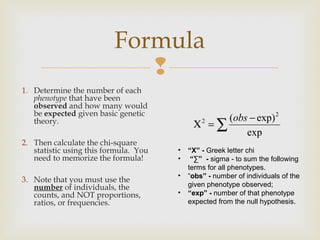
1. Determine the number of each
   phenotype that have been
   observed and how many would
   be expected given basic genetic
                                                   (obs − exp) 2
   theory.                                  Χ2 = ∑
                                                       exp
2. Then calculate the chi-square
   statistic using this formula. You   •   “Χ” - Greek letter chi
   need to memorize the formula!       •    “∑” - sigma - to sum the following
                                           terms for all phenotypes.
                                       •   “obs” - number of individuals of the
3. Note that you must use the
   number of individuals, the              given phenotype observed;
   counts, and NOT proportions,        •   “exp” - number of that phenotype
   ratios, or frequencies.                 expected from the null hypothesis.
Example
                                    
   you count F2 offspring: 290 purple and 110 white flowers.
       This is a total of 400 (290 + 110) offspring.

   We expect a 3: 1 ratio. We need to calculate the expected NUMBERS.
       multiply the total offspring by the expected proportions.
       This we expect 400 * 3/4 = 300 purple, and 400 * 1/4 = 100 white.
   Purple: obs = 290 and exp = 300.
   White: obs = 110 and exp = 100.

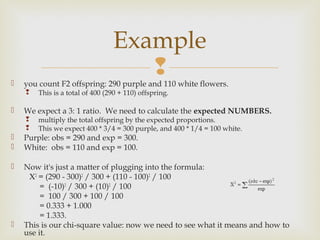
   Now it's just a matter of plugging into the formula:
     Χ2 = (290 - 300)2 / 300 + (110 - 100)2 / 100
         = (-10)2 / 300 + (10)2 / 100
         = 100 / 300 + 100 / 100
         = 0.333 + 1.000
         = 1.333.
   This is our chi-square value: now we need to see what it means and how to
    use it.
Chi-Square Distribution
   do the same experiment 1000
    times, do the same self-
    pollination of a Pp
    heterozygote, which should
    give the 3 : 1 ratio.
   For each experiment we
    calculate the chi-square value,
    them plot them all on a graph.

   x-axis is the chi-square value
    calculated from the formula
   y-axis is the number of
    individual experiments that
    got that chi-square value.
Chi-Square Distribution
   You see that there is a range here:
       if the results were perfect you get
        a chi-square value of 0 (because
        obs = exp).
       This rarely happens: most
        experiments give a small chi-
        square value (the hump in the
        graph).

   Sometimes you get really wild
    results, with obs very different
    from exp
       the long tail on the graph. Really
        odd things occasionally do
        happen by chance alone
The Critical Question

    result?
    
                  
    How do you tell a really odd but correct result from a WRONG

        occasionally very skewed distributions of data occur even though you
        performed the experiment correctly (correct theory)
   Never for certain that a given result is “wrong”,
       determine whether a given result is likely or unlikely.

       2 ways of getting a high chi-square value: ( statistics is never able
        to discriminate between true and false with 100% certainty)
       an unusual result from the correct theory,
       or a result from the wrong theory.

   Does your 290: 110 offspring ratio really fit a 3/4 : 1/4 ratio or was
    it the result of a mistake or accident?
       You can’t be certain, but you can at least determine whether your result
        is REASONABLE
Reasonable
                          
   subjective and arbitrary.
   A result is said to not differ significantly from expectations, if the
    difference between the observed results and the expected results is
    small enough that it would be seen at least 1 time in 20 over
    thousands of experiments


   For technical reasons, we use “fail to reject” instead of “accept”.

   Probability value p = 0.05, because 1/20 = 0.05.
Degrees of Freedom
              
 the number of independent random variables
  involved.
 Degrees of freedom is simply the number of classes
  of offspring minus 1.

 For our example, there are 2 classes of offspring:
  purple and white. Thus, degrees of freedom (d.f.) =
  2 -1 = 1.
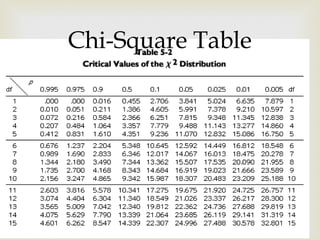
Critical Chi-Square

                         
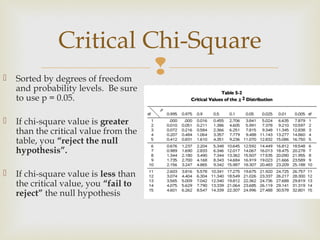
    Sorted by degrees of freedom
    and probability levels. Be sure
    to use p = 0.05.

   If chi-square value is greater
    than the critical value from the
    table, you “reject the null
    hypothesis”.

   If chi-square value is less than
    the critical value, you “fail to
    reject” the null hypothesis
Using the Table
                             
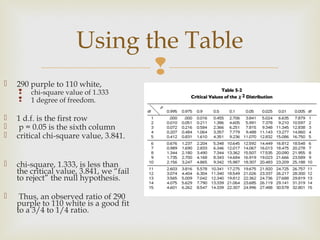
   290 purple to 110 white,
       chi-square value of 1.333
       1 degree of freedom.

   1 d.f. is the first row
    p = 0.05 is the sixth column
   critical chi-square value, 3.841.


   chi-square, 1.333, is less than
    the critical value, 3.841, we “fail
    to reject” the null hypothesis.

    Thus, an observed ratio of 290
    purple to 110 white is a good fit
    to a 3/4 to 1/4 ratio.
Another Example: from Mendel
              (Dihybrid Cross)
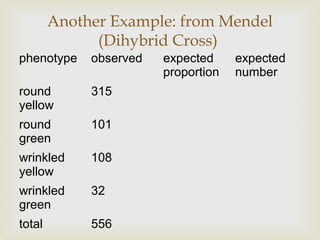
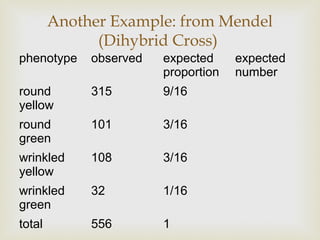
phenotype    observed   expected     expected
                        proportion   number
round        315
yellow
round        101
green
wrinkled     108
yellow
wrinkled     32
green
total        556
Another Example: from Mendel
              (Dihybrid Cross)
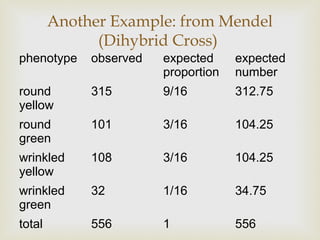
phenotype    observed   expected     expected
                        proportion   number
round        315        9/16
yellow
round        101        3/16
green
wrinkled     108        3/16
yellow
wrinkled     32         1/16
green
total        556        1
Another Example: from Mendel
              (Dihybrid Cross)
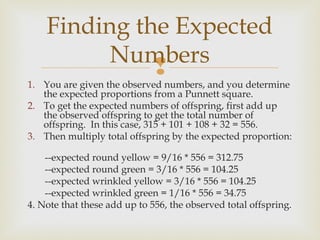
phenotype    observed   expected     expected
                        proportion   number
round        315        9/16         312.75
yellow
round        101        3/16         104.25
green
wrinkled     108        3/16         104.25
yellow
wrinkled     32         1/16         34.75
green
total        556        1            556
Finding the Expected
          Numbers
              
1. You are given the observed numbers, and you determine
   the expected proportions from a Punnett square.
2. To get the expected numbers of offspring, first add up
   the observed offspring to get the total number of
   offspring. In this case, 315 + 101 + 108 + 32 = 556.
3. Then multiply total offspring by the expected proportion:

    --expected round yellow = 9/16 * 556 = 312.75
    --expected round green = 3/16 * 556 = 104.25
    --expected wrinkled yellow = 3/16 * 556 = 104.25
    --expected wrinkled green = 1/16 * 556 = 34.75
4. Note that these add up to 556, the observed total offspring.
Calculating the Chi-Square Value
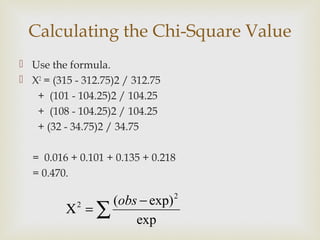
 Use the formula.
 X2 = (315 - 312.75)2 / 312.75
   + (101 - 104.25)2 / 104.25
   + (108 - 104.25)2 / 104.25
   + (32 - 34.75)2 / 34.75

  = 0.016 + 0.101 + 0.135 + 0.218
  = 0.470.

               (obs − exp)        2
          Χ =∑
            2

                   exp
D.F. and Critical Value
            
 Degrees of freedom is 1 less than the number of
  classes of offspring. Here, 4 - 1 = 3 d.f.

 For 3 d.f. and p = 0.05, the critical chi-square value is
  7.815.

 Since the observed chi-square (0.470) is less than the
  critical value, we fail to reject the null hypothesis.
  We accept Mendel’s conclusion that the observed
  results for a 9/16 : 3/16 : 3/16 : 1/16 ratio.
Chi-Square Table
       

Chi square[1]

  • 1.
  • 2.
    Chi-Square Test   A fundamental problem in genetics is determining whether the experimentally determined data fits the results expected from theory  i.e. Mendel’s laws as expressed in the Punnett square  How can you tell if an observed set of offspring counts is legitimately the result of a given underlying simple ratio?  For example, you do a cross and see:  290 purple flowers and 110 white flowers in the offspring.  This is pretty close to a 3: 1 ratio, but how do you formally define "pretty close"?  What about 250:150?
  • 3.
    Goodness of Fit   Mendel has no way of solving this problem.  Shortly after the rediscovery of his work in 1900, Karl Pearson and R.A. Fisher developed the “chi-square” test  The chi-square test is a “goodness of fit” test: it answers the question of how well do experimental data fit expectations.  We start with a theory for how the offspring will be distributed: the “null hypothesis”.  The offspring of a self-pollination of a heterozygote.  The null hypothesis is that the offspring will appear in a ratio of 3/4 dominant to 1/4 recessive.
  • 4.
    Formula  1. Determine the number of each phenotype that have been observed and how many would be expected given basic genetic (obs − exp) 2 theory. Χ2 = ∑ exp 2. Then calculate the chi-square statistic using this formula. You • “Χ” - Greek letter chi need to memorize the formula! • “∑” - sigma - to sum the following terms for all phenotypes. • “obs” - number of individuals of the 3. Note that you must use the number of individuals, the given phenotype observed; counts, and NOT proportions, • “exp” - number of that phenotype ratios, or frequencies. expected from the null hypothesis.
  • 5.
    Example   you count F2 offspring: 290 purple and 110 white flowers.  This is a total of 400 (290 + 110) offspring.  We expect a 3: 1 ratio. We need to calculate the expected NUMBERS.  multiply the total offspring by the expected proportions.  This we expect 400 * 3/4 = 300 purple, and 400 * 1/4 = 100 white.  Purple: obs = 290 and exp = 300.  White: obs = 110 and exp = 100.  Now it's just a matter of plugging into the formula: Χ2 = (290 - 300)2 / 300 + (110 - 100)2 / 100 = (-10)2 / 300 + (10)2 / 100 = 100 / 300 + 100 / 100 = 0.333 + 1.000 = 1.333.  This is our chi-square value: now we need to see what it means and how to use it.
  • 6.
    Chi-Square Distribution  do the same experiment 1000 times, do the same self- pollination of a Pp heterozygote, which should give the 3 : 1 ratio.  For each experiment we calculate the chi-square value, them plot them all on a graph.  x-axis is the chi-square value calculated from the formula  y-axis is the number of individual experiments that got that chi-square value.
  • 7.
    Chi-Square Distribution  You see that there is a range here:  if the results were perfect you get a chi-square value of 0 (because obs = exp).  This rarely happens: most experiments give a small chi- square value (the hump in the graph).  Sometimes you get really wild results, with obs very different from exp  the long tail on the graph. Really odd things occasionally do happen by chance alone
  • 8.
    The Critical Question  result?   How do you tell a really odd but correct result from a WRONG occasionally very skewed distributions of data occur even though you performed the experiment correctly (correct theory)  Never for certain that a given result is “wrong”,  determine whether a given result is likely or unlikely.  2 ways of getting a high chi-square value: ( statistics is never able to discriminate between true and false with 100% certainty)  an unusual result from the correct theory,  or a result from the wrong theory.  Does your 290: 110 offspring ratio really fit a 3/4 : 1/4 ratio or was it the result of a mistake or accident?  You can’t be certain, but you can at least determine whether your result is REASONABLE
  • 9.
    Reasonable   subjective and arbitrary.  A result is said to not differ significantly from expectations, if the difference between the observed results and the expected results is small enough that it would be seen at least 1 time in 20 over thousands of experiments  For technical reasons, we use “fail to reject” instead of “accept”.  Probability value p = 0.05, because 1/20 = 0.05.
  • 10.
    Degrees of Freedom   the number of independent random variables involved.  Degrees of freedom is simply the number of classes of offspring minus 1.  For our example, there are 2 classes of offspring: purple and white. Thus, degrees of freedom (d.f.) = 2 -1 = 1.
  • 11.
    Critical Chi-Square   Sorted by degrees of freedom and probability levels. Be sure to use p = 0.05.  If chi-square value is greater than the critical value from the table, you “reject the null hypothesis”.  If chi-square value is less than the critical value, you “fail to reject” the null hypothesis
  • 12.
    Using the Table   290 purple to 110 white,  chi-square value of 1.333  1 degree of freedom.  1 d.f. is the first row  p = 0.05 is the sixth column  critical chi-square value, 3.841.  chi-square, 1.333, is less than the critical value, 3.841, we “fail to reject” the null hypothesis.  Thus, an observed ratio of 290 purple to 110 white is a good fit to a 3/4 to 1/4 ratio.
  • 13.
    Another Example: fromMendel (Dihybrid Cross) phenotype observed expected expected proportion number round 315 yellow round 101 green wrinkled 108 yellow wrinkled 32 green total 556
  • 14.
    Another Example: fromMendel (Dihybrid Cross) phenotype observed expected expected proportion number round 315 9/16 yellow round 101 3/16 green wrinkled 108 3/16 yellow wrinkled 32 1/16 green total 556 1
  • 15.
    Another Example: fromMendel (Dihybrid Cross) phenotype observed expected expected proportion number round 315 9/16 312.75 yellow round 101 3/16 104.25 green wrinkled 108 3/16 104.25 yellow wrinkled 32 1/16 34.75 green total 556 1 556
  • 16.
    Finding the Expected Numbers  1. You are given the observed numbers, and you determine the expected proportions from a Punnett square. 2. To get the expected numbers of offspring, first add up the observed offspring to get the total number of offspring. In this case, 315 + 101 + 108 + 32 = 556. 3. Then multiply total offspring by the expected proportion: --expected round yellow = 9/16 * 556 = 312.75 --expected round green = 3/16 * 556 = 104.25 --expected wrinkled yellow = 3/16 * 556 = 104.25 --expected wrinkled green = 1/16 * 556 = 34.75 4. Note that these add up to 556, the observed total offspring.
  • 17.
    Calculating the Chi-SquareValue  Use the formula.  X2 = (315 - 312.75)2 / 312.75 + (101 - 104.25)2 / 104.25 + (108 - 104.25)2 / 104.25 + (32 - 34.75)2 / 34.75 = 0.016 + 0.101 + 0.135 + 0.218 = 0.470. (obs − exp) 2 Χ =∑ 2 exp
  • 18.
    D.F. and CriticalValue   Degrees of freedom is 1 less than the number of classes of offspring. Here, 4 - 1 = 3 d.f.  For 3 d.f. and p = 0.05, the critical chi-square value is 7.815.  Since the observed chi-square (0.470) is less than the critical value, we fail to reject the null hypothesis. We accept Mendel’s conclusion that the observed results for a 9/16 : 3/16 : 3/16 : 1/16 ratio.
  • 19.