CHEMICAL TREATMENT
METHODS
DONE BY: MAHASWARI JOGIA
WASTE MANAGEMENT TECHNIQUES (HCE 24)
SEMINAR ON:
CONTENTS
 INTRODUCTION
 CHEMICAL TREATMENT
 COAGULATION
 NEUTRALIZATION
 PRECIPITATION
 OXIDATION
 REFERENCES
4/12/2017
2
DSCE,CHEMKCALENGGDEPT
INTRODUCTION
● Industries use water that obtained from the water treatment system for a variety
of purposes, such as:
- For manufacturing goods.
- For heating.
- For cooling.
- As carrier of raw material.
- As carrier of waste matter.
- As a solvent.
● The resulting water is then classified as a wastewater.
4/12/2017
3
DSCE,CHEMKCALENGGDEPT
● The indiscriminate discharge of these wastewater streams into the environment
can
- Render soils "sick ".
- Pollute the receiving bodies of water.
- Cause air pollution by generating obnoxious gases.
● Discharge untreated wastewater into the domestic sewer system makes the task
of treating domestic sewage, a very difficult and costly exercise.
● To prevent any health hazards caused by discharging wastewater into the
environment and protect domestic sewage , the wastewater must be treated
before discharge.
4/12/2017
4
DSCE,CHEMKCALENGGDEPT
CHEMICAL TREATMENT
• Treatment methods in which the removal or conversion of contaminants is
brought about by the addition of chemicals or by other chemical reactions.
• Precipitation, adsorption, and disinfection are the most common examples used in
wastewater treatment.
• Basically the treatment includes:
- Coagulation
- Precipitation
- Disinfection
- Oxidation
- Neutralization, scale control
4/12/2017
5
DSCE,CHEMKCALENGGDEPT
Very fine suspended particles present in wastewaters cannot be removed in
sedimentation due to settling velocity is very low.
Fine colloidal or dispersed particles contain electric charges and continuously in
motion known as Brownian motion and they are not settled down by gravity force.
Very fine suspended particles can be removed by increasing their size(flocculated
particles). Certain chemical compounds called coagulants are added to the wastewater
which on thorough mixing form a gelatinuous precipitate called floc.
COAGULATION
4/12/2017
6
DSCE,CHEMKCALENGGDEPT
After which they pass through sedimentation tank and settle down.
It takes place in rapid mix, or flash mix basins which are very rapid. The primary
function of rapid mix basin is to disperse the coagulant so that it contacts all of the
wastewater.
Over the years a number of different substances have been used as coagulants.
The most common ones
-Alum(Al2(SO4)3.18H2O).
-Ferrous Sulfate(FeSO4.7H2O).
-Lime Ca(OH)2.
-Ferric Chloride (FeCl3).
-Ferric Sulfate (Fe2(SO4)3).
4/12/2017
7
DSCE,CHEMKCALENGGDEPT
Principle of Coagulation
In coagulation, individual particles combine together. When a coagulant is used in
water, it forms a spongy gelatinous precipitate which absorbs fine size particles in
water and binds them together. The whole process results into bigger particles
which are heavier and easily settle able.
Properties of common coagulants
• React quickly
• Cheap
•Easy to handle and store
• React in longer range of pH
• Electrolyte ( positively charged)
• High valance ions for high efficiency
•Not detoriate
4/12/2017
8
DSCE,CHEMKCALENGGDEPT
Coagulation & Flocculation Process
4/12/2017
9
DSCE,CHEMKCALENGGDEPT
ALUM [Al2(S04)3 18H2O]:
Alum is the most widely used coagulant in water treatment. It reacts quickly
giving excellent stable flocs. It is cheap and can be easily stored and handled. The
alum when added to raw water, reacts with natural alkalinity in water (if that is
insufficient, lime may be added) so as to form a gelatinuous precipitate of
aluminium hydroxide. It increases the sulphate hardness and corrosiveness of
water to a small extent.
4/12/2017
10
DSCE,CHEMKCALENGGDEPT
NEUTRALIZATION
If a waste stream is found to be hazardous due to corrosivity, neutralization is the
primary treatment used. It is used as a pretreatment system before a variety of
biological, chemical, and physical treatment processes.
It is the process of adjusting the pH of water through the addition of an acid or a
base, depending on the target pH and process requirements. Some processes such as
boiler operations and drinking water standards need neutral water at a pH of 7.
4/12/2017
11
DSCE,CHEMKCALENGGDEPT
Water or wastewater is generally considered adequately neutralized if:
(1) its damage to metals, concrete, or other materials is minimal; (2) it has little
effect on fish and aquatic life; (3) it has no effect on biological matter (i.e., biological
treatment systems).
PARAMETERS WHICH AFFECT NEUTRALIZATION:
-pH
-alkalinity/acidity
-Hardness
-Buffers
4/12/2017
12
DSCE,CHEMKCALENGGDEPT
Fig: continuous neutralization tank
4/12/2017
13
DSCE,CHEMKCALENGGDEPT
PRECIPITATION
•It is used for removing dissolved metals from waste water solution containing toxic
materials. To convert this dissolved metal into solid particles, a precipitation
reagent is added. A chemical reaction occurs where dissolved metals form solid
particles.
•Filtration can be used to remove the particles from the mixtures. How well the
process takes place depends on the types of metal present, its concentration, and
reagent used.
4/12/2017
14
DSCE,CHEMKCALENGGDEPT
•Example : in hydroxide precipitation, calcium or sodium hydroxide is used as a
reagent to create solid metal hydroxides.
But the main difficulty being the mixture of metals in waste water making it
difficult to precipitate.
4/12/2017
15
DSCE,CHEMKCALENGGDEPT
OXIDATION
•It is a waste water treatment which involves the use of oxidizing agents such as
ozone, hydrogen peroxide, permanganate, chloride, chlorine, oxygen etc.
•The electrons move from the oxidant to the pollutants in waste water. They
undergo structural modification becoming less destructive compounds.
•Alkaline chlorination uses chlorine as oxidizing agent against cyanide. But it can
lead to production of toxic chlorinated compounds hence require further steps.
4/12/2017
16
DSCE,CHEMKCALENGGDEPT
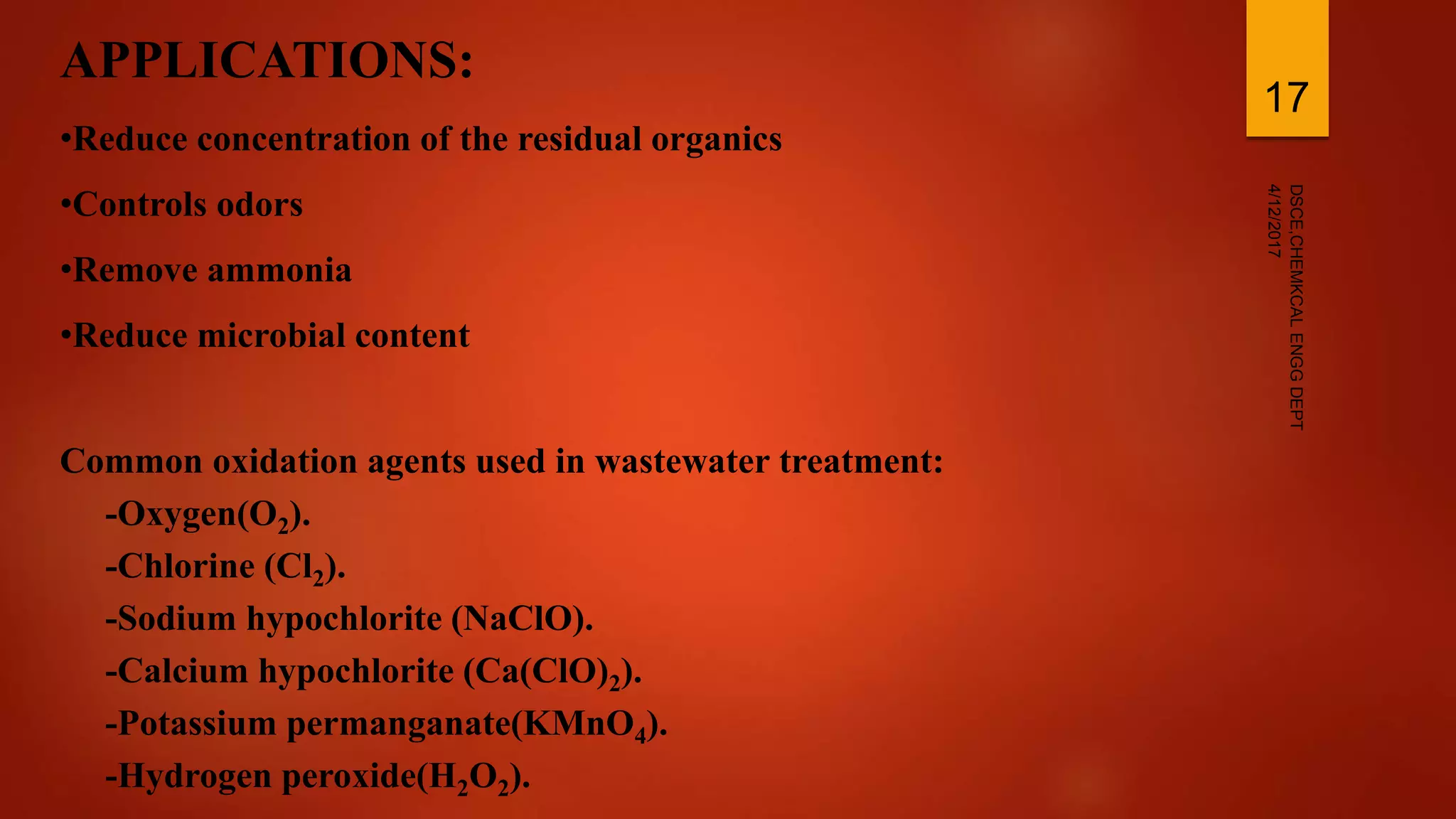
APPLICATIONS:
•Reduce concentration of the residual organics
•Controls odors
•Remove ammonia
•Reduce microbial content
Common oxidation agents used in wastewater treatment:
-Oxygen(O2).
-Chlorine (Cl2).
-Sodium hypochlorite (NaClO).
-Calcium hypochlorite (Ca(ClO)2).
-Potassium permanganate(KMnO4).
-Hydrogen peroxide(H2O2).
4/12/2017
17
DSCE,CHEMKCALENGGDEPT
•www.thomasnet.com/articles/chemicaltreatment
•https://frtr.gov/matrix2/section4/4-50.html
•https://www.slideshare.net/chemicalwatertreatment/industrial+wastewater+treatment
•Centralized water treatment prepared by Innocent L Swai, Bsc EHS
•Flow equalization and neutralization by Ramesh K. Goel, Joseph R.V. Flora,
and J. Paul Chen
•wastewater engineering– objectives of wastewater treatment, primary treatment of
wastewater by Dr. Asha Gupta
•Waste water engineering treatment and reuse by metcalf and eddy
REFERENCE
4/12/2017
18
DSCE,CHEMKCALENGGDEPT
4/12/2017
19
DSCE,CHEMKCALENGGDEPT

Chemical treatment methods

  • 1.
    CHEMICAL TREATMENT METHODS DONE BY:MAHASWARI JOGIA WASTE MANAGEMENT TECHNIQUES (HCE 24) SEMINAR ON:
  • 2.
    CONTENTS  INTRODUCTION  CHEMICALTREATMENT  COAGULATION  NEUTRALIZATION  PRECIPITATION  OXIDATION  REFERENCES 4/12/2017 2 DSCE,CHEMKCALENGGDEPT
  • 3.
    INTRODUCTION ● Industries usewater that obtained from the water treatment system for a variety of purposes, such as: - For manufacturing goods. - For heating. - For cooling. - As carrier of raw material. - As carrier of waste matter. - As a solvent. ● The resulting water is then classified as a wastewater. 4/12/2017 3 DSCE,CHEMKCALENGGDEPT
  • 4.
    ● The indiscriminatedischarge of these wastewater streams into the environment can - Render soils "sick ". - Pollute the receiving bodies of water. - Cause air pollution by generating obnoxious gases. ● Discharge untreated wastewater into the domestic sewer system makes the task of treating domestic sewage, a very difficult and costly exercise. ● To prevent any health hazards caused by discharging wastewater into the environment and protect domestic sewage , the wastewater must be treated before discharge. 4/12/2017 4 DSCE,CHEMKCALENGGDEPT
  • 5.
    CHEMICAL TREATMENT • Treatmentmethods in which the removal or conversion of contaminants is brought about by the addition of chemicals or by other chemical reactions. • Precipitation, adsorption, and disinfection are the most common examples used in wastewater treatment. • Basically the treatment includes: - Coagulation - Precipitation - Disinfection - Oxidation - Neutralization, scale control 4/12/2017 5 DSCE,CHEMKCALENGGDEPT
  • 6.
    Very fine suspendedparticles present in wastewaters cannot be removed in sedimentation due to settling velocity is very low. Fine colloidal or dispersed particles contain electric charges and continuously in motion known as Brownian motion and they are not settled down by gravity force. Very fine suspended particles can be removed by increasing their size(flocculated particles). Certain chemical compounds called coagulants are added to the wastewater which on thorough mixing form a gelatinuous precipitate called floc. COAGULATION 4/12/2017 6 DSCE,CHEMKCALENGGDEPT
  • 7.
    After which theypass through sedimentation tank and settle down. It takes place in rapid mix, or flash mix basins which are very rapid. The primary function of rapid mix basin is to disperse the coagulant so that it contacts all of the wastewater. Over the years a number of different substances have been used as coagulants. The most common ones -Alum(Al2(SO4)3.18H2O). -Ferrous Sulfate(FeSO4.7H2O). -Lime Ca(OH)2. -Ferric Chloride (FeCl3). -Ferric Sulfate (Fe2(SO4)3). 4/12/2017 7 DSCE,CHEMKCALENGGDEPT
  • 8.
    Principle of Coagulation Incoagulation, individual particles combine together. When a coagulant is used in water, it forms a spongy gelatinous precipitate which absorbs fine size particles in water and binds them together. The whole process results into bigger particles which are heavier and easily settle able. Properties of common coagulants • React quickly • Cheap •Easy to handle and store • React in longer range of pH • Electrolyte ( positively charged) • High valance ions for high efficiency •Not detoriate 4/12/2017 8 DSCE,CHEMKCALENGGDEPT
  • 9.
    Coagulation & FlocculationProcess 4/12/2017 9 DSCE,CHEMKCALENGGDEPT
  • 10.
    ALUM [Al2(S04)3 18H2O]: Alumis the most widely used coagulant in water treatment. It reacts quickly giving excellent stable flocs. It is cheap and can be easily stored and handled. The alum when added to raw water, reacts with natural alkalinity in water (if that is insufficient, lime may be added) so as to form a gelatinuous precipitate of aluminium hydroxide. It increases the sulphate hardness and corrosiveness of water to a small extent. 4/12/2017 10 DSCE,CHEMKCALENGGDEPT
  • 11.
    NEUTRALIZATION If a wastestream is found to be hazardous due to corrosivity, neutralization is the primary treatment used. It is used as a pretreatment system before a variety of biological, chemical, and physical treatment processes. It is the process of adjusting the pH of water through the addition of an acid or a base, depending on the target pH and process requirements. Some processes such as boiler operations and drinking water standards need neutral water at a pH of 7. 4/12/2017 11 DSCE,CHEMKCALENGGDEPT
  • 12.
    Water or wastewateris generally considered adequately neutralized if: (1) its damage to metals, concrete, or other materials is minimal; (2) it has little effect on fish and aquatic life; (3) it has no effect on biological matter (i.e., biological treatment systems). PARAMETERS WHICH AFFECT NEUTRALIZATION: -pH -alkalinity/acidity -Hardness -Buffers 4/12/2017 12 DSCE,CHEMKCALENGGDEPT
  • 13.
    Fig: continuous neutralizationtank 4/12/2017 13 DSCE,CHEMKCALENGGDEPT
  • 14.
    PRECIPITATION •It is usedfor removing dissolved metals from waste water solution containing toxic materials. To convert this dissolved metal into solid particles, a precipitation reagent is added. A chemical reaction occurs where dissolved metals form solid particles. •Filtration can be used to remove the particles from the mixtures. How well the process takes place depends on the types of metal present, its concentration, and reagent used. 4/12/2017 14 DSCE,CHEMKCALENGGDEPT
  • 15.
    •Example : inhydroxide precipitation, calcium or sodium hydroxide is used as a reagent to create solid metal hydroxides. But the main difficulty being the mixture of metals in waste water making it difficult to precipitate. 4/12/2017 15 DSCE,CHEMKCALENGGDEPT
  • 16.
    OXIDATION •It is awaste water treatment which involves the use of oxidizing agents such as ozone, hydrogen peroxide, permanganate, chloride, chlorine, oxygen etc. •The electrons move from the oxidant to the pollutants in waste water. They undergo structural modification becoming less destructive compounds. •Alkaline chlorination uses chlorine as oxidizing agent against cyanide. But it can lead to production of toxic chlorinated compounds hence require further steps. 4/12/2017 16 DSCE,CHEMKCALENGGDEPT
  • 17.
    APPLICATIONS: •Reduce concentration ofthe residual organics •Controls odors •Remove ammonia •Reduce microbial content Common oxidation agents used in wastewater treatment: -Oxygen(O2). -Chlorine (Cl2). -Sodium hypochlorite (NaClO). -Calcium hypochlorite (Ca(ClO)2). -Potassium permanganate(KMnO4). -Hydrogen peroxide(H2O2). 4/12/2017 17 DSCE,CHEMKCALENGGDEPT
  • 18.
    •www.thomasnet.com/articles/chemicaltreatment •https://frtr.gov/matrix2/section4/4-50.html •https://www.slideshare.net/chemicalwatertreatment/industrial+wastewater+treatment •Centralized water treatmentprepared by Innocent L Swai, Bsc EHS •Flow equalization and neutralization by Ramesh K. Goel, Joseph R.V. Flora, and J. Paul Chen •wastewater engineering– objectives of wastewater treatment, primary treatment of wastewater by Dr. Asha Gupta •Waste water engineering treatment and reuse by metcalf and eddy REFERENCE 4/12/2017 18 DSCE,CHEMKCALENGGDEPT
  • 19.