Equilibrium
By: Dr. Sagir
Equilibrium
Equilibrium is a state in which there are
no observable changes as time goes by.
Chemical equilibrium is achieved when:
1.) the rates of the forward and reverse
reactions are equal and
2.) the concentrations of the reactants
and products remain constant
Equilibrium
• There are two types of equilibrium:
Physical and Chemical.
– Physical Equilibrium
• H20 (l) ↔ H20 (g)
– Chemical Equilibrium
• N2O4 (g) ↔ 2NO2
Physical Equilibrium
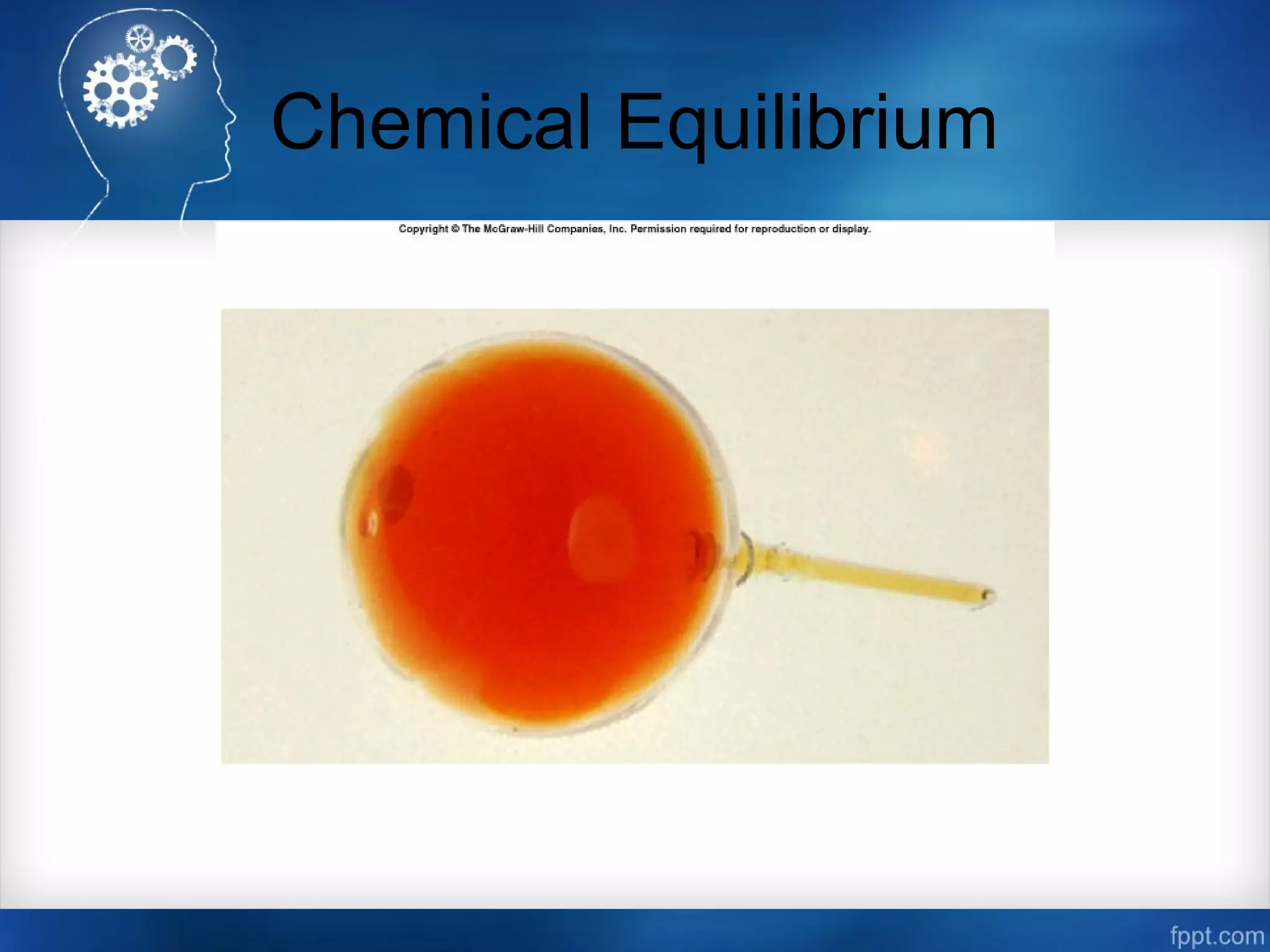
Chemical Equilibrium
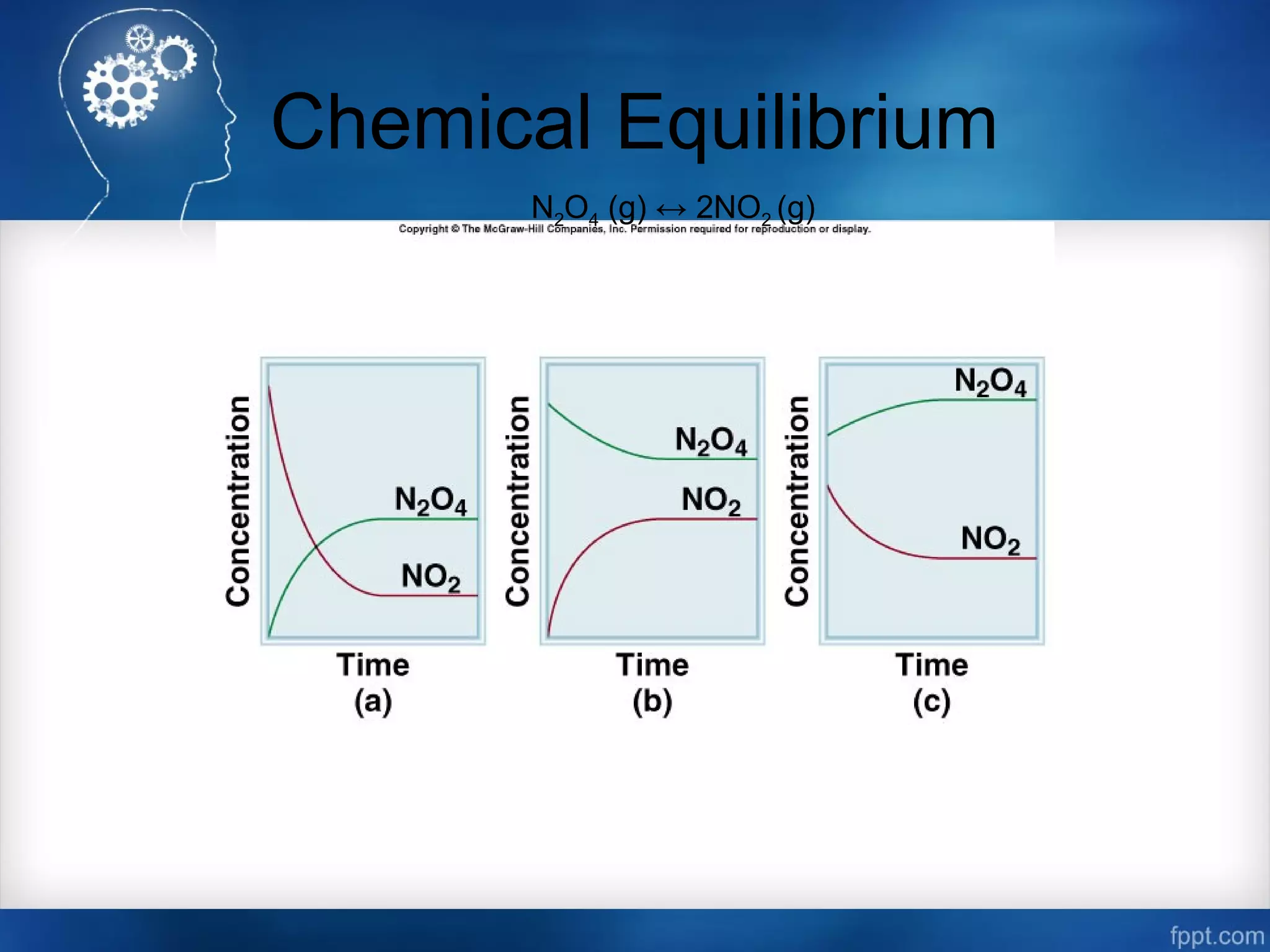
N2O4 (g) ↔ 2NO2 (g)
Law of Mass Action
• Law of Mass Action- For a reversible reaction
at equilibrium and constant temperature, a
certain ratio of reactant and product
concentrations has a constant value (K).
• The Equilibrium Constant (K)- A number equal
to the ratio of the equilibrium concentrations of
products to the equilibrium concentrations of
reactants each raised to the power of its
stoichiometric coefficient.
Law of Mass Action
• For the general reaction:
K =
[C]c
[D]d
[A]a
[B]b
aA (g) + bB (g) cC (g) + dD (g)
Equilibrium Constant
N2O4 (g) ↔ 2NO2 (g)
Chemical Equilibrium
• Chemical equilibrium is defined by K.
• The magnitude of K will tell us if the
equilibrium reaction favors the reactants or
the products.
• If K » 1……..favors products
• If K « 1……..favors reactants
Equilibrium Constant Expressions
• Equilibrium constants can be expressed
using Kc or Kp.
• Kc uses the concentration of reactants and
products to calculate the eq. constant.
• Kp uses the pressure of the gaseous
reactants and products to calculate the eq.
constant.
Equilibrium Constant Expressions
• Equilibrium Constant Equations
Kc =
[NO2]2
[N2O4]
Kp =
NO2
P2
N2O4
P
aA (g) + bB (g) cC (g) + dD (g)
Homogeneous Equilibrium
• Homogeneous Equilibrium- applies to
reactions in which all reacting species are
in the same phase.
N2O4 (g) ↔ 2NO2 (g)
Kp =
NO2
P2
N2O4
P
In most cases
Kc ≠ Kp
Kc =
[NO2]2
[N2O4]
Equilibrium Constant Expressions
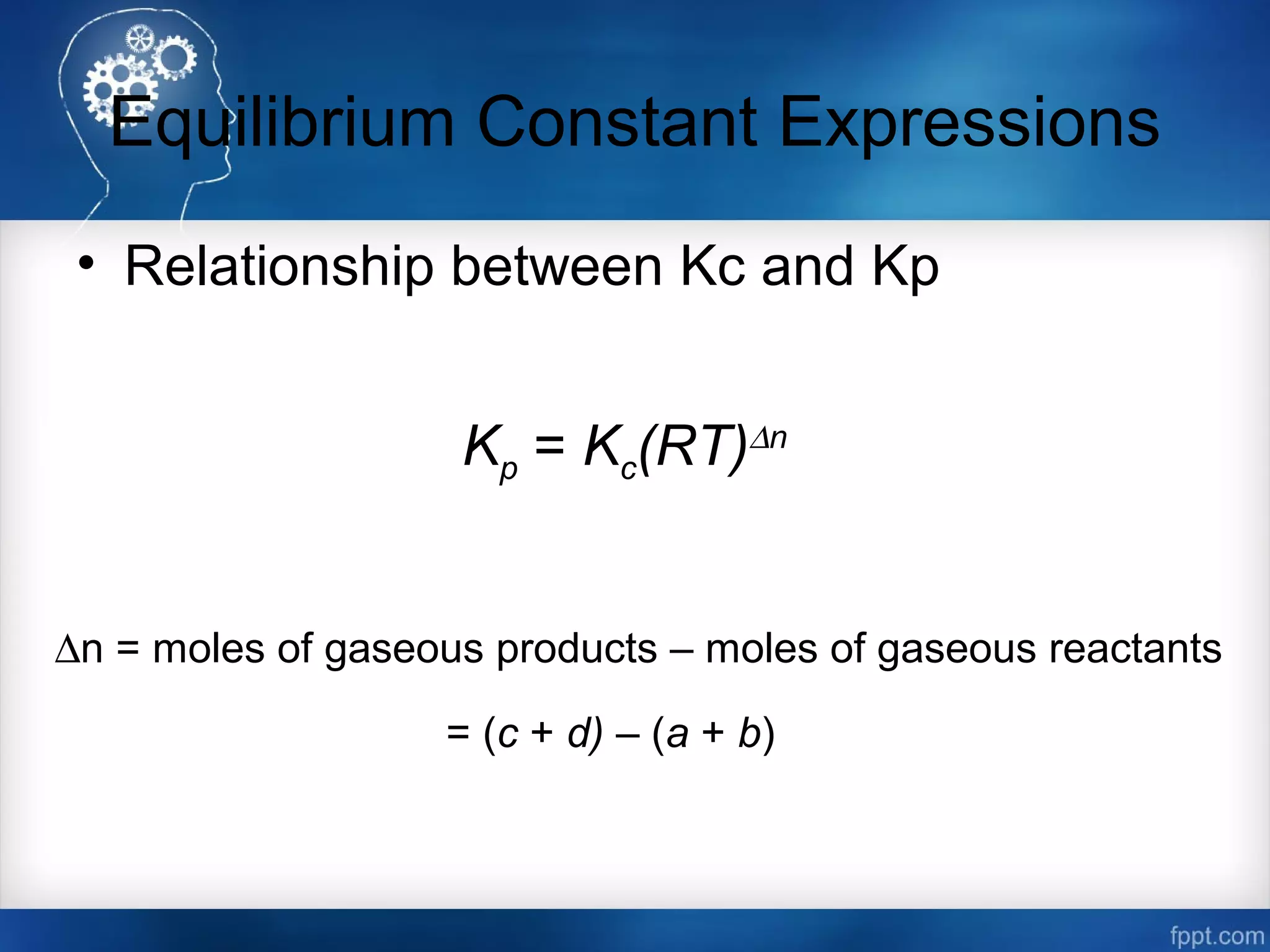
• Relationship between Kc and Kp
Kp = Kc(RT)∆n
∆n = moles of gaseous products – moles of gaseous reactants
= (c + d) – (a + b)
Equilibrium Constant Calculations
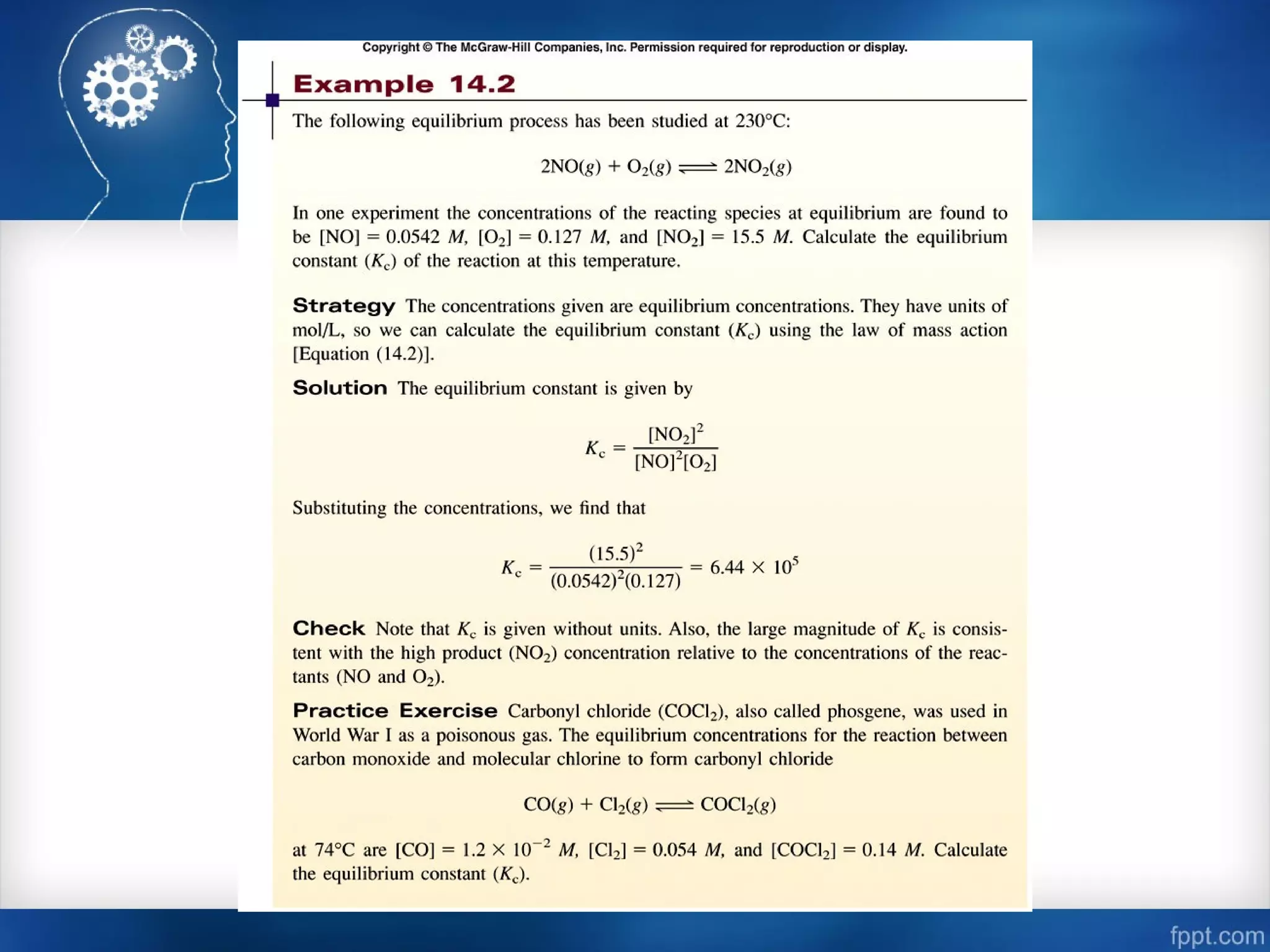
The equilibrium concentrations for the reaction between carbon monoxide and
molecular chlorine to form COCl2 (g) at 740C are [CO] = 0.012 M, [Cl2] =
0.054 M, and [COCl2] = 0.14 M. Calculate the equilibrium constants Kc and
Kp.
CO (g) + Cl2 (g) COCl2 (g)
Kc =
[COCl2]
[CO][Cl2]
=
0.14
0.012 x 0.054
= 220
Kp = Kc(RT)∆n
∆n = 1 – 2 = -1 R = 0.0821 T = 273 + 74 = 347 K
Kp = 220 x (0.0821 x 347)-1
= 7.7
Equilibrium Constant Calculations
• The equilibrium constant Kp for the reaction is 158 at
1000K. What is the equilibrium pressure of O2 if the PNO
= 0.400 atm and PNO = 0.270 atm?
Kp =
2
PNO PO
2
PNO
2
2
PO2 = Kp
PNO
2
2
PNO
2
PO2 = 158 x (0.400)2
/(0.270)2
= 347 atm
Heterogeneous Equilibrium
• Heterogeneous Equilibrium- results from
a reversible reaction involving reactants
and products that are in different phases.
• Can include liquids, gases and solids as
either reactants or products.
• Equilibrium expression is the same as that
for a homogeneous equilibrium.
• Omit pure liquids and solids from the
equilibrium constant expressions.
Heterogeneous Equilibrium Constant
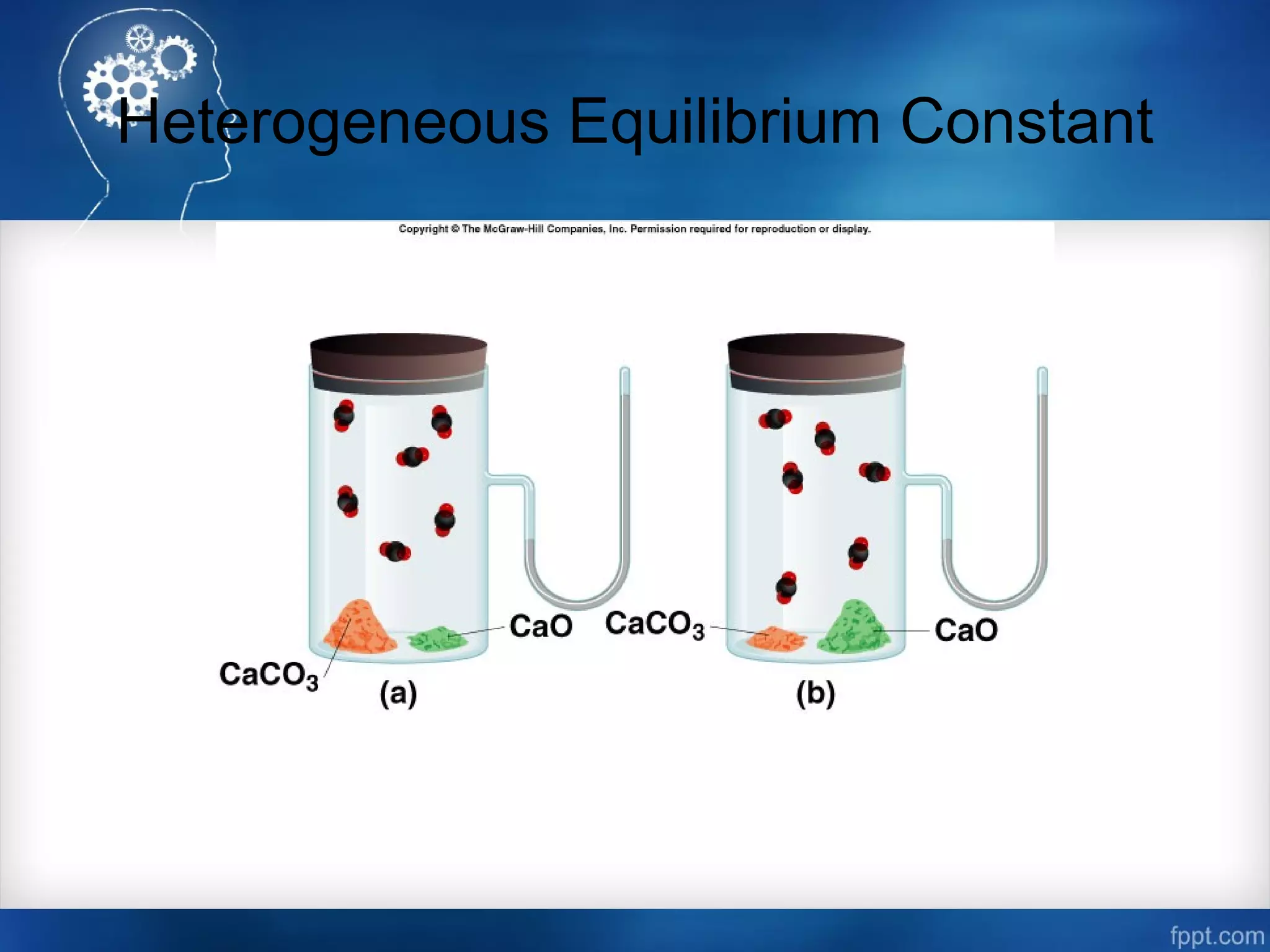
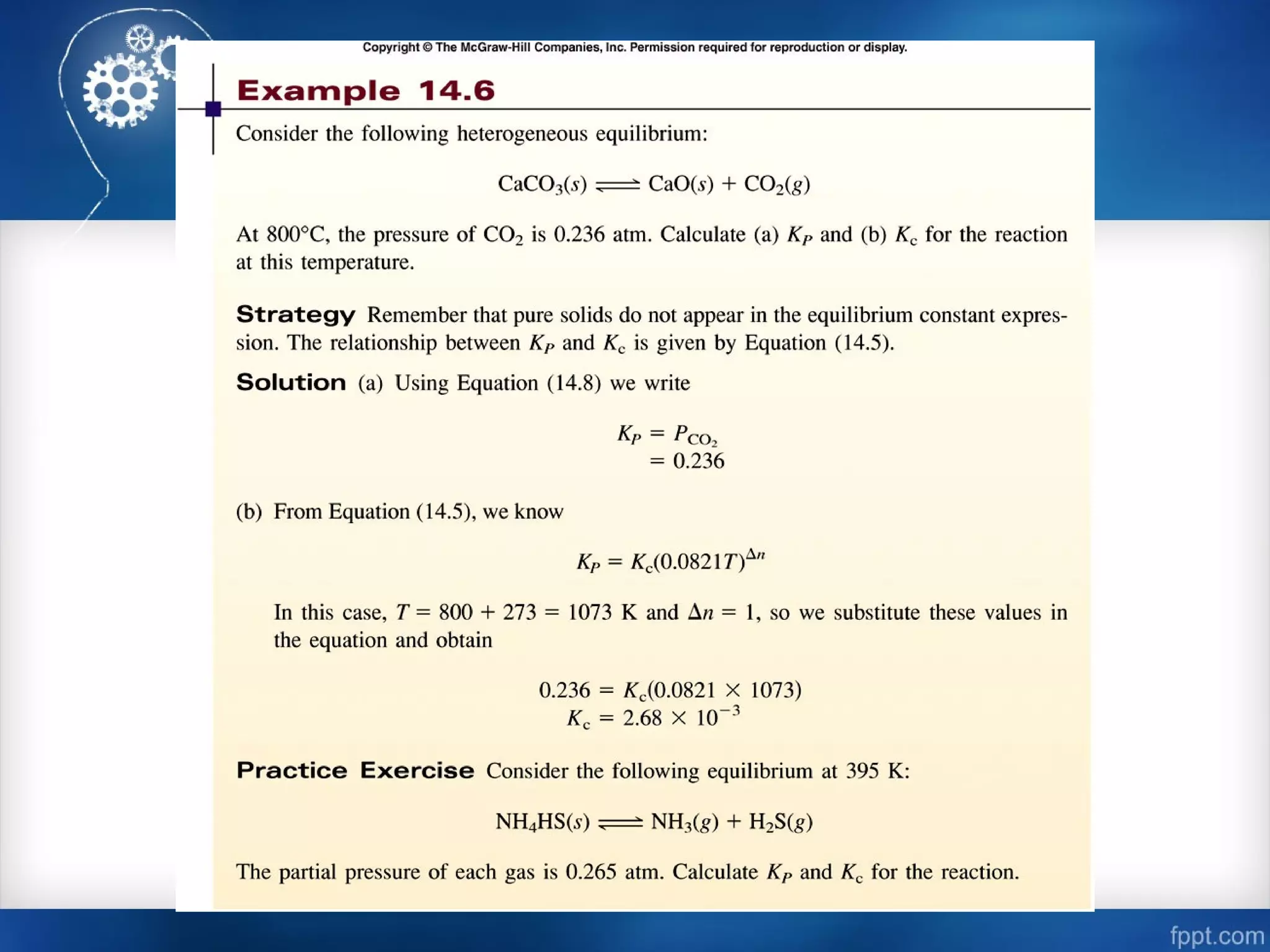
CaCO3 (s) CaO (s) + CO2 (g)
[CaCO3] = constant
[CaO] = constant
Kp = PCO2
The concentration of solids and pure liquids are not
included in the expression for the equilibrium constant.
Heterogeneous Equilibrium Constant
Equilibrium Constant Calculations
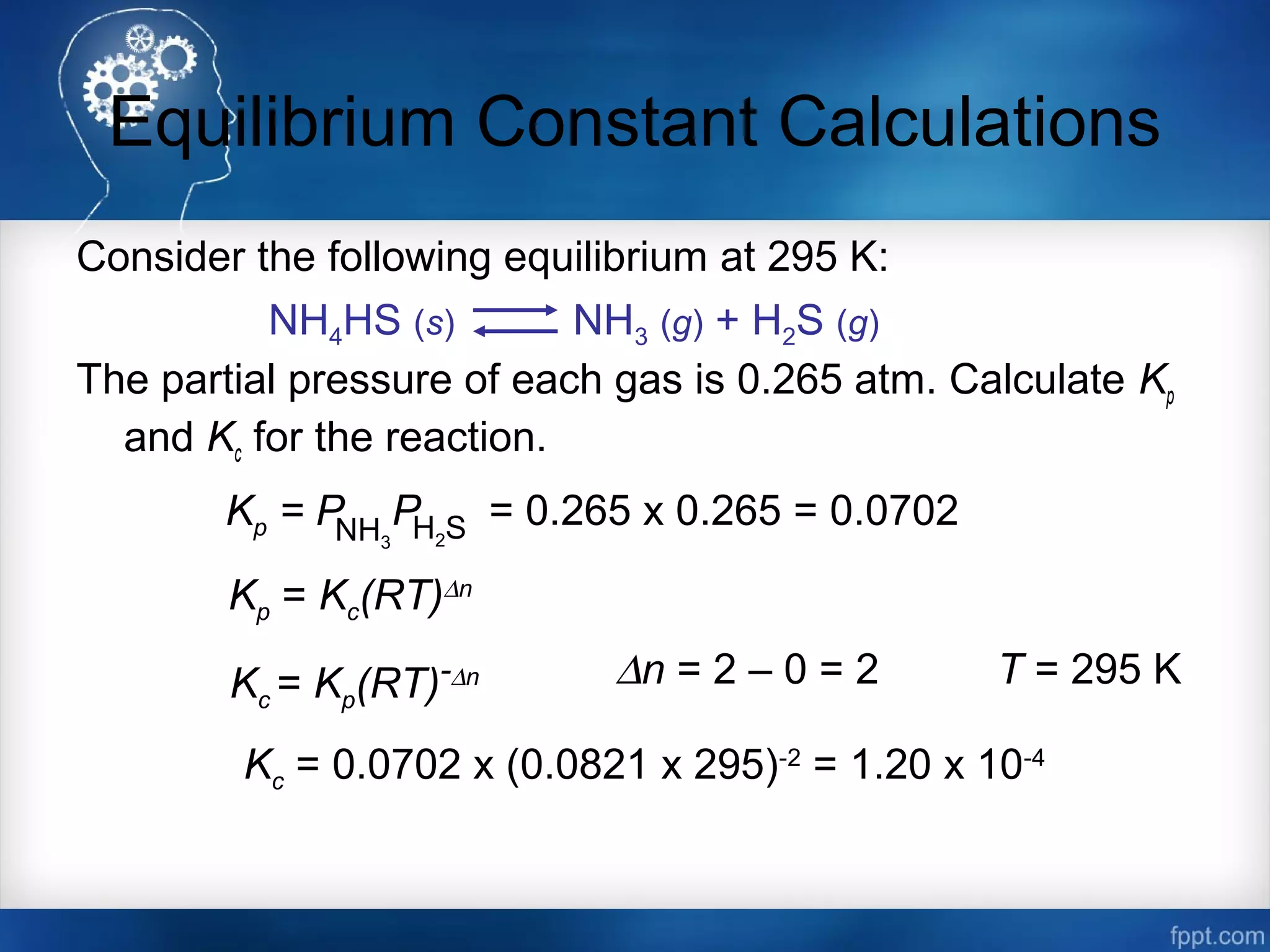
Consider the following equilibrium at 295 K:
The partial pressure of each gas is 0.265 atm. Calculate Kp
and Kc for the reaction.
NH4HS (s) NH3 (g) + H2S (g)
Kp = PNH3
H2SP = 0.265 x 0.265 = 0.0702
Kp = Kc(RT)∆n
Kc = Kp(RT)-∆n ∆n = 2 – 0 = 2 T = 295 K
Kc = 0.0702 x (0.0821 x 295)-2
= 1.20 x 10⁻⁴
Multiple Equilibria
• Multiple Equilibria- Product molecules of one equilibrium
constant are involved in a second equilibrium process.
A + B C + D
C + D E + F
A + B E + F
Kc‘
Kc‘‘
Kc
Kc = Kc‘‘Kc‘ x
Kc =‘
[C][D]
[A][B]
Kc =‘‘
[E][F]
[C][D]
[E][F]
[A][B]
Kc =
Writing Equilibrium Constant Expressions
• The concentrations of the reacting species in the condensed phase are
expressed in M. In the gaseous phase, the concentrations can be expressed in
M or in atm.
• The concentrations of pure solids, pure liquids and solvents do not appear in
the equilibrium constant expressions.
• The equilibrium constant is a dimensionless quantity.
• In quoting a value for the equilibrium constant, you must specify the balanced
equation and the temperature.
• If a reaction can be expressed as a sum of two or more reactions, the
equilibrium constant for the overall reaction is given by the product of the
equilibrium constants of the individual reactions.
14.2
What does the Equilibrium Constant tell
us?
• We can:
– Predict the direction in which a reaction
mixture will proceed to reach equilibrium
– Calculate the concentration of reactants and
products once equilibrium has been reached
Predicting the Direction of a Reaction
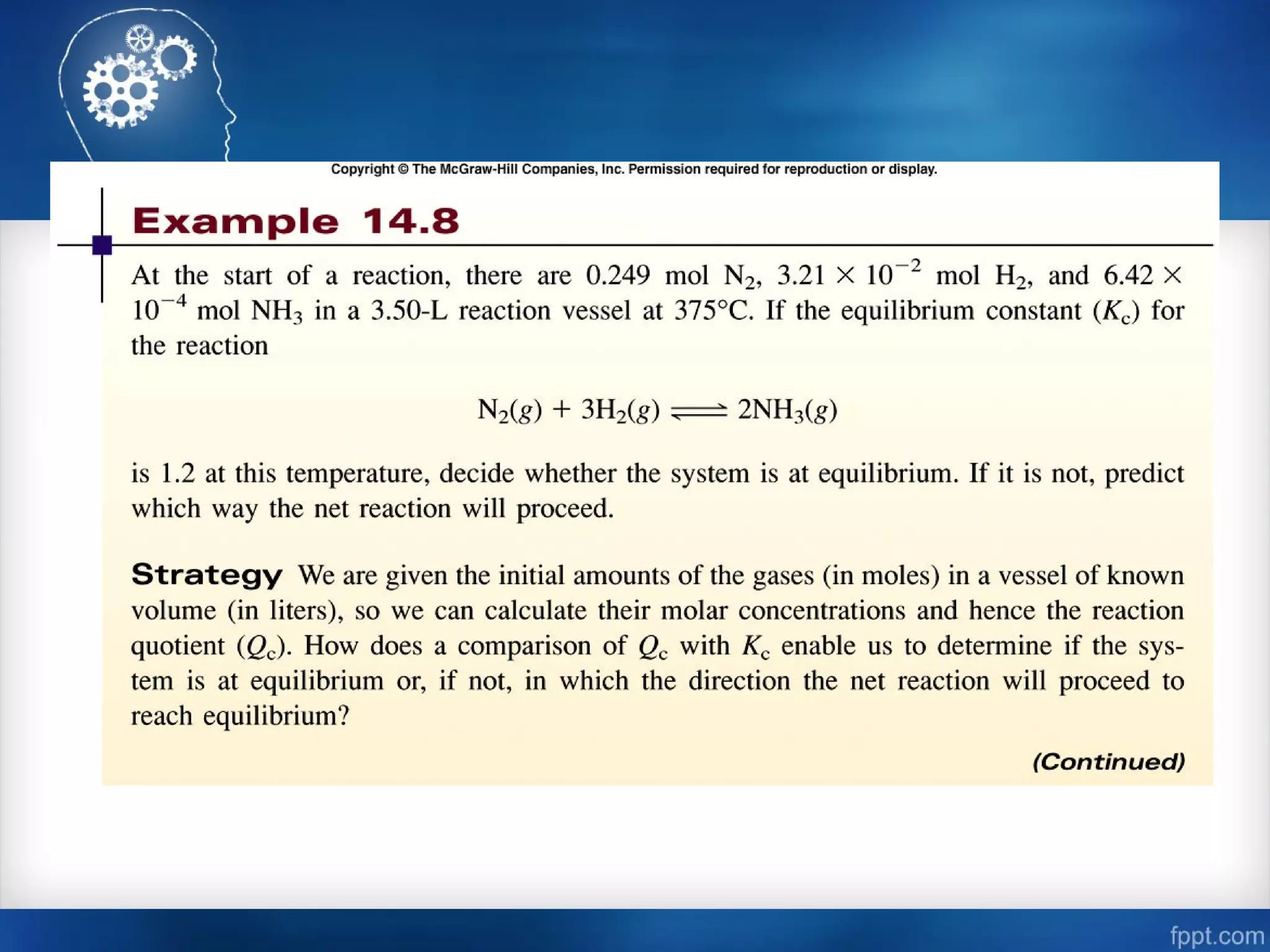
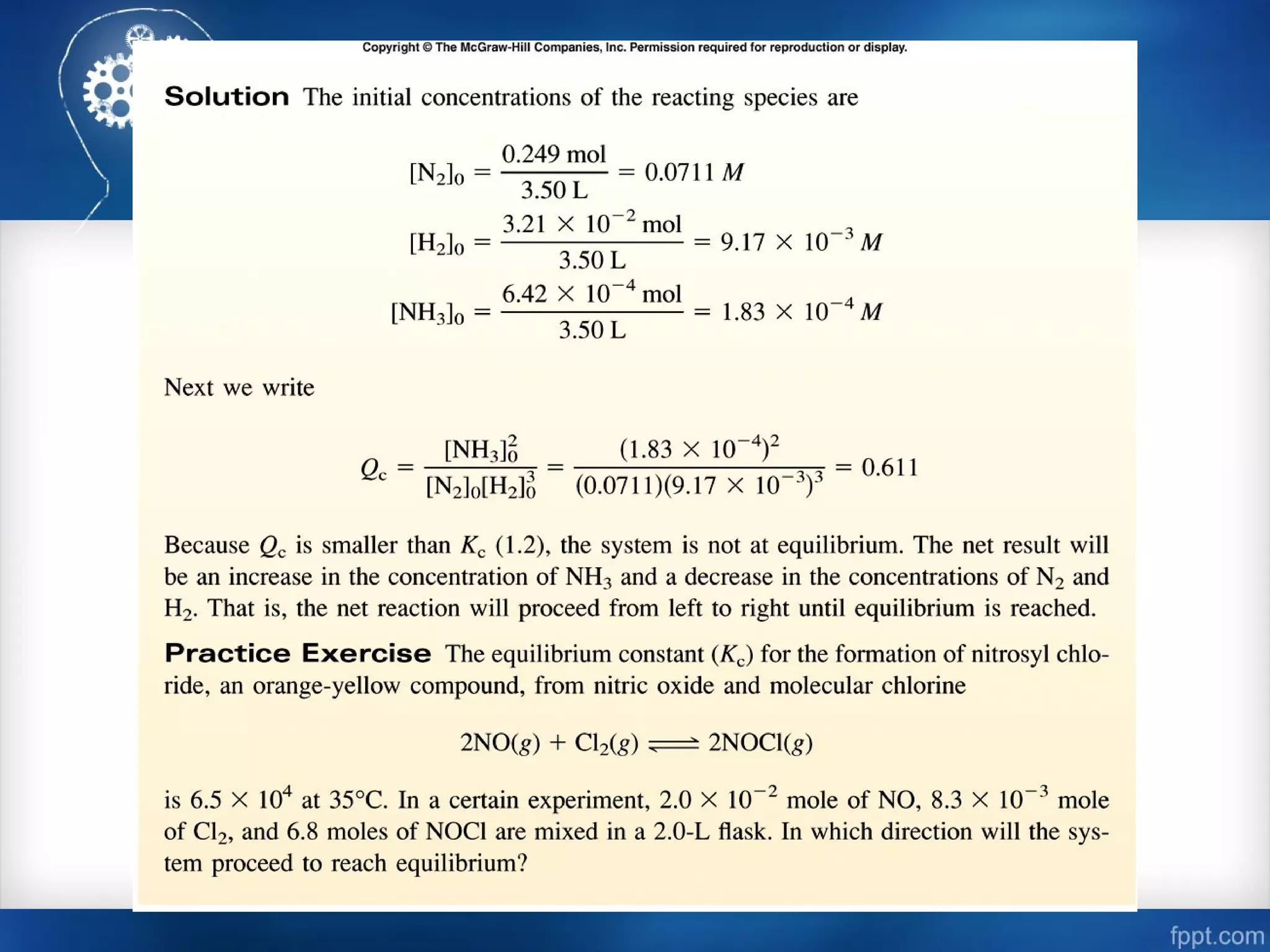
• The Kc for hydrogen iodide in the following equation is
53.4 at 430ºC. Suppose we add 0.243 mol H2, 0.146 mol
I2 and 1.98 mol HI to a 1.00L container at 430ºC. Will
there be a net reaction to form more H2 and I2 or HI?
H2 (g) + I2 (g) → 2HI (g)
[HI]0
2
[H2]0 [I2]0
Kc =
[1.98]2
[0.243] [0.146]
Kc = Kc = 111
Reaction Quotient
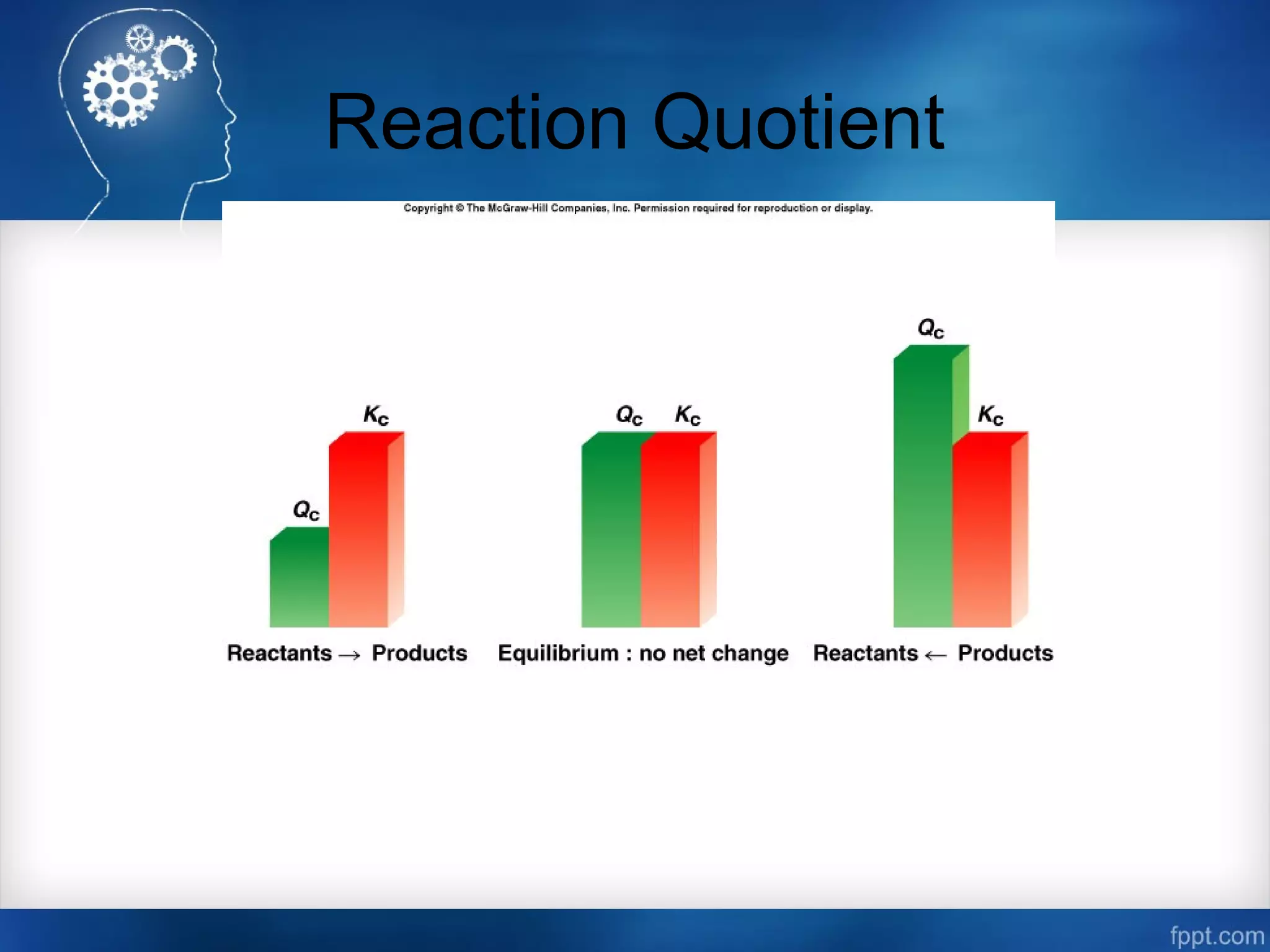
The reaction quotient (Qc) is calculated by substituting the
initial concentrations of the reactants and products into
the equilibrium constant (Kc) expression.
IF
• Qc > Kc system proceeds from right to left to
reach equilibrium
• Qc = Kc the system is at equilibrium
• Qc < Kc system proceeds from left to right to
reach equilibrium
Reaction Quotient
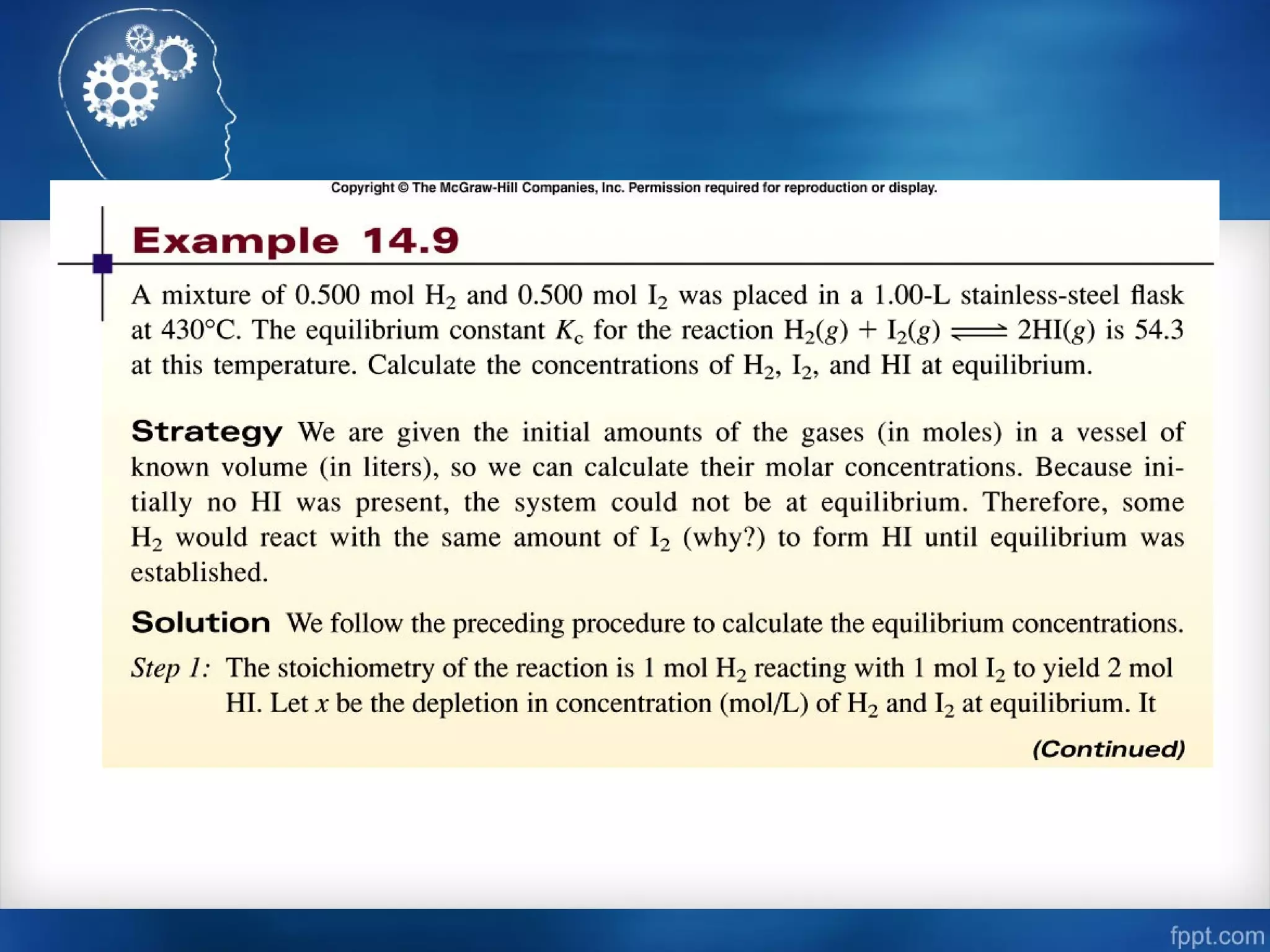
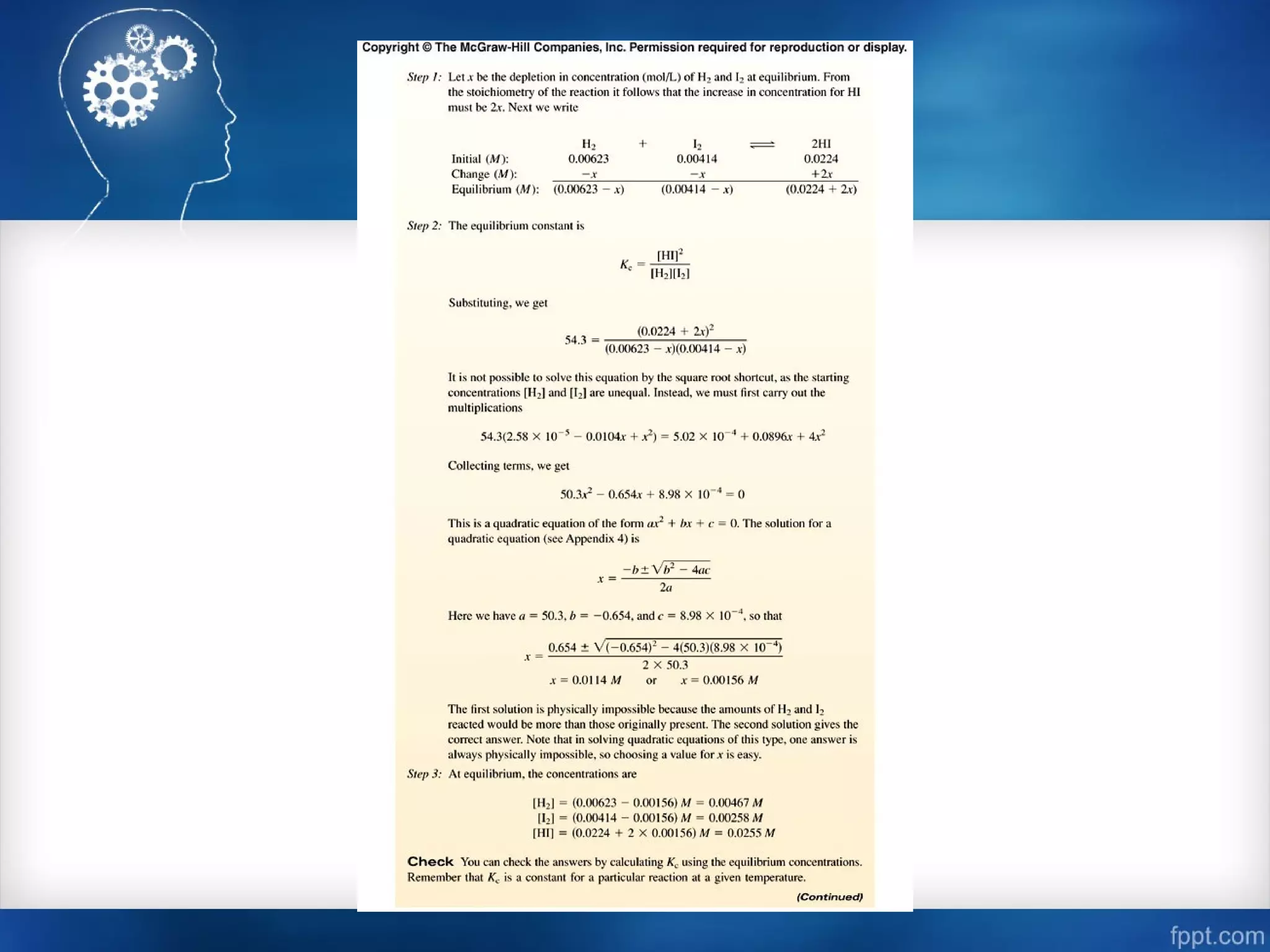
Calculating Equilibrium Concentrations
• If we know the equilibrium constant for a
reaction and the initial concentrations, we can
calculate the reactant concentrations at
equilibrium.
• ICE method
Reactants Products
Initial (M):
Change (M):
Equilibrium (M):
Calculating Equilibrium Concentrations
• At 1280ºC the equilibrium constant (Kc) for the reaction is
1.1 x 10⁻³
. If the initial concentrations are [Br2] = 0.063 M
and [Br] = 0.012 M, calculate the concentrations of these
species at equilibrium.
Br2 (g) 2Br (g)
Let x be the change in concentration of Br2
Br2 (g) 2Br (g)
Initial (M)
Change (M)
Equilibrium (M)
0.063
-x
0.063 - x
0.012
+2x
0.012 + 2x
Calculating Equilibrium Concentrations
[Br]2
[Br2]
Kc =
Kc =
(0.012 + 2x)2
0.063 - x
= 1.1 x 10⁻³
4x2
+ 0.048x + 0.000144 = 0.0000693 – 0.0011x
4x2
+ 0.0491x + 0.0000747 = 0
ax2
+ bx + c = 0 -b ± b2
– 4ac√
2a
x =
x = -0.00178
x = -0.0105
Calculating Equilibrium Concentrations
Br2 (g) 2Br (g)
Initial (M)
Change (M)
Equilibrium (M)
0.063 0.012
-x +2x
0.063 - x 0.012 + 2x
At equilibrium, [Br] = 0.012 + 2x = -0.009 M
At equilibrium, [Br2] = 0.063 – x = 0.0648 M
or 0.00844 M
Calculating Equilibrium Concentrations
• Express the equilibrium concentrations of all
species in terms of the initial concentrations and
a single unknown x, which represents the
change in concentration.
• Write the equilibrium constant expression in
terms of the equilibrium concentrations.
Knowing the value of the equilibrium constant,
solve for x.
• Having solved for x, calculate the equilibrium
concentrations of all species.
Factors that Affect Chemical
Equilibrium
• Chemical Equilibrium represents a
balance between forward and reverse
reactions.
• Changes in the following will alter the
direction of a reaction:
– Concentration
– Pressure
– Volume
– Temperature
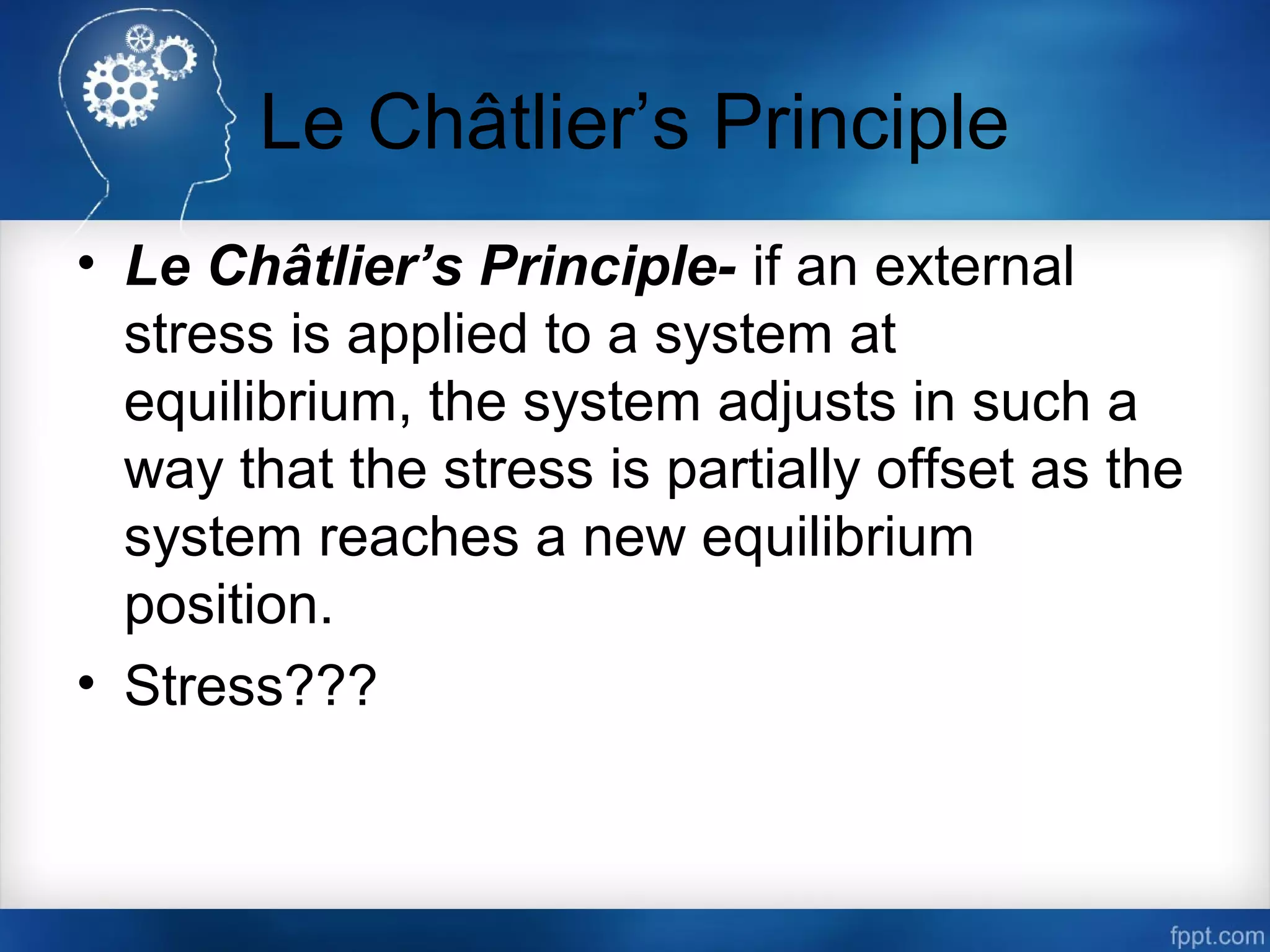
Le Châtlier’s Principle
• Le Châtlier’s Principle- if an external
stress is applied to a system at
equilibrium, the system adjusts in such a
way that the stress is partially offset as the
system reaches a new equilibrium
position.
• Stress???
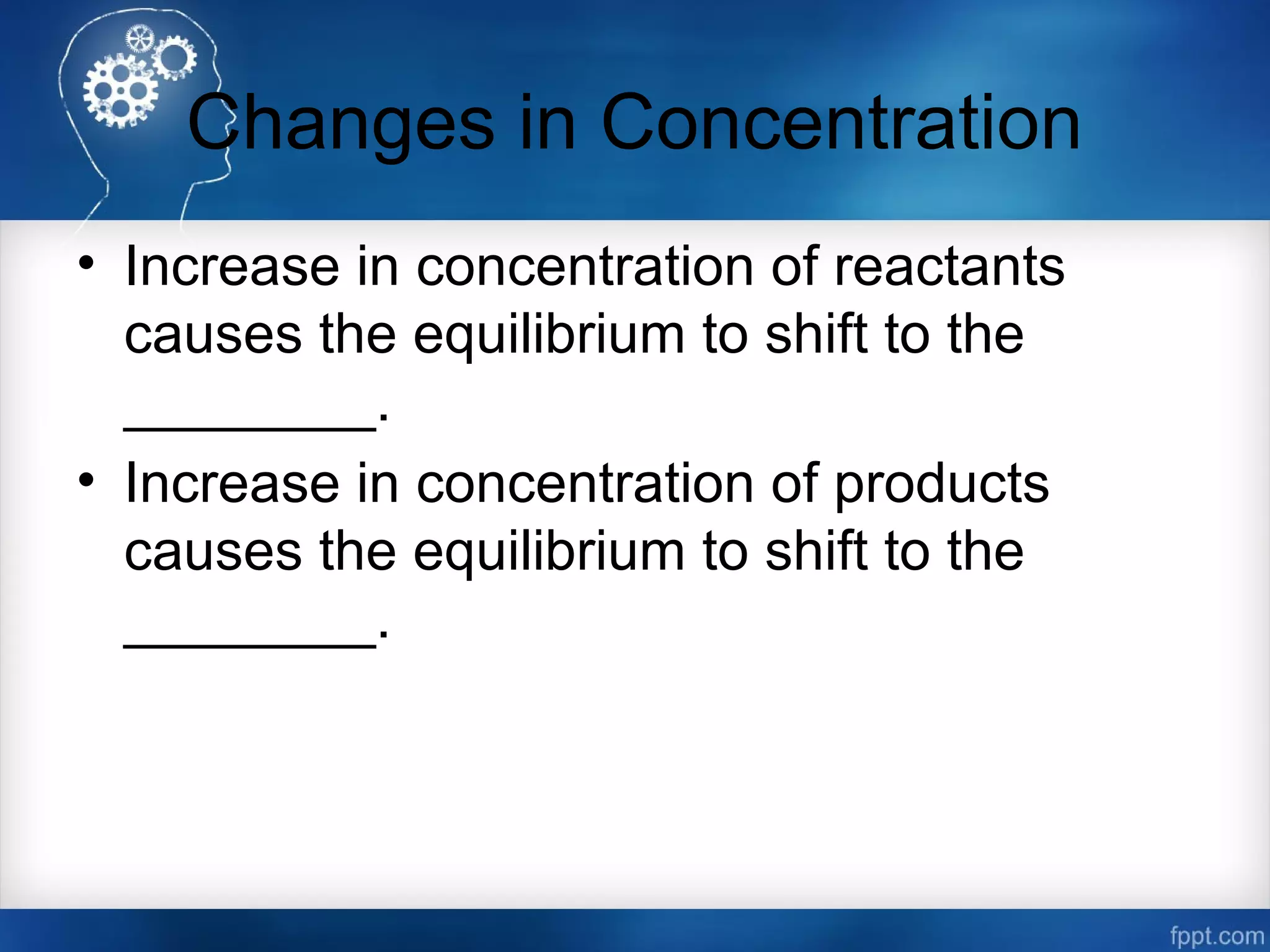
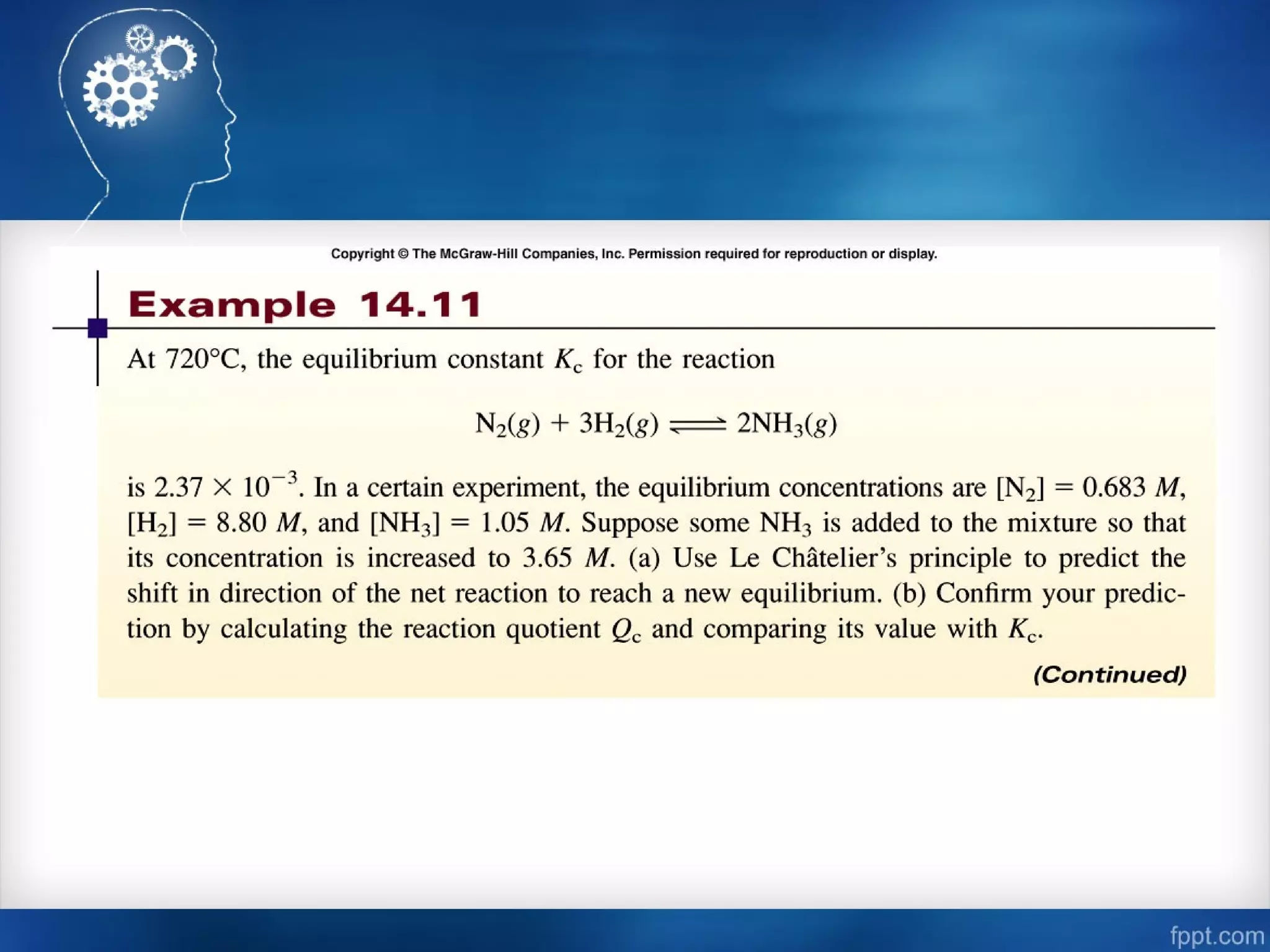
Changes in Concentration
• Increase in concentration of reactants
causes the equilibrium to shift to the
________.
• Increase in concentration of products
causes the equilibrium to shift to the
________.
Changes in Concentration
Change Shift in Equilibrium
Increase in [Products] left
Decrease in [Products] right
Increase in [Reactants] right
Decrease in [Reactants] left
Changes in Concentration
FeSCN2+
(aq) ↔ Fe3+
(aq) +
SCN-
(aq)
a.) Solution at equilibrium
b.) Increase in SCN-
(aq)
c.) Increase in Fe3+
(aq)
d.) Increase in FeSCN2+
(aq)
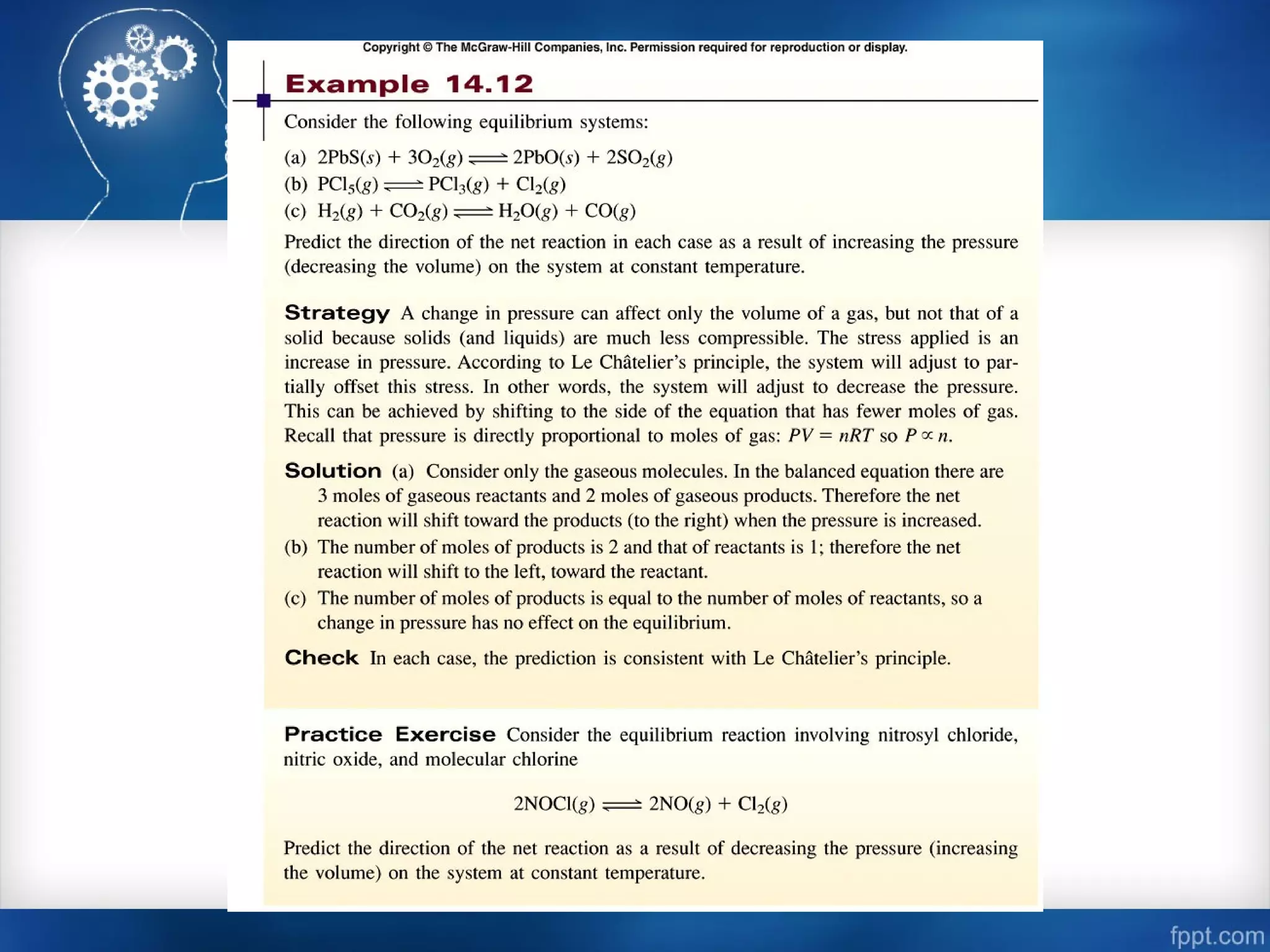
Changes in Volume and Pressure
• Changes in pressure primarily only
concern gases.
• Concentration of gases are greatly
affected by pressure changes and volume
changes according to the ideal gas law.
PV = nRT
P = (n/V)RT
Changes in Pressure and Volume
Change Shift in Equilibrium
Increase in Pressure Side with fewest moles
Decrease in Pressure Side with most moles
Increase in Volume Side with most moles
Decrease in Volume Side with fewest moles
Changes in Pressure and Volume
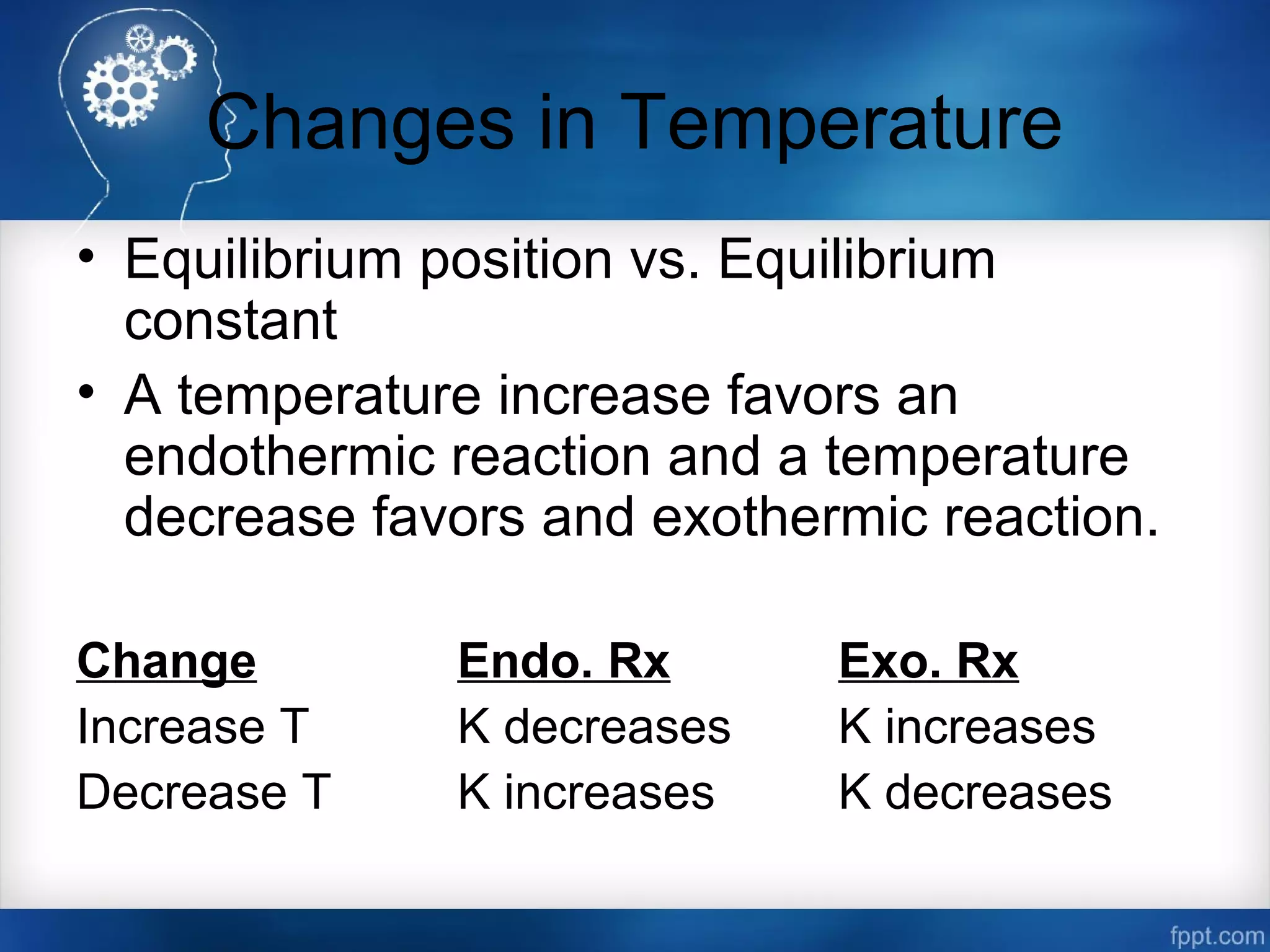
Changes in Temperature
• Equilibrium position vs. Equilibrium
constant
• A temperature increase favors an
endothermic reaction and a temperature
decrease favors and exothermic reaction.
Change Endo. Rx Exo. Rx
Increase T K decreases K increases
Decrease T K increases K decreases
Changes in Temperature
Consider: N2O4(g) ↔ 2NO2(g)
The forward reaction absorbs heat; endothermic
heat + N2O4(g) ↔ 2NO2(g)
So the reverse reaction releases heat; exothermic
2NO2(g) ↔ N2O4(g) + heat
Changes in temperature??
Effect of a catalyst
• How would the presence of a catalyst
affect the equilibrium position of a
reaction?

Chemical equilibrium

  • 1.
  • 2.
    Equilibrium Equilibrium is astate in which there are no observable changes as time goes by. Chemical equilibrium is achieved when: 1.) the rates of the forward and reverse reactions are equal and 2.) the concentrations of the reactants and products remain constant
  • 3.
    Equilibrium • There aretwo types of equilibrium: Physical and Chemical. – Physical Equilibrium • H20 (l) ↔ H20 (g) – Chemical Equilibrium • N2O4 (g) ↔ 2NO2
  • 4.
  • 5.
  • 6.
  • 7.
    Law of MassAction • Law of Mass Action- For a reversible reaction at equilibrium and constant temperature, a certain ratio of reactant and product concentrations has a constant value (K). • The Equilibrium Constant (K)- A number equal to the ratio of the equilibrium concentrations of products to the equilibrium concentrations of reactants each raised to the power of its stoichiometric coefficient.
  • 8.
    Law of MassAction • For the general reaction: K = [C]c [D]d [A]a [B]b aA (g) + bB (g) cC (g) + dD (g)
  • 9.
  • 10.
    Chemical Equilibrium • Chemicalequilibrium is defined by K. • The magnitude of K will tell us if the equilibrium reaction favors the reactants or the products. • If K » 1……..favors products • If K « 1……..favors reactants
  • 11.
    Equilibrium Constant Expressions •Equilibrium constants can be expressed using Kc or Kp. • Kc uses the concentration of reactants and products to calculate the eq. constant. • Kp uses the pressure of the gaseous reactants and products to calculate the eq. constant.
  • 12.
    Equilibrium Constant Expressions •Equilibrium Constant Equations Kc = [NO2]2 [N2O4] Kp = NO2 P2 N2O4 P aA (g) + bB (g) cC (g) + dD (g)
  • 13.
    Homogeneous Equilibrium • HomogeneousEquilibrium- applies to reactions in which all reacting species are in the same phase. N2O4 (g) ↔ 2NO2 (g) Kp = NO2 P2 N2O4 P In most cases Kc ≠ Kp Kc = [NO2]2 [N2O4]
  • 18.
    Equilibrium Constant Expressions •Relationship between Kc and Kp Kp = Kc(RT)∆n ∆n = moles of gaseous products – moles of gaseous reactants = (c + d) – (a + b)
  • 19.
    Equilibrium Constant Calculations Theequilibrium concentrations for the reaction between carbon monoxide and molecular chlorine to form COCl2 (g) at 740C are [CO] = 0.012 M, [Cl2] = 0.054 M, and [COCl2] = 0.14 M. Calculate the equilibrium constants Kc and Kp. CO (g) + Cl2 (g) COCl2 (g) Kc = [COCl2] [CO][Cl2] = 0.14 0.012 x 0.054 = 220 Kp = Kc(RT)∆n ∆n = 1 – 2 = -1 R = 0.0821 T = 273 + 74 = 347 K Kp = 220 x (0.0821 x 347)-1 = 7.7
  • 20.
    Equilibrium Constant Calculations •The equilibrium constant Kp for the reaction is 158 at 1000K. What is the equilibrium pressure of O2 if the PNO = 0.400 atm and PNO = 0.270 atm? Kp = 2 PNO PO 2 PNO 2 2 PO2 = Kp PNO 2 2 PNO 2 PO2 = 158 x (0.400)2 /(0.270)2 = 347 atm
  • 22.
    Heterogeneous Equilibrium • HeterogeneousEquilibrium- results from a reversible reaction involving reactants and products that are in different phases. • Can include liquids, gases and solids as either reactants or products. • Equilibrium expression is the same as that for a homogeneous equilibrium. • Omit pure liquids and solids from the equilibrium constant expressions.
  • 23.
    Heterogeneous Equilibrium Constant CaCO3(s) CaO (s) + CO2 (g) [CaCO3] = constant [CaO] = constant Kp = PCO2 The concentration of solids and pure liquids are not included in the expression for the equilibrium constant.
  • 24.
  • 27.
    Equilibrium Constant Calculations Considerthe following equilibrium at 295 K: The partial pressure of each gas is 0.265 atm. Calculate Kp and Kc for the reaction. NH4HS (s) NH3 (g) + H2S (g) Kp = PNH3 H2SP = 0.265 x 0.265 = 0.0702 Kp = Kc(RT)∆n Kc = Kp(RT)-∆n ∆n = 2 – 0 = 2 T = 295 K Kc = 0.0702 x (0.0821 x 295)-2 = 1.20 x 10⁻⁴
  • 29.
    Multiple Equilibria • MultipleEquilibria- Product molecules of one equilibrium constant are involved in a second equilibrium process. A + B C + D C + D E + F A + B E + F Kc‘ Kc‘‘ Kc Kc = Kc‘‘Kc‘ x Kc =‘ [C][D] [A][B] Kc =‘‘ [E][F] [C][D] [E][F] [A][B] Kc =
  • 31.
    Writing Equilibrium ConstantExpressions • The concentrations of the reacting species in the condensed phase are expressed in M. In the gaseous phase, the concentrations can be expressed in M or in atm. • The concentrations of pure solids, pure liquids and solvents do not appear in the equilibrium constant expressions. • The equilibrium constant is a dimensionless quantity. • In quoting a value for the equilibrium constant, you must specify the balanced equation and the temperature. • If a reaction can be expressed as a sum of two or more reactions, the equilibrium constant for the overall reaction is given by the product of the equilibrium constants of the individual reactions. 14.2
  • 32.
    What does theEquilibrium Constant tell us? • We can: – Predict the direction in which a reaction mixture will proceed to reach equilibrium – Calculate the concentration of reactants and products once equilibrium has been reached
  • 33.
    Predicting the Directionof a Reaction • The Kc for hydrogen iodide in the following equation is 53.4 at 430ºC. Suppose we add 0.243 mol H2, 0.146 mol I2 and 1.98 mol HI to a 1.00L container at 430ºC. Will there be a net reaction to form more H2 and I2 or HI? H2 (g) + I2 (g) → 2HI (g) [HI]0 2 [H2]0 [I2]0 Kc = [1.98]2 [0.243] [0.146] Kc = Kc = 111
  • 34.
    Reaction Quotient The reactionquotient (Qc) is calculated by substituting the initial concentrations of the reactants and products into the equilibrium constant (Kc) expression. IF • Qc > Kc system proceeds from right to left to reach equilibrium • Qc = Kc the system is at equilibrium • Qc < Kc system proceeds from left to right to reach equilibrium
  • 35.
  • 38.
    Calculating Equilibrium Concentrations •If we know the equilibrium constant for a reaction and the initial concentrations, we can calculate the reactant concentrations at equilibrium. • ICE method Reactants Products Initial (M): Change (M): Equilibrium (M):
  • 39.
    Calculating Equilibrium Concentrations •At 1280ºC the equilibrium constant (Kc) for the reaction is 1.1 x 10⁻³ . If the initial concentrations are [Br2] = 0.063 M and [Br] = 0.012 M, calculate the concentrations of these species at equilibrium. Br2 (g) 2Br (g) Let x be the change in concentration of Br2 Br2 (g) 2Br (g) Initial (M) Change (M) Equilibrium (M) 0.063 -x 0.063 - x 0.012 +2x 0.012 + 2x
  • 40.
    Calculating Equilibrium Concentrations [Br]2 [Br2] Kc= Kc = (0.012 + 2x)2 0.063 - x = 1.1 x 10⁻³ 4x2 + 0.048x + 0.000144 = 0.0000693 – 0.0011x 4x2 + 0.0491x + 0.0000747 = 0 ax2 + bx + c = 0 -b ± b2 – 4ac√ 2a x = x = -0.00178 x = -0.0105
  • 41.
    Calculating Equilibrium Concentrations Br2(g) 2Br (g) Initial (M) Change (M) Equilibrium (M) 0.063 0.012 -x +2x 0.063 - x 0.012 + 2x At equilibrium, [Br] = 0.012 + 2x = -0.009 M At equilibrium, [Br2] = 0.063 – x = 0.0648 M or 0.00844 M
  • 42.
    Calculating Equilibrium Concentrations •Express the equilibrium concentrations of all species in terms of the initial concentrations and a single unknown x, which represents the change in concentration. • Write the equilibrium constant expression in terms of the equilibrium concentrations. Knowing the value of the equilibrium constant, solve for x. • Having solved for x, calculate the equilibrium concentrations of all species.
  • 47.
    Factors that AffectChemical Equilibrium • Chemical Equilibrium represents a balance between forward and reverse reactions. • Changes in the following will alter the direction of a reaction: – Concentration – Pressure – Volume – Temperature
  • 48.
    Le Châtlier’s Principle •Le Châtlier’s Principle- if an external stress is applied to a system at equilibrium, the system adjusts in such a way that the stress is partially offset as the system reaches a new equilibrium position. • Stress???
  • 49.
    Changes in Concentration •Increase in concentration of reactants causes the equilibrium to shift to the ________. • Increase in concentration of products causes the equilibrium to shift to the ________.
  • 50.
    Changes in Concentration ChangeShift in Equilibrium Increase in [Products] left Decrease in [Products] right Increase in [Reactants] right Decrease in [Reactants] left
  • 51.
    Changes in Concentration FeSCN2+ (aq)↔ Fe3+ (aq) + SCN- (aq) a.) Solution at equilibrium b.) Increase in SCN- (aq) c.) Increase in Fe3+ (aq) d.) Increase in FeSCN2+ (aq)
  • 54.
    Changes in Volumeand Pressure • Changes in pressure primarily only concern gases. • Concentration of gases are greatly affected by pressure changes and volume changes according to the ideal gas law. PV = nRT P = (n/V)RT
  • 55.
    Changes in Pressureand Volume Change Shift in Equilibrium Increase in Pressure Side with fewest moles Decrease in Pressure Side with most moles Increase in Volume Side with most moles Decrease in Volume Side with fewest moles
  • 56.
  • 58.
    Changes in Temperature •Equilibrium position vs. Equilibrium constant • A temperature increase favors an endothermic reaction and a temperature decrease favors and exothermic reaction. Change Endo. Rx Exo. Rx Increase T K decreases K increases Decrease T K increases K decreases
  • 59.
    Changes in Temperature Consider:N2O4(g) ↔ 2NO2(g) The forward reaction absorbs heat; endothermic heat + N2O4(g) ↔ 2NO2(g) So the reverse reaction releases heat; exothermic 2NO2(g) ↔ N2O4(g) + heat Changes in temperature??
  • 60.
    Effect of acatalyst • How would the presence of a catalyst affect the equilibrium position of a reaction?

Editor's Notes

  • #3 In equilibrium, the concentration on reactants and products remains constant. Constant transfer. Although it seems like there are no more reactions taking place, r to p and p to r formation is continuously occurring. There are several types of equilibrium reactions that can occur and we will discuss all of them. In this chapter we will be looking at the types of equilibrium reactions, the equilibrium constant and its relationship to the rate constant and factors that can disrupt a system at equilibrium. Most reactions are reversible. As soon as p forms, r begins to reform. R then forms more p.
  • #4 Physical- equilibrium between two phases of the same substance. Changes that occur are physical. Chemical- equilibrium chemists are more interested in this b/c the progress of the reaction can be easily monitored.
  • #5 Liquid water in equilibrium with its vapor. The number of water molecules leaving the liquid is equivalent to those returning to the liquid.
  • #6 Reversible reaction between nitrogen dioxide and dinitrogen tetroxide forms an orange colored product. Nit. Di. Is colorless and dinit. Tet. Is brown. Brown forms immediately, followed by the color lightnening due to reverse reaction occurring.
  • #7 a.) initially only NO2 b.) Initially only N2O4 c.) Mixture Equilibrium always occurs and at app. The same time.
  • #11 Greater than 1 = any number greater than 10 Less than 1 = any number less than 0.1
  • #19 R = 0.0821 L x atm/K x mol
  • #23 Liquids and solids are “1” in these problems because they are a constant. Molar concentration is density. Density never changes regardless of quantity present.
  • #25 Partial pressure of CO2 does not change regardless of the changes in concentration of solids. Temp. has to stay the same.
  • #30 Quote the balanced equation, temperature given from the calculation. This is because the different ways to balance the equation will result in different equilibrium values.
  • #33 Only true for point of equilibrium.