Chatbot using python
Ambrish Santoki
12102040703001
Madhuben and Bhanubhai Patel Institute of Technology
Outline
 Introduction of Project
 Technology Used
 Proposed Work
 System Design (Diagrams)
 Implementation
 Future Work
 Conclusion
 References
Introduction of Project
 Chatbot is a application which has a database, it has an app l and APIs to call the
other external administrations. However, bots cannot comprehend about what the
customer has planned. It is a very much common problem that must be tackled. Bots
are generally trained according to the past information which is only available to them.
So in most of the organizations, chatbot maintains their logs of discussions so that they
can understand their customers behaviour.
 Developers utilize these logs to analyse what clients are trying to ask. Developers
coordinate their with their client inquiries and reply with the best appropriate answer
with the blend of machine learning tools and models. Training a chatbot is very much
faster and also on a large scale as compared to human beings. A customer support
chatbot is filled with a very large number of conversation logs which help the chatbot
to understand what kinds of questions should be asked and answers should be given.
While a normal customer service representatives are given manual instructions which
they have to go through with. The chatbots is based on three methods:
Technology Used
 Natural Language Processing (NLP) Libraries:
NLTK (Natural Language Toolkit): It provides various tools and algorithms for tokenization, stemming,
tagging, parsing, and semantic reasoning.
spaCy: A popular NLP library that offers efficient tokenization, part-of-speech tagging, named entity
recognition, and dependency parsing.
Gensim: Useful for topic modeling, similarity analysis, and document indexing.
 Chatbot Frameworks:
ChatterBot: A Python library that employs machine learning algorithms to generate conversational
responses.
Rasa: An open-source framework for building chatbots using machine learning and natural language
understanding.
 Web Frameworks:
Flask: A lightweight web framework suitable for building chatbot APIs and integrating them
into web applications.
Django: A more comprehensive web framework that provides tools for handling user
requests,sessions, and managing databases.
Proposed Work
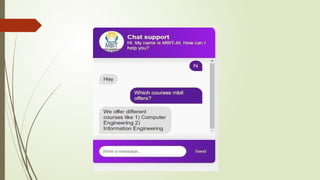
 The proposed system aims to develop a chatbot using Python for providing efficient and
automated customer support. The chatbot will interact with customers, understand their queries,
and provide appropriate responses, reducing the need for human intervention. Here's an outline of
the proposed system:
User Interface
Natural Language Understanding (NLU):
Response Generation:
Knowledge Base:
Machine Learning:
Integration with APIs and Services:
 By implementing this proposed chatbot system, businesses can enhance their customer support
capabilities, provide faster responses, and reduce the workload on support teams. It will result in
improved customer satisfaction, increased efficiency, and cost savings for the organization.
Implementation
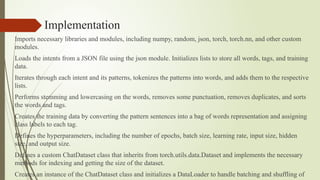
Imports necessary libraries and modules, including numpy, random, json, torch, torch.nn, and other custom
modules.
Loads the intents from a JSON file using the json module. Initializes lists to store all words, tags, and training
data.
Iterates through each intent and its patterns, tokenizes the patterns into words, and adds them to the respective
lists.
Performs stemming and lowercasing on the words, removes some punctuation, removes duplicates, and sorts
the words and tags.
Creates the training data by converting the pattern sentences into a bag of words representation and assigning
class labels to each tag.
Defines the hyperparameters, including the number of epochs, batch size, learning rate, input size, hidden
size, and output size.
Defines a custom ChatDataset class that inherits from torch.utils.data.Dataset and implements the necessary
methods for indexing and getting the size of the dataset.
Creates an instance of the ChatDataset class and initializes a DataLoader to handle batching and shuffling of
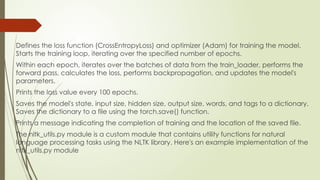
Defines the loss function (CrossEntropyLoss) and optimizer (Adam) for training the model.
Starts the training loop, iterating over the specified number of epochs.
Within each epoch, iterates over the batches of data from the train_loader, performs the
forward pass, calculates the loss, performs backpropagation, and updates the model's
parameters.
Prints the loss value every 100 epochs.
Saves the model's state, input size, hidden size, output size, words, and tags to a dictionary.
Saves the dictionary to a file using the torch.save() function.
Prints a message indicating the completion of training and the location of the saved file.
The nltk_utils.py module is a custom module that contains utility functions for natural
language processing tasks using the NLTK library. Here's an example implementation of the
nltk_utils.py module
Future Work
 Improved Natural Language Understanding (NLU):
Enhance the chatbot's ability to understand user input by incorporating more advanced natural language
processing (NLP) techniques. This can include using pre-trained language models like GPT-3 or BERT to
improve the chatbot's understanding of context, entity recognition, and sentiment analysis.
 Contextual Conversation Management:
Implement a memory component in the chatbot to enable contextual conversation management. This can involve
maintaining a history of user interactions and leveraging that information to provide more accurate and context-
aware responses. Techniques like attention mechanisms or recurrent neural networks can be employed to capture
and utilize conversational context.
 Intent Classification and Entity Extraction:
Strengthen the chatbot's intent classification and entity extraction capabilities. This can involve training the
model on a larger and more diverse dataset to improve accuracy. Additionally, explore advanced techniques like
deep learning models, such as LSTM or transformers, to handle complex language understanding tasks.
Conclusion
 In conclusion, developing a chatbot using Python can provide numerous benefits for various
applications. Throughout the project, we have successfully implemented a chatbot that can
understand user input, classify intents, and generate appropriate responses. The chatbot utilizes
natural language processing techniques, neural network models, and data handling mechanisms
to achieve its functionality.
 The chatbot's key components include preprocessing the training data, creating a dataset, and
training a neural network model. We leveraged the NLTK library for text tokenization and
stemming, and PyTorch for building and training the neural network model. The model was
trained using a dataset consisting of intents and patterns, and it learned to classify user inputs into
specific intent categories.
References
 Bayan Abu Shawar and Eric Atwell, 2007 “Chatbots: Are they Really Useful?”
 LDV Forum - GLDV Journal for Computational Linguistics and Language Technology.
 http://www.ldv-forum.org/2007_Heft1/Bayan_AbuShawar _and_Eric_Atwell.pdf
 Bringing chatbots into education: Towards natural language negotiation of open learner models.
Know.- Based Syst. 20, 2 (Mar. 2007), 177-185.
 Intelligent Tutoring Systems: Prospects for Guided Practice and Efficient Learning. Whitepaper
for the Army's Science of Learning Workshop, Hampton, VA. Aug 1-3, 2006.
Chatbot using Python, mini project presentation

  • 1.
    Chatbot using python AmbrishSantoki 12102040703001 Madhuben and Bhanubhai Patel Institute of Technology
  • 2.
    Outline  Introduction ofProject  Technology Used  Proposed Work  System Design (Diagrams)  Implementation  Future Work  Conclusion  References
  • 3.
    Introduction of Project Chatbot is a application which has a database, it has an app l and APIs to call the other external administrations. However, bots cannot comprehend about what the customer has planned. It is a very much common problem that must be tackled. Bots are generally trained according to the past information which is only available to them. So in most of the organizations, chatbot maintains their logs of discussions so that they can understand their customers behaviour.  Developers utilize these logs to analyse what clients are trying to ask. Developers coordinate their with their client inquiries and reply with the best appropriate answer with the blend of machine learning tools and models. Training a chatbot is very much faster and also on a large scale as compared to human beings. A customer support chatbot is filled with a very large number of conversation logs which help the chatbot to understand what kinds of questions should be asked and answers should be given. While a normal customer service representatives are given manual instructions which they have to go through with. The chatbots is based on three methods:
  • 4.
    Technology Used  NaturalLanguage Processing (NLP) Libraries: NLTK (Natural Language Toolkit): It provides various tools and algorithms for tokenization, stemming, tagging, parsing, and semantic reasoning. spaCy: A popular NLP library that offers efficient tokenization, part-of-speech tagging, named entity recognition, and dependency parsing. Gensim: Useful for topic modeling, similarity analysis, and document indexing.  Chatbot Frameworks: ChatterBot: A Python library that employs machine learning algorithms to generate conversational responses. Rasa: An open-source framework for building chatbots using machine learning and natural language understanding.  Web Frameworks: Flask: A lightweight web framework suitable for building chatbot APIs and integrating them into web applications. Django: A more comprehensive web framework that provides tools for handling user requests,sessions, and managing databases.
  • 5.
    Proposed Work  Theproposed system aims to develop a chatbot using Python for providing efficient and automated customer support. The chatbot will interact with customers, understand their queries, and provide appropriate responses, reducing the need for human intervention. Here's an outline of the proposed system: User Interface Natural Language Understanding (NLU): Response Generation: Knowledge Base: Machine Learning: Integration with APIs and Services:  By implementing this proposed chatbot system, businesses can enhance their customer support capabilities, provide faster responses, and reduce the workload on support teams. It will result in improved customer satisfaction, increased efficiency, and cost savings for the organization.
  • 6.
    Implementation Imports necessary librariesand modules, including numpy, random, json, torch, torch.nn, and other custom modules. Loads the intents from a JSON file using the json module. Initializes lists to store all words, tags, and training data. Iterates through each intent and its patterns, tokenizes the patterns into words, and adds them to the respective lists. Performs stemming and lowercasing on the words, removes some punctuation, removes duplicates, and sorts the words and tags. Creates the training data by converting the pattern sentences into a bag of words representation and assigning class labels to each tag. Defines the hyperparameters, including the number of epochs, batch size, learning rate, input size, hidden size, and output size. Defines a custom ChatDataset class that inherits from torch.utils.data.Dataset and implements the necessary methods for indexing and getting the size of the dataset. Creates an instance of the ChatDataset class and initializes a DataLoader to handle batching and shuffling of
  • 7.
    Defines the lossfunction (CrossEntropyLoss) and optimizer (Adam) for training the model. Starts the training loop, iterating over the specified number of epochs. Within each epoch, iterates over the batches of data from the train_loader, performs the forward pass, calculates the loss, performs backpropagation, and updates the model's parameters. Prints the loss value every 100 epochs. Saves the model's state, input size, hidden size, output size, words, and tags to a dictionary. Saves the dictionary to a file using the torch.save() function. Prints a message indicating the completion of training and the location of the saved file. The nltk_utils.py module is a custom module that contains utility functions for natural language processing tasks using the NLTK library. Here's an example implementation of the nltk_utils.py module
  • 9.
    Future Work  ImprovedNatural Language Understanding (NLU): Enhance the chatbot's ability to understand user input by incorporating more advanced natural language processing (NLP) techniques. This can include using pre-trained language models like GPT-3 or BERT to improve the chatbot's understanding of context, entity recognition, and sentiment analysis.  Contextual Conversation Management: Implement a memory component in the chatbot to enable contextual conversation management. This can involve maintaining a history of user interactions and leveraging that information to provide more accurate and context- aware responses. Techniques like attention mechanisms or recurrent neural networks can be employed to capture and utilize conversational context.  Intent Classification and Entity Extraction: Strengthen the chatbot's intent classification and entity extraction capabilities. This can involve training the model on a larger and more diverse dataset to improve accuracy. Additionally, explore advanced techniques like deep learning models, such as LSTM or transformers, to handle complex language understanding tasks.
  • 10.
    Conclusion  In conclusion,developing a chatbot using Python can provide numerous benefits for various applications. Throughout the project, we have successfully implemented a chatbot that can understand user input, classify intents, and generate appropriate responses. The chatbot utilizes natural language processing techniques, neural network models, and data handling mechanisms to achieve its functionality.  The chatbot's key components include preprocessing the training data, creating a dataset, and training a neural network model. We leveraged the NLTK library for text tokenization and stemming, and PyTorch for building and training the neural network model. The model was trained using a dataset consisting of intents and patterns, and it learned to classify user inputs into specific intent categories.
  • 11.
    References  Bayan AbuShawar and Eric Atwell, 2007 “Chatbots: Are they Really Useful?”  LDV Forum - GLDV Journal for Computational Linguistics and Language Technology.  http://www.ldv-forum.org/2007_Heft1/Bayan_AbuShawar _and_Eric_Atwell.pdf  Bringing chatbots into education: Towards natural language negotiation of open learner models. Know.- Based Syst. 20, 2 (Mar. 2007), 177-185.  Intelligent Tutoring Systems: Prospects for Guided Practice and Efficient Learning. Whitepaper for the Army's Science of Learning Workshop, Hampton, VA. Aug 1-3, 2006.