SCRIPTWRITING – Seymour B. Sanchez
 The fictional character can be represented in this
way:
 Around 10-15% -What we actually learn about the
person
 Around 20-25% -What we can deduce about the
person
 Around 60-70% - Everything we do not need to know
about the person
 Always try to find some easily recognizable trait
for the person and decide what other people’s
first impression of this person is.
 PHYSICAL COMPONENT
 Sex
 Age
 Build (thin, tall, athletic) and bearing
 Attractive or unattractive physical attributes
 Color and style of hair
 Typical clothing and condition of clothing
 Gestures and mimicry
 Way of talking (accent, slang, articulation)
 Any defects (deformities, illness)
 SOCIOLOGICAL COMPONENT
 Ethnic background and nationality
 Social class
 Education
 Profession (income, working conditions)
 Living conditions
 SOCIOLOGICAL COMPONENT
 Family (married / single, children, relations with
other family members)
 Friends (at work and outside of work)
 Hobbies, interests
 Political views and affiliations
 Religious views and affiliations
 Name
 PSYCHOLOGICAL COMPONENT
 Ambitions (long and short-term objectives)
 Frustrations (everything that prevents him or her
from achieving his/her objectives)
 Dreams (which the character may think
unattainable)
 Personal weaknesses
 Temperament
 Intelligence
 PSYCHOLOGICAL COMPONENT
 Attitude toward life (optimistic /pessimistic,
rebellious, happy, altruistic, selfish)
 Fundamental values (concrete expressions of
what the person holds dear, e.g., family, life, hard
work)
 Romantic / sexual disposition
 Complexes (inhibitions, phobias, fixed ideas)
 Special talents (music, sport)
 Character traits can be shown in the following
ways:
 Through action (what the person tries to do and how
he tries to do it)
 Through reaction (how the person reacts to new
situations and do what other people do)
 Through the reactions of others
 Through dialogue (particularly what the other person
does not say, what he hides; incidentally, his way of
speaking is just as important as what he says)
 Through his appearance, clothes, and
characteristic patterns of behavior
 Through his relationship to props
 Through his relationship to his setting
 Through contrast with what others do
 Through name
A trait of character is often enhanced if the person is
allowed to display minor traits which contradict
the main attribute (e.g., A ruthless man is more
dangerous if he is shown to be thoughtful and
loving in certain situations.)
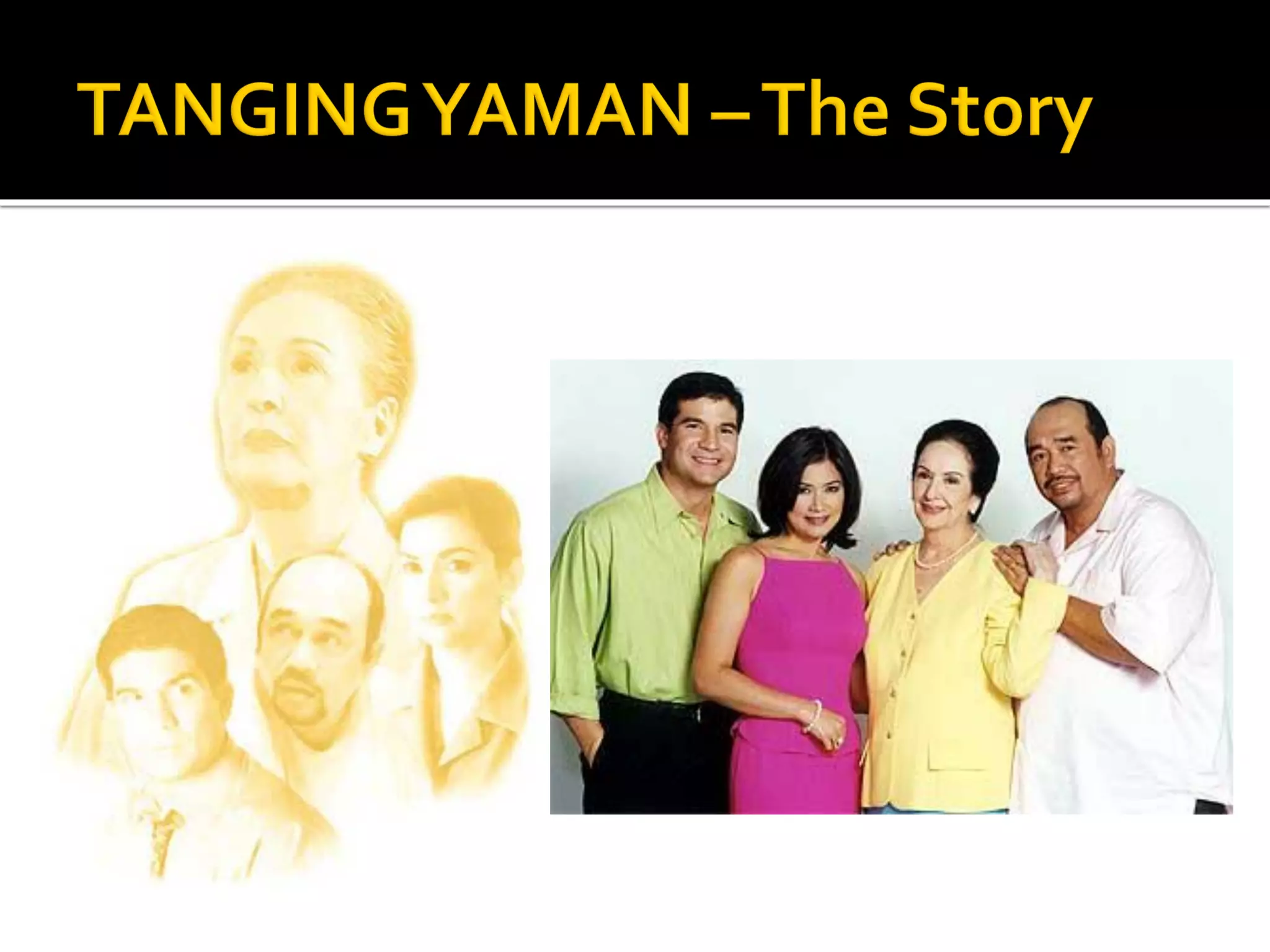
 Dolores (Loleng) Rosales, 74 years old;
widow; mother of Danilo, Gracia, andArturo;
mestiza; comes from a rich family; educated;
kind mother; religious; likes music; will have
Alzheimer’s disease.
 THE PAMPANGA BRANCH OFTHE FAMILY
 THE L.A. BRANCH OFTHE FAMILY
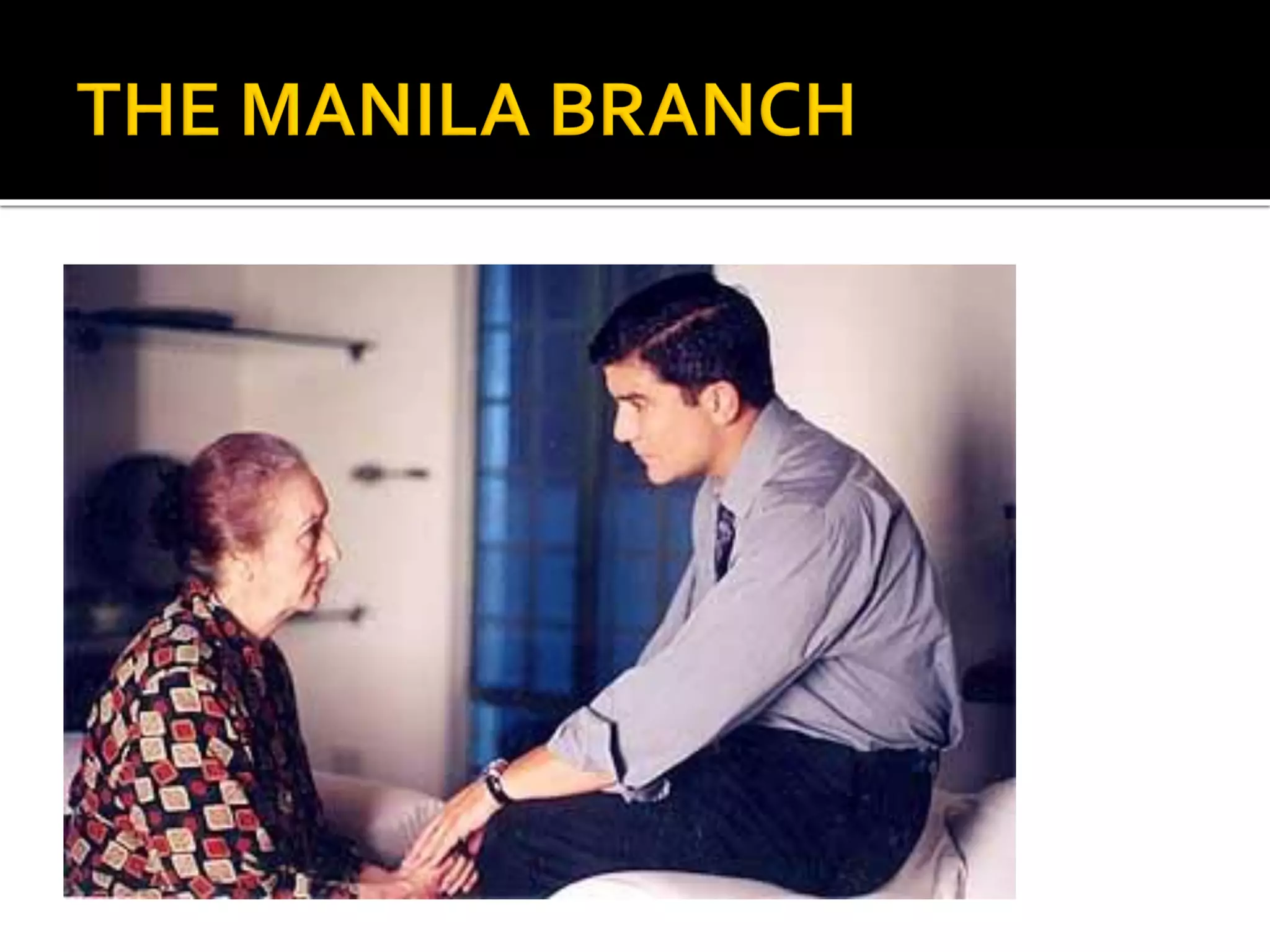
 THE MANILA BRANCH OFTHE FAMILY
 Danny, 45 years old; eldest among the
Rosales children; former black sheep of the
family; did not graduate from college; owns
three tricycles which are not brand new;
knows auto mechanics; lives with his mother
and family; not trusted by his siblings until
now; sweet and kind husband and father to
his children.
 Celine, 40 years old; Danny’s wife; daughter
of anAmerican whom Danny met in Manila
when they were still young and married
without their parents knowing about it; has
no finesse but a kind daughter-in-law, loyal
wife, and knows how to take care of Danny
and their children; good cook; industrious.
 Danilo Jr. (Boyet), 22 years old; eldest child of
Danny and Celine; intelligent and ambitious;
wants to be a successful lawyer like hisTito
Art; graduating UP student.
 Chona, 16 years old; inherited Loleng’s ability
to sing and play the piano; simple provincial
lass; religious.
 Carina (Cacay), 8 years old; closest to Lola;
kind yet naughty; active; everyone’s “baby.”
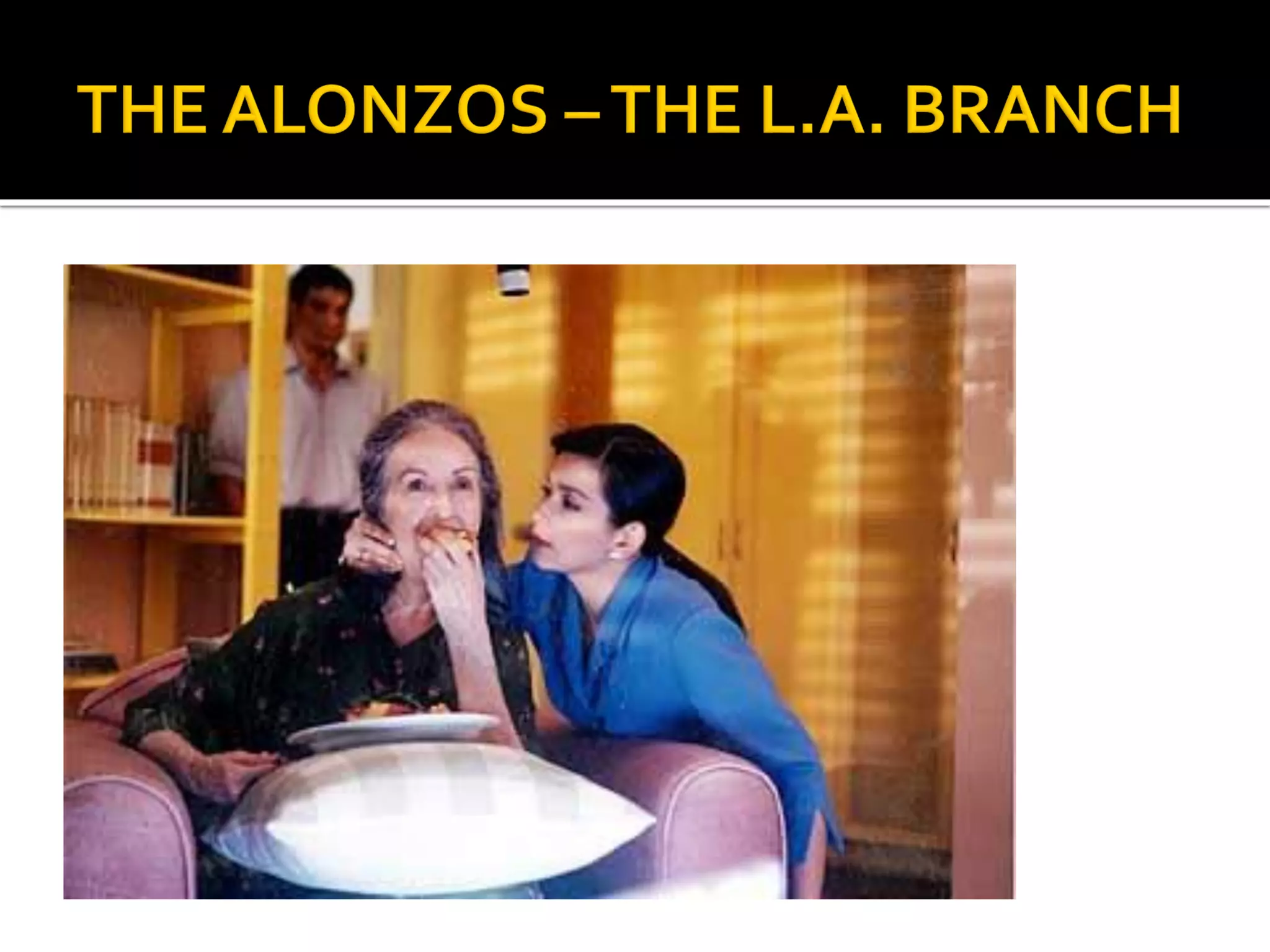
 Grace Rosales Alonzo, 36 years old; youngest
child of Loleng; mestiza; graduated from an
exclusive girls’ school in Manila; grew up
spoiled and pampered; defied her mother by
following the dictates of her heart and
marrying her college sweetheart who is not
rich; migrated to America where she works all
the time; her beauty faded, she became out
of shape but tough; because it is difficult to
earn money in America, she becomes too
practical and obsessed with money; in the
process, she becomes emotionally distant from
her kids and husband, forgetting the reasons
why she fell in love with him; works in a nursing
home
 Francis, 40 years old; Grace’s husband; has very
Pinoy features; kind, industrious, understanding,
not demanding; through the years he is still very
much in love with Grace; a loving father to his
children and always defends Grace from
them; their children are closer to him; works
as a mailman.
 Madeleine, 17 years old; looks like her
Mommy but is closer to her Daddy; always at
odds with Grace; hasAmerican views and
manner of speaking.
 Andrew, 15 years old; studious; quiet; cute;
his mother’s baby.
 Art, 42 years old; second child of Loleng;
good lawyer; selfish; dominant; thinks that he
is always right; his inner character is hidden
by his usual demeanor and outer appearance.
 Nanette, 39 years old; Art’s wife; intelligent;
educated; careerwoman; her work involves
frequent trips to the provinces; assertive and
confident in the workplace but subservient to
Art at home; frustrated because their family
life is not harmonious.
 Rommel, 20 years old; forced by his father to
study medicine but he is really wants to take
up FineArts; doesn’t want his life to be
“boxed”; secretly hates his father but he fears
him; interested in photography.
 John-john, 12 years old; nerdy; likes to watch
TV; more well-adjusted than Rommel.
 Joel, 20 years old; Boyet’s childhood friend;
finished his two-year course sa Marine
Engineering; just waiting for the approval of
his papers to become a seaman; in the
meantime, he drives one of Danny’s tricycles;
wants to go abroad since he was young; will
fall in love with Madeleine.
 Manang Gunding, 55 years old; Loleng’s long-
time maid; treated like one of the members
of the family.
 Fr. Lito, 50 years old; Chaplain of DMI and
parish priest of the church in Angeles where
Loleng goes.
 Cris, 40’s; Danny’s childhood friend who is a
real estate agent.
 Marta, 40 years old; maid of Art and Nanette;
loyal; usually has tantrums.
 Fr. Perez, 50 years old; hearsArt’s confession.
 Dr. Arvisu, Loleng’s physician.
 Chief of Police, Danny’s friend; will help in
looking for Rommel.
 Young Grace, 18 years old; mestiza; has a
beautiful and gentle face; slim.
 Girl at the Skating Rink, 15 years old; cute;
Rommel somehow connects with her
although he doesn’t know her; through her,
Rommel musters the courage to stand up to
his father.
 Three siblings are now well settled with their
respective families, in widely contrasting
lifestyles.The one common thing that binds
them loosely together is the love that their
mother holds for all of them and her
grandchildren, albeit expressed in varying ways
and degrees, but always equally nurturing and
self-giving. Much as they are held together by
her, they are in turn separated by physical
distance and the sad legacy left behind by their
deceased, erstwhile strong-willed father.
 Long suppressed pains and resentments
unravel as the three siblings argue over the
prospect of selling a vast track of land left
behind by the patriarch.The process also
brings to surface the hurts between parents
and children, a likely spectacle of the “sins of
the father visiting upon the children,”
threatening to spill over to the third
generation.
 What stuff each one is made of faces its true test
when the family matriarch, in an act richly
resonant with ritual Christian self-offering, yields
her whole being to the God of Providence and
succumbs to a debilitating disease. Do her
beloved children unite, or do the frayed
relationships finally break up?
 The family saga is a stark and poignant
dramatization of provincial values vs. urban
survival instincts precariously held in the balance
by the abiding love, hope, and faith against the
gnawing disease of the spirit brought by
cynicism, materialism, and an unforgiving heart.
 The most common error in writing dialogues
is to load them with too much information
IMAGE SOUND
INFORMATION 70% 30%
EMOTION 30% 70%
 Many a good film story is weakened by poor
dialogue. One good way of getting it right is
first to try to write the scene with no dialogue
at all.
 What is the purpose of the scene?
 What do the characters want?
 What actually happens?
 Can this be shown through physical action,
gesture, looks, props, setting?
 Dialogue must be realistic and credible in its context
When characters speak, we should have the impression
that these people speak in this way and no other
 The dialogue should characterize the person who
speaks
The way he expresses himself tells us a great deal about
him
 The dialogue must express the speaker’s mood
The way it is expressed is more important than the words
spoken
 The dialogue should characterize the person being
spoken to or about
 If we see a person who is disdainful and insolent toward
everybody but becomes cautious and respectful when a
certain person appears, the newcomer does not need to say
or do anything
 The dialogue should move the action forward
 It should be a driving force in the drama
 Dialogue should give information
 But the information should come naturally from the
context and not be placed in the mouths of the characters
 Dialogue should sound natural and not made up
 But everyday speech is full of repetition and
superfluity – it contains too many words and
inessentials
 Selection
 Concentration
 Compactness
 Film dialogue simulates real speech but does not copy it
 It must also be based on oral rather than written forms
 Film dialogue is not grammatically correct
 Gestures, exclamations and actions should take the place
of the spoken word whenever possible
 The intensity of the dialogue should reflect the intensity of
the situation
 A less intense scene permits dialogue that is more discursive
 In a dramatically heightened situation, the dialogue is more
compressed and spare
 The lines should be written so that they say
one thing at a time
 Lines should be as short as possible
 Any superfluous words should be dropped
DON’T “Yes, but surely one should consider people’s
anxiety and fear as well.”
DO “People are scared.
Should we ignore that?”
TV debate
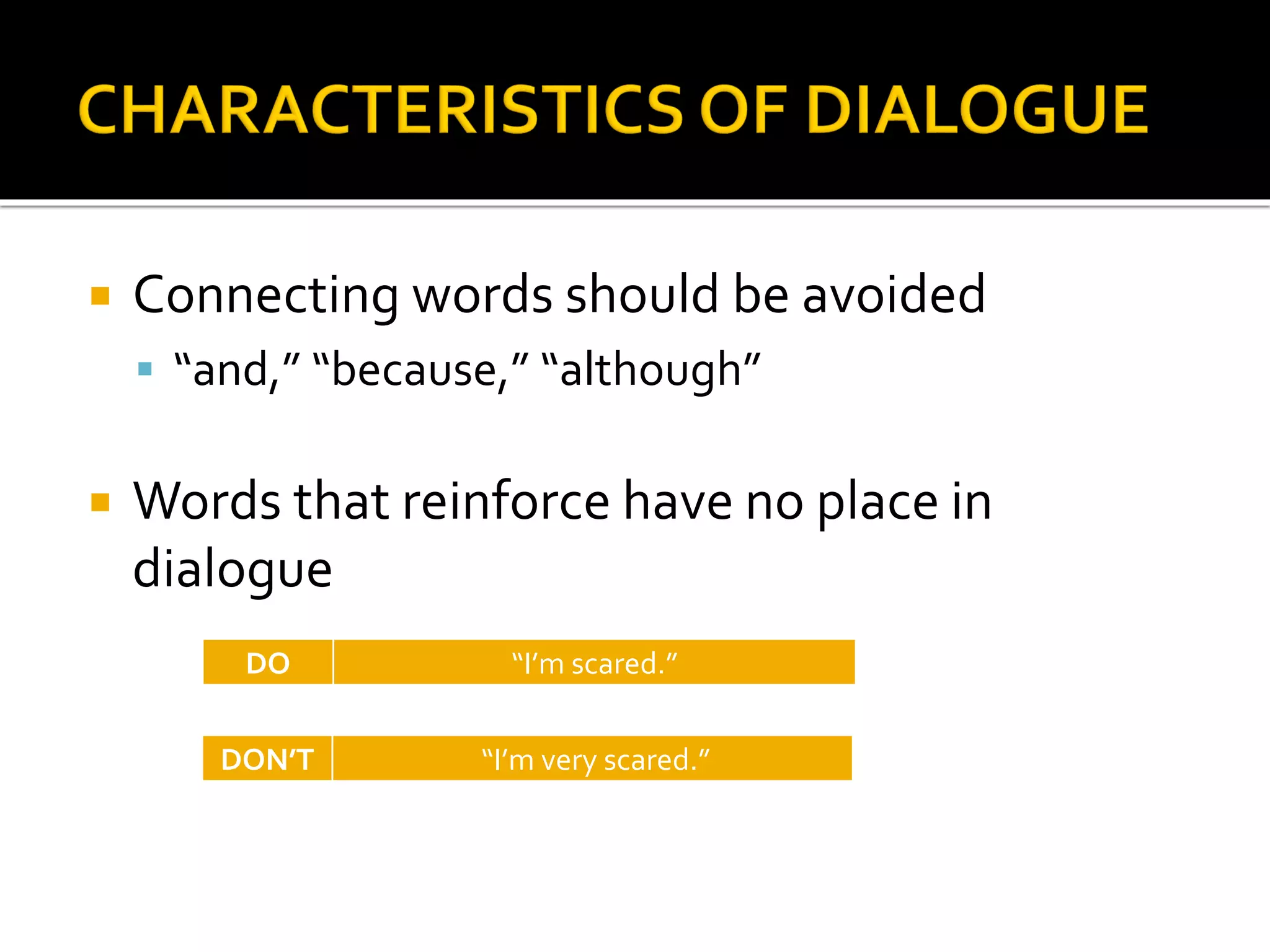
 Connecting words should be avoided
 “and,” “because,” “although”
 Words that reinforce have no place in
dialogue
DO “I’m scared.”
DON’T “I’m very scared.”
TEXT SUB-TEXTand
wording of the
dialogue,
conventional
meaning of the
words
deeper veiled
meaning, behind
the words
true intentions and
goals of the
characters
in the real
– and often
unspoken – rapport
between the
characters
Sub-text
“I love you”
Text Text Text Text
Sub-text
“I hate you”
Text
“I love you”

Character and Dialogues

  • 1.
  • 2.
     The fictionalcharacter can be represented in this way:  Around 10-15% -What we actually learn about the person  Around 20-25% -What we can deduce about the person  Around 60-70% - Everything we do not need to know about the person  Always try to find some easily recognizable trait for the person and decide what other people’s first impression of this person is.
  • 3.
     PHYSICAL COMPONENT Sex  Age  Build (thin, tall, athletic) and bearing  Attractive or unattractive physical attributes  Color and style of hair  Typical clothing and condition of clothing  Gestures and mimicry  Way of talking (accent, slang, articulation)  Any defects (deformities, illness)
  • 4.
     SOCIOLOGICAL COMPONENT Ethnic background and nationality  Social class  Education  Profession (income, working conditions)  Living conditions
  • 5.
     SOCIOLOGICAL COMPONENT Family (married / single, children, relations with other family members)  Friends (at work and outside of work)  Hobbies, interests  Political views and affiliations  Religious views and affiliations  Name
  • 6.
     PSYCHOLOGICAL COMPONENT Ambitions (long and short-term objectives)  Frustrations (everything that prevents him or her from achieving his/her objectives)  Dreams (which the character may think unattainable)  Personal weaknesses  Temperament  Intelligence
  • 7.
     PSYCHOLOGICAL COMPONENT Attitude toward life (optimistic /pessimistic, rebellious, happy, altruistic, selfish)  Fundamental values (concrete expressions of what the person holds dear, e.g., family, life, hard work)  Romantic / sexual disposition  Complexes (inhibitions, phobias, fixed ideas)  Special talents (music, sport)
  • 8.
     Character traitscan be shown in the following ways:  Through action (what the person tries to do and how he tries to do it)  Through reaction (how the person reacts to new situations and do what other people do)  Through the reactions of others  Through dialogue (particularly what the other person does not say, what he hides; incidentally, his way of speaking is just as important as what he says)
  • 9.
     Through hisappearance, clothes, and characteristic patterns of behavior  Through his relationship to props  Through his relationship to his setting  Through contrast with what others do  Through name A trait of character is often enhanced if the person is allowed to display minor traits which contradict the main attribute (e.g., A ruthless man is more dangerous if he is shown to be thoughtful and loving in certain situations.)
  • 11.
     Dolores (Loleng)Rosales, 74 years old; widow; mother of Danilo, Gracia, andArturo; mestiza; comes from a rich family; educated; kind mother; religious; likes music; will have Alzheimer’s disease.  THE PAMPANGA BRANCH OFTHE FAMILY  THE L.A. BRANCH OFTHE FAMILY  THE MANILA BRANCH OFTHE FAMILY
  • 13.
     Danny, 45years old; eldest among the Rosales children; former black sheep of the family; did not graduate from college; owns three tricycles which are not brand new; knows auto mechanics; lives with his mother and family; not trusted by his siblings until now; sweet and kind husband and father to his children.
  • 14.
     Celine, 40years old; Danny’s wife; daughter of anAmerican whom Danny met in Manila when they were still young and married without their parents knowing about it; has no finesse but a kind daughter-in-law, loyal wife, and knows how to take care of Danny and their children; good cook; industrious.
  • 15.
     Danilo Jr.(Boyet), 22 years old; eldest child of Danny and Celine; intelligent and ambitious; wants to be a successful lawyer like hisTito Art; graduating UP student.  Chona, 16 years old; inherited Loleng’s ability to sing and play the piano; simple provincial lass; religious.  Carina (Cacay), 8 years old; closest to Lola; kind yet naughty; active; everyone’s “baby.”
  • 17.
     Grace RosalesAlonzo, 36 years old; youngest child of Loleng; mestiza; graduated from an exclusive girls’ school in Manila; grew up spoiled and pampered; defied her mother by following the dictates of her heart and marrying her college sweetheart who is not rich; migrated to America where she works all the time; her beauty faded, she became out of shape but tough; because it is difficult to
  • 18.
    earn money inAmerica, she becomes too practical and obsessed with money; in the process, she becomes emotionally distant from her kids and husband, forgetting the reasons why she fell in love with him; works in a nursing home  Francis, 40 years old; Grace’s husband; has very Pinoy features; kind, industrious, understanding, not demanding; through the years he is still very much in love with Grace; a loving father to his
  • 19.
    children and alwaysdefends Grace from them; their children are closer to him; works as a mailman.  Madeleine, 17 years old; looks like her Mommy but is closer to her Daddy; always at odds with Grace; hasAmerican views and manner of speaking.  Andrew, 15 years old; studious; quiet; cute; his mother’s baby.
  • 21.
     Art, 42years old; second child of Loleng; good lawyer; selfish; dominant; thinks that he is always right; his inner character is hidden by his usual demeanor and outer appearance.  Nanette, 39 years old; Art’s wife; intelligent; educated; careerwoman; her work involves frequent trips to the provinces; assertive and confident in the workplace but subservient to Art at home; frustrated because their family life is not harmonious.
  • 22.
     Rommel, 20years old; forced by his father to study medicine but he is really wants to take up FineArts; doesn’t want his life to be “boxed”; secretly hates his father but he fears him; interested in photography.  John-john, 12 years old; nerdy; likes to watch TV; more well-adjusted than Rommel.
  • 23.
     Joel, 20years old; Boyet’s childhood friend; finished his two-year course sa Marine Engineering; just waiting for the approval of his papers to become a seaman; in the meantime, he drives one of Danny’s tricycles; wants to go abroad since he was young; will fall in love with Madeleine.  Manang Gunding, 55 years old; Loleng’s long- time maid; treated like one of the members of the family.
  • 24.
     Fr. Lito,50 years old; Chaplain of DMI and parish priest of the church in Angeles where Loleng goes.  Cris, 40’s; Danny’s childhood friend who is a real estate agent.  Marta, 40 years old; maid of Art and Nanette; loyal; usually has tantrums.  Fr. Perez, 50 years old; hearsArt’s confession.  Dr. Arvisu, Loleng’s physician.
  • 25.
     Chief ofPolice, Danny’s friend; will help in looking for Rommel.  Young Grace, 18 years old; mestiza; has a beautiful and gentle face; slim.  Girl at the Skating Rink, 15 years old; cute; Rommel somehow connects with her although he doesn’t know her; through her, Rommel musters the courage to stand up to his father.
  • 27.
     Three siblingsare now well settled with their respective families, in widely contrasting lifestyles.The one common thing that binds them loosely together is the love that their mother holds for all of them and her grandchildren, albeit expressed in varying ways and degrees, but always equally nurturing and self-giving. Much as they are held together by her, they are in turn separated by physical distance and the sad legacy left behind by their deceased, erstwhile strong-willed father.
  • 28.
     Long suppressedpains and resentments unravel as the three siblings argue over the prospect of selling a vast track of land left behind by the patriarch.The process also brings to surface the hurts between parents and children, a likely spectacle of the “sins of the father visiting upon the children,” threatening to spill over to the third generation.
  • 29.
     What stuffeach one is made of faces its true test when the family matriarch, in an act richly resonant with ritual Christian self-offering, yields her whole being to the God of Providence and succumbs to a debilitating disease. Do her beloved children unite, or do the frayed relationships finally break up?  The family saga is a stark and poignant dramatization of provincial values vs. urban survival instincts precariously held in the balance by the abiding love, hope, and faith against the gnawing disease of the spirit brought by cynicism, materialism, and an unforgiving heart.
  • 30.
     The mostcommon error in writing dialogues is to load them with too much information IMAGE SOUND INFORMATION 70% 30% EMOTION 30% 70%
  • 31.
     Many agood film story is weakened by poor dialogue. One good way of getting it right is first to try to write the scene with no dialogue at all.  What is the purpose of the scene?  What do the characters want?  What actually happens?  Can this be shown through physical action, gesture, looks, props, setting?
  • 32.
     Dialogue mustbe realistic and credible in its context When characters speak, we should have the impression that these people speak in this way and no other  The dialogue should characterize the person who speaks The way he expresses himself tells us a great deal about him  The dialogue must express the speaker’s mood The way it is expressed is more important than the words spoken
  • 33.
     The dialogueshould characterize the person being spoken to or about  If we see a person who is disdainful and insolent toward everybody but becomes cautious and respectful when a certain person appears, the newcomer does not need to say or do anything  The dialogue should move the action forward  It should be a driving force in the drama  Dialogue should give information  But the information should come naturally from the context and not be placed in the mouths of the characters
  • 34.
     Dialogue shouldsound natural and not made up  But everyday speech is full of repetition and superfluity – it contains too many words and inessentials  Selection  Concentration  Compactness
  • 35.
     Film dialoguesimulates real speech but does not copy it  It must also be based on oral rather than written forms  Film dialogue is not grammatically correct  Gestures, exclamations and actions should take the place of the spoken word whenever possible  The intensity of the dialogue should reflect the intensity of the situation  A less intense scene permits dialogue that is more discursive  In a dramatically heightened situation, the dialogue is more compressed and spare
  • 36.
     The linesshould be written so that they say one thing at a time  Lines should be as short as possible  Any superfluous words should be dropped DON’T “Yes, but surely one should consider people’s anxiety and fear as well.” DO “People are scared. Should we ignore that?” TV debate
  • 37.
     Connecting wordsshould be avoided  “and,” “because,” “although”  Words that reinforce have no place in dialogue DO “I’m scared.” DON’T “I’m very scared.”
  • 38.
    TEXT SUB-TEXTand wording ofthe dialogue, conventional meaning of the words deeper veiled meaning, behind the words true intentions and goals of the characters in the real – and often unspoken – rapport between the characters
  • 39.
  • 40.