Regional Economic
Integration
CHAPTER 3
Regional Economic Integration
• Refers to agreements among countries in a
geographic region tor educe, and ultimately
remove, tariff and non tariff barriers to the free flow
of goods, services and factors of production
between each other.
• Regional economic integration also known as
trade blocs .
Levels of Economic Integration
1. Free Trade Area
2. Customs Union
3. Common Market
4. Economic Union
5. Political Union
• Free Trade Area: all barriers to the trade of
goods and services among member countries are
removed.
Levels of Integration
• Customs Union: eliminates trade barriers between
member countries and adopts a common external trade
policy.
• Common Market: Has no barriers to trade between
member countries, includes a common external trade
policy, and allows factors of production to move freely
between members.
• Economic Union: involves free flow of products and
factors of production between member countries and
adoption of a common external trade policy. It also
requires common currency, harmonization of members’
tax rates, and a common monetary and fiscal policy.
Levels of Integration
• Political Union: Moving toward economic union,
raises questions of how to coordinate bureaucracy
accountable to the citizens of member nations.
Political union in which a central political apparatus
coordinates the economic, social, and foreign policy
of the member states is the answer.
Case for regional integration
• Economic case:
• Unrestricted free trade will allow countries to
specialize in production of goods and services that
they can produce most efficiently.
• Allowing free trade stimulates econmic growth
• FDI can transfer technological, marketing and
managerial know-how to host nations
• It is easier to establish a free trade regional
agreement among a free countries than with say
WTO.
Case for regional integration
• Political case:
• Linking economies together and creating
dependencies forces them to resolve conflicts in an
amiable manner
• By grouping their economies, the regional countries
can enhance their political clout in the world
Disadvantages trade to integration
• Loss of sovereignty: giving up controls in fiscal
and monetary policy as well as tax rates
• Loss of jobs – in some sectors
o NAFTA – USA and Canada workers lost jobs in the textile and
other low-cost jobs
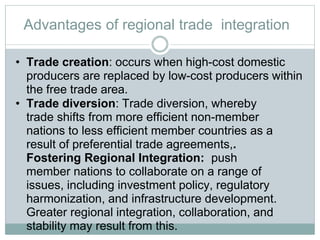
Advantages of regional trade integration
• Trade creation: occurs when high-cost domestic
producers are replaced by low-cost producers within
the free trade area.
• Trade diversion: Trade diversion, whereby
trade shifts from more efficient non-member
nations to less efficient member countries as a
result of preferential trade agreements,.
Fostering Regional Integration: push
member nations to collaborate on a range of
issues, including investment policy, regulatory
harmonization, and infrastructure development.
Greater regional integration, collaboration, and
stability may result from this.
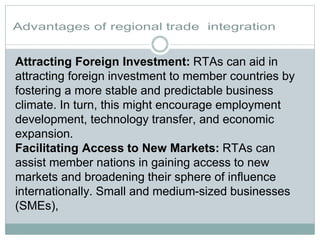
Attracting Foreign Investment: RTAs can aid in
attracting foreign investment to member countries by
fostering a more stable and predictable business
climate. In turn, this might encourage employment
development, technology transfer, and economic
expansion.
Facilitating Access to New Markets: RTAs can
assist member nations in gaining access to new
markets and broadening their sphere of influence
internationally. Small and medium-sized businesses
(SMEs),
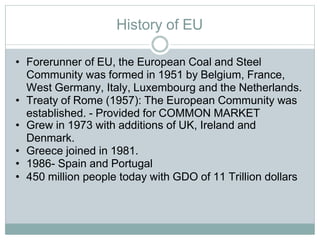
History of EU
• Forerunner of EU, the European Coal and Steel
Community was formed in 1951 by Belgium, France,
West Germany, Italy, Luxembourg and the Netherlands.
• Treaty of Rome (1957): The European Community was
established. - Provided for COMMON MARKET
• Grew in 1973 with additions of UK, Ireland and
Denmark.
• Greece joined in 1981.
• 1986- Spain and Portugal
• 450 million people today with GDO of 11 Trillion dollars
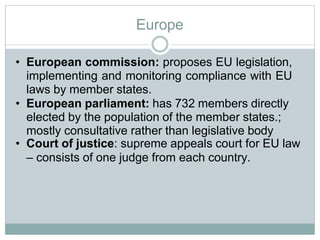
Europe
• European commission: proposes EU legislation,
implementing and monitoring compliance with EU
laws by member states.
• European parliament: has 732 members directly
elected by the population of the member states.;
mostly consultative rather than legislative body
• Court of justice: supreme appeals court for EU law
– consists of one judge from each country.
Regional Trade Unions
• NAFTA: USA, Canada, Mexico
• Andean Pact: Bolivia, Chile, Ecuador, Colombia and
Peru (now operates as a customs union including
Venezuela but minus Chile)
• MERCOSUR – originated with Brazil and Argentina
0 includes Paraguay and Uruguay.
• ASEAN: Brunei, Cambodia, Indonesia, Laos,
Malaysia, Myanmar, Philippines, Singapore,
Thailand, Vietnam
END
THANK YOU

chapter3.pptx

  • 1.
  • 2.
    Regional Economic Integration •Refers to agreements among countries in a geographic region tor educe, and ultimately remove, tariff and non tariff barriers to the free flow of goods, services and factors of production between each other. • Regional economic integration also known as trade blocs .
  • 3.
    Levels of EconomicIntegration 1. Free Trade Area 2. Customs Union 3. Common Market 4. Economic Union 5. Political Union • Free Trade Area: all barriers to the trade of goods and services among member countries are removed.
  • 4.
    Levels of Integration •Customs Union: eliminates trade barriers between member countries and adopts a common external trade policy. • Common Market: Has no barriers to trade between member countries, includes a common external trade policy, and allows factors of production to move freely between members. • Economic Union: involves free flow of products and factors of production between member countries and adoption of a common external trade policy. It also requires common currency, harmonization of members’ tax rates, and a common monetary and fiscal policy.
  • 5.
    Levels of Integration •Political Union: Moving toward economic union, raises questions of how to coordinate bureaucracy accountable to the citizens of member nations. Political union in which a central political apparatus coordinates the economic, social, and foreign policy of the member states is the answer.
  • 6.
    Case for regionalintegration • Economic case: • Unrestricted free trade will allow countries to specialize in production of goods and services that they can produce most efficiently. • Allowing free trade stimulates econmic growth • FDI can transfer technological, marketing and managerial know-how to host nations • It is easier to establish a free trade regional agreement among a free countries than with say WTO.
  • 7.
    Case for regionalintegration • Political case: • Linking economies together and creating dependencies forces them to resolve conflicts in an amiable manner • By grouping their economies, the regional countries can enhance their political clout in the world
  • 8.
    Disadvantages trade tointegration • Loss of sovereignty: giving up controls in fiscal and monetary policy as well as tax rates • Loss of jobs – in some sectors o NAFTA – USA and Canada workers lost jobs in the textile and other low-cost jobs
  • 9.
    Advantages of regionaltrade integration • Trade creation: occurs when high-cost domestic producers are replaced by low-cost producers within the free trade area. • Trade diversion: Trade diversion, whereby trade shifts from more efficient non-member nations to less efficient member countries as a result of preferential trade agreements,. Fostering Regional Integration: push member nations to collaborate on a range of issues, including investment policy, regulatory harmonization, and infrastructure development. Greater regional integration, collaboration, and stability may result from this.
  • 10.
    Attracting Foreign Investment:RTAs can aid in attracting foreign investment to member countries by fostering a more stable and predictable business climate. In turn, this might encourage employment development, technology transfer, and economic expansion. Facilitating Access to New Markets: RTAs can assist member nations in gaining access to new markets and broadening their sphere of influence internationally. Small and medium-sized businesses (SMEs),
  • 11.
    History of EU •Forerunner of EU, the European Coal and Steel Community was formed in 1951 by Belgium, France, West Germany, Italy, Luxembourg and the Netherlands. • Treaty of Rome (1957): The European Community was established. - Provided for COMMON MARKET • Grew in 1973 with additions of UK, Ireland and Denmark. • Greece joined in 1981. • 1986- Spain and Portugal • 450 million people today with GDO of 11 Trillion dollars
  • 12.
    Europe • European commission:proposes EU legislation, implementing and monitoring compliance with EU laws by member states. • European parliament: has 732 members directly elected by the population of the member states.; mostly consultative rather than legislative body • Court of justice: supreme appeals court for EU law – consists of one judge from each country.
  • 13.
    Regional Trade Unions •NAFTA: USA, Canada, Mexico • Andean Pact: Bolivia, Chile, Ecuador, Colombia and Peru (now operates as a customs union including Venezuela but minus Chile) • MERCOSUR – originated with Brazil and Argentina 0 includes Paraguay and Uruguay. • ASEAN: Brunei, Cambodia, Indonesia, Laos, Malaysia, Myanmar, Philippines, Singapore, Thailand, Vietnam
  • 14.