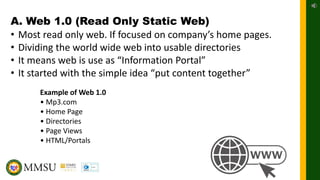
A. Web 1.0(Read Only Static Web)
• Most read only web. If focused on company’s home pages.
• Dividing the world wide web into usable directories
• It means web is use as “Information Portal”
• It started with the simple idea “put content together”
Example of Web 1.0
• Mp3.com
• Home Page
• Directories
• Page Views
• HTML/Portals
7.
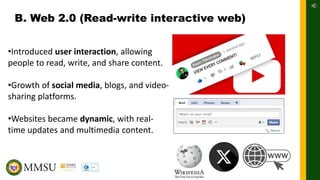
B. Web 2.0(Read-write interactive web)
•Introduced user interaction, allowing
people to read, write, and share content.
•Growth of social media, blogs, and video-
sharing platforms.
•Websites became dynamic, with real-
time updates and multimedia content.
8.
Example of Web2.0
are the following:
• Social Networking
• Example Facebook, Twitter, LinkedIn, Google+, Pinterest,
Tumblr, Instagram and Page
• B. Blogs
• Example Wordpress Blogger Tumbler
• C. Wikis
• Example:
Wikipedia,Wikibooks,Wikiversity,Commons,Wiktionary,Wikiqu
ote Wikivoyage,Wikidata,Wikinews,Wikispecies, MediaWiki
• D. Video Sharing Sites
• Example: Youtube, Facebook, LinkedIn,Flickr,
Photobucket,LinkedIn,Flickr Photobucket,Twitter, Veoh,
Dailymotion,VimeoPRO, Myspace.com, Metacafe
9.
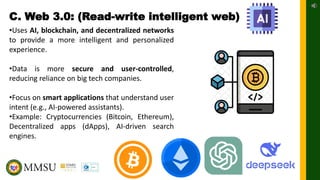
C. Web 3.0:(Read-write intelligent web)
•Uses AI, blockchain, and decentralized networks
to provide a more intelligent and personalized
experience.
•Data is more secure and user-controlled,
reducing reliance on big tech companies.
•Focus on smart applications that understand user
intent (e.g., AI-powered assistants).
•Example: Cryptocurrencies (Bitcoin, Ethereum),
Decentralized apps (dApps), AI-driven search
engines.
10.
Types of websites:
1.eCommerce Website
2. Business Website
3. Entertainment Website
4. Media Website
5. Brochure Website
6. Nonprofit Website
7. Educational Website
8. Personal Website
9. Web Portal
10. Wiki or Community Forum Website
13.
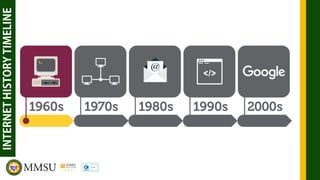
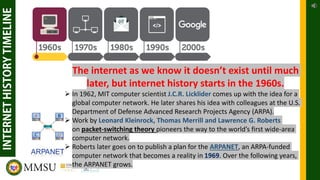
The internet aswe know it doesn’t exist until much
later, but internet history starts in the 1960s.
➢ In 1962, MIT computer scientist J.C.R. Licklider comes up with the idea for a
global computer network. He later shares his idea with colleagues at the U.S.
Department of Defense Advanced Research Projects Agency (ARPA).
➢ Work by Leonard Kleinrock, Thomas Merrill and Lawrence G. Roberts
on packet-switching theory pioneers the way to the world’s first wide-area
computer network.
➢ Roberts later goes on to publish a plan for the ARPANET, an ARPA-funded
computer network that becomes a reality in 1969. Over the following years,
the ARPANET grows.
14.
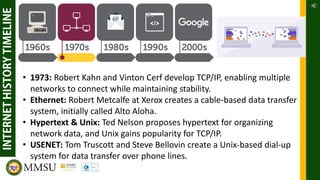
• 1973: RobertKahn and Vinton Cerf develop TCP/IP, enabling multiple
networks to connect while maintaining stability.
• Ethernet: Robert Metcalfe at Xerox creates a cable-based data transfer
system, initially called Alto Aloha.
• Hypertext & Unix: Ted Nelson proposes hypertext for organizing
network data, and Unix gains popularity for TCP/IP.
• USENET: Tom Truscott and Steve Bellovin create a Unix-based dial-up
system for data transfer over phone lines.
15.
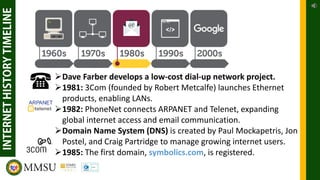
➢Dave Farber developsa low-cost dial-up network project.
➢1981: 3Com (founded by Robert Metcalfe) launches Ethernet
products, enabling LANs.
➢1982: PhoneNet connects ARPANET and Telenet, expanding
global internet access and email communication.
➢Domain Name System (DNS) is created by Paul Mockapetris, Jon
Postel, and Craig Partridge to manage growing internet users.
➢1985: The first domain, symbolics.com, is registered.
16.
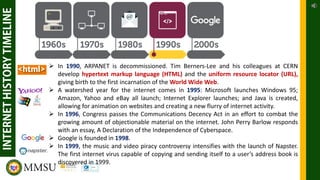
➢ In 1990,ARPANET is decommissioned. Tim Berners-Lee and his colleagues at CERN
develop hypertext markup language (HTML) and the uniform resource locator (URL),
giving birth to the first incarnation of the World Wide Web.
➢ A watershed year for the internet comes in 1995: Microsoft launches Windows 95;
Amazon, Yahoo and eBay all launch; Internet Explorer launches; and Java is created,
allowing for animation on websites and creating a new flurry of internet activity.
➢ In 1996, Congress passes the Communications Decency Act in an effort to combat the
growing amount of objectionable material on the internet. John Perry Barlow responds
with an essay, A Declaration of the Independence of Cyberspace.
➢ Google is founded in 1998.
➢ In 1999, the music and video piracy controversy intensifies with the launch of Napster.
The first internet virus capable of copying and sending itself to a user’s address book is
discovered in 1999.
17.
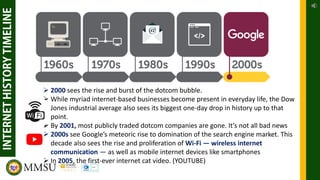
➢ 2000 seesthe rise and burst of the dotcom bubble.
➢ While myriad internet-based businesses become present in everyday life, the Dow
Jones industrial average also sees its biggest one-day drop in history up to that
point.
➢ By 2001, most publicly traded dotcom companies are gone. It’s not all bad news
➢ 2000s see Google’s meteoric rise to domination of the search engine market. This
decade also sees the rise and proliferation of Wi-Fi — wireless internet
communication — as well as mobile internet devices like smartphones
➢ In 2005, the first-ever internet cat video. (YOUTUBE)
18.
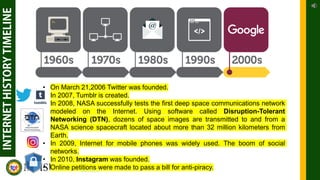
• On March21,2006 Twitter was founded.
• In 2007, Tumblr is created.
• In 2008, NASA successfully tests the first deep space communications network
modeled on the Internet. Using software called Disruption-Tolerant
Networking (DTN), dozens of space images are transmitted to and from a
NASA science spacecraft located about more than 32 million kilometers from
Earth.
• In 2009, Internet for mobile phones was widely used. The boom of social
networks.
• In 2010, Instagram was founded.
• Online petitions were made to pass a bill for anti-piracy.
19.
Major Components ofthe Internet
Types of Servers:
a. Application Server
b. Web Server
c. Proxy Server
d. Mail Server
e. File Server
d. Policy Server
20.
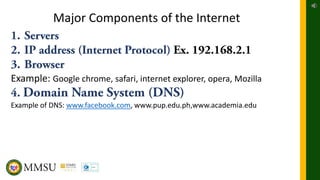
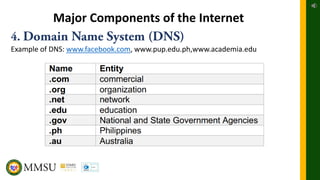
Major Components ofthe Internet
Example: Google chrome, safari, internet explorer, opera, Mozilla
Example of DNS: www.facebook.com, www.pup.edu.ph,www.academia.edu
21.
Major Components ofthe Internet
Example of DNS: www.facebook.com, www.pup.edu.ph,www.academia.edu
22.
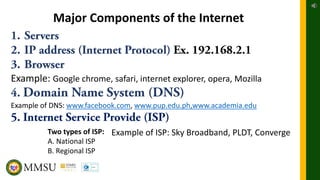
Major Components ofthe Internet
Example: Google chrome, safari, internet explorer, opera, Mozilla
Example of DNS: www.facebook.com, www.pup.edu.ph,www.academia.edu
Two types of ISP:
A. National ISP
B. Regional ISP
Example of ISP: Sky Broadband, PLDT, Converge
23.
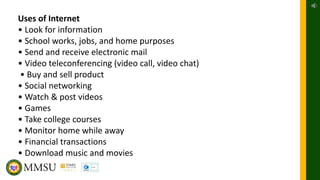
Uses of Internet
•Look for information
• School works, jobs, and home purposes
• Send and receive electronic mail
• Video teleconferencing (video call, video chat)
• Buy and sell product
• Social networking
• Watch & post videos
• Games
• Take college courses
• Monitor home while away
• Financial transactions
• Download music and movies







![[GE207] Session01: Introduction to Digital Technology](https://cdn.slidesharecdn.com/ss_thumbnails/ge2072nd6102introdigitaltechnology-190126183545-thumbnail.jpg?width=640&height=640&fit=bounds)


![The Internet and the World Wide Web [Fall 2012 RTF 319 Session 04]](https://cdn.slidesharecdn.com/ss_thumbnails/rtf319session04-120912112238-phpapp02-thumbnail.jpg?width=640&height=640&fit=bounds)


