Chapter 7. Basic
Processing Unit
Overview
 Instruction Set Processor (ISP)
 Central Processing Unit (CPU)
 A typical computing task consists of a series
of steps specified by a sequence of machine
instructions that constitute a program.
 An instruction is executed by carrying out a
sequence of more rudimentary operations.
Some Fundamental
Concepts
Fundamental Concepts
 Processor fetches one instruction at a time and
perform the operation specified.
 Instructions are fetched from successive memory
locations until a branch or a jump instruction is
encountered.
 Processor keeps track of the address of the memory
location containing the next instruction to be fetched
using Program Counter (PC).
 Instruction Register (IR)
Executing an Instruction
 Fetch the contents of the memory location pointed
to by the PC. The contents of this location are
loaded into the IR (fetch phase).
IR ← [[PC]]
 Assuming that the memory is byte addressable,
increment the contents of the PC by 4 (fetch phase).
PC ← [PC] + 4
 Carry out the actions specified by the instruction in
the IR (execution phase).
Processor Organization
lines
Data
Address
lines
bus
Memory
Carry -in
ALU
PC
MAR
MDR
Y
Z
Add
XOR
Sub
bus
IR
TEMP
R0
control
ALU
lines
Control signals
R n 1
-
 
Instruction
decoder and
Internal processor
control logic
A B
Figure 7.1. Single-bus organization of the datapath inside a processor.
MUX
Select
Constant 4
Datapath
Textbook Page 413
MDR HAS
TWO INPUTS
AND TWO
OUTPUTS
Executing an Instruction
 Transfer a word of data from one processor
register to another or to the ALU.
 Perform an arithmetic or a logic operation
and store the result in a processor register.
 Fetch the contents of a given memory
location and load them into a processor
register.
 Store a word of data from a processor
register into a given memory location.
Register Transfers
B
A
Z
ALU
Yin
Y
Zin
Zout
Riin
Ri
Riout
bus
Internal processor
Constant 4
MUX
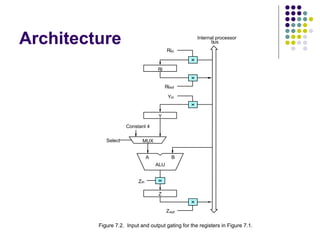
Figure 7.2. Input and output gating for the registers in Figure 7.1.
Select
Register Transfers
 All operations and data transfers are controlled by the processor clock.
Figure 7.3. Input and output g
ating for one re
gister bit.
D Q
Q
Clock
1
0
Riout
Riin
Bus
Figure 7.3. Input and output gating for one register bit.
Performing an Arithmetic or
Logic Operation
 The ALU is a combinational circuit that has no
internal storage.
 ALU gets the two operands from MUX and bus.
The result is temporarily stored in register Z.
 What is the sequence of operations to add the
contents of register R1 to those of R2 and store the
result in R3?
1. R1out, Yin
2. R2out, SelectY, Add, Zin
3. Zout, R3in
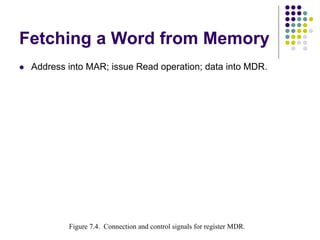
Fetching a Word from Memory
 Address into MAR; issue Read operation; data into MDR.
MDR
Memory -b
us
Figure 7.4. Connection and control signals for re
gister MDR.
data lines
Internal processor
bus
MDRout
MDRoutE
MDRin
MDRinE
Figure 7.4. Connection and control signals for register MDR.
Fetching a Word from Memory
 The response time of each memory access varies
(cache miss, memory-mapped I/O,…).
 To accommodate this, the processor waits until it
receives an indication that the requested operation
has been completed (Memory-Function-Completed,
MFC).
 Move (R1), R2
 MAR ← [R1]
 Start a Read operation on the memory bus
 Wait for the MFC response from the memory
 Load MDR from the memory bus
 R2 ← [MDR]
Timing
Figure 7.5. Timing of a memory Read operation.
MFC
MDRout
Assume MAR
is always available
on the address lines
of the memory bus.
R2 ← [MDR]
MAR ← [R1]
Start a Read operation on the memory bus
Wait for the MFC response from the memory
Load MDR from the memory bus
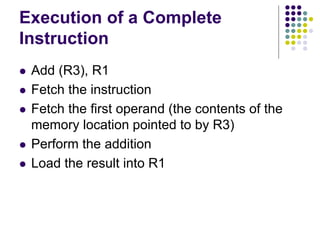
Execution of a Complete
Instruction
 Add (R3), R1
 Fetch the instruction
 Fetch the first operand (the contents of the
memory location pointed to by R3)
 Perform the addition
 Load the result into R1
Architecture
B
A
Z
ALU
Yin
Y
Zin
Zout
Riin
Ri
Riout
bus
Internal processor
Constant 4
MUX
Figure 7.2. Input and output gating for the registers in Figure 7.1.
Select
Execution of a Complete
Instruction
Step Action
1 PCout , MARin , Read,Select4,
Add, Zin
2 Zout , PCin , Yin , WMF C
3 MDRout , IRin
4 R3out , MARin , Read
5 R1out , Yin , WMF C
6 MDRout , SelectY,Add, Zin
7 Zout , R1in , End
Figure7.6. Control sequence
for executionof the instruction Add (R3),R1.
lines
Data
Address
lines
bus
Memory
Carry -in
ALU
PC
MAR
MDR
Y
Z
Add
XOR
Sub
bus
IR
TEMP
R0
control
ALU
lines
Control signals
R n 1
-
 
Instruction
decoder and
Internal processor
control logic
A B
Figure 7.1. Single-bus organization of the datapath inside a processor.
MUX
Select
Constant 4
Add (R3), R1
Execution of Branch
Instructions
 A branch instruction replaces the contents of
PC with the branch target address, which is
usually obtained by adding an offset X given
in the branch instruction.
 The offset X is usually the difference between
the branch target address and the address
immediately following the branch instruction.
 Conditional branch
Execution of Branch
Instructions
Step Action
1 PCout , MAR in , Read, Select4,Add, Zin
2 Zout, PCin , Yin, WMF C
3 MDRout , IRin
4 Offset-field-of-IR
out, Add, Zin
5 Zout, PCin , End
Figure 7.7. Control sequence for an unconditional branch instruction.
Multiple-Bus Organization
Memory b
us
data lines
Figure 7.8. Three-b
us or
ganization of the datapath.
Bus A Bus B Bus C
Instruction
decoder
PC
Re
gister
f ile
Constant 4
ALU
MDR
A
B
R
MUX
Incrementer
Address
lines
MAR
IR
Multiple-Bus Organization
 Add R4, R5, R6
Step Action
1 PCout, R=B, MAR in , Read, IncPC
2 WMFC
3 MDRoutB, R=B, IRin
4 R4outA, R5outB, SelectA, Add, R6in, End
Figure 7.9. Control sequence for the instruction. Add R4,R5,R6,
for the three-bus organization in Figure 7.8.
Quiz
 What is the control
sequence for
execution of the
instruction
Add R1, R2
including the
instruction fetch
phase? (Assume
single bus
architecture)
lines
Data
Address
lines
bus
Memory
Carry -in
ALU
PC
MAR
MDR
Y
Z
Add
XOR
Sub
bus
IR
TEMP
R0
control
ALU
lines
Control signals
R n 1
-
 
Instruction
decoder and
Internal processor
control logic
A B
Figure 7.1. Single-bus organization of the datapath inside a processor.
MUX
Select
Constant 4
Hardwired Control
Overview
 To execute instructions, the processor must
have some means of generating the control
signals needed in the proper sequence.
 Two categories: hardwired control and
microprogrammed control
 Hardwired system can operate at high speed;
but with little flexibility.
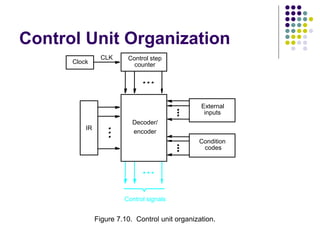
Control Unit Organization
Figure 7.10. Control unit organization.
CLK
Clock
Control step
IR
encoder
Decoder/
Control signals
codes
counter
inputs
Condition
External
Detailed Block Description
External
inputs
Figure 7.11. Separation of the decoding and encoding functions.
Encoder
Reset
CLK
Clock
Control signals
counter
Run End
Condition
codes
decoder
Instruction
Step decoder
Control step
IR
T1 T2 Tn
INS1
INS2
INS
m
Generating Zin
 Zin = T1 + T6 • ADD + T4 • BR + …
Figure 7.12. Generation of the Zin control signal for the processor in Figure 7.1.
T1
Add
Branch
T4 T6
Generating End
 End = T7 • ADD + T5 • BR + (T5 • N + T4 • N) • BRN +…
Figure 7.13.Generation of the End control signal.
T7
Add Branch
Branch<0
T5
End
N
N
T4
T5
A Complete Processor
Instruction
unit
Inte
ger
unit
Floating-point
unit
Instruction
cache
Data
cache
Bus interf
ace
Main
memory
Input/
Output
Sy stem b
us
Processor
Figure 7.14. Block diagram of a complete processor
.
Microprogrammed
Control
Microprogrammed Control
 Control Word – individual bits – control
signals.
 Sequence of CW – Microroutine.
 Individual CW - Microinstructions
Overview
 Control signals are generated by a program similar to machine
language programs.
 Control Word (CW); microroutine; microinstruction
PC
in
PC
out
MAR
in
Read
MDR
out
IR
in
Y
in
Select
Add
Z
in
Z
out
R1
out
R1
in
R3
out
WMFC
End
0
1
0
0
0
0
0
0
0
0
0
0
0
1
1
0
0
0
0
0
0
1
0
0
1
0
0
0
1
0
0
1
0
0
0
0
0
1
0
0
1
0
0
0
1
0
0
0
0
0
1
0
0
1
0
0
1
0
0
0
0
0
0
1
0
0
0
0
1
0
1
0
0
0
0
1
0
0
1
0
0
0
0
1
0
0
0
0
1
0
0
0
0
0
0
0
0
1
0
0
0
1
0
0
0
0
1
0
0
1
0
0
Micro -
instruction
1
2
3
4
5
6
7
Figure 7.15 An e
xample of microinstructions for Figure 7.6.
Overview
Step Action
1 PCout , MARin , Read,Select4,
Add, Zin
2 Zout , PCin , Yin , WMF C
3 MDRout , IRin
4 R3out , MARin , Read
5 R1out , Yin , WMF C
6 MDRout , SelectY,Add, Zin
7 Zout , R1in , End
Figure7.6. Control sequence
for executionof the instruction Add (R3),R1.
Overview
 Control store
Figure 7.16. Basic organization of a microprogrammed control unit.
store
Control
generator
Starting
address
CW
Clock PC
IR
One function
cannot be carried
out by this simple
organization.
Overview
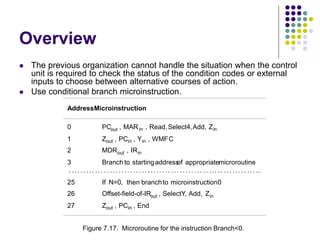
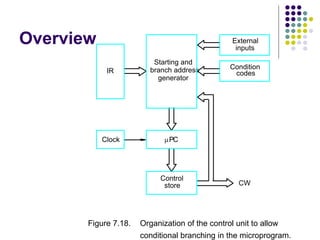
 The previous organization cannot handle the situation when the control
unit is required to check the status of the condition codes or external
inputs to choose between alternative courses of action.
 Use conditional branch microinstruction.
AddressMicroinstruction
0 PCout , MARin , Read,Select4,Add, Zin
1 Zout , PCin , Yin , WMFC
2 MDRout , IRin
3 Branch to startingaddress
of appropriatemicroroutine
. ... .. ... ... .. ... .. ... ... .. ... ... .. ... .. ... ... .. ... .. ... ... .. ... ..
25 If N=0, then branchto microinstruction0
26 Offset-field-of-IRout , SelectY, Add, Zin
27 Zout , PCin , End
Figure 7.17. Microroutine for the instruction Branch<0.
Overview
Figure 7.18. Organization of the control unit to allow
conditional branching in the microprogram.
Control
store
Clock
generator
Starting and
branch address Condition
codes
inputs
External
CW
IR
PC
Microinstructions
 A straightforward way to structure
microinstructions is to assign one bit position
to each control signal.
 However, this is very inefficient.
 The length can be reduced: most signals are
not needed simultaneously, and many signals
are mutually exclusive.
 All mutually exclusive signals are placed in
the same group in binary coding.
Partial Format for the
Microinstructions
F2 (3 bits)
000: No transf er
001: PC
in
010: IR
in
011: Z
in
100: R0
in
101: R1
in
110: R2
in
111: R3
in
F1 F2 F3 F4 F5
F1 (4 bits) F3 (3 bits) F4 (4 bits) F5 (2 bits)
0000: No transf er
0001: PC
out
0010: MDR
out
0011: Z
out
0100: R0
out
0101: R1
out
0110: R2
out
0111: R3
out
1010: TEMP
out
1011: Of f set
out
000: No transf er
001: MARin
010: MDR
in
011: TEMP
in
100: Y
in
0000: Add
0001: Sub
1111: XOR
16 ALU
f unctions
00: No action
01: Read
10: Write
F6 F7 F8
F6 (1 bit) F7 (1 bit) F8 (1 bit)
0: SelectY
1: Select4
0: No action
1: WMFC
0: Continue
1: End
Figure 7.19. An example of a partial format for field-encoded microinstructions.
Microinstruction
What is the price paid for
this scheme?
Further Improvement
 Enumerate the patterns of required signals in
all possible microinstructions. Each
meaningful combination of active control
signals can then be assigned a distinct code.
 Vertical organization
 Horizontal organization
Microprogram Sequencing
 If all microprograms require only straightforward
sequential execution of microinstructions except for
branches, letting a μPC governs the sequencing
would be efficient.
 However, two disadvantages:
 Having a separate microroutine for each machine instruction results
in a large total number of microinstructions and a large control store.
 Longer execution time because it takes more time to carry out the
required branches.
 Example: Add src, Rdst
 Four addressing modes: register, autoincrement,
autodecrement, and indexed (with indirect forms).
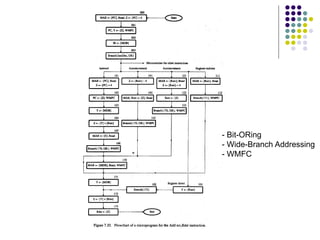
- Bit-ORing
- Wide-Branch Addressing
- WMFC
OP code 0 1 0 Rsrc Rdst
Mode
Contents of IR
0
3
4
7
8
10
11
Figure 7.21. Microinstruction for Add (Rsrc)+,Rdst.
Note:Microinstruction at location 170 is not executed for this addressing mode.
Address Microinstruction
(octal)
000 PC
out, MARin, Read, Select
4, Add, Zin
001 Zout, PC
in, Yin, WMFC
002 MDRout, IRin
003 Branch {
PC 101 (from Instruction decoder);
PC
5,4  [IR10,9
]; PC
3 
121 Rsrc
out, MARin, Read, Select4, Add, Z
in
122 Zout, Rsrc
in
123
170 MDRout, MARin, Read, WMFC
171 MDRout, Yin
172 Rdst
out, SelectY
, Add, Zin
173 Zout, Rdst
in, End
[IR10]  [IR9]  [IR8]}
Branch {
PC 170;PC
0  [IR8]}, WMFC
Microinstructions with Next-
Address Field
 The microprogram we discussed requires several
branch microinstructions, which perform no useful
operation in the datapath.
 A powerful alternative approach is to include an
address field as a part of every microinstruction to
indicate the location of the next microinstruction to
be fetched.
 Pros: separate branch microinstructions are virtually
eliminated; few limitations in assigning addresses to
microinstructions.
 Cons: additional bits for the address field (around
1/6)
Microinstructions with Next-
Address Field
Figure 7.22. Microinstruction-sequencing organization.
Condition
codes
IR
Decoding circuits
Control store
Next address
Microinstruction decoder
Control signals
Inputs
External
AR
I R
Implementation of the
Microroutine
(See Figure 7.23 for encoded signals.)
Figure 7.24. Implementation of the microroutine of Figure 7.21 using a
1
0
1
1
1
1
1
0
0
1
1
1
1
1
0
0
0
1
0
0
1
1
2
1 0
0
0
0
0
0
0
0
0
0
0
0
0
0
0
0
0 0
0
0
0
0
0 0
0
1
0
1
1
1
0
3
7
7
0
0
0
0
0
0
0
0
0 1
1
1
1
1
1
0
0
0
0
1
7
0
7
F9
0
0
0
0
0
0
F10
0
0
0
0
0
0
0
0
0
0
0
0
0
0
F8
F7
F6
F5
F4
0
0
0 0 0 0 0 0
0
0
0
0
0
1
0
0
0
0
0
0
0
0
0
0
0
0 1
1
0
0
0 0
1
0
0
0
1
0
0
0
0
0
0
0
0
1
1
0
0
0
0
0
1
0
0
0
0
0
0
0
1
0 0
0
0
0
0
0
0
0 0
1
0
0
0
0
0
0
0
0
1
1
1
0
1
0
0
1
0
F2
1
1
1
0 0 0 0 0 0
1
1
2
2
1
0
1
1
1
1
0
1
1
1 0
0
1
1
2
0
2
1
0
0
0
address
Octal
1
1
1 0
0
0
0
0
1 0
0
0
0
0
0
0
1
0
0
0
0
0
0
0
F0 F1
0
0 0 1
0 0
0
1
0
0
1
0
0 1
1
0
0
1
1
1
0
1
0
0
0
0
0
1
1
0
1
F3
next-microinstruction address field.
0
1
1
0
0
0 0 0 0 0 0
0 0
0 0
0
0
0
0 0 0 0 0 0
3
0 0 0
0 0 0
decoder
Microinstruction
Other control signals
Rdst
in
Rsrc
out
Rsrc
in
Figure 7.25. Some details of the control-signal-generating circuitry.
bit-ORing
Further Discussions
 Prefetching
 Emulation

chapter3 - Basic Processing Unit.ppt

  • 1.
  • 2.
    Overview  Instruction SetProcessor (ISP)  Central Processing Unit (CPU)  A typical computing task consists of a series of steps specified by a sequence of machine instructions that constitute a program.  An instruction is executed by carrying out a sequence of more rudimentary operations.
  • 3.
  • 4.
    Fundamental Concepts  Processorfetches one instruction at a time and perform the operation specified.  Instructions are fetched from successive memory locations until a branch or a jump instruction is encountered.  Processor keeps track of the address of the memory location containing the next instruction to be fetched using Program Counter (PC).  Instruction Register (IR)
  • 5.
    Executing an Instruction Fetch the contents of the memory location pointed to by the PC. The contents of this location are loaded into the IR (fetch phase). IR ← [[PC]]  Assuming that the memory is byte addressable, increment the contents of the PC by 4 (fetch phase). PC ← [PC] + 4  Carry out the actions specified by the instruction in the IR (execution phase).
  • 6.
    Processor Organization lines Data Address lines bus Memory Carry -in ALU PC MAR MDR Y Z Add XOR Sub bus IR TEMP R0 control ALU lines Controlsignals R n 1 -   Instruction decoder and Internal processor control logic A B Figure 7.1. Single-bus organization of the datapath inside a processor. MUX Select Constant 4 Datapath Textbook Page 413 MDR HAS TWO INPUTS AND TWO OUTPUTS
  • 7.
    Executing an Instruction Transfer a word of data from one processor register to another or to the ALU.  Perform an arithmetic or a logic operation and store the result in a processor register.  Fetch the contents of a given memory location and load them into a processor register.  Store a word of data from a processor register into a given memory location.
  • 8.
    Register Transfers B A Z ALU Yin Y Zin Zout Riin Ri Riout bus Internal processor Constant4 MUX Figure 7.2. Input and output gating for the registers in Figure 7.1. Select
  • 9.
    Register Transfers  Alloperations and data transfers are controlled by the processor clock. Figure 7.3. Input and output g ating for one re gister bit. D Q Q Clock 1 0 Riout Riin Bus Figure 7.3. Input and output gating for one register bit.
  • 10.
    Performing an Arithmeticor Logic Operation  The ALU is a combinational circuit that has no internal storage.  ALU gets the two operands from MUX and bus. The result is temporarily stored in register Z.  What is the sequence of operations to add the contents of register R1 to those of R2 and store the result in R3? 1. R1out, Yin 2. R2out, SelectY, Add, Zin 3. Zout, R3in
  • 11.
    Fetching a Wordfrom Memory  Address into MAR; issue Read operation; data into MDR. MDR Memory -b us Figure 7.4. Connection and control signals for re gister MDR. data lines Internal processor bus MDRout MDRoutE MDRin MDRinE Figure 7.4. Connection and control signals for register MDR.
  • 12.
    Fetching a Wordfrom Memory  The response time of each memory access varies (cache miss, memory-mapped I/O,…).  To accommodate this, the processor waits until it receives an indication that the requested operation has been completed (Memory-Function-Completed, MFC).  Move (R1), R2  MAR ← [R1]  Start a Read operation on the memory bus  Wait for the MFC response from the memory  Load MDR from the memory bus  R2 ← [MDR]
  • 13.
    Timing Figure 7.5. Timingof a memory Read operation. MFC MDRout Assume MAR is always available on the address lines of the memory bus. R2 ← [MDR] MAR ← [R1] Start a Read operation on the memory bus Wait for the MFC response from the memory Load MDR from the memory bus
  • 14.
    Execution of aComplete Instruction  Add (R3), R1  Fetch the instruction  Fetch the first operand (the contents of the memory location pointed to by R3)  Perform the addition  Load the result into R1
  • 15.
    Architecture B A Z ALU Yin Y Zin Zout Riin Ri Riout bus Internal processor Constant 4 MUX Figure7.2. Input and output gating for the registers in Figure 7.1. Select
  • 16.
    Execution of aComplete Instruction Step Action 1 PCout , MARin , Read,Select4, Add, Zin 2 Zout , PCin , Yin , WMF C 3 MDRout , IRin 4 R3out , MARin , Read 5 R1out , Yin , WMF C 6 MDRout , SelectY,Add, Zin 7 Zout , R1in , End Figure7.6. Control sequence for executionof the instruction Add (R3),R1. lines Data Address lines bus Memory Carry -in ALU PC MAR MDR Y Z Add XOR Sub bus IR TEMP R0 control ALU lines Control signals R n 1 -   Instruction decoder and Internal processor control logic A B Figure 7.1. Single-bus organization of the datapath inside a processor. MUX Select Constant 4 Add (R3), R1
  • 17.
    Execution of Branch Instructions A branch instruction replaces the contents of PC with the branch target address, which is usually obtained by adding an offset X given in the branch instruction.  The offset X is usually the difference between the branch target address and the address immediately following the branch instruction.  Conditional branch
  • 18.
    Execution of Branch Instructions StepAction 1 PCout , MAR in , Read, Select4,Add, Zin 2 Zout, PCin , Yin, WMF C 3 MDRout , IRin 4 Offset-field-of-IR out, Add, Zin 5 Zout, PCin , End Figure 7.7. Control sequence for an unconditional branch instruction.
  • 19.
    Multiple-Bus Organization Memory b us datalines Figure 7.8. Three-b us or ganization of the datapath. Bus A Bus B Bus C Instruction decoder PC Re gister f ile Constant 4 ALU MDR A B R MUX Incrementer Address lines MAR IR
  • 20.
    Multiple-Bus Organization  AddR4, R5, R6 Step Action 1 PCout, R=B, MAR in , Read, IncPC 2 WMFC 3 MDRoutB, R=B, IRin 4 R4outA, R5outB, SelectA, Add, R6in, End Figure 7.9. Control sequence for the instruction. Add R4,R5,R6, for the three-bus organization in Figure 7.8.
  • 21.
    Quiz  What isthe control sequence for execution of the instruction Add R1, R2 including the instruction fetch phase? (Assume single bus architecture) lines Data Address lines bus Memory Carry -in ALU PC MAR MDR Y Z Add XOR Sub bus IR TEMP R0 control ALU lines Control signals R n 1 -   Instruction decoder and Internal processor control logic A B Figure 7.1. Single-bus organization of the datapath inside a processor. MUX Select Constant 4
  • 22.
  • 23.
    Overview  To executeinstructions, the processor must have some means of generating the control signals needed in the proper sequence.  Two categories: hardwired control and microprogrammed control  Hardwired system can operate at high speed; but with little flexibility.
  • 24.
    Control Unit Organization Figure7.10. Control unit organization. CLK Clock Control step IR encoder Decoder/ Control signals codes counter inputs Condition External
  • 25.
    Detailed Block Description External inputs Figure7.11. Separation of the decoding and encoding functions. Encoder Reset CLK Clock Control signals counter Run End Condition codes decoder Instruction Step decoder Control step IR T1 T2 Tn INS1 INS2 INS m
  • 26.
    Generating Zin  Zin= T1 + T6 • ADD + T4 • BR + … Figure 7.12. Generation of the Zin control signal for the processor in Figure 7.1. T1 Add Branch T4 T6
  • 27.
    Generating End  End= T7 • ADD + T5 • BR + (T5 • N + T4 • N) • BRN +… Figure 7.13.Generation of the End control signal. T7 Add Branch Branch<0 T5 End N N T4 T5
  • 28.
    A Complete Processor Instruction unit Inte ger unit Floating-point unit Instruction cache Data cache Businterf ace Main memory Input/ Output Sy stem b us Processor Figure 7.14. Block diagram of a complete processor .
  • 29.
  • 30.
    Microprogrammed Control  ControlWord – individual bits – control signals.  Sequence of CW – Microroutine.  Individual CW - Microinstructions
  • 31.
    Overview  Control signalsare generated by a program similar to machine language programs.  Control Word (CW); microroutine; microinstruction PC in PC out MAR in Read MDR out IR in Y in Select Add Z in Z out R1 out R1 in R3 out WMFC End 0 1 0 0 0 0 0 0 0 0 0 0 0 1 1 0 0 0 0 0 0 1 0 0 1 0 0 0 1 0 0 1 0 0 0 0 0 1 0 0 1 0 0 0 1 0 0 0 0 0 1 0 0 1 0 0 1 0 0 0 0 0 0 1 0 0 0 0 1 0 1 0 0 0 0 1 0 0 1 0 0 0 0 1 0 0 0 0 1 0 0 0 0 0 0 0 0 1 0 0 0 1 0 0 0 0 1 0 0 1 0 0 Micro - instruction 1 2 3 4 5 6 7 Figure 7.15 An e xample of microinstructions for Figure 7.6.
  • 32.
    Overview Step Action 1 PCout, MARin , Read,Select4, Add, Zin 2 Zout , PCin , Yin , WMF C 3 MDRout , IRin 4 R3out , MARin , Read 5 R1out , Yin , WMF C 6 MDRout , SelectY,Add, Zin 7 Zout , R1in , End Figure7.6. Control sequence for executionof the instruction Add (R3),R1.
  • 33.
    Overview  Control store Figure7.16. Basic organization of a microprogrammed control unit. store Control generator Starting address CW Clock PC IR One function cannot be carried out by this simple organization.
  • 34.
    Overview  The previousorganization cannot handle the situation when the control unit is required to check the status of the condition codes or external inputs to choose between alternative courses of action.  Use conditional branch microinstruction. AddressMicroinstruction 0 PCout , MARin , Read,Select4,Add, Zin 1 Zout , PCin , Yin , WMFC 2 MDRout , IRin 3 Branch to startingaddress of appropriatemicroroutine . ... .. ... ... .. ... .. ... ... .. ... ... .. ... .. ... ... .. ... .. ... ... .. ... .. 25 If N=0, then branchto microinstruction0 26 Offset-field-of-IRout , SelectY, Add, Zin 27 Zout , PCin , End Figure 7.17. Microroutine for the instruction Branch<0.
  • 35.
    Overview Figure 7.18. Organizationof the control unit to allow conditional branching in the microprogram. Control store Clock generator Starting and branch address Condition codes inputs External CW IR PC
  • 36.
    Microinstructions  A straightforwardway to structure microinstructions is to assign one bit position to each control signal.  However, this is very inefficient.  The length can be reduced: most signals are not needed simultaneously, and many signals are mutually exclusive.  All mutually exclusive signals are placed in the same group in binary coding.
  • 37.
    Partial Format forthe Microinstructions F2 (3 bits) 000: No transf er 001: PC in 010: IR in 011: Z in 100: R0 in 101: R1 in 110: R2 in 111: R3 in F1 F2 F3 F4 F5 F1 (4 bits) F3 (3 bits) F4 (4 bits) F5 (2 bits) 0000: No transf er 0001: PC out 0010: MDR out 0011: Z out 0100: R0 out 0101: R1 out 0110: R2 out 0111: R3 out 1010: TEMP out 1011: Of f set out 000: No transf er 001: MARin 010: MDR in 011: TEMP in 100: Y in 0000: Add 0001: Sub 1111: XOR 16 ALU f unctions 00: No action 01: Read 10: Write F6 F7 F8 F6 (1 bit) F7 (1 bit) F8 (1 bit) 0: SelectY 1: Select4 0: No action 1: WMFC 0: Continue 1: End Figure 7.19. An example of a partial format for field-encoded microinstructions. Microinstruction What is the price paid for this scheme?
  • 38.
    Further Improvement  Enumeratethe patterns of required signals in all possible microinstructions. Each meaningful combination of active control signals can then be assigned a distinct code.  Vertical organization  Horizontal organization
  • 39.
    Microprogram Sequencing  Ifall microprograms require only straightforward sequential execution of microinstructions except for branches, letting a μPC governs the sequencing would be efficient.  However, two disadvantages:  Having a separate microroutine for each machine instruction results in a large total number of microinstructions and a large control store.  Longer execution time because it takes more time to carry out the required branches.  Example: Add src, Rdst  Four addressing modes: register, autoincrement, autodecrement, and indexed (with indirect forms).
  • 40.
    - Bit-ORing - Wide-BranchAddressing - WMFC
  • 41.
    OP code 01 0 Rsrc Rdst Mode Contents of IR 0 3 4 7 8 10 11 Figure 7.21. Microinstruction for Add (Rsrc)+,Rdst. Note:Microinstruction at location 170 is not executed for this addressing mode. Address Microinstruction (octal) 000 PC out, MARin, Read, Select 4, Add, Zin 001 Zout, PC in, Yin, WMFC 002 MDRout, IRin 003 Branch { PC 101 (from Instruction decoder); PC 5,4  [IR10,9 ]; PC 3  121 Rsrc out, MARin, Read, Select4, Add, Z in 122 Zout, Rsrc in 123 170 MDRout, MARin, Read, WMFC 171 MDRout, Yin 172 Rdst out, SelectY , Add, Zin 173 Zout, Rdst in, End [IR10]  [IR9]  [IR8]} Branch { PC 170;PC 0  [IR8]}, WMFC
  • 42.
    Microinstructions with Next- AddressField  The microprogram we discussed requires several branch microinstructions, which perform no useful operation in the datapath.  A powerful alternative approach is to include an address field as a part of every microinstruction to indicate the location of the next microinstruction to be fetched.  Pros: separate branch microinstructions are virtually eliminated; few limitations in assigning addresses to microinstructions.  Cons: additional bits for the address field (around 1/6)
  • 43.
    Microinstructions with Next- AddressField Figure 7.22. Microinstruction-sequencing organization. Condition codes IR Decoding circuits Control store Next address Microinstruction decoder Control signals Inputs External AR I R
  • 45.
    Implementation of the Microroutine (SeeFigure 7.23 for encoded signals.) Figure 7.24. Implementation of the microroutine of Figure 7.21 using a 1 0 1 1 1 1 1 0 0 1 1 1 1 1 0 0 0 1 0 0 1 1 2 1 0 0 0 0 0 0 0 0 0 0 0 0 0 0 0 0 0 0 0 0 0 0 0 0 0 1 0 1 1 1 0 3 7 7 0 0 0 0 0 0 0 0 0 1 1 1 1 1 1 0 0 0 0 1 7 0 7 F9 0 0 0 0 0 0 F10 0 0 0 0 0 0 0 0 0 0 0 0 0 0 F8 F7 F6 F5 F4 0 0 0 0 0 0 0 0 0 0 0 0 0 1 0 0 0 0 0 0 0 0 0 0 0 0 1 1 0 0 0 0 1 0 0 0 1 0 0 0 0 0 0 0 0 1 1 0 0 0 0 0 1 0 0 0 0 0 0 0 1 0 0 0 0 0 0 0 0 0 0 1 0 0 0 0 0 0 0 0 1 1 1 0 1 0 0 1 0 F2 1 1 1 0 0 0 0 0 0 1 1 2 2 1 0 1 1 1 1 0 1 1 1 0 0 1 1 2 0 2 1 0 0 0 address Octal 1 1 1 0 0 0 0 0 1 0 0 0 0 0 0 0 1 0 0 0 0 0 0 0 F0 F1 0 0 0 1 0 0 0 1 0 0 1 0 0 1 1 0 0 1 1 1 0 1 0 0 0 0 0 1 1 0 1 F3 next-microinstruction address field. 0 1 1 0 0 0 0 0 0 0 0 0 0 0 0 0 0 0 0 0 0 0 0 0 3 0 0 0 0 0 0
  • 46.
    decoder Microinstruction Other control signals Rdst in Rsrc out Rsrc in Figure7.25. Some details of the control-signal-generating circuitry.
  • 47.
  • 48.