Low Vision or Blindness Chapter 11
“ Vision is a distance sense that provides us with information from outside our bodies.  When vision is limited, it affects the individual in significant ways, limiting mobility, access to printed information, and independent living.  Visual disabilities (low vision and blindness) in children is a low incidence disability, affecting about 0.05% of all schoolchildren.” p.384
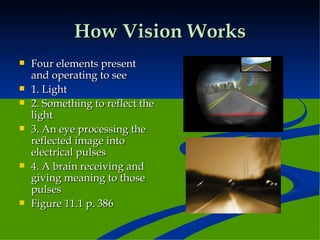
How Vision Works Four elements present and operating to see 1. Light 2. Something to reflect the light 3. An eye processing the reflected image into electrical pulses 4. A brain receiving and giving meaning to those pulses Figure 11.1 p. 386
What are the different types of visual disabilities? LOW VISION Use sight to learn VD interferes with daily functioning “ legally blind” criteria: central visual acuity of 20/200 or less (p. 389) BLINDNESS Uses touch or hearing to learn and does not have any functional use of sight Congenitally blind - at birth or during infancy Adventitiously blind - after the age of two Table 11.1 p.388 to see a complete list of Visual Disabilities
How are these disabilities identified? 20/70 - 20/200 in better eye considered low vision 20/200 or lower considered legally blind Snellen Chart Diagnosticians, affected children, parents, educators, school nurse and eye specialists Ophthalmologists and Optometrists Possible signs of Visual Disabilities table 11.2 p.390
Bit-O-History Homer, Greek poet who composed the Odyssey and the Iliad, was blind 1784 Valentin Hauy opened first school for blind; The Institution for Blind Youth & raised letters 1800 Louis Braille designed embossed six dot system 1821 New England Asylum for the Blind 1900 Chicago, mainstreaming 1913 Boston, partially sighted 1915-1965 “sight saving classes” 1964 Natalie Barraga- vision more limited when not used 1918-1925 guide dogs for French & German soldiers 1928 Seeing Eye dogs introduced in USA 1960s Rubella epidemic 1970s Kurzweil Reader first print-to-voice translator
Prevalence, Causes & Prevention According to the American Foundation for the Blind: 1.3 million Americans legally blind Worldwide only 4% of all blind are children 4 in 10,000 schoolchildren have VD 14,546 6-17 receiving special education because of low vision or blindness Of that, 1/3 legally blind ROP retinopathy of prematurity and rubella Congenital or Aquired
Characteristics Develop relationships in the first 2 years Lack of understanding social cues Low self esteem, socially immature, egocentric, self conscience, isolated, passive, withdrawn, and dependent What can sighted peers, parents and teachers do to help? Provide social opportunites Model appropriate behavior Encourage full participation in all school activities
Educational Needs Allow and encourage increased initiations from the child to reduce adult reliance  Long cane for orientation and mobility Life skills Direct Instruction to master reading and achieve literacy Classroom modifications p.398-399 Braille, enlarged print, magnifying glass, telescope, audio versions of texbooks, personal readers,  IDEA now requires Braille consideration in IEP’s Orientation & Mobility Extented Time and Computer use Careful use of language “go get it, it’s over there”
Successful Transition VD students have the highest high school graduation rate of disabled students Only 30% can find competitive jobs College Success Program Organization, social and study skill Being assertive and advocating for oneself Gaining access to printed materials Hire a reader Visual, Audio & Tactile aids cost table 11.4 p.408
In Conclusion As teachers we can: Eliminate dangerous & hazardous obstacles Provide consistent organization, expectations and consequences Position low vision students where they benefit most from activity (close to board) Oral summaries, printed information, handouts of lectures

Chapter11.Sped

  • 1.
    Low Vision orBlindness Chapter 11
  • 2.
    “ Vision isa distance sense that provides us with information from outside our bodies. When vision is limited, it affects the individual in significant ways, limiting mobility, access to printed information, and independent living. Visual disabilities (low vision and blindness) in children is a low incidence disability, affecting about 0.05% of all schoolchildren.” p.384
  • 3.
    How Vision WorksFour elements present and operating to see 1. Light 2. Something to reflect the light 3. An eye processing the reflected image into electrical pulses 4. A brain receiving and giving meaning to those pulses Figure 11.1 p. 386
  • 4.
    What are thedifferent types of visual disabilities? LOW VISION Use sight to learn VD interferes with daily functioning “ legally blind” criteria: central visual acuity of 20/200 or less (p. 389) BLINDNESS Uses touch or hearing to learn and does not have any functional use of sight Congenitally blind - at birth or during infancy Adventitiously blind - after the age of two Table 11.1 p.388 to see a complete list of Visual Disabilities
  • 5.
    How are thesedisabilities identified? 20/70 - 20/200 in better eye considered low vision 20/200 or lower considered legally blind Snellen Chart Diagnosticians, affected children, parents, educators, school nurse and eye specialists Ophthalmologists and Optometrists Possible signs of Visual Disabilities table 11.2 p.390
  • 6.
    Bit-O-History Homer, Greekpoet who composed the Odyssey and the Iliad, was blind 1784 Valentin Hauy opened first school for blind; The Institution for Blind Youth & raised letters 1800 Louis Braille designed embossed six dot system 1821 New England Asylum for the Blind 1900 Chicago, mainstreaming 1913 Boston, partially sighted 1915-1965 “sight saving classes” 1964 Natalie Barraga- vision more limited when not used 1918-1925 guide dogs for French & German soldiers 1928 Seeing Eye dogs introduced in USA 1960s Rubella epidemic 1970s Kurzweil Reader first print-to-voice translator
  • 7.
    Prevalence, Causes &Prevention According to the American Foundation for the Blind: 1.3 million Americans legally blind Worldwide only 4% of all blind are children 4 in 10,000 schoolchildren have VD 14,546 6-17 receiving special education because of low vision or blindness Of that, 1/3 legally blind ROP retinopathy of prematurity and rubella Congenital or Aquired
  • 8.
    Characteristics Develop relationshipsin the first 2 years Lack of understanding social cues Low self esteem, socially immature, egocentric, self conscience, isolated, passive, withdrawn, and dependent What can sighted peers, parents and teachers do to help? Provide social opportunites Model appropriate behavior Encourage full participation in all school activities
  • 9.
    Educational Needs Allowand encourage increased initiations from the child to reduce adult reliance Long cane for orientation and mobility Life skills Direct Instruction to master reading and achieve literacy Classroom modifications p.398-399 Braille, enlarged print, magnifying glass, telescope, audio versions of texbooks, personal readers, IDEA now requires Braille consideration in IEP’s Orientation & Mobility Extented Time and Computer use Careful use of language “go get it, it’s over there”
  • 10.
    Successful Transition VDstudents have the highest high school graduation rate of disabled students Only 30% can find competitive jobs College Success Program Organization, social and study skill Being assertive and advocating for oneself Gaining access to printed materials Hire a reader Visual, Audio & Tactile aids cost table 11.4 p.408
  • 11.
    In Conclusion Asteachers we can: Eliminate dangerous & hazardous obstacles Provide consistent organization, expectations and consequences Position low vision students where they benefit most from activity (close to board) Oral summaries, printed information, handouts of lectures